REVIEW 2 major objections 3 minor 52 references
Continuous monitoring of a trapped, superconducting spin
T0 review · 2 major / 3 minor · reviewed 2026-08-14 · deepseek-v4-flash
Pith's one-line read The paper demonstrates the first single-shot, quantum-non-demolition readout of a single spin using circuit quantum electrodynamics, achieved by detecting the spin-dependent supercurrent of a quasiparticle trapped in a nanowire Josephson…
desk verdict First single-shot cQED readout of a single superconducting spin, with solid multi-observable evidence; the spin-label assignment leans on an assumed spin-conserving current, but the core result holds up. read the letter →
The pith
A machine-rendered reading of the paper's core claim, the machinery that carries it, and where it could break.
The reading
What carries the argument
The central object is the spin-dependent supercurrent operator $J = dH_A/d\Phi$ of the nanowire's two-doublet Andreev Hamiltonian. Because spin-orbit coupling makes the Fermi velocity spin-dependent, $J$ has appreciable matrix elements only between lower- and upper-doublet states of the same spin, and these spin-conserving inter-doublet transitions generate a dispersive readout: $\chi_{s,1} = -(\Phi_r^2/2\pi\hbar^2)\,[2f_s/(f_s^2-f_r^2)]\,|\langle s,2|J|s,1\rangle|^2$, where $\Phi_r$ is the zero-point flux drop across the shared inductance and $f_r$ the bare resonator frequency. Fitting the measured transition spectrum to $H_A$ gives $J$, and the predicted $\Phi$-dependent shifts reproduce the cluster positions with $\Phi_r$ within 10% of the circuit calculation.
What would settle it
Detune the readout tone across the resonator line and re-measure the separation of the three cluster centers: the paper's Eq. (2) predicts the separation scales with $2f_s/(f_s^2-f_r^2)$ using the spectroscopy-determined matrix elements, so a deviation where spin-flipping transitions cross the resonator would reveal that $J$ carries spin-flip matrix elements and would break the assignment.
Extended reading notes
Core claim
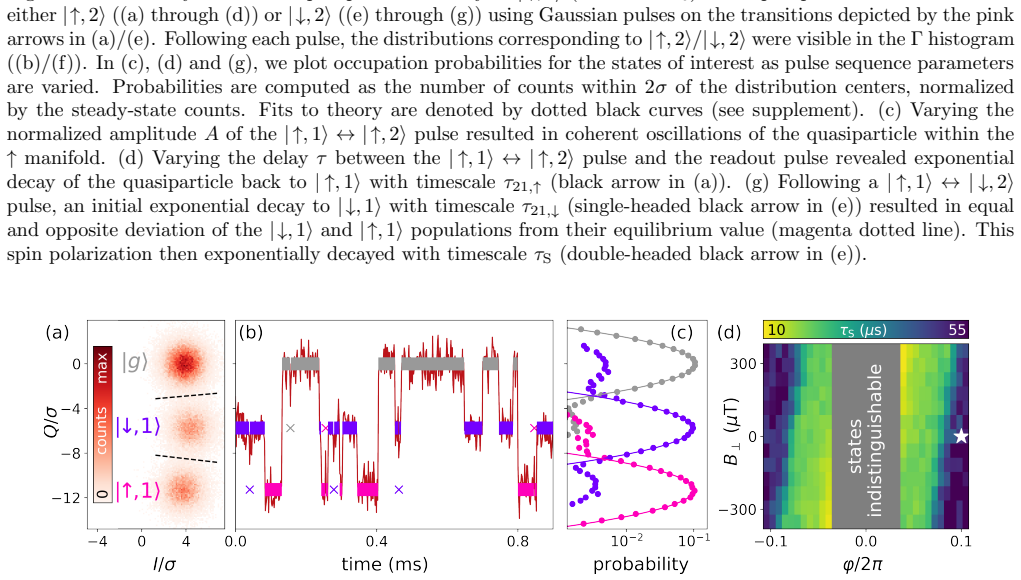
On the paper's own terms, the discovery is that a trapped quasiparticle's spin can be detected nondestructively because it controls the supercurrent through a Josephson nanowire. Spin-orbit interaction in the InAs nanowire gives the two spin states different Fermi velocities, breaking the spin degeneracy of the Andreev doublets at zero magnetic field and making the junction current operator $J$ effectively spin-conserving. The resonator flux couples through $J$, so the lower-doublet states $|\downarrow,1\rangle$ and $|\uparrow,1\rangle$ acquire different dispersive shifts $\chi_{s,1}$; reflected microwave amplitude histograms cluster into three clouds assigned to $|g\rangle$, $|\downarrow,1\rangle$, and $|\uparrow,1\rangle$. Consecutive-shot analysis yields a quantum-non-demolition fidelity $F = 92.2\pm 0.1\%$, with spin lifetime $51\pm 4$ $\mu$s at the chosen bias, and driven pulses produce Rabi oscillations between Andreev doublets, demonstrating coherent control of an individual quasiparticle.
Load-bearing premise
The quantitative assignment of the three readout clusters to empty, spin-down, and spin-up rests on assuming that the resonator couples through a current operator that preserves spin; if spin-flipping matrix elements were significant, the dispersive shifts could mix the state labels.
Editorial extensions
If this is right
- Single-shot, QND spin readout at 92.2% fidelity in 1.9 $\mu$s brings single fermionic spins into the cQED toolbox, the same platform used for superconducting qubits.
- Because the spin-dependent supercurrent extends over the whole superconducting circuit, the readout is inherently long-range and could be used to couple distant superconducting spin qubits at zero magnetic field rather than through small charge-confining potentials.
- A trapped quasiparticle is shown to be coherently controllable: Rabi oscillations between Andreev doublets are observed, and spin polarization can be initialized by a spin-flip pulse followed by spin-conserving relaxation.
- Real-time monitoring of quantum jumps quantifies the two error channels that limit readout: quasiparticle escape (trapping lifetime $31\pm 1$ $\mu$s) and spin relaxation ($51\pm 4$ $\mu$s at the chosen bias), giving a concrete benchmark for improving both superconducting spin qubits and Majorana-based devices.
- At fields near 1 T, where the nanowire is expected to enter a topological phase, the same dispersive readout could track the quasiparticle dynamics of a weak-link Majorana mode.
Reading between the lines
- If the spin-conserving coupling assumption survives a direct matrix-element test, the same readout should transfer to other spin-orbit-coupled semiconductor-superconductor junctions, including topological nanowires, without a change in the measurement protocol.
- The enormous synthetic g-factor ($\sim 4\times 10^5$) means the spin splitting is set by flux with extraordinary sensitivity; this can be read as a built-in flux-to-spin transducer, but it also implies flux noise will be a dominant dephasing source for any qubit built from this spin.
- The temperature independence of the spin-flip rates below roughly 150 mK suggests the low-temperature spin lifetime is set by a nonthermal bath rather than by equilibrium phonons or quasiparticles; comparing $\tau_S$ under added electric-field noise or quasiparticle injection would test that interpretation directly.
Signed reviews
Editorial analysis
A structured set of objections, weighed in public.
Referee Report
Summary. This manuscript reports the first single-shot, circuit-QED readout of an individual spin, realized as a quasiparticle trapped in the Andreev levels of an InAs/Al nanowire Josephson weak link. The spin-dependent supercurrent produces a state-dependent dispersive shift of a superconducting resonator, yielding three histogram clusters assigned to |g>, |↓,1>, and |↑,1>. Supporting experiments include microwave spectroscopy of four inter-doublet transitions, Rabi oscillations of a single quasiparticle between doublets, spin-conserving relaxation, quantum jumps under continuous readout, hidden-Markov-model extraction of all six transition rates, a spin lifetime of 51±4 μs at the operating point, a QND fidelity of 92.2±0.1%, and the field and temperature dependence of the rates. The authors claim the first demonstration of quantum control of an individual quasiparticle excitation of a superconductor and discuss implications for fermionic cQED, zero-field superconducting spin qubits, and time-domain measurements of Majorana modes.
Significance. If the central claim holds, this is an important advance: it brings single-spin measurement into the circuit-QED toolbox, with 92% QND fidelity in 1.9 μs, and it demonstrates coherent control of a single quasiparticle. The paper's strengths include a multi-observable experimental package (spectroscopy, Rabi oscillations, relaxation, quantum jumps, HMM rates) that cross-validates the three-state model, and a transparent accounting of the model parameters, including a dispersive-coupling parameter that agrees within 10% with an independent circuit estimate. The manuscript is also candid about its limitations, explicitly calling the Andreev Hamiltonian 'crude' and identifying the inverse-inductance contribution as an unsolved problem. The main risk is the quantitative support for the spin-conserving current-operator assumption that underlies the cluster-to-state assignment; this is addressable with additional analysis and does not, on the evidence presented, constitute a demonstrated error.
major comments (2)
- [Supplementary Information, Eqs. (4), (6), (8)] The assignment of the three histogram clusters to |g>, |↓,1>, and |↑,1> rests on the prediction that the dispersive shifts are dominated by spin-conserving inter-doublet transitions, but this property is imposed by the model Hamiltonian H_A: because H_A couples only states of like spin, the operator J = dH_A/dΦ is block-diagonal in spin by construction, and the spin-flip matrix elements ⟨s̄,2|J|s,1⟩ vanish identically in Eq. (8). The only direct empirical evidence for the spin structure of J is the brightness contrast in Extended Data Fig. 5, which is quoted qualitatively ('at least an order of magnitude larger drive amplitude') and is not converted into a bound on the spin-flip matrix elements. Since Eq. (7) would include those matrix elements in χ_s,1, the cluster-to-state mapping is not quantitatively protected against an unmodeled spin-flip component of the current. Please add a quantitative analysis: extract or bound |⟨s̄,2|J|s,1⟩/⟨s,2|J|s,1⟩| from the drive-power dependence of the transition brightness, include the resulting spin-flip contributions in the dispersive shift, and show that the predicted cluster centers move by less than, say, half the measured cluster separation at the operating point Φ = 0.10Φ0. The spin-conserving relaxation in Fig. 3(d,g) is supportive but does not directly measure the matrix elements of J.
- [Fig. 2(d) and SI 'Model of the nanowire/resonator coupling'] The statement that the dispersive-shift data are described with only one additional free parameter needs a caveat: the four spectral parameters m1, m2, Φ_cross, and r are fit to the same observed transition frequencies, and the paper itself notes that the model is 'crude' and that the inverse-inductance term (set to zero) is an unsolved problem. This does not invalidate the readout demonstration, but the claim that the distributions are 'mapped' to the three states should be made robust by reporting the measured versus predicted cluster centers at the readout operating point, and by quantifying how sensitive the assignment is to the model assumptions. If the assignment relies primarily on the qualitative ordering of the shifts together with the independently observed spin-conserving decay, that should be stated explicitly rather than implied by the model comparison.
minor comments (3)
- [Methods, Quantum jump analysis] The parity-lifetime formula contains an apparent typo: it reads 1/(γ↑1,0 + γ↓1,0 + γ0,↑1 + γ0,↑1); the second γ0,↑1 should presumably be γ0,↓1.
- [Supplementary Information, Purcell limit] The sentence 'This is roughly three orders of magnitude higher than the observed decay rate' is inconsistent with the preceding rate 1/4.3 ms; the Purcell lifetime is three orders of magnitude longer than the observed few-microsecond decay, so the Purcell decay rate is three orders of magnitude lower. Please rephrase.
- [Main text and Methods] The main text says the micrograph in Fig. 1(c) is of a similar device, while Methods states that the measured device is shown in Extended Data Fig. 1(e); please harmonize the figure references and remove the apparent placeholder '?junction?' in the sentence discussing the finite trapping lifetime.
Circularity Check
The dispersive-shift 'prediction' used for spin-state assignment relies on a Hamiltonian fitted to the same device's spectrum and on a J operator that is spin-conserving by construction; the central spin-readout claim nevertheless retains independent experimental support.
-
fitted input called prediction
[Main text, Fig. 2(d) paragraph; Supplementary Information Eqs. (4), (6), (8)]
"From the fit, we infer a Hamiltonian H(Φ), and therefore a current operator J(Φ)=dH(Φ)/dΦ over the measured flux and frequency range. We then fit the Φ-dependent χs,1 via Eq. (2), yielding the Qs,1(Φ) plotted in Fig. 2(d). The only free parameter is Φr..."
The predicted χs,1 is not an independent first-principles check of the spin readout: HA is fit to the observed inter-doublet transition spectrum, and J=dHA/dΦ is block-diagonal in spin by construction because HA only couples same-spin states. Consequently Eq. (8) forces the spin-flip matrix elements to zero, so the spin-dependent dispersive shifts used to assign the three histogram clusters to |g⟩, |↓,1⟩, and |↑,1⟩ encode the assumed spin-conservation rather than testing it. The brightness contrast in Extended Data Fig. 5 and the driven-dynamics checks provide independent support, so the circularity is partial rather than total.
full rationale
The paper's central achievement is experimental: three well-separated histogram clusters, 92% QND fidelity over 1.9 μs, quantum jumps, and coherent population transfer verified by driven dynamics. These observations do not reduce to the model. The spin label of the lower-doublet states does, however, come from a model in which the coupling operator J is spin-conserving by construction: HA couples only same-spin states, so J=dHA/dΦ has zero spin-flip matrix elements, and Eq. (8) therefore excludes spin-flip contributions to the dispersive shift by assumption rather than by measurement. The paper presents the brightness contrast of spin-flipping versus spin-conserving transitions as evidence, but that contrast is not converted into a quantitative bound on the spin-flip matrix elements. The 'prediction' of Qs,1(Φ) also uses a Hamiltonian fit to the same device's transition frequencies and a single free parameter fit to the dispersive-shift data, so it is a consistency check rather than a parameter-free first-principles prediction. Because the spin readout claim is backed by directly observed state dynamics and the model is openly phenomenological, this is a minor circularity in the state-assignment chain, not a collapse of the main result.
Assumptions & free parameters
free parameters (6)
- m1 (slope of higher Andreev doublet) =
h × 22.6 GHz
- m2 (slope of lower Andreev doublet) =
h × 21.4 GHz
- Phi_cross (flux at level crossing) =
0.055 Φ0
- r (avoided crossing strength) =
h × 7.6 GHz
- pΦzpf/Φ0 (resonator-nanowire flux coupling) =
1.70 × 10^-3
- EZ (Zeeman-like shift at B⊥=380 μT) =
h × 35 MHz
assumptions (5)
- standard math Andreev level formation via constructive interference: 2πm = 2φprop + 2φA,±, with φprop = εℓ/(ℏ v_F^s) and φA,± = ε/Δ ∓ (φ+π)/2.
- standard math Second-order perturbation theory gives the dispersive shift χs,n = -(pΦzpf)^2/ℏ^2 Σ ... (SI Eq. 7).
- domain assumption The nanowire is modeled by a four-level phenomenological Hamiltonian HA(Φ) (SI Eq. 4) with two spin doublets, avoided crossings between like-spin levels, and parameters fit to the observed transition frequencies.
- domain assumption The current operator J = dHA/dΦ is approximately block-diagonal in spin, so spin-flip transitions do not contribute to the dispersive shift.
- domain assumption Hidden Markov model analysis assumes the system has three states |g>, |↓,1>, |↑,1> with stationary emission distributions.
Cite this review
Pith. "Pith review of Continuous monitoring of a trapped, superconducting spin." pith.science (2026). https://pith.science/paper/JAQBDM3O
@misc{pith2026190802800,
  author       = {Pith},
  title        = {Pith review of: Continuous monitoring of a trapped, superconducting spin},
  year         = {2026},
  howpublished = {\url{https://pith.science/paper/JAQBDM3O}},
  note         = {Machine review of arXiv:1908.02800}
}
abstract
Readout and control of fermionic spins in solid-state systems are key primitives of quantum information processing and microscopic magnetic sensing. The highly localized nature of most fermionic spins decouples them from parasitic degrees of freedom, but makes long-range interoperability difficult to achieve. In light of this challenge, an active effort is underway to integrate fermionic spins with circuit quantum electrodynamics (cQED), which was originally developed in the field of superconducting qubits to achieve single-shot, quantum-non-demolition (QND) measurements and long-range couplings. However, single-shot readout of an individual spin with cQED has remained elusive due to the difficulty of coupling a resonator to a particle trapped by a charge-confining potential. Here we demonstrate the first single-shot, cQED readout of a single spin. In our novel implementation, the spin is that of an individual superconducting quasiparticle trapped in the Andreev levels of a semiconductor nanowire Josephson element. Due to a spin-orbit interaction inside the nanowire, this "superconducting spin" directly determines the flow of supercurrent through the element. We harnessed this spin-dependent supercurrent to achieve both a zero-field spin splitting as well as a long-range interaction between the quasiparticle and a superconducting microwave resonator. Owing to the strength of this interaction in our device, measuring the resultant spin-dependent resonator frequency yielded QND spin readout with 92% fidelity in 1.9 $\mu$s and allowed us to monitor the quasiparticle's spin in real time. These results pave the way for new "fermionic cQED" devices: superconducting spin qubits operating at zero magnetic field, devices in which the spin has enhanced governance over the circuit, and time-domain measurements of Majorana modes.
Figures


Figures from the paper (1 more)
Reference graph
Works this paper leans on
-
[1]
Hanson, R., Kouwenhoven, L. P., Petta, J. R., Tarucha, S. & Vandersypen, L. M. K. Spins in few-electron quantum dots. Rev. Mod. Phys. 79, 1217–1265 (2007)
work page 2007
-
[2]
Childress, L. & Hanson, R. Diamond NV centers for quantum computing and quantum networks. MRS Bull. 38, 134–138 (2013)
work page 2013
-
[3]
Nakajima, T. et al. Quantum non-demolition measurement of an electron spin qubit.Nat. Nanotechnol. 1 (2019)
work page 2019
-
[4]
Hong, S. et al. Nanoscale magnetometry with NV centers in diamond. MRS Bull. 38, 155–161 (2013)
2013
-
[5]
Blais, A., Huang, R.-S., Wallraff, A., Girvin, S. M. & Schoelkopf, R. J. Cavity quantum electrodynamics for superconducting electrical circuits: An architecture for quantum computation. Phys. Rev. A 69, 062320 (2004)
work page 2004
-
[6]
Wallraff, A. et al. Strong coupling of a single photon to a superconducting qubit using circuit quantum electro- dynamics. Nature 431, 162 (2004). 6 Figure 1: Schematic of spin-orbit split Andreev levels coupled to a microwave resonator. (a) One quasiparticle is trapped in a Josephson nanowire, where its Hilbert space is restricted to two doublets of Andre...
work page 2004
-
[7]
Petersson, K. D. et al. Circuit quantum electrodynamics with a spin qubit. Nature 490, 380 (2012)
work page 2012
-
[8]
Samkharadze, N. et al. Strong spin-photon coupling in silicon. Science 359, 1123–1127 (2018)
work page 2018
Show all 52 references
-
[9]
Mi, X. et al. A coherent spin–photon interface in silicon. Nature 555, 599 (2018)
2018
-
[10]
Harvey, S. P. et al. Coupling two spin qubits with a high-impedance resonator. Phys. Rev. B 97, 235409 (2018)
2018
-
[11]
Landig, A. J. et al. Coherent spin–photon coupling using a resonant exchange qubit. Nature 560, 179 (2018)
2018
-
[12]
Cubaynes, T. et al. Highly coherent spin states in carbon nanotubes coupled to cavity photons. npj Quantum Inf. 5 (2019)
2019
-
[13]
& Petta, J
Borjans, F., Croot, X., Mi, X., Gullans, M. & Petta, J. Long-Range Microwave Mediated Interactions Between Electron Spins. Preprint at https://arxiv.org/abs/1905.00776 (2019)
2019 arXiv
-
[14]
Zheng, G. et al. Rapid gate-based spin read-out in silicon using an on-chip resonator. Nat. Nanotechol. 1 (2019)
2019
-
[15]
West, A. et al. Gate-based single-shot readout of spins in silicon. Nat. Nanotechol. 14, 437 (2019)
2019
-
[16]
Urdampilleta, M. et al. Gate-based high fidelity spin readout in a CMOS device. Nat. Nanotechol. (2019)
2019
-
[17]
Lupa¸ scu, A. et al. Quantum non-demolition measurement of a superconducting two-level system. Nat. Phys. 3, 119 (2007)
2007
-
[18]
Majer, J. et al. Coupling superconducting qubits via a cavity bus. Nature 449, 443 (2007)
2007
-
[19]
Krogstrup, P. et al. Epitaxy of semiconductor–superconductor nanowires. Nat. Mater. 14, 400–406 (2015)
2015
-
[20]
Van Woerkom, D. J. et al. Microwave spectroscopy of spinful Andreev bound states in ballistic semiconductor Josephson junctions. Nat. Phys. 13, 876 (2017)
2017
-
[21]
Chtchelkatchev, N. M. & Nazarov, Y. V. Andreev Quantum Dots for Spin Manipulation. Phys. Rev. Lett. 90, 226806 (2003)
2003
-
[22]
& Nazarov, Y
Padurariu, C. & Nazarov, Y. V. Theoretical proposal for superconducting spin qubits. Phys. Rev. B 81, 144519 (2010)
2010
-
[23]
A., Usaj, G., Balseiro, C
Reynoso, A. A., Usaj, G., Balseiro, C. A., Feinberg, D. & Avignon, M. Spin-orbit-induced chirality of Andreev states in Josephson junctions. Phys. Rev. B 86, 214519 (2012)
2012
-
[24]
& Yeyati, A
Park, S. & Yeyati, A. L. Andreev spin qubits in multichannel Rashba nanowires. Phys. Rev. B 96, 125416 (2017)
2017
-
[25]
Tosi, L. et al. Spin-orbit splitting of Andreev states revealed by microwave spectroscopy.Phys. Rev. X 9, 011010 (2019)
2019
-
[26]
& Kane, C
Fu, L. & Kane, C. L. Superconducting proximity effect and Majorana fermions at the surface of a topological insulator. Phys. Rev. Lett. 100, 096407 (2008). 10
2008
-
[27]
Mourik, V. et al. Signatures of Majorana Fermions in Hybrid Superconductor-Semiconductor Nanowire Devices. Science 336, 1003–1007 (2012)
2012
-
[28]
& Devoret, M
Roy, A. & Devoret, M. Introduction to parametric amplification of quantum signals with Josephson circuits. C. R. Phys. 17, 740–755 (2016)
2016
-
[29]
& Van Houten, H
Beenakker, C. & Van Houten, H. Josephson current through a superconducting quantum point contact shorter than the coherence length. Phys Rev. Lett. 66, 3056 (1991)
1991
-
[30]
& Tsukada, M
Furusaki, A. & Tsukada, M. Current-carrying states in Josephson junctions. Phys. Rev. B 43, 10164–10169 (1991)
1991
-
[31]
Janvier, C. et al. Coherent manipulation of Andreev states in superconducting atomic contacts. Science 349, 1199–1202 (2015)
2015
-
[32]
Hays, M. et al. Direct microwave measurement of Andreev-bound-state dynamics in a semiconductor-nanowire josephson junction. Phys. Rev. Lett. 121, 047001 (2018)
2018
-
[33]
W., Martinis, J
Aumentado, J., Keller, M. W., Martinis, J. M. & Devoret, M. H. Nonequilibrium quasiparticles and 2e periodicity in single-cooper-pair transistors. Phys. Rev. Lett. 92, 066802 (2004)
2004
-
[34]
& Z¨ ulicke, U
Governale, M. & Z¨ ulicke, U. Spin accumulation in quantum wires with strong Rashba spin-orbit coupling.Phys. Rev. B 66, 073311 (2002)
2002
-
[35]
Touzard, S. et al. Gated conditional displacement readout of superconducting qubits. Phys. Rev. Lett. 122, 080502 (2019)
2019
-
[36]
synthetic
Johnson, A. et al. Triplet–singlet spin relaxation via nuclei in a double quantum dot. Nature 435, 925 (2005). Methods Experiment device and setup. At the time of writing, the device was still inaccessible due to ongoing measure- ments, so the micrograph displayed in Fig. 1(c)...
2005
-
[37]
E., Sivak, V
Frattini, N. E., Sivak, V. V., Lingenfelter, A., Shankar, S. & Devoret, M. H. Optimizing the Nonlinearity and Dissipation of a SNAIL Parametric Amplifier for Dynamic Range. Phys. Rev. Applied 10, 054020 (2018)
2018
-
[38]
Goffman, M. F. et al. Conduction channels of an InAs-Al nanowire Josephson weak link. New J. Phys. 19, 092002 (2017)
2017
-
[39]
Chang, W. et al. Hard gap in epitaxial semiconductor–superconductor nanowires. Nature nanotechnology 10, 232 (2015)
2015
-
[40]
short junction
Press, W. Numerical Recipes in C++ : The Art of Scientific Computing (Cambridge University Press, 2002). Acknowledgements We thank Nick Frattini and Vladimir Sivak for providing the SNAIL parametric amplifier. We are grateful to Marcelo Goffman, Hugues Pothier, Leandro Tosi, and ...
2002
-
[41]
Nazarov, Y. V. & Blanter, Y. M. Quantum Transport: Introduction to Nanoscience (Cambridge University Press, 2009)
2009
-
[42]
& Wendin, G
Zazunov, A., Shumeiko, V., Bratus, E., Lantz, J. & Wendin, G. Andreev level qubit. Phys. Rev. Lett. 90, 087003 (2003)
2003
-
[43]
Localized excitations in superconducting atomic contacts: probing the Andreev doublet
Bretheau, L. Localized excitations in superconducting atomic contacts: probing the Andreev doublet. PhD thesis (Ecole Polytechnique X, 2013)
2013
-
[44]
We thank Cristi´ an Urbina for pointing out how this expansion and rotating wave approximation can lead to a frequency shift
-
[45]
Manucharyan, V. E. Superinductance. PhD thesis (Yale University, 2012)
2012
-
[46]
Axline, C. J. Building Blocks for Modular Circuit QED QuantumComputing PhD thesis (Yale University, 2018)
2018
-
[47]
Pozar, D. M. Microwave Engineering (John Wiley & Sons, 2009)
2009
-
[48]
Purcell, E. M. Spontaneous emission probabilities at radio frequencies. Phys. Rev. 69, 681 (1946)
1946
-
[49]
M., Ansmann, M
Martinis, J. M., Ansmann, M. & Aumentado, J. Energy decay in superconducting Josephson-junction qubits from nonequilibrium quasiparticle excitations. Phys. Rev. Lett. 103, 097002 (2009)
2009
-
[50]
Barends, R. et al. Minimizing quasiparticle generation from stray infrared light in superconducting quantum circuits. Appl. Phys. Lett. 99, 113507 (2011)
2011
-
[51]
J., Devoret, M
Catelani, G., Schoelkopf, R. J., Devoret, M. H. & Glazman, L. I. Relaxation and frequency shifts induced by quasiparticles in superconducting qubits. Phys. Rev. B 84, 064517 (2011)
2011
-
[52]
Serniak, K. et al. Hot nonequilibrium quasiparticles in transmon qubits. Phys. Rev. Lett. 121, 157701 (2018). 28
2018
Reviewed August 14, 2026 · model on record in the stance chip above.
Discussion (0). Continue with ORCID to comment.