REVIEW 4 major objections 4 minor 15 references
SciRet: A Compute-Aware Empirical Study of Retrieval and Reranking for Scientific RAG
T0 review · 4 major / 4 minor · reviewed 2026-08-05 · deepseek-v4-flash
Pith's one-line read In a fixed scientific RAG pipeline over COVID-19 literature, fusing BM25 lexical search with dense embeddings via reciprocal rank fusion reaches Recall@10 of 1.000 at both the smallest and largest corpus scales, while a generic web-trained
desk verdict The paper is an honest, compute-aware empirical study, but its central hybrid-retrieval claim is undermined by a circular pseudo-label design and an internal contradiction in Table 2. read the letter →
The pith
A machine-rendered reading of the paper's core claim, the machinery that carries it, and where it could break.
The reading
What carries the argument
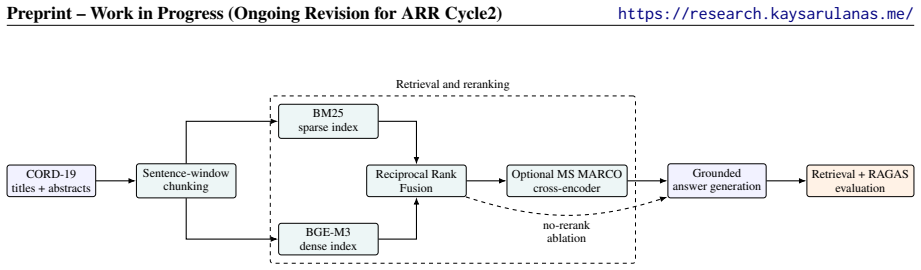
The load-bearing mechanism is reciprocal rank fusion (RRF): for each candidate document d, RRF(d) = Σ_i 1/(60 + rank_i(d)) over the sparse and dense ranked lists. This cheap, parameter-light fusion rule turns the complementary strengths of BM25 and BGE-M3 into the hybrid ranked list that dominates the experiments. The other central pieces are the pseudo-relevance label rule (treating the hybrid's top-3 outputs per query as relevant) and the optional cross-encoder reranker, evaluated as an ablation to test whether stronger query–passage interaction transfers from web data. RRF carries the argument: its fused ranking defines both the hybrid's advantage and, through the label rule, the evaluati
What would settle it
Recompute Recall@K and Precision@K on the same 15 queries after replacing pseudo-labels with independent expert relevance judgments. If hybrid no longer reaches Recall@10 of 1.000 at the 1K and 15K scales, or no longer beats both dense-only and BM25 at K≥5, the central robustness claim fails. A simpler arithmetic check: because the stated labels are the hybrid's top-3 hits, Hybrid R@3 should equal 1.000 at every scale; any lower value means the labeling rule and the reported numbers are inconsistent.
Extended reading notes
Core claim
The paper's claim is empirical and comparative: on the corpus it uses, hybrid retrieval is the most reliable retrieval configuration. Concretely, merging BM25 lexical scores with BGE-M3 dense-embedding scores via reciprocal rank fusion reaches Recall@10 of 1.000 at both the 1K and 15K scales and beats each component alone at cutoffs of 5 and above. The paper also reports a negative reranking result: adding a cross-encoder trained on web-search pairs lowers Precision@K across all reported cutoffs, implying that domain mismatch can outweigh the benefit of deeper query–passage interaction. Finally, automated faithfulness and answer-relevancy scores improve as the corpus grows, while context-pre
Load-bearing premise
The retrieval metrics are judged against pseudo-relevance labels built from the hybrid system's own top-three results, so the hybrid's high recall is partly built into the measurement.
Editorial extensions
If this is right
- For resource-constrained scientific RAG, sparse–dense fusion with reciprocal rank fusion is a sensible default because the two retrievers return largely disjoint evidence (mean Jaccard overlap of about 0.21 at the 1K scale).
- A generic web-search-trained reranker can reduce precision on scientific abstracts, so rerankers should be validated on the target domain before deployment.
- Small-scale runs are useful for debugging but not final design decisions, because retrieval behavior shifts between the 1K and 15K settings.
- Because the retrieval labels are pseudo-relevant and the query set contains 15 items, the numbers support within-pipeline comparisons, not leaderboard-style claims.
Reading between the lines
- The pseudo-label design can serve as a starting point for a cleaner benchmark: re-running the same pipeline with independently annotated relevance labels would remove the circularity the paper flags and make the comparison reusable.
- The negative reranker result probably depends on the reranker's web-search training data; a cross-encoder fine-tuned on biomedical or scientific pairs could reverse the effect, and testing that would separate domain mismatch from reranking in general.
- The rise in faithfulness with corpus scale may reflect better coverage of the fixed query set rather than a general benefit of larger corpora; varying retrieved depth while holding queries fixed would separate the two.
- One could test whether fusion's advantage grows with scale by measuring sparse–dense result-set overlap at every corpus size, not just at 1K.
Editorial analysis
A structured set of objections, weighed in public.
Referee Report
Summary. The paper reports a compute-aware empirical comparison of retrieval and reranking components for scientific RAG over CORD-19 at three corpus scales (1K, 5K, 15K abstracts), using a fixed pipeline: sentence-window chunking, BM25, BGE-M3 dense retrieval, reciprocal rank fusion (RRF), an optional MS MARCO cross-encoder reranker, and GPT-4o-mini-based generation. The central claims are that hybrid retrieval is more robust than either sparse-only or dense-only retrieval, that the MS MARCO cross-encoder reduces precision on scientific text, and that RAGAS faithfulness and answer relevancy increase with corpus scale. Retrieval evaluation uses pseudo-relevance labels defined as the top-3 hybrid results per query; the authors disclose the circularity and frame the results as controlled comparative evidence rather than benchmark scores. Code, indexes, and evaluation outputs are released.
Significance. If the findings were supported, the negative reranking result would be a useful caution about domain transfer, and the multi-scale design is a reasonable template for resource-constrained scientific RAG. The authors deserve credit for a fixed-pipeline controlled design, explicit limitations, and releasing artifacts. However, the central retrieval claim is not currently supported: the evaluation labels are self-referential, and the reported recall numbers are incompatible with the stated labeling rule under the natural per-scale reading. Without independent relevance labels or a clear, consistent label protocol, the empirical retrieval comparison cannot be validated. The paper's 'controlled comparative evidence' framing does not remove the bias or the internal inconsistency.
major comments (4)
- [Section 3.4 vs. Table 2] The relevance-labeling rule is not self-consistent as written. Section 3.4 defines the gold set as 'the top-3 hybrid results per query.' If these labels are recomputed per scale, then hybrid R@3, R@5, R@10, and R@20 must all be 1.000 and R@1 must be 0.333 at every scale. Table 2 reports values such as Hybrid R@3=0.627 at 1K, R@3=0.613 at 5K, R@5=0.820/0.847, and R@10=0.993 at 5K, which are impossible under that rule. If instead the labels form a single fixed set (e.g., from the 15K index), the paper must say so; under that reading the 15K hybrid row is perfect by construction, so the abstract's claim that hybrid 'reaches Recall@10 of 1.000 at 15K' is vacuous. The Section 6 limitation note acknowledges circularity but does not resolve this ambiguity. The central retrieval table cannot be interpreted as it stands.
- [Section 3.4 / Section 6] Even after the scale ambiguity is resolved, using the hybrid system's own top-3 as pseudo-relevance labels makes the comparison systematically favor the hybrid system: the gold set is chosen by the same ranking function being evaluated. This is not an independent test of whether hybrid retrieval is 'more robust.' The paper's caveat that the results are 'controlled comparative evidence rather than benchmark scores' does not remove the bias; it only warns the reader. A convincing defense of the main claim would require evaluation against independent relevance judgments, such as an existing scientific-QA benchmark with gold evidence or human annotations. Without that, the headline robustness claim is not established.
- [Section 4.1 / Table 2] All retrieval conclusions rest on 15 queries per scale, with no confidence intervals, significance tests, or per-query breakdowns. Differences such as Hybrid R@10 = 1.000 at 1K versus 0.993 at 5K correspond to a single query event. The paper's claim that hybrid retrieval is 'more robust' across scales is therefore not statistically supported even setting aside the label problem. This is especially consequential because the main contribution is an empirical comparison.
- [Section 4.2 / Table 3] The reranking conclusion is also computed against the same pseudo-relevance labels. Because the labels are the hybrid's top-3 results, the no-rerank P@1=1.000 and P@3=1.000 are at least partly forced by construction if the no-rerank list is the hybrid list. The reranked versus no-rerank comparison may still show a relative degradation, but the absolute precision values and the conclusion that reranking 'reduces precision on the scientific corpus' must be qualified as conditional on the hybrid-derived labels. The current Table 3 does not support a general claim about cross-encoder rerankers in the scientific domain.
minor comments (4)
- [Section 3.2, Eq. (1)] Please clarify the notation rank_i(d): what is the index i (dense list, BM25 list, both?) and how ties are handled. Also state whether the RRF constant 60 is a fixed hyperparameter or was tuned.
- [Section 4.2] The sentence 'Since the no-rerank baseline is identical at both scales' is misleading: the P@K values are identical, but the underlying retrieved lists and corpora differ. The conclusion that the degradation is 'rather than to weaker Stage 1 retrieval' is not supported because the two scales have different indexes.
- [Section 3.1 / Appendix F] The paper says '15 evaluation queries per scale' but Appendix F lists one set of 15 questions. Please clarify whether the same 15 queries are used at all scales and whether the pseudo-relevance labels are recomputed per scale.
- [Appendix C] The statement that a mean Jaccard similarity of 0.213 means 'roughly 79% of retrieved documents differ' is imprecise. Jaccard measures overlap over the union, not the proportion of different documents in a fixed-size set. Please rephrase or report intersection-over-union explicitly.
Circularity Check
Hybrid-derived pseudo-relevance labels make the headline retrieval and reranking results circular; Table 2 also contradicts the stated labeling rule.
-
self definitional
[Section 3.4 (Retrieval Evaluation Note); also Abstract and Section 6]
"Retrieval evaluation uses pseudo-relevance labels: the top-3 hybrid results per query are treated as relevant. This makes our results useful for controlled comparison and debugging, but it introduces circularity that may favor the hybrid system, and a 15-query set limits statistical power."
The relevance labels are constructed from the hybrid system's own top-3 output. Therefore any query's relevant set is a subset of the hybrid result list, so Hybrid Recall@K for K>=3 equals 1.0 by construction. The headline claim that 'hybrid retrieval is more robust ... reaching Recall@10 of 1.000' is thus a direct consequence of the label definition rather than an independent empirical finding. Table 2 reports Hybrid R@3 = 0.627 at 1K and 0.613 at 5K, which cannot be true if the labels are the hybrid's own top-3, so the actual label construction is at best unclear and at worst the reported recall numbers are miscalculated. Either way, the central comparison is not independent.
-
self definitional
[Section 3.4 with Section 4.2 (Table 3)]
"Retrieval evaluation uses pseudo-relevance labels: the top-3 hybrid results per query are treated as relevant. ... At 1K, P@5 drops from 0.600 to 0.404. At 5K, it drops from 0.600 to 0.368."
The reranking ablation's precision is measured against the same hybrid-defined labels. Because no-rerank hybrid P@3 is 1.000 by construction, any reranker that changes the hybrid top-3 membership will appear to reduce precision even if it finds better scientific evidence. Thus the paper's negative reranking result ('an MS MARCO-trained cross-encoder reduces precision on the scientific corpus') is partly forced by the self-referential label set, not an independent demonstration of domain mismatch.
full rationale
SciRet is transparent: it repeatedly calls the retrieval results 'pseudo-relevance' and frames them as 'controlled comparative evidence rather than a benchmark claim.' However, transparency does not remove circularity. The load-bearing retrieval comparison (hybrid vs. sparse vs. dense) is scored against labels that are the hybrid system's own top-3 outputs. For K>=3, hybrid recall is 1.0 by definition, so the reported Recall@10 = 1.000 is a definitional artifact. The Table 2 numbers (e.g., Hybrid R@3 = 0.627 at 1K) contradict the stated labeling rule, meaning either the labels are not actually hybrid top-3 (so the method description is inaccurate and the degree of circularity is unknown) or the recall values are miscalculated. The reranking result is similarly self-referential: scoring a reranker against the hybrid's own top-3 labels systematically penalizes any reordering, so the observed precision drop does not independently establish domain mismatch. The generation RAGAS metrics and the chunking/complementarity analyses are not circular in this way. There are no load-bearing self-citations or imported uniqueness theorems. A score of 8 reflects that the central retrieval and reranking claims reduce by construction to the hybrid-defined labels; the explicit limitation note and the presence of some independent analyses prevent a 10.
Assumptions & free parameters
free parameters (4)
- Number of pseudo-relevant documents per query =
3
- Reciprocal rank fusion constant k =
60
- Stage 1 candidate cutoff =
50
- Evaluation query count per scale =
15
assumptions (3)
- domain assumption CORD-19 titles and abstracts are a representative scientific corpus for evaluating RAG retrieval.
- ad hoc to paper Pseudo-relevance labels from the hybrid top-3 are a valid proxy for true relevance.
- domain assumption RAGAS automated metrics are a meaningful signal of generation quality.
Cite this review
Pith. "Pith review of SciRet: A Compute-Aware Empirical Study of Retrieval and Reranking for Scientific RAG." pith.science (2026). https://pith.science/paper/JCKB33ME
@misc{pith2026260803860,
  author       = {Pith},
  title        = {Pith review of: SciRet: A Compute-Aware Empirical Study of Retrieval and Reranking for Scientific RAG},
  year         = {2026},
  howpublished = {\url{https://pith.science/paper/JCKB33ME}},
  note         = {Machine review of arXiv:2608.03860}
}
read the original abstract
We introduce SciRet, a compute-aware empirical study of retrieval-augmented generation for scientific question answering over CORD-19. Rather than proposing a new model, we evaluate a fixed scientific RAG pipeline across three corpus scales: 1,034 chunks (1K papers), 5,160 chunks (5K papers), and 15,480 chunks (15K papers). The pipeline combines sentence-window chunking, BM25, BGE-M3 dense retrieval, reciprocal rank fusion, optional cross-encoder reranking, and grounded answer generation. Across these settings, hybrid retrieval is more robust than either sparse-only or dense-only retrieval in our setting, reaching Recall@10 of 1.000 at 1K and 15K. In contrast, an MS MARCO-trained cross-encoder reranker reduces precision on the scientific corpus, suggesting that domain mismatch can outweigh the benefits of stronger query-passage interaction. Generation faithfulness measured with RAGAS increases with corpus scale in our setup. Retrieval evaluation uses pseudo-relevance labels derived from the hybrid system, so we treat the results as controlled comparative evidence rather than a benchmark claim. We release code, indexes, and evaluation outputs to support replication and follow-up studies.
Figures


Figures from the paper (2 more)


Reference graph
Works this paper leans on
-
[1]
arXiv preprint arXiv:2402.03216 , year =
Jianlv Chen and Shitao Xiao and Peitian Zhang and Kun Luo and Defu Lian and Zheng Liu , title =. arXiv preprint arXiv:2402.03216 , year =
-
[2]
Arman Cohan and Sergey Feldman and Iz Beltagy and Doug Downey and Daniel S. Weld , title =. Proceedings of the 58th Annual Meeting of the Association for Computational Linguistics , pages =
-
[3]
Gordon V. Cormack and Charles L. A. Clarke and Stefan Buettcher , title =. Proceedings of the 32nd International ACM SIGIR Conference on Research and Development in Information Retrieval , pages =
-
[4]
arXiv preprint arXiv:2309.15217 , year =
Shahul Es and Jithin James and Luis Espinosa-Anke and Steven Schockaert , title =. arXiv preprint arXiv:2309.15217 , year =
-
[5]
Gautier Izacard and Edouard Grave , title =. Proceedings of the 16th Conference of the European Chapter of the Association for Computational Linguistics , pages =
-
[6]
Dense Passage Retrieval for Open-Domain Question Answering , booktitle =
Vladimir Karpukhin and Barlas O. Dense Passage Retrieval for Open-Domain Question Answering , booktitle =
-
[7]
Retrieval-Augmented Generation for Knowledge-Intensive
Patrick Lewis and Ethan Perez and Aleksandra Piktus and Fabio Petroni and Vladimir Karpukhin and Naman Goyal and Heinrich K. Retrieval-Augmented Generation for Knowledge-Intensive. Advances in Neural Information Processing Systems , volume =
-
[8]
Proceedings of the 2023 Conference on Empirical Methods in Natural Language Processing , pages =
Sewon Min and Kalpesh Krishna and Xinxi Lyu and Mike Lewis and Wen. Proceedings of the 2023 Conference on Empirical Methods in Natural Language Processing , pages =
work page 2023
Show all 15 references
-
[9]
Proceedings of the 1st Workshop on NLP for COVID-19 at ACL 2020 , year =
Timo M. Proceedings of the 1st Workshop on NLP for COVID-19 at ACL 2020 , year =
2020
-
[10]
Proceedings of the 2019 Conference on Empirical Methods in Natural Language Processing and the 9th International Joint Conference on Natural Language Processing , pages =
Nils Reimers and Iryna Gurevych , title =. Proceedings of the 2019 Conference on Empirical Methods in Natural Language Processing and the 9th International Joint Conference on Natural Language Processing , pages =
2019
-
[11]
Foundations and Trends in Information Retrieval , volume =
Stephen Robertson and Hugo Zaragoza , title =. Foundations and Trends in Information Retrieval , volume =
-
[12]
Proceedings of the Thirty-Fifth Conference on Neural Information Processing Systems Datasets and Benchmarks Track , year =
Nandan Thakur and Nils Reimers and Andreas R. Proceedings of the Thirty-Fifth Conference on Neural Information Processing Systems Datasets and Benchmarks Track , year =
-
[13]
Alvers and Dirk Weissenborn and Anastasia Krithara and Sergios Petridis and Dimitris Polychronopoulos , title =
George Tsatsaronis and Georgios Balikas and Prodromos Malakasiotis and Ioannis Partalas and Matthias Zschunke and Michael R. Alvers and Dirk Weissenborn and Anastasia Krithara and Sergios Petridis and Dimitris Polychronopoulos , title =. BMC Bioinformatics , volume =
-
[14]
Proceedings of the 2020 Conference on Empirical Methods in Natural Language Processing , pages =
David Wadden and Shanchuan Lin and Kyle Lo and Lucy Lu Wang and Madeleine van Zuylen and Arman Cohan and Hannaneh Hajishirzi , title =. Proceedings of the 2020 Conference on Empirical Methods in Natural Language Processing , pages =
2020
-
[15]
arXiv preprint arXiv:2004.10706 , year =
Lucy Lu Wang and Kyle Lo and Yoganand Chandrasekhar and Russell Reas and Jiangjiang Yang and Doug Baber and Kathryn Eide and Brendan Ros and Nascence Kim and Spencer Wilhelm , title =. arXiv preprint arXiv:2004.10706 , year =
2004 arXiv
Reviewed August 5, 2026 · model on record in the stance chip above.
Discussion (0). Continue with ORCID to comment.