REVIEW 2 major objections 4 minor 45 references
This paper claims naturalistic presentation edits—lighting, background, staging—can more than double the chance a vision-language model selects an image, across product, hiring, housing, and hotel tasks.
Reviewed by Pith at T0; open to challenge. T0 means a machine referee read the full paper against a public rubric. the ladder, T0–T4 →
Naturalistic edits to background, lighting, and staging systematically shift the choices of frontier vision-language models, and a new optimization-plus-interpretation framework (CVPO) discovers and explains the visual themes that drive those shifts.
T0 review reviewed 2026-08-02 challenge →
load-bearing objection Large, replicated effect of image edits on VLM choices, but the 'presentation-only' claim rests on an unenforced identity constraint; the paper needs a post-hoc identity check and a relabeled conclusion. the 2 major comments →
Visual Persuasion: What Influences Decisions of Vision-Language Models?
The pith
A machine-rendered reading of the paper's core claim, the machinery that carries it, and where it could break.
The reading
Core claim
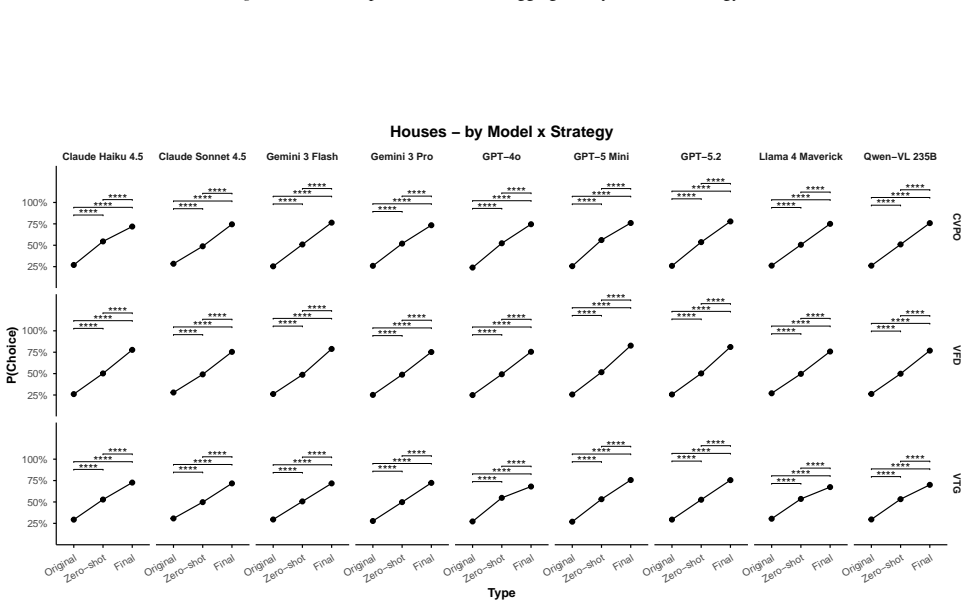
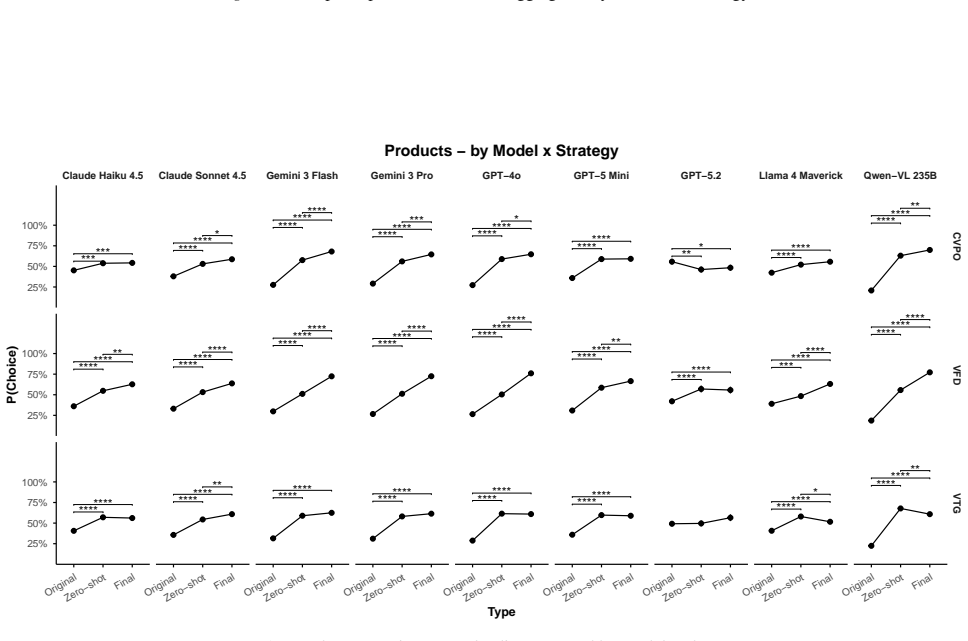
On the paper's own terms, the central discovery is that visual presentation alone—holding the underlying object or scene fixed—has a large, consistent effect on VLM agentic choice. In controlled head-to-head comparisons, zero-shot edits can more than double the probability that an image is selected, and optimization adds further gains; a novel competitive optimization method (CVPO) wins most comparisons against two adapted baselines. An automatic interpretability pipeline identifies stable themes (pools, fire pits, luxury furniture, twilight lighting, formal attire) that drive these decisions, and human participants show similar preferences in most tasks. The authors also report that asking
What carries the argument
The central object is visual prompt optimization: instead of perturbing pixels, the authors optimize an editable text prompt parameterizing an image-editing operator, treating the VLM's decision function as a latent utility landscape inferred from pairwise comparisons. The load-bearing device is the identity-maintenance constraint—edits must depict the same entity or scene up to nuisance variation—intended to separate presentation from substance, but implemented only as a verbal instruction to the editing model. Their new competitive method, CVPO, stages head-to-head contests among candidate edits judged by a panel of VLMs with consistency checks, generates challengers from the losing image,
Load-bearing premise
The whole result depends on the claim that edits change only presentation, not substance—but the paper never verifies this; it only tells the editing model to keep the object, house, hotel, or person the same, and some of its own discovered themes (pools, fire pits, suits) look like substantive changes.
What would settle it
Have human raters classify each optimized edit as presentation-only (lighting, angle, background, framing) versus substance-changing (added pool, outdoor kitchen, furniture, business attire, changed amenity), then re-run the head-to-head comparisons using only the presentation-only subset, with edits that violate a strict identity check removed. If the large choice-probability shifts disappear or shrink to noise, the claim that presentation alone drives VLM choices is falsified.
If this is right
- If the central claim holds, standard accuracy benchmarks miss a major behavioral risk: a model can be 'correct' about what an image shows while still being steered by irrelevant presentation details.
- Optimization procedures like CVPO give auditors a tool to discover hidden visual preferences proactively rather than waiting for real-world manipulation.
- The recurring themes imply concrete, transferable edit recipes that could be applied zero-shot to new images, amortizing the cost of optimization.
- Because normalization only partially removes the effect, deployment of VLM agents in high-stakes visual decisions (hiring, real estate, purchasing) should include explicit presentation-robustness checks.
- The human results suggest the discovered preferences are not purely an artifact of one model family, so the framework could inform the study of visual persuasion more broadly.
Where Pith is reading between the lines
- Inference: If identity were enforced by a real post-hoc check rather than a verbal instruction, the measured effects would likely shrink; separating lighting/background-only edits from amenity edits (pools, furniture, clothing) is a direct test the paper did not run.
- Inference: The convergence of themes across optimization methods may partly reflect properties of the specific edit and judge models used in the pipeline, so the discovered 'preferences' should be replicated across model families before treating them as general VLM truths.
- Inference: The same loop could be used adversarially by marketplace actors to differentially advantage listings without changing substantive quality, giving a measurable 'machine fluency' advantage to those who know the tricks—an extension the paper notes only as a risk.
- Inference: A cheap practical extension is to use the distilled theme prompts as a red-teaming checklist for any image-fed agent, since they require no per-image optimization.
Editorial analysis
A structured set of objections, weighed in public.
Referee Report
Summary. The paper introduces a framework for studying the visual preferences of vision-language models (VLMs) by iteratively editing images with a text-to-image model and measuring changes in pairwise choice probabilities. The authors propose three optimization methods (VTG, VFD, and the novel CVPO), evaluate them on nine frontier VLMs across four realistic agentic tasks (product purchasing, hiring, house search, hotel booking), and find that zero-shot edits and optimized edits substantially increase the probability of an image being chosen. They also run human experiments showing similar effects, develop an automatic interpretability pipeline that identifies recurring visual themes, and test an image-normalization mitigation strategy that partially reduces the effect. The central claim is that visual presentation alone—while keeping semantic content constant—can systematically steer VLM decisions.
Significance. If the central claim were fully established, this would be a valuable contribution: a scalable, interpretable methodology for auditing and red-teaming image-based AI agents, plus a new optimization algorithm (CVPO) that outperforms adapted baselines. The paper's strengths are its large scale (1.8M+ API requests, 9 VLMs, 4 tasks), its careful pairwise-choice design (order counterbalancing, filtering of order-inconsistent judgments, cluster-robust standard errors, Benjamini-Hochberg corrections), and the inclusion of human validation showing that the edited images also shift human choices. The zero-shot effects are particularly clean because they do not involve an optimization loop. However, the headline interpretation that effects occur 'even when primary semantic content is held constant' is currently undercut by the paper's own admitted limitations about the identity-preserving constraint.
major comments (2)
- [§3.2, Definition 3.1; §5 Limitations] The central claim that 'visual presentation alone has a large effect' (§4.1) and 'even when primary semantic content is held constant' (§6) rests entirely on the identity-preserving constraint C(x0) in Eq. (6). The paper states that the identity predicate I can be 'approximated via simple verbal instructions' and that 'simple instructions suffice,' but no post-hoc check, similarity threshold, or verification of I is reported. The auto-interpretability results (Appendix C) show that the optimizer discovers edits such as adding pools, outdoor kitchens, and business suits; the limitations section concedes that 'the boundary between presentation and substance can be fuzzy' and that amenity changes 'may offer some increased utility.' Therefore the empirical finding that edited images shift choices is robust, but the interpretation that this occurs 'even when primary semantic content is held c
- [§3.4, §4.1, Table 1] The optimization loop uses Gemini 3 Flash as the judge model for all three methods (stated in §3.4: 'we use Gemini 3 Flash as the judge model in all optimization pipelines'), and Gemini 3 Flash is also one of the nine evaluator VLMs in the main results. Consequently, for this model, the optimized images are selected to satisfy the same model that later evaluates them; the gains from optimization are partly in-sample. The zero-shot results are unaffected, but the claim that optimized images shift choices 'across all evaluators' is stronger than what is demonstrated. I recommend reporting all main contrasts with the optimizer-judge model excluded, or at least a sensitivity analysis; given Table 1, the aggregate conclusion is likely robust, but the point estimate for Gemini 3 Flash and the method-comparison (CVPO vs. VFD) should be labeled as in-sample for that model.
minor comments (4)
- [Appendix E.3] Typo: 'oberservations' should be 'observations.'
- [§4.2] The efficiency metric 'Budget %' measures iterations only, but CVPO generates more images per iteration. Consider reporting API cost or total images generated to make the efficiency comparison fair across methods.
- [§3.2] The notation for the number of judges k, challengers K, and mitigation passes κ is easy to confuse. Consider renaming to avoid k/K/κ collision.
- [§5] The limitations paragraph on identity maintenance is appropriately candid but should be moved earlier or cross-referenced in §4.1 where the 'presentation alone' claim is first made, so readers can immediately calibrate the strength of the claim.
Circularity Check
Partial circularity: Gemini 3 Flash is both the optimization judge and an evaluated model, so its CVPO win is in-sample; the 'presentation-only' interpretation rests on an unverified verbal identity constraint rather than a measured predicate. Cross-model zero-shot results remain independent.
specific steps
-
fitted input called prediction
[§3.3 (Specific Optimization Methods) and Table 1; see also Algorithm 1]
""Note: we use Gemini 3 Flash as the judge model in all optimization pipelines." Table 1 row: "Gemini 3 Flash ... CVPO 0.761"."
All three optimizers (CVPO, VFD, VTG) use Gemini 3 Flash's pairwise judgments as the acceptance/selection signal (Algorithm 1: "k judges vote via pairwise comparisons with consistency checks"; VFD: evaluator J; VTG: LLM critic). The final edited images for Gemini 3 Flash are therefore selected to maximize that model's own preference. Reporting Gemini 3 Flash's 0.761 preference for CVPO's final images as evidence that optimization shifts VLM choices is an in-sample measure of the fitted objective, not an independent prediction. The non-circular evidence is the zero-shot effect on all models and the optimized effects on the eight evaluator models never used as judge or editor.
-
self definitional
[§3.2 (Definition 3.1, identity constraints) + §5 Limitations + Appendix C]
""The predicate I can be implemented by post-hoc checks (e.g. prompting a VLM to verify invariants and reject violating proposals), similarity thresholds, or approximated via simple verbal instructions in the editing instructions. In practice, with a sufficiently controllable editing model Edit, we find that simple instructions suffice." §5: "the boundary between presentation and substance can be fuzzy in some instances"."
The paper's conclusion that edits shift choices "even when primary semantic content is held constant" (Conclusion) treats the editing instruction "Keep the product itself exactly unchanged" as if it implemented the identity predicate I(x,x0). But I is never computed: there is no post-hoc check or similarity threshold, only a verbal prompt. Appendix C shows the optimizer added pools, fire pits, outdoor kitchens, business suits, and "Product internal content exposure"—plausibly substantive changes. Thus the "presentation-only" interpretation is an assumption embedded in the prompt text, not a measured property of the images; the headline interpretive claim reduces to the unverified identity instruction rather than to an enforced constraint.
full rationale
The central empirical result—zero-shot edits shift choices on all nine VLMs, and optimization generalizes to the eight models not used as judge—is not a fitted value: those are out-of-sample measurements, and the human studies (N=154) are independent external evidence. However, two load-bearing pieces are circular. First, the Gemini 3 Flash row in Table 1 measures the exact objective that all three optimizers were maximizing (Gemini judged every proposal), so that row's CVPO advantage and optimized-vs-original shift are in-sample by construction. Second, the interpretation that effects are due to "visual presentation alone" depends on the identity predicate I(x,x0), which is never computed; the paper substitutes a verbal instruction to the editor for the constraint and then concludes "even when primary semantic content is held constant." Appendix C themes (pools, outdoor kitchens, business suits, revealing product contents) show the edits plausibly cross into substantive changes, and §5 concedes the boundary is fuzzy and that amenity changes "may offer some increased utility." Thus the presentation-only interpretation reduces to the unverified prompt text. This is partial circularity rather than total: the aggregate zero-shot/cross-model evidence and the human results do not depend on the circular steps, so the score is 6, not 8 or 10.
Axiom & Free-Parameter Ledger
free parameters (2)
- Optimization hyperparameters (k judges, challenger count K, patience, iteration bounds T_min/T_max, equilibrium threshol =
k=3; patience=3; T_min=10; T_max=30; epsilon symbolic; kappa in {0,1,3}
- Hand-authored base-prior prompts p0, judge prompts, and optimizer instructions per task =
per-task text, Appendix H
axioms (4)
- domain assumption Pairwise choices reveal a scalar latent utility via sigma(U_tau(x_a) - U_tau(x_b)) (Eq. 3).
- ad hoc to paper Verbal instruction to the editor suffices to keep edits inside the identity-preserving set C(x0).
- domain assumption Order-inconsistent evaluator judgments are noise and may be discarded.
- domain assumption Gemini 3 Flash judge preferences proxy for the preferences of other frontier VLMs.
invented entities (1)
-
Latent visual utility landscape U_tau over images
independent evidence
Cite this review
Pith. "Pith review of Visual Persuasion: What Influences Decisions of Vision-Language Models?." pith.science (2026). https://pith.science/paper/JCUMHOG5
@misc{pith2026260215278,
  author       = {Pith},
  title        = {Pith review of: Visual Persuasion: What Influences Decisions of Vision-Language Models?},
  year         = {2026},
  howpublished = {\url{https://pith.science/paper/JCUMHOG5}},
  note         = {Machine review of arXiv:2602.15278}
}
read the original abstract
The web is littered with images, once created for human consumption and now increasingly interpreted by agents using vision-language models (VLMs). These agents make visual decisions at scale, deciding what to click, recommend, or buy. Yet, we know little about the structure of their visual preferences. We introduce a framework for studying this by placing VLMs in controlled image-based choice tasks and systematically perturbing their inputs. Our key idea is to treat the agent's decision function as a latent visual utility that can be inferred through revealed preference: choices between systematically edited images. Starting from common images, such as product photos, we propose methods for visual prompt optimization, adapting text optimization methods to iteratively propose and apply visually plausible modifications using an image generation model (such as in composition, lighting, or background). We then evaluate which edits increase selection probability. Through large-scale experiments on frontier VLMs, we demonstrate that optimized edits significantly shift choice probabilities in head-to-head comparisons. We develop an automatic interpretability pipeline to explain these preferences, identifying consistent visual themes that drive selection. We argue that this approach offers a practical and efficient way to surface visual vulnerabilities, safety concerns that might otherwise be discovered implicitly in the wild, supporting more proactive auditing and governance of image-based AI agents.
Figures





Reference graph
Works this paper leans on
-
[1]
write newline
" write newline "" before.all 'output.state := FUNCTION n.dashify 't := "" t empty not t #1 #1 substring "-" = t #1 #2 substring "--" = not "--" * t #2 global.max substring 't := t #1 #1 substring "-" = "-" * t #2 global.max substring 't := while if t #1 #1 substring * t #2 global.max substring 't := if while FUNCTION format.date year duplicate empty "emp...
-
[2]
A., Tan, S., Soylu, D., Ziems, N., Khare, R., Opsahl-Ong, K., Singhvi, A., Shandilya, H., Ryan, M
Agrawal, L. A., Tan, S., Soylu, D., Ziems, N., Khare, R., Opsahl-Ong, K., Singhvi, A., Shandilya, H., Ryan, M. J., Jiang, M., et al. Gepa: Reflective prompt evolution can outperform reinforcement learning. arXiv preprint arXiv:2507.19457, 2025
Pith/arXiv arXiv 2025
-
[3]
Ahmed, E. and Moustafa, M. House price estimation from visual and textual features. arXiv preprint arXiv:1609.08399, 2016
Pith/arXiv arXiv 2016
-
[4]
Language models can explain neurons in language models, 2023
Bills, S., Cammarata, N., Mossing, D., Tillman, H., Gao, L., Goh, G., Sutskever, I., Leike, J., Wu, J., and Saunders, W. Language models can explain neurons in language models, 2023. URL https://openaipublic.blob.core.windows.net/neuron-explainer/paper/index.html
2023
-
[5]
and Toubia, O
Brucks, M. and Toubia, O. Prompt architecture can induce methodological artifacts in large language models. Available at SSRN 4484416, 2023
2023
-
[6]
Budny, N., Ghods, K., Campbell, D., Marjieh, R., Joshi, A., Kumar, S., Cohen, J. D., Webb, T. W., and Griffiths, T. L. Visual serial processing deficits explain divergences in human and vlm reasoning. arXiv preprint arXiv:2509.25142, 2025
arXiv 2025
-
[7]
N., Ghods, K., Joshi, A., Ku, A., Frankland, S., Griffiths, T., Cohen, J
Campbell, D., Rane, S., Giallanza, T., De Sabbata, C. N., Ghods, K., Joshi, A., Ku, A., Frankland, S., Griffiths, T., Cohen, J. D., et al. Understanding the limits of vision language models through the lens of the binding problem. Advances in Neural Information Processing Systems, 37: 0 113436--113460, 2024
2024
-
[8]
Superficial alignment, subtle divergence, and nudge sensitivity in llm decision-making
Cherep, M., Singh, N., and Maes, P. Superficial alignment, subtle divergence, and nudge sensitivity in llm decision-making. In NeurIPS 2024 Workshop on Behavioral Machine Learning, 2024
2024
-
[9]
A framework for studying ai agent behavior: Evidence from consumer choice experiments
Cherep, M., Ma, C., Xu, A., Shaked, M., Maes, P., and Singh, N. A framework for studying ai agent behavior: Evidence from consumer choice experiments. arXiv preprint arXiv:2509.25609, 2025 a
arXiv 2025
-
[10]
Llm agents are hypersensitive to nudges
Cherep, M., Maes, P., and Singh, N. Llm agents are hypersensitive to nudges. arXiv preprint arXiv:2505.11584, 2025 b
Pith/arXiv arXiv 2025
-
[11]
Behavioral systems require behavioral tests
Cherep, M., Singh, N., and Maes, P. Behavioral systems require behavioral tests. In NeurIPS 2025 Workshop on Bridging Language, Agent, and World Models for Reasoning and Planning, 2025 c
2025
-
[12]
Choi, Y., Kim, D., Baek, J., and Hwang, S. J. Multimodal prompt optimization: Why not leverage multiple modalities for mllms. arXiv preprint arXiv:2510.09201, 2025
arXiv 2025
-
[13]
F., Dideriksen, T., Arora, H., Guillaumin, M., and Malik, J
Collins, J., Goel, S., Deng, K., Luthra, A., Xu, L., Gundogdu, E., Zhang, X., Yago Vicente, T. F., Dideriksen, T., Arora, H., Guillaumin, M., and Malik, J. Abo: Dataset and benchmarks for real-world 3d object understanding. CVPR, 2022
2022
-
[14]
Cuesta-Vali \ n o, P., Kazakov, S., Guti \'e rrez-Rodr \' guez, P., and Rua, O. L. The effects of the aesthetics and composition of hotels’ digital photo images on online booking decisions. Humanities and Social Sciences Communications, 10 0 (1): 0 1--11, 2023
2023
-
[15]
C., Wu, W., and Liu, Z
Fu, J., Li, S., Jiang, Y., Lin, K.-Y., Qian, C., Loy, C. C., Wu, W., and Liu, Z. Stylegan-human: A data-centric odyssey of human generation. In European Conference on Computer Vision, pp.\ 1--19. Springer, 2022
2022
-
[16]
Gavrikov, P., Lukasik, J., Jung, S., Geirhos, R., Mirza, M. J., Keuper, M., and Keuper, J. Can we talk models into seeing the world differently? arXiv preprint arXiv:2403.09193, 2024
Pith/arXiv arXiv 2024
-
[17]
J., Shlens, J., and Szegedy, C
Goodfellow, I. J., Shlens, J., and Szegedy, C. Explaining and harnessing adversarial examples. arXiv preprint arXiv:1412.6572, 2014
Pith/arXiv arXiv 2014
-
[18]
The agentic investor: Ai for real estate investment management
Graham, L. The agentic investor: Ai for real estate investment management. Available at SSRN 5720342, 2025
2025
-
[19]
Grigsby, J., Zhu, Y., Ryoo, M., and Niebles, J. C. Vlm q-learning: Aligning vision-language models for interactive decision-making. arXiv preprint arXiv:2505.03181, 2025
Pith/arXiv arXiv 2025
-
[20]
R., and Price, S
Gupta, I., Fronsdal, K., Sheshadri, A., Michala, J., Tay, J., Wang, R., Bowman, S. R., and Price, S. Bloom: an open source tool for automated behavioral evaluations, 2025. URL https://github.com/safety-research/bloom
2025
-
[21]
Handa, K., Gal, Y., Pavlick, E., Goodman, N., Andreas, J., Tamkin, A., and Li, B. Z. Bayesian preference elicitation with language models. arXiv preprint arXiv:2403.05534, 2024
Pith/arXiv arXiv 2024
-
[22]
Agentic interactions
Imas, A., Lee, K., and Misra, S. Agentic interactions. Available at SSRN 5875162, 2025
2025
-
[23]
How to distinguish ai-generated images from authentic photographs
Kamali, N., Nakamura, K., Chatzimparmpas, A., Hullman, J., and Groh, M. How to distinguish ai-generated images from authentic photographs. arXiv preprint arXiv:2406.08651, 2024
Pith/arXiv arXiv 2024
-
[24]
H., Zheng, W., Zhou, Y., Mai, Y., Roberts, J
Lee, T., Tu, H., Wong, C. H., Zheng, W., Zhou, Y., Mai, Y., Roberts, J. S., Yasunaga, M., Yao, H., Xie, C., et al. Vhelm: A holistic evaluation of vision language models. Advances in Neural Information Processing Systems, 37: 0 140632--140666, 2024
2024
-
[25]
Feedback descent: Open-ended text optimization via pairwise comparison
Lee, Y., Boen, J., and Finn, C. Feedback descent: Open-ended text optimization via pairwise comparison. arXiv preprint arXiv:2511.07919, 2025
arXiv 2025
-
[26]
Li, C., Camu \ n as, J. L., Touchet, J. T., Andreas, J., Lapedriza, A., Torralba, A., and Shaham, T. R. Automated detection of visual attribute reliance with a self-reflective agent. arXiv preprint arXiv:2510.21704, 2025
arXiv 2025
-
[27]
P.-W., Qiu, J., Wang, Z., Yu, H., Chen, Y., Zhang, G., and Lo, B
Lo, F. P.-W., Qiu, J., Wang, Z., Yu, H., Chen, Y., Zhang, G., and Lo, B. Ai hiring with llms: A context-aware and explainable multi-agent framework for resume screening. In Proceedings of the Computer Vision and Pattern Recognition Conference, pp.\ 4184--4193, 2025
2025
-
[28]
Improving text-to-image consistency via automatic prompt optimization
Ma \ n as, O., Astolfi, P., Hall, M., Ross, C., Urbanek, J., Williams, A., Agrawal, A., Romero-Soriano, A., and Drozdzal, M. Improving text-to-image consistency via automatic prompt optimization. arXiv preprint arXiv:2403.17804, 2024
Pith/arXiv arXiv 2024
-
[29]
Automatically interpreting millions of features in large language models
Paulo, G., Mallen, A., Juang, C., and Belrose, N. Automatically interpreting millions of features in large language models. arXiv preprint arXiv:2410.13928, 2024
Pith/arXiv arXiv 2024
-
[30]
Discovering language model behaviors with model-written evaluations
Perez, E., Ringer, S., Lukosiute, K., Nguyen, K., Chen, E., Heiner, S., Pettit, C., Olsson, C., Kundu, S., Kadavath, S., et al. Discovering language model behaviors with model-written evaluations. In Findings of the Association for Computational Linguistics: ACL 2023, pp.\ 13387--13434, 2023
2023
-
[31]
Pryzant, R., Iter, D., Li, J., Lee, Y. T., Zhu, C., and Zeng, M. Automatic prompt optimization with" gradient descent" and beam search. arXiv preprint arXiv:2305.03495, 2023
Pith/arXiv arXiv 2023
-
[32]
R., and Jagersand, M
Qin, X., Zhang, Z., Huang, C., Dehghan, M., Zaiane, O. R., and Jagersand, M. U2-net: Going deeper with nested u-structure for salient object detection. Pattern recognition, 106: 0 107404, 2020
2020
-
[33]
W., Hallacy, C., Ramesh, A., Goh, G., Agarwal, S., Sastry, G., Askell, A., Mishkin, P., Clark, J., et al
Radford, A., Kim, J. W., Hallacy, C., Ramesh, A., Goh, G., Agarwal, S., Sastry, G., Askell, A., Mishkin, P., Clark, J., et al. Learning transferable visual models from natural language supervision. In International conference on machine learning, pp.\ 8748--8763. PmLR, 2021
2021
-
[34]
Sclar, M., Choi, Y., Tsvetkov, Y., and Suhr, A. Quantifying language models' sensitivity to spurious features in prompt design or: How i learned to start worrying about prompt formatting. arXiv preprint arXiv:2310.11324, 2023
Pith/arXiv arXiv 2023
-
[35]
Intriguing properties of neural networks
Szegedy, C., Zaremba, W., Sutskever, I., Bruna, J., Erhan, D., Goodfellow, I., and Fergus, R. Intriguing properties of neural networks. arXiv preprint arXiv:1312.6199, 2013
Pith/arXiv arXiv 2013
-
[36]
Wan, X., Zhou, H., Sun, R., Nakhost, H., Jiang, K., Sinha, R., and Ar k, S. \"O . Maestro: Self-improving text-to-image generation via agent orchestration. arXiv preprint arXiv:2509.10704, 2025
Pith/arXiv arXiv 2025
-
[37]
H., Jiang, Z., Zheng, Z., Wu, Z., Chen, M., and Xiao, C
Wang, J., Liu, Z., Park, K. H., Jiang, Z., Zheng, Z., Wu, Z., Chen, M., and Xiao, C. Adversarial demonstration attacks on large language models. arXiv preprint arXiv:2305.14950, 2023
Pith/arXiv arXiv 2023
-
[38]
C., Sheikh, H
Wang, Z., Bovik, A. C., Sheikh, H. R., and Simoncelli, E. P. Image quality assessment: from error visibility to structural similarity. IEEE transactions on image processing, 13 0 (4): 0 600--612, 2004
2004
-
[39]
Wu, C., Li, J., Zhou, J., Lin, J., Gao, K., Yan, K., Yin, S.-m., Bai, S., Xu, X., Chen, Y., et al. Qwen-image technical report. arXiv preprint arXiv:2508.02324, 2025
Pith/arXiv arXiv 2025
-
[40]
Webshop: Towards scalable real-world web interaction with grounded language agents
Yao, S., Chen, H., Yang, J., and Narasimhan, K. Webshop: Towards scalable real-world web interaction with grounded language agents. Advances in Neural Information Processing Systems, 35: 0 20744--20757, 2022
2022
-
[41]
Yu, K., Yu, N., Wang, H., Yang, R., and Zhang, H. How do visual attributes influence web agents? a comprehensive evaluation of user interface design factors. arXiv preprint arXiv:2601.21961, 2026
arXiv 2026
-
[42]
Optimizing generative ai by backpropagating language model feedback
Yuksekgonul, M., Bianchi, F., Boen, J., Liu, S., Lu, P., Huang, Z., Guestrin, C., and Zou, J. Optimizing generative ai by backpropagating language model feedback. Nature, 639 0 (8055): 0 609--616, 2025
2025
-
[43]
Fine-tuning large vision-language models as decision-making agents via reinforcement learning
Zhai, S., Bai, H., Lin, Z., Pan, J., Tong, P., Zhou, Y., Suhr, A., Xie, S., LeCun, Y., Ma, Y., et al. Fine-tuning large vision-language models as decision-making agents via reinforcement learning. Advances in neural information processing systems, 37: 0 110935--110971, 2024
2024
-
[44]
A., Shechtman, E., and Wang, O
Zhang, R., Isola, P., Efros, A. A., Shechtman, E., and Wang, O. The unreasonable effectiveness of deep features as a perceptual metric. In Proceedings of the IEEE conference on computer vision and pattern recognition, pp.\ 586--595, 2018
2018
-
[45]
F., Zhu, H., Zhou, X., Lo, R., Sridhar, A., Cheng, X., Ou, T., Bisk, Y., Fried, D., et al
Zhou, S., Xu, F. F., Zhu, H., Zhou, X., Lo, R., Sridhar, A., Cheng, X., Ou, T., Bisk, Y., Fried, D., et al. Webarena: A realistic web environment for building autonomous agents. arXiv preprint arXiv:2307.13854, 2023
Pith/arXiv arXiv 2023
This paper was first reviewed by deepseek-v4-flash on August 2, 2026.
discussion (0)
Sign in with ORCID, Apple, or X to comment. Anyone can read and Pith papers without signing in.