REVIEW 5 major objections 5 minor 38 references
HiBug2: Efficient and Interpretable Error Slice Discovery for Comprehensive Model Debugging
T0 review · 5 major / 5 minor · reviewed 2026-08-10 · deepseek-v4-flash
Pith's one-line read HiBug2 claims that error slice discovery should start from a structured vocabulary of visual attributes—main object, background, global—and that a breadth-first tree enumeration over that vocabulary finds coherent, interpretable failure…
desk verdict A solid slice-discovery method with real algorithmic improvements, but the headline 'unseen slice' evaluation is unauditable as written. read the letter →
The pith
A machine-rendered reading of the paper's core claim, the machinery that carries it, and where it could break.
The reading
What carries the argument
The machinery is the attribute-tag vocabulary plus a breadth-first tree-structured slice enumeration. Attributes are generated by prompting a large multimodal model with comparative image pairs and task-specific failure queries; tags are refined in a multi-stage process with a yes/no convention for binary attributes and a 'not visible' tag for absent elements. The tree is built so that each node adds one attribute-tag pair to its parent, and because the data count of a slice is monotonically non-increasing as depth grows, the algorithm prunes any subtree whose parent has fewer than ten examples and only forms new candidates by intersecting matched slice pairs that share k−1 attributes. This replaces a combinatorial scan over all attribute combinations with a linear scan over surviving candidates; hash tables speed up matched-pair search and matrix multiplication accelerates data counting and accuracy computation.
What would settle it
Take a validation set with known ground-truth subgroup labels, systematically corrupt the tag assignment for one subgroup (e.g., all low-light images tagged as 'bright'), run HiBug2, and check whether the discovered error slices shift to follow the corrupted tags; a second check is comparing HiBug2's slice membership against a human-annotated tag set on a random sample of images and measuring how often a discovered 'low-performance' slice would be spurious.
Extended reading notes
Core claim
The paper's central claim is that error slice discovery should be reordered: first build a task-specific vocabulary of visual attributes—grouped into main object, background, and global categories—with consistent, unambiguous tags, and only then enumerate slices over that vocabulary. HiBug2 shows that this tag-then-slice order, combined with a breadth-first tree enumeration that prunes low-count subtrees and intersects surviving parent slices, identifies hundreds to thousands of low-performance slices across image classification, pose estimation, and object detection. The authors further claim that two cheap heuristics—substituting a tag with the nearest alternative in a contrastive embedding space and asking a large multimodal model to predict confusable attribute combinations—reliably predict slices the validation set never contained, with observed performance drops up to 64.6% on those predicted slices. The experiments also support the claim that error slices are shared across models on the same task (86% overlap among the worst detection slices for four detectors) and that querying data from the worst-discovered slices improves model performance more than random data selection or the prior HiBug method.
Load-bearing premise
The whole pipeline assumes the multimodal model assigns tags to images accurately enough that the statistics computed over each slice reflect true subgroups; the paper verifies tag format and attribute names but not semantic correctness, and asserts without measurement that a few misclassified points do not alter a slice's average performance.
Editorial extensions
If this is right
- Multi-attribute error slices can be enumerated in minutes rather than hours: the reported 510x speedup makes four-attribute slices practical, and runtime scales linearly with the number of images.
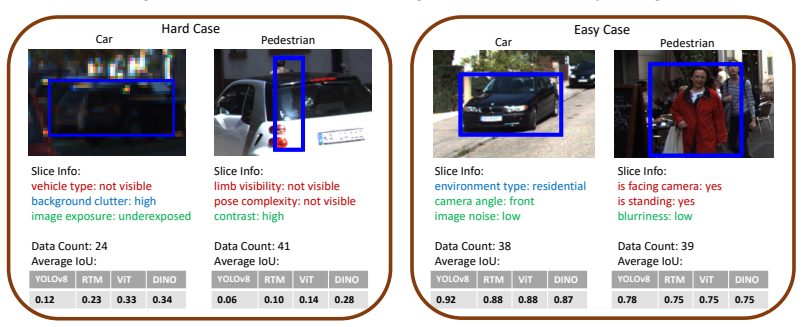
- Slices become directly interpretable, so an engineer can see at a glance that a classifier fails on white teddy bears not holding an item, or that a detector fails on underexposed high-clutter scenes.
- Error slices can be predicted beyond the validation set, which matters when the labeled pool is small: the paper reports performance drops up to 64.6% on predicted slices.
- The framework transfers across tasks—classification, pose estimation, and object detection—and the discovered slices generalize across model architectures, with 86% overlap among top detection slices.
- Targeted data querying from the worst slices repairs models better than random augmentation: gains of 7.6%, 2.1%, and 4.9% on the three tasks, with random selection yielding 4.7%, 0.9%, and 0.6%.
Reading between the lines
- If tag quality is the bottleneck, the repair gains may partly measure the multimodal model's ability to describe images rather than the slicing algorithm itself; an ablation varying the attribute vocabulary size and tagging source would separate the two.
- The monotonicity-based pruned enumeration is not limited to error slices: it could apply to any subgroup analysis over categorical metadata, such as intersectional fairness audits over demographic tags.
- The paper's 'a few misclassified tags do not change slice averages' claim is untested for systematic tagging bias; injecting correlated tag noise into a known subgroup would show whether discovered slices remain stable.
- The high cross-model slice overlap in detection suggests the framework could pick one representative model for debugging a whole family of detectors, reserving per-model analysis for tasks like classification where overlap is only 31%.
Editorial analysis
A structured set of objections, weighed in public.
Referee Report
Summary. The paper presents HiBug2, an automated framework for error slice discovery and model repair. It generates task-specific visual attributes and tags using GPT-4V through a structured prompting process, enumerates data slices via a breadth-first tree search with pruning and intersection, and proposes two methods (tag substitution and instruction-based) to predict error slices beyond the validation set. The authors evaluate HiBug2 on image classification, pose estimation, and object detection, reporting improved attribute quality, a 510x speedup over naive enumeration, performance degradation on predicted unseen slices, and gains in model repair relative to HiBug and random selection.
Significance. If substantiated, the HiBug2 framework would be a valuable contribution to the model-debugging literature, as it directly addresses the combinatorial explosion in slice search and extends the scope of slice discovery to non-validation data. The paper's strengths include its clearly described enumeration algorithms (with pseudo-code in Appendix A.7), the breadth of tasks evaluated, and the concrete speedup claims. However, the current evidence is not fully convincing because the unseen-slice experiment is not auditable, the correctness of the GPT-4V-based tags is not validated against systematic errors, and the quantitative comparisons lack uncertainty estimates. These issues are fixable within the scope of a revision by adding a clear hold-out protocol, tag-quality checks, and error bars.
major comments (5)
- [Section 5.4, Table 1] The claim that HiBug2 predicts error slices beyond the validation set is not auditable because the paper does not specify which images are used to compute the performance degradations in Table 1. If the validation set is used, any predicted slice with at least M=10 images would already have been enumerated by Algorithm 3 and is therefore not 'unseen'; if an external pool is used, the per-slice sample sizes and the selection protocol are missing, and the pool may overlap with the repair data of Section 5.5. Please provide a clear description of the data source, per-slice counts, and a disjoint hold-out set.
- [Section 3.2.2, Appendix A.1.1, Section 6] The entire pipeline relies on GPT-4V to assign tags to all images, but the paper only verifies that tags conform to predefined formats (Appendix A.1.1), not that they are semantically correct. The defense in Section 6 that 'a few misclassified data points do not alter the average performance of a slice' addresses random tagging noise but not systematic bias (e.g., consistent mislabeling of a visual subgroup). A systematic bias could create spurious slices or conceal real ones, directly affecting the discovered error slices and the repair gains in Table 2. Please report a quantitative tag-accuracy evaluation on a labeled subset, or otherwise show that tagging errors for any subgroup are bounded.
- [Section 5.5, Table 2] The model repair results are averaged over five runs, but no standard deviations, confidence intervals, or significance tests are reported. Without this information, the differences between HiBug2, HiBug, and random selection (e.g., +7.6% vs +6.3% vs +4.7% in image classification) could be within run-to-run variability. Please add error bars and a significance test or a clear statement of variance.
- [Section 4.1.4, Section 5.3] The key hyper-parameters C (error threshold) and M (minimum slice count) are set to 0.2 and 10 without sensitivity analysis. These values directly determine the number and composition of error slices, and thus affect all downstream results. An ablation varying C and M would demonstrate that the reported findings (e.g., the 510x speedup, the slice overlap statistics, and the repair improvements) are not sensitive to these arbitrary choices.
- [Appendix A.6, Table 6] The user study has only four participants, all described as machine-learning and computer-vision practitioners, and it reports unanimous preference for HiBug2 on all four criteria. With n=4, this result has very low statistical power, and the paper does not state whether the participants were independent of the authors. This evidence is only suggestive; please expand the study or qualify the claims accordingly.
minor comments (5)
- [Section 1 vs Section 5.3] The introduction mentions 'approximately 500 distinct error slices for CLIP', while Section 5.3 reports 499; please make these numbers consistent.
- [Section 5.2, Figure 4] The caption of Figure 4 does not report the dataset size, number of attributes, or tag set sizes used in the timing experiment; please add these details so the speedup comparison is reproducible.
- [Section 5.3] The sentence 'we consider slices with three attributes' is a design choice; please justify this choice or state that higher-depth slices were not used for the analysis.
- [Section 5.4] The number of predicted slices (100, 20, 40) is given, but not the number of attributes per slice; please specify the composition of the predicted slices.
- [Appendix A.5] The manual check for no overlap between the web-collected data and the validation set is not described; please explain the procedure or state that it was verified with code.
Circularity Check
No significant circularity: HiBug2's predictions and repair gains are evaluated empirically rather than derived from fitted inputs.
full rationale
HiBug2 is an empirical pipeline rather than a closed-form derivation, and I find no step in which a claimed prediction reduces by construction to its input. The predicted error slices in Section 5.4 are produced by CLIP-based tag substitution or by GPT prompting, and the reported performance degradation is then measured on those candidate slices; GPT and CLIP do not have access to the target model's actual per-slice performance, so the result is not a fitted parameter relabeled as a prediction. The enumeration speedup in Section 5.2 follows from a valid monotonicity property of slice data counts and from pruning/intersection rules, not from the target conclusion. The model repair experiment in Section 5.5 explicitly uses a hold-out test set distinct from the validation set used for slice identification, so the improvement is not measured on the same data that selected the slices. The paper does cite the authors' own HiBug work as motivation and as a baseline, but that self-citation is not load-bearing: HiBug is directly compared in the experiments, and the central claims stand independently of the cited assertion about entangled embedding spaces. The main caveats are experimental-auditability concerns rather than circularity: Table 1 does not specify which image pool is used to compute the reported degradation, and Section 6 acknowledges GPT tagging errors without measuring systematic tag bias. These affect external validity, not whether the derivation reduces to its own inputs.
Assumptions & free parameters
free parameters (4)
- Error slice threshold C =
0.2
- Minimum slice data count M =
10
- Maximum slice depth D =
3 (main experiments), 4 (efficiency test)
- Number of predicted slices =
100 (classification), 20 (pose), 40 (detection)
assumptions (4)
- domain assumption GPT-4V tag assignments are mostly accurate and errors are randomly distributed
- domain assumption The generated attribute set captures error-relevant visual factors
- domain assumption CLIP text embedding distance is a valid proxy for visual tag similarity in tag substitution
- standard math Monotonicity of slice data counts
Cite this review
Pith. "Pith review of HiBug2: Efficient and Interpretable Error Slice Discovery for Comprehensive Model Debugging." pith.science (2026). https://pith.science/paper/JDB3JKE4
@misc{pith2026250116751,
  author       = {Pith},
  title        = {Pith review of: HiBug2: Efficient and Interpretable Error Slice Discovery for Comprehensive Model Debugging},
  year         = {2026},
  howpublished = {\url{https://pith.science/paper/JDB3JKE4}},
  note         = {Machine review of arXiv:2501.16751}
}
read the original abstract
Despite the significant success of deep learning models in computer vision, they often exhibit systematic failures on specific data subsets, known as error slices. Identifying and mitigating these error slices is crucial to enhancing model robustness and reliability in real-world scenarios. In this paper, we introduce HiBug2, an automated framework for error slice discovery and model repair. HiBug2 first generates task-specific visual attributes to highlight instances prone to errors through an interpretable and structured process. It then employs an efficient slice enumeration algorithm to systematically identify error slices, overcoming the combinatorial challenges that arise during slice exploration. Additionally, HiBug2 extends its capabilities by predicting error slices beyond the validation set, addressing a key limitation of prior approaches. Extensive experiments across multiple domains, including image classification, pose estimation, and object detection - show that HiBug2 not only improves the coherence and precision of identified error slices but also significantly enhances the model repair capabilities.
Figures


Figures from the paper (8 more)




Reference graph
Works this paper leans on
-
[1]
Qwen-vl: A versatile vision-language model for understanding, localization, text reading, and beyond
Jinze Bai, Shuai Bai, Shusheng Yang, Shijie Wang, Sinan Tan, Peng Wang, Junyang Lin, Chang Zhou, and Jingren Zhou. Qwen-vl: A versatile vision-language model for understanding, localization, text reading, and beyond. arXiv preprint arXiv:2308.12966, 2023
arXiv 2023
-
[2]
Richard Bellman. On a routing problem. Quarterly of applied mathematics, 16 0 (1): 0 87--90, 1958
work page 1958
-
[3]
Corner cases for visual perception in automated driving: some guidance on detection approaches
Jasmin Breitenstein, Jan-Aike Term \"o hlen, Daniel Lipinski, and Tim Fingscheidt. Corner cases for visual perception in automated driving: some guidance on detection approaches. arXiv preprint arXiv:2102.05897, 2021
arXiv 2021
-
[4]
Gender shades: Intersectional accuracy disparities in commercial gender classification
Joy Buolamwini and Timnit Gebru. Gender shades: Intersectional accuracy disparities in commercial gender classification. In Conference on fairness, accountability and transparency, pp.\ 77--91. PMLR, 2018
work page 2018
-
[5]
Ovarnet: Towards open-vocabulary object attribute recognition
Keyan Chen, Xiaolong Jiang, Yao Hu, Xu Tang, Yan Gao, Jianqi Chen, and Weidi Xie. Ovarnet: Towards open-vocabulary object attribute recognition. In Proceedings of the IEEE/CVF conference on computer vision and pattern recognition, pp.\ 23518--23527, 2023
work page 2023
-
[6]
Hibug: on human-interpretable model debug
Muxi Chen, Yu Li, and Qiang Xu. Hibug: on human-interpretable model debug. Advances in Neural Information Processing Systems, 36, 2024
work page 2024
-
[7]
Imagenet: A large-scale hierarchical image database
Jia Deng, Wei Dong, Richard Socher, Li-Jia Li, Kai Li, and Li Fei-Fei. Imagenet: A large-scale hierarchical image database. In 2009 IEEE conference on computer vision and pattern recognition, pp.\ 248--255. Ieee, 2009
2009
-
[8]
The spotlight: A general method for discovering systematic errors in deep learning models
Greg d'Eon, Jason d'Eon, James R Wright, and Kevin Leyton-Brown. The spotlight: A general method for discovering systematic errors in deep learning models. In Proceedings of the 2022 ACM Conference on Fairness, Accountability, and Transparency, pp.\ 1962--1981, 2022
work page 2022
Show all 38 references
-
[9]
Domino: Discovering systematic errors with cross-modal embeddings
Sabri Eyuboglu, Maya Varma, Khaled Saab, Jean-Benoit Delbrouck, Christopher Lee-Messer, Jared Dunnmon, James Zou, and Christopher R \'e . Domino: Discovering systematic errors with cross-modal embeddings. arXiv preprint arXiv:2203.14960, 2022
2022 arXiv
-
[10]
Deep learning-based image recognition for autonomous driving
Hironobu Fujiyoshi, Tsubasa Hirakawa, and Takayoshi Yamashita. Deep learning-based image recognition for autonomous driving. IATSS research, 43 0 (4): 0 244--252, 2019
2019
-
[11]
Adaptive testing of computer vision models
Irena Gao, Gabriel Ilharco, Scott Lundberg, and Marco Tulio Ribeiro. Adaptive testing of computer vision models. In Proceedings of the IEEE/CVF International Conference on Computer Vision, pp.\ 4003--4014, 2023
2023
-
[12]
Are we ready for autonomous driving? the kitti vision benchmark suite
Andreas Geiger, Philip Lenz, and Raquel Urtasun. Are we ready for autonomous driving? the kitti vision benchmark suite. In 2012 IEEE conference on computer vision and pattern recognition, pp.\ 3354--3361. IEEE, 2012
2012
-
[13]
Machine learning in medical imaging
Maryellen L Giger. Machine learning in medical imaging. Journal of the American College of Radiology, 15 0 (3): 0 512--520, 2018
2018
-
[14]
Deep residual learning for image recognition
Kaiming He, Xiangyu Zhang, Shaoqing Ren, and Jian Sun. Deep residual learning for image recognition. In Proceedings of the IEEE conference on computer vision and pattern recognition, pp.\ 770--778, 2016
2016
-
[15]
Distilling model failures as directions in latent space
Saachi Jain, Hannah Lawrence, Ankur Moitra, and Aleksander Madry. Distilling model failures as directions in latent space. arXiv preprint arXiv:2206.14754, 2022
2022 arXiv
-
[16]
Rtmpose: Real-time multi-person pose estimation based on mmpose
Tao Jiang, Peng Lu, Li Zhang, Ningsheng Ma, Rui Han, Chengqi Lyu, Yining Li, and Kai Chen. Rtmpose: Real-time multi-person pose estimation based on mmpose. arXiv preprint arXiv:2303.07399, 2023
2023 arXiv
-
[17]
Where does my model underperform? a human evaluation of slice discovery algorithms
Nari Johnson, \'A ngel Alexander Cabrera, Gregory Plumb, and Ameet Talwalkar. Where does my model underperform? a human evaluation of slice discovery algorithms. In Proceedings of the AAAI Conference on Human Computation and Crowdsourcing, volume 11, pp.\ 65--76, 2023
2023
-
[18]
Blip: Bootstrapping language-image pre-training for unified vision-language understanding and generation
Junnan Li, Dongxu Li, Caiming Xiong, and Steven Hoi. Blip: Bootstrapping language-image pre-training for unified vision-language understanding and generation. In International conference on machine learning, pp.\ 12888--12900. PMLR, 2022 a
2022
-
[19]
Exploring plain vision transformer backbones for object detection
Yanghao Li, Hanzi Mao, Ross Girshick, and Kaiming He. Exploring plain vision transformer backbones for object detection. In European conference on computer vision, pp.\ 280--296. Springer, 2022 b
2022
-
[20]
Aide: An automatic data engine for object detection in autonomous driving
Mingfu Liang, Jong-Chyi Su, Samuel Schulter, Sparsh Garg, Shiyu Zhao, Ying Wu, and Manmohan Chandraker. Aide: An automatic data engine for object detection in autonomous driving. In Proceedings of the IEEE/CVF Conference on Computer Vision and Pattern Recognition, pp.\ 14695--...
2024
-
[21]
Visual instruction tuning
Haotian Liu, Chunyuan Li, Qingyang Wu, and Yong Jae Lee. Visual instruction tuning. Advances in neural information processing systems, 36, 2024
2024
-
[22]
Rtmdet: An empirical study of designing real-time object detectors
Chengqi Lyu, Wenwei Zhang, Haian Huang, Yue Zhou, Yudong Wang, Yanyi Liu, Shilong Zhang, and Kai Chen. Rtmdet: An empirical study of designing real-time object detectors. arXiv preprint arXiv:2212.07784, 2022
2022 arXiv
-
[23]
Identification of systematic errors of image classifiers on rare subgroups
Jan Hendrik Metzen, Robin Hutmacher, N Grace Hua, Valentyn Boreiko, and Dan Zhang. Identification of systematic errors of image classifiers on rare subgroups. In Proceedings of the IEEE/CVF International Conference on Computer Vision, pp.\ 5064--5073, 2023
2023
- [24]
-
[25]
Learning transferable visual models from natural language supervision
Alec Radford, Jong Wook Kim, Chris Hallacy, Aditya Ramesh, Gabriel Goh, Sandhini Agarwal, Girish Sastry, Amanda Askell, Pamela Mishkin, Jack Clark, et al. Learning transferable visual models from natural language supervision. In International conference on machine learning, pp...
2021
-
[26]
Sliceline: Fast, linear-algebra-based slice finding for ml model debugging
Svetlana Sagadeeva and Matthias Boehm. Sliceline: Fast, linear-algebra-based slice finding for ml model debugging. In Proceedings of the 2021 international conference on management of data, pp.\ 2290--2299, 2021
2021
-
[27]
Grad-cam: Visual explanations from deep networks via gradient-based localization
Ramprasaath R Selvaraju, Michael Cogswell, Abhishek Das, Ramakrishna Vedantam, Devi Parikh, and Dhruv Batra. Grad-cam: Visual explanations from deep networks via gradient-based localization. In Proceedings of the IEEE international conference on computer vision, pp.\ 618--626, 2017
2017
-
[28]
Vlslice: Interactive vision-and-language slice discovery
Eric Slyman, Minsuk Kahng, and Stefan Lee. Vlslice: Interactive vision-and-language slice discovery. In Proceedings of the IEEE/CVF International Conference on Computer Vision, pp.\ 15291--15301, 2023
2023
-
[29]
Yolov8: A novel object detection algorithm with enhanced performance and robustness
Rejin Varghese and M Sambath. Yolov8: A novel object detection algorithm with enhanced performance and robustness. In 2024 International Conference on Advances in Data Engineering and Intelligent Computing Systems (ADICS), pp.\ 1--6. IEEE, 2024
2024
-
[30]
Learning concise and descriptive attributes for visual recognition
An Yan, Yu Wang, Yiwu Zhong, Chengyu Dong, Zexue He, Yujie Lu, William Yang Wang, Jingbo Shang, and Julian McAuley. Learning concise and descriptive attributes for visual recognition. In Proceedings of the IEEE/CVF International Conference on Computer Vision, pp.\ 3090--3100, 2023
2023
-
[31]
Language in a bottle: Language model guided concept bottlenecks for interpretable image classification
Yue Yang, Artemis Panagopoulou, Shenghao Zhou, Daniel Jin, Chris Callison-Burch, and Mark Yatskar. Language in a bottle: Language model guided concept bottlenecks for interpretable image classification. In Proceedings of the IEEE/CVF Conference on Computer Vision and Pattern R...
2023
-
[32]
Facts: First amplify correlations and then slice to discover bias
Sriram Yenamandra, Pratik Ramesh, Viraj Prabhu, and Judy Hoffman. Facts: First amplify correlations and then slice to discover bias. In Proceedings of the IEEE/CVF International Conference on Computer Vision, pp.\ 4794--4804, 2023
2023
-
[33]
Recognize anything: A strong image tagging model
Youcai Zhang, Xinyu Huang, Jinyu Ma, Zhaoyang Li, Zhaochuan Luo, Yanchun Xie, Yuzhuo Qin, Tong Luo, Yaqian Li, Shilong Liu, et al. Recognize anything: A strong image tagging model. In Proceedings of the IEEE/CVF Conference on Computer Vision and Pattern Recognition, pp.\ 1724-...
2024
-
[34]
Detrs with collaborative hybrid assignments training
Zhuofan Zong, Guanglu Song, and Yu Liu. Detrs with collaborative hybrid assignments training. In Proceedings of the IEEE/CVF international conference on computer vision, pp.\ 6748--6758, 2023
2023
-
[35]
write newline
" write newline "" before.all 'output.state := FUNCTION n.dashify 't := "" t empty not t #1 #1 substring "-" = t #1 #2 substring "--" = not "--" * t #2 global.max substring 't := t #1 #1 substring "-" = "-" * t #2 global.max substring 't := while if t #1 #1 substring * t #2 gl...
-
[36]
@esa (Ref
\@ifxundefined[1] #1\@undefined \@firstoftwo \@secondoftwo \@ifnum[1] #1 \@firstoftwo \@secondoftwo \@ifx[1] #1 \@firstoftwo \@secondoftwo [2] @ #1 \@temptokena #2 #1 @ \@temptokena \@ifclassloaded agu2001 natbib The agu2001 class already includes natbib coding, so you should ...
-
[37]
\@lbibitem[] @bibitem@first@sw\@secondoftwo \@lbibitem[#1]#2 \@extra@b@citeb \@ifundefined br@#2\@extra@b@citeb \@namedef br@#2 \@nameuse br@#2\@extra@b@citeb \@ifundefined b@#2\@extra@b@citeb @num @parse #2 @tmp #1 NAT@b@open@#2 NAT@b@shut@#2 \@ifnum @merge>\@ne @bibitem@firs...
-
[38]
main object
@open @close @open @close and [1] URL: #1 \@ifundefined chapter * \@mkboth \@ifxundefined @sectionbib * \@mkboth * \@mkboth\@gobbletwo \@ifclassloaded amsart * \@ifclassloaded amsbook * \@ifxundefined @heading @heading NAT@ctr thebibliography [1] @ \@biblabel @NAT@ctr \@bibset...
2014
Reviewed August 10, 2026 · model on record in the stance chip above.
Discussion (0). Continue with ORCID to comment.