REVIEW 2 major objections 6 minor 74 references
Critical fluctuations at a many-body exceptional point
T0 review · 2 major / 6 minor · reviewed 2026-08-14 · deepseek-v4-flash
Pith's one-line read At a critical exceptional point, phase noise diverges up to four spatial dimensions
desk verdict A credible linearized mechanism for giant phase fluctuations at a critical exceptional point, with a one-loop RG claim that needs more support. read the letter →
The pith
A machine-rendered reading of the paper's core claim, the machinery that carries it, and where it could break.
The reading
What carries the argument
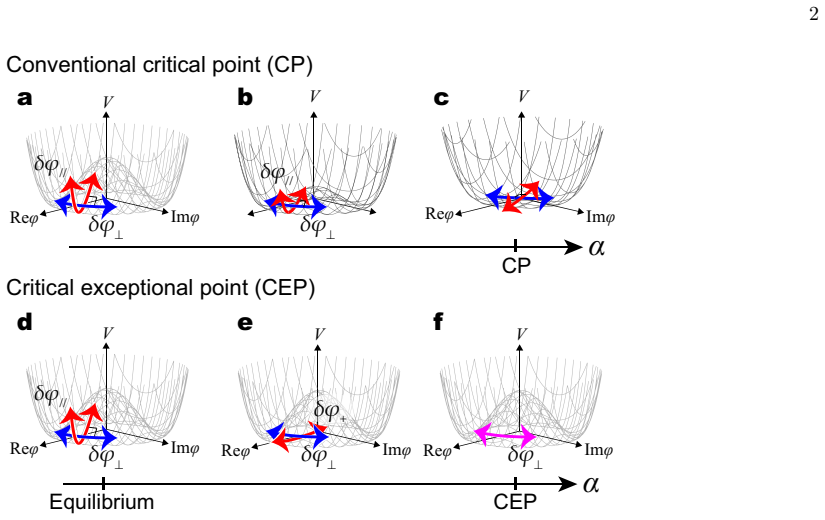
The load-bearing object is the $2\times2$ non-Hermitian linear kernel $W(\nabla)$ of the KPZ-like phase equation obtained after integrating out amplitude fluctuations, together with the triangular basis that separates the Goldstone mode from its perpendicular partner. At the CEP one has $s_l=s_g=\kappa$, so the uniform part of $W$ is at an exceptional point; the off-diagonal piece $\zeta=s_l+s_g=2\kappa$ converts longitudinal noise into the Goldstone mode, producing the $A/k^4$ correlator. The same coalescence produces a sound mode $\pm v|k|$ from the square-root branch of the exceptional-point dispersion, making the diffusion constant $D$ dangerously irrelevant. The RG relevance of the effective coupling $\Gamma\propto D^{-5}$ is what pushes the upper critical dimension to $d_c=8$.
What would settle it
Numerically integrate the full stochastic Gross-Pitaevskii equation at the CEP in $d=1,2,3$ and extract the phase-phase correlator: the central claim predicts $\sim A/k^4$ behavior that diverges for $d\le4$ and a scaling exponent $\chi=\chi_G-\epsilon/10$, whereas a conventional KPZ or diffusive result would give a $k^{-2}$ correlator and different scaling.
Extended reading notes
Core claim
The central claim is that at a many-body exceptional point—a non-Hermitian spectral degeneracy in the steady state of a noisy driven-dissipative condensate—the coalescence of the Goldstone mode with the longitudinal mode changes the nature of criticality entirely. Instead of a softened massive mode, the gap closes because the two eigenmodes become collinear; the non-Hermitian off-diagonal coupling $\zeta = s_l+s_g$ then feeds longitudinal fluctuations directly into the Goldstone mode. The resulting equal-time phase correlator behaves as $\langle\delta\theta_\alpha\delta\theta_\beta\rangle\sim A/k^4$ with $A=\kappa^2\sigma_{\|\|}/Dv^2$, diverging at dimensions $d\le4$, and the dispersion at the CEP develops sound-like branches $\omega_\pm(k)=\pm v|k|-iDk^2$ despite the dissipative character. The dynamic RG then shows that the combined nonlinearities organize into an effective coupling $\Gamma = t_\|\sigma_{\|\|}/(D^5)(t_\| v^2+4\kappa^2\lambda^\|_{\perp\perp})$ that is relevant up to $d_c=8$; an $\epsilon=8-d$ expansion around that upper critical dimension yields a strong-coupling fixed point with $\chi=\chi_G-\epsilon/10$ and $z=z_G=1$. This defines a universality class absent from the standard classification because the enhanced relevance comes from the dangerously irrelevant diffusion constant $D$ flowing to zero.
Load-bearing premise
The derivation assumes that amplitude fluctuations around the steady state are small and overdamped, so they can be eliminated at linear order; if that elimination fails near the CEP, the phase-only description and its $A/k^4$ correlator and $d_c=8$ fixed point no longer follow.
Editorial extensions
If this is right
- At the CEP, the absence of long-range order extends to $d=4$, one dimension higher than the conventional $d\le2$ bound for continuous symmetry breaking.
- Nonlinear many-body correlations remain relevant up to $d=8$, so the CEP is a much more strongly correlated critical point than an ordinary Ising or XY critical point.
- The critical region near the CEP scales as $\gamma_c\sim \sqrt{\sigma_{\|\|}}$, making the anomalous fluctuations easier to reach experimentally than the linear scaling of conventional critical points.
- A sound mode appears despite dissipation, changing the dynamical scaling from diffusive ($z=2$) to ballistic ($z=1$).
- The phase-phase correlator is measurable by interferometry in exciton-polariton condensates, so the predicted $A/k^4$ scaling is an experimentally accessible signature.
Reading between the lines
- The same mode-coalescence mechanism should operate in classical non-reciprocal systems such as flocking and synchronization models with non-reciprocal interactions, where the analog of the CEP has already been located; repeating the fluctuation analysis there would predict the same $A/k^4$ phase correlator at the time-crystal transition.
- Because the $1/k^4$ correlator mirrors the random-field disorder problem, the CEP state in $d=2$ may break into domains or show enhanced vortex proliferation; counting defects in direct numerical simulations of the stochastic Gross-Pitaevskii equation would test this dynamical analog.
- The $\epsilon=8-d$ expansion is not controlled at physical dimensions $d=1,2,3$; if the strong-coupling fixed point survives there, direct simulation should show scaling with $\chi$ below the Gaussian value, whereas if it does not, only the linearized $A/k^4$ regime will be observable.
- Relaxing the overdamped-amplitude assumption is a natural extension: underdamped amplitude dynamics could modify the phase-only reduction, changing the effective coupling and possibly the value of $d_c$.
Signed reviews
Editorial analysis
A structured set of objections, weighed in public.
Referee Report
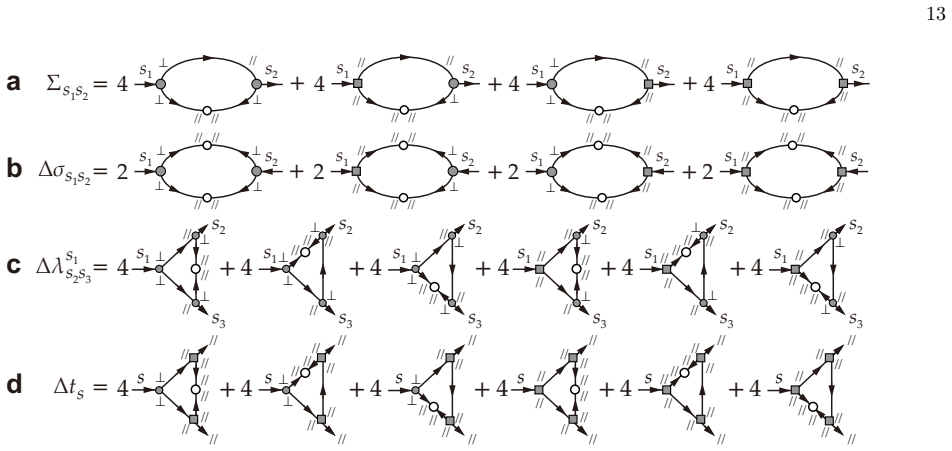
Summary. This manuscript studies the steady state of a two-component driven-dissipative Gross-Pitaevskii model and argues that at a critical exceptional point (CEP), where the two collective modes coalesce into the Goldstone mode, phase fluctuations acquire a 1/k^4 correlation function that diverges for d≤4. By deriving a coupled KPZ-like equation for the phases (Appendix B) and performing a one-loop dynamic RG (Appendix C), the authors obtain an effective coupling Γ that is relevant below an upper critical dimension d_c=8, and find a strong-coupling fixed point at d=8−ε with exponents χ≈χ_G−ε/10 and z=1, which they interpret as a new universality class outside the Hohenberg–Halperin classification. The paper also estimates the size of the critical region and identifies measurable signatures in polariton condensates.
Significance. If the phase-only reduction and the one-loop fixed point survive scrutiny, this would constitute a genuinely new mechanism of criticality: the gap closure at the CEP is caused by non-Hermitian mode coalescence rather than by softening of a massive mode, and the predicted d≤4 divergence of phase fluctuations and the high upper critical dimension d_c=8 are striking. The manuscript has notable strengths: it is largely self-contained, with explicit formulas for all coefficients in the KPZ-like equation in terms of the original GP parameters (Appendix B, Eqs. B7–B16), a transparent diagrammatic derivation of the one-loop RG (Appendix C), and no fitted parameters in the RG analysis. The predictions are falsifiable, for example through the phase correlator (Eq. 15) measured by interferometry. The principal risk is the adiabatic elimination of amplitude fluctuations, which underpins all the quantitative results.
major comments (2)
- [Appendix B, Eqs. (B3)–(B6); Sec. V] The phase-only equation (3) is derived by neglecting the time derivatives ∂t δ|Φ_α| in Eqs. (B3)–(B5), i.e., by adiabatically eliminating the amplitude fluctuations at linear order. The manuscript never checks that this elimination is controlled at the CEP, where the phase sector itself becomes gapless (Eq. 5). The correct test is to linearize the full 4×4 system for (δ|Φ_l|, δ|Φ_g|, δθ_l, δθ_g) around the steady state at the CEP parameters (A9)–(A11) and confirm that the two amplitude eigenvalues have negative real parts bounded away from zero and that the two gapless modes are predominantly phase-like. If either condition fails, the low-energy theory is not the coupled KPZ-like equation (3), and the 1/k^4 correlator (Eq. 8) and the d_c=8 fixed point (Eqs. 19–21) do not follow from the model. This is a load-bearing gap because the main quantitative claims are all computed from the phase-only equation. Adding this check, or an explicit numerical verification for a representative parameter set, is necessary to support the central claim.
- [Sec. IV, Eqs. (20)–(21); Sec. V] The existence of a new universality class is established only at one-loop order in an ε-expansion around d=8, with the fixed point at Γ* = O(ε). The abstract and Section IV present this as a property of the CEP at all d<8, but Section V correctly notes that the ε-expansion cannot be directly applied to d=1,2,3. As written, the distinction between the controlled perturbative result near d=8 and the extrapolated claim to physical dimensions is not explicit in the abstract, which states that the analysis shows a strong-coupling fixed point at dimensions as high as d<8. The authors should either label the result as a one-loop ε-expansion prediction with the extrapolation identified as a conjecture, or provide additional support (for example, the numerical simulation mentioned as in progress). This is directly load-bearing for the claim of a new universality class.
minor comments (6)
- [Throughout] There are several typos that should be corrected: 'Strinkingly' in the Introduction, 'occurance' in Section V, 'absense' in Appendix A, 'implicity' and 'funtions' in Section V, 'irrelavant' in Section IV, 'valuables' in Appendix C, and 'greaterorsimilar' in Eq. (23).
- [Sec. III, Eq. (8)] The derivation of the 1/k^4 correlator retains only the σ‖‖ noise component. For completeness, the authors should state explicitly that the σ⊥⊥ and σ⊥‖ components are subleading because they yield correlators that scale at most as 1/k^2, so that the retention of only σ‖‖ is justified.
- [Sec. IV, Eq. (14)] The notation 'χl = χg(≡χ)' would be clearer if the text stated that a single roughness exponent χ is imposed on both phase components during the RG rescaling, rather than component-dependent exponents; the scaling form (15) then reduces to the 2χ used in the flow equations.
- [Appendix B, Eqs. (B8) and (B16)] The superscript 0 on |Φ_g| is sometimes omitted (e.g., in Eq. B8 and in parts of B16), making the notation inconsistent with the rest of the paper; please make it uniform.
- [References] Reference [7] is garbled: 'S. ¨Ozedemir' should be 'S. Özdemir'.
- [Abstract/PACS] The PACS line is empty; either provide PACS numbers or remove the line.
Circularity Check
No significant circularity: the CEP fluctuation spectrum and d_c=8 RG fixed point are derived from the stated stochastic GP model with explicit coefficients.
full rationale
The paper's central results are self-contained calculations from the stochastic driven-dissipative Gross-Pitaevskii equation (Eq. 1). The CEP conditions κ=g and δ~=0 are rederived in Appendix A (Eqs. A8-A11), so the existence of the CEP does not rest on the self-citation [29]; that reference is used only for the phase-boundary endpoint interpretation and experimental context, which is not load-bearing for Eq. (8) or the RG flow. The phase-only reduction in Appendix B is an explicit, stated approximation (overdamped, large steady-state amplitude), and while it is a legitimate correctness concern near the CEP, it is not circular: it does not assume the A/k^4 correlator or the d_c=8 fixed point. All coefficient functions, noise levels, and couplings are expressed analytically in terms of the original GP parameters; no parameter is fitted to the predicted correlator or exponents. The fixed point at d_c=8 follows from the one-loop flow equations (16)-(20) with explicit diagrammatic self-energies, not from postulating the result. I therefore find no step in which a prediction reduces by construction to an input.
Assumptions & free parameters
assumptions (6)
- domain assumption The noisy driven-dissipative Gross-Pitaevskii equation with white noise (Eq. 1) correctly describes the long-wavelength steady-state critical properties of the underlying Keldysh field theory.
- domain assumption Amplitude fluctuations around the steady state are small and overdamped, so they can be integrated out at linear order, neglecting O((delta|Phi|)^2) terms.
- domain assumption The retained nonlinear terms in the phase equation are the most relevant ones; higher-order massive terms such as O((delta theta_l - delta theta_g)^3) are dropped.
- domain assumption The stability conditions gamma >= 0 and v^2 >= 0 hold, which require sufficiently large nonlinear saturation v_g and gain-component diffusion D_g.
- ad hoc to paper The strong-coupling fixed point is close to the Gaussian fixed point, justifying chi_l = chi_g and a one-loop epsilon expansion near d = 8.
- domain assumption The effective coupling Gamma(l=0) is positive so that the flow reaches the strong-coupling fixed point; for Gamma < 0 the one-loop flow runs to -infinity.
Cite this review
Pith. "Pith review of Critical fluctuations at a many-body exceptional point." pith.science (2026). https://pith.science/paper/JEPQIBB6
@misc{pith2026190803243,
  author       = {Pith},
  title        = {Pith review of: Critical fluctuations at a many-body exceptional point},
  year         = {2026},
  howpublished = {\url{https://pith.science/paper/JEPQIBB6}},
  note         = {Machine review of arXiv:1908.03243}
}
abstract
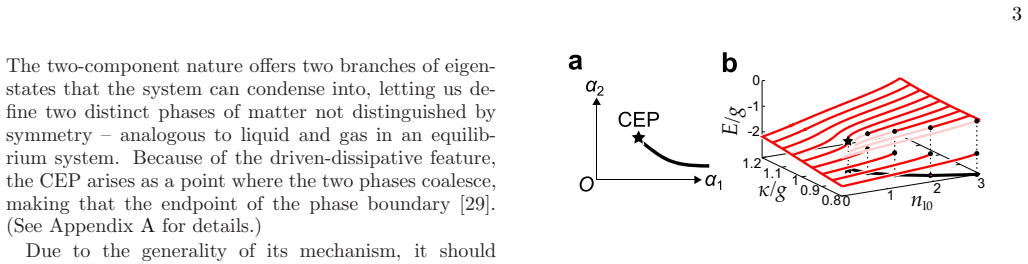
Critical phenomena arise ubiquitously in various context of physics, from condensed matter, high energy physics, cosmology, to biological systems, and consist of slow and long-distance fluctuations near a phase transition or critical point. Usually, these phenomena are associated with the softening of a massive mode. Here we show that a novel, non-Hermitian-induced mechanism of critical phenomena that do not fall into this class can arise in the steady state of generic driven-dissipative many-body systems with coupled binary order parameters such as exciton-polariton condensates and driven-dissipative Bose-Einstein condensates in a double-well potential. The criticality of this ``critical exceptional point'' is attributed to the coalescence of the collective eigenmodes that convert all the thermal-and-dissipative-noise activated fluctuations to the Goldstone mode, leading to anomalously giant phase fluctuations that diverge at spatial dimensions $d\le 4$. Our dynamic renormalization group analysis shows that this gives rise to a strong-coupling fixed point at dimensions as high as $d<8$ associated with a new universality class beyond the classification by Hohenberg and Halperin, indicating how anomalously strong the many-body corrections are at this point. We find that this anomalous enhancement of many-body correlation is due to the appearance of a sound mode at the critical exceptional point despite the system's dissipative character.
Figures
Reference graph
Works this paper leans on
-
[1]
in terms of the noise- activated amplitude δ|Φ α (r, t)| and phase fluctuations δθα (r, t) by rewriting the macroscopic wavefunction as the deviation from the steady state, Ψ α (r, t) = [Φ 0 α + δΦ α (r, t)]e−iEt = (|Φ 0 α | + δ|Φ α (r, t)|)ei(θ 0 α +δθ α (r,t ))e−iEt, where Φ 0 α = |Φ 0 α |eiθ 0 α . By integrating out δ|Φ α (r, t)| up to linear order and ...
-
[2]
at the CEP: t‖ = √ 2Ugκ vg , (B23) λ‖ ⊥⊥ = − DgUg + (Kl − Kg)vg 2 √ 2vg . (B24) 12 Note how the sign of the KPZ-like coupling λ‖ ⊥⊥ depends on the details of the parameters in the original GP equation . This makes it possible for the effective coupling to take either sign, Γ = 16 √ 2(Kl − Kg)Ugvg [ DgUg + (Kl − Kg)vg ] (U 2 g + v2 g)κ3 (KgUg + Dgvg)5 (B25)...
-
[3]
C. M. Bender and S. Boettcher, Real spectra in non- Hermitian Hamiltonians having PT Symmetry. Phys. Rev. Lett. 80, 5243 (1998)
work page 1998
-
[4]
W. D. Heiss, Phases of wave functions and level repulsion. Eur. Phys. J. D. 7, 1 (1999)
work page 1999
-
[5]
In this case, we find both eigenmodes ω±(k) to be gapless, which interestingly are sound modes, ω±(k) = ±v|k| − iDk2, (5) showing that both components play role and thus modi- fies the scaling properties. A crucial observation is that, this gap closure is associ- ated with the coalescence of the collective modes, which is crucially different from just being ...
-
[6]
Z. Lin, H. Ramezani, T. Eichelkraut, T. Kottos, H. Cao, and D. N. Christodoulides, Unidirectional invisibility in - duced by PT-symmetric periodic structures. Phys. Rev. Lett. 106, 213901 (2011)
work page 2011
-
[7]
W. Chan, S. ¨Ozedemir, G. Zhao, J. Wiersig, and L. Yang, Exceptional points enhance sensing in an optical micro- cavity. Nature 548, 192 (2017)
work page 2017
-
[8]
is expanded in terms of the distance from the CEP γ as, ⟨ δθα (k)δθβ (−k) ⟩ ∼ A k4 [ 1 + γ Dk2 + O ( ( γ Dk2 ) 2)] .(12) Therefore, the correlation length ξCEP (which sets the wavelength that justifies the above expansion) is es- timated as ξCEP ∼ √ D/γ, while the effective ther- mal de Broglie length (that makes A/k4 > O (1) at |k| <∼ (λCEP T )−1) is estim...
Show all 74 references
-
[9]
also flows to zero as approach- ing the fixed point. At spatial dimensions close to the upper critical dimen- sion, d = dc − ǫ = 8 − ǫ, we find a strong-coupling fixed point at (˜γ∗, Γ ∗) ≈ (0, ǫ(32 · 8)/(5C8)), associated with a new universality class with critical exponents, χ ≈...
-
[10]
Ignoring Γ( l) for simplicity, we get ˜γ(l) ≃ e2l˜γ(l = 0), which gives el0 = [˜γ(l = 0)] − 1 2 Λ c
In this case, our CEP flow equations ( 16)-(20) are valid in the initial flow but stops being justified at l = l0 where ˜γ(l) has grown to ˜ γ(l0)Λ c = 1. Ignoring Γ( l) for simplicity, we get ˜γ(l) ≃ e2l˜γ(l = 0), which gives el0 = [˜γ(l = 0)] − 1 2 Λ c. (22) In the case where Γ...
-
[11]
J. Li, A. K. Harter, J. Liu, L. de Melo, Y. N. Jogleka, and L. Luo, Observation of parity-time symmetry breaking transitions in a dissipative Floquet system of ultracold atoms. Nat. Commun. 10, 855 (2019)
2019
-
[12]
at the CEP to extract the 8 critical exponents at these dimensions d = 1 , 2, 3 is un- der progress. However, our analysis clearly demonstrates the key aspect of this novel dynamical critical phenom- ena at the CEP, which is the anomalous enhancement of the many-body correlati...
-
[13]
and ( 24). Notice the low power on the left-hand side that makes it easier to get into the non- Gaussian regimes with small nonlinearities, which is to be compared to the conventional Ising model case where this power is replaced by 2/(4−d) [57]. This is originated from the an...
-
[14]
the velocity v) to be fixed, κ flows to infinity as l → ∞ while D → 0
changes κ, v and D as κ → κezl, v → ve(z−1)l and D → De(z−2)l, respec- tively, but when we require, as usual, the lowest-order kinetic term (i.e. the velocity v) to be fixed, κ flows to infinity as l → ∞ while D → 0. Here, we require A = κ2σ‖‖ /(Dv2), ˜γ ≡ γ/D, and v to be fixed, ...
-
[15]
that the critical properties of a driven-dissipative condensate can be captured by taking the noise aver- age of the noisy driven-dissipative Gross-Pitaevskii (GP) equation [27, 28]. It is straightforward to extend this dis- cussion to our two component case [29], to show that...
-
[16]
Thus, we would not see any CEP physics in this regime
makes ˜γ(l) to be monotoni- cally increasing function in terms of l, there is no region that is appropriate to use our CEP flow equations ( 16)- (20). Thus, we would not see any CEP physics in this regime. This is consistent with the critical region ( 13) estimated in Sec. III,...
-
[17]
−” solution with ( E = E−, Φ 0 − ⁄= 0 , Φ 0 + = 0) and the “+
to the steady state condition for Φ 0 α , E ( Φ 0 l Φ 0 g ) = AGP(Φ 0 l , Φ 0 g) ( Φ 0 l Φ 0 g ) = ( ωl − iκ g g ω g + Ug|Φ 0 g|2 + i(P − vg|Φ 0 g|2) )( Φ 0 l Φ 0 g ) . (A1) Here, E is the emission energy of the condensate that needs to be real suc h that it is consistent with...
-
[18]
(B20) Especially, at the CEP, v2 = κ(Dgvg + KgUg − KlUg) vg , (B21) D = 1 2 [ Dg + KgUg vg ] > 0
For the above-obtained “ −” solution, we get, γ = 2g2 κ − 2κ + 2Ug √ g2 − κ2 vg ≥ 0, (B18) v2 = 1 2g2κ2v3g|Φ 0 g|2 [ Klκ5[ 2Ugvgκ − U 2 g √ g2 − κ2 + v2 g √ g2 − κ2] − g4vg [ Kgκ(Ugκ + vg √ g2 − κ2) + Kl(Ugκ2 + 2v2 g √ g2 − κ2|Φ 0 g|2) ] + g2κ2 [ Kl[U 2 g κ √ g2 − κ2 + v2 g √ ...
-
[19]
Especially in the polariton system, both the first-order-like phase transition [30–35]) (corre- sponding to the solid line in Fig
and a plasmonic-lattice polariton BEC [40] seems es- pecially promising, since they are both composed of two components (i.e., photons and excitons for the former and surface lattice resonance mode and the dye molecule excitation modes for the latter) and thus meet all three c...
-
[20]
Weiss, Quantum dissipative systems
U. Weiss, Quantum dissipative systems. (World Scien- tific, Singapore, 1999), 2nd ed
1999
-
[21]
Kato, Perturbation theory of linear operators
T. Kato, Perturbation theory of linear operators. (Springer, Berlin, 1966)
1966
-
[22]
A. Guo, G. J. Salamo, D. Duchesne, R. Morandotti, M. Volatier-Ravat and V. Aimez, G. A. Siviloglou and D. N. Christodoulides, Observation of PT-symmetry break- ing in complex optical potentials. Phys. Rev. Lett. 103, 093902 (2009)
2009
-
[23]
Hodaei, A
H. Hodaei, A. U. Hassan, S. Wittek, H. Garcia-Gracia, R. El-Ganainy, D. N. Christodoulides, and M. Khajavikhan, Enhanced sensitivity at higher-order exceptional points. Nature 548, 187 (2017)
2017
-
[24]
Doppler, A
J. Doppler, A. A. Mailybaev, J. B¨ ohm, U. Kuhl, A. Girschik, F. Libisch, T. J. Milburn, P. Rabl, N. Moi- seyev, and S. Rotter, Dynamically encircling an excep- tional point for asymmetric mode switching. Nature 537, 76 (2016)
2016
-
[25]
N. M. Chtchelkatchev, A. A. Golubov, T. I. Baturina, and V. M. Vinokur, Stimulation of the fluctuation su- perconductivity by PT symmetry. Phys. Rev. Lett. 109, 150405 (2012)
2012
-
[26]
Biancalani, F
T. Biancalani, F. Jafarpour, and N. Goldenfeld, Giant amplification of noise in fluctuation-induced pattern for- mation, Phys. Rev. Lett. 118, 018101 (2017)
2017
-
[27]
Luitz and F
D. Luitz and F. Piazza, Exceptional points and the topol- ogy of quantum many-body spectra. arXiv: 1906.02224
1906 arXiv
-
[28]
Kozii and L
V. Kozii and L. Fu, Non-Hermitian topological theory of finite-lifetime quasiparticles: Prediction of bulk Ferm i arc due to exceptional point. arXiv: 1708.05841
-
[29]
D. J. Amit and V. Martin-Mayor, Field Theory, the Renormalization Group, and Critical Phenomena. (World Scientific, Singapore, 2005), 3rd ed
2005
-
[30]
Altland and B
A. Altland and B. Simons, Condensed matter field the- ory. (Cambridge University Press, New York, 2010), 2nd ed
2010
-
[31]
Tripathi, A
V. Tripathi, A. Galda, H. Barman, and V. M. Vinokur, Parity-time symmetry-breaking mechanism of dynamic Mott transitions in dissipative systems. Phys. Rev. B 94, 041104(R) (2016)
2016
-
[32]
Poccia, T
N. Poccia, T. I. Baturina, F. Coneri, C. G. Molenaar, X. R. Wang, G. Bianconi, A. Brinkman, H. Hilgenkamp, A. A. Golubov, V. M. Vinokur, Critical behavior at a dy- namic vortex insulator-to-metal transition. Science 349, 1202 (2015)
2015
-
[33]
Ashida, S
Y. Ashida, S. Furukawa, and M. Ueda, Parity-time- symmetric quantum critical phenomena. Nat. Comm. 8, 15791 (2017)
2017
-
[34]
Carusotto and C
I. Carusotto and C. Ciuti, Quantum fluids of light. Rev. Mod. Phys. 85, 299 (2013)
2013
-
[35]
Graefe, Stationary states of a PT symmetric two-mode BoseEinstein condensate
E. Graefe, Stationary states of a PT symmetric two-mode BoseEinstein condensate. J. Phys. A 45, 444015 (2012)
2012
-
[36]
Cartarius and G
H. Cartarius and G. Wunner, Model of a PT-symmetric Bose-Einstein condensate in a δ -function double-well po- tential. Phys. Rev. A 86, 013612 (2012)
2012
-
[37]
D. Dast, D. Haag, H. Cartarius, G. Wunner, R. Eichler, and J. Main, A BoseEinstein condensate in a PT sym- metric double well. Fortschr. Phys. 61, 124 (2013)
2013
-
[38]
N. D. Mermin and H. Wagner, Absence of ferromag- netism or antiferromagnetism in one- or two-dimensional isotropic Heisenberg models. Phys. Rev. Lett. 17, 1133 (1966)
1966
-
[39]
P. C. Hohenberg, Existence of long-range order in one 16 and two dimensions. Phys. Rev. 158, 383 (1967)
1967
-
[40]
P. C. Hohenberg and B. I. Halperin, Theory of dynamic critical phenomena. Rev. Mod. Phys. 49, 435 (1977)
1977
-
[41]
Ma, B Saxberg, C
R. Ma, B Saxberg, C. Owens, N. Leung, Y. Lu, J. Si- mon, and D. I. Schuster, A dissipatively stabilized Mott insulator of photons. Nature 566, 51 (2019)
2019
-
[42]
Wouters and I
M. Wouters and I. Carusotto, Excitations in a nonequi- librium Bose-Einstein condensate of exciton polaritons. Phys. Rev. Lett. 99, 140402 (2007)
2007
-
[43]
M. H. Szyma´ nska, J. Keeling, and P. B. Littlewood, Nonequilibrium quantum condensation in an incoher- ently pumped dissipative system. Phys. Rev. Lett. 96, 230602 (2006)
2006
-
[44]
Hanai, A
R. Hanai, A. Edelman, Y. Ohashi, and P. B. Littlewood, Non-Hermitian phase transition from a polariton Bose- Einstein condensate to a photon laser. Phys. Rev. Lett. 122, 185301 (2019)
2019
-
[45]
Bajoni, P
D. Bajoni, P. Senellart, E. Wertz, I. Sagnes, A. Miard, A. Lema ˆ ıtre, and J. Bloch, Photon lasing in GaAs microcav- ity: Similarities with a polariton condensate. Phys. Rev. Lett. 100, 047401 (2008)
2008
-
[46]
Balili, B
R. Balili, B. Nelsen, D. W. Snoke, L. Pfeiffer, and K. West, Role of the stress trap in the polariton quasiequi- librium condensation in GaAs microcavities. Phys. Rev. B 79, 075319 (2009)
2009
-
[47]
Nelsen, R
B. Nelsen, R. Balili, D. W. Snoke, L. Pfeiffer, and K. West, Lasing and polariton condensation: Two distinct transitions in GaAs microcavities with stress traps. J. Appl. Phys. 10, 122414 (2009)
2009
-
[48]
J. S. Tempel, F. Veit, M. Aßmann, L. E. Kreilkamp, A. Rahimi-Iman, A. L¨ offler, S. H¨ ofling, S. Reitzenstein, L. Worschech, A. Forchel, and M. Bayer, Characterization of two-threshold behavior of the emission from a GaAs microcavity. Phys. Rev. B 85, 075318 (2012)
2012
-
[49]
by coarse-graining the Keldysh partition function
-
[50]
Tsotsis, P
P. Tsotsis, P. S. Eldridge, T. Gao, S. I. Tsintzos, Z. Hat- zopoulos, and P. G. Savvidis, Lasing threshold doubling at the crossover from strong to weak coupling regime in GaAs microcavity. New J. Phys. 14, 023060 (2012)
2012
-
[51]
Horikiri, Y
T. Horikiri, Y. Matsuo, Y. Shikano, A. L¨ offler, S. H¨ ofling, A. Forchel, and Y. Yamamoto, Temperature dependence of highly excited exciton polaritons in semiconductor mi- crocavities. J. Phys. Soc. Jpn. 82, 084709 (2013)
2013
-
[52]
A. J. Daley, Quantum trajectories and open many-body quantum systems. Adv. Phys. 63, 77 (2014)
2014
-
[53]
A. A. Houck, H. E. Treci, and J. Koch, On-chip quantum simulation with superconducting circuits. Nat. Phys. 8, 292 (2012)
2012
-
[54]
Fitzpatrick, N
M. Fitzpatrick, N. M. Sundaresan, A. C. Y. Li, J. Koch, and A. A. Houck, Observation of a dissipative phase tran- sition in a one-dimensional circuit QED. Phys. Rev. X 7, 011016 (2017)
2017
-
[55]
Klaers, J
J. Klaers, J. Schmitt, F. Vewinger, and M. Weitz, BoseE- instein condensation of photons in an optical microcavity. Nature 468, 545 (2010)
2010
-
[56]
T. K. Hakala, A. J. Moilanen, A. I. V¨ akev¨ ainen, R. Guo, J-P. Martikainen, K. S. Daskalakis, H. T. Rekola, A. Julku, and P. T¨ orm¨ a, BoseEinstein condensation in a plasmonic lattice. Nat. Phys. 14, 739 (2018)
2018
-
[57]
H. Deng, G. Weihs, D. Snoke, J. Bloch, and Y. Ya- mamoto, Polariton lasing vs. photon lasing in a semi- conductor microcavity. PNAS 100, 15318 (2003)
2003
-
[58]
Marchetti, J. F. Joanny, S. Ramaswamy, T. B. Liverpool, J. Prost, M. Rao, and R. A. Simha, Hydrodynamics of soft active matter, Rev. Mod. Phys. 85, 1143 (2013)
2013
-
[59]
Fruchart, R
M. Fruchart, R. Hanai, P. B. Littlewood, and V. Vitelli, Phase transitions in non-reciprocal active sys- tems. arXiv:2003.13176 (2020)
2020 arXiv
-
[60]
Vicsek, A
T. Vicsek, A. Czir´ ok, E. Ben-Jacob, I. Cohen, and O. Shochet, Novel type of phase transition in a system of self-driven particles. Phys. Rev. Lett. 75, 1226 (1995)
1995
-
[61]
Toner and Y
J. Toner and Y. Tu, Long-range order in a twodimen- sional Dynamical XY Model: How birds fly together, Phys. Rev. Lett. 75, 4326 (1995)
1995
-
[62]
Kuramoto, Chemical Oscillations, Waves, and Turbu- lence (Springer Berlin Heidelberg, 1984)
Y. Kuramoto, Chemical Oscillations, Waves, and Turbu- lence (Springer Berlin Heidelberg, 1984)
1984
-
[63]
J. D. Cowan, J. Neuman, W. van Drogelen, WilsonCowan Equations for Neocortical Dynamics. J. Math. Neurosc. 6, 1 (2016)
2016
-
[64]
L. M. Sieberer, M. Buchhold, and S. Diehl, Keldysh field theory for driven open quantum systems. Rep. Prog. 79, 096001 (2016)
2016
-
[65]
V. V. Konotop, J. Yang, and D. A. Zezyulin, Nonlinear waves in PT-symmetric systems, Rev. Mod. Phys. 88, 035002 (2016)
2016
-
[66]
Altman, L
E. Altman, L. M. Sieberer, L. Chen, S. Diehl, and J. Toner, Two-dimensional superfluidity of exciton- polaritons requires strong anisotropy. Phys. Rev. X 5, 011017 (2015)
2015
-
[67]
Kardar, G
M. Kardar, G. Parisi, and Y. Zhang, Dynamic scaling of growing interfaces. Phys. Rev. Lett. 56, 889 (1986)
1986
-
[68]
Wachtel, L
G. Wachtel, L. M. Sieberer, S. Diehl, and E. Altman, Electrodynamic duality and vortex unbinding in driven- dissipative condensates. Phys. Rev. B 94, 104520 (2016)
2016
-
[69]
L. He, L. M. Sieberer, and S. Diehl, Space-time vortex driven crossover and vortex turbulence phase transition in one-dimensional driven open condensates. Phys. Rev. Lett. 118, 085301 (2017)
2017
-
[70]
Comaron, G
P. Comaron, G. Dagvadorj, A. Zamora, I. Carusotto, N. P. Proukakis, and M. H. Szyma´ nska, Dynamical critical exponents in driven-dissipative quantum systems. Phys. Rev. Lett. 121, 095302 (2018)
2018
-
[71]
Imry and S.-K
Y. Imry and S.-K. Ma, Random-field instability of the ordered state of continuous symmetry. Phys. Rev. Lett. 35, 1399 (1975)
1975
-
[72]
D. J. Amit, D. J. Bergman, and Y. Imry, The Wilson theory and the Ginzburg critical region. J. Phys. C: Solid State Phys. 6, 2685 (1973)
1973
-
[73]
Caputo, D
D. Caputo, D. Ballarini, G. Dagvadorj, C. S. Mu˜ noz, M. D. Giorgi, L. Dominici, K. West, L. N. Pfeiffer, G. Gigli, F. P. Laussy, M. H. Szyma´ nska, and D. Sanvitto, Topological order and thermal equilibrium in polariton condensates. Nat. Mat. 17, 145 (2017)
2017
-
[74]
Medina, T
E. Medina, T. Hwa, M. Kardar, and Y. -C. Zhang, Burg- ers equation with correlated noise: Renormalization- group analysis and applications to directed polymers and interface growth. Phys. Rev. A 39, 3053 (1989)
1989
Reviewed August 14, 2026 · model on record in the stance chip above.
Discussion (0). Continue with ORCID to comment.