Resonant Brane Splatting for Arbitrary-Scale Super-Resolution
Pith reviewed 2026-06-30 07:34 UTC · model grok-4.3
The pith
Resonant Brane Splatting replaces flat Gaussians with mode-augmented primitives that emit varying colors to handle arbitrary-scale super-resolution with fewer overlaps.
A machine-rendered reading of the paper's core claim, the machinery that carries it, and where it could break.
Core claim
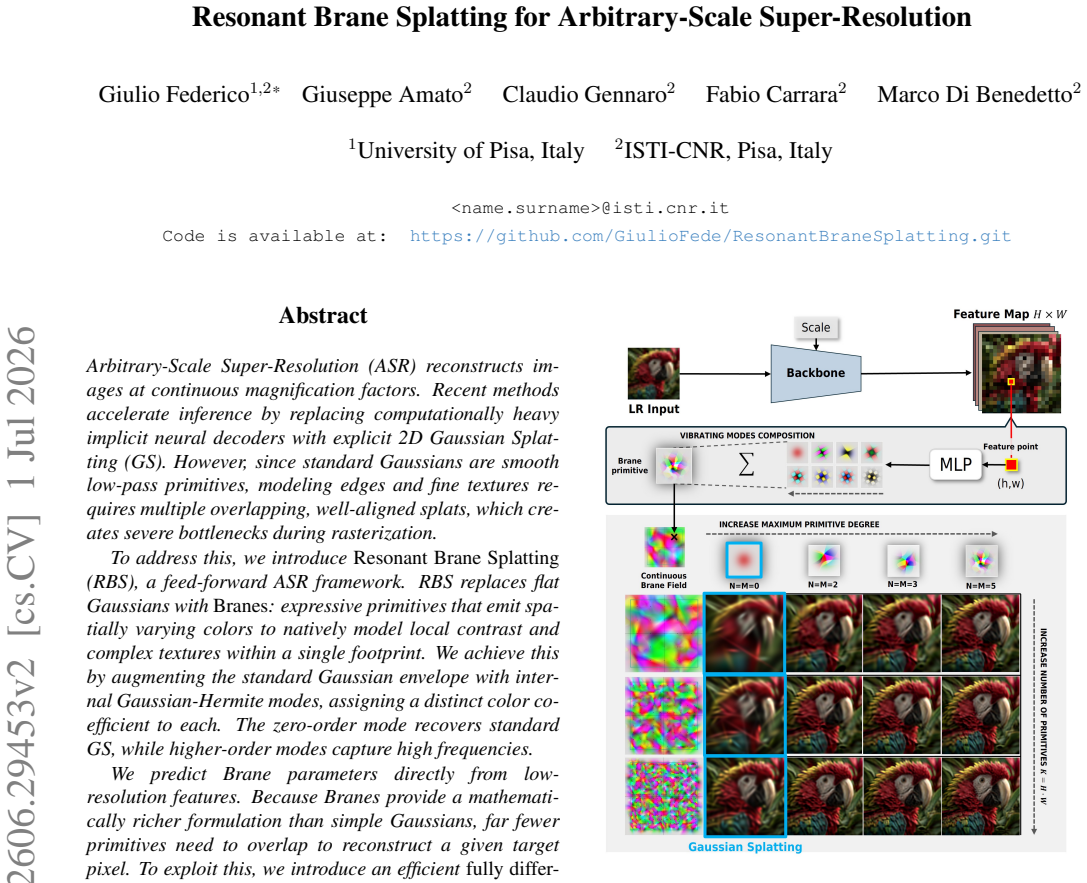
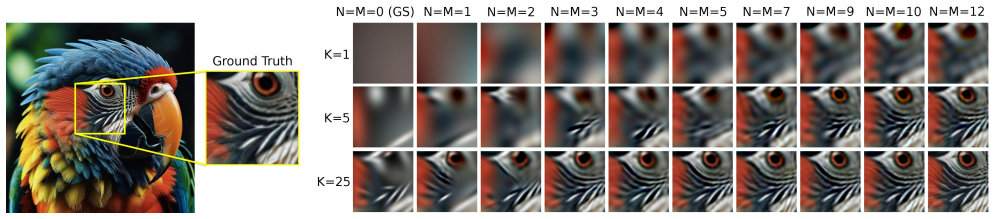
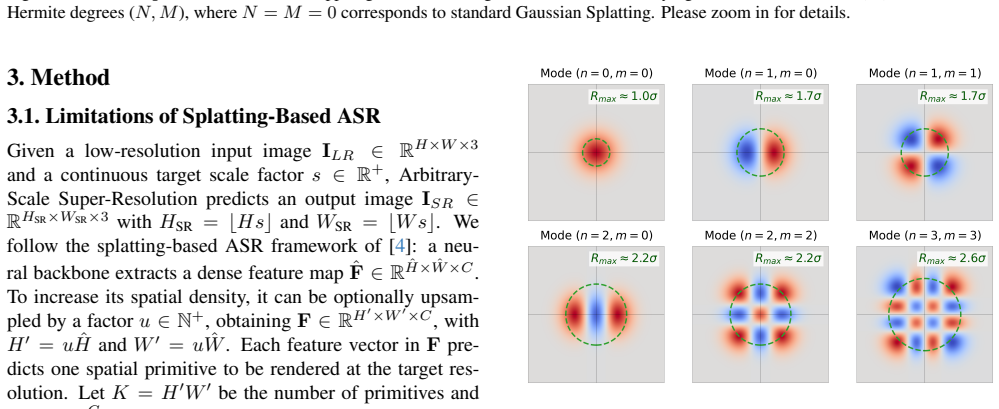
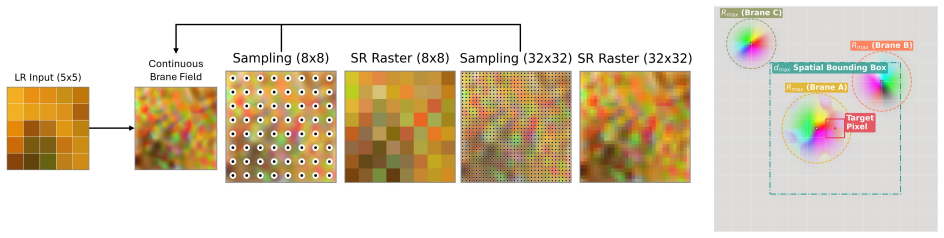
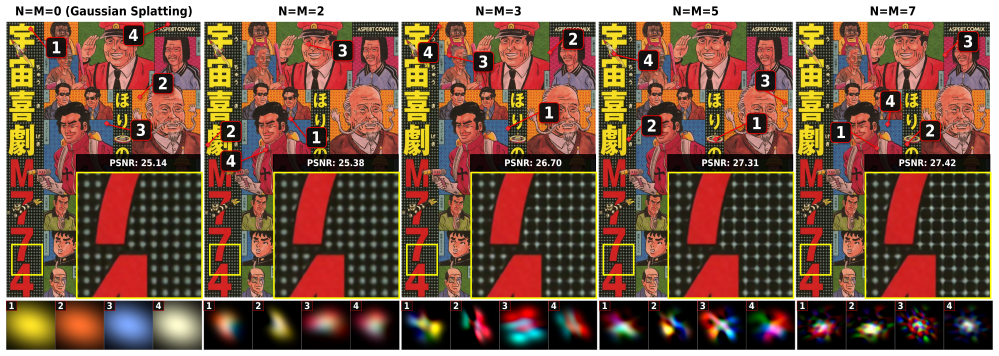
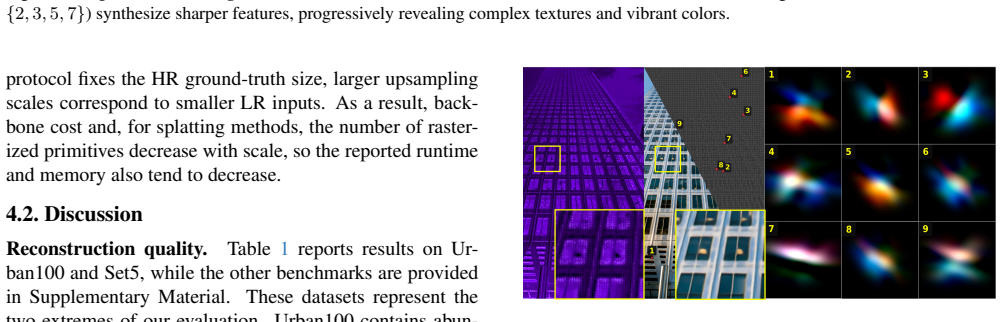
Resonant Brane Splatting augments the standard Gaussian envelope with internal Gaussian-Hermite modes, each assigned a distinct color coefficient, so that the zero-order mode recovers ordinary Gaussian splatting while higher-order modes capture high frequencies within a single footprint. Brane parameters are predicted directly from low-resolution features. Because each Brane is mathematically richer than a flat Gaussian, far fewer primitives need to overlap to reconstruct a target pixel, and a fully differentiable rasterizer with quantum turning point culling safely skips negligible regions to reduce rendering cost.
What carries the argument
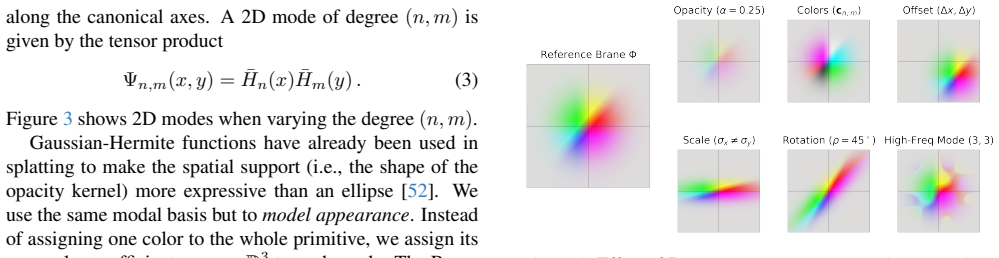
Branes: Gaussian envelopes augmented with Gaussian-Hermite modes that each carry a separate color coefficient, enabling spatially varying output from one primitive.
If this is right
- Far fewer primitives must overlap to reconstruct each target pixel.
- The rasterizer can safely omit negligible regions via quantum turning point culling without harming output.
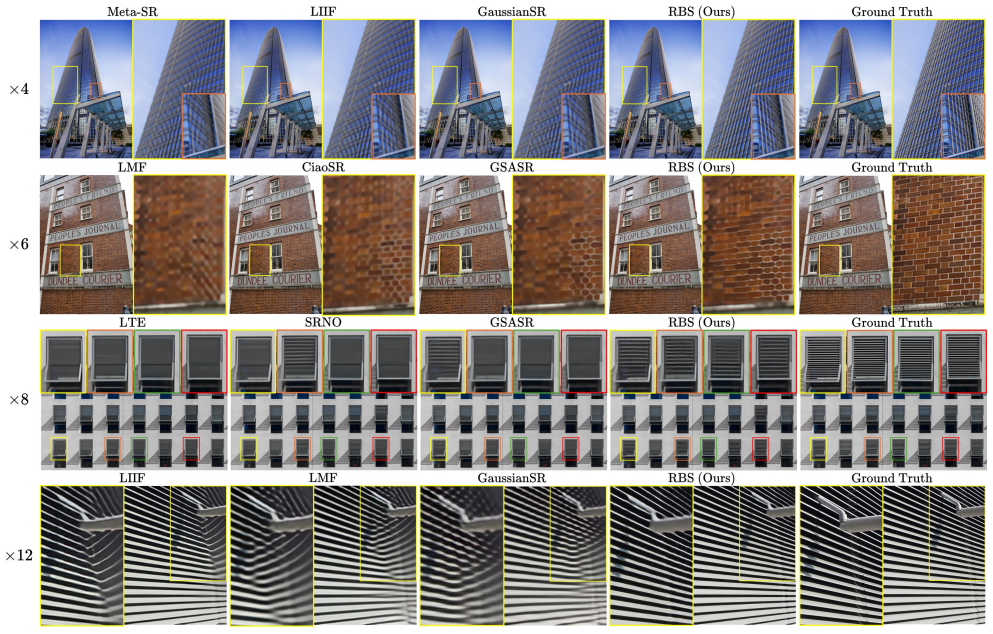
- Reconstruction quality exceeds both implicit neural decoders and standard Gaussian splatting on ASR benchmarks.
- The speed-quality trade-off surpasses prior Gaussian splatting methods for continuous scales.
Where Pith is reading between the lines
- The single-pass prediction of higher-order coefficients could be examined for numerical stability when input resolution drops further.
- The same mode-augmented primitive might reduce overlap counts in other explicit rendering pipelines that currently rely on many smooth Gaussians.
- Orthogonal expansions already common in signal processing could be swapped into the Brane definition to test additional frequency behaviors.
Load-bearing premise
Brane parameters including higher-order mode coefficients can be accurately and stably predicted in one feed-forward pass from low-resolution features, and the quantum turning point culling stays safe and artifact-free at every magnification factor.
What would settle it
Reconstruction at magnification factors outside the tested range produces visible artifacts or measurable quality loss when the predicted higher-order coefficients are used.
Figures
read the original abstract
Arbitrary-Scale Super-Resolution (ASR) reconstructs images at continuous magnification factors. Recent methods accelerate inference by replacing computationally heavy implicit neural decoders with explicit 2D Gaussian Splatting (GS). However, since standard Gaussians are smooth low-pass primitives, modeling edges and fine textures requires multiple overlapping, well-aligned splats, which creates severe bottlenecks during rasterization. To address this, we introduce Resonant Brane Splatting (RBS), a feed-forward ASR framework. RBS replaces flat Gaussians with Branes: expressive primitives that emit spatially varying colors to natively model local contrast and complex textures within a single footprint. We achieve this by augmenting the standard Gaussian envelope with internal Gaussian-Hermite modes, assigning a distinct color coefficient to each. The zero-order mode recovers standard GS, while higher-order modes capture high frequencies. We predict Brane parameters directly from low-resolution features. Because Branes provide a mathematically richer formulation than simple Gaussians, far fewer primitives need to overlap to reconstruct a given target pixel. To exploit this, we introduce an efficient fully differentiable rasterizer with a precise culling strategy based on the classical quantum turning point. This allows us to safely skip negligible regions, drastically reducing the rendering overhead. Experiments on standard ASR benchmarks show that RBS improves reconstruction quality over implicit and GS baselines, while achieving superior speed-quality trade-off than prior GS methods.
Editorial analysis
A structured set of objections, weighed in public.
Referee Report
Summary. The manuscript proposes Resonant Brane Splatting (RBS), a feed-forward framework for arbitrary-scale super-resolution (ASR). It replaces standard 2D Gaussians with Branes—primitives augmented by Gaussian-Hermite modes that assign distinct color coefficients to each mode, allowing a single footprint to capture high-frequency content. A fully differentiable rasterizer is introduced that employs a culling strategy derived from the classical quantum turning point. The central claim is that RBS improves reconstruction quality over implicit and Gaussian-splatting baselines while achieving a superior speed-quality trade-off on standard ASR benchmarks.
Significance. If the empirical claims hold, the work offers a concrete route to reducing primitive count in explicit representations for continuous-magnification tasks by replacing low-pass Gaussians with richer mode-augmented primitives and a mathematically grounded culling rule. The zero-order mode recovering standard GS provides a clean compatibility path.
major comments (2)
- [Abstract] Abstract: the claim that 'far fewer primitives need to overlap' and that the method achieves 'superior speed-quality trade-off' rests on stable single-pass regression of higher-order Gaussian-Hermite color coefficients from low-resolution features alone. No training loss, scale-specific ablation, or coefficient-prediction error analysis is supplied to substantiate that this regression remains accurate and artifact-free across magnification factors.
- [Abstract] Rasterizer description: the assertion that quantum-turning-point culling 'safely skip[s] negligible regions' without visible artifacts for arbitrary continuous scales is load-bearing for the efficiency claim. No derivation of the culling threshold, no energy-preservation bound, and no per-scale artifact quantification appear in the provided text.
minor comments (1)
- [Abstract] The term 'Brane' is introduced without an explicit mapping to the underlying Gaussian-Hermite parameter vector; a short notational table would clarify how the zero-order mode recovers standard GS.
Simulated Author's Rebuttal
We thank the referee for the constructive feedback. We address each major comment below and will revise the manuscript to strengthen the presentation of the claims.
read point-by-point responses
-
Referee: [Abstract] Abstract: the claim that 'far fewer primitives need to overlap' and that the method achieves 'superior speed-quality trade-off' rests on stable single-pass regression of higher-order Gaussian-Hermite color coefficients from low-resolution features alone. No training loss, scale-specific ablation, or coefficient-prediction error analysis is supplied to substantiate that this regression remains accurate and artifact-free across magnification factors.
Authors: We agree that the stability of regressing higher-order coefficients is central to the efficiency and quality claims. The manuscript does not currently include scale-specific ablations or coefficient-prediction error analysis across magnification factors. We will add these analyses, along with explicit details on the training loss, in the revised version to better support the claims. revision: yes
-
Referee: [Abstract] Rasterizer description: the assertion that quantum-turning-point culling 'safely skip[s] negligible regions' without visible artifacts for arbitrary continuous scales is load-bearing for the efficiency claim. No derivation of the culling threshold, no energy-preservation bound, and no per-scale artifact quantification appear in the provided text.
Authors: The culling rule is motivated by the quantum turning point to identify regions where higher-order mode contributions become negligible. We acknowledge that the current text lacks an explicit derivation of the threshold, an energy-preservation bound, and per-scale artifact quantification. We will include these elements in the revision to substantiate the rasterizer's behavior for continuous scales. revision: yes
Circularity Check
No circularity: method is a direct architectural proposal with external experimental validation
full rationale
The paper defines Branes as an explicit augmentation of Gaussians using Gaussian-Hermite modes with per-mode color coefficients, predicts the full parameter set in one feed-forward pass from LR features, and applies a differentiable culling rule derived from the classical quantum turning point. None of these steps reduce to self-definition, fitted-input-as-prediction, or self-citation chains; the zero-order mode simply recovers standard GS while higher modes are introduced as a richer basis. The central claims rest on benchmark comparisons (external data) rather than any quantity being defined in terms of its own fitted values. No load-bearing self-citations or ansatzes imported from prior author work appear in the derivation. The architecture is therefore self-contained against external benchmarks.
Axiom & Free-Parameter Ledger
invented entities (1)
-
Brane
no independent evidence
Reference graph
Works this paper leans on
-
[1]
Low-complexity single-image super-resolution based on nonnegative neighbor embedding
Marco Bevilacqua, Aline Roumy, Christine Guillemot, and Marie Line Alberi-Morel. Low-complexity single-image super-resolution based on nonnegative neighbor embedding
-
[2]
Ciaosr: Continuous implicit attention-in- attention network for arbitrary-scale image super-resolution
Jiezhang Cao, Qin Wang, Yongqin Xian, Yawei Li, Bingbing Ni, Zhiming Pi, Kai Zhang, Yulun Zhang, Radu Timofte, and Luc Van Gool. Ciaosr: Continuous implicit attention-in- attention network for arbitrary-scale image super-resolution. InProceedings of the IEEE/CVF Conference on Computer Vision and Pattern Recognition, pages 1796–1807, 2023. 1, 2, 5
2023
-
[3]
Ssl: A self-similarity loss for improving generative image super- resolution
Du Chen, Zhengqiang Zhang, Jie Liang, and Lei Zhang. Ssl: A self-similarity loss for improving generative image super- resolution. InProceedings of the 32nd ACM International Conference on Multimedia, pages 3189–3198, 2024. 2
2024
-
[4]
Generalized and efficient 2d gaussian splatting for arbitrary- scale super-resolution
Du Chen, Liyi Chen, Zhengqiang Zhang, and Lei Zhang. Generalized and efficient 2d gaussian splatting for arbitrary- scale super-resolution. InProceedings of the IEEE/CVF In- ternational Conference on Computer Vision (ICCV), pages 26435–26445, 2025. 1, 2, 3, 5, 6
2025
-
[5]
Haodong Chen, Runnan Chen, Qiang Qu, Zhaoqing Wang, Tongliang Liu, Xiaoming Chen, and Yuk Ying Chung. Be- yond gaussians: Fast and high-fidelity 3d splatting with lin- ear kernels.arXiv preprint arXiv:2411.12440, 2024. 2
-
[6]
Cascaded local implicit transformer for arbitrary-scale super-resolution
Hao-Wei Chen, Yu-Syuan Xu, Min-Fong Hong, Yi-Min Tsai, Hsien-Kai Kuo, and Chun-Yi Lee. Cascaded local implicit transformer for arbitrary-scale super-resolution. In Proceedings of the IEEE/CVF Conference on Computer Vi- sion and Pattern Recognition (CVPR), pages 18257–18267,
-
[7]
Hat: Hybrid attention transformer for image restoration.IEEE Transac- tions on Pattern Analysis and Machine Intelligence, 48(3): 2676–2694, 2026
Xiangyu Chen, Xintao Wang, Wenlong Zhang, Xiangtao Kong, Yu Qiao, Jiantao Zhou, and Chao Dong. Hat: Hybrid attention transformer for image restoration.IEEE Transac- tions on Pattern Analysis and Machine Intelligence, 48(3): 2676–2694, 2026. 7
2026
-
[8]
Learning continuous image representation with local implicit image function
Yinbo Chen, Sifei Liu, and Xiaolong Wang. Learning continuous image representation with local implicit image function. InProceedings of the IEEE/CVF conference on computer vision and pattern recognition, pages 8628–8638,
-
[9]
A general expression for hermite expansions with applications.The Mathematics Enthusiast, 21(1):71– 87, 2024
Tom P Davis. A general expression for hermite expansions with applications.The Mathematics Enthusiast, 21(1):71– 87, 2024. 3
2024
-
[10]
Simoncelli
Keyan Ding, Kede Ma, Shiqi Wang, and Eero P. Simoncelli. Image quality assessment: Unifying structure and texture similarity.IEEE Transactions on Pattern Analysis and Ma- chine Intelligence, 44(5):2567–2581, 2022. 5
2022
-
[11]
Learning a deep convolutional network for image super-resolution
Chao Dong, Chen Change Loy, Kaiming He, and Xiaoou Tang. Learning a deep convolutional network for image super-resolution. InEuropean conference on computer vi- sion, pages 184–199. Springer, 2014. 2
2014
-
[12]
Accel- erating the super-resolution convolutional neural network
Chao Dong, Chen Change Loy, and Xiaoou Tang. Accel- erating the super-resolution convolutional neural network. InComputer Vision – ECCV 2016, pages 391–407, Cham,
2016
-
[13]
Springer International Publishing. 5
-
[14]
Acceler- ating the super-resolution convolutional neural network
Chao Dong, Chen Change Loy, and Xiaoou Tang. Acceler- ating the super-resolution convolutional neural network. In European conference on computer vision, pages 391–407. Springer, 2016. 2
2016
-
[15]
M theory (the theory formerly known as strings)
Michael J Duff. M theory (the theory formerly known as strings). InThe World in Eleven Dimensions, pages 416–
-
[16]
Ges : Generalized exponential splatting for efficient radiance field rendering
Abdullah Hamdi, Luke Melas-Kyriazi, Jinjie Mai, Guocheng Qian, Ruoshi Liu, Carl V ondrick, Bernard Ghanem, and Andrea Vedaldi. Ges : Generalized exponential splatting for efficient radiance field rendering. InProceedings of the IEEE/CVF Conference on Computer Vision and Pattern Recognition (CVPR), pages 19812–19822, 2024. 2
2024
-
[17]
Latent modulated function for com- putational optimal continuous image representation
Zongyao He and Zhi Jin. Latent modulated function for com- putational optimal continuous image representation. InPro- ceedings of the IEEE/CVF Conference on Computer Vision and Pattern Recognition (CVPR), pages 26026–26035, 2024. 1, 2, 5
2024
-
[18]
3d con- vex splatting: Radiance field rendering with 3d smooth con- vexes
Jan Held, Renaud Vandeghen, Abdullah Hamdi, Adrien Deliege, Anthony Cioppa, Silvio Giancola, Andrea Vedaldi, Bernard Ghanem, and Marc Van Droogenbroeck. 3d con- vex splatting: Radiance field rendering with 3d smooth con- vexes. InProceedings of the IEEE/CVF Conference on Com- puter Vision and Pattern Recognition (CVPR), pages 21360– 21369, 2025. 2
2025
-
[19]
Gaussiansr: High fidelity 2d gaussian splatting for arbitrary-scale image super-resolution
Jintong Hu, Bin Xia, Bin Chen, Wenming Yang, and Lei Zhang. Gaussiansr: High fidelity 2d gaussian splatting for arbitrary-scale image super-resolution. InProceedings of the AAAI Conference on Artificial Intelligence, pages 3554– 3562, 2025. 1, 2, 5, 6
2025
-
[20]
Meta-sr: A magnification- arbitrary network for super-resolution
Xuecai Hu, Haoyuan Mu, Xiangyu Zhang, Zilei Wang, Tieniu Tan, and Jian Sun. Meta-sr: A magnification- arbitrary network for super-resolution. InProceedings of the IEEE/CVF conference on computer vision and pattern recognition, pages 1575–1584, 2019. 1, 2, 5
2019
-
[21]
Sin- gle image super-resolution from transformed self-exemplars
Jia-Bin Huang, Abhishek Singh, and Narendra Ahuja. Sin- gle image super-resolution from transformed self-exemplars. InProceedings of the IEEE Conference on Computer Vision and Pattern Recognition (CVPR), 2015. 5, 7
2015
-
[22]
Deformable radial kernel splatting
Yi-Hua Huang, Ming-Xian Lin, Yang-Tian Sun, Ziyi Yang, Xiaoyang Lyu, Yan-Pei Cao, and Xiaojuan Qi. Deformable radial kernel splatting. InProceedings of the IEEE/CVF Conference on Computer Vision and Pattern Recognition (CVPR), pages 21513–21523, 2025. 2
2025
-
[23]
Grape (gaussian ren- dering for accelerated pixel enhancement) brings fast and lightweight arbitrary super-resolution
Jung In Jang and Kyong Hwan Jin. Grape (gaussian ren- dering for accelerated pixel enhancement) brings fast and lightweight arbitrary super-resolution. InProceedings of the IEEE/CVF Winter Conference on Applications of Computer Vision (WACV), pages 7750–7758, 2026. 2, 5, 6
2026
-
[24]
The weighted hermite polynomials form a basis for l 2 (R).The American Mathematical Monthly, 121(3):249–253, 2014
William Johnston. The weighted hermite polynomials form a basis for l 2 (R).The American Mathematical Monthly, 121(3):249–253, 2014. 3
2014
-
[25]
3d gaussian splatting for real-time radiance field rendering.ACM Trans
Bernhard Kerbl, Georgios Kopanas, Thomas Leimk ¨uhler, George Drettakis, et al. 3d gaussian splatting for real-time radiance field rendering.ACM Trans. Graph., 42(4):139–1,
-
[26]
Accurate image super-resolution using very deep convolutional net- 9 works
Jiwon Kim, Jung Kwon Lee, and Kyoung Mu Lee. Accurate image super-resolution using very deep convolutional net- 9 works. InProceedings of the IEEE Conference on Computer Vision and Pattern Recognition (CVPR), 2016. 2
2016
-
[27]
Deeply- recursive convolutional network for image super-resolution
Jiwon Kim, Jung Kwon Lee, and Kyoung Mu Lee. Deeply- recursive convolutional network for image super-resolution. InProceedings of the IEEE conference on computer vision and pattern recognition, pages 1637–1645, 2016
2016
-
[28]
Deep laplacian pyramid networks for fast and accurate super-resolution
Wei-Sheng Lai, Jia-Bin Huang, Narendra Ahuja, and Ming- Hsuan Yang. Deep laplacian pyramid networks for fast and accurate super-resolution. InProceedings of the IEEE con- ference on computer vision and pattern recognition, pages 624–632, 2017. 2
2017
-
[29]
Deblurring 3d gaussian splatting
Byeonghyeon Lee, Howoong Lee, Xiangyu Sun, Usman Ali, and Eunbyung Park. Deblurring 3d gaussian splatting. InComputer Vision – ECCV 2024, pages 127–143, Cham,
2024
-
[30]
Springer Nature Switzerland. 2
-
[31]
Local texture estima- tor for implicit representation function
Jaewon Lee and Kyong Hwan Jin. Local texture estima- tor for implicit representation function. InProceedings of the IEEE/CVF conference on computer vision and pattern recognition, pages 1929–1938, 2022. 1, 2, 5
1929
-
[32]
Ls- dir: A large scale dataset for image restoration
Yawei Li, Kai Zhang, Jingyun Liang, Jiezhang Cao, Ce Liu, Rui Gong, Yulun Zhang, Hao Tang, Yun Liu, Denis Deman- dolx, Rakesh Ranjan, Radu Timofte, and Luc Van Gool. Ls- dir: A large scale dataset for image restoration. InProceed- ings of the IEEE/CVF Conference on Computer Vision and Pattern Recognition (CVPR) Workshops, pages 1775–1787,
-
[33]
Feedback network for image super- resolution
Zhen Li, Jinglei Yang, Zheng Liu, Xiaomin Yang, Gwang- gil Jeon, and Wei Wu. Feedback network for image super- resolution. InProceedings of the IEEE/CVF Conference on Computer Vision and Pattern Recognition (CVPR), 2019. 2
2019
-
[34]
Swinir: Image restoration us- ing swin transformer
Jingyun Liang, Jiezhang Cao, Guolei Sun, Kai Zhang, Luc Van Gool, and Radu Timofte. Swinir: Image restoration us- ing swin transformer. InProceedings of the IEEE/CVF Inter- national Conference on Computer Vision (ICCV) Workshops, pages 1833–1844, 2021. 2
2021
-
[35]
Details or artifacts: A locally discriminative learning approach to realistic im- age super-resolution
Jie Liang, Hui Zeng, and Lei Zhang. Details or artifacts: A locally discriminative learning approach to realistic im- age super-resolution. InProceedings of the IEEE/CVF con- ference on computer vision and pattern recognition, pages 5657–5666, 2022. 2
2022
-
[36]
Enhanced deep residual networks for single image super-resolution
Bee Lim, Sanghyun Son, Heewon Kim, Seungjun Nah, and Kyoung Mu Lee. Enhanced deep residual networks for single image super-resolution. InProceedings of the IEEE Confer- ence on Computer Vision and Pattern Recognition (CVPR) Workshops, 2017. 5, 7
2017
-
[37]
Deformable beta splatting
Rong Liu, Dylan Sun, Meida Chen, Yue Wang, and Andrew Feng. Deformable beta splatting. InProceedings of the Spe- cial Interest Group on Computer Graphics and Interactive Techniques Conference Conference Papers, New York, NY , USA, 2025. Association for Computing Machinery. 2
2025
-
[38]
Martin, C
D. Martin, C. Fowlkes, D. Tal, and J. Malik. A database of human segmented natural images and its application to evaluating segmentation algorithms and measuring ecolog- ical statistics. InProceedings Eighth IEEE International Conference on Computer Vision. ICCV 2001, pages 416–423 vol.2, 2001. 5
2001
-
[39]
Sketch-based manga retrieval using manga109 dataset.Mul- timedia tools and applications, 76(20):21811–21838, 2017
Yusuke Matsui, Kota Ito, Yuji Aramaki, Azuma Fujimoto, Toru Ogawa, Toshihiko Yamasaki, and Kiyoharu Aizawa. Sketch-based manga retrieval using manga109 dataset.Mul- timedia tools and applications, 76(20):21811–21838, 2017. 5
2017
-
[40]
Long Peng, Anran Wu, Wenbo Li, Peizhe Xia, Xueyuan Dai, Xinjie Zhang, Xin Di, Haoze Sun, Renjing Pei, Yang Wang, et al. Pixel to gaussian: Ultra-fast continuous super-resolution with 2d gaussian modeling.arXiv preprint arXiv:2503.06617, 2025. 2, 5, 6
-
[41]
Dirichlet branes and ramond-ramond charges.Physical Review Letters, 75(26):4724, 1995
Joseph Polchinski. Dirichlet branes and ramond-ramond charges.Physical Review Letters, 75(26):4724, 1995. 2
1995
-
[42]
Cambridge university press, 2020
Jun John Sakurai and Jim Napolitano.Modern quantum me- chanics. Cambridge university press, 2020. 2, 3, 5
2020
-
[43]
Ntire 2017 challenge on single image super-resolution: Methods and results
Radu Timofte, Eirikur Agustsson, Luc Van Gool, Ming- Hsuan Yang, and Lei Zhang. Ntire 2017 challenge on single image super-resolution: Methods and results. InProceed- ings of the IEEE Conference on Computer Vision and Pattern Recognition (CVPR) Workshops, 2017. 5, 7
2017
-
[44]
Learning a single net- work for scale-arbitrary super-resolution
Longguang Wang, Yingqian Wang, Zaiping Lin, Jungang Yang, Wei An, and Yulan Guo. Learning a single net- work for scale-arbitrary super-resolution. InProceedings of the IEEE/CVF international conference on computer vision, pages 4801–4810, 2021. 2
2021
-
[45]
Esrgan: En- hanced super-resolution generative adversarial networks
Xintao Wang, Ke Yu, Shixiang Wu, Jinjin Gu, Yihao Liu, Chao Dong, Yu Qiao, and Chen Change Loy. Esrgan: En- hanced super-resolution generative adversarial networks. In Proceedings of the European conference on computer vision (ECCV) workshops, pages 0–0, 2018. 2
2018
-
[46]
Bovik, H.R
Zhou Wang, A.C. Bovik, H.R. Sheikh, and E.P. Simoncelli. Image quality assessment: from error visibility to structural similarity.IEEE Transactions on Image Processing, 13(4): 600–612, 2004. 5
2004
-
[47]
Super-resolution neural oper- ator
Min Wei and Xuesong Zhang. Super-resolution neural oper- ator. InProceedings of the IEEE/CVF Conference on Com- puter Vision and Pattern Recognition (CVPR), pages 18247– 18256, 2023. 1, 2, 5
2023
-
[48]
String theory dynamics in various dimen- sions.Nuclear Physics B, 443(1-2):85–126, 1995
Edward Witten. String theory dynamics in various dimen- sions.Nuclear Physics B, 443(1-2):85–126, 1995. 2
1995
-
[49]
Seesr: Towards semantics- aware real-world image super-resolution
Rongyuan Wu, Tao Yang, Lingchen Sun, Zhengqiang Zhang, Shuai Li, and Lei Zhang. Seesr: Towards semantics- aware real-world image super-resolution. InProceedings of the IEEE/CVF conference on computer vision and pattern recognition, pages 25456–25467, 2024. 2
2024
-
[50]
Im- plicit transformer network for screen content image contin- uous super-resolution
Jingyu Yang, Sheng Shen, Huanjing Yue, and Kun Li. Im- plicit transformer network for screen content image contin- uous super-resolution. InAdvances in Neural Information Processing Systems, pages 13304–13315. Curran Associates, Inc., 2021. 2
2021
-
[51]
Local implicit normalizing flow for arbitrary-scale image super-resolution
Jie-En Yao, Li-Yuan Tsao, Yi-Chen Lo, Roy Tseng, Chia- Che Chang, and Chun-Yi Lee. Local implicit normalizing flow for arbitrary-scale image super-resolution. InProceed- ings of the IEEE/CVF Conference on Computer Vision and Pattern Recognition (CVPR), pages 1776–1785, 2023. 1, 2, 5
2023
-
[52]
Fine-structure preserved real-world im- age super-resolution via transfer vae training
Qiaosi Yi, Shuai Li, Rongyuan Wu, Lingchen Sun, Yuhui Wu, and Lei Zhang. Fine-structure preserved real-world im- age super-resolution via transfer vae training. InProceed- ings of the IEEE/CVF international conference on computer vision, pages 12415–12426, 2025. 2 10
2025
-
[53]
Scaling up to excellence: Practicing model scaling for photo- realistic image restoration in the wild
Fanghua Yu, Jinjin Gu, Zheyuan Li, Jinfan Hu, Xiangtao Kong, Xintao Wang, Jingwen He, Yu Qiao, and Chao Dong. Scaling up to excellence: Practicing model scaling for photo- realistic image restoration in the wild. InProceedings of the IEEE/CVF conference on computer vision and pattern recognition, pages 25669–25680, 2024. 2
2024
-
[54]
2dgh: 2d gaussian-hermite splatting for high-quality render- ing and better geometry features.IEEE Transactions on Visu- alization and Computer Graphics, 32(2):1513–1524, 2026
Ruihan Yu, Tianyu Huang, Jingwang Ling, and Feng Xu. 2dgh: 2d gaussian-hermite splatting for high-quality render- ing and better geometry features.IEEE Transactions on Visu- alization and Computer Graphics, 32(2):1513–1524, 2026. 2, 4
2026
-
[55]
On single image scale-up using sparse-representations
Roman Zeyde, Michael Elad, and Matan Protter. On single image scale-up using sparse-representations. InCurves and Surfaces, pages 711–730, Berlin, Heidelberg, 2012. Springer Berlin Heidelberg. 5
2012
-
[56]
Transcending the limit of local window: Ad- vanced super-resolution transformer with adaptive token dic- tionary
Leheng Zhang, Yawei Li, Xingyu Zhou, Xiaorui Zhao, and Shuhang Gu. Transcending the limit of local window: Ad- vanced super-resolution transformer with adaptive token dic- tionary. InProceedings of the IEEE/CVF conference on computer vision and pattern recognition, pages 2856–2865,
-
[57]
Efros, Eli Shecht- man, and Oliver Wang
Richard Zhang, Phillip Isola, Alexei A. Efros, Eli Shecht- man, and Oliver Wang. The unreasonable effectiveness of deep features as a perceptual metric. InProceedings of the IEEE Conference on Computer Vision and Pattern Recogni- tion (CVPR), 2018. 5
2018
-
[58]
Efficient long-range attention network for image super- resolution
Xindong Zhang, Hui Zeng, Shi Guo, and Lei Zhang. Efficient long-range attention network for image super- resolution. InEuropean conference on computer vision, pages 649–667. Springer, 2022. 2
2022
-
[59]
Image super-resolution using very deep residual channel attention networks
Yulun Zhang, Kunpeng Li, Kai Li, Lichen Wang, Bineng Zhong, and Yun Fu. Image super-resolution using very deep residual channel attention networks. InProceedings of the European conference on computer vision (ECCV), pages 286–301, 2018. 2
2018
-
[60]
Residual dense network for image super-resolution
Yulun Zhang, Yapeng Tian, Yu Kong, Bineng Zhong, and Yun Fu. Residual dense network for image super-resolution. InProceedings of the IEEE conference on computer vision and pattern recognition, pages 2472–2481, 2018. 2, 5, 6, 7, 8 11
2018
discussion (0)
Sign in with ORCID, Apple, or X to comment. Anyone can read and Pith papers without signing in.