Off-shell Hessian thermodynamic stability of higher-curvature black holes
Pith reviewed 2026-06-28 09:20 UTC · model grok-4.3
The pith
Local stability of higher-curvature black holes is governed by the off-shell Hessian H = S'_W T' rather than temperature slope alone.
A machine-rendered reading of the paper's core claim, the machinery that carries it, and where it could break.
Core claim
Equilibrium black holes are stationary points of the off-shell Gibbs free energy G_off. Their local stability is governed by the Hessian H = S'_W(r_h) T'(r_h) rather than by the temperature slope alone. The same off-shell structure yields the local A3 cusp normal form near criticality with mean-field 1/2 branch separation exponent. In Lovelock black holes S'_W can change sign on non-planar branches, reversing the temperature-slope stability assignment, but S'_W stays positive on ghost-free and branch-regular exteriors.
What carries the argument
The off-shell Hessian H = S'_W(r_h) T'(r_h) obtained from the off-shell Gibbs free energy G_off together with the Wald entropy S_W.
If this is right
- In the five-dimensional charged regular AdS black hole in quasi-topological gravity, monotonic S_W recovers the ordinary temperature-slope stability rule.
- In Lovelock black holes S'_W can change sign on non-planar branches and thereby reverse the stability assignment given by temperature slope.
- On ghost-free and branch-regular Lovelock exteriors S'_W remains positive, protecting the ordinary slope rule.
- The off-shell Hessian produces the local A3 cusp normal form and explains the mean-field 1/2 exponent that smooth observables inherit near criticality.
Where Pith is reading between the lines
- Smooth nondegenerate observables such as the Lyapunov exponent inherit the same 1/2 scaling because they are regular functions on the branches.
- The framework supplies a diagnostic that can be applied to any higher-curvature theory once the Wald entropy and temperature functions are known.
- Numerical evolution of small perturbations on a branch where S'_W changes sign would directly test whether the Hessian correctly predicts the onset of instability.
Load-bearing premise
Equilibrium black holes are stationary points of the off-shell Gibbs free energy and the Wald entropy together with temperature supply the complete data needed for the Hessian stability test on fixed-parameter slices.
What would settle it
A concrete counter-example would be a physically admissible black-hole branch on which the sign of S'_W T' disagrees with the sign of the specific heat obtained from linear perturbation analysis.
Figures
read the original abstract
We develop a branch-sensitive thermodynamic framework for higher-curvature black holes using the off-shell Gibbs free energy $G_{\rm off}$ and the Wald entropy$S_W$ as the basic data. On fixed-parameter slices, equilibrium black holes are stationary points of $G_{\rm off}$, and their local stability is governed by the Hessian $H=S'_W(r_h)T'(r_h)$, rather than by the temperature slope alone. For the five-dimensional charged regular AdS black hole in quasi-topological gravity, $S_W$ remains monotonic on the physical branch, so the usual temperature-slope rule is recovered only as a special consequence. The same off-shell structure also gives the local $A_3$ cusp normal form near criticality, yielding the mean-field $1/2$ branch separation exponent and explaining why smooth nondegenerate observables, such as the Lyapunov exponent, inherit the same scaling. In Lovelock black holes, $S'_W$ can change sign on non-planar branches, reversing the temperature slope stability assignment. However, on ghost-free and branch-regular Lovelock exteriors $S'_W$ remains positive. Thus the off-shell Hessian criterion also diagnoses why the ordinary slope rule is protected on physically admissible black holes branches.
Editorial analysis
A structured set of objections, weighed in public.
Referee Report
Summary. The manuscript develops an off-shell thermodynamic framework for higher-curvature black holes, taking the off-shell Gibbs free energy G_off = M(r_h) - T S_W(r_h) and Wald entropy S_W as basic data. Equilibrium black holes are stationary points of G_off on fixed-parameter slices, with local stability governed by the Hessian H = S'_W(r_h) T'(r_h) rather than the temperature slope T' alone. For the five-dimensional charged regular AdS black hole in quasi-topological gravity, S_W is monotonic on the physical branch so the standard temperature-slope rule is recovered; in Lovelock gravity S'_W can change sign on non-planar branches (reversing the stability assignment) but remains positive on ghost-free, branch-regular exteriors. The same off-shell structure yields the local A3 cusp normal form near criticality, producing the mean-field 1/2 branch-separation exponent for smooth nondegenerate observables such as the Lyapunov exponent.
Significance. If the central claims hold, the work supplies a general, branch-sensitive stability criterion that explains why the conventional temperature-slope rule is protected on physically admissible branches while diagnosing exceptions in higher-curvature theories. The derivation of the A3 cusp normal form directly from the off-shell potential is a notable strength, furnishing a model-independent mechanism for the 1/2 exponent without additional assumptions. The framework is logically economical, relying only on the first law to reduce the second-derivative test, and applies uniformly to the quasi-topological and Lovelock examples.
minor comments (3)
- [Abstract] Abstract: the explicit functional form of G_off and the precise definition of the off-shell Hessian H are introduced without an accompanying equation; adding the relation G_off'' = S'_W T' (which follows from the first law at equilibrium) would improve immediate readability.
- [Abstract] The statement that 'the same off-shell structure also gives the local A3 cusp normal form' would be clearer if the leading terms of the normal-form expansion (e.g., G_off ~ a (r-r_c)^3 + b (T-T_c)(r-r_c)) were written explicitly, even if only to recall the standard A3 form.
- The claim that S_W remains monotonic on the physical branch of the quasi-topological black hole is central to recovering the temperature-slope rule; an explicit derivative plot or inequality establishing S'_W > 0 throughout the physical range would strengthen the presentation.
Simulated Author's Rebuttal
We thank the referee for the careful reading and positive assessment of the manuscript, including the recommendation for minor revision. No specific major comments appear in the report.
Circularity Check
No significant circularity identified
full rationale
The central result follows from the standard second-derivative test applied to the off-shell Gibbs free energy G_off = M(r_h) - T S_W(r_h). With the first law dM = T dS_W, the second derivative at equilibrium points reduces identically to S'_W T' by direct differentiation, yielding the Hessian criterion as a mathematical identity rather than an independent prediction or fitted input. The A3 cusp normal form is likewise the generic local Taylor expansion of this G_off when T'(r_c) = 0. No self-citations, ansatzes smuggled via prior work, or uniqueness theorems are invoked to support the load-bearing steps. The derivation is self-contained against external thermodynamic benchmarks and does not reduce any claimed result to its own inputs by construction.
Axiom & Free-Parameter Ledger
axioms (2)
- domain assumption Equilibrium black holes are stationary points of the off-shell Gibbs free energy G_off
- domain assumption Wald entropy S_W is the appropriate entropy for constructing the stability Hessian in higher-curvature theories
Reference graph
Works this paper leans on
-
[1]
AtP= 0.8P c, the coexistence temperature isT 0 =T coex ≃0.125587
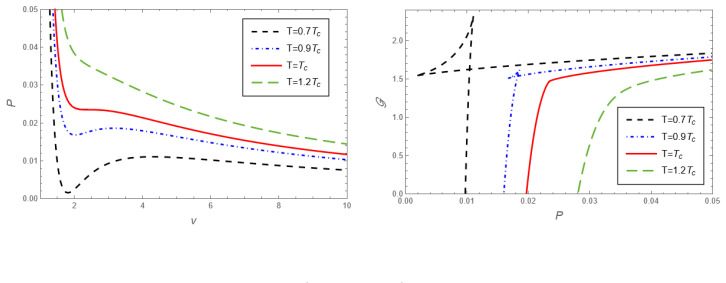
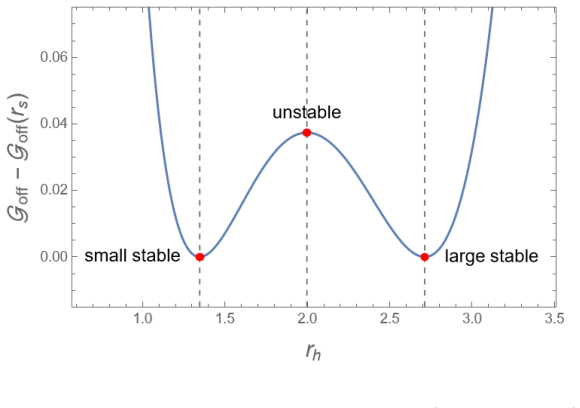
The critical point is obtained from ∂P ∂v T = 0, ∂2P ∂v2 T = 0.(59) Numerically, we havev c ≃2.425463, r h,c ≃1.819097, andT c ≃0.137859, P c ≃0.0234737. AtP= 0.8P c, the coexistence temperature isT 0 =T coex ≃0.125587. The stationary points ofG QT off are located at rh,s ≃1.346955, r h,m ≃1.997594, r h,l ≃2.712503.(60) The small and large black holes are...
-
[2]
In the Lovelock-polynomial convention used in Sec
Einstein–Gauss–Bonnet AdS black holes As a first standard check, consider Einstein–Gauss–Bonnet gravity inD≥5. In the Lovelock-polynomial convention used in Sec. IV: Υ(g) = ˆc0 +g+α GBg2 . For a topological black hole with horizon curvaturek= 1,0,−1, the Wald entropy is SGB W = ΣD−2rD−2 h 4G 1 + 2(D−2)α GBk (D−4)r 2 h . Hence dSGB W drh = ΣD−2(D−2) 4G rD−...
-
[3]
For such solutions, the Wald entropy is simply a constant rescaling of the area entropy, Sf(R) W = fR(R0) 4G ΣD−2rD−2 h
Constant-curvaturef(R)AdS black holes As a second check, we consider anf(R) theory admitting a constant-curvature black hole with R=R 0, f R(R0)≡ d f dR R0 = constant. For such solutions, the Wald entropy is simply a constant rescaling of the area entropy, Sf(R) W = fR(R0) 4G ΣD−2rD−2 h . Therefore, we have dSf(R) W drh = fR(R0) 4G (D−2)Σ D−2rD−3 h . The ...
-
[4]
E. Witten, Eur. Phys. J. Plus140(2025) no.5, 430 doi:10.1140/epjp/s13360-025-06288-y [arXiv:2412.16795 [hep-th]]
-
[5]
Thermodynamical Aspects of Gravity: New insights
T. Padmanabhan, Rept. Prog. Phys.73(2010), 046901 doi:10.1088/0034-4885/73/4/046901 [arXiv:0911.5004 [gr-qc]]
work page internal anchor Pith review Pith/arXiv arXiv doi:10.1088/0034-4885/73/4/046901 2010
-
[6]
J. M. Bardeen, B. Carter and S. W. Hawking, Commun. Math. Phys.31(1973), 161-170 doi:10.1007/BF01645742 28
-
[7]
J. D. Bekenstein, Phys. Rev. D7(1973), 2333-2346 doi:10.1103/PhysRevD.7.2333
-
[8]
Some Properties of Noether Charge and a Proposal for Dynamical Black Hole Entropy
V. Iyer and R. M. Wald, Phys. Rev. D50(1994), 846-864 doi:10.1103/PhysRevD.50.846 [arXiv:gr-qc/9403028 [gr-qc]]
work page internal anchor Pith review Pith/arXiv arXiv doi:10.1103/physrevd.50.846 1994
-
[9]
Strominger, JHEP02(1998), 009 doi:10.1088/1126-6708/1998/02/009 [arXiv:hep- th/9712251 [hep-th]]
A. Strominger, JHEP02(1998), 009 doi:10.1088/1126-6708/1998/02/009 [arXiv:hep- th/9712251 [hep-th]]
-
[10]
S. W. Wei and Y. X. Liu, Phys. Rev. Lett.115(2015) no.11, 111302 [erratum: Phys. Rev. Lett.116(2016) no.16, 169903] doi:10.1103/PhysRevLett.115.111302 [arXiv:1502.00386 [gr- qc]]
work page internal anchor Pith review Pith/arXiv arXiv doi:10.1103/physrevlett.115.111302 2015
-
[11]
J. M. Maldacena and A. Strominger, Phys. Rev. Lett.77(1996), 428-429 doi:10.1103/PhysRevLett.77.428 [arXiv:hep-th/9603060 [hep-th]]
work page internal anchor Pith review Pith/arXiv arXiv doi:10.1103/physrevlett.77.428 1996
-
[12]
S. W. Wei, Y. X. Liu and R. B. Mann, Phys. Rev. Lett.123(2019) no.7, 071103 doi:10.1103/PhysRevLett.123.071103 [arXiv:1906.10840 [gr-qc]]
-
[13]
J. M. Maldacena, Adv. Theor. Math. Phys.2(1998), 231-252 doi:10.4310/ATMP.1998.v2.n2.a1 [arXiv:hep-th/9711200 [hep-th]]
work page internal anchor Pith review Pith/arXiv arXiv doi:10.4310/atmp.1998.v2.n2.a1 1998
-
[14]
Large N Field Theories, String Theory and Gravity
O. Aharony, S. S. Gubser, J. M. Maldacena, H. Ooguri and Y. Oz, Phys. Rept.323(2000), 183-386 doi:10.1016/S0370-1573(99)00083-6 [arXiv:hep-th/9905111 [hep-th]]
work page internal anchor Pith review Pith/arXiv arXiv doi:10.1016/s0370-1573(99)00083-6 2000
-
[15]
S. W. Hawking and D. N. Page, Commun. Math. Phys.87(1983), 577 doi:10.1007/BF01208266
-
[16]
Anti-de Sitter Space, Thermal Phase Transition, And Confinement In Gauge Theories
E. Witten, Adv. Theor. Math. Phys.2(1998), 505-532 doi:10.4310/ATMP.1998.v2.n3.a3 [arXiv:hep-th/9803131 [hep-th]]
work page internal anchor Pith review Pith/arXiv arXiv doi:10.4310/atmp.1998.v2.n3.a3 1998
-
[17]
Holography, Thermodynamics and Fluctuations of Charged AdS Black Holes
A. Chamblin, R. Emparan, C. V. Johnson and R. C. Myers, Phys. Rev. D60(1999), 104026 doi:10.1103/PhysRevD.60.104026 [arXiv:hep-th/9904197 [hep-th]]
work page internal anchor Pith review Pith/arXiv arXiv doi:10.1103/physrevd.60.104026 1999
-
[19]
P-V criticality of charged AdS black holes
D. Kubiznak and R. B. Mann, JHEP07(2012), 033 doi:10.1007/JHEP07(2012)033 [arXiv:1205.0559 [hep-th]]
work page internal anchor Pith review Pith/arXiv arXiv doi:10.1007/jhep07(2012)033 2012
-
[20]
B. P. Dolan, Class. Quant. Grav.28(2011), 235017 doi:10.1088/0264-9381/28/23/235017 [arXiv:1106.6260 [gr-qc]]
work page internal anchor Pith review Pith/arXiv arXiv doi:10.1088/0264-9381/28/23/235017 2011
-
[21]
R. G. Cai, L. M. Cao, L. Li and R. Q. Yang, JHEP09(2013), 005 doi:10.1007/JHEP09(2013)005 [arXiv:1306.6233 [gr-qc]]
work page internal anchor Pith review Pith/arXiv arXiv doi:10.1007/jhep09(2013)005 2013
-
[22]
Critical phenomena in the extended phase space of Kerr-Newman-AdS black holes
P. Cheng, S. W. Wei and Y. X. Liu, Phys. Rev. D94(2016) no.2, 024025 29 doi:10.1103/PhysRevD.94.024025 [arXiv:1603.08694 [gr-qc]]
work page internal anchor Pith review Pith/arXiv arXiv doi:10.1103/physrevd.94.024025 2016
-
[23]
Z. M. Xu, B. Wu and W. L. Yang, Sci. China Phys. Mech. Astron.66(2023) no.4, 240411 doi:10.1007/s11433-022-2022-6 [arXiv:2211.03512 [gr-qc]]
-
[24]
Z. M. Xu, P. P. Zhang, B. Wu and X. Zhang, JHEP12(2024), 181 doi:10.1007/JHEP12(2024)181 [arXiv:2407.08241 [gr-qc]]
-
[25]
Kerr-AdS analogue of triple point and solid/liquid/gas phase transition
N. Altamirano, D. Kubiznak, R. B. Mann and Z. Sherkatghanad, Class. Quant. Grav.31 (2014), 042001 doi:10.1088/0264-9381/31/4/042001 [arXiv:1308.2672 [hep-th]]
work page internal anchor Pith review Pith/arXiv arXiv doi:10.1088/0264-9381/31/4/042001 2014
-
[26]
Reentrant Phase Transitions in Rotating AdS Black Holes
N. Altamirano, D. Kubiznak and R. B. Mann, Phys. Rev. D88(2013) no.10, 101502 doi:10.1103/PhysRevD.88.101502 [arXiv:1306.5756 [hep-th]]
work page internal anchor Pith review Pith/arXiv arXiv doi:10.1103/physrevd.88.101502 2013
-
[27]
A. M. Frassino, D. Kubiznak, R. B. Mann and F. Simovic, JHEP09(2014), 080 doi:10.1007/JHEP09(2014)080 [arXiv:1406.7015 [hep-th]]
work page internal anchor Pith review Pith/arXiv arXiv doi:10.1007/jhep09(2014)080 2014
-
[28]
R. A. Hennigar, R. B. Mann and E. Tjoa, Phys. Rev. Lett.118(2017) no.2, 021301 doi:10.1103/PhysRevLett.118.021301 [arXiv:1609.02564 [hep-th]]
work page internal anchor Pith review Pith/arXiv arXiv doi:10.1103/physrevlett.118.021301 2017
-
[29]
N. C. Bai, L. Li and J. Tao, Sci. China Phys. Mech. Astron.66(2023) no.12, 120411 doi:10.1007/s11433-023-2203-5 [arXiv:2305.15258 [gr-qc]]
-
[30]
B. P. Dolan, A. Kostouki, D. Kubiznak and R. B. Mann, Class. Quant. Grav.31(2014) no.24, 242001 doi:10.1088/0264-9381/31/24/242001 [arXiv:1407.4783 [hep-th]]
work page internal anchor Pith review Pith/arXiv arXiv doi:10.1088/0264-9381/31/24/242001 2014
-
[31]
Y. P. Hu, Y. S. An, G. Y. Sun, W. L. You, D. N. Shi, H. Zhang, X. Chen and R. G. Cai, [arXiv:2410.23783 [gr-qc]]
-
[32]
M. B. Ahmed, D. Kubiznak and R. B. Mann, Phys. Rev. D107(2023) no.4, 046013 doi:10.1103/PhysRevD.107.046013 [arXiv:2207.02147 [hep-th]]
-
[33]
S. J. Yang, S. P. Wu, S. W. Wei and Y. X. Liu, Sci. China Phys. Mech. Astron.68(2025) no.12, 120412 doi:10.1007/s11433-025-2787-4 [arXiv:2505.20860 [gr-qc]]
-
[34]
X. R. Chen, B. Wu and Z. M. Xu, Phys. Dark Univ.42(2023), 101317 doi:10.1016/j.dark.2023.101317
-
[35]
D. Wu, W. Liu, S. Q. Wu and R. B. Mann, Phys. Rev. D111(2025) no.6, L061501 doi:10.1103/PhysRevD.111.L061501 [arXiv:2411.10102 [hep-th]]
-
[36]
S. H. Zhang, Z. Y. Li, J. F. Zhang and X. Zhang, [arXiv:2512.16629 [gr-qc]]
-
[37]
S. W. Wei, Y. X. Liu and R. B. Mann, Phys. Rev. D110(2024) no.8, L081501 doi:10.1103/PhysRevD.110.L081501 [arXiv:2409.09333 [gr-qc]]
-
[38]
S. W. Wei and Y. X. Liu, Sci. China Phys. Mech. Astron.69(2026) no.6, 260401 30 doi:10.1007/s11433-025-2923-3 [arXiv:2605.00037 [gr-qc]]
work page internal anchor Pith review Pith/arXiv arXiv doi:10.1007/s11433-025-2923-3 2026
-
[39]
W. Liu, L. Zhang, D. Wu and J. Wang, Class. Quant. Grav.42(2025), 125007 doi:10.1088/1361-6382/ade35b [arXiv:2409.11666 [hep-th]]
-
[40]
Z. M. Xu, Y. S. Wang, B. Wu and W. L. Yang, Phys. Lett. B850(2024), 138528 doi:10.1016/j.physletb.2024.138528 [arXiv:2305.05916 [gr-qc]]
-
[41]
Z. M. Xu and R. B. Mann, Phys. Rev. Lett.136(2026) no.4, 041402 doi:10.1103/c39y-zcz6 [arXiv:2504.05708 [gr-qc]]
-
[42]
S. H. Zhang, S. W. Wei, J. F. Zhang and X. Zhang, [arXiv:2604.08315 [gr-qc]]
-
[43]
B. Zwiebach, Phys. Lett. B156(1985), 315-317 doi:10.1016/0370-2693(85)91616-8
-
[44]
D. J. Gross and E. Witten, Nucl. Phys. B277(1986), 1 doi:10.1016/0550-3213(86)90429-3
-
[45]
M. B. Green and P. Vanhove, Phys. Lett. B408(1997), 122-134 doi:10.1016/S0370- 2693(97)00785-5 [arXiv:hep-th/9704145 [hep-th]]
work page internal anchor Pith review Pith/arXiv arXiv doi:10.1016/s0370- 1997
-
[46]
J. F. Donoghue, Phys. Rev. D50(1994), 3874-3888 doi:10.1103/PhysRevD.50.3874 [arXiv:gr- qc/9405057 [gr-qc]]
-
[47]
D. Lovelock, J. Math. Phys.12(1971), 498-501 doi:10.1063/1.1665613
-
[48]
D. G. Boulware and S. Deser, Phys. Rev. Lett.55(1985), 2656 doi:10.1103/PhysRevLett.55.2656
-
[49]
R. G. Cai, Phys. Rev. D65(2002), 084014 doi:10.1103/PhysRevD.65.084014 [arXiv:hep- th/0109133 [hep-th]]
-
[50]
P. Bueno, P. A. Cano and R. A. Hennigar, Phys. Lett. B861(2025), 139260 doi:10.1016/j.physletb.2025.139260 [arXiv:2403.04827 [gr-qc]]
-
[51]
P. Bueno, P. A. Cano, R. A. Hennigar and ´A. J. Murcia, Phys. Rev. D111(2025) no.10, 104009 doi:10.1103/PhysRevD.111.104009 [arXiv:2412.02740 [gr-qc]]
-
[53]
R. C. Myers and B. Robinson, JHEP08(2010), 067 doi:10.1007/JHEP08(2010)067 [arXiv:1003.5357 [gr-qc]]
work page internal anchor Pith review Pith/arXiv arXiv doi:10.1007/jhep08(2010)067 2010
-
[54]
M. H. Dehghani, A. Bazrafshan, R. B. Mann, M. R. Mehdizadeh, M. Ghanaatian and M. H. Vahidinia, Phys. Rev. D85(2012), 104009 doi:10.1103/PhysRevD.85.104009 [arXiv:1109.4708 [hep-th]]
work page internal anchor Pith review Pith/arXiv arXiv doi:10.1103/physrevd.85.104009 2012
-
[55]
Quintessential Quartic Quasi-topological Quartet
J. Ahmed, R. A. Hennigar, R. B. Mann and M. Mir, JHEP05(2017), 134 31 doi:10.1007/JHEP05(2017)134 [arXiv:1703.11007 [hep-th]]
work page internal anchor Pith review Pith/arXiv arXiv doi:10.1007/jhep05(2017)134 2017
-
[56]
Quintic quasi-topological gravity
A. Cisterna, L. Guajardo, M. Hassaine and J. Oliva, JHEP04(2017), 066 doi:10.1007/JHEP04(2017)066 [arXiv:1702.04676 [hep-th]]
work page internal anchor Pith review Pith/arXiv arXiv doi:10.1007/jhep04(2017)066 2017
-
[57]
V. P. Frolov, A. Koek, J. P. Soto and A. Zelnikov, Phys. Rev. D111(2025) no.4, 4 doi:10.1103/PhysRevD.111.044034 [arXiv:2411.16050 [gr-qc]]
-
[58]
V. P. Frolov, Phys. Rev. D113(2026) no.6, 064023 doi:10.1103/mbdj-tqtv [arXiv:2512.14674 [gr-qc]]
-
[59]
F. Di Filippo, I. Kol´ aˇ r and D. Kubiznak, Phys. Rev. D111(2025) no.4, L041505 doi:10.1103/PhysRevD.111.L041505 [arXiv:2404.07058 [gr-qc]]
-
[60]
M. Aguayo, L. Gajardo, N. Grandi, J. Moreno, J. Oliva and M. Reyes, JHEP09(2025), 030 doi:10.1007/JHEP09(2025)030 [arXiv:2505.11736 [hep-th]]
- [61]
-
[62]
J. Borissova and R. Carballo-Rubio, JCAP05(2026), 023 doi:10.1088/1475- 7516/2026/05/023 [arXiv:2601.17115 [gr-qc]]
work page internal anchor Pith review Pith/arXiv arXiv doi:10.1088/1475- 2026
-
[63]
Y. Ling and Z. Yu, JCAP03(2026), 004 doi:10.1088/1475-7516/2026/03/004 [arXiv:2509.00137 [gr-qc]]
-
[64]
C. H. Hao, J. Jing and J. Wang, JCAP05(2026), 067 doi:10.1088/1475-7516/2026/05/067 [arXiv:2512.04604 [gr-qc]]
-
[65]
C. H. Hao, Y. Q. Wang and J. Wang, [arXiv:2604.02631 [gr-qc]]
- [66]
- [67]
-
[68]
E. N. Saridakis, [arXiv:2604.13002 [gr-qc]]
-
[69]
S. W. Wang, S. P. Wu and S. W. Wei, Phys. Lett. B864(2025), 139402 doi:10.1016/j.physletb.2025.139402 [arXiv:2412.05811 [gr-qc]]
-
[70]
R. A. Hennigar, D. Kubizˇ n´ ak, S. Murk and I. Soranidis, JHEP11(2025), 121 doi:10.1007/JHEP11(2025)121 [arXiv:2505.11623 [gr-qc]]
-
[71]
Probing phase transitions of regular black holes in anti-de Sitter space with Lyapunov exponent
H. Xie and S. J. Yang, Eur. Phys. J. C85(2025) no.12, 1374 doi:10.1140/epjc/s10052-025- 15111-y [arXiv:2510.23387 [gr-qc]]
work page internal anchor Pith review Pith/arXiv arXiv doi:10.1140/epjc/s10052-025- 2025
-
[72]
J. W. York, Jr., Phys. Rev. D33(1986), 2092-2099 doi:10.1103/PhysRevD.33.2092
-
[73]
S. W. Wei, Y. X. Liu and R. B. Mann, Phys. Rev. Lett.129(2022) no.19, 191101 doi:10.1103/PhysRevLett.129.191101 [arXiv:2208.01932 [gr-qc]]. 32
- [74]
-
[75]
M. Zhang, S. Z. Han, J. Jiang and W. B. Liu, Phys. Rev. D99(2019) no.6, 065016 [arXiv:1903.08293 [hep-th]]
Pith/arXiv arXiv 2019
-
[76]
Y. M. Xu, H. M. Wang, Y. X. Liu and S. W. Wei, Phys. Rev. D100(2019) no.10, 104044 [arXiv:1906.03334 [gr-qc]]
arXiv 2019
-
[77]
H. Li, Y. Chen and S. J. Zhang, Nucl. Phys. B954(2020), 114975 [arXiv:1908.09570 [hep- th]]
arXiv 2020
-
[78]
A. Naveena Kumara, C. L. Ahmed Rizwan, S. Punacha, K. M. Ajith and M. S. Ali, Phys. Rev. D102(2020) no.8, 084059 [arXiv:1912.11909 [gr-qc]]
arXiv 2020
-
[79]
Y. Z. Du, H. F. Li, F. Liu and L. C. Zhang, JHEP01(2023), 137 [arXiv:2204.01007 [hep-th]]
arXiv 2023
-
[80]
Kumar, S
A. Kumar, S. G. Ghosh and A. Wang, Phys. Dark Univ.46(2024), 101608
2024
-
[81]
S. Yang, J. Tao, B. Mu and A. He, JCAP07(2023), 045 [arXiv:2304.01877 [gr-qc]]
arXiv 2023
-
[82]
X. Lyu, J. Tao and P. Wang, Eur. Phys. J. C84(2024), 974 [arXiv:2312.11912 [gr-qc]]
arXiv 2024
discussion (0)
Sign in with ORCID, Apple, or X to comment. Anyone can read and Pith papers without signing in.