Yoctosecond imaging of the ground state of ¹²⁹Xe at the Large Hadron Collider
Pith reviewed 2026-06-28 07:47 UTC · model grok-4.3
The pith
LHC collision data infers that the xenon-129 nucleus is nearly maximally triaxial.
A machine-rendered reading of the paper's core claim, the machinery that carries it, and where it could break.
Core claim
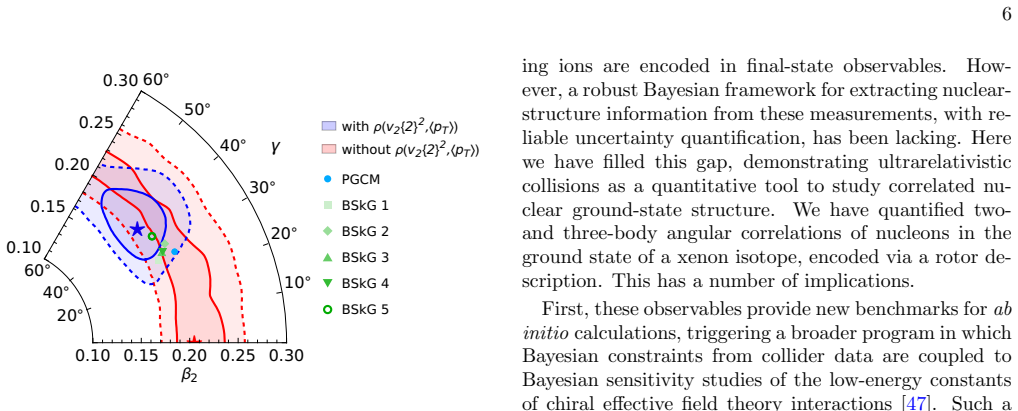
A global analysis of Large Hadron Collider data on Xe-Xe and Pb-Pb collisions, performed with a deformed-rotor description of the nuclei and hydrodynamic modeling of the collision evolution, yields a nearly maximally triaxial shape for the 129Xe ground state; two- and three-particle correlations evaluated from this shape supply new constraints for ab initio nuclear theory.
What carries the argument
The deformed-rotor description of the colliding nuclei, which encodes the many-body dynamics of neutrons and protons and is sampled event by event before hydrodynamic evolution.
If this is right
- Collider experiments become a quantitative tool for measuring proton-neutron correlations generated by residual QCD forces.
- The extracted shape supplies concrete benchmarks that ab initio nuclear-structure calculations must reproduce.
- The same analysis framework can be applied to other deformed nuclei to map their ground-state triaxiality.
Where Pith is reading between the lines
- The method could be extended to lighter or heavier deformed species once sufficient collision data become available.
- If the triaxiality result holds, it would strengthen the case that mean-field approaches already capture the dominant correlations in mid-shell nuclei.
- Event-by-event nuclear orientation fluctuations may affect other observables, such as flow harmonics, in a predictable way that future data can test.
Load-bearing premise
The deformed-rotor description of the colliding nuclei accurately encodes the many-body dynamics of constituent neutrons and protons.
What would settle it
An independent low-energy measurement of the quadrupole and triaxial deformation parameters of 129Xe that lies outside the posterior range extracted from the LHC data would falsify the central claim.
Figures
read the original abstract
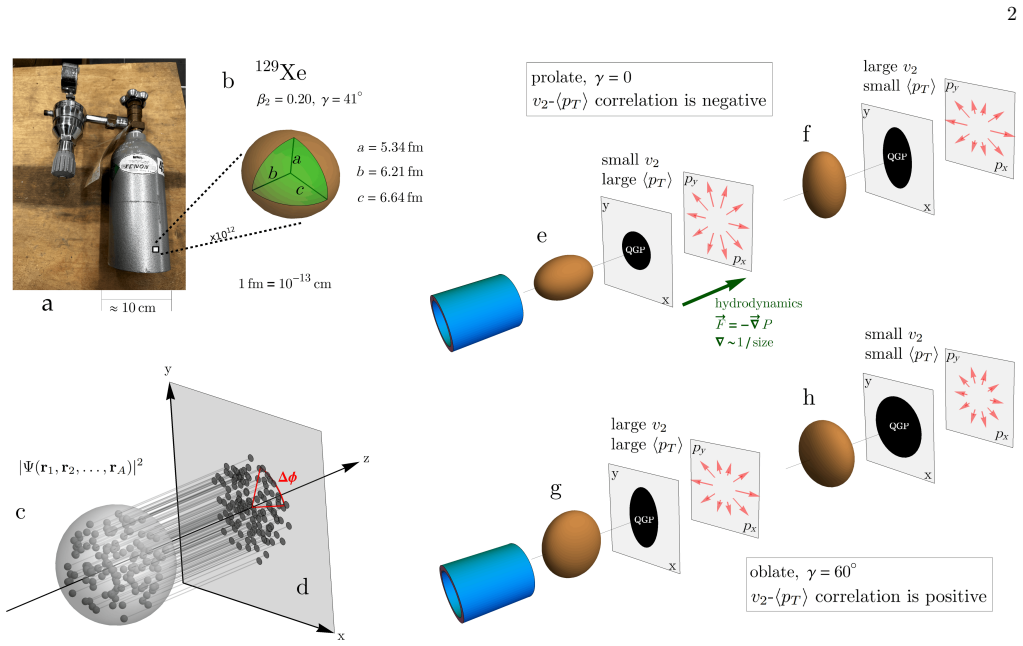
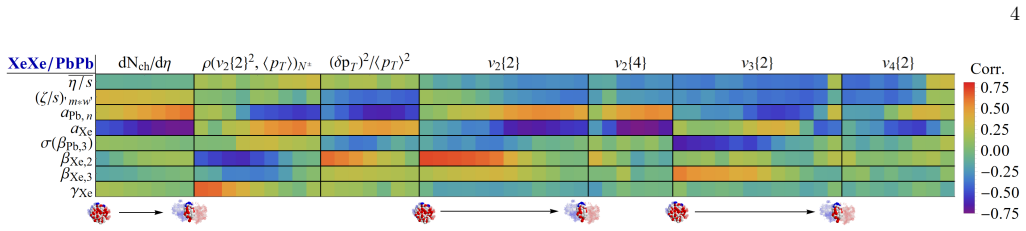
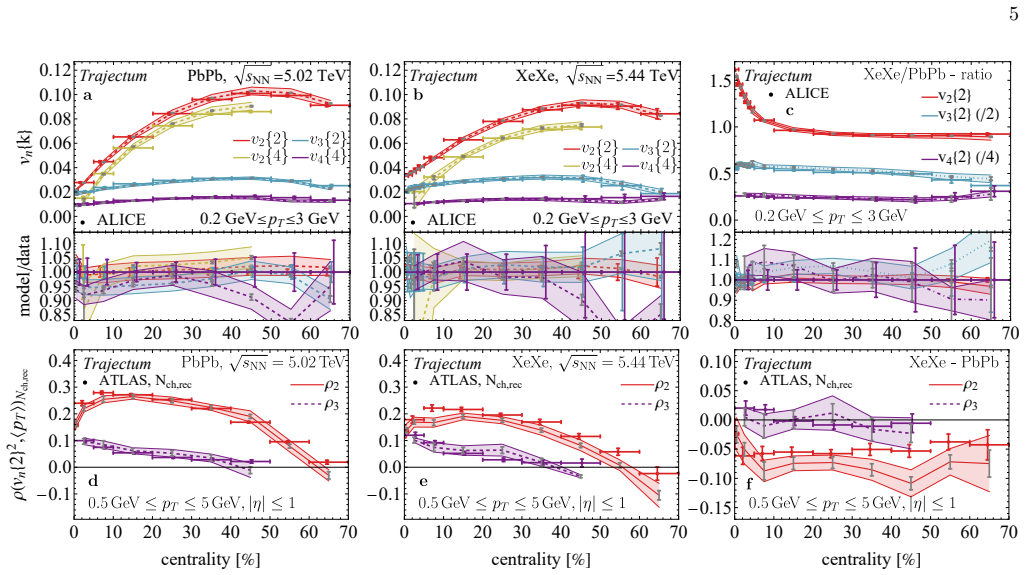
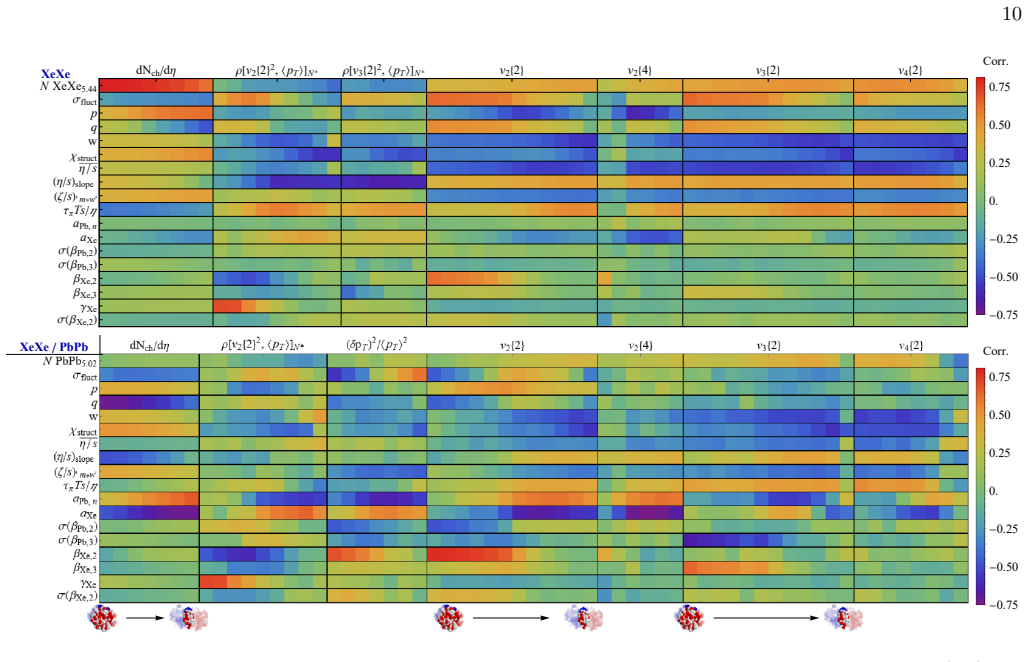
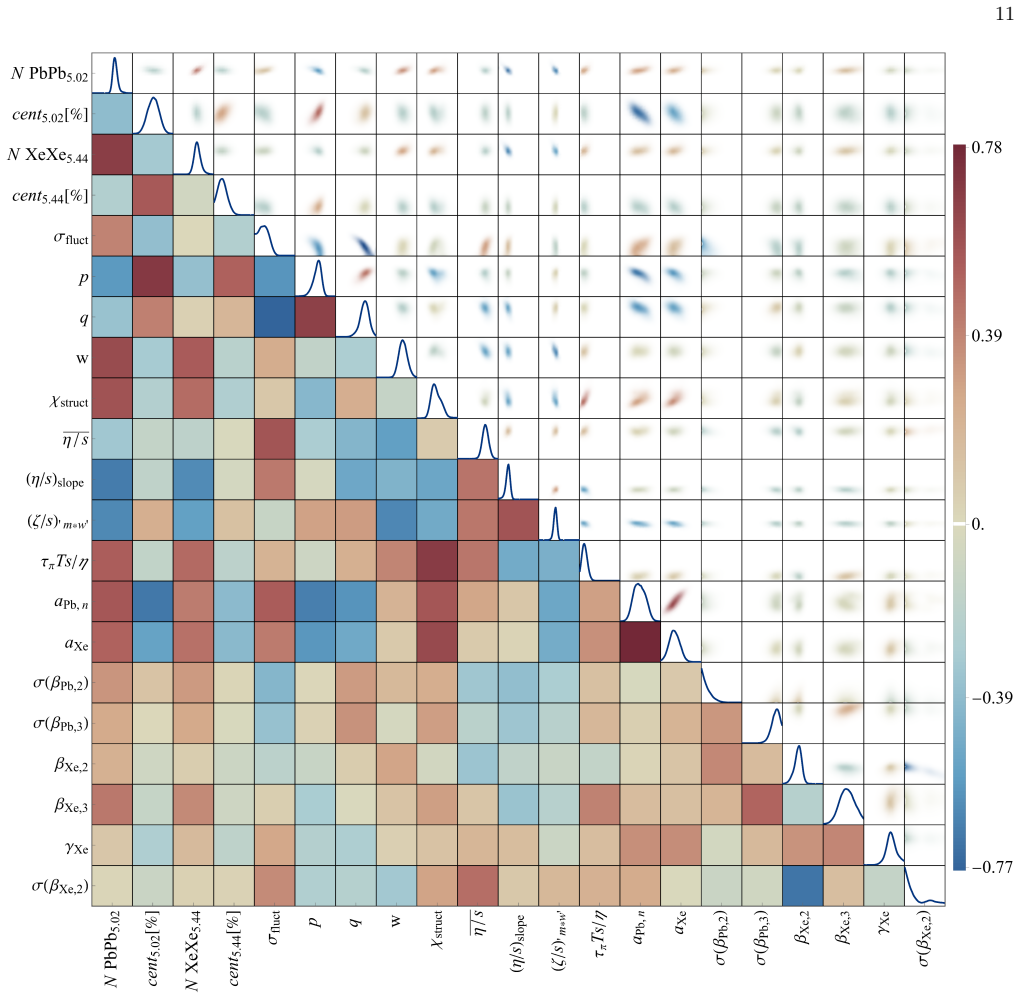
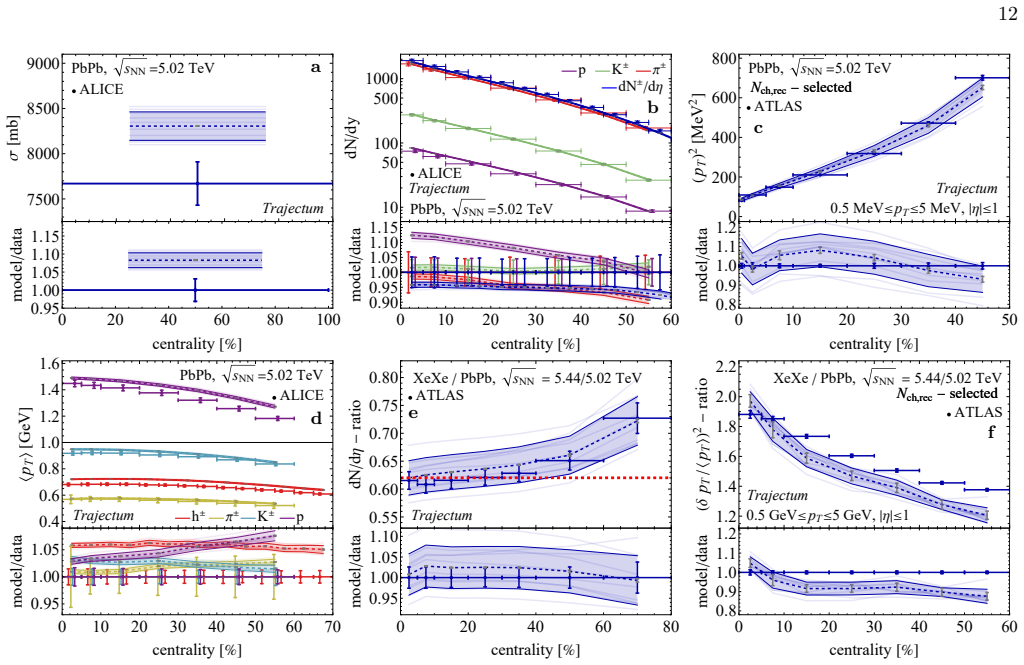
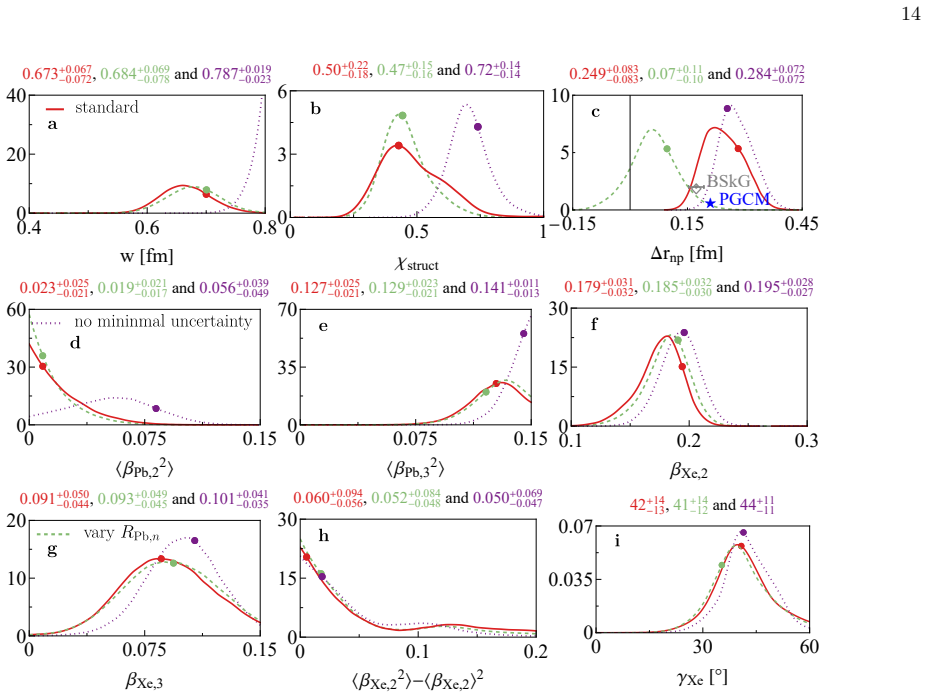
Imaging a quantum many-body system requires probes that resolve the coordinates of its constituents in sufficiently large event samples, allowing measurements of correlation functions [1-4]. High-energy nuclear collisions provide this opportunity on the nuclear scale [5], enabling features of colliding ions, such as their deformation, to be probed through particle correlation observables [6, 7]. However, a quantitative extraction of the correlation properties of nuclei from these measurements is still lacking. Here we show that this is possible for the nucleus $^{129}$Xe using Bayesian inference methods. We combine a deformed-rotor description of the colliding nuclei, which encodes the many-body dynamics of constituent neutrons and protons, with hydrodynamic simulations of the ensuing collision evolution. From a combined global analysis of Large Hadron Collider data on Xe-Xe and Pb-Pb collisions, we then infer that the shape of $^{129}$Xe is nearly maximally triaxial, which aligns with mean-field results for xenon isotopes away from shell closure [8, 9]. From this we evaluate two- and three-particle correlations in the nuclear ground state to provide new constraints for \textit{ab initio} methods in nuclear theory. We establish thus collider experiments as a means of quantifying correlations of protons and neutrons arising from residual forces of quantum chromodynamics.
Editorial analysis
A structured set of objections, weighed in public.
Referee Report
Summary. The manuscript claims that a deformed-rotor parametrization of nuclear ground states, when combined with hydrodynamic simulations of heavy-ion collisions and subjected to a global Bayesian analysis of LHC Xe-Xe and Pb-Pb data, allows quantitative extraction of two- and three-particle correlations in the ¹²⁹Xe ground state. The central result is that ¹²⁹Xe is inferred to be nearly maximally triaxial, consistent with mean-field calculations for xenon isotopes away from shell closure.
Significance. If the mapping from rotor parameters to microscopic correlations holds and the Bayesian extraction is robust, the work would open a new experimental route to constrain nuclear many-body correlations using collider observables, providing falsifiable input for ab initio nuclear theory beyond what is available from low-energy probes alone.
major comments (2)
- [Abstract] Abstract, paragraph beginning 'We combine a deformed-rotor description...': The assertion that the deformed-rotor description 'encodes the many-body dynamics of constituent neutrons and protons' is load-bearing for the triaxiality posterior, yet the manuscript provides no independent validation (e.g., comparison to ab initio calculations or direct tests of short-range correlations) that this collective parametrization faithfully reproduces the relevant two- and three-body correlations; incompleteness here would systematically shift the extracted shape parameters even if hydrodynamics and data are perfect.
- [Abstract] The global Bayesian fit relies on hydrodynamic model parameters that are typically tuned to similar heavy-ion data; without explicit demonstration that the extracted triaxiality is independent of those tunings (e.g., via prior variation or cross-validation against Pb-Pb-only constraints), the inference risks circularity.
minor comments (1)
- [Abstract] The abstract does not specify the form of the likelihood, the choice of priors on the rotor parameters, or the goodness-of-fit metrics used in the global analysis; these details are required for reproducibility.
Simulated Author's Rebuttal
We thank the referee for the thoughtful and constructive report. The two major comments identify important points regarding validation of the model assumptions and robustness of the Bayesian inference. We address each below and outline the revisions we will make.
read point-by-point responses
-
Referee: [Abstract] Abstract, paragraph beginning 'We combine a deformed-rotor description...': The assertion that the deformed-rotor description 'encodes the many-body dynamics of constituent neutrons and protons' is load-bearing for the triaxiality posterior, yet the manuscript provides no independent validation (e.g., comparison to ab initio calculations or direct tests of short-range correlations) that this collective parametrization faithfully reproduces the relevant two- and three-body correlations; incompleteness here would systematically shift the extracted shape parameters even if hydrodynamics and data are perfect.
Authors: We agree that the claim requires stronger support. The deformed-rotor parametrization is a standard collective model whose two- and three-particle correlations are derived analytically from the assumed quadrupole deformation parameters; however, the manuscript does not contain direct comparisons to ab initio results for those correlation functions. In the revised version we will add a dedicated paragraph (and supplementary figure) that compares the rotor-model correlations to available ab initio calculations for nearby xenon isotopes, explicitly stating the level of agreement and the remaining model uncertainty this introduces for the extracted triaxiality. revision: yes
-
Referee: [Abstract] The global Bayesian fit relies on hydrodynamic model parameters that are typically tuned to similar heavy-ion data; without explicit demonstration that the extracted triaxiality is independent of those tunings (e.g., via prior variation or cross-validation against Pb-Pb-only constraints), the inference risks circularity.
Authors: The analysis uses informative priors on the hydrodynamic parameters taken from earlier Pb-Pb studies, and the Xe-Xe data set supplies independent constraints. Nevertheless, the referee correctly notes that explicit tests of robustness against those priors are not shown. In the revision we will include (i) a prior-variation study in which the hydrodynamic priors are widened by a factor of two and the triaxiality posterior is re-extracted, and (ii) a Pb-Pb-only fit whose posterior is compared with the joint Xe-Xe + Pb-Pb result to demonstrate that the Xe-Xe data drive the triaxiality constraint. revision: yes
Circularity Check
No significant circularity in the derivation chain
full rationale
The paper introduces a deformed-rotor description as an explicit modeling assumption that 'encodes the many-body dynamics of constituent neutrons and protons' and then performs a Bayesian global fit of its parameters to LHC Xe-Xe and Pb-Pb data via hydrodynamic simulations. The extracted triaxiality is therefore a fit result constrained by external observables, not a quantity defined in terms of itself or renamed from a prior fit. No equations or self-citations are shown that reduce the central claim to an input by construction, and the cited mean-field results [8,9] serve only for post-hoc alignment rather than load-bearing justification. The derivation remains self-contained against the collision data benchmarks.
Axiom & Free-Parameter Ledger
axioms (2)
- domain assumption Deformed-rotor description accurately encodes the many-body dynamics of neutrons and protons in 129Xe
- domain assumption Hydrodynamic simulations correctly capture the collision evolution from initial nuclear shape to final particle correlations
Reference graph
Works this paper leans on
-
[1]
F. Serwane, G. Z¨ urn, T. Lompe, T. B. Ottenstein, A. N. Wenz, and S. Jochim, Science332, 1201351 (2011), arXiv:1101.2124 [cond-mat.quant-gas]
Pith/arXiv arXiv 2011
-
[2]
T. de Jongh, J. Verstraten, M. Dixmerias, C. Daix, B. Peaudecerf, and T. Yefsah, Phys. Rev. Lett.134, 183403 (2025), arXiv:2411.08776 [cond-mat.quant-gas]
arXiv 2025
- [3]
-
[4]
R. Yao, S. Chi, M. Wang, R. J. Fletcher, and M. Zwierlein, Phys. Rev. Lett.134, 183402 (2025), arXiv:2411.08780 [cond-mat.quant-gas]
arXiv 2025
-
[5]
M. I. Abdulhamidet al.(STAR), Nature635, 67 (2024), arXiv:2401.06625 [nucl-ex]
arXiv 2024
- [6]
- [7]
- [8]
- [9]
- [10]
- [11]
-
[12]
Brandstetteret al., Nature Phys.21, 52 (2025), arXiv:2308.09699 [cond-mat.quant-gas]
S. Brandstetteret al., Nature Phys.21, 52 (2025), arXiv:2308.09699 [cond-mat.quant-gas]
arXiv 2025
-
[13]
S. Brandstetter, C. Heintze, P. Hill, P. M. Preiss, M. Ga lka, and S. Jochim, Phys. Rev. Lett.135, 103401 (2025), arXiv:2409.18954 [cond-mat.quant-gas]
arXiv 2025
-
[14]
L. Adamczyket al.(STAR), Phys. Rev. Lett.115, 222301 (2015), arXiv:1505.07812 [nucl-ex]
Pith/arXiv arXiv 2015
-
[15]
S. Acharyaet al.(ALICE), Phys. Lett. B784, 82 (2018), arXiv:1805.01832 [nucl-ex]
Pith/arXiv arXiv 2018
-
[16]
M. Abdallahet al.(STAR), Phys. Rev. C105, 014901 (2022), arXiv:2109.00131 [nucl-ex]
arXiv 2022
-
[17]
G. Aadet al.(ATLAS), Phys. Rev. C107, 054910 (2023), arXiv:2205.00039 [nucl-ex]
arXiv 2023
-
[18]
Collaborationet al.(ALICE), Phys
A. Collaborationet al.(ALICE), Phys. Lett. B869, 139855 (2025), arXiv:2409.04343 [nucl-ex]
arXiv 2025
-
[19]
Rept. Prog. Phys.88, 108601 (2025), arXiv:2506.17785 [nucl-ex]
arXiv 2025
-
[20]
G. Aadet al.(ATLAS), Phys. Rev. C113, 045205 (2026), arXiv:2509.05171 [nucl-ex]
Pith/arXiv arXiv 2026
-
[21]
I. J. Abualrobet al.(ALICE), (2025), arXiv:2509.06428 [nucl-ex]
arXiv 2025
-
[22]
Hayrapetyanet al.(CMS), (2025), arXiv:2510.02580 [nucl-ex]
A. Hayrapetyanet al.(CMS), (2025), arXiv:2510.02580 [nucl-ex]
arXiv 2025
-
[23]
A. Hayrapetyanet al.(CMS), Phys. Lett. B876, 140359 (2026), arXiv:2510.26766 [nucl-ex]
Pith/arXiv arXiv 2026
-
[24]
J.-Y. Ollitrault, Eur. Phys. J. A59, 236 (2023), arXiv:2308.11674 [nucl-ex]
arXiv 2023
-
[25]
F. Gelis, Int. J. Mod. Phys. E24, 1530008 (2015), arXiv:1508.07974 [hep-ph]
Pith/arXiv arXiv 2015
-
[26]
M. L. Miller, K. Reygers, S. J. Sanders, and P. Steinberg, Ann. Rev. Nucl. Part. Sci.57, 205 (2007), arXiv:nucl- ex/0701025
arXiv 2007
-
[27]
W. Busza, K. Rajagopal, and W. van der Schee, Ann. Rev. Nucl. Part. Sci.68, 339 (2018), arXiv:1802.04801 [hep-ph]
Pith/arXiv arXiv 2018
-
[28]
Bender, P.-H
M. Bender, P.-H. Heenen, and P.-G. Reinhard, Rev. Mod. Phys.75, 121 (2003)
2003
-
[29]
J. Dobaczewski, A. Gade, K. Godbey, R. V. F. Janssens, and W. Nazarewicz, Phys. Rev. Res.7, 043159 (2025), arXiv:2507.05208 [nucl-th]
arXiv 2025
- [30]
-
[31]
S. Bofos, Y. Li, C. Ding, B. Bally, T. Duguet, M. Frosini, and J. Yao, (2026), arXiv:2605.28813 [nucl-th]
Pith/arXiv arXiv 2026
- [32]
-
[33]
J.-P. Blaizot and G. Giacalone, Eur. Phys. J. A61, 220 (2025), arXiv:2504.15421 [nucl-th]
arXiv 2025
- [34]
-
[35]
P. Bozek and W. Broniowski, Phys. Rev. C85, 044910 (2012), arXiv:1203.1810 [nucl-th]
Pith/arXiv arXiv 2012
-
[36]
G. Giacalone, Phys. Rev. Lett.124, 202301 (2020), arXiv:1910.04673 [nucl-th]
arXiv 2020
- [37]
-
[38]
G. Nijs, W. van der Schee, U. G¨ ursoy, and R. Snellings, Phys. Rev. Lett.126, 202301 (2021), arXiv:2010.15130 [nucl-th]
arXiv 2021
-
[39]
G. Nijs, W. van der Schee, U. G¨ ursoy, and R. Snellings, Phys. Rev. C103, 054909 (2021), arXiv:2010.15134 [nucl-th]
arXiv 2021
-
[40]
P. Bozek, Phys. Rev. C93, 044908 (2016), arXiv:1601.04513 [nucl-th]
Pith/arXiv arXiv 2016
-
[41]
H. Mehrabpour, G. Giacalone, and M. W. Luzum, (2026), arXiv:2604.00619 [nucl-th]
arXiv 2026
-
[42]
S. Bofos, B. Bally, T. Duguet, and M. Frosini, (2026), arXiv:2602.09890 [nucl-th]
Pith/arXiv arXiv 2026
-
[43]
J.-P. Blaizot, G. Giacalone, and A. Lovato, (2025), arXiv:2512.18926 [nucl-th]
arXiv 2025
-
[44]
X. Sun, J. Dobaczewski, W. Nazarewicz, and H. Wi- bowo, (2026), arXiv:2605.26088 [nucl-th]
Pith/arXiv arXiv 2026
-
[45]
Hendersonet al., Phys
J. Hendersonet al., Phys. Rev. Lett.134, 062502 (2025)
2025
-
[46]
Belleyet al., (2026), arXiv:2605.11353 [nucl-th]
A. Belleyet al., (2026), arXiv:2605.11353 [nucl-th]
Pith/arXiv arXiv 2026
-
[47]
Z. H. Sun, A. Ekstr¨ om, C. Forss´ en, G. Hagen, G. R. Jansen, and T. Papenbrock, Phys. Rev. X15, 011028 (2025), arXiv:2404.00058 [nucl-th]
arXiv 2025
-
[48]
R. Somasundaram, I. Svensson, S. De, A. E. Deneris, Y. Dietz, P. Landry, A. Schwenk, and I. Tews, Nature Commun.16, 9819 (2025), arXiv:2410.00247 [nucl-th]
arXiv 2025
-
[49]
M. Agostini, G. Benato, J. A. Detwiler, J. Men´ endez, and F. Vissani, Rev. Mod. Phys.95, 025002 (2023), arXiv:2202.01787 [hep-ex]
arXiv 2023
-
[50]
Y. Li, X. Zhang, G. Giacalone, and J. Yao, Phys. Rev. Lett.135, 022301 (2025), arXiv:2502.08027 [nucl-th]
arXiv 2025
-
[51]
D. Aristizabal Sierra, J. Liao, and D. Marfatia, JHEP 06, 141 (2019), arXiv:1902.07398 [hep-ph]
Pith/arXiv arXiv 2019
- [52]
-
[53]
J. Weilet al.(SMASH), Phys. Rev. C94, 054905 (2016), arXiv:1606.06642 [nucl-th]. 8
Pith/arXiv arXiv 2016
-
[54]
smash-transport/smash: Smash-1.8,
D. Oliinychenko, V. Steinberg, J. Weil, M. Kretz, J. Stau- denmaier, S. Ryu, A. Sch¨ afer, J. Rothermel, J. Mohs, F. Li, H. E. (Petersen), L. Pang, D. Mitrovic, A. Gold- schmidt, L. Geiger, J.-B. Rose, J. Hammelmann, and L. Prinz, “smash-transport/smash: Smash-1.8,” (2020)
2020
-
[55]
J. S. Moreland, J. E. Bernhard, and S. A. Bass, Phys. Rev. C92, 011901 (2015), arXiv:1412.4708 [nucl-th]
Pith/arXiv arXiv 2015
- [56]
-
[57]
A. Bazavovet al.(HotQCD), Phys. Rev. D90, 094503 (2014), arXiv:1407.6387 [hep-lat]
Pith/arXiv arXiv 2014
-
[58]
J. E. Bernhard,Bayesian parameter estimation for rela- tivistic heavy-ion collisions, Ph.D. thesis, Duke U. (2018), arXiv:1804.06469 [nucl-th]
Pith/arXiv arXiv 2018
-
[59]
J. E. Bernhard, J. S. Moreland, and S. A. Bass, Nature Phys.15, 1113 (2019)
2019
-
[60]
S. Pratt and G. Torrieri, Phys. Rev. C82, 044901 (2010), arXiv:1003.0413 [nucl-th]
Pith/arXiv arXiv 2010
-
[61]
Acharyaet al.(ALICE), JINST19, P02039 (2024), arXiv:2204.10148 [nucl-ex]
S. Acharyaet al.(ALICE), JINST19, P02039 (2024), arXiv:2204.10148 [nucl-ex]
arXiv 2024
-
[62]
J. Adamet al.(ALICE), Phys. Rev. Lett.116, 222302 (2016), arXiv:1512.06104 [nucl-ex]
Pith/arXiv arXiv 2016
-
[63]
S. Acharyaet al.(ALICE), Phys. Rev. C101, 044907 (2020), arXiv:1910.07678 [nucl-ex]
arXiv 2020
-
[64]
S. Acharyaet al.(ALICE), Phys. Lett. B790, 35 (2019), arXiv:1805.04432 [nucl-ex]
Pith/arXiv arXiv 2019
-
[65]
Acharyaet al.(ALICE), JHEP07, 103 (2018), arXiv:1804.02944 [nucl-ex]
S. Acharyaet al.(ALICE), JHEP07, 103 (2018), arXiv:1804.02944 [nucl-ex]
Pith/arXiv arXiv 2018
-
[66]
W. D. Vousden, W. M. Farr, and I. Mandel, Mon. Not. Roy. Astron. Soc.455, 1919 (2016), arXiv:1501.05823
Pith/arXiv arXiv 1919
-
[67]
D. Foreman-Mackey, D. W. Hogg, D. Lang, and J. Goodman, Publ. Astron. Soc. Pac.125, 306 (2013), arXiv:1202.3665 [astro-ph.IM]
Pith/arXiv arXiv 2013
-
[68]
G. Giacalone, J. Jia, and V. Som` a, Phys. Rev. C104, L041903 (2021), arXiv:2102.08158 [nucl-th]
arXiv 2021
-
[69]
G. Nijs and W. van der Schee, SciPost Phys.15, 041 (2023), arXiv:2112.13771 [nucl-th]
arXiv 2023
-
[70]
H.-j. Xu, W. Zhao, H. Li, Y. Zhou, L.-W. Chen, and F. Wang, Phys. Rev. C108, L011902 (2023), arXiv:2111.14812 [nucl-th]
arXiv 2023
- [71]
-
[72]
H. M¨ antysaari, B. Schenke, C. Shen, and W. Zhao, Phys. Rev. C110, 054913 (2024), arXiv:2409.19064 [nucl-th]
arXiv 2024
-
[73]
Giacaloneet al., (2025), arXiv:2507.01454 [nucl-ex]
G. Giacaloneet al., (2025), arXiv:2507.01454 [nucl-ex]
arXiv 2025
-
[74]
C. Loizides, J. Kamin, and D. d’Enterria, Phys. Rev. C97, 054910 (2018), [Erratum: Phys.Rev.C 99, 019901 (2019)], arXiv:1710.07098 [nucl-ex]
Pith/arXiv arXiv 2018
-
[75]
M. Centelles, X. Roca-Maza, X. Vinas, and M. Warda, Phys. Rev. C82, 054314 (2010), arXiv:1010.5396 [nucl- th]
Pith/arXiv arXiv 2010
-
[76]
G. Giacalone, G. Nijs, and W. van der Schee, Phys. Rev. Lett.131, 202302 (2023), arXiv:2305.00015 [nucl-th]
arXiv 2023
-
[77]
G. Nijs and W. van der Schee, Phys. Rev. Lett.129, 232301 (2022), arXiv:2206.13522 [nucl-th]
arXiv 2022
-
[78]
Giacalone, (2022), arXiv:2208.06839 [nucl-th]
G. Giacalone, (2022), arXiv:2208.06839 [nucl-th]
arXiv 2022
-
[79]
G. Giacalone, B. Schenke, and C. Shen, Phys. Rev. Lett. 128, 042301 (2022), arXiv:2111.02908 [nucl-th]
arXiv 2022
-
[80]
F. Jonas and C. Loizides, Phys. Rev. C104, 044905 (2021), arXiv:2104.14903 [nucl-ex]
arXiv 2021
discussion (0)
Sign in with ORCID, Apple, or X to comment. Anyone can read and Pith papers without signing in.