REVIEW 4 major objections 5 minor 128 references
$\Lambda$XCDM: a running vacuum strategy for crossing the phantom divide
T0 review · 4 major / 5 minor · reviewed 2026-08-04 · deepseek-v4-flash
Pith's one-line read A composite running-vacuum model with a phantom-matter cosmon naturally produces the dark-energy phantom-divide crossing that recent galaxy-survey data suggest near redshift 0.4, and it fits the data better than the standard ΛCDM and CPL pa
desk verdict Careful fit of ΛXCDM to DESI DR2, but the claimed edge over CPL and the crossing 'prediction' are softer than the abstract implies. read the letter →
The pith
A machine-rendered reading of the paper's core claim, the machinery that carries it, and where it could break.
The reading
What carries the argument
The central object is the effective equation-of-state parameter of the composite dark-energy fluid, w_eff(z) = −1 + (1+w_X) Ω_X(z)/Ω_D(z), where Ω_X is the cosmon energy density and Ω_D the total dark-energy density; the phantom-divide crossing occurs exactly when Ω_X(z*) = 0. The two load-bearing pieces are the running vacuum law ρ_vac(H) = ρ_vac^0 + (3ν/8π)(H² − H₀²)m_Pl², whose negative ν makes the vacuum grow by absorbing energy from the cosmon, and the assumption that the cosmon has constant w_X < −1 but negative energy density and positive pressure. The model is reparameterized in terms of (ϵ, w_X, δ) with ϵ = ν(1+w_X) and δ = Ω_X^0(1+w_X), which removes degeneracies with the ΛCDM limi
What would settle it
Use future galaxy-survey and CMB-lensing data to reconstruct the effective dark-energy equation of state w_eff(z) at multiple redshifts; if the reconstruction shows no crossing below z ≈ 1 or a crossing in the opposite direction (quintessence-to-phantom toward the present), the ΛXCDM parameter region preferred here would be excluded. On the model side, a detection that the cosmon's energy density is positive today (ρ_X > 0) would contradict the phantom-matter assumption directly.
Extended reading notes
Core claim
The central claim is that in the ΛXCDM model the effective equation of state of the composite dark-energy fluid, w_eff = −1 + (1+w_X) Ω_X/Ω_D, necessarily crosses the phantom divide from phantom-like to quintessence-like behavior as Ω_X changes sign, provided the cosmon X behaves as phantom matter (w_X < −1, Ω_X < 0 today) and the vacuum runs with coefficient ν < 0 (equivalently ϵ = ν(1+w_X) > 0). The crossing redshift is given by an explicit formula, and when the model is fitted to Planck PR4 CMB data, DESI DR2 BAO data, and either Pantheon+ or DES-Dovekie supernovae, it yields z* ≈ 0.2–0.9 at 95% CL, consistent with the crossing inferred from model-agnostic analyses of the same data. In th
Load-bearing premise
The load-bearing premise is the existence of a 'cosmon' fluid with w_X < −1 and negative energy density today that feeds energy into a running vacuum; the data cannot determine w_X below about −2, so the reported bounds come from the prior −4 ≤ w_X ≤ −1 rather than from the likelihood, and the crossing redshift is a fitted consequence rather than an independent prediction.
Editorial extensions
If this is right
- If correct, the DESI dynamical-dark-energy signal can be realized by a composite running-vacuum model rather than a free parameterization, and the crossing redshift naturally lands in the observed range z ≈ 0.4–0.8 for the preferred parameter region.
- The model provides a better fit to CMB + BAO + supernova data than both ΛCDM and the CPL parameterization, with ΔAIC ≈ 6–8 over ΛCDM, so the extra parameters are statistically compensated.
- In the same parameter region, the coincidence ratio remains bounded with a future maximum of order one, offering an alleviation of the cosmic-coincidence problem without additional priors.
- A wide family of cosmon realizations (any w_X ≲ −1.5) all produce the crossing, making the prediction robust to the microphysical nature of X; the profile likelihood is flat for w_X < −2.
- With the datasets used, the model does not cure the Hubble tension (H0 ≈ 66.7–67.1 km/s/Mpc), and it slightly increases σ12 and S8 compared to ΛCDM, so its success is specific to the phantom-divide crossing and coincidence problem rather than to all cosmological tensions.
Reading between the lines
- If the plateau in the profile likelihood for w_X persists with future data, the cosmon's equation of state may remain permanently underdetermined by distance and CMB data alone, pointing to a need for probes sensitive to negative-energy-density fluids, such as growth or lensing anomalies.
- The paper's string-theory motivation suggests a testable cross-check: if phantom-matter 'bubbles' exist, they could produce anomalous structure formation at z ≈ 5–10, a signature that upcoming high-redshift surveys could confirm or exclude.
- A natural extension, which the authors note, is to let w_X vary with redshift; such a generalization could alter the predicted H0 and might reconcile the model with local distance-ladder measurements.
- Because the model predicts one-way crossings only (phantom-to-quintessence toward the present), a future reconstruction showing the opposite direction—or no crossing below z ≈ 1—would directly falsify this mechanism within the preferred parameter region.
Signed reviews
Editorial analysis
A structured set of objections, weighed in public.
Referee Report
Summary. The paper studies the ΛXCDM composite dark-energy model, in which a running vacuum density exchanges energy with a generic component X ('cosmon'). The authors derive analytic expressions for the effective equation of state, the energy densities, the coincidence ratio, and the phantom-crossing redshift z*, and then fit the model with three additional parameters (ϵ, w_X, δ) to Planck PR4 CMB, DESI DR2 BAO, and either Pantheon+ or DES-Dovekie SNIa data using CLASS/Cobaya/GetDist. They report that ΛXCDM improves the fit over ΛCDM by Δχ²≈12–14 and over CPL by Δχ²≈2.9–3.8, gives ΛCDM exclusion significances of 2.68σ/2.97σ, produces a phantom-divide crossing at z*≈0.4–0.8, and alleviates the cosmic coincidence problem. The paper explicitly acknowledges non-Gaussian posteriors, a relaxed convergence criterion, and a flat profile likelihood for w_X.
Significance. If the central claim were fully established, the paper would be significant: it would offer a theoretically motivated composite DE model, with analytic control, that reproduces the DESI crossing and simultaneously addresses cosmic coincidence, going beyond the phenomenological CPL parametrization. The use of public likelihoods and standard MCMC tools, together with analytic background expressions and a transparent profile-likelihood analysis, are strengths. However, the statistical evidence for the advertised claims is weaker than the abstract suggests: the improvement over CPL is marginal after parameter counting, the ΛCDM exclusion is computed in a regime where Wilks' theorem is questionable, the key parameter w_X is prior-dominated, and the claimed crossing redshift is an output of the fit to the same data from which the crossing is inferred. These issues are load-bearing for the paper's main conclusions, but they are correctable by reframing the claims and adding calibrated model-comparison statistics.
major comments (4)
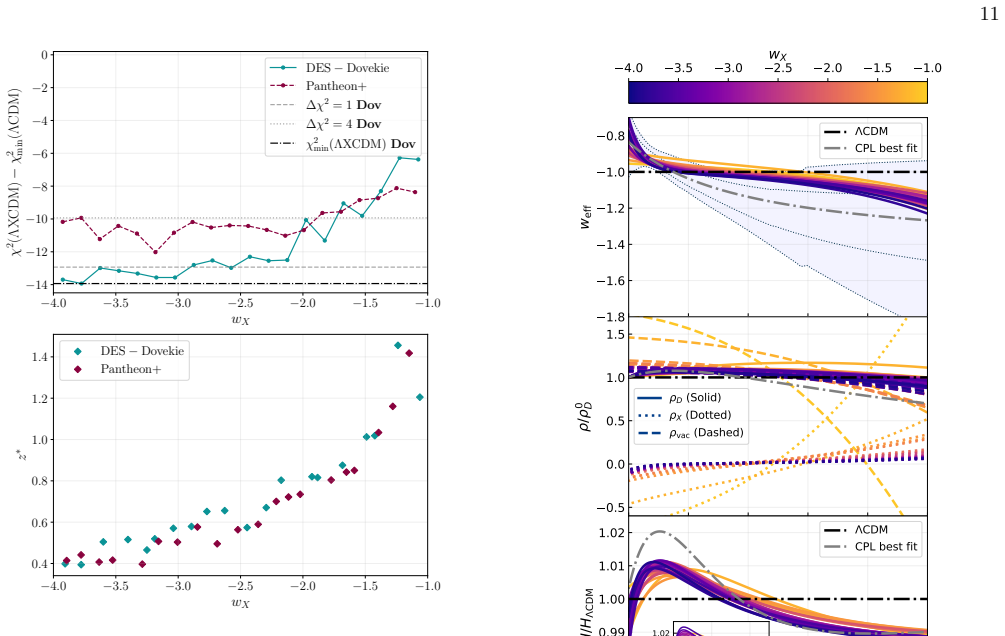
- [§4, Table 1] The abstract and §4 state that ΛXCDM 'provides a better fit than w0waCDM'. This is not supported after penalizing the extra parameter. From Table 1, Δχ²(ΛXCDM−CPL) = 12381.87−12385.64 = −3.77 for Pantheon+ and 12608.36−12611.22 = −2.86 for DES-Dovekie, but ΛXCDM has one more parameter than CPL. The corresponding ΔAIC values in favor of ΛXCDM are only 1.77 and 0.86, well below the Jeffreys' 'positive evidence' threshold that the paper itself adopts. The 'strong evidence' ΔAIC≈6–8 quoted in §4 is relative to ΛCDM, not to CPL. The claim of outperforming CPL should be softened or supported by a calibrated model-comparison statistic.
- [§3, Table 1, §4] The reported exclusion significances for ΛCDM (EΛCDM=2.68σ/2.97σ) are computed via the likelihood-ratio test with Wilks' theorem, but the assumptions are violated. The ΛCDM limit corresponds to w_X=−1, which is the boundary of the prior −4≤w_X≤−1, and the parameter ϵ=ν(1+w_X) is also degenerate along that line. The authors themselves note the 'non-Gaussian features' and relax the convergence criterion for the chains, and the profile likelihood in Fig. 1 is flat for w_X<−2. In such settings Wilks' theorem is not valid, so the quoted p-values and equivalent Gaussian significances are overconfident. I would ask for a simulation-based calibration of the likelihood-ratio statistic, or at least a clear caveat that the 2.68σ/2.97σ numbers are not reliable as evidence against ΛCDM.
- [§2, Eq. (25); §4, Fig. 1] The phantom-divide crossing redshift z* is presented as a key success ('naturally performs the crossing... as observed by DESI'), but it is not an independent prediction. Equation (25) expresses z* directly in terms of the fitted parameters (ν, w_X, Ω_X^0), and the lower panel of Fig. 1 plots z* as a function of the profiled w_X. Since the same CMB+BAO+SNIa data are used both to fit the model and to infer the 'observed' crossing from CPL and model-agnostic reconstructions, the agreement is a consistency check rather than a prediction. The manuscript should explicitly label z* as a derived postdiction and, if predictive power is claimed, provide an out-of-sample test or use a dataset split.
- [§3, Fig. 1; §4; Conclusions] The central physical ingredient, phantom matter with w_X<−1 and ρ_X<0, is not constrained by the data. The profile likelihood for w_X is flat in the entire range w_X<−2, and the 95% upper limits w_X<−1.66/−1.96 are set by the arbitrary prior boundary at w_X=−4, as the authors acknowledge. The statement in the Conclusions that the fit picks out 'w_X<−1.5' is therefore a prior/methodology effect, not a data-driven result. Relatedly, the abstract's 'from first principles' wording overstates the status of the model: the cosmon is left completely unspecified, and ν and w_X are free parameters. I recommend rewriting the abstract and conclusions to distinguish the model's theoretical motivation from what the data actually establish.
minor comments (5)
- [Table 1] For the Pantheon+ ΛXCDM column, the δ parameter is printed as '−0.107 +0.047 −0.063' (or similar), which conflicts with the text's claim that δ is positive and quintessence-like at present. Check the sign/formatting of this entry; the Dovekie value appears positive.
- [Fig. 1] The upper panel labels 'Δχ²=1 Dov' and 'Δχ²=4 Dov' are useful, but the corresponding horizontal lines are not described in the caption. State explicitly what these thresholds represent (e.g., 1σ and 2σ for one degree of freedom).
- [§3] The convergence criterion is relaxed from R−1=0.02 for ΛCDM/CPL to R−1=0.03 for ΛXCDM. This is disclosed, but it would be helpful to report the final R−1 values and chain lengths in the appendix so the reader can judge whether the relaxed criterion is sufficient.
- [Eq. (25)] The expression for z* would benefit from a short derivation or cross-reference to the definition of ϵ and δ in terms of the original parameters (ν, w_X, Ω_X^0), because the text jumps from Eq. (22) to the compact formula. This is a clarity issue, not a technical error.
- [Abstract and §5] The phrase 'from first principles' appears twice in the abstract and is repeated in the Conclusions. Given the unspecified nature of X and the phenomenological parametrization of the running vacuum, a more cautious phrase such as 'theoretically motivated' would be more accurate.
Circularity Check
The empirical fit is self-contained, but the advertised 'first-principles' status of ΛXCDM rests on a load-bearing self-citation chain; the crossing redshift is a postdiction, not an independent prediction.
-
self citation load bearing
[Abstract; Sec. 5 (Conclusions)]
"Given that PM appears in stringy versions of the RVM (Mavromatos & Solà Peracaula 2021a,b), the ΛXCDM appears to be a composite DDE model with a good chance of explaining the crossing of the phantom divide from first principles"
The 'from first principles' claim is not derived in this paper; it is imported from prior works by the same authors (Mavromatos & Solà Peracaula 2021a,b; Solà Peracaula 2022, 2026; Moreno-Pulido & Solà Peracaula 2020, 2022). The model's distinctive ingredient, the cosmon with w_X<-1 and negative energy density, is an assumed input (the paper states 'we have just assumed that its EoS is constant and lies somewhere in the deep PM domain'). Thus the advertised fundamentality reduces to a self-citation chain rather than an independent derivation. The numerical fit to DESI/CMB/SN data is, however, independently computed and does not reduce to these citations.
full rationale
No construction-level circularity is present in the main derivation. Equations (1)-(11) define the ΛXCDM model; weff (Eq. 2) and z* (Eq. 25) are mathematical consequences of those definitions and of the parameter signs returned by the fit. The likelihood is not defined in terms of z*, and the model could in principle return no crossing, so the crossing redshift is a postdiction rather than a fitted input. Calling it a 'prediction' would overstate the case, but that is a framing issue, not a definitional equivalence. The claim that ΛXCDM fits the data better than CPL is assessed through Δχ² and ΔAIC against external DESI DR2, Planck PR4 and SNIa data, independent of self-citations. The flat profile in w_X and the prior-dominated 95% bounds are statistical validity concerns, not circularity. The only circularity-adjacent element is the 'from first principles' conclusion, which leans on self-cited prior RVM/stringy-RVM work rather than on a derivation contained in this paper; hence score 4 rather than 0.
Assumptions & free parameters
free parameters (3)
- ϵ ≡ ν(1 + w_X) =
~0.024-0.026 (best fit, positive)
- w_X (cosmon EoS) =
only upper bound: < -1.66 (Pan) / < -1.96 (Dov) at 95% CL; profile flat for w_X < -2
- δ ≡ Ω_X^0 (1 + w_X) =
~0.11-0.15 (best fit, positive)
assumptions (6)
- domain assumption Running vacuum form ρ_vac(H) = ρ0_vac + (3ν/8π)(H² - H0²)m_Pl² (Eq. 1)
- domain assumption Vacuum equation of state is canonical, P_vac = -ρ_vac
- domain assumption Only vacuum and cosmon exchange energy; matter (dust and radiation) is self-conserved
- domain assumption Cosmon X has a constant barotropic EoS w_X
- domain assumption Dark energy does not cluster (sound speed c_s = 1)
- domain assumption Spatially flat ΛCDM background with standard neutrino hierarchy (one massive neutrino, 0.06 eV)
invented entities (1)
-
Cosmon X (phantom matter)
Cite this review
Pith. "Pith review of $\Lambda$XCDM: a running vacuum strategy for crossing the phantom divide." pith.science (2026). https://pith.science/paper/JGXDU73Z
@misc{pith2026260726050,
  author       = {Pith},
  title        = {Pith review of: $\Lambda$XCDM: a running vacuum strategy for crossing the phantom divide},
  year         = {2026},
  howpublished = {\url{https://pith.science/paper/JGXDU73Z}},
  note         = {Machine review of arXiv:2607.26050}
}
abstract
Composite dynamical dark energy (DDE) has recently been explored as an efficient way to help cure cosmological tensions through the so-called $w$XCDM model (Gomez-Valent & Sol\`a Peracaula 2024; 2025), a toy-model version of the $\Lambda$XCDM model (Grande et al., 2006). The latter is a composite running vacuum model (RVM) that involves a DE component $X$ (`cosmon') of generic nature. We compute the effective equation of state of $\Lambda$XCDM and use state-of-the-art techniques to fit this model to two standard sets of cosmological data, one involving SNIa from Pantheon$+$ and the other SNIa from DES-Dovekie, in addition to BAO data from DESI DR2 and the CMB data from Planck PR4. We do not use large scale structure formation data for this analysis nor the SH0ES calibration of $H_0$. We find that $\Lambda$XCDM naturally performs the crossing of the phantom divide as observed by DESI near $z\simeq 0.4$ using the $w_0w_a$CDM parameterization, a feature well favored by existing model-agnostic analyzes of the same data (Gonz\'alez-Fuentes & G\'omez-Valent:2025; 2026). It turns out that the cosmon $X$ behaves as `phantom matter' (PM) near the present, which in contrast to usual phantom DE satisfies the strong energy condition (as ordinary matter) and furnishes positive pressure ($P_X>-\rho_X>0$) at the expense of negative energy density ($\rho_X<0$). $\Lambda$XCDM provides a better fit than $w_0w_a$CDM and, as a bonus, alleviates the cosmic coincidence problem. Given that PM appears in stringy versions of the RVM (Mavromatos & Sol\`a Peracaula 2021 a,b) , the $\Lambda$XCDM appears to be a composite DDE model with a good chance of explaining the crossing of the phantom divide from first principles, therefore providing theoretical support to the DESI observations inferred from generic parameterizations of the DE.
Figures


Figures from the paper (2 more)


Reference graph
Works this paper leans on
-
[1]
Abbott, T. M. C., et al. 2024, Astrophys. J. Lett., 973, L14, 10.3847/2041-8213/ad6f9f
-
[2]
---. 2026. 2602.10065
arXiv 2026
-
[3]
2022, JHEAp, 34, 49, 10.1016/j.jheap.2022.04.002
Abdalla, E., et al. 2022, JHEAp, 34, 49, 10.1016/j.jheap.2022.04.002
-
[4]
Abdul Karim, M., et al. 2025, Phys. Rev. D, 112, 083515, 10.1103/tr6y-kpc6
-
[5]
Adame, A. G., et al. 2025, JCAP, 02, 021, 10.1088/1475-7516/2025/02/021
-
[6]
Ade, P. A. R., et al. 2016, Astron. Astrophys., 594, A13, 10.1051/0004-6361/201525830
-
[7]
Adil, S. A., Mukhopadhyay, U., Sen, A. A., & Vagnozzi, S. 2023, JCAP, 10, 072, 10.1088/1475-7516/2023/10/072
-
[8]
Aghanim, N., et al. 2020, Astron. Astrophys., 641, A6, 10.1051/0004-6361/201833910
Show all 128 references
-
[9]
1974, IEEE Trans
Akaike, H. 1974, IEEE Trans. Autom. Control, 19, 716, 10.1109/TAC.1974.1100705
1974
-
[10]
D., Escamilla, L
Akarsu, \"O ., Barrow, J. D., Escamilla, L. A., & Vazquez, J. A. 2020, Phys. Rev. D, 101, 063528, 10.1103/PhysRevD.101.063528
2020 doi
-
[11]
O ., Kumar, S., \
Akarsu, \"O ., Kumar, S., \"Oz\"ulker, E., & Vazquez, J. A. 2021, Phys. Rev. D, 104, 123512, 10.1103/PhysRevD.104.123512
2021 doi
-
[12]
O ., Perivolaropoulos, L., Y \
Akarsu, \"O ., Perivolaropoulos, L., Y \"u kselci, A. E., & Zhuk, A. 2026. 2606.11062
2026 arXiv
-
[13]
Akarsu, \"O ., et al. 2023. 2307.10899
2023 arXiv
-
[14]
2021, Phys
Alestas, G., Kazantzidis, L., & Perivolaropoulos, L. 2021, Phys. Rev. D, 103, 083517, 10.1103/PhysRevD.103.083517
2021 doi
-
[15]
2022, Phys
Alestas, G., et al. 2022, Phys. Rev. D, 105, 063538, 10.1103/PhysRevD.105.063538
2022 doi
-
[16]
E., & Saridakis, E
Asimakis, P., Basilakos, S., Mavromatos, N. E., & Saridakis, E. N. 2022, Phys. Rev. D, 105, 084010, 10.1103/PhysRevD.105.084010
2022 doi
- [17]
-
[18]
2014, Mon
Basilakos, S., & Sol\`a, J. 2014, Mon. Not. Roy. Astron. Soc., 437, 3331, 10.1093/mnras/stt2135
2014 doi
-
[19]
2010, JCAP, 12, 029, 10.1088/1475-7516/2010/12/029
Bauer, F., Sola, J., & Stefancic, H. 2010, JCAP, 12, 029, 10.1088/1475-7516/2010/12/029
2010 doi
-
[20]
2018, Phys
Beltr \'a n Jim \'e nez, J., Heisenberg, L., & Koivisto, T. 2018, Phys. Rev. D, 98, 044048, 10.1103/PhysRevD.98.044048
2018 doi
-
[21]
2025, Phys
Berti, M., Bellini, E., Bonvin, C., et al. 2025, Phys. Rev. D, 112, 023518, 10.1103/dj3k-84v4
2025 doi
-
[22]
2011, JCAP, 1107, 034, 10.1088/1475-7516/2011/07/034
Blas, D., Lesgourgues, J., & Tram, T. 2011, JCAP, 1107, 034, 10.1088/1475-7516/2011/07/034
2011 doi
-
[23]
Bouhmadi-L \'o pez, M., Chiang, H.-W., & Ibarra-Uriondo, B. 2026. 2607.05044
2026 arXiv
- [24]
-
[25]
2026, Res
Cai, R.-G., & Wang, S.-J. 2026, Res. Astron. Astrophys., 26, 084011, 10.1088/1674-4527/ae842f
2026 doi
-
[26]
2026, Natl
Cai, Y., Ren, X., Qiu, T., Li, M., & Zhang, X. 2026, Natl. Sci. Rev., 13, nwag115, 10.1093/nsr/nwag115
2026 doi
-
[27]
Cai, Y.-F., Capozziello, S., De Laurentis, M., & Saridakis, E. N. 2016, Rept. Prog. Phys., 79, 106901, 10.1088/0034-4885/79/10/106901
2016 doi
-
[28]
2024, JCAP, 10, 048, 10.1088/1475-7516/2024/10/048
Calder\'on, R., et al. 2024, JCAP, 10, 048, 10.1088/1475-7516/2024/10/048
2024 doi
-
[29]
2011, Phys
Capozziello, S., & De Laurentis, M. 2011, Phys. Rept., 509, 167, 10.1016/j.physrep.2011.09.003
2011 doi
-
[30]
2022, JCAP, 09, 039, 10.1088/1475-7516/2022/09/039
Carron, J., Mirmelstein, M., & Lewis, A. 2022, JCAP, 09, 039, 10.1088/1475-7516/2022/09/039
2022 doi
-
[31]
K., Das, S., & Dutta, K
Chakraborty, A., Chanda, P. K., Das, S., & Dutta, K. 2025, JCAP, 11, 047, 10.1088/1475-7516/2025/11/047
2025 doi
-
[32]
2026, Astrophys
Chakraborty, A., Ray, T., Das, S., Banerjee, A., & Ganesan, V. 2026, Astrophys. J., 998, 83, 10.3847/1538-4357/ae2ff8
2026 doi
-
[33]
2001, Int
Chevallier, M., & Polarski, D. 2001, Int. J. Mod. Phys., D10, 213, 10.1142/S0218271801000822
2001 doi
- [34]
-
[35]
S., & Khoury, J
Das, S., Corasaniti, P. S., & Khoury, J. 2006, Phys. Rev. D, 73, 083509, 10.1103/PhysRevD.73.083509
2006 doi
-
[36]
2026, Phys
de Cruz P \'e rez, J., G \'o mez-Valent, A., & Sol \`a Peracaula, J. 2026, Phys. Rev. D, 113, 083521, 10.1103/xchk-xlk1
2026 doi
-
[38]
2021 b , Astropart
---. 2021 b , Astropart. Phys., 131, 102604, 10.1016/j.astropartphys.2021.102604
2021
-
[39]
2019, 10.21105/astro.1910.00483
Efstathiou, G., & Gratton, S. 2019, 10.21105/astro.1910.00483
2019 arXiv
-
[40]
2026, Phys
Errahmani, A., Magrach, M., Dahmani, S., Bouali, A., & Ouali, T. 2026, Phys. Lett. B, 872, 140040, 10.1016/j.physletb.2025.140040
2026
-
[41]
2024, Phys
Favale, A., G \'o mez-Valent, A., & Migliaccio, M. 2024, Phys. Lett. B, 858, 139027, 10.1016/j.physletb.2024.139027
2024
-
[42]
2025, Phys
Forconi, M., Favale, A., & G \'o mez-Valent, A. 2025, Phys. Rev. D, 112, 023517, 10.1103/rpf5-ldks
2025 doi
-
[43]
Gelman, A., & Rubin, D. B. 1992, Statistical Science, 7, 457, 10.1214/ss/1177011136
1992
-
[44]
Goh, L. W. K., & Taylor, A. N. 2025, Mon. Not. Roy. Astron. Soc., 544, 3142, 10.1093/mnras/staf1927
2025 doi
-
[45]
2022, Phys
G \'o mez-Valent, A. 2022, Phys. Rev. D, 106, 063506, 10.1103/PhysRevD.106.063506
2022 doi
-
[46]
G\'omez-Valent, A., Favale, A., Migliaccio, M., & Sen, A. A. 2024, Phys. Rev. D, 109, 023525, 10.1103/PhysRevD.109.023525
2024 doi
-
[47]
2026, Phys
G \'o mez-Valent, A., & Gonz \'a lez-Fuentes, A. 2026, Phys. Lett. B, 872, 140096, 10.1016/j.physletb.2025.140096
2026
-
[48]
E., & Sol\`a Peracaula, J
G\'omez-Valent, A., Mavromatos, N. E., & Sol\`a Peracaula, J. 2023, Class. Quant. Grav., 41, 015026, 10.1088/1361-6382/ad0fb8
2023 doi
-
[49]
2018, Mon
G \' o mez-Valent, A., & Sol \` a Peracaula, J. 2018, Mon. Not. Roy. Astron. Soc., 478, 126, 10.1093/mnras/sty1028
2018 doi
-
[50]
2024, Astrophys
G\'omez-Valent, A., & Sol \`a Peracaula, J. 2024, Astrophys. J., 975, 64, 10.3847/1538-4357/ad7a62
2024 doi
-
[51]
2025, Phys
G \'o mez-Valent, A., & Sol \`a Peracaula, J. 2025, Phys. Lett. B, 864, 139391, 10.1016/j.physletb.2025.139391
2025
-
[52]
G \'o mez-Valent, A., Zheng, Z., & Amendola, L. 2026. 2604.12032
2026 arXiv
-
[53]
2021, Phys
G \'o mez-Valent, A., Zheng, Z., Amendola, L., Pettorino, V., & Wetterich, C. 2021, Phys. Rev. D, 104, 083536, 10.1103/PhysRevD.104.083536
2021 doi
-
[54]
2025, JCAP, 12, 049, 10.1088/1475-7516/2025/12/049
Gonz \'a lez-Fuentes, A., & G \'o mez-Valent, A. 2025, JCAP, 12, 049, 10.1088/1475-7516/2025/12/049
2025 doi
-
[55]
2026, JCAP, 07, 040, 10.1088/1475-7516/2026/07/040
---. 2026, JCAP, 07, 040, 10.1088/1475-7516/2026/07/040
2026 doi
-
[56]
2009, Phys
Grande, J., Pelinson, A., & Sol\`a, J. 2009, Phys. Rev. D, 79, 043006, 10.1103/PhysRevD.79.043006
2009 doi
-
[57]
2006, JCAP, 08, 011, 10.1088/1475-7516/2006/08/011
Grande, J., Sol\`a, J., & Stefancic, H. 2006, JCAP, 08, 011, 10.1088/1475-7516/2006/08/011
2006 doi
- [58]
-
[59]
Harko, T., Lobo, F. S. N., Nojiri, S., & Odintsov, S. D. 2011, Phys. Rev. D, 84, 024020, 10.1103/PhysRevD.84.024020
2011 doi
-
[60]
1970, Biometrika, 57, 97, 10.1093/biomet/57.1.97
Hastings, W. 1970, Biometrika, 57, 97, 10.1093/biomet/57.1.97
1970 doi
-
[61]
2022, Phys
Heisenberg, L., Villarrubia-Rojo, H., & Zosso, J. 2022, Phys. Rev. D, 106, 043503, 10.1103/PhysRevD.106.043503
2022 doi
-
[62]
S., & Vagnozzi, S
Jiang, J.-Q., Pedrotti, D., da Costa, S. S., & Vagnozzi, S. 2024, Phys. Rev. D, 110, 123519, 10.1103/PhysRevD.110.123519
2024 doi
-
[63]
E., & Shafieloo, A
Keeley, R. E., & Shafieloo, A. 2023, Phys. Rev. Lett., 131, 111002, 10.1103/PhysRevLett.131.111002
2023 doi
-
[64]
2025, Phys
Khoury, J., Lin, M.-X., & Trodden, M. 2025, Phys. Rev. Lett., 135, 181001, 10.1103/w4qb-plk8
2025 doi
-
[65]
2020, Phys
Knox, L., & Millea, M. 2020, Phys. Rev. D, 101, 043533, 10.1103/PhysRevD.101.043533
2020 doi
-
[66]
\'O ., Sheikh-Jabbari, M
Krishnan, C., Mohayaee, R., Colg \'a in, E. \'O ., Sheikh-Jabbari, M. M., & Yin, L. 2021, Class. Quant. Grav., 38, 184001, 10.1088/1361-6382/ac1a81
2021 doi
-
[67]
2023, Nature, 616, 266, 10.1038/s41586-023-05786-2
Labb\'e, I., et al. 2023, Nature, 616, 266, 10.1038/s41586-023-05786-2
2023 doi
-
[68]
\'O ., Sheikh-Jabbari, M
Lee, B.-H., Lee, W., Colg \'a in, E. \'O ., Sheikh-Jabbari, M. M., & Thakur, S. 2022, JCAP, 04, 004, 10.1088/1475-7516/2022/04/004
2022 doi
-
[69]
Lesgourgues, J. 2011. 1104.2932
2011 arXiv
-
[70]
Lewis, A. 2019. 1910.13970
2019 arXiv
-
[71]
2025, Eur
Li, J.-X., & Wang, S. 2025, Eur. Phys. J. C, 85, 1308, 10.1140/epjc/s10052-025-15065-1
2025 doi
-
[72]
Li, T.-N., Giar \`e , W., Du, G.-H., et al. 2026. 2601.07361
2026 arXiv
-
[73]
Linder, E. V. 2003, Phys. Rev. Lett., 90, 091301, 10.1103/PhysRevLett.90.091301
2003 doi
- [74]
-
[75]
2021, Phys
Marra, V., & Perivolaropoulos, L. 2021, Phys. Rev. D, 104, L021303, 10.1103/PhysRevD.104.L021303
2021 doi
-
[76]
M., Croitoru, C., & Harko, T
Matei, T. M., Croitoru, C., & Harko, T. 2026, Phys. Dark Univ., 53, 102362, 10.1016/j.dark.2026.102362
2026
-
[77]
E., & Sol\`a Peracaula, J
Mavromatos, N. E., & Sol\`a Peracaula, J. 2021 a , Eur. Phys. J. ST, 230, 2077, 10.1140/epjs/s11734-021-00197-8
2021 doi
- [78]
-
[79]
A., Mukhopadhyay, U., Sen, A
Menci, N., Adil, S. A., Mukhopadhyay, U., Sen, A. A., & Vagnozzi, S. 2024, JCAP, 07, 072, 10.1088/1475-7516/2024/07/072
2024 doi
-
[80]
Metropolis, N., et al. 1953, J. Chem. Phys., 21, 1087, 10.1063/1.1699114
1953 doi
-
[81]
G., & Nagataki, S
Montani, G., Navone, I., Dainotti, M. G., & Nagataki, S. 2026, 10.1103/xthk-9854
2026 doi
-
[82]
2020, Eur
Moreno-Pulido, C., & Sol\`a Peracaula, J. 2020, Eur. Phys. J. C, 80, 692, 10.1140/epjc/s10052-020-8238-6
2020 doi
- [83]
-
[84]
2022, Eur
Moreno-Pulido, C., & Sol \` a Peracaula, J. 2022, Eur. Phys. J. C, 82, 1137, 10.1140/epjc/s10052-022-11117-y
2022 doi
-
[85]
2023, Eur
Moreno-Pulido, C., Sol\`a Peracaula, J., & Cheraghchi, S. 2023, Eur. Phys. J. C, 83, 637, 10.1140/epjc/s10052-023-11772-9
2023 doi
-
[86]
Neyman, J., & Pearson, E. S. 1933, Philosophical Transactions of the Royal Society of London. Series A, 231, 289, 10.1098/rsta.1933.0009
1933
- [87]
-
[88]
D., Sol \` a , J., & Wetterich, C
Peccei, R. D., Sol \` a , J., & Wetterich, C. 1987, Phys. Lett., B195, 183, 10.1016/0370-2693(87)91191-9
1987 doi
-
[89]
A., Marra, V., Perivolaropoulos, L., & Vagnozzi, S
Pedrotti, D., Escamilla, L. A., Marra, V., Perivolaropoulos, L., & Vagnozzi, S. 2026, Phys. Rev. D, 113, 043507, 10.1103/pn9j-8whx
2026 doi
-
[90]
Peebles, P. J. E., & Ratra, B. 2003, Rev. Mod. Phys., 75, 559, 10.1103/RevModPhys.75.559
2003 doi
-
[91]
2021, Phys
Perivolaropoulos, L., & Skara, F. 2021, Phys. Rev. D, 104, 123511, 10.1103/PhysRevD.104.123511
2021 doi
-
[92]
2022 a , Universe, 8, 502, 10.3390/universe8100502
---. 2022 a , Universe, 8, 502, 10.3390/universe8100502
2022 doi
-
[93]
2022 b , New Astron
---. 2022 b , New Astron. Rev., 95, 101659, 10.1016/j.newar.2022.101659
2022
-
[94]
2026, Mon
Popovic, B., et al. 2026, Mon. Not. Roy. Astron. Soc., 548, stag632, 10.1093/mnras/stag632
2026 doi
-
[95]
G., et al
Riess, A. G., et al. 2022, Astrophys. J. Lett., 934, L7, 10.3847/2041-8213/ac5c5b
2022 doi
-
[96]
2022, Mon
Rosenberg, E., Gratton, S., & Efstathiou, G. 2022, Mon. Not. Roy. Astron. Soc., 517, 4620, 10.1093/mnras/stac2744
2022 doi
-
[97]
A., Escamilla, L
Sabogal, M. A., Escamilla, L. A., Pedrotti, D., Selimaj, E., & Vagnozzi, S. 2026. 2607.21244
2026 arXiv
-
[98]
S\'anchez, A. G. 2020, Phys. Rev. D, 102, 123511, 10.1103/PhysRevD.102.123511
2020 doi
-
[99]
2022, Mon
Semenaite, A., et al. 2022, Mon. Not. Roy. Astron. Soc., 512, 5657, 10.1093/mnras/stac829
2022 doi
- [100]
-
[101]
Sol\`a, J. 2011, J. Phys. Conf. Ser., 283, 012033, 10.1088/1742-6596/283/1/012033
2011 doi
-
[102]
Sol \` a , J. 2013, J. Phys. Conf. Ser., 453, 012015, 10.1088/1742-6596/453/1/012015
2013 doi
-
[103]
2017, Astrophys
Sol\`a, J., Gómez-Valent, A., & de Cruz Pérez, J. 2017, Astrophys. J., 836, 43, 10.3847/1538-4357/836/1/43
2017 doi
-
[104]
2015, Astrophys.J.Lett., 811, L14, 10.1088/2041-8205/811/1/L14
Sol\`a, J., G\'omez-Valent, A., & de Cruz P\'erez, J. 2015, Astrophys.J.Lett., 811, L14, 10.1088/2041-8205/811/1/L14
2015 doi
-
[105]
2005, Phys
Sol\`a, J., & Stefancic, H. 2005, Phys. Lett. B, 624, 147, 10.1016/j.physletb.2005.08.051
2005 doi
- [106]
-
[107]
2022, Phil
Sol\`a Peracaula, J. 2022, Phil. Trans. Roy. Soc. Lond. A, 380, 20210182, 10.1098/rsta.2021.0182
2022
- [108]
-
[109]
2018 a , EPL, 121, 39001, 10.1209/0295-5075/121/39001
Sol\`a Peracaula, J., de Cruz P\'erez, J., & G\'omez-Valent, A. 2018 a , EPL, 121, 39001, 10.1209/0295-5075/121/39001
2018 doi
- [110]
-
[111]
2017, Phys
Sol \` a Peracaula, J., G \' o mez-Valent, A., & de Cruz P \' e rez, J. 2017, Phys. Lett., B774, 317, 10.1016/j.physletb.2017.09.073
2017 doi
-
[112]
2019, Phys
---. 2019, Phys. Dark Univ., 25, 100311, 10.1016/j.dark.2019.100311
2019
-
[113]
2021, EPL, 134, 19001, 10.1209/0295-5075/134/19001
Sol\`a Peracaula, J., G\'omez-Valent, A., de Cruz P\'erez, J., & Moreno-Pulido, C. 2021, EPL, 134, 19001, 10.1209/0295-5075/134/19001
2021 doi
-
[114]
2023, Universe, 9, 262, 10.3390/universe9060262
---. 2023, Universe, 9, 262, 10.3390/universe9060262
2023 doi
-
[115]
2026, Class
Sol \`a Peracaula, J., Gonz \'a lez-Fuentes, A., & Moreno-Pulido, C. 2026, Class. Quant. Grav., 10.1088/1361-6382/ae7ba8
2026 doi
-
[116]
2025, Universe, 11, 118, 10.3390/universe11040118
Sol \`a Peracaula, J., Moreno-Pulido, C., & Gonz \'a lez-Fuentes, A. 2025, Universe, 11, 118, 10.3390/universe11040118
2025 doi
-
[117]
P., & Faraoni, V
Sotiriou, T. P., & Faraoni, V. 2010, Rev. Mod. Phys., 82, 451, 10.1103/RevModPhys.82.451
2010 doi
-
[118]
2021, JCAP, 05, 057, 10.1088/1475-7516/2021/05/057
Torrado, J., & Lewis, A. 2021, JCAP, 05, 057, 10.1088/1475-7516/2021/05/057
2021 doi
-
[119]
S., & White, M
Turner, M. S., & White, M. J. 1997, Phys. Rev. D, 56, R4439, 10.1103/PhysRevD.56.R4439
1997 doi
- [120]
-
[121]
2023, Universe, 9, 393, 10.3390/universe9090393
---. 2023, Universe, 9, 393, 10.3390/universe9090393
2023 doi
-
[122]
2024, Astrophys
Vincenzi, M., et al. 2024, Astrophys. J., 975, 86, 10.3847/1538-4357/ad5e6c
2024 doi
-
[123]
2026, Phys
Wang, J.-Q., Cai, R.-G., Guo, Z.-K., & Wang, S.-J. 2026, Phys. Rev. D, 113, 083534, 10.1103/r6cx-8ghz
2026 doi
- [124]
-
[125]
Wilks, S. S. 1938, The Annals of Mathematical Statistics, 9, 60, 10.1214/aoms/1177732360
1938
-
[126]
J., & Ferreira, P
Wolf, W. J., & Ferreira, P. G. 2023, Phys. Rev. D, 108, 103519, 10.1103/PhysRevD.108.103519
2023 doi
-
[127]
H., et al
Wright, A. H., et al. 2025, Astron. Astrophys., 703, A158, 10.1051/0004-6361/202554908
2025 doi
-
[128]
P., Gao, H., Luo, X., & Li, M
Xu, K., Jing, Y. P., Gao, H., Luo, X., & Li, M. 2024, Astrophys. J., 973, 102, 10.3847/1538-4357/ad6156
2024 doi
- [129]
Reviewed August 4, 2026 · model on record in the stance chip above.
Discussion (0). Continue with ORCID to comment.