Self-Calibration of the Neutrino-Argon Cross Section with Solar Neutrinos
Pith reviewed 2026-06-26 23:39 UTC · model grok-4.3
The pith
Solar neutrino data can measure the argon charged-current cross section to ≲2% precision in the 9-15 MeV range.
A machine-rendered reading of the paper's core claim, the machinery that carries it, and where it could break.
Core claim
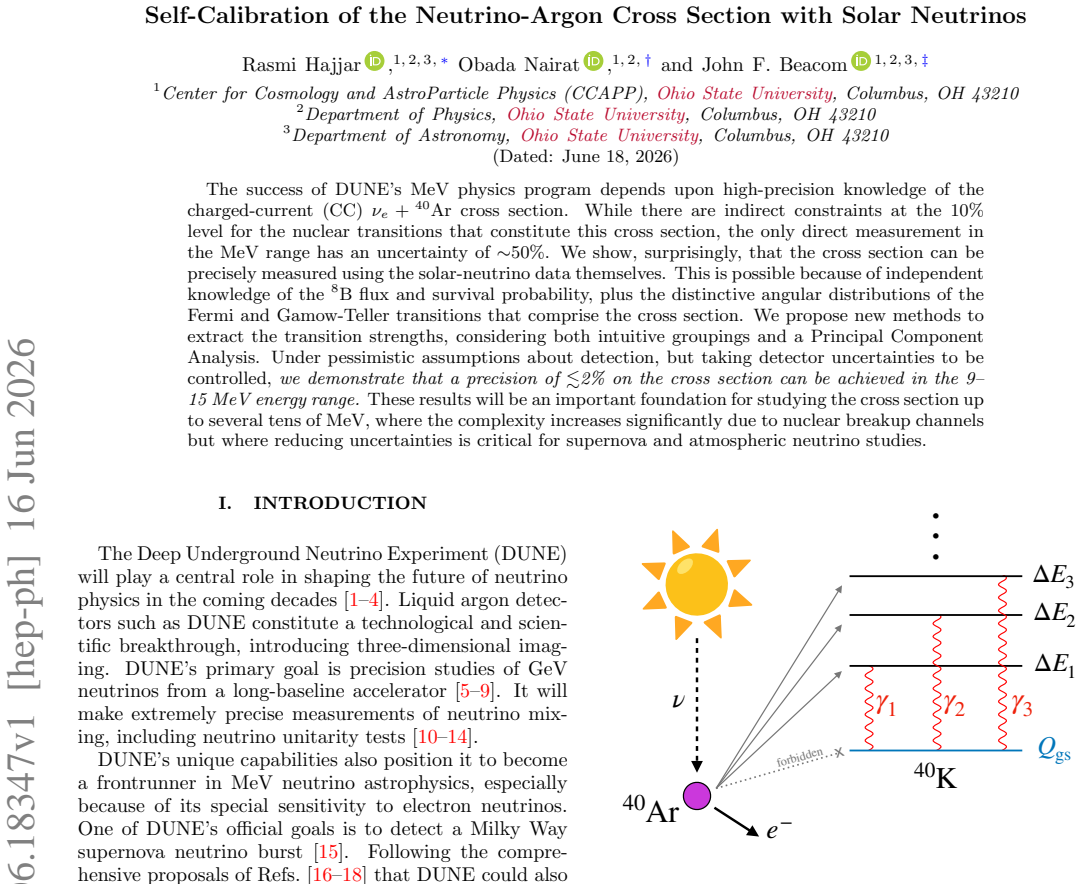
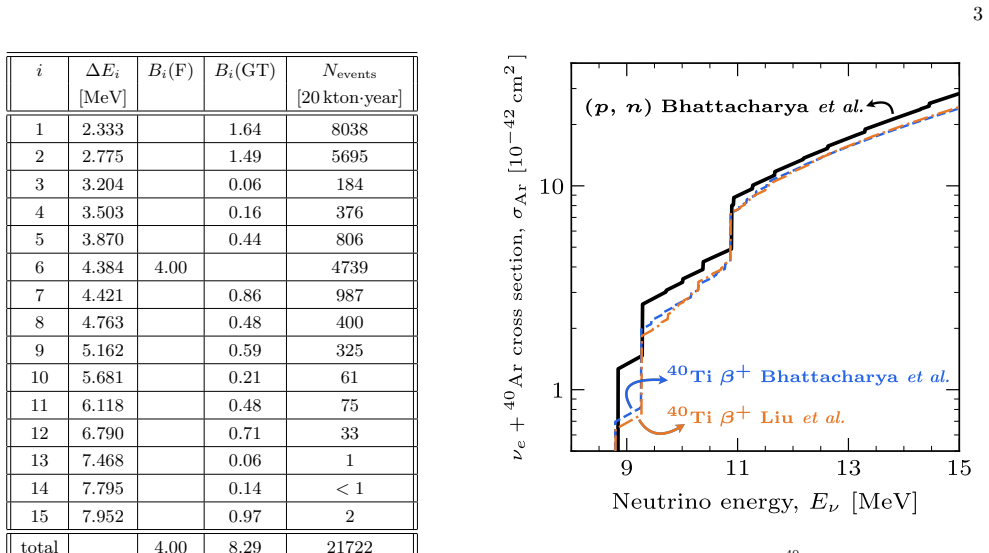
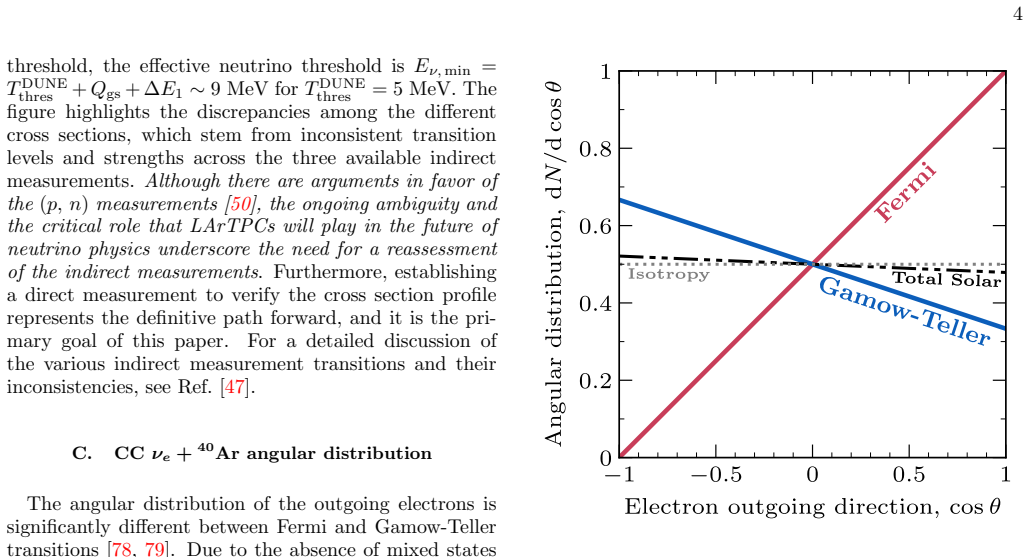
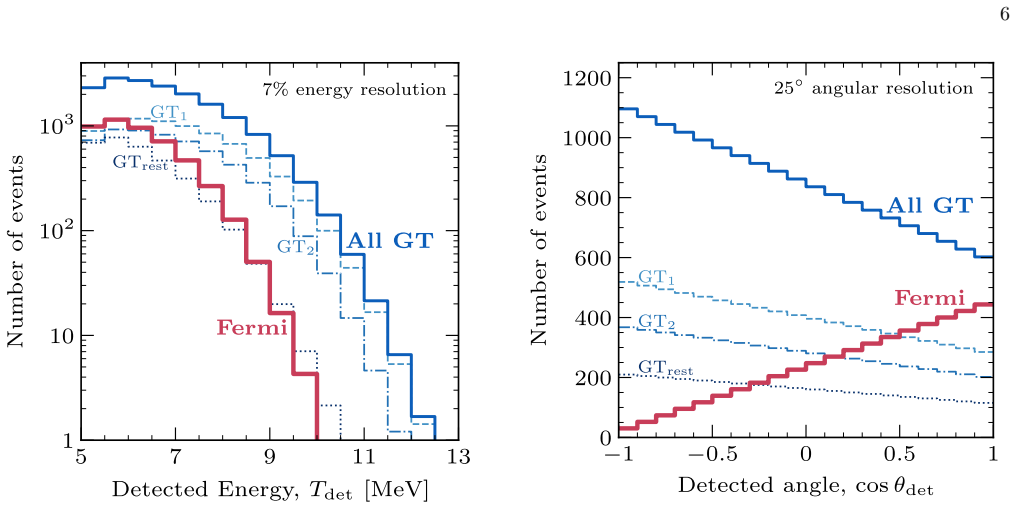
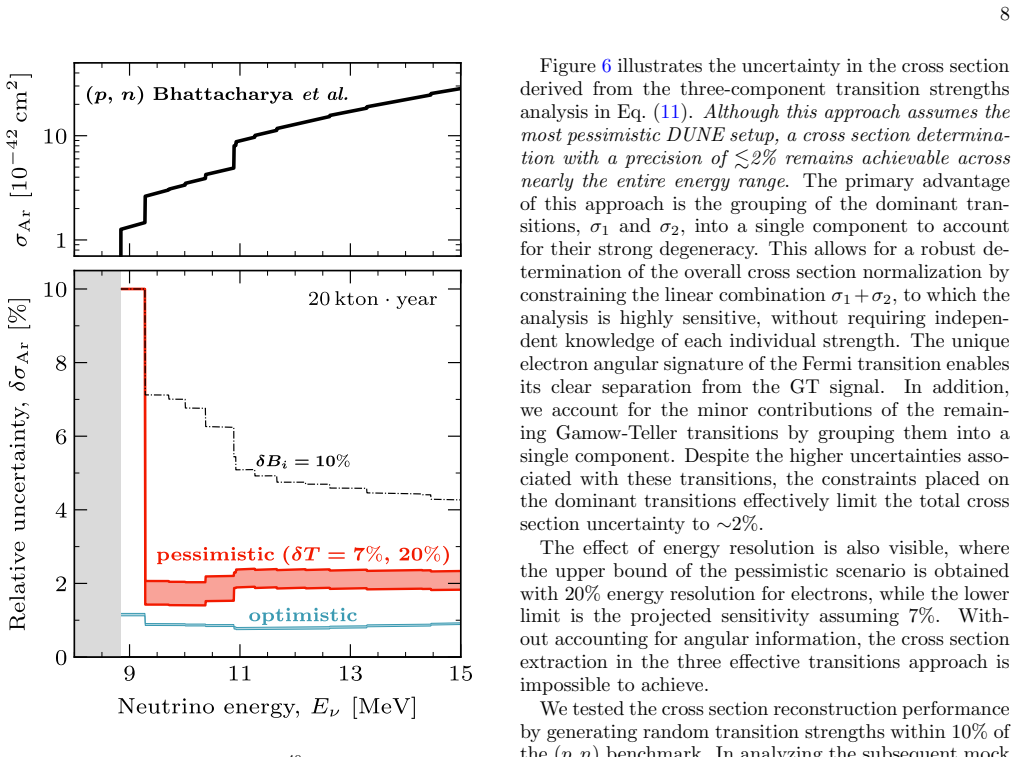
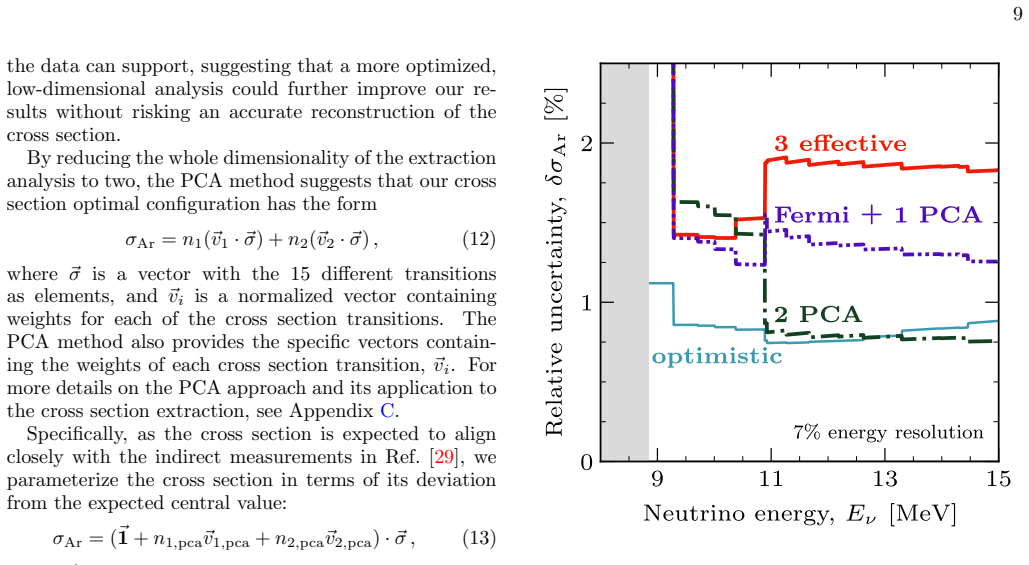
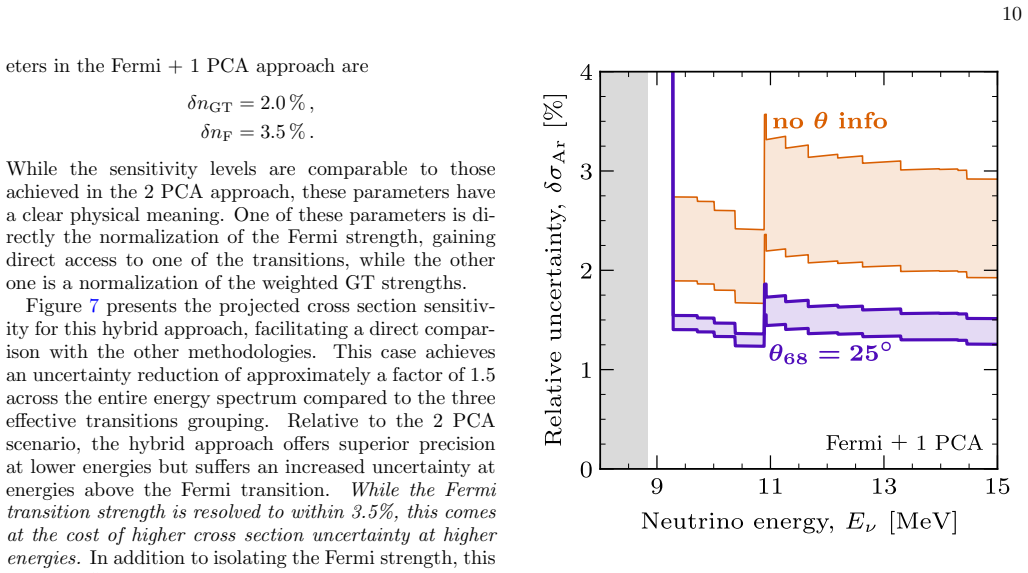
We show, surprisingly, that the cross section can be precisely measured using the solar-neutrino data themselves. This is possible because of independent knowledge of the 8B flux and survival probability, plus the distinctive angular distributions of the Fermi and Gamow-Teller transitions that comprise the cross section. We propose new methods to extract the transition strengths, considering both intuitive groupings and a Principal Component Analysis. Under pessimistic assumptions about detection, but taking detector uncertainties to be controlled, we demonstrate that a precision of ≲2% on the cross section can be achieved in the 9-15 MeV energy range.
What carries the argument
The distinctive angular distributions of Fermi and Gamow-Teller transitions that allow separation of their individual strengths when combined with the known 8B solar flux and survival probability.
If this is right
- The 2% precision supplies the high-accuracy input required for DUNE's MeV physics program.
- The same solar data set forms the basis for extending the cross-section measurement to several tens of MeV where nuclear breakup channels open.
- Reduced uncertainties at higher energies directly improve supernova and atmospheric neutrino analyses.
- The approach replaces reliance on indirect 10% constraints or the existing ~50% direct measurement.
Where Pith is reading between the lines
- If the angular separation works as described, the method could be tested first on existing or near-term solar neutrino data sets before DUNE operation.
- The principal component analysis technique might be adapted to other nuclear targets once similar independent flux information is available.
Load-bearing premise
Detector uncertainties can be controlled independently of the cross-section extraction, and the angular distributions of the Fermi and Gamow-Teller transitions are sufficiently distinctive to allow reliable separation of transition strengths.
What would settle it
A data analysis in which the extracted cross-section uncertainty remains larger than 2% or the angular distributions fail to separate Fermi from Gamow-Teller contributions at the required level would falsify the claimed precision.
Figures
read the original abstract
The success of DUNE's MeV physics program depends upon high-precision knowledge of the charged-current (CC) $\nu_e+\mathrm{^{40}Ar}$ cross section. While there are indirect constraints at the 10% level for the nuclear transitions that constitute this cross section, the only direct measurement in the MeV range has an uncertainty of $\sim$50%. We show, surprisingly, that the cross section can be precisely measured using the solar-neutrino data themselves. This is possible because of independent knowledge of the $^8$B flux and survival probability, plus the distinctive angular distributions of the Fermi and Gamow-Teller transitions that comprise the cross section. We propose new methods to extract the transition strengths, considering both intuitive groupings and a Principal Component Analysis. Under pessimistic assumptions about detection, but taking detector uncertainties to be controlled, we demonstrate that a precision of $\lesssim$2% on the cross section can be achieved in the 9-15 MeV energy range. These results will be an important foundation for studying the cross section up to several tens of MeV, where the complexity increases significantly due to nuclear breakup channels but where reducing uncertainties is critical for supernova and atmospheric neutrino studies.
Editorial analysis
A structured set of objections, weighed in public.
Referee Report
Summary. The manuscript proposes a self-calibration technique for the charged-current ν_e + 40Ar cross section in DUNE using solar 8B neutrinos. It exploits independent external knowledge of the 8B flux and survival probability together with the angular distributions of the Fermi and Gamow-Teller transitions that make up the cross section. Transition strengths are extracted both by intuitive groupings and by Principal Component Analysis. Under pessimistic detection assumptions but with detector uncertainties taken as independently controlled, the work claims a precision of ≲2% on the cross section in the 9-15 MeV range, providing a foundation for higher-energy studies relevant to supernova and atmospheric neutrinos.
Significance. If the central result holds, the work would deliver a substantial improvement over the existing ~50% direct-measurement uncertainty, supplying a critical calibration input for DUNE’s MeV program. The use of solar neutrinos for in-situ self-calibration is novel and could reduce reliance on external cross-section data. The approach is particularly relevant for extending precision to tens of MeV where nuclear breakup channels appear.
major comments (2)
- [Abstract] Abstract: The claimed ≲2% precision is obtained only after explicitly assuming that detector uncertainties can be controlled independently of the cross-section extraction. The manuscript does not quantify the degradation in precision when this assumption is relaxed by even 1-2%, nor does it propagate residual correlations between the external 8B flux/survival-probability inputs and the detector model; this assumption is load-bearing for the central claim.
- [Methods] Methods (angular/PCA separation): The separation of Fermi and Gamow-Teller strengths relies on the angular distributions being sufficiently distinctive. The manuscript should demonstrate robustness against finite angular resolution, overlap between distributions, and unmodeled backgrounds, because any coupling of the extracted strengths to the detector response would directly degrade the self-calibration precision.
minor comments (1)
- [Abstract] The abstract refers to “pessimistic assumptions about detection” without enumerating them; a concise list or reference to the relevant section would improve clarity.
Simulated Author's Rebuttal
We thank the referee for the constructive and detailed report. The comments correctly identify that our central precision claim rests on an explicit but unquantified assumption about detector uncertainties, and that robustness of the angular/PCA separation requires further demonstration. We will revise the manuscript to address both points with additional sensitivity studies.
read point-by-point responses
-
Referee: [Abstract] Abstract: The claimed ≲2% precision is obtained only after explicitly assuming that detector uncertainties can be controlled independently of the cross-section extraction. The manuscript does not quantify the degradation in precision when this assumption is relaxed by even 1-2%, nor does it propagate residual correlations between the external 8B flux/survival-probability inputs and the detector model; this assumption is load-bearing for the central claim.
Authors: We agree that the assumption of independently controlled detector uncertainties is load-bearing for the ≲2% result and that the manuscript does not quantify the impact of relaxing it or of correlations with the external 8B inputs. In the revised manuscript we will add a dedicated sensitivity study that (i) relaxes the independence assumption by 1–2% and reports the resulting degradation in cross-section precision and (ii) propagates residual correlations between the external flux/survival-probability priors and the detector model. This will make the scope and limitations of the quoted precision explicit. revision: yes
-
Referee: [Methods] Methods (angular/PCA separation): The separation of Fermi and Gamow-Teller strengths relies on the angular distributions being sufficiently distinctive. The manuscript should demonstrate robustness against finite angular resolution, overlap between distributions, and unmodeled backgrounds, because any coupling of the extracted strengths to the detector response would directly degrade the self-calibration precision.
Authors: The manuscript already shows the distinct angular distributions of the Fermi and Gamow-Teller components and applies both intuitive groupings and PCA to extract their strengths. However, it does not contain explicit tests of finite angular resolution, distribution overlap, or unmodeled backgrounds. We will revise the Methods and Results sections (and add an appendix if needed) to include Monte Carlo studies that quantify how the extracted transition strengths and final cross-section precision respond to realistic angular smearing, partial overlap, and plausible background levels. These studies will confirm that the separation remains effective under the pessimistic detection assumptions already adopted in the paper. revision: yes
Circularity Check
No significant circularity; derivation relies on external inputs
full rationale
The paper's central result is a proposed extraction method for the nu-Ar cross section using solar neutrinos, conditioned on independent external knowledge of the 8B flux and survival probability plus the distinct angular distributions of Fermi vs. Gamow-Teller transitions. No step reduces a prediction to a fitted parameter by construction, invokes a self-citation as the sole justification for a uniqueness claim, or renames a known result. The ≲2% precision is presented as a simulation outcome under stated assumptions about detector control, not as a self-defining tautology. This is the normal case of a self-contained proposal against external benchmarks.
Axiom & Free-Parameter Ledger
axioms (2)
- domain assumption Independent knowledge of the 8B solar neutrino flux and electron-neutrino survival probability
- domain assumption Distinctive angular distributions of Fermi and Gamow-Teller transitions allow separation of their contributions
Reference graph
Works this paper leans on
-
[1]
By incorporating both energy and angular in- formation, we find that the effective dimensionality of the data is two
Principal Component Analysis method PCA not only identifies the principal components of the cross section sensitivity but also quantifies the num- ber of optimal degrees of freedom in a purely data-driven manner. By incorporating both energy and angular in- formation, we find that the effective dimensionality of the data is two. This indicates that the th...
-
[2]
Here, our primary objective is to extract the νe + 40Ar CC cross section while maintaining physical interpretability
Fermi strength + 1 PCA While PCA might be the optimal method to extract the cross section, the lack of physical intuition and sen- sitivity to individual strengths makes the PCA approach less appealing if there is not a substantial gain of sen- sitivity. Here, our primary objective is to extract the νe + 40Ar CC cross section while maintaining physical in...
-
[3]
Uncertainties remain below 2% even under highly pessimistic resolution as- sumptions, effectively establishing this value as an upper bound for the sensitivity projection
PCA power and additional possibilities A further advantage of the PCA approach over the three effective transitions model is its superior stability against degraded energy resolution. Uncertainties remain below 2% even under highly pessimistic resolution as- sumptions, effectively establishing this value as an upper bound for the sensitivity projection. F...
-
[4]
Z T up i T low i dR dTdet dTdet # ×
Basic setup In this study, we focus exclusively on theν e + 40Ar charged-current interaction in DUNE, employing the kinetic energy and angular distribution of the outgoing electron to perform the cross section extraction. The number of events within a particular electron kinetic energy [T low i , T up i ] and angular range [cosθ low i ,cosθ up i ] is obta...
-
[5]
(A1) contains the energy-dependent rate
Detected energy The first term in brackets in Eq. (A1) contains the energy-dependent rate. This is the most complex term, as it accounts for the entire neutrino journey from emission to detection. It encodes information regarding the emission, transport and detection processes. However, given the precise expected characterization of solar neutrino emissio...
-
[6]
(A1) contains the angular distribution of the observed event rate
Angular smearing The last term in Eq. (A1) contains the angular distribution of the observed event rate. In this case, it corresponds to the detected angular distribution of the electrons, and it reads as [102, 103] dR d cosθdet = 1 4π Z d cosθtruedϕRθ(θtrue, θdet) dσ d cosθtrue ,(A4) whereθ true andϕare the true zenith and relative azimuth angles of the ...
-
[7]
Likelihood In order to study the potential sensitivity for cross section extraction using solar 8B neutrinos we neglect the tiny uncertainties of the initial flux and the oscillation parameters involved. Each cross section transition depends on two quantities: the transition energy, which is extremely well measured and therefore assumed to be perfectly kn...
-
[8]
This analysis is fully guided by the PCA framework to maximize extraction sensitivity with the lowest dimensionality possible
Cross section extraction with 2 PCA vectors The most general scenario considered is the application of PCA to the pessimistic case, exploiting the full di- mensionality of the available information, including detected energy and angular distributions. This analysis is fully guided by the PCA framework to maximize extraction sensitivity with the lowest dim...
-
[9]
By doing so, we can perform a direct measurement of thei= 6 state’s transition strength
Cross section extraction with Fermi + 1 PCA Guided by Figure C6 and the distinct angular distribution of thei= 6 transition relative to the others, there is a clear physical basis for isolating this specific state. By doing so, we can perform a direct measurement of thei= 6 state’s transition strength. This allows for comparison with the theory value for ...
arXiv 2020
-
[10]
Fukugita and T
M. Fukugita and T. Yanagida,Baryogenesis Without Grand Unification,Phys. Lett. B174(1986) 45–47
1986
-
[11]
H. Nunokawa, S. J. Parke, and J. W. F. Valle,CP Violation and Neutrino Oscillations,Prog. Part. Nucl. Phys.60(2008) 338–402, [0710.0554]
Pith/arXiv arXiv 2008
-
[12]
S. Davidson, E. Nardi, and Y. Nir,Leptogenesis,Phys. Rept.466(2008) 105–177, [0802.2962]
Pith/arXiv arXiv 2008
-
[13]
S. Parke and M. Ross-Lonergan,Unitarity and the three flavor neutrino mixing matrix,Phys. Rev. D93 (2016), no. 11 113009, [1508.05095]
Pith/arXiv arXiv 2016
-
[14]
X. Qian and P. Vogel,Neutrino Mass Hierarchy,Prog. Part. Nucl. Phys.83(2015) 1–30, [1505.01891]. [15]DUNE Collaboration, B. Abiet al.,Supernova neutrino burst detection with the Deep Underground Neutrino Experiment,Eur. Phys. J. C81(2021), no. 5 423, [2008.06647]
Pith/arXiv arXiv 2015
-
[15]
F. Capozzi, S. W. Li, G. Zhu, and J. F. Beacom, DUNE as the Next-Generation Solar Neutrino Experiment,Phys. Rev. Lett.123(2019), no. 13 131803, [1808.08232]
arXiv 2019
-
[16]
G. Zhu, S. W. Li, and J. F. Beacom,Developing the MeV potential of DUNE: Detailed considerations of muon-induced spallation and other backgrounds,Phys. Rev. C99(2019), no. 5 055810, [1811.07912]
Pith/arXiv arXiv 2019
-
[17]
S. A. Meighen-Berger, J. L. Newstead, J. F. Beacom, N. F. Bell, and M. J. Dolan,Enhancing DUNE’s Solar Neutrino Capabilities with Neutral-Current Detection, Phys. Rev. Lett.135(2025), no. 1 011803, [2410.00330]
arXiv 2025
-
[18]
J. N. Bahcall, M. Baldo-Ceolin, D. B. Cline, and C. Rubbia,Predictions for a Liquid Argon Solar Neutrino Detector,Phys. Lett. B178(1986) 324
1986
-
[19]
Parsaet al.,SoLAr: Solar Neutrinos in Liquid Argon, inSnowmass 2021, 3, 2022.2203.07501
S. Parsaet al.,SoLAr: Solar Neutrinos in Liquid Argon, inSnowmass 2021, 3, 2022.2203.07501. [21]MicroBooNE Collaboration, P. Abratenkoet al., Measurement of ambient radon progeny decay rates and energy spectra in liquid argon using the MicroBooNE detector,Phys. Rev. D.109(2024) 052007, [2307.03102]
arXiv 2021
-
[20]
M. ´A. Garc´ ıa-Periset al.,Opportunities and challenges to study solar neutrinos with a Q-Pix pixel readout, Phys. Rev. D112(2025), no. 9 092009, [2507.15459]
arXiv 2025
-
[21]
Ruiz Ferreira,Solar Neutrino Detection with a Pixelated Liquid-Argon Time Projection Chamber
G. Ruiz Ferreira,Solar Neutrino Detection with a Pixelated Liquid-Argon Time Projection Chamber. PhD thesis, Manchester U., 2025
2025
-
[22]
R. S. Raghavan,Inverse Beta Decay of 40Ar: A New Approach for Observing MeV Neutrinos From Laboratory and Astrophysical Sources,Phys. Rev. D34 (1986) 2088–2091
1986
-
[23]
W. E. Ormand, P. M. Pizzochero, P. F. Bortignon, and R. A. Broglia,Neutrino capture cross-sections for Ar-40 and Beta decay of Ti-40,Phys. Lett. B345 (1995) 343–350, [nucl-th/9405007]
Pith/arXiv arXiv 1995
-
[24]
Trinderet al.,Ti-40 beta decay and the neutrino capture cross-section of Ar-40,Phys
W. Trinderet al.,Ti-40 beta decay and the neutrino capture cross-section of Ar-40,Phys. Lett. B415 (1997) 211–216
1997
-
[25]
Bhattacharyaet al.,Neutrino absorption efficiency of an Ar-40 detector from the beta decay of Ti-40, Phys
M. Bhattacharyaet al.,Neutrino absorption efficiency of an Ar-40 detector from the beta decay of Ti-40, Phys. Rev. C58(1998) 3677–3687. [28]ICARUS Collaboration, W. Liuet al.,Beta decay of Ti-40 and Ti-41 and implication for solar neutrino detection,Phys. Rev. C58(1998) 2677–2688
1998
-
[26]
M. Bhattacharya, C. D. Goodman, and A. Garcia, Weak-interaction strength from charge-exchange reactions versus beta decay in the A=40 isoquintet, Phys. Rev. C80(2009) 055501. [30]DEAP-3600 Collaboration, P. A. Amaudruzet al., Design and Construction of the DEAP-3600 Dark Matter Detector,Astropart. Phys.108(2019) 1–23, [1712.01982]. [31]DEAP Collaboration,...
Pith/arXiv arXiv 2009
-
[27]
W. T. Winter, S. J. Freedman, K. E. Rehm, and J. P. Schiffer,The B-8 neutrino spectrum,Phys. Rev. C73 (2006) 025503, [nucl-ex/0406019]. [33]SNO Collaboration, B. Aharmimet al.,Combined Analysis of all Three Phases of Solar Neutrino Data from the Sudbury Neutrino Observatory,Phys. Rev. C 88(2013) 025501, [1109.0763]. [34]BOREXINO Collaboration, M. Agostini...
Pith/arXiv arXiv 2006
-
[28]
Mezzacappa,ASCERTAINING THE CORE COLLAPSE SUPERNOVA MECHANISM: The State of the Art and the Road Ahead,Ann
A. Mezzacappa,ASCERTAINING THE CORE COLLAPSE SUPERNOVA MECHANISM: The State of the Art and the Road Ahead,Ann. Rev. Nucl. Part. Sci.55(2005) 467–515
2005
-
[29]
O. Pejcha and T. A. Thompson,The Physics of the Neutrino Mechanism of Core-Collapse Supernovae, Astrophys. J.746(2012) 106, [1103.4864]
Pith/arXiv arXiv 2012
-
[30]
Janka,Explosion Mechanisms of Core-Collapse Supernovae,Ann
H.-T. Janka,Explosion Mechanisms of Core-Collapse Supernovae,Ann. Rev. Nucl. Part. Sci.62(2012) 407–451, [1206.2503]
Pith/arXiv arXiv 2012
-
[31]
Burrows,Colloquium: Perspectives on core-collapse supernova theory,Rev
A. Burrows,Colloquium: Perspectives on core-collapse supernova theory,Rev. Mod. Phys.85(2013) 245, [1210.4921]
Pith/arXiv arXiv 2013
-
[32]
S. M. Adams, C. S. Kochanek, J. F. Beacom, M. R. Vagins, and K. Z. Stanek,Observing the Next Galactic Supernova,Astrophys. J.778(2013) 164, [1306.0559]. [41]DUNE Collaboration, A. Abed Abudet al.,Impact of cross-section uncertainties on supernova neutrino spectral parameter fitting in the Deep Underground Neutrino Experiment,Phys. Rev. D107(2023), no. 11 ...
Pith/arXiv arXiv 2013
-
[33]
G. Battistoni, A. Ferrari, T. Montaruli, and P. R. Sala, The atmospheric neutrino flux below 100-MeV: The FLUKA results,Astropart. Phys.23(2005) 526–534. [44]Super-Kamiokande Collaboration, K. Abeet al., Diffuse supernova neutrino background search at Super-Kamiokande,Phys. Rev. D104(2021), no. 12 122002, [2109.11174]
arXiv 2005
-
[34]
B. Zhou and J. F. Beacom,First detailed calculation of atmospheric neutrino foregrounds to the diffuse supernova neutrino background in Super-Kamiokande, Phys. Rev. D109(2024), no. 10 103003, [2311.05675]. [46]Super-Kamiokande Collaboration, K. Abeet al., Search for Diffuse Supernova Neutrino Background with 956.2 days of Super-Kamiokande Gadolinium Datas...
arXiv 2024
-
[35]
Gardiner,Nuclear de-excitations in low-energy charged-currentν e scattering on 40Ar,Phys
S. Gardiner,Nuclear de-excitations in low-energy charged-currentν e scattering on 40Ar,Phys. Rev. C 103(2021), no. 4 044604, [2010.02393]
arXiv 2021
-
[36]
Rubbia,The Liquid Argon Time Projection Chamber: A New Concept for Neutrino Detectors,
C. Rubbia,The Liquid Argon Time Projection Chamber: A New Concept for Neutrino Detectors,
-
[37]
R. S. Raghavan, S. Pakvasa, and B. A. Brown,New Tools for Solving the Solar Neutrino Problem,Phys. Rev. Lett.57(1986) 1801–1804
1986
-
[38]
Karako¸ cet al.,Gamow-Teller transitions in the A=40 isoquintet of relevance for neutrino captures in Ar40,Phys
M. Karako¸ cet al.,Gamow-Teller transitions in the A=40 isoquintet of relevance for neutrino captures in Ar40,Phys. Rev. C89(2014), no. 6 064313
2014
-
[39]
Gardiner,Simulating low-energy neutrino interactions with MARLEY,Comput
S. Gardiner,Simulating low-energy neutrino interactions with MARLEY,Comput. Phys. Commun. 269(2021) 108123, [2101.11867]
arXiv 2021
-
[40]
A. Bueno, I. Gil Botella, and A. Rubbia,Supernova neutrino detection in a liquid argon TPC, hep-ph/0307222
-
[41]
E. Kolbe, K. Langanke, G. Martinez-Pinedo, and P. Vogel,Neutrino nucleus reactions and nuclear structure,J. Phys. G29(2003) 2569–2596, [nucl-th/0311022]
Pith/arXiv arXiv 2003
-
[42]
I. Gil Botella and A. Rubbia,Oscillation effects on supernova neutrino rates and spectra and detection of the shock breakout in a liquid argon TPC,JCAP10 (2003) 009, [hep-ph/0307244]
Pith/arXiv arXiv 2003
-
[43]
Sajjad Athar and S
M. Sajjad Athar and S. K. Singh,nu/e (anti-nu/e) - Ar-40 absorption cross sections for supernova neutrinos,Phys. Lett. B591(2004) 69–75
2004
-
[44]
M. Sajjad Athar, S. Ahmad, and S. K. Singh,Neutrino nucleus cross sections for low energy neutrinos at SNS facilities,Nucl. Phys. A764(2006) 551–568, [nucl-th/0506046]
Pith/arXiv arXiv 2006
-
[45]
Cheoun, E
M.-K. Cheoun, E. Ha, and T. Kajino,Reactions on Ar-40 involving solar neutrinos and neutrinos from core-collapsing supernovae,Phys. Rev. C83(2011) 028801
2011
-
[46]
Cheoun, E
M.-K. Cheoun, E. Ha, and T. Kajino,High-lying excited states in Gamow Teller strength and their roles in neutrino reactions,Eur. Phys. J. A48(2012) 137
2012
-
[47]
Tsakstara, T
V. Tsakstara, T. Kosmas, and J. Vergados,Weak Responses of Neutral Current Neutrino-Nucleus Reactions,Rom. J. Phys.58(2013) 1258–1269
2013
-
[48]
N. Paar, H. Tutman, T. Marketin, and T. Fischer, Large-scale calculations of supernova neutrino-induced reactions in Z=8–82 target nuclei,Phys. Rev. C87 (2013), no. 2 025801, [1210.2655]
Pith/arXiv arXiv 2013
-
[49]
H. Dapo and N. Paar,Neutral-current neutrino-nucleus cross sections based on relativistic nuclear energy density functional,Phys. Rev. C86 (2012) 035804, [1203.5224]
Pith/arXiv arXiv 2012
-
[50]
S. Chauhan, M. Sajjad Athar, and S. K. Singh, Neutrino-nucleus cross-sections at supernova neutrino energies,Int. J. Mod. Phys. E26(2017), no. 7 1750047, [1704.04582]
Pith/arXiv arXiv 2017
-
[51]
Kostensalo, J
J. Kostensalo, J. Suhonen, and K. Zuber,Shell-model computed cross sections for charged-current scattering of astrophysical neutrinos off 40Ar,Phys. Rev. C97 (2018), no. 3 034309
2018
-
[52]
T. Suzuki and M. Honma,Neutrino Capture Reactions on 40Ar,Phys. Rev. C87(2013), no. 1 014607, [1211.4078]
Pith/arXiv arXiv 2013
-
[53]
Suzuki, M
T. Suzuki, M. Honma, A. B. Balantekin, T. Kajino, and S. Chiba,New neutrino-nucleus reaction cross sections at solar, reactor and supernova neutrino energies,EPJ Web Conf.66(2014) 07025
2014
-
[54]
V. Pandey, N. Jachowicz, T. Van Cuyck, J. Ryckebusch, and M. Martini,Low-energy excitations and quasielastic contribution to electron-nucleus and neutrino-nucleus scattering in the continuum random-phase approximation,Phys. Rev. C92(2015), no. 2 024606, [1412.4624]
Pith/arXiv arXiv 2015
-
[55]
N. Van Dessel, N. Jachowicz, R. Gonz´ alez-Jim´ enez, V. Pandey, and T. Van Cuyck,A-dependence of quasielastic charged-current neutrino-nucleus cross sections,Phys. Rev. C97(2018), no. 4 044616, [1704.07817]
Pith/arXiv arXiv 2018
-
[56]
S. J. Gardiner,Nuclear Effects in Neutrino Detection. PhD thesis, UC, Davis, 2018
2018
-
[57]
N. Van Dessel, N. Jachowicz, and A. Nikolakopoulos, Forbidden transitions in neutral and charged current interactions between low-energy neutrinos and Argon, Phys. Rev. C100(2019), no. 5 055503, [1903.07726]
arXiv 2019
-
[58]
N. Jachowicz, N. Van Dessel, and A. Nikolakopoulos, Low-energy neutrino scattering in experiment and astrophysics,J. Phys. G46(2019), no. 8 084003, [1906.08191]
arXiv 2019
-
[59]
S. Dolan, A. Nikolakopoulos, O. Page, S. Gardiner, N. Jachowicz, and V. Pandey,Implementation of the 21 continuum random phase approximation model in the GENIE generator and an analysis of nuclear effects in low-energy transfer neutrino interactions,Phys. Rev. D 106(2022), no. 7 073001, [2110.14601]
arXiv 2022
-
[60]
Pandey,Neutrino-Nucleus Scattering Cross Sections at Medium Energies,2511.05413
V. Pandey,Neutrino-Nucleus Scattering Cross Sections at Medium Energies,2511.05413
-
[61]
A. Nikolakopoulos, N. Jachowicz, N. Van Dessel, K. Niewczas, R. Gonz´ alez-Jim´ enez, J. M. Ud´ ıas, and V. Pandey,Electron versus Muon Neutrino Induced Cross Sections in Charged Current Quasielastic Processes,Phys. Rev. Lett.123(2019), no. 5 052501, [1901.08050]
arXiv 2019
-
[62]
S. Gardiner, P. Barham Alz´ as, A. Nikolakopoulos, L. H. A. El-Haj, N. Jachowicz, and V. Pandey, Continuum contribution to charged-current absorption of low-energyν e on 40Ar,2604.26801
-
[63]
Schopper, ed.,Numerical Tables for Beta-Decay and Electron Capture / Numerische Tabellen f¨ ur Beta-Zerfall und Elektronen-Einfang, vol
H. Schopper, ed.,Numerical Tables for Beta-Decay and Electron Capture / Numerische Tabellen f¨ ur Beta-Zerfall und Elektronen-Einfang, vol. 4 of Landolt-Boernstein - Group I Elementary Particles, Nuclei and Atoms. Springer, 1969
1969
-
[64]
E. J. Konopinski,The theory of beta radio activity / Emil Jan Konopinski.Clarendon Press, Oxford, 1966
1966
-
[65]
I. S. Towner and J. C. Hardy,Superallowed 0 +→0 + nuclearβ-decays,Nucl. Phys. A205(1973) 33–55
1973
-
[66]
J. F. Beacom and P. Vogel,Can a supernova be located by its neutrinos?,Phys. Rev. D60(1999) 033007, [astro-ph/9811350]
Pith/arXiv arXiv 1999
-
[67]
P. Vogel and J. F. Beacom,Angular distribution of neutron inverse beta decay, anti-neutrino(e) + p —> e+ + n,Phys. Rev. D60(1999) 053003, [hep-ph/9903554]
Pith/arXiv arXiv 1999
-
[68]
Arneodoet al.,Study of solar neutrinos with the 600-t liquid argon ICARUS detector,Nucl
F. Arneodoet al.,Study of solar neutrinos with the 600-t liquid argon ICARUS detector,Nucl. Instrum. Meth. A455(2000) 376–389. [81]ArgoNeuT Collaboration, R. Acciarriet al., Demonstration of MeV-Scale Physics in Liquid Argon Time Projection Chambers Using ArgoNeuT,Phys. Rev. D99(2019), no. 1 012002, [1810.06502]. [82]MicroBooNE Collaboration, P. Abratenko...
Pith/arXiv arXiv 2000
-
[69]
W. Castiglioni, W. Foreman, I. Lepetic, B. R. Littlejohn, M. Malaker, and A. Mastbaum,Benefits of MeV-scale reconstruction capabilities in large liquid argon time projection chambers,Phys. Rev. D102 (2020), no. 9 092010, [2006.14675]
arXiv 2020
-
[70]
M. H. Morquecho, B. Littlejohn, P. Sala, and L. Wan, Neutron Reconstruction via Blips in Liquid Argon Time Projection Chambers,2604.11774
-
[71]
Acharyaet al.,Solar fusion III: New data and theory for hydrogen-burning stars,Rev
B. Acharyaet al.,Solar fusion III: New data and theory for hydrogen-burning stars,Rev. Mod. Phys.97 (2025), no. 3 035002, [2405.06470]
arXiv 2025
-
[72]
Longfellowet al.,Determination of the B8 neutrino energy spectrum using trapped ions,Phys
B. Longfellowet al.,Determination of the B8 neutrino energy spectrum using trapped ions,Phys. Rev. C107 (2023), no. 3 L032801
2023
-
[73]
M. Bishai, “Status of the DUNE Experiment.” Presentation at the Symposium of the US-Japan Science and Technology Cooperation Program 2025, May, 2025. [88]JUNO Collaboration, A. Abuslemeet al.,Feasibility and physics potential of detecting 8B solar neutrinos at JUNO,Chin. Phys. C45(2021), no. 2 023004, [2006.11760]
arXiv 2025
-
[74]
I. Esteban, M. C. Gonzalez-Garcia, M. Maltoni, I. Martinez-Soler, J. P. Pinheiro, and T. Schwetz, NuFit-6.0: updated global analysis of three-flavor neutrino oscillations,JHEP12(2024) 216, [2410.05380]
Pith/arXiv arXiv 2024
-
[75]
P. F. de Salas, D. V. Forero, S. Gariazzo, P. Mart´ ınez-Mirav´ e, O. Mena, C. A. Ternes, M. T´ ortola, and J. W. F. Valle,2020 global reassessment of the neutrino oscillation picture,JHEP 02(2021) 071, [2006.11237]. [91]JUNO Collaboration, A. Abuslemeet al.,First measurement of reactor neutrino oscillations at JUNO, 2511.14593. [92]JUNO Collaboration, A....
Pith/arXiv arXiv 2020
-
[76]
Caratelliet al.,Low-Energy Physics in Neutrino LArTPCs,2203.00740
D. Caratelliet al.,Low-Energy Physics in Neutrino LArTPCs,2203.00740
-
[77]
W. Shi, X. Ning, D. Pershey, F. Marinho, A. Fleuri, C. Riccio, J. H. Jo, C. Zhang, and F. Cavanna,Physics prospects with MeV neutrino-argon charged current interactions using enhanced photon detection in future LArTPCs,Phys. Rev. D112(2025), no. 1 012019, [2502.18498]. [95]MicroBooNE Collaboration, P. Abratenkoet al., Characterizing the energy resolution ...
arXiv 2025
-
[78]
Fisher,Statistical Analysis of Circular Data
N. Fisher,Statistical Analysis of Circular Data. Statistical Analysis of Circular Data. Cambridge University Press, 1995
1995
-
[79]
Mardia and P
K. Mardia and P. Jupp,Directional Statistics.John Wiley & Sons, Ltd, United States, 2000
2000
-
[80]
Fisher,Dispersion on a Sphere,Proceedings of the Royal Society of London Series A217(May, 1953) 295–305
R. Fisher,Dispersion on a Sphere,Proceedings of the Royal Society of London Series A217(May, 1953) 295–305
1953
discussion (0)
Sign in with ORCID, Apple, or X to comment. Anyone can read and Pith papers without signing in.