REVIEW 3 major objections 4 minor 1 cited by
Quantum parameter-mass induced scalarization of qOS-black hole in the Einstein-Gauss-Bonnet-scalar theory
T0 review · 3 major / 4 minor · reviewed 2026-08-07 · deepseek-v4-flash
Pith's one-line read For the qOS black hole, the two heat-capacity Davies points coincide exactly with the critical onset parameters for spontaneous scalarization, giving the first concrete link between bald-black-hole thermodynamics and scalarization.
desk verdict The Davies/onset coincidence is real algebra, but it rests on a non-standard temperature that is defined to make the first law hold, so the physical claim is conditional. read the letter →
The pith
A machine-rendered reading of the paper's core claim, the machinery that carries it, and where it could break.
The reading
What carries the argument
The argument is carried by two objects. The first is the qOS metric function $g(r)=1-2M/r+\alpha M^2/r^4$ together with the postulated energy-momentum tensor $T^{\rm qOS,\nu}_{\ \ \mu}=(3\alpha M^2/r^6)\,{\rm diag}[-1,-1,2,2]$, which allows the thermodynamics to be defined with $\alpha$ as an independent thermodynamic variable through the first law $dm=T\,dS+W_\alpha\,d\alpha$ and Smarr formula $m=2TS+2W_\alpha\alpha$. The second is the effective-mass term of the scalar perturbation, $\tilde{m}^2_{\rm eff}=-(48\lambda M^2/r^6)(3\alpha^2 M^2/r^6-5\alpha M/r^3+1)$, whose zero sets the resonance condition $3\tilde{\alpha}_c^2-5\tilde{\alpha}_c+1=0$ via Hod's approach; the small root $\tilde{\alpha}_c=0.2324$ locates the onset of scalarization. The heat capacity $C=NC/DC$ diverges when $DC(M,\alpha)=0$, and the paper shows $DC=0$ gives exactly the same $\alpha$ and $M$ as the resonance condition.
What would settle it
Construct the scalarized qOS black holes by solving the full field equations (3) and (9) with a concrete, known qOS action and compare the threshold with $\alpha_c=1.2835$; if the first scalarized solution appears at an $\alpha$ different from the heat-capacity Davies point, or if no scalarized solutions exist, the claimed identification is refuted. A cheaper check is to compute the actual energy-momentum tensor of the qOS action once it is identified and test whether it equals the postulated form with $P=M$.
Extended reading notes
Core claim
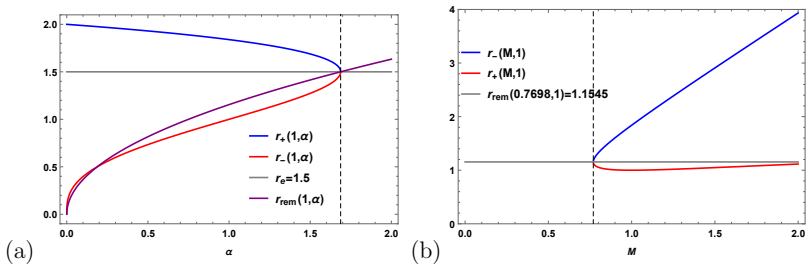
The central claim is a dual equality: in the Einstein-Gauss-Bonnet-scalar theory with the qOS metric, the thermodynamic Davies points, where the heat capacity diverges and changes sign, are the same numbers as the critical parameters at which the scalar perturbation around the bald black hole first becomes tachyonic. Concretely, solving the resonance condition $3\tilde{\alpha}_c^2-5\tilde{\alpha}_c+1=0$ gives $\tilde{\alpha}_c=0.2324$, which translates to $\alpha_c=1.2835$ at $M=1$, and this is exactly the Davies point $\alpha_D$; solving the same condition for mass gives $M_c=0.8827$ at $\alpha=1$, equal to $M_D$. The author verifies the equality $\alpha_c(M,\alpha)=\alpha_D(M,\alpha)$ and $M_c(M,\alpha)=M_D(M,\alpha)$ continuously over the allowed range $0.0128\lesssim M,\alpha \lesssim 1.6875$, and presents this as the first example in which bald-black-hole thermodynamics and spontaneous scalarization are connected.
Load-bearing premise
The entire argument assumes that the qOS black hole, whose fundamental action is not known, can be embedded in Einstein-Gauss-Bonnet-scalar theory by postulating the specific energy-momentum tensor $T^{\rm qOS,\nu}_{\ \ \mu}=(3\alpha M^2/r^6)\,{\rm diag}[-1,-1,2,2]$ and adding the scalar-Gauss-Bonnet coupling to the resulting metric; if the true qOS action has a different energy-momentum tensor, the Davies-point/scalarization coincidence loses its physical meaning.
Editorial extensions
If this is right
- For $M=1$, qOS black holes with $\alpha > 1.2835$ enter the scalarization window up to the extremal point $\alpha_e=1.6875$; below $\alpha_c$ the tachyonic instability is absent and no scalar hair forms.
- For $\alpha=1$, qOS black holes with remnant mass $M_{\rm rem}=0.7698 < M < M_c=0.8827$ scalarize; more massive bald black holes are stable against scalarization.
- Using the surface-gravity temperature $T_\kappa$ rather than the thermodynamic temperature $T$ would violate the first law and the Smarr formula, so the Davies-point/scalarization identification depends on the corrected thermodynamics adopted in the paper.
- The shadow-radius comparison with EHT yields no upper limit on $\alpha$, but for $\alpha=1$ restricts the mass to $0.8989\lesssim M\lesssim1.024$ at $1\sigma$ and $0.8358\lesssim M\lesssim1.088$ at $2\sigma$; the naked-singularity branch $M\in[0.6,0.7698]$ is excluded at $2\sigma$.
- The same analysis with the nonlinear-electrodynamics action gives Davies points $\alpha_D=2.2888$, $M_D=0.8130$ that do not match the critical onsets $\alpha_c=2.4948$, $M_c=0.7556$, so the thermodynamic-scalarization coincidence is not generic to the class of $\alpha M^2/r^4$ metrics.
Reading between the lines
- A testable extension is that the equality between $DC=0$ and the scalarization onset may hold for any spherically symmetric background in Einstein-Gauss-Bonnet-scalar theory, which would let one read off scalarization thresholds directly from the heat capacity without solving the perturbation equation; the NED counterexample in the paper suggests the equality is a property of the qOS energy-moment
- The result implies that the thermodynamic ensemble matters for the connection: treating $\alpha$ as a chemical-potential variable is what produces the corrected temperature and the Davies points, so the identification would not survive in an ensemble where $\alpha$ is held fixed rather than the chemical potential.
- Because the true qOS action is unknown, the coincidence could be used as a consistency check on proposed actions: any candidate $L_{\rm qOS}$ whose energy-momentum tensor differs from the postulated form would be expected to break the Davies/onset equality, making the equality a selection rule on quantum-gravity phenomenology.
Editorial analysis
A structured set of objections, weighed in public.
Referee Report
Summary. The paper studies the quantum Oppenheimer-Snyder (qOS) black hole, given by the metric function g(r)=1-2M/r+αM^2/r^4, in the context of Einstein-Gauss-Bonnet-scalar (EGBS) theory with an unknown qOS action. The authors define thermodynamic quantities using the temperature T=∂m/∂S with entropy S=πr_+^2, derive a Smarr formula, and locate Davies points in the heat capacity. They then compute the onset of spontaneous scalarization using the Hod approach and find that the two critical parameters (α_c for M=1 and M_c for α=1) coincide with the two Davies points (α_D and M_D). A shadow radius analysis is also performed and compared with EHT observations. The paper claims that this is the first example of a close connection between bald black hole thermodynamics and spontaneous scalarization.
Significance. If the claimed connection were physically robust, it would be a novel and interesting result linking black hole thermodynamics to scalarization thresholds. The algebraic identity between the Davies denominator and the scalarization onset condition is internally consistent and the paper presents numerical checks. The shadow analysis is straightforward and yields new mass constraints. However, the physical significance is weakened by the use of a non-standard temperature T=∂m/∂S instead of the surface gravity temperature, and by the absence of a known action for the qOS sector. The paper explicitly recognizes these limitations but does not resolve them.
major comments (3)
- [Section 3, Eqs. (14) and (19)] The temperature T=∂m/∂S used in the heat capacity is not the surface gravity temperature T_κ; the two differ by a factor r_+/√(r_+^2-α). The paper rejects T_κ because the first law and Smarr formula fail for it, but the first law dm=T dS+W_α dα with T and W_α defined as partial derivatives is a tautology for any smooth function m(S,α), and the Smarr formula m=2TS+2W_αα follows from dimensional homogeneity alone. Thus the 'Davies points' obtained from Eq. (15) are features of a chosen coordinate/ensemble, not of the standard Killing-horizon thermodynamics. The central claim that two Davies points coincide with scalarization thresholds therefore lacks a clear physical basis unless T is derived from the underlying (unknown) action. I ask the authors to compute the heat capacity with T_κ and report whether any divergences still occur at α_c and M_c, or to provide a physical justification for T as the thermodynamic temperature of the qOS black hole.
- [Section 2, Eq. (6)] The energy-momentum tensor T^{qOS,ν}_μ = (3αM^2/r^6) diag[-1,-1,2,2] is postulated without an action. The paper acknowledges that L_qOS is unknown, so the Einstein equation (3) is not derived from a specified theory. The proposed NED action (7) is shown to reproduce the EMT only if P=M, which is not allowed for non-extremal black holes. This leaves the thermodynamic analysis (entropy, temperature, chemical potential) and even the background metric itself without a known action-level justification. The physical interpretation of the Davies/scalarization coincidence depends on this postulated EMT. Please clarify whether an action exists that yields Eq. (6) for non-extremal black holes, or discuss how the results would change if the NED action with P≠M were used.
- [Section 5, Eq. (39) and after] The paper states that α_c=α_D and M_c=M_D are checked numerically for a range of parameters, but the algebraic reduction of the Davies denominator D_C(M,α) in Eq. (15) to the polynomial x(3x^2-5x+1) is not shown. Since this identity is the central result of the paper, the explicit derivation should be included rather than relying on numerical checks over a range; numerical checks are not a proof of exact identity.
minor comments (4)
- [Abstract and Section 7] The phrase 'quantum number' is used in Section 7 to refer to α, but the rest of the paper correctly calls it the quantum parameter; please make the terminology consistent.
- [Section 3, after Eq. (12)] The text says 'Hawking temperature defined by T=∂m/∂S', but Eq. (14) is not the standard Hawking temperature; it differs from the surface gravity T_κ in Eq. (19). Please reword to avoid implying that T is the Hawking temperature.
- [Section 3, Eq. (21)] The Smarr formula m=2TS+2W_αα is stated as a consequence of the first law, but it is in fact a homogeneity relation. The paper should mention this to avoid appearing to derive independent physical content from it.
- [Section 4, Fig. 4] The figure caption refers to '1σ and 2σ ranges from EHT observation', but the text quotes specific numerical ranges (4.55–5.22 and 4.21–5.56). Please make the figure and text consistent by explicitly stating the units (in units of M, presumably) and the source of these ranges.
Circularity Check
Central Davies/scalarization equality is an algebraic identity, not a fitted fit; the only mild circularity is that the first law and Smarr formula are definitional because T and W_alpha are defined as derivatives of m.
-
self definitional
[Section 3, Eqs. (13)-(21); also Section 5]
"We find that black hole mass m(M, α) obtained from g(r+) = 0 after replacing M with m, area-law entropy S = πr2+, the Hawking temperature defined by T = ∂m ∂S , heat capacity C = ∂m ∂r+ ( ∂T ∂r+ )−1, chemical potential Wα = ∂m ∂α ... At this stage, we wish to check that the first law of thermodynamics is satisfied as dm = T dS+ Wαdα. ... Importantly, if one uses Tκ(M, α), the following first law and Smarr formula are not satisfied."
T and W_alpha are defined as partial derivatives of m(S,alpha), so dm = T dS + W_alpha d_alpha is an identity for any smooth mass function, and the Smarr relation m = 2TS + 2W_alpha alpha follows from the homogeneity of m(S,alpha) under (S,alpha)->(lambda^2 S, lambda^2 alpha) rather than from an independent action-level first law. The paper explicitly rejects the surface-gravity temperature T_kappa because it would break this constructed first law. Thus the Davies points are defined with a temperature chosen to make the first law tautological; however, the equality of those Davies points with the scalarization onsets is a separate algebraic fact that both quantities reduce to the same polynomial, so this mild definitional circularity does not compromise the central threshold identity.
full rationale
The paper's headline claim — that two Davies points of heat capacity coincide with the critical onset quantum parameter and mass for scalarization — is not a fitted prediction. The scalarization thresholds come from setting the effective mass (Eq. 36) to zero at the horizon (Eqs. 38-39), while the Davies points come from the denominator of the heat capacity (Eq. 15). Both reduce, for the outer horizon, to the same polynomial condition 3x^2 - 5x + 1 = 0, and the paper verifies the equality numerically over a range of M and alpha. There is no parameter fitted to force this match, so the central connection has independent content. The one genuinely definitional element is the thermodynamic framework in Section 3: T and W_alpha are defined as partial derivatives of m(S,alpha), making the first law dm = T dS + W_alpha d_alpha a tautology, and the Smarr formula follows from Euler homogeneity rather than from the unknown qOS action. Since the paper chooses T = ∂m/∂S over the surface-gravity temperature T_kappa (which it notes would violate the first law), the thermodynamic interpretation is partly circular and non-standard. Still, this does not infect the separate algebraic derivation of the Davies/onset equality. The cited prior work [22] is not by the present author and is not load-bearing; the comparisons with the nonlinear electrodynamics action strengthen the claim by showing that the equality is special to the qOS metric. Overall, the central derivation is self-contained, with only a mild definitional circularity in the thermodynamic labelling, so a score of 2 is appropriate.
Assumptions & free parameters
free parameters (1)
- Magnetic charge P in the nonlinear electrodynamics comparison =
0.6
assumptions (5)
- domain assumption The unknown qOS action LqOS yields the energy-momentum tensor T^{qOS,nu}_mu = (3 alpha M^2 / r^6) diag[-1,-1,2,2].
- domain assumption The scalar coupling is f(phi) = 2 phi^2 with Gauss-Bonnet coupling lambda < 0.
- domain assumption The onset threshold is determined by the degenerate potential well condition m_eff^2 = 0 at the horizon in the lambda to -infinity limit, following the Hod approach.
- domain assumption The entropy is given by the area law S = pi r_+^2, and the temperature and chemical potential are T = dm/dS and W_alpha = dm/dalpha.
- domain assumption The qOS black hole is asymptotically flat and non-extremal outside the bounds M_rem <= M and alpha <= alpha_e.
Cite this review
Pith. "Pith review of Quantum parameter-mass induced scalarization of qOS-black hole in the Einstein-Gauss-Bonnet-scalar theory." pith.science (2026). https://pith.science/paper/JKUPFLRA
@misc{pith2026250519450,
  author       = {Pith},
  title        = {Pith review of: Quantum parameter-mass induced scalarization of qOS-black hole in the Einstein-Gauss-Bonnet-scalar theory},
  year         = {2026},
  howpublished = {\url{https://pith.science/paper/JKUPFLRA}},
  note         = {Machine review of arXiv:2505.19450}
}
abstract
We obtain quantum parameter ($\alpha$)-mass ($M$) induced spontaneous scalarization of quantum Oppenheimer-Snyder (qOS)-black hole in the Einstein-Gauss-Bonnet-scalar theory with the unknown qOS action. We derive Smarr formula which describes a correct thermodynamics for the bald qOS-black hole. It is turned out that two Davies points of heat capacity are identified with two critical onset mass and quantum parameter for spontaneous scalarization. However, we do not obtain such connections from the Einstein-Gauss-Bonnet-scalar theory with the nonlinear electrodynamics action. Furthermore, the shadow radius analysis of qOS-black hole is performed to distinguish quantum parameter from mass by comparing them with the EHT observation. There is no constraints on the quantum parameter, but new constraints are found for the mass. This work is considered as the first example to show a close connection between thermodynamics of bald black hole and spontaneous scalarization.
Figures


Figures from the paper (3 more)


Forward citations
Cited by 1 Pith paper
-
Two scalarizations of magnetically charged black holes
For a magnetically charged black hole in Einstein-Gauss-Bonnet-scalar theory with nonlinear electrodynamics, the paper derives thermodynamic relations, finds shadow-based mass constraints, and predicts two scalarizati...
Reference graph
Works this paper leans on
-
[22]
L. Chen and S. Jiang, Phys. Lett. B 866 (2025), 139522 doi:10.1016/j.physletb.2025.139522
arXiv 2025
-
[1]
B. Carter, Phys. Rev. Lett. 26 (1971), 331-333 doi:10.1103/PhysRevLett.26.331
-
[2]
R. Ruffini and J. A. Wheeler, Phys. Today 24 (1971) no.1, 30 doi:10.1063/1.3022513
-
[3]
C. A. R. Herdeiro and E. Radu, Int. J. Mod. Phys. D 24 (2015) no.09, 1542014 doi:10.1142/S0218271815420146 [arXiv:1504.08209 [gr-qc]]
arXiv 2015
-
[4]
G. Antoniou, A. Bakopoulos and P. Kanti, Phys. Rev. Lett. 120 (2018) no.13, 131102 doi:10.1103/PhysRevLett.120.131102 [arXiv:1711.03390 [hep-th]]
arXiv 2018
-
[5]
D. D. Doneva and S. S. Yazadjiev, Phys. Rev. Lett. 120 (2018) no.13, 131103 doi:10.1103/PhysRevLett.120.131103 [arXiv:1711.01187 [gr-qc]]
arXiv 2018
-
[6]
H. O. Silva, J. Sakstein, L. Gualtieri, T. P. Sotiriou and E. Berti, Phys. Rev. Lett. 120 (2018) no.13, 131104 doi:10.1103/PhysRevLett.120.131104 [arXiv:1711.02080 [gr-qc]]
arXiv 2018
-
[7]
C. A. R. Herdeiro, E. Radu, N. Sanchis-Gual and J. A. Font, Phys. Rev. Lett. 121 (2018) no.10, 101102 doi:10.1103/PhysRevLett.121.101102 [arXiv:1806.05190 [gr-qc]]
arXiv 2018
Show all 31 references
-
[8]
Y. S. Myung and D. C. Zou, Eur. Phys. J. C 79 (2019) no.3, 273 doi:10.1140/epjc/s10052-019-6792-6 [arXiv:1808.02609 [gr-qc]]
2019 arXiv
-
[9]
Cunha, V.P., C
P. Cunha, V.P., C. A. R. Herdeiro and E. Radu, Phys. Rev. Lett. 123 (2019) no.1, 011101 doi:10.1103/PhysRevLett.123.011101 [arXiv:1904.09997 [gr-qc]]
2019 arXiv
-
[10]
L. G. Collodel, B. Kleihaus, J. Kunz and E. Berti, Class. Quant. Grav. 37 (2020) no.7, 075018 doi:10.1088/1361-6382/ab74f9 [arXiv:1912.05382 [gr-qc]]
2020 arXiv
-
[11]
A. Dima, E. Barausse, N. Franchini and T. P. Sotiriou, Phys. Rev. Lett. 125 (2020) no.23, 231101 doi:10.1103/PhysRevLett.125.231101 [arXiv:2006.03095 [gr-qc]]
2020 arXiv
-
[12]
Hod, Phys
S. Hod, Phys. Rev. D 102 (2020) no.8, 084060 doi:10.1103/PhysRevD.102.084060 [arXiv:2006.09399 [gr-qc]]
2020 arXiv
-
[13]
S. J. Zhang, B. Wang, A. Wang and J. F. Saavedra, Phys. Rev. D 102 (2020) no.12, 124056 doi:10.1103/PhysRevD.102.124056 [arXiv:2010.05092 [gr-qc]]. 18
2020 arXiv
-
[14]
D. D. Doneva, L. G. Collodel, C. J. Kr¨ uger and S. S. Yazadjiev, Phys. Rev. D 102 (2020) no.10, 104027 doi:10.1103/PhysRevD.102.104027 [arXiv:2008.07391 [gr-qc]]
2020 arXiv
-
[15]
C. A. R. Herdeiro, E. Radu, H. O. Silva, T. P. Sotiriou and N. Yunes, Phys. Rev. Lett. 126 (2021) no.1, 011103 doi:10.1103/PhysRevLett.126.011103 [arXiv:2009.03904 [gr-qc]]
2021 arXiv
-
[16]
Berti, L
E. Berti, L. G. Collodel, B. Kleihaus and J. Kunz, Phys. Rev. Lett. 126 (2021) no.1, 011104 doi:10.1103/PhysRevLett.126.011104 [arXiv:2009.03905 [gr-qc]]
2021 arXiv
-
[17]
M. Y. Lai, Y. S. Myung, R. H. Yue and D. C. Zou, Phys. Rev. D 106 (2022) no.4, 044045 doi:10.1103/PhysRevD.106.044045 [arXiv:2206.11587 [gr-qc]]
2022 arXiv
-
[18]
M. Y. Lai, Y. S. Myung, R. H. Yue and D. C. Zou, Phys. Rev. D 106 (2022) no.8, 084043 doi:10.1103/PhysRevD.106.084043 [arXiv:2208.11849 [gr-qc]]
2022 arXiv
-
[19]
Lewandowski, Y
J. Lewandowski, Y. Ma, J. Yang and C. Zhang, Phys. Rev. Lett. 130 (2023) no.10, 101501 doi:10.1103/PhysRevLett.130.101501 [arXiv:2210.02253 [gr-qc]]
2023 arXiv
-
[20]
S. H. Dong, F. Hosseinifar, F. Studniˇ cka and H. Hassanabadi, Phys. Lett. B 860 (2025), 139182 doi:10.1016/j.physletb.2024.139182
2025
-
[21]
J. P. Ye, Z. Q. He, A. X. Zhou, Z. Y. Huang and J. H. Huang, Phys. Lett. B 851 (2024), 138566 doi:10.1016/j.physletb.2024.138566 [arXiv:2312.17724 [gr-qc]]
2024
-
[23]
S. H. Mazharimousavi, [arXiv:2502.10457 [gr-qc]]
-
[24]
Y. S. Myung and T. Nakas, [arXiv:2505.02368 [gr-qc]]
-
[25]
Hajian and B
K. Hajian and B. Tekin, Phys. Rev. Lett. 132 (2024) no.19, 191401 doi:10.1103/PhysRevLett.132.191401 [arXiv:2309.07634 [gr-qc]]
2024 arXiv
-
[26]
Smarr, Phys
L. Smarr, Phys. Rev. Lett. 30 (1973), 71-73 [erratum: Phys. Rev. Lett. 30 (1973), 521-521] doi:10.1103/PhysRevLett.30.71 19
1973 doi
-
[27]
Akiyama et al.[Event Horizon Telescope], Astrophys
K. Akiyama et al.[Event Horizon Telescope], Astrophys. J. Lett.930, no.2, L12 (2022) doi:10.3847/2041-8213/ac6674 [arXiv:2311.08680 [astro-ph.HE]]
2022 arXiv
-
[28]
Akiyama et al.[Event Horizon Telescope], Astrophys
K. Akiyama et al.[Event Horizon Telescope], Astrophys. J. Lett.930, no.2, L14 (2022) doi:10.3847/2041-8213/ac6429 [arXiv:2311.09479 [astro-ph.HE]]
2022 arXiv
-
[29]
Akiyama et al.[Event Horizon Telescope], Astrophys
K. Akiyama et al.[Event Horizon Telescope], Astrophys. J. Lett.930, no.2, L17 (2022) doi:10.3847/2041-8213/ac6756 [arXiv:2311.09484 [astro-ph.HE]]
2022 arXiv
-
[30]
Vagnozzi, R
S. Vagnozzi, R. Roy, Y. D. Tsai, L. Visinelli, M. Afrin, A. Allahyari, P. Bambhaniya, D. Dey, S. G. Ghosh and P. S. Joshi, et al. Class. Quant. Grav. 40, no.16, 165007 (2023) doi:10.1088/1361-6382/acd97b [arXiv:2205.07787 [gr-qc]]
2023 arXiv
-
[31]
Dotti and R
G. Dotti and R. J. Gleiser, Class. Quant. Grav. 22 (2005), L1 doi:10.1088/0264- 9381/22/1/L01 [arXiv:gr-qc/0409005 [gr-qc]]. 20
2005 arXiv
Reviewed August 7, 2026 · model on record in the stance chip above.
Discussion (0). Sign in to comment.