REVIEW 4 major objections 5 minor 55 references
Towards a Proactive Autoscaling Framework for Data Stream Processing at the Edge using GRU and Transfer Learning
T0 review · 4 major / 5 minor · reviewed 2026-08-06 · deepseek-v4-flash
Pith's one-line read A lightweight GRU that forecasts edge stream load with as little as 1.3% SMAPE is the proposed engine for proactive autoscaling, backed by DTW/MMD transfer learning and a horizontal scaler.
desk verdict A framework paper that is honest about its conceptual status but whose title and abstract overclaim; the implemented part is a narrow one-step forecasting benchmark. read the letter →
The pith
A machine-rendered reading of the paper's core claim, the machinery that carries it, and where it could break.
The reading
What carries the argument
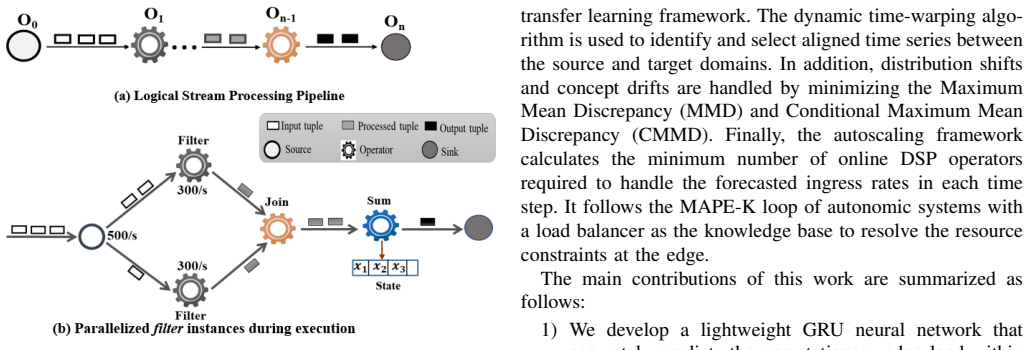
The carrying mechanism is the GRU's update-gate and reset-gate state update, which the paper uses to forecast load windows, combined with three supporting components: a DTW threshold that selects similar source time series, a joint loss $L_{\text{joint}} = L_t + \lambda_1 L_M + \lambda_2 L_{\text{CMMD}}$ that aligns marginal and conditional distributions in an RKHS, and the minimum-parallelism formula $\eta_{o_i}$ that converts predicted rates into operator replicas. The GRU is the only implemented component; it takes the last 24 time steps and outputs the next load value through a single-unit dense layer.
What would settle it
Train the same GRU to produce $p$-step-ahead forecasts on the IoT Traffic and NYCTT series; if SMAPE grows sharply as $p$ increases, or if the checkpoint-restart rescaling time exceeds the forecast lead time, the proactive autoscaler cannot act before load changes.
Extended reading notes
Core claim
The paper's central claim is that a lightweight GRU is an accurate and cheap predictor of non-stationary edge stream load, and that such a predictor can be made to work online through a homogeneous transductive transfer-learning procedure (DTW-based source selection plus joint distribution adaptation with MMD and CMMD losses) and can drive horizontal autoscaling through a parallelism formula adapted from earlier stream-processing work. The result, as the authors present it, is that GRU load forecasts with up to 1.3% SMAPE are accurate enough to precompute operator parallelism, and that the transfer and scaling stages turn those forecasts into proactive edge scaling decisions.
Load-bearing premise
The load-bearing premise is that the GRU's accuracy in predicting the very next load value survives when the model must predict several time steps ahead, which is what the autoscaling problem's projection horizon $p$ requires.
Editorial extensions
If this is right
- If the GRU's forecast accuracy holds online, an edge autoscaler can change operator parallelism before a load spike arrives instead of after a threshold is breached.
- The measured average training and inference time of 218.8 seconds suggests the predictive model is light enough to run periodically at the edge, unlike RL policies that need thousands of training iterations.
- The DTW-plus-MMD/CMMD transfer step, if implemented, would let a model pre-trained on historical data be fine-tuned on a short online sample, addressing the short retention of stream databases.
- The parallelism formula plus the cloud-migration rule gives a concrete policy for stateful operators that saturate edge nodes: scale to the maximum and offload when edge latency exceeds migration plus cloud latency.
- Because the current experiments are one-step-ahead, the framework's proactive promise stands or falls on a multi-step evaluation.
- The 1.3% SMAPE is reported after standardizing the real-world series to match the mean and variance of the synthetic data; an evaluation on raw, unprocessed stream load would isolate how much of the accuracy comes from preprocessing.
- A direct multi-step forecasting test using the same GRU and datasets is the first experiment that would settle whether the proactive claim is viable.
- The load-balancer migration rule compares edge latency with migration-plus-cloud latency, but the checkpoint-restart cost in the MAPE-K execute phase is not measured; that cost determines the minimum forecast lead time the system needs.
Signed reviews
Editorial analysis
A structured set of objections, weighed in public.
Referee Report
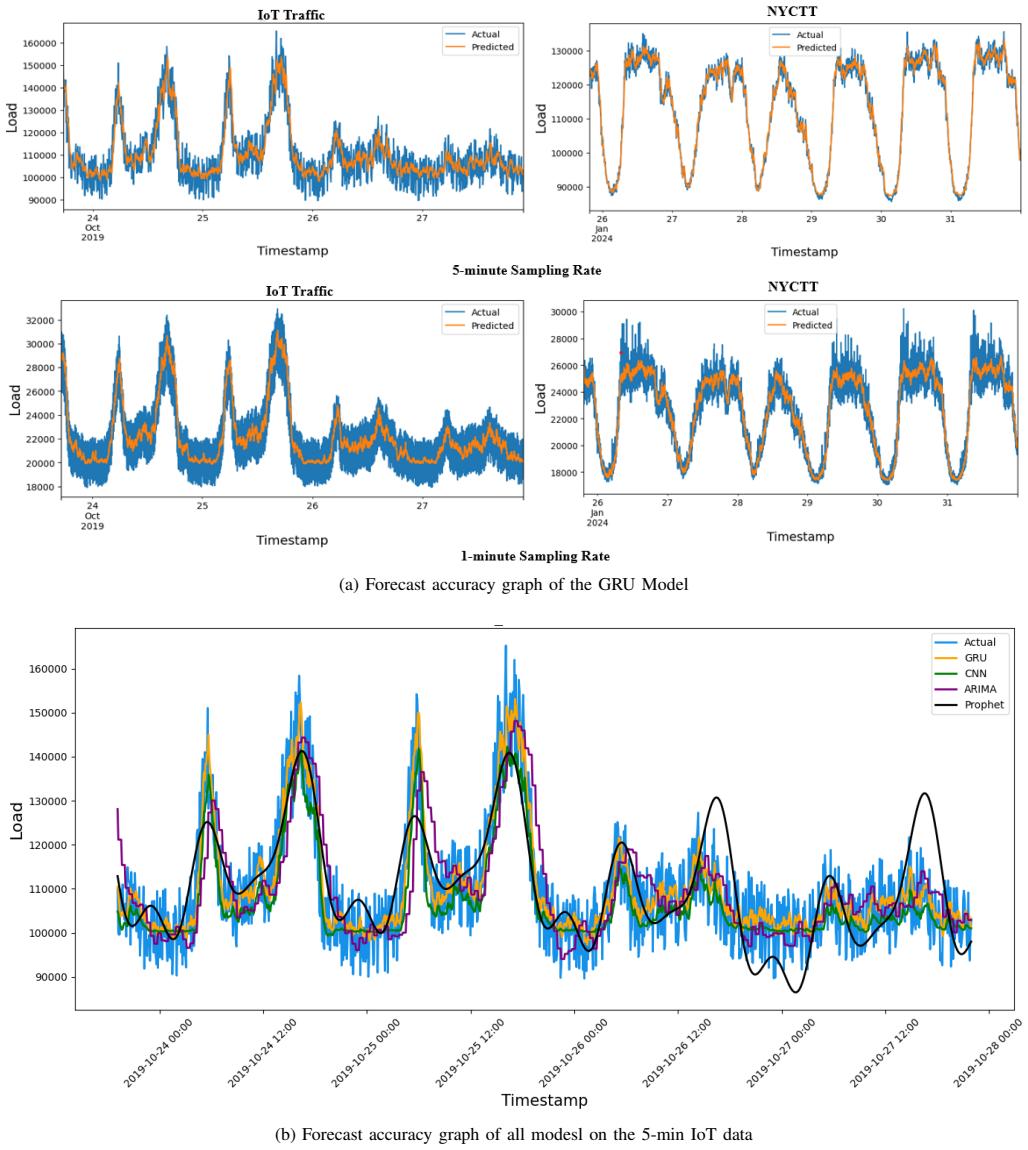
Summary. The paper proposes a three-step framework for proactive horizontal autoscaling of edge stream processing: a GRU-based load forecaster, a transfer-learning module using DTW and MMD/CMMD, and a horizontal autoscaler following the MAPE-K loop. The authors implement and evaluate only the forecasting component, comparing GRU, CNN, ARIMA, and Prophet on six datasets (synthetic IoT traffic and New York City taxi trip records at 1-, 2-, and 5-minute sampling rates). They report that GRU achieves the lowest SMAPE (1.34% on the 5-minute NYCTT set) and lower training time than the baselines. The transfer-learning and autoscaling components are explicitly stated, in Sections IV and VII, to be at the conceptual stage rather than implemented.
Significance. If the forecasting results were conclusive, they would provide a modest contribution to load prediction for distributed stream processing. The paper's broader significance as an autoscaling framework is limited because two of the three components are not implemented or evaluated; the honest disclosure of this limitation is a strength, and the problem formulation in Section III is clear. The forecasting comparison is reproducible in principle, but the evaluation design and the one-step horizon undermine the strength of the claims. The paper does not provide code or machine-checked artifacts, and no falsifiable system-level predictions are tested.
major comments (4)
- [Abstract; Sections IV and VII] The abstract and title present a complete proactive autoscaling framework, but Section IV states that "both the transfer learning and autoscaling frameworks are currently at advanced conceptual stages," and Section VII repeats this qualification. The experimental evaluation in Section V covers only the predictive module. As a result, the evidence supports only a load-forecasting benchmark, not the framework-level claim. Please either implement and evaluate the transfer-learning and autoscaling components or reframe the contributions to explicitly scope the paper as a forecasting study with a proposed, not yet validated, framework.
- [Section III-A vs. Section V-B] Section III-A defines the autoscaling objective as multi-step forecasting over a projection horizon p, f({ϖ_i}_{i=1}^n) ≈ {ϖ̂_i}_{i=n+1}^{n+p}, while Section V-B specifies that a fully connected output layer with a single unit is used to predict the load for the next time step. No multi-step forecasting experiments or lead-time analysis are reported, although the checkpoint-restart scaling procedure in Section IV-C-1-d introduces reconfiguration latency that requires a forecast horizon longer than one step. The paper should either add multi-step forecasting evaluation (e.g., recursive or direct strategies) and analyze the forecast lead time against the scaling latency, or revise the problem definition to a one-step lookahead.
- [Section V-A, Algorithm 2] Algorithm 2 standardizes the real-world NYCTT time series by shifting and scaling its z-scores to match the mean and standard deviation of the synthetic IoT Traffic data. This preprocessing removes the real-world distributional characteristics that the transfer-learning framework is intended to address, and it makes the "real-world dataset" claim in the abstract misleading. The evaluation should be repeated on the raw NYCTT series (or at least both raw and matched versions reported), and the authors should justify the normalization as a realistic benchmarking procedure.
- [Section V-B and Section VI] The ARIMA model is restricted to p,q ≤ 3, d ∈ {0,1}, Nelder-Mead optimization, and 30 iterations, and the text acknowledges that these constraints "capped its accuracy." The resulting comparison does not fairly represent ARIMA's performance, so the claim that GRU outperforms ARIMA is weaker than stated. Please use a standard auto_arima configuration or otherwise justify the restricted search space, and report variability across repeated runs (e.g., mean ± standard deviation over multiple seeds) for the neural models, since none of the reported numbers carry error bars.
minor comments (5)
- [Section I] The phrase "The the three-step proactive autoscaling framework" contains a duplicated article and should be corrected.
- [Figure 6b caption] The caption contains the typo "modesl" instead of "models".
- [Section V-B] The text says "Table 1 shows the runtime of the experiments," but Table I lists configuration specifications (CPU, RAM, GPU, software), not runtimes; the reference should point to the table containing training-time results.
- [Section IV-A-2] The ARIMA equation shown is a simplified ARMA(1,1) form rather than a general ARIMA(p,d,q) model; the notation should be either explicitly restricted or corrected to the general form.
- [Section VI] The explanation that all models achieve lower errors on NYCTT than on IoT Traffic is stated twice in the same section; the duplicate explanation should be consolidated.
Circularity Check
No circularity: the implemented GRU forecasting benchmark is self-contained, and the untested transfer-learning and autoscaling modules are explicitly disclosed as conceptual rather than presented as derived predictions.
full rationale
The paper's only implemented and evaluated component is the GRU load forecaster in Section V. The forecast is trained on an 80% split and tested on the held-out 20% split, with SMAPE and RMSE computed from the actual versus predicted series; no fitted parameter is renamed as a prediction and no evaluation equation is equivalent to the training objective by construction. The transfer-learning and autoscaling parts of the framework are explicitly labeled as not implemented: Section IV states that 'both the transfer learning and autoscaling frameworks are currently at advanced conceptual stages guided by theoretical principles and design considerations,' and the conclusion repeats this qualification. Because these modules are not claimed to have produced measured results, their absence is a completeness/validation gap rather than a circular derivation. The normalization in Algorithm 2, which z-scores the NYCTT counts and shifts/scales them to the IoT Traffic mean and standard deviation, is a preprocessing and comparability choice; it may weaken the claim that the model was tested on a genuine raw real-world distribution, and it narrows the domain gap that the transfer-learning stage is supposed to address, but it does not make the forecast equal to its input or force the reported error values. The parallelism formula in Section IV-C is adopted from an external prior work ([7]), not from the authors' own prior results, so there is no self-citation chain carrying the argument. Overall, no load-bearing step reduces to its own inputs by definition, by fitted-value construction, or by self-citation.
Assumptions & free parameters
free parameters (6)
- GRU model hyperparameters (units/layer, learning rate, dropout, batch size, epochs, sequence length) =
64, 0.01, 0.2, 16, 10, 24
- ARIMA search-space bounds =
p,q <= 3; d in {0,1}
- Adjustment factor alpha =
Not specified
- DTW distance threshold dt =
Not specified
- Domain adaptation loss weights lambda1, lambda2 =
Not specified
- Load balancer latency thresholds =
Not specified
assumptions (4)
- domain assumption Ingress rate is a sufficient univariate reflection of the load on the stream processing system.
- domain assumption The parallelism formula from reference 7 is valid in edge environments, assuming additive rates and no inter-operator contention.
- domain assumption The generated datasets (cubic-spline interpolation, plus/minus 10% noise, z-score matching) represent real edge stream workloads.
- domain assumption Minimizing MMD and CMMD drives the source and target conditional and marginal distributions to match, making the transferred model accurate online.
Cite this review
Pith. "Pith review of Towards a Proactive Autoscaling Framework for Data Stream Processing at the Edge using GRU and Transfer Learning." pith.science (2026). https://pith.science/paper/JMAOB4Z5
@misc{pith2026250714597,
  author       = {Pith},
  title        = {Pith review of: Towards a Proactive Autoscaling Framework for Data Stream Processing at the Edge using GRU and Transfer Learning},
  year         = {2026},
  howpublished = {\url{https://pith.science/paper/JMAOB4Z5}},
  note         = {Machine review of arXiv:2507.14597}
}
read the original abstract
Processing data at high speeds is becoming increasingly critical as digital economies generate enormous data. The current paradigms for timely data processing are edge computing and data stream processing (DSP). Edge computing places resources closer to where data is generated, while stream processing analyzes the unbounded high-speed data in motion. However, edge stream processing faces rapid workload fluctuations, complicating resource provisioning. Inadequate resource allocation leads to bottlenecks, whereas excess allocation results in wastage. Existing reactive methods, such as threshold-based policies and queuing theory scale only after performance degrades, potentially violating SLAs. Although reinforcement learning (RL) offers a proactive approach through agents that learn optimal runtime adaptation policies, it requires extensive simulation. Furthermore, predictive machine learning models face online distribution and concept drift that minimize their accuracy. We propose a three-step solution to the proactive edge stream processing autoscaling problem. Firstly, a GRU neural network forecasts the upstream load using real-world and synthetic DSP datasets. Secondly, a transfer learning framework integrates the predictive model into an online stream processing system using the DTW algorithm and joint distribution adaptation to handle the disparities between offline and online domains. Finally, a horizontal autoscaling module dynamically adjusts the degree of operator parallelism, based on predicted load while considering edge resource constraints. The lightweight GRU model for load predictions recorded up to 1.3\% SMAPE value on a real-world data set. It outperformed CNN, ARIMA, and Prophet on the SMAPE and RMSE evaluation metrics, with lower training time than the computationally intensive RL models.
Figures


Figures from the paper (4 more)



Reference graph
Works this paper leans on
-
[1]
An overview on edge computing research,
K. Cao, Y . Liu, G. Meng, and Q. Sun, “An overview on edge computing research,” IEEE access, vol. 8, pp. 85 714–85 728, 2020
work page 2020
-
[2]
Towards automatic parameter tuning of stream processing systems,
M. Bilal and M. Canini, “Towards automatic parameter tuning of stream processing systems,” in Proceedings of the 2017 Symposium on Cloud Computing, 2017, pp. 189–200
work page 2017
-
[3]
Wasp: Wide-area adaptive stream processing,
A. Jonathan, A. Chandra, and J. Weissman, “Wasp: Wide-area adaptive stream processing,” in Proceedings of the 21st international middleware conference, 2020, pp. 221–235
work page 2020
-
[4]
Automatic performance tuning for distributed data stream processing systems,
H. Herodotou, L. Odysseos, Y . Chen, and J. Lu, “Automatic performance tuning for distributed data stream processing systems,” in 2022 IEEE 38th International Conference on Data Engineering (ICDE) . IEEE, 2022, pp. 3194–3197
work page 2022
-
[5]
Hierarchical auto- scaling policies for data stream processing on heterogeneous resources,
G. Russo Russo, V . Cardellini, and F. Lo Presti, “Hierarchical auto- scaling policies for data stream processing on heterogeneous resources,” ACM Transactions on Autonomous and Adaptive Systems, vol. 18, no. 4, pp. 1–44, 2023
work page 2023
-
[6]
Towards evaluating stream processing autoscalers,
G. Siachamis, J. Kanis, W. Koper, K. Psarakis, M. Fragkoulis, A. Van Deursen, and A. Katsifodimos, “Towards evaluating stream processing autoscalers,” in 2023 IEEE 39th International Conference on Data Engineering Workshops (ICDEW) . IEEE, 2023, pp. 95–99
work page 2023
-
[7]
V . Kalavri, J. Liagouris, M. Hoffmann, D. Dimitrova, M. Forshaw, and T. Roscoe, “Three steps is all you need: fast, accurate, automatic scaling decisions for distributed streaming dataflows,” in 13th USENIX Symposium on Operating Systems Design and Implementation (OSDI 18), 2018, pp. 783–798
work page 2018
-
[8]
Fas: A flow aware scaling mechanism for stream processing platform service based on lms,
Y . Wu, R. Rao, P. Hong, and J. Ma, “Fas: A flow aware scaling mechanism for stream processing platform service based on lms,” in Proceedings of the 2017 International Conference on Management Engineering, Software Engineering and Service Sciences, 2017, pp. 280– 284
work page 2017
Show all 55 references
-
[9]
Stream data load prediction for resource scaling using online support vector regression,
Z. Hu, H. Kang, and M. Zheng, “Stream data load prediction for resource scaling using online support vector regression,” Algorithms, vol. 12, no. 2, p. 37, 2019
2019
-
[10]
Recurrent concept drifts on data streams,
N. Gunasekara, B. Pfahringer, H. M. Gomes, A. Bifet, and Y . Sing, “Recurrent concept drifts on data streams,” in Proceedings of the Thirty- Third International Joint Conference on Artificial Intelligence, IJCAI-24, 2024, pp. 8029–8037
2024
-
[11]
Elastic data stream processing,
T. Heinze, “Elastic data stream processing,” 2021
2021
-
[12]
Model-based reinforcement learning for elastic stream processing in edge computing,
J. Xu and B. Palanisamy, “Model-based reinforcement learning for elastic stream processing in edge computing,” in 2021 IEEE 28th International Conference on High Performance Computing, Data, and Analytics (HiPC). IEEE, 2021, pp. 292–301
2021
-
[13]
Runtime adaptation of data stream processing systems: The state of the art,
V . Cardellini, F. Lo Presti, M. Nardelli, and G. R. Russo, “Runtime adaptation of data stream processing systems: The state of the art,” ACM Computing Surveys, vol. 54, no. 11s, pp. 1–36, 2022
2022
-
[14]
Mead: Model-based vertical auto-scaling for data stream processing,
G. R. Russo, V . Cardellini, G. Casale, and F. L. Presti, “Mead: Model-based vertical auto-scaling for data stream processing,” in 2021 IEEE/ACM 21st International Symposium on Cluster, Cloud and Internet Computing (CCGrid). IEEE, 2021, pp. 314–323
2021
-
[15]
Q-flink: A qos-aware controller for apache flink,
M. R. HoseinyFarahabady, A. Jannesari, J. Taheri, W. Bao, A. Y . Zomaya, and Z. Tari, “Q-flink: A qos-aware controller for apache flink,” in 2020 20th IEEE/ACM International Symposium on Cluster, Cloud and Internet Computing (CCGRID) . IEEE, 2020, pp. 629–638
2020
-
[16]
Auto-sizing for stream processing applications at {LinkedIn},
R. P. Singh, B. Kumarasubramanian, P. Maheshwari, and S. Shetty, “Auto-sizing for stream processing applications at {LinkedIn},” in 12th USENIX Workshop on Hot Topics in Cloud Computing (HotCloud 20) , 2020
2020
-
[17]
Turbine: Facebook’s service management platform for stream processing,
Y . Mei, L. Cheng, V . Talwar, M. Y . Levin, G. Jacques-Silva, N. Simha, A. Banerjee, B. Smith, T. Williamson, S. Yilmaz et al. , “Turbine: Facebook’s service management platform for stream processing,” in 2020 IEEE 36th International Conference on Data Engineering (ICDE) . IE...
2020
-
[18]
An optimal model for optimizing the placement and parallelism of data stream processing applications on cloud-edge computing,
F. R. De Souza, M. D. de Assunc ¸ao, E. Caron, and A. da Silva Veith, “An optimal model for optimizing the placement and parallelism of data stream processing applications on cloud-edge computing,” in 2020 IEEE 32nd International Symposium on Computer Architecture and High Per...
2020
-
[19]
Joint operator scaling and placement for distributed stream processing applications in edge computing,
Q. Peng, Y . Xia, Y . Wang, C. Wu, X. Luo, and J. Lee, “Joint operator scaling and placement for distributed stream processing applications in edge computing,” in Service-Oriented Computing: 17th International Conference, ICSOC 2019, Toulouse, France, October 28–31, 2019, Proc...
2019
-
[20]
Elastic resource allocation based on dynamic perception of operator influence domain in distributed stream processing,
F. Liu, W. Zhu, W. Mu, Y . Zhang, M. Li, Z. Zhu, and W. Wang, “Elastic resource allocation based on dynamic perception of operator influence domain in distributed stream processing,” in International Conference on Computational Science . Springer, 2022, pp. 734–748
2022
-
[21]
Optimal operator deployment and replication for elastic distributed data stream processing. concurr. comput.(2017)
V . Cardellini, F. Lo Presti, M. Nardelli, and G. Russo Russo, “Optimal operator deployment and replication for elastic distributed data stream processing. concurr. comput.(2017).”
2017
-
[22]
Streamcloud: An elastic and scalable data streaming system,
V . Gulisano, R. Jimenez-Peris, M. Patino-Martinez, C. Soriente, and P. Valduriez, “Streamcloud: An elastic and scalable data streaming system,” IEEE Transactions on Parallel and Distributed Systems, vol. 23, no. 12, pp. 2351–2365, 2012
2012
-
[23]
Elastic scaling for data stream processing,
B. Gedik, S. Schneider, M. Hirzel, and K.-L. Wu, “Elastic scaling for data stream processing,” IEEE Transactions on Parallel and Distributed Systems, vol. 25, no. 6, pp. 1447–1463, 2013
2013
-
[24]
Elastic pulsar functions for distributed stream processing,
G. Russo Russo, A. Schiazza, and V . Cardellini, “Elastic pulsar functions for distributed stream processing,” in Companion of the ACM/SPEC International Conference on Performance Engineering , 2021, pp. 9–16
2021
-
[25]
Elastic symbiotic scaling of operators and resources in stream processing systems,
F. Lombardi, L. Aniello, S. Bonomi, and L. Querzoni, “Elastic symbiotic scaling of operators and resources in stream processing systems,” IEEE Transactions on Parallel and Distributed Systems , vol. 29, no. 3, pp. 572–585, 2017
2017
-
[26]
Proactive elasticity and energy aware- ness in data stream processing,
T. De Matteis and G. Mencagli, “Proactive elasticity and energy aware- ness in data stream processing,” Journal of Systems and Software , vol. 127, pp. 302–319, 2017
2017
-
[27]
Drs: Auto-scaling for real-time stream analytics,
T. Z. Fu, J. Ding, R. T. Ma, M. Winslett, Y . Yang, and Z. Zhang, “Drs: Auto-scaling for real-time stream analytics,” IEEE/ACM Transactions on networking, vol. 25, no. 6, pp. 3338–3352, 2017
2017
-
[28]
Elastic stream processing with latency guarantees,
B. Lohrmann, P. Janacik, and O. Kao, “Elastic stream processing with latency guarantees,” in 2015 IEEE 35th International Conference on Distributed Computing Systems . IEEE, 2015, pp. 399–410
2015
-
[29]
Feedback-control & queueing theory-based resource management for streaming applications,
R. Tolosana-Calasanz, J. Diaz-Montes, O. F. Rana, and M. Parashar, “Feedback-control & queueing theory-based resource management for streaming applications,” IEEE Transactions on parallel and distributed systems, vol. 28, no. 4, pp. 1061–1075, 2016
2016
-
[30]
A stream-processing server with an internal and an external queue,
T. Cooper, P. Ezhilchelvan, and I. Mitrani, “A stream-processing server with an internal and an external queue,” Queueing Models and Service Management, vol. 4, no. 1, pp. 31–53, 2021
2021
-
[31]
Model-based scheduling for stream processing systems,
Y . Wang, Z. Tari, M. R. HoseinyFarahabady, and A. Y . Zomaya, “Model-based scheduling for stream processing systems,” in 2017 IEEE 19th International Conference on High Performance Computing and Communications; IEEE 15th International Conference on Smart City; IEEE 3rd Intern...
2017
-
[32]
Elastic complex event processing exploiting prediction,
N. Zacheilas, V . Kalogeraki, N. Zygouras, N. Panagiotou, and D. Gunop- ulos, “Elastic complex event processing exploiting prediction,” in 2015 IEEE International Conference on Big Data (Big Data) . IEEE, 2015, pp. 213–222
2015
-
[33]
Evaluation of load prediction techniques for distributed stream processing,
K. Gontarska, M. Geldenhuys, D. Scheinert, P. Wiesner, A. Polze, and L. Thamsen, “Evaluation of load prediction techniques for distributed stream processing,” in 2021 IEEE International Conference on Cloud Engineering (IC2E). IEEE, 2021, pp. 91–98
2021
-
[34]
Caladrius: A performance modelling service for distributed stream processing systems,
F. Kalim, T. Cooper, H. Wu, Y . Li, N. Wang, N. Lu, M. Fu, X. Qian, H. Luo, D. Cheng et al., “Caladrius: A performance modelling service for distributed stream processing systems,” in 2019 IEEE 35th Inter- national Conference on Data Engineering (ICDE) . IEEE, 2019, pp. 1886–1897
2019
-
[35]
Qos-and contention- aware resource provisioning in a stream processing engine,
M. R. H. Farahabady, A. Y . Zomaya, and Z. Tari, “Qos-and contention- aware resource provisioning in a stream processing engine,” in 2017 IEEE International Conference on Cluster Computing (CLUSTER) . IEEE, 2017, pp. 137–146
2017
-
[36]
Cost-effective transfer learning for data streams,
O. Wu, Y . S. Koh, G. Dobbie, and T. Lacombe, “Cost-effective transfer learning for data streams,” in 2022 IEEE International Conference on Data Mining (ICDM) . IEEE, 2022, pp. 1233–1238
2022
-
[37]
Multi-source transfer learning for non-stationary environments,
H. Du, L. L. Minku, and H. Zhou, “Multi-source transfer learning for non-stationary environments,” in 2019 International Joint Conference on Neural Networks (IJCNN) . IEEE, 2019, pp. 1–8
2019
-
[38]
Proscale: Proactive autoscaling for microservice with time- varying workload at the edge,
K. Cheng, S. Zhang, C. Tu, X. Shi, Z. Yin, S. Lu, Y . Liang, and Q. Gu, “Proscale: Proactive autoscaling for microservice with time- varying workload at the edge,” IEEE Transactions on Parallel and Distributed Systems, vol. 34, no. 4, pp. 1294–1312, 2023
2023
-
[39]
Introduction to sequence learning models: Rnn, lstm, gru,
S. Ashraf Zargar, “Introduction to sequence learning models: Rnn, lstm, gru,” 2021
2021
-
[40]
Deep learning for time series forecasting: a survey,
J. F. Torres, D. Hadjout, A. Sebaa, F. Mart´ınez- ´Alvarez, and A. Troncoso, “Deep learning for time series forecasting: a survey,” Big data, vol. 9, no. 1, pp. 3–21, 2021
2021
-
[41]
A comparative study on long short-term memory and gated recurrent unit neural networks in fault diagnosis for chemical processes using visualization,
S. Mirzaei, J.-L. Kang, and K.-Y . Chu, “A comparative study on long short-term memory and gated recurrent unit neural networks in fault diagnosis for chemical processes using visualization,” Journal of the Taiwan Institute of Chemical Engineers , vol. 130, p. 104028, 2022
2022
-
[42]
Lstm and gru neural networks as models of dynamical processes used in predictive control: A comparison of models developed for two chemical reactors,
K. Zarzycki and M. Ławry ´nczuk, “Lstm and gru neural networks as models of dynamical processes used in predictive control: A comparison of models developed for two chemical reactors,” Sensors, vol. 21, no. 16, p. 5625, 2021
2021
-
[43]
A comparison between arima, lstm, and gru for time series forecasting,
P. T. Yamak, L. Yujian, and P. K. Gadosey, “A comparison between arima, lstm, and gru for time series forecasting,” in Proceedings of the 2019 2nd international conference on algorithms, computing and artificial intelligence, 2019, pp. 49–55
2019
-
[44]
Implementing transfer learning across different datasets for time series forecasting,
R. Ye and Q. Dai, “Implementing transfer learning across different datasets for time series forecasting,” Pattern Recognition, vol. 109, p. 107617, 2021
2021
-
[45]
Predictive efficiency of arima and ann models: A case analysis of nifty fifty in indian stock market,
V . S. Pandey and A. Bajpai, “Predictive efficiency of arima and ann models: A case analysis of nifty fifty in indian stock market,” Inter- national Journal of Applied Engineering Research , vol. 14, no. 2, pp. 232–244, 2019
2019
-
[46]
Rafferty, Forecasting Time Series Data with Facebook Prophet: Build, improve, and optimize time series forecasting models using the advanced forecasting tool
G. Rafferty, Forecasting Time Series Data with Facebook Prophet: Build, improve, and optimize time series forecasting models using the advanced forecasting tool. Packt Publishing Ltd, 2021
2021
-
[47]
A multi- source transfer learning model based on lstm and domain adaptation for building energy prediction,
H. Lu, J. Wu, Y . Ruan, F. Qian, H. Meng, Y . Gao, and T. Xu, “A multi- source transfer learning model based on lstm and domain adaptation for building energy prediction,” International Journal of Electrical Power & Energy Systems , vol. 149, p. 109024, 2023
2023
-
[48]
Maximum mean discrepancy for generalization in the presence of distribution and missingness shift,
L. Ouyang and A. Key, “Maximum mean discrepancy for generalization in the presence of distribution and missingness shift,” arXiv preprint arXiv:2111.10344, 2021
2021 arXiv
-
[49]
Learning from the past: Adaptive parallelism tuning for stream processing systems,
Y . Han, L. Chen, H. Wang, Z. Chen, Y . Zhang, C. Yang, K. Hao, and Z. Yang, “Learning from the past: Adaptive parallelism tuning for stream processing systems,” arXiv preprint arXiv:2504.12074 , 2025
2025 arXiv
-
[50]
Investigating edge vs. cloud computing trade-offs for stream processing,
P. Silva, A. Costan, and G. Antoniu, “Investigating edge vs. cloud computing trade-offs for stream processing,” in 2019 IEEE International Conference on Big Data (Big Data) . IEEE, 2019, pp. 469–474
2019
-
[51]
A review on architecture and models for autonomic software systems,
P. Dehraj and A. Sharma, “A review on architecture and models for autonomic software systems,” The Journal of Supercomputing , vol. 77, no. 1, pp. 388–417, 2021
2021
-
[52]
Some new observations on slo-aware edge stream processing,
A. Shahid, P. Kang, P. Lama, and S. U. Khan, “Some new observations on slo-aware edge stream processing,” in 2023 IEEE Cloud Summit . IEEE, 2023, pp. 27–32
2023
-
[53]
Using stream processing to find suitable rides: An exploration based on new york city taxi data,
R. Tsch ¨umperlin, D. Bucher, and J. Schito, “Using stream processing to find suitable rides: An exploration based on new york city taxi data,” in Proceedings of Spatial Big Data and Machine Learning in GIScience- Workshop at GIScience 2018 . SpatialBigData, 2018, pp. 13–16
2018
-
[54]
Efficient taxi and passenger searching in smart city using distributed coordination,
A. Agrawal, V . Raychoudhury, D. Saxena, and A. D. Kshemkalyani, “Efficient taxi and passenger searching in smart city using distributed coordination,” in 2018 21st International Conference on Intelligent Transportation Systems (ITSC) . IEEE, 2018, pp. 1920–1927
2018
-
[55]
Model-based stream processing auto-scaling in geo-distributed environments,
H. Arkian, G. Pierre, J. Tordsson, and E. Elmroth, “Model-based stream processing auto-scaling in geo-distributed environments,” in 2021 International Conference on Computer Communications and Networks (ICCCN). IEEE, 2021, pp. 1–10
2021
Reviewed August 6, 2026 · model on record in the stance chip above.
Discussion (0). Continue with ORCID to comment.