REVIEW 3 major objections 3 minor 2 cited by
This paper argues that a single varying-speed-of-light parameter b can raise the early-universe Hubble constant to about 73 km/s/Mpc while making supernova time dilation deviate from the standard (1+z) law as n=1-b/4.
Reviewed by Pith at T0; open to challenge. T0 means a machine referee read the full paper against a public rubric. the ladder, T0–T4 →
The meVSL model's parameter b reduces the baryon drag sound horizon, raising inferred H0, and changes the cosmological time-dilation exponent to n=1-b/4; the paper forecasts SN sample sizes to detect this.
T0 review reviewed 2026-08-05 challenge →
load-bearing objection Same-parameter story is appealing, but the paper's own equations put z_drag above z_star for b>0, undercutting the headline H0≈73. the 3 major comments →
Alleviating the Hubble Tension via Cosmological Time Dilation in the meVSL Model
The pith
A machine-rendered reading of the paper's core claim, the machinery that carries it, and where it could break.
The reading
Core claim
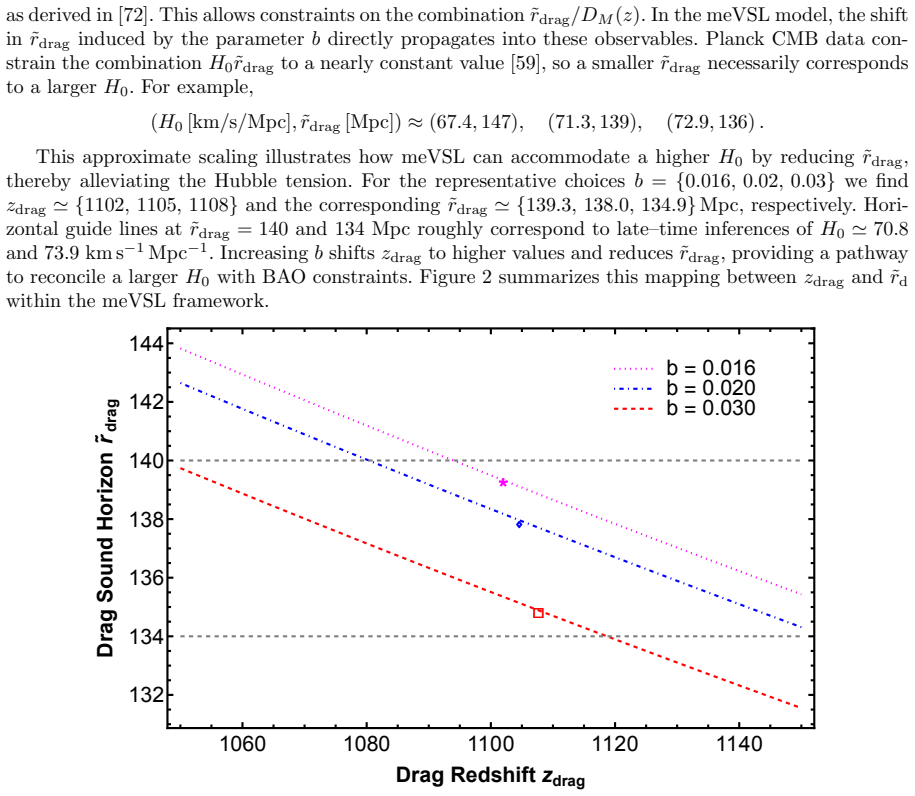
The central claim, stated the way the author would state it, is that the meVSL parameter b is not an isolated tweak: the same index that rescales the apparent speed of light changes two independent observables in the same direction. It raises the drag redshift (z_drag about 1108 for b=0.03), lowers the drag-epoch sound horizon to about 135 Mpc, and thereby raises the early-universe H0 inferred from the nearly constant Planck product H0 times r_drag to about 73 km/s/Mpc. The same b lowers the cosmological time-dilation exponent from 1 to n=1-b/4, so supernova light curves stretch less than the standard (1+z) law as redshift grows. Using Fisher forecasts, the paper quantifies how many SNe Ia a
What carries the argument
The load-bearing object is the meVSL scaling index b, defined by c = c0 a^(b/4). Through modified Friedmann equations and a b-dependent Thomson scattering rate, b shifts photon decoupling downward and the baryon drag redshift upward, shortening the comoving sound horizon r_drag. The connection to H0 is made by the Planck-calibrated near-invariance of H0 times r_drag; the time-domain connection is n=1-b/4. The drag optical depth condition tau_drag(z)=1 selects z_drag(b), and the Fisher information from light-curve widths sets the detectability.
Load-bearing premise
The paper's headline H0 about 73 rests on assuming Planck's constraint on H0 times r_drag is unchanged in meVSL, so shrinking r_drag raises H0 without a full meVSL Boltzmann check of the rest of the CMB.
What would settle it
A full meVSL CMB spectrum calculation: if at b=0.03 the predicted TT/EE/TE spectra fit Planck significantly worse than LCDM, the assumed H0 times r_drag invariance fails and the headline H0 about 73 is falsified. Independently, a supernova survey measuring the time-dilation exponent with total uncertainty near 0.003 that returns n=1.000 plus or minus 0.003 would rule out b about 0.04 and above, since the model predicts n=1-b/4.
If this is right
- A single positive b simultaneously raises H0 toward 73 km/s/Mpc and lowers the time-dilation exponent to n=1-b/4, making the two anomalies two faces of one parameter.
- A 3-sigma detection of n=0.990 requires about 225 SNe with statistical errors only, and about 450 with a systematic floor of 0.05, within reach of current and upcoming surveys.
- Detecting |n-1| of 0.001 at 3-sigma needs tens of thousands of SNe, marking the regime only next-generation surveys can access.
- Joint fitting of r_drag from CMB/BAO and n from supernova durations provides a self-consistent cross-check of b, independent of distance-ladder systematics.
Where Pith is reading between the lines
- Implicit in the paper but not developed: the same b rescales the redshift inferred from spectra, so existing CTD measurements that use the standard redshift mapping may be slightly biased; reanalyzing DES with the b-dependent redshift could shift the best-fit n.
- The paper lists BBN and fine-structure constant as complementary probes but does not fold their limits into the allowed range of b; doing so would likely close off part of the parameter space and sharpen the prediction.
- If a near-future survey measures n=1 with total error below 0.003 while independent late-time measurements keep H0 near 73, the dual-parameter link would be broken and the meVSL resolution of the Hubble tension would be disfavored even before a Boltzmann calculation.
- The H0 about 73 number should be read as an illustrative mapping until a self-consistent meVSL recombination and CMB spectrum calculation is done; that calculation is the natural next step and would turn the claim into a full cosmological model test.
Editorial analysis
A structured set of objections, weighed in public.
Referee Report
Summary. The paper claims that a single parameter b in the minimally extended varying-speed-of-light (meVSL) model can simultaneously reduce the baryon drag-epoch sound horizon and modify the cosmological time-dilation exponent, n = 1 - b/4. For b=0.03 it quotes z_drag ≈ 1108, r_drag ≈ 135 Mpc, and H0 ≈ 73 km/s/Mpc, thereby 'alleviating' the Hubble tension. It also presents Fisher forecasts for DES-like samples to estimate the number of SNe needed to detect n ≠ 1. The core sections (3.1.2-3.1.4) derive the b-dependence of z_star, z_drag, r_drag and map the latter to H0; Section 4 imports the CTD scaling and performs forecasting.
Significance. If the claimed relation between b, r_drag, and H0 were correct, the paper would provide a minimal, testable resolution of the Hubble tension with a distinct time-domain prediction. The Fisher-forecast framework is clearly laid out and easily reproducible, and the paper is candid about the need for a future Boltzmann calculation. However, the central illustration is internally inconsistent: the model's own approximate formulas violate the physical ordering of recombination and drag epoch for the parameter values used to claim H0 ≈ 73. Since the headline result depends on this ordering and on an imported ΛCDM relation that is not rederived in meVSL, the manuscript's central claims are not established as they stand.
major comments (3)
- [§3.1.2 and §3.1.3, Eqs. (18) and (21)] There is an internal inconsistency in the redshift evolution used to compute r_drag. Eq. (18) gives z_star(b) ≈ 1090 − 3808 b, so z_star decreases with b (e.g., z_star ≈ 1052 at b=0.01 and ≈ 976 at b=0.03). In contrast, Eq. (21) gives z_drag increasing with b: z_drag(0.01)=1095 and z_drag(0.03)=1106.7. Thus for any b ≳ 0.0075, z_drag > z_star, reversing the physical order in which recombination precedes baryon drag. The paper itself states in §3.1.3 that the z_star−z_drag offset 'should be recomputed rather than held fixed,' but the two approximations actually used produce a crossing. Consequently the r_drag values quoted in §3.1.4 and Fig. 2 are evaluated at a redshift that is not a physically meaningful drag epoch, and the resulting H0 ≈ 73 is unsupported.
- [§3.1.4, H0–r_drag mapping] The mapping from a reduced r_drag to H0 ≈ 73 assumes that the Planck constraint on H0 r_drag is unchanged in meVSL. This is an imported ΛCDM relation (Ref. [59]) applied to a model that modifies recombination (z_star, z_drag), the Thomson scattering rate, and the sound speed. The influence on CMB spectra, Silk damping, and the acoustic scale is not computed, and the paper explicitly defers a full Boltzmann calculation to future work. The linear scaling H0 ∝ 1/r_drag is therefore a conjecture, not a derived consequence. This is load-bearing for the paper's main claim, so the claim is not yet supported.
- [§4.2 and Eq. (25)] The paper cites the DES i-band time-dilation measurement n = 0.988 ± 0.008 as independent support for b ≈ 0.048. However, Eq. (25) states that for b ≠ 0 the redshift mapping itself changes, so a self-consistent CTD fit must use zeff(b), not the standard redshift. The quoted DES analysis uses standard redshifts; applying it to infer b without recomputing the redshift transformation is not independent. Moreover, b ≈ 0.048 combined with Eq. (18) gives z_star ≈ 907, while Eq. (21) extrapolates to z_drag ≈ 1110, again violating z_drag < z_star and underscoring that the model's internal consistency is broken for just the parameter values promoted as preferred.
minor comments (3)
- [Abstract and §3.1.3] The abstract quotes z_drag ≃ 1108 for b=0.03, while Eq. (21) lists (0.03, 1106.7). Please reconcile these numbers.
- [§4.3.3 / Fig. 5] The per-band forecast is not reproducible: the text does not specify the photometric error model or the redshift distribution used for the g, r, i, z bands, yet Figure 5 presents precise required-sample numbers. A brief table of assumed noise parameters would help.
- [Eq. (7) and notation] The notation H in Eq. (5) is defined as the standard GR Hubble parameter while the text also uses H for the physical expansion rate; this becomes confusing in Eqs. (17)-(20). Please use a distinct symbol (e.g., H_GR) or clarify consistently.
Circularity Check
Partial circularity: the time-dilation probe n=1-b/4 is imported from the author's own prior papers and then used to claim independent support, while the sound-horizon and Fisher calculations are self-contained.
specific steps
-
self citation load bearing
[Section 4.1, Eq. (26); used in Abstract and Section 4.2]
"In meVSL the scaling of c with a modifies the exponent to n = 1 − b/4 , (26) so that n ̸= 1 encodes an effective, observational rescaling of cosmic time rather than a violation of relativistic time dilation."
The n-b relation is not derived in this paper; it is attributed to the same author's prior papers [16, 23-25]. It is load-bearing because Section 4.2 converts the DES measurement n=0.988±0.008 into b≈0.048 and calls this 'independently supported by supernova observations' for the b>0 that is claimed to alleviate the Hubble tension. Thus the time-domain check is calibrated by the self-cited framework it is supposed to test; within this paper the link is an input, not an independent prediction. The r_drag side is computed here, so the circularity is partial.
full rationale
Most of the r_drag calculation is self-contained: Eqs. (8)-(10) define the sound horizon, Appendix A provides Xe templates, and Section 3.1.3 solves τ_drag=1 to obtain z_drag(b) and r_drag(b). The Fisher forecast is a well-posed calculation of required sample sizes, and b is used as an illustration rather than fitted to H0, so no fitted parameter is renamed as a prediction. The H0≈73 statement is a forward application of the external Planck constraint H0 r_drag ≈ const, not a fit, and therefore is not circular, though it rests on the unverified assumption that this invariant survives in meVSL; the paper itself calls for 'self-consistent Boltzmann calculations' in the Conclusion. The moderate score comes from the n=1-b/4 relation: it is imported from the author's prior work and then used as the bridge from DES time-dilation data to b, making the CTD probe partly a self-citation chain rather than an independent derivation. A separate, non-circular correctness problem is flagged: Eq. (18) has z* decreasing with b while Eq. (21) has z_drag increasing, so for b>0 one gets z_drag > z*, reversing the physical recombination/drag ordering; this invalidates the r_drag values and the H0≈73 illustration, but it is an internal inconsistency rather than circularity.
Axiom & Free-Parameter Ledger
free parameters (4)
- b =
0.016, 0.02, 0.03 (illustrations); 0.048 +/- 0.032 from DES i-band in Sec 4.2
- tanh recombination template parameters =
z_t about 1090, Delta z about 80-100, X_res about 2e-4 to 1e-3; z1 about 1090, Delta z1 about 90
- sigma_0 =
0.05
- sigma_sys =
0.01, 0.05
axioms (5)
- ad hoc to paper meVSL scaling relations: c=c0 a^{b/4}, G=G0 a^b, e=e0 a^{-b/4}, h=h0 a^{-b/4} (Table 1).
- domain assumption Modified Friedmann equations Eqs. (2)-(6) with Bianchi conservation Eq. (4).
- domain assumption Thomson cross section scales as sigma_T = sigma_T0 (1+z)^{b/2} and baryon number density n_e is unchanged (Eqs. 11-16).
- domain assumption Planck CMB data constrain H0 * r_drag to a nearly constant value (Section 3.1.4, citing [59]).
- ad hoc to paper Standard LCDM recombination history X_e(z) from Eq. (37) is used for b != 0.
invented entities (1)
-
meVSL b-parameter effective rescaling of fundamental constants
independent evidence
Cite this review
Pith. "Pith review of Alleviating the Hubble Tension via Cosmological Time Dilation in the meVSL Model." pith.science (2026). https://pith.science/paper/JNX4A4KY
@misc{pith2026250908840,
  author       = {Pith},
  title        = {Pith review of: Alleviating the Hubble Tension via Cosmological Time Dilation in the meVSL Model},
  year         = {2026},
  howpublished = {\url{https://pith.science/paper/JNX4A4KY}},
  note         = {Machine review of arXiv:2509.08840}
}
read the original abstract
We show that a minimally extended varying-speed-of-light (meVSL) cosmology can alleviate the Hubble tension through a single parameter, b. This parameter both shortens the sound horizon at the drag epoch and modifies cosmological time dilation for transients, Delta_t_obs=(1+z)^n Delta_t_emit with n=1-b/4. The reduction in r_d raises the early-universe-inferred H_0 from CMB/BAO analyses, while departures of n from unity provide an independent, time-domain probe of b. Using Fisher forecasts for a DES-like survey, we estimate the supernova sample size required to detect sub-percent deviations in n under realistic statistical and systematic uncertainties. For illustration, b=0.03 yields z_drag = 1108 and r_d = 135 Mpc, consistent with H_0=~73 km/s/Mpc. We conclude that current and upcoming time-domain surveys can place competitive constraints on b and, jointly with CMB/BAO, provide a self-consistent observational test of meVSL's ability to alleviate the H_0 discrepancy.
Figures



Forward citations
Cited by 2 Pith papers
-
Geometric Matching of Local Static Regions in Cosmological Spacetimes with an Evolving Lapse
Embedding a static Schwarzschild interior into a GCT-FLRW exterior via Israel junction conditions produces a geometric consistency condition that coincides with the GCT background equations.
-
QCD CP-violation scenario for a revised cosmological dynamics: analysis of the binned Pantheon Sample of Super Novae Ia
The paper fits a dark-matter–dark-energy interaction model from a complex scalar field to binned Pantheon SNeIa data and claims to explain the redshift-running H0, but the derivation's equations are internally inconsistent.
Reference graph
Works this paper leans on
-
[1]
Ryder, Introduction to General Relativity(Cambridge University Press, 2009)
L. Ryder, Introduction to General Relativity(Cambridge University Press, 2009)
work page 2009
-
[2]
J. N. Islam, An Introduction to Mathematical Cosmology(Cambridge University Press, 2001)
work page 2001
-
[3]
J. V. Narlikar, An Introduction to Cosmology(Cambridge University Press, 3rd Ed 2002)
work page 2002
-
[4]
M. P. Hobson, G. P. Efstathiou, and A. N. Lasenby, General Relativity: An Introduction for Physicists (Cambridge University Press, 2006)
work page 2006
-
[5]
Roos, Introduction to Cosmology(John Wiley and Sons, 2015)
M. Roos, Introduction to Cosmology(John Wiley and Sons, 2015)
work page 2015
-
[6]
L. Perivolaropoulos and F. Skara, New Astron. Rev. 95, 101659 (2022) doi:10.1016/j.newar.2022.101659 [arXiv:2105.05208 [astro-ph.CO]]
arXiv 2022
-
[7]
E. Abdalla, G. Franco Abell´ an, A. Aboubrahim, A. Agnello, O. Akarsu, Y. Akrami, G. Alestas, D. Aloni, L. Amendola and L. A. Anchordoqui, et al. JHEAp 34, 49-211 (2022) doi:10.1016/j.jheap.2022.04.002 [arXiv:2203.06142 [astro-ph.CO]]
Pith/arXiv arXiv 2022
-
[8]
E. Di Valentino, J. Levi Said, A. Riess, A. Pollo, V. Poulin, A. G´ omez-Valent, A. Weltman, A. Palmese, C. D. Huang and C. van de Bruck, et al. [arXiv:2504.01669 [astro-ph.CO]]
-
[9]
Efstathiou, [arXiv:2007.10716 [astro-ph.CO]]
G. Efstathiou, [arXiv:2007.10716 [astro-ph.CO]]
Pith/arXiv arXiv 2007
-
[10]
Bayesian distances for quantifying tensions in cosmological inference and the surprise statistic
B. Schosser, P. R. Mello, M. Quartin and B. M. Schaefer, doi:10.33232/001c.129700 [arXiv:2402.19100 [astro-ph.CO]]
work page internal anchor Pith review Pith/arXiv arXiv
-
[11]
L. Perivolaropoulos, Phys. Rev. D 110, no.12, 123518 (2024) doi:10.1103/PhysRevD.110.123518 [arXiv:2408.11031 [astro-ph.CO]]
Pith/arXiv arXiv 2024
-
[12]
J. L. Bernal, L. Verde and A. G. Riess, JCAP 10, 019 (2016) doi:10.1088/1475-7516/2016/10/019 [arXiv:1607.05617 [astro-ph.CO]]
Pith/arXiv arXiv 2016
-
[13]
M. Raveri, Phys. Rev. D 101, no.8, 083524 (2020) doi:10.1103/PhysRevD.101.083524 [arXiv:1902.01366 [astro-ph.CO]]
Pith/arXiv arXiv 2020
-
[14]
V. Poulin, T. L. Smith, T. Karwal and M. Kamionkowski, Phys. Rev. Lett. 122, no.22, 221301 (2019) doi:10.1103/PhysRevLett.122.221301 [arXiv:1811.04083 [astro-ph.CO]]
Pith/arXiv arXiv 2019
-
[15]
K. Jedamzik and L. Pogosian, Phys. Rev. Lett. 125, no.18, 181302 (2020) doi:10.1103/PhysRevLett.125.181302 [arXiv:2004.09487 [astro-ph.CO]]
Pith/arXiv arXiv 2020
-
[16]
Lee, JCAP 08, 054 (2021) doi:10.1088/1475-7516/2021/08/054 [arXiv:2011.09274 [astro-ph.CO]]
S. Lee, JCAP 08, 054 (2021) doi:10.1088/1475-7516/2021/08/054 [arXiv:2011.09274 [astro-ph.CO]]
Pith/arXiv arXiv 2021
- [17]
-
[18]
Constraining minimally extended varying speed of light by cosmological chronometers
S. Lee, Mon. Not. Roy. Astron. Soc. 522, no.3, 3248-3255 (2023) doi:10.1093/mnras/stad1190 [arXiv:2301.06947 [astro-ph.CO]]
work page internal anchor Pith review Pith/arXiv arXiv 2023
-
[19]
S. Lee, Mon. Not. Roy. Astron. Soc. 524, no.3, 4019-4023 (2023) doi:10.1093/mnras/stad2084 [arXiv:2302.09735 [astro-ph.CO]]
Pith/arXiv arXiv 2023
-
[20]
Cosmography of the minimally extended Varying Speed of Light Model
S. Lee, Astronomy 3, 100-113 (2024) doi:10.3390/astronomy3020007 [arXiv:2406.05990 [physics.gen- ph]]
work page internal anchor Pith review Pith/arXiv arXiv 2024
- [21]
-
[22]
S. Lee, Found. Phys. 53, 40 (2023) doi:10.1007/s10701-023-00682-1 [arXiv:2303.13772 [physics.gen- ph]]
Pith/arXiv arXiv 2023
-
[23]
Review on the minimally extended varying speed of light model
S. Lee, Particles 7, no.2, 309-326 (2024) doi:10.3390/particles7020019 [arXiv:2406.02556 [physics.gen-ph]]. 14
work page internal anchor Pith review Pith/arXiv arXiv 2024
-
[24]
S. Lee, Class. Quant. Grav. 42, no.2, 025026 (2025) doi:10.1088/1361-6382/ada2d5 [arXiv:2412.19049 [gr-qc]]
Pith/arXiv arXiv 2025
- [25]
-
[26]
Time Dilation in the Light Curve of the Distant Type Ia Supernovae SN 1995K
B. Leibundgut, Astrophys. J. Lett. 466, L21 (1996) doi:10.1086/310164 [arXiv:astro-ph/9605134 [astro-ph]]
work page internal anchor Pith review Pith/arXiv arXiv 1996
-
[27]
A. G. Riess et al. [Supernova Search Team], Astron. J. 114, 722 (1997) doi:10.1086/118506 [arXiv:astro-ph/9707260 [astro-ph]]
Pith/arXiv arXiv 1997
-
[28]
R. J. Foley, A. V. Filippenko, D. C. Leonard, A. G. Riess, P. Nugent and S. Perlmutter, Astrophys. J. Lett. 626, L11-L14 (2005) doi:10.1086/431241 [arXiv:astro-ph/0504481 [astro-ph]]
work page internal anchor Pith review Pith/arXiv arXiv 2005
-
[29]
S. Blondin and J. L. Tonry, Astrophys. J. 666, 1024-1047 (2007) doi:10.1086/520494 [arXiv:0709.4488 [astro-ph]]
Pith/arXiv arXiv 2007
-
[30]
Time Dilation in Type Ia Supernova Spectra at High Redshift
S. Blondin, T. M. Davis, K. Krisciunas, B. P. Schmidt, J. Sollerman, W. M. Wood-Vasey, A. C. Becker, P. Challis, A. Clocchiatti and G. Damke, et al. Astrophys. J. 682, 724-736 (2008) doi:10.1086/589568 [arXiv:0804.3595 [astro-ph]]
work page internal anchor Pith review Pith/arXiv arXiv 2008
-
[31]
R. M. T. White et al. [DES], Mon. Not. Roy. Astron. Soc. 533, no.3, 3365-3378 (2024) doi:10.1093/mnras/stae2008 [arXiv:2406.05050 [astro-ph.CO]]
work page internal anchor Pith review Pith/arXiv arXiv 2024
-
[32]
An interpretation of cosmological model with variable light velocity,
J. P. Petit, “An interpretation of cosmological model with variable light velocity,” Mod. Phys. Lett. A. 3, 1527–1532 (1988) doi:10.1142/S0217732388001823
-
[33]
Cosmological model with variable light velocity: the interpretation of red shifts,
J. P. Petit, “Cosmological model with variable light velocity: the interpretation of red shifts,” Mod. Phys. Lett. A. 3, 1733–1744 (1988) doi:10.1142/S0217732388002099
-
[34]
Gauge cosmological model with variable light velocity. Comparizon with QSO observational data,
J. P. Petit and M. Viton, “Gauge cosmological model with variable light velocity. Comparizon with QSO observational data,” Mod. Phys. Lett. A.4, 2201–2210 (1989) doi:10.1142/S0217732389002471
-
[35]
P. Midy and J P. Petit, “Scale invariant cosmology,” Int. J. Mod. Phys. D 8, 271–280 (1989)
work page 1989
-
[36]
Cosmologies with Varying Light-Speed
J. D. Barrow, “Cosmologies with varying light speed,” Phy. Rev. D. 59, 043515 (1988) doi:10.1103/PhysRevD.59.043515 [arXiv:astro-ph/9811022 [astro-ph]]
work page internal anchor Pith review Pith/arXiv arXiv 1988
-
[37]
Superluminary Universe: A Possible Solution to the Initial Value Problem in Cosmology
J. W. Moffat, “Superluminary universe: A Possible solution to the initial value problem in cosmol- ogy,” Int. J. Mod. Phys. D 2, 351-366 (1993) doi:10.1142/S0218271893000246 [arXiv:gr-qc/9211020 [gr-qc]]
work page internal anchor Pith review Pith/arXiv arXiv 1993
-
[38]
J. P. Petit, “Twin Universe Cosmology,” Astrophys. Sp. Science. 226, 273 (1995) Bib- code:1995Ap&SS.226..273P. CiteSeerX 10.1.1.692.7762. doi:10.1007/bf00627375
-
[39]
A time varying speed of light as a solution to cosmological puzzles
A. Albrecht and J. Magueijo, “A Time varying speed of light as a solution to cosmological puzzles,” Phys. Rev. D 59, 043516 (1999) doi:10.1103/PhysRevD.59.043516 [arXiv:astro-ph/9811018 [astro- ph]]
work page internal anchor Pith review Pith/arXiv arXiv 1999
-
[40]
Solutions to the Quasi-flatness and Quasi-lambda Problems
J. D. Barrow and J. Magueijo, “Solutions to the quasi-flatness and quasi lambda problems,” Phys. Lett. B 447, 246 (1999) doi:10.1016/S0370-2693(99)00008-8 [arXiv:astro-ph/9811073 [astro-ph]]
work page internal anchor Pith review Pith/arXiv arXiv 1999
-
[41]
Dynamical Mechanism for Varying Light Velocity as a Solution to Cosmological Problems
M. A. Clayton and J. W. Moffat, “Dynamical mechanism for varying light velocity as a solution to cosmological problems,” Phys. Lett. B 460, 263-270 (1999) doi:10.1016/S0370-2693(99)00774-1 [arXiv:astro-ph/9812481 [astro-ph]]
work page internal anchor Pith review Pith/arXiv arXiv 1999
-
[42]
J. D. Barrow and J. Magueijo, “Solving the flatness and quasiflatness problems in Brans-Dicke cosmologies with a varying light speed,” Class. Quant. Grav.16, 1435-1454 (1999) doi:10.1088/0264- 9381/16/4/030 [arXiv:astro-ph/9901049 [astro-ph]]
work page internal anchor Pith review Pith/arXiv arXiv 1999
-
[43]
Scalar-Tensor Gravity Theory For Dynamical Light Velocity
M. A. Clayton and J. W. Moffat, “Scalar tensor gravity theory for dynamical light velocity,” Phys. Lett. B 477, 269-275 (2000) doi:10.1016/S0370-2693(00)00192-1 [arXiv:gr-qc/9910112 [gr-qc]]
work page internal anchor Pith review Pith/arXiv arXiv 2000
-
[44]
R. H. Brandenberger and J. Magueijo, “Imaginative cosmology,” [arXiv:hep-ph/9912247 [hep-ph]]. 15
work page internal anchor Pith review Pith/arXiv arXiv
-
[45]
Geometrodynamics of variable speed of light cosmologies,
B. A. Bassett, S. Liberati, C. Molina-Paris and M. Visser, “Geometrodynamics of variable speed of light cosmologies,” Phys. Rev. D 62, 103518 (2000) doi:10.1103/PhysRevD.62.103518 [arXiv:astro- ph/0001441 [astro-ph]]
-
[46]
Solutions to Cosmological Problems with Energy Conservation and Varying c, G and Lambda
P. Gopakumar and G. V. Vijayagovindan, “Solutions to cosmological problems with en- ergy conservation and varying c, G and Lambda,” Mod. Phys. Lett. A 16, 957-962 (2001) doi:10.1142/S0217732301004042 [arXiv:gr-qc/0003098 [gr-qc]]
work page internal anchor Pith review Pith/arXiv arXiv 2001
-
[47]
Covariant and locally Lorentz-invariant varying speed of light theories
J. Magueijo, “Covariant and locally Lorentz invariant varying speed of light theories,” Phys. Rev. D 62, 103521 (2000) doi:10.1103/PhysRevD.62.103521 [arXiv:gr-qc/0007036 [gr-qc]]
work page internal anchor Pith review Pith/arXiv arXiv 2000
-
[48]
Stars and black holes in varying speed of light theories
J. Magueijo, “Stars and black holes in varying speed of light theories,” Phys. Rev. D 63, 043502 (2001) doi:10.1103/PhysRevD.63.043502 [arXiv:astro-ph/0010591 [astro-ph]]
work page internal anchor Pith review Pith/arXiv arXiv 2001
-
[49]
New varying speed of light theories,
J. Magueijo, “New varying speed of light theories,” Rept. Prog. Phys. 66, 2025 (2003) doi:10.1088/0034-4885/66/11/R04 [arXiv:astro-ph/0305457 [astro-ph]]
Pith/arXiv arXiv 2025
-
[50]
Comments on "Note on varying speed of light theories"
J. Magueijo and J. W. Moffat, “Comments on ’Note on varying speed of light theories’,” Gen. Rel. Grav. 40, 1797-1806 (2008) doi:10.1007/s10714-007-0568-2 [arXiv:0705.4507 [gr-qc]]
work page internal anchor Pith review Pith/arXiv arXiv 2008
-
[51]
J. P. Petit and G. d’Agostini, “Bigravity: A Bimetric model of the Universe with variable constants, inluding VSL (variable speed of light),” [arXiv:0803.1362 [math-ph]]
work page internal anchor Pith review Pith/arXiv arXiv
-
[52]
Cosmological solutions of time varying speed of light theories
M. Roshan, M. Nouri and F. Shojai, “Cosmological solutions of time varying speed of light theories,” Phys. Lett. B 672, 197-202 (2009) doi:10.1016/j.physletb.2009.01.042 [arXiv:0901.3191 [gr-qc]]
work page internal anchor Pith review Pith/arXiv arXiv 2009
-
[53]
Empirical evidences in favor of a varying-speed-of-light
Y. H. Sanejouand, “About some possible empirical evidences in favor of a cosmological time variation of the speed of light.,” Europhys. Lett. 88, 59002 (2009) [arXiv:0908.0249]
work page internal anchor Pith review Pith/arXiv arXiv 2009
-
[54]
Variation of the speed of light with temperature of the expanding universe
C. Nassif and A. C. Amaro de Faria, “Variation of the speed of light with temperature of the expand- ing universe,” Phys. Rev. D 86 (2012), 027703 doi:10.1103/PhysRevD.86.027703 [arXiv:1205.2298 [gr-qc]]
work page internal anchor Pith review Pith/arXiv arXiv 2012
-
[55]
Variable Speed of Light Cosmology, Primordial Fluctuations and Gravitational Waves
J. W. Moffat, “Variable Speed of Light Cosmology, Primordial Fluctuations and Gravitational Waves,” Eur. Phys. J. C 76, no.3, 130 (2016) doi:10.1140/epjc/s10052-016-3971-6 [arXiv:1404.5567 [astro-ph.CO]]
work page internal anchor Pith review Pith/arXiv arXiv 2016
-
[56]
Normal DGP in varying speed of light cosmology
A. Ravanpak, H. Farajollahi and G. F. Fadakar, “Normal DGP in varying speed of light cosmology,” Res. Astron. Astrophys. 17, no.3, 26 (2017) doi:10.1088/1674-4527/17/3/26 [arXiv:1703.09811 [gr- qc]]
work page internal anchor Pith review Pith/arXiv arXiv 2017
-
[57]
Covariant c-flation: a variational approach
R. Costa, R. R. Cuzinatto, E. M. G. Ferreira and G. Franzmann, “Covariant c-flation: a varia- tional approach,” Int. J. Mod. Phys. D 28, no.09, 1950119 (2019) doi:10.1142/S0218271819501190 [arXiv:1705.03461 [gr-qc]]
work page internal anchor Pith review Pith/arXiv arXiv 2019
-
[58]
C. Nassif and F. A. Silva, “Variation of the speed of light and a minimum speed in the sce- nario of an inflationary universe with accelerated expansion,” Phys. Dark Universe, 22, 127 (2018) [arXiv:2009.05397 [physics.gen-ph]]
work page internal anchor Pith review Pith/arXiv arXiv 2018
-
[59]
J. Evslin, A. A. Sen and Ruchika, Phys. Rev. D 97, no.10, 103511 (2018) doi:10.1103/PhysRevD.97.103511 [arXiv:1711.01051 [astro-ph.CO]]
Pith/arXiv arXiv 2018
-
[60]
C. T. Chiang and A. Slosar, [arXiv:1811.03624 [astro-ph.CO]]
-
[61]
K. Aylor, M. Joy, L. Knox, M. Millea, S. Raghunathan and W. L. K. Wu, Astrophys. J. 874, no.1, 4 (2019) doi:10.3847/1538-4357/ab0898 [arXiv:1811.00537 [astro-ph.CO]]
Pith/arXiv arXiv 2019
-
[62]
P. Agrawal, F. Y. Cyr-Racine, D. Pinner and L. Randall, Phys. Dark Univ. 42, 101347 (2023) doi:10.1016/j.dark.2023.101347 [arXiv:1904.01016 [astro-ph.CO]]
-
[63]
L. Knox and M. Millea, Phys. Rev. D 101, no.4, 043533 (2020) doi:10.1103/PhysRevD.101.043533 [arXiv:1908.03663 [astro-ph.CO]]
Pith/arXiv arXiv 2020
-
[64]
T. Sekiguchi and T. Takahashi, Phys. Rev. D 103, no.8, 083507 (2021) doi:10.1103/PhysRevD.103.083507 [arXiv:2007.03381 [astro-ph.CO]]. 16
Pith/arXiv arXiv 2021
-
[65]
N. Lee, Y. Ali-Ha ¨ ımoud, N. Sch¨ oneberg and V. Poulin, Phys. Rev. Lett.130, no.16, 161003 (2023) doi:10.1103/PhysRevLett.130.161003 [arXiv:2212.04494 [astro-ph.CO]]
Pith/arXiv arXiv 2023
-
[66]
N. Sch¨ oneberg and L. Vacher, JCAP 03, 004 (2025) doi:10.1088/1475-7516/2025/03/004 [arXiv:2407.16845 [astro-ph.CO]]
Pith/arXiv arXiv 2025
-
[67]
A. Chatrchyan, F. Niedermann, V. Poulin and M. S. Sloth, Phys. Rev. D 111, no.4, 043536 (2025) doi:10.1103/PhysRevD.111.043536 [arXiv:2408.14537 [astro-ph.CO]]
Pith/arXiv arXiv 2025
-
[68]
S. H. Mirpoorian, K. Jedamzik and L. Pogosian, Phys. Rev. D 111, no.8, 083519 (2025) doi:10.1103/PhysRevD.111.083519 [arXiv:2411.16678 [astro-ph.CO]]
Pith/arXiv arXiv 2025
-
[69]
T. L. Smith and N. Sch¨ oneberg, [arXiv:2503.20002 [astro-ph.CO]]
- [70]
-
[71]
N. Aghanim et al. [Planck], Astron. Astrophys. 641, A6 (2020) [erratum: Astron. Astrophys. 652, C4 (2021)] doi:10.1051/0004-6361/201833910 [arXiv:1807.06209 [astro-ph.CO]]
Pith/arXiv arXiv 2020
-
[72]
D. W. Hogg, [arXiv:astro-ph/9905116 [astro-ph]]
-
[73]
D. J. Eisenstein, H. j. Seo, E. Sirko and D. Spergel, Astrophys. J. 664, 675-679 (2007) doi:10.1086/518712 [arXiv:astro-ph/0604362 [astro-ph]]
Pith/arXiv arXiv 2007
- [74]
-
[75]
L. Anderson et al. [BOSS], Mon. Not. Roy. Astron. Soc. 441, no.1, 24-62 (2014) doi:10.1093/mnras/stu523 [arXiv:1312.4877 [astro-ph.CO]]. 17
Pith/arXiv arXiv 2014
This paper was first reviewed by deepseek-v4-flash on August 5, 2026.
discussion (0)
Sign in with ORCID, Apple, or X to comment. Anyone can read and Pith papers without signing in.