REVIEW 2 major objections 8 minor 33 references
Swapping softmax for entmax in CLIP's final layers sharpens dense prediction
Reviewed by Pith at T0; open to challenge. T0 means a machine referee read the full paper against a public rubric. the ladder, T0–T4 →
T0 review · glm-5.2
2026-07-09 19:13 UTC pith:JRB2HAAG
load-bearing objection Solid empirical study with a useful finding, but the central proportionality claim is under-quantified. the 2 major comments →
Sparse Attention for Dense Open-Vocabulary Prediction in CLIP
The pith
A machine-rendered reading of the paper's core claim, the machinery that carries it, and where it could break.
Core claim
The gain from attention sparsification in frozen CLIP is governed by a single quantitative property of the baseline attention distribution: how much probability mass each patch spreads over non-class tokens. When that tail is large, replacing softmax with alpha-entmax in the final layers denoises the distribution and sharpens dense predictions substantially; when the mass is already concentrated on same-class tokens, sparsification has nothing to prune and can hurt. This means the failure mode of CLIP's dense features can be partially diagnosed and predicted by measuring attention diffuseness, and the fix is a parameter-free, inference-time substitution that isolates attention density as the
What carries the argument
The alpha-entmax transform, which replaces the row-wise softmax in the final self-attention layers. Entmax solves a Tsallis-entropy-regularized optimization that yields a thresholded closed form: a single scalar threshold tau separates active coordinates from those mapped exactly to zero, with alpha controlling the entropy regularization (alpha approaching 1 recovers softmax, alpha equals 2 gives sparsemax). The threshold is data-dependent—computed per attention row from the sorted scores—so it adapts to each query's distribution and prunes only the low-relevance tail rather than applying a fixed sparsity pattern.
Load-bearing premise
The paper assumes that the noise obscuring dense predictions in CLIP originates primarily in the softmax normalizer of the final attention layers, manifesting as a low-relevance tail that can be cleanly separated and zeroed by a data-dependent threshold. If the degradation in dense features is instead caused by the representational geometry of the value vectors or earlier-layer mixing, sparsifying the final attention distribution alone would not produce the observed gains.
What would settle it
If one could show that the same dense-prediction gains are achievable by simply sharpening softmax with a fixed temperature (no zeroing), or by applying a random mask of matched sparsity, then the data-dependent thresholding mechanism of entmax would not be the operative cause and the paper's central mechanistic claim would fail. The paper addresses this with control experiments showing entmax outperforms both alternatives.
If this is right
- If the diffuseness-to-gain proportionality generalizes, one could build a diagnostic that predicts whether sparsification will help a given model or layer by measuring how much attention mass falls on non-class tokens, without running the full downstream task.
- The finding that the residual connection in the final block impedes localization more than the FFN suggests that architectural denoising (removing the residual) and attention sparsification target the same noise source from different angles, and could be combined or made complementary.
- Because the benefit grows with token count, the method becomes more valuable as vision-language models scale to higher resolutions and larger patch grids, where softmax attention becomes increasingly diffuse.
- The proportionality principle could extend to other transformer-based vision models whose dense features degrade due to global objectives, provided their final-layer attention exhibits the same diffuse-tail signature.
Where Pith is reading between the lines
- If the value vectors themselves encode spatially degraded features (independent of the attention weights), then sparsifying attention would not help—but the paper's observed gains on self-correlated distributions suggest the value representations retain usable structure that is merely being diluted by the attention mixing, not destroyed.
- A natural next step would be to learn alpha per-head rather than using a fixed value, since different heads may exhibit different diffuseness profiles and thus benefit from different sparsity strengths.
- The proportionality finding implies a potential failure mode for entmax on models or layers where attention is already sharp: it could zero out relevant mass. This suggests an adaptive scheme that applies entmax only when measured diffuseness exceeds a threshold.
- The interaction between sparsification and resolution scaling raises the question of whether entmax could enable efficient high-resolution inference by allowing aggressive sparsity without the quadratic cost penalty of dense softmax attention.
Editorial analysis
A structured set of objections, weighed in public.
Referee Report
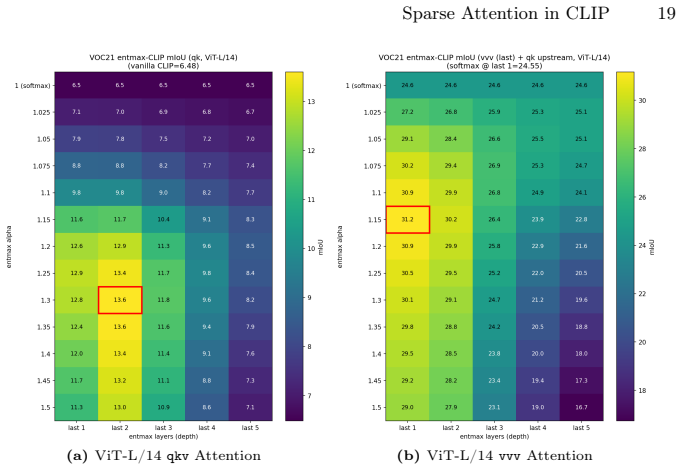
Summary. This paper studies a training-free, inference-time modification to frozen CLIP visual encoders: replacing the row-wise softmax in the final self-attention layers with the α-entmax transform. The motivation is that softmax assigns strictly positive weight to every token pair, spreading attention across low-relevance background patches and obscuring the fine-grained, spatially localized features needed for dense prediction. Because entmax applies a data-dependent threshold that maps low scores exactly to zero, it acts as an implicit denoiser. The authors evaluate this substitution across multiple attention score variants (standard qkv and self-correlation variants such as qqv, kkv, vvv), two backbones (ViT-B/16, ViT-L/14), and two task families (open-vocabulary semantic segmentation on VOC, Context, ADE20K; fine-grained region-text retrieval on FG-OVD). The central empirical finding is that the gain from sparsification is proportional to how diffuse the baseline attention distribution is: distributions that spread mass off the target class benefit more, while already-concentrated distributions (e.g., vvv on ViT-B/16) gain little or degrade. The paper also provides ablations against random masking and temperature sharpening, depth sweeps, resolution sweeps, and architectural ablations of the final transformer block.
Significance. The paper addresses a well-recognized problem in the CLIP dense-prediction literature: the final attention layers spread probability mass globally, degrading per-patch discrimination. While prior training-free methods (MaskCLIP, SCLIP, GEM, ClearCLIP, NACLIP) modify the score source or value path, they all retain the softmax normalizer. This paper isolates the normalizer as a variable and shows that a principled, parameter-free sparsification (α-entmax) yields consistent gains on self-correlated distributions. The contribution is primarily analytical rather than a new state-of-the-art method, but the systematic study is valuable: the entmax substitution is parameter-free, leaves pretrained weights untouched, and the ablations (Table 3: random mask vs. temperature vs. entmax) cleanly isolate the data-dependent threshold as the source of benefit. The finding that gains scale with resolution and backbone size (Tables 5–6) is a falsifiable, practically useful observation. The work is a well-scoped addition to the training-free CLIP dense-prediction literature.
major comments (2)
- §1 and §5: The paper's central claim is that entmax gain is 'proportional to how diffuse the underlying attention is.' The evidence for this is indirect: cross-distribution comparisons (Table 1: qkv gains more than vvv) confound diffuseness with other properties that differ between score sources (grouping quality, value geometry, head specialization), and resolution/backbone scaling (Tables 5–6) confounds diffuseness with token count and model capacity. The one piece of direct per-patch evidence—Figure 1 (right), plotting per-patch entmax-minus-softmax gain against off-target attention fraction—is presented without a correlation coefficient, regression line, sample size, or variance estimate. It is therefore impossible to assess whether this is a strong linear relationship or a weak, high-variance trend. Quantifying this plot (Pearson/Spearman correlation, regression, N, confidence bands
- §5.1 and Table 1: The vvv-on-ViT-B/16 exception (where entmax degrades performance) is explained post-hoc as 'already concentrated, so there is no tail to prune.' This explanation is plausible but not isolated from alternatives: the value-path geometry could be insensitive to attention sparsification for reasons unrelated to diffuseness (e.g., value vectors already carry localized information regardless of attention weighting). The paper does not hold diffuseness fixed while varying other factors, so the proportionality claim is underdetermined. A controlled experiment—e.g., artificially diffusing the vvv distribution on B/16 and showing that entmax then helps—would strengthen the causal claim. At minimum, the authors should acknowledge that the cross-distribution argument conflates diffuseness with score-source identity.
minor comments (8)
- §5.1: 'yeilds' should be 'yields.'
- §5.1 and §5.2: 'effected' should be 'affected' (e.g., 'is not effected as much' → 'is not affected as much').
- §3.1: The choice of α=1.2 as the default is used throughout but the justification is only empirical (Figure 5 sweep). A brief note on why α=1.2 is a reasonable operating point (vs. α=1.5 used in some NLP work) would help reproducibility.
- Figure 1 (left): The caption mentions a green × marker for the query patch, but the marker is difficult to locate in the figure. A more prominent marker or arrow would help.
- Table 1: The 'v-only' reference row appears in Tables 5–6 but not in Table 1, making cross-table comparison harder. Adding it or noting its absence would keep tables self-contained.
- §4.1: The background threshold for VOC is swept and the best is reported, but the actual threshold value(s) used are not stated. Reporting the selected threshold would aid reproducibility.
- Reference 33 (Zohra et al. 2026) is a self-citation that appears in the evaluation protocol context. It is not load-bearing for the central claim, but the authors should ensure it is not presented as a prerequisite result.
- Figure 5 caption: 'Sweeps α' is slightly ambiguous about whether α is the entmax parameter or a learning rate. Consistent notation would help.
Circularity Check
No circularity: the paper applies an externally defined mathematical transform (α-entmax) to externally provided models (CLIP) and evaluates on external benchmarks.
full rationale
The paper's central claim—that entmax gain is proportional to baseline attention diffuseness—is an empirical hypothesis tested against external benchmarks (Pascal VOC, Pascal Context, ADE20K, FG-OVD) using externally defined mathematical tools (α-entmax from Blondel et al. 2019, Peters et al. 2019) and externally provided pretrained models (CLIP ViT-B/16, ViT-L/14). The derivation of entmax (§3.1) is standard and self-contained, recovering softmax as α→1 and sparsemax at α=2, with no re-derivation tailored to fit the results. The one self-citation (ref 33, Zohra et al. 2026, beta-CLIP) appears only in a list of evaluation-protocol references and is not load-bearing for the sparsification claim. No equation or definition reduces to its own inputs by construction. The proportionality claim is an empirical observation, not a derivation: the paper does not define diffuseness in terms of entmax gain or vice versa. While the skeptic correctly notes that the evidence for proportionality is indirect and confounded, that is a correctness/evaluative concern, not a circularity concern. The derivation chain is self-contained against external benchmarks with no self-citation chain forcing the result.
Axiom & Free-Parameter Ledger
free parameters (3)
- α (entmax sparsity parameter) =
1.2
- Number of final layers sparsified (depth) =
1-2
- Background threshold (VOC) =
0.85 (mentioned in Fig 4 caption)
axioms (3)
- domain assumption CLIP's dense-prediction noise originates primarily in the last layers' attention normalizer.
- domain assumption Self-correlation attention distributions (qq, kk, vv) localize better than qk for dense prediction.
- standard math The α-entmax transform provides a data-dependent threshold that correctly identifies irrelevant tokens.
read the original abstract
Contrastive Language-Image Pre-training (CLIP) relies on softmax-based self-attention, a strictly positive distribution that assigns probability mass to every pair of tokens-even semantically irrelevant ones. While these dense softmax weights are effective for gathering broad context during pre-training, they spread attention across many low-salience tokens, producing noise that obscures the fine-grained, spatially localized cues required for dense, open-vocabulary prediction. We study an inference-time substitution of the row-wise softmax in the final visual self-attention layers with the $\alpha$-entmax transform, applied across both the standard query-key attention and self-correlation variants. Because entmax applies a data-dependent threshold that maps low scores exactly to zero, it acts as an implicit denoiser, zeroing contextually irrelevant dependencies while redistributing mass onto the most relevant tokens. We evaluate on open-vocabulary tasks-dense semantic segmentation (Pascal VOC, Pascal Context, ADE20K) and fine-grained retrieval (FG-OVD)-and find the gain from attention sparsification is proportional to how much the baseline attention spreads off the target class.
Figures




Reference graph
Works this paper leans on
-
[1]
Bianchi, L., Carrara, F., Messina, N., Gennaro, C., Falchi, F.: The devil is in the fine-grained details: Evaluating open-vocabulary object detectors for fine-grained understanding. arXiv (2023).https://doi.org/10.48550/arxiv.2311.17518
work page internal anchor Pith review Pith/arXiv arXiv doi:10.48550/arxiv.2311.17518 2023
-
[2]
In: Chaudhuri, K., Sugiyama, M
Blondel, M., Martins, A.F.T., Niculae, V.: Learning classifiers with fenchel-young losses: Generalized entropies, margins, and algorithms. In: Chaudhuri, K., Sugiyama, M. (eds.) Proceedings of the 22nd International Conference on Artificial Intelligence and Statistics. Proceedings of Machine Learning Research, vol. 89, pp. 606–615. PMLR (April16–18 2019),...
work page 2019
-
[3]
In: Proceedings of the IEEE/CVF Conference on Computer Vision and Pattern Recognition (CVPR)
Bousselham, W., Petersen, F., Ferrari, V., Kuehne, H.: Grounding everything: Emerging localization properties in vision-language transformers. In: Proceedings of the IEEE/CVF Conference on Computer Vision and Pattern Recognition (CVPR). pp. 3828–3837 (June 2024)
work page 2024
- [4]
-
[5]
Dong, X., Bao, J., Zheng, Y., Zhang, T., Chen, D., Yang, H., Zeng, M., Zhang, W., Yuan, L., Chen, D., Wen, F., Yu, N.: Maskclip: Masked self-distillation advances contrastive language-image pretraining (2023)
work page 2023
-
[6]
International Journal of Computer Vision111(1), 98–136 (Jan 2015)
Everingham, M., Eslami, S.M.A., Van Gool, L., Williams, C.K.I., Winn, J., Zisser- man, A.: The pascal visual object classes challenge: A retrospective. International Journal of Computer Vision111(1), 98–136 (Jan 2015)
work page 2015
-
[7]
Fang, Y., Wang, W., Xie, B., Sun, Q., Wu, L., Wang, X., Huang, T., Wang, X., Cao, Y.: Eva: Exploring the limits of masked visual representation learning at scale (2022)
work page 2022
-
[8]
In: Proceedings of the Winter Conference on Applications of Computer Vision (WACV)
Hajimiri, S., Ben Ayed, I., Dolz, J.: Pay attention to your neighbours: Training-free open-vocabulary semantic segmentation. In: Proceedings of the Winter Conference on Applications of Computer Vision (WACV). pp. 5061–5071 (February 2025)
work page 2025
-
[9]
Jia, C., Yang, Y., Xia, Y., Chen, Y.T., Parekh, Z., Pham, H., Le, Q.V., Sung, Y., Li, Z., Duerig, T.: Scaling up visual and vision-language representation learning with noisy text supervision (2021)
work page 2021
-
[10]
Jing, D., He, X., Luo, Y., Fei, N., Yang, G., Wei, W., Zhao, H., Lu, Z.: FineCLIP: Self-distilled region-based CLIP for better fine-grained understanding. In: The Thirty-eighth Annual Conference on Neural Information Processing Systems (2024), https://openreview.net/forum?id=nExI4FuKWD
work page 2024
-
[11]
In: European Conference on Computer Vision
Lan, M., Chen, C., Ke, Y., Wang, X., Feng, L., Zhang, W.: Clearclip: Decomposing clip representations for dense vision-language inference. In: European Conference on Computer Vision. pp. 143–160. Springer (2024)
work page 2024
-
[12]
Li, F., et al.: Grounded language-image pre-training. In: CVPR (2022)
work page 2022
-
[13]
Li, Y., Wang, H., Duan, Y., Zhang, J., Li, X.: A closer look at the explainability of contrastive language-image pre-training (2024),https://arxiv.org/abs/2304. 05653
work page 2024
-
[14]
Ma, Z., Hong, J., Gul, M.O., Gandhi, M., Gao, I., Krishna, R.: Crepe: Can vision- language foundation models reason compositionally? (2023),https://arxiv.org/ abs/2212.07796
work page internal anchor Pith review Pith/arXiv arXiv 2023
-
[15]
Martins, A.F.T., Astudillo, R.F.: From softmax to sparsemax: A sparse model of attention and multi-label classification (2016),https://arxiv.org/abs/1602. 02068 16 F. Zohra et al
work page 2016
-
[16]
Martins, P.H., Marinho, Z., Martins, A.F.T.: Sparse text generation (2020),https: //arxiv.org/abs/2004.02644
work page internal anchor Pith review Pith/arXiv arXiv 2020
-
[17]
In: Proceedings of the IEEE Conference on Computer Vision and Pattern Recognition (CVPR) (June 2014)
Mottaghi, R., Chen, X., Liu, X., Cho, N.G., Lee, S.W., Fidler, S., Urtasun, R., Yuille, A.: The role of context for object detection and semantic segmentation in the wild. In: Proceedings of the IEEE Conference on Computer Vision and Pattern Recognition (CVPR) (June 2014)
work page 2014
-
[18]
Peters, B., Niculae, V., Martins, A.F.T.: Sparse sequence-to-sequence models (2019), https://arxiv.org/abs/1905.05702
work page internal anchor Pith review Pith/arXiv arXiv 2019
-
[19]
Qiu, C., Wu, Y., Ke, W., Bai, X., Zhang, T.: Refining clip’s spatial awareness: A visual-centric perspective (2025),https://arxiv.org/abs/2504.02328
work page internal anchor Pith review Pith/arXiv arXiv 2025
-
[20]
Radford, A., Kim, J.W., Hallacy, C., et al.: Learning transferable visual models from natural language supervision. ICML (2021)
work page 2021
-
[21]
Ranasinghe, K., McKinzie, B., Ravi, S., Yang, Y., Toshev, A., Shlens, J.: Perceptual grouping in contrastive vision-language models (2023),https://arxiv.org/abs/ 2210.09996
work page internal anchor Pith review Pith/arXiv arXiv 2023
-
[22]
Shao,T.,Tian,Z.,Zhao,H.,Su,J.:Explorethepotentialofclipfortraining-freeopen vocabulary semantic segmentation (2024),https://arxiv.org/abs/2407.08268
work page internal anchor Pith review Pith/arXiv arXiv 2024
-
[23]
Vaswani, A., Shazeer, N., Parmar, N., Uszkoreit, J., Jones, L., Gomez, A.N., Kaiser, L., Polosukhin, I.: Attention is all you need (2023)
work page 2023
-
[24]
Voita, E., Talbot, D., Moiseev, F., Sennrich, R., Titov, I.: Analyzing multi-head self-attention: Specialized heads do the heavy lifting, the rest can be pruned (2019), https://arxiv.org/abs/1905.09418
work page internal anchor Pith review Pith/arXiv arXiv 2019
-
[25]
SCLIP: Rethinking Self-Attention for Dense Vision-Language Inference
Wang, F., Mei, J., Yuille, A.: Sclip: Rethinking self-attention for dense vision- language inference. arXiv preprint arXiv:2312.01597 (2023)
work page internal anchor Pith review Pith/arXiv arXiv 2023
-
[26]
Wu, S., Zhang, W., Xu, L., Jin, S., Li, X., Liu, W., Loy, C.C.: Clipself: Vision transformer distills itself for open-vocabulary dense prediction (2024),https:// arxiv.org/abs/2310.01403
work page internal anchor Pith review Pith/arXiv arXiv 2024
-
[27]
Wu, X., et al.: Regionclip: Region-based language Image pre-training. In: CVPR (2022)
work page 2022
-
[28]
Xie, C., Wang, B., Kong, F., Li, J., Liang, D., Zhang, G., Leng, D., Yin, Y.: Fg-clip: Fine-grained visual and textual alignment (2025),https://arxiv.org/abs/2505. 05071
work page 2025
-
[29]
Yuksekgonul, M., Bianchi, F., Kalluri, P., Jurafsky, D., Zou, J.: When and why vision-language models behave like bags-of-words, and what to do about it? (2023), https://arxiv.org/abs/2210.01936
work page internal anchor Pith review Pith/arXiv arXiv 2023
-
[30]
Zhai, X., Mustafa, B., Kolesnikov, A., Beyer, L.: Sigmoid loss for language image pre-training (2023),https://arxiv.org/abs/2303.15343
work page internal anchor Pith review Pith/arXiv arXiv 2023
-
[31]
Zhou, B., Zhao, H., Puig, X., Xiao, T., Fidler, S., Barriuso, A., Torralba, A.: Semanticunderstandingofscenesthroughtheade20kdataset.Int.J.Comput.Vision 127(3), 302–321 (Mar 2019).https://doi.org/10.1007/s11263- 018- 1140- 0 , https://doi.org/10.1007/s11263-018-1140-0
-
[32]
Zhou, Y., Fritz, M., Keuper, M.: Multimax: Sparse and multi-modal attention learning (2025),https://arxiv.org/abs/2406.01189
work page internal anchor Pith review Pith/arXiv arXiv 2025
-
[33]
Zohra, F., Zhao, C., Itani, H., Ghanem, B.:beta-CLIP: Text-conditioned contrastive learning for multi-granular vision-language alignment. arXiv (2026).https://doi. org/10.48550/arxiv.2512.12678 Sparse Attention in CLIP 17 A Extended Quantitative Analysis A.1 Resolution Scaling for Dense Segmentation on ViT-B/16 Table 7 extends the resolution sweep to dens...
discussion (0)
Sign in with ORCID, Apple, or X to comment. Anyone can read and Pith papers without signing in.