REVIEW 3 major objections 4 minor 4 cited by
Establishing Task Scaling Laws via Compute-Efficient Model Ladders
T0 review · 3 major / 4 minor · reviewed 2026-08-11 · deepseek-v4-flash
Pith's one-line read Task accuracy of large overtrained language models can be predicted from a small fixed set of 'ladder' models via a two-step parametric pipeline, landing within 2 absolute points on four multiple-choice benchmarks for under 1% of the…
desk verdict A solid empirical paper that does something genuinely new—predicting individual task accuracy from a 1%-compute ladder—but the headline 'within 2 points' rests on a sigmoid extrapolation that is thinner than the paper's tone suggests. read the letter →
The pith
A machine-rendered reading of the paper's core claim, the machinery that carries it, and where it could break.
The reading
What carries the argument
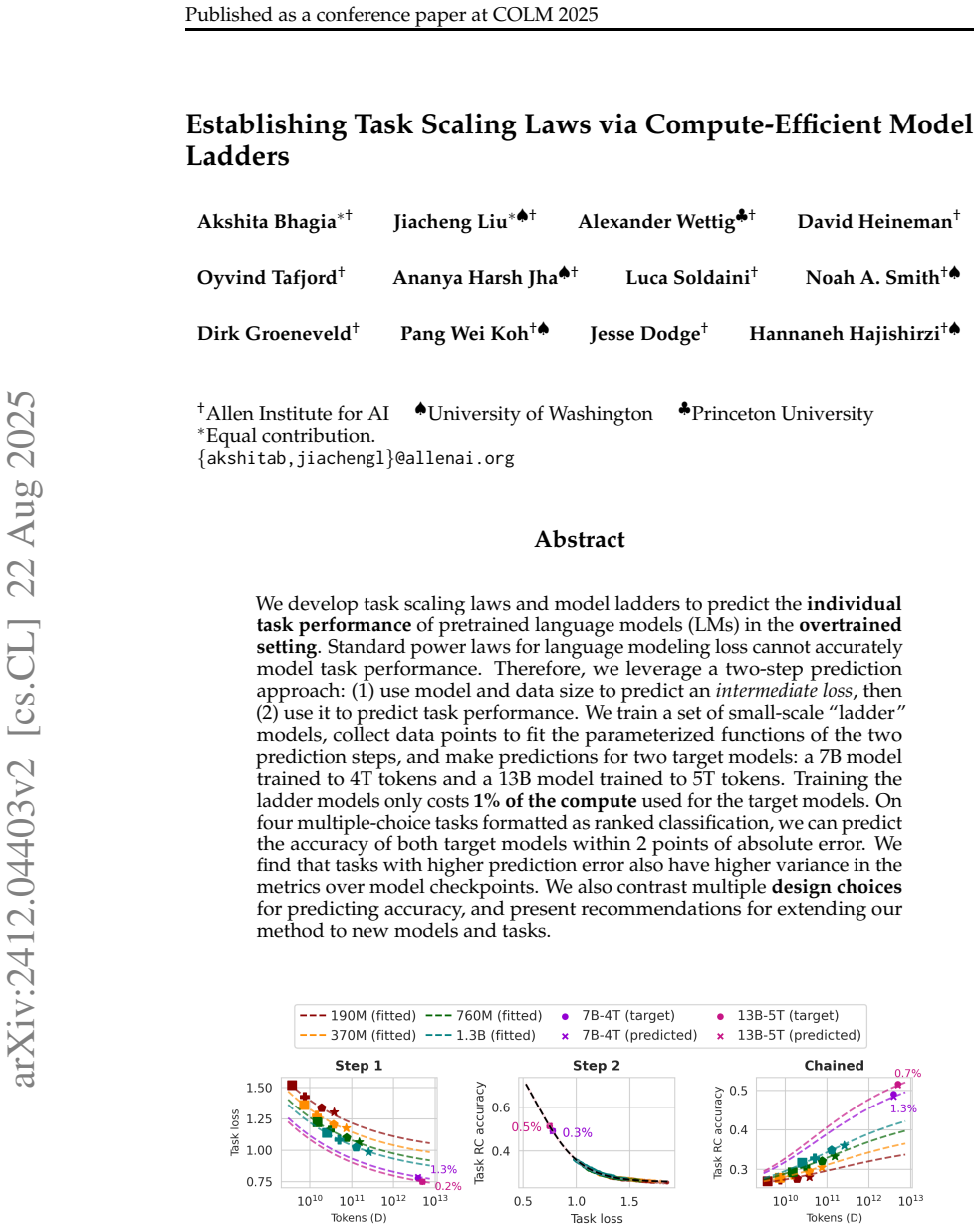
The machinery is the model ladder plus the two fitted curves it feeds. The ladder is a fixed grid of 16 models — four sizes ($N \in \{190\text{M}, 370\text{M}, 760\text{M}, 1.3\text{B}\}$ non-embedding parameters) by four data budgets ($D \in \{1\text{x}, 2\text{x}, 5\text{x}, 10\text{x}\}$ of the Chinchilla-optimal amount) — sharing the target models' architecture, data mixture, and learning-rate schedule, so that scale, not recipe, is the only difference being extrapolated. Step 1 fits the power law $L(N, D) = A/N^\alpha + B/D^\beta + E$ to the final-checkpoint task losses, and step 2 fits the sigmoid $\mathrm{Acc}(L) = a/(1 + e^{-k(L-L_0)}) + b$ to the loss-accuracy pairs of roughly 1,400 ladder checkpoints. The load-bearing move is that both curves are fitted on small models and then evaluated by extrapolation along $N$ and $D$; the ladder stays cheap — about 1% of target compute — while the power law carries the prediction from the small-model regime up to the target scale.
What would settle it
Train a fresh ladder and one or two intermediate-size models from the same family and data mixture (for instance a 2B-3.5B model at roughly 20x-28x the Chinchilla-optimal budget), fit both curves using ladder points only, and compare predicted versus measured accuracy at the intermediate sizes; if the error grows systematically with the ladder-to-target gap, or if the fitted exponents shift noticeably when the intermediate runs are added to the fit, the extrapolation is falsified.
Extended reading notes
Core claim
The central claim is that a chained two-step parametric pipeline predicts the accuracy of overtrained language models on individual multiple-choice tasks, when the problems are posed in ranked-classification form. Step 1 fits the power law $L(N, D) = A/N^\alpha + B/D^\beta + E$ to the task loss of the ladder models — task loss being the bits-per-byte of the correct answer — with a separate fit per task. Step 2 fits a sigmoid $\mathrm{Acc}(L) = a/(1 + e^{-k(L-L_0)}) + b$ to roughly 1,400 (loss, accuracy) points gathered from both final and intermediate checkpoints of the same ladder. Chaining the two fitted functions predicts the target models' accuracy; on MMLU, HellaSwag, PIQA, and SocialIQA the prediction is within 2 absolute points for both the 7B-4T and 13B-5T targets, and the average absolute error across both targets and all eight OLMES tasks is roughly 4 points. The paper further claims that checkpoint-to-checkpoint variance of the largest ladder model predicts which tasks will be hard to forecast (Pearson $r = 0.821$, $p = 0.004$ for 7B-4T), and that task-specific loss is the more broadly reliable intermediate feature, with C4 language-modeling loss helping only some tasks and TaskCE amplifying small step-1 errors.
Load-bearing premise
The formulas fitted on small ladder models (up to 1.3B parameters, trained on up to ten times the data-optimal budget) are assumed to keep their shape and fitted values when extended to models of 7B to 13B parameters trained on far more data, so that a prediction is just an extension of the curves; if the curves bend differently at large scale, every predicted accuracy is biased.
Editorial extensions
If this is right
- A pretraining team can estimate whether a planned run will hit a target task score (MMLU, HellaSwag, PIQA, SocialIQA) before spending the training compute: for these four tasks the paper's chained prediction is within 2 absolute points for both the 7B-4T and 13B-5T targets.
- The ladder transfers beyond the sizes it was built for: predictions for a 32B-6T model of the same family, made at 0.45% compute, keep the same trend, with the low-variance tasks (HellaSwag, PIQA, SocialIQA) within 3 absolute points.
- Task predictability can be assessed before training the target by measuring the checkpoint-to-checkpoint variance (SD10) of the largest ladder model; tasks with high variance (ARC-Challenge, ARC-Easy, OpenBookQA) are the ones whose predictions should be distrusted.
- Design guidance follows from the comparisons: a task-specific loss is the more broadly reliable intermediate feature, including model size $N$ in the input features matters more than extending training duration, and a single-step fit straight from $(N, D)$ to accuracy is less robust than the two-step chain.
- For the multiple-choice (MC) format, the ladder alone cannot fit the sigmoid because small models sit at random accuracy, but using early checkpoints of the target run the paper predicts MMLU MC accuracy within 3% relative error; the same two-step idea therefore extends to MC with an added cost of intermediate target checkpoints.
Reading between the lines
- Because the ladder is mixture-matched to the target, the same two-curve setup should be able to compare candidate data mixtures cheaply — for example, which mixture yields a higher predicted MMLU score for a fixed $(N, D)$ — a use the paper motivates but does not run.
- The claimed within-2-point accuracy is demonstrated for one model family, one data mixture, and four RC-formatted tasks; the honest scope is 'same family, same mixture, ranked-classification tasks', and generality to other recipes or generation-style evaluations is untested.
- The chained errors compound through the sigmoid's slope: on tasks where accuracy rises steeply over a narrow loss range, tiny step-1 errors in the predicted loss become large accuracy errors, so reporting fitted-parameter uncertainty propagated through both curves would give practitioners honest intervals; the paper shows step-2 intervals but does not propagate step-1 uncertainty.
- The SD10 variance diagnostic could be turned into a pre-registration criterion: a practitioner could set a variance threshold on the largest ladder model before committing to a task set or ladder design, since the paper shows variance correlates with prediction error ($r \approx 0.82$-$0.86$).
Editorial analysis
A structured set of objections, weighed in public.
Referee Report
Summary. The paper proposes a two-step pipeline for predicting the ranked-classification (RC) accuracy of overtrained language models. Step 1 fits the power law L(N,D)=A/N^alpha+B/D^beta+E to task loss using 16 ladder models (190M-1.3B parameters, 1x-10x Chinchilla data). Step 2 fits a sigmoid mapping task loss to accuracy using approximately 1,400 ladder checkpoints plus one synthetic anchor at (L=0, Acc=1). The chained predictor is applied to two held-out target models, 7B-4T and 13B-5T, on eight OLMES tasks. The paper reports absolute errors below 2 points on MMLU, HellaSwag, PiQA, and SocialIQA, an average absolute error near 4 points across all eight tasks, and a further validation on 32B-6T in Appendix D.
Significance. If the result holds, the paper provides a practical and comparatively cheap way to estimate downstream task accuracy of same-family overtrained models from a fixed ladder of small models, which is directly useful for pretraining decisions. The paper is transparent in reporting all task-level results, gives precise fitting details, genuinely holds out the target models from the ladder fits, and includes a welcome 32B-6T stress test. The variance analysis (SD10) is a useful diagnostic for saying in advance which tasks are likely to be hard to predict. The main caveat is that the headline claim is narrower than the abstract suggests, and the step-2 extrapolation is more fragile than the reported fitting errors indicate.
major comments (3)
- [Section 3.2, Eq. (2), Figure 4] The step-2 sigmoid is effectively unconstrained in the loss region that matters for the target predictions. The ladder checkpoints used for fitting lie almost entirely above the target models' predicted task losses, and the only data point below that region is the synthetic anchor (L=0, Acc=1) inserted to stabilize the fit. For MMLU, for example, the observed ladder points end near L≈0.94 while the chained predictions for 7B-4T and 13B-5T are near L≈0.75–0.76, so the sigmoid branch that maps loss to the reported 48–85% accuracies is extrapolated from a functional-form assumption plus one anchor. The reported step-2 fitting errors (0.4–2.6%) are in-sample diagnostics over the observed loss range and cannot detect misspecification in the extrapolation region. The 32B-6T check in Appendix D uses the same ladder and the same extrapolation region, so it does not independently validate the upper branch. Please add a sensitivity analysis (for example, vary or remove the anchor, or compare against an alternative bounded curve) and clearly label the extrapolated part of the curve in Figure 4.
- [Section 2.3 and Figure 2] The 'within 2 points' headline covers four of eight remaining tasks, and two additional tasks (BoolQ, Winogrande) are excluded from the main task set because their metrics are described as 'noisier.' Since the four successful tasks are identified after the predictions were made, the claim should be explicitly scoped as a demonstration on a selected subset rather than as a general capability. The full table shows absolute errors of 8.0–11.1 points on ARC-Challenge and ARC-Easy, so the abstract's statement that 'we can predict the accuracy of both target models within 2 points' is too strong as written. The SD10 analysis in Section 5 is a useful post hoc explanation, but it does not replace a pre-specified selection rule. I also note that BoolQ, excluded in Section 2.3, has a relative chained error of only 1.8% in Table 4, which suggests that the exclusion criterion is not based solely on the reported noise measure.
- [Section 3.1, Eq. (1)] The paper validates the power-law form for task loss only in-sample on the 16 ladder points, and the extrapolation from N≤1.3B and D≤10xC to N=7–13B and D≈28xC is load-bearing for the entire chained prediction. I request an internal extrapolation check inside the ladder: for example, fit Eq. (1) without the 1.3B models or without the 10xC runs and predict the held-out ladder losses. This would show whether the fitted form extrapolates along each axis before being used for the targets. Figures 9–10 are cumulative ablations rather than true held-out extrapolations, so they do not fully address this concern. Without such a check, the two target models and the 32B-6T result are the only evidence for the extrapolation, and the 32B result is subject to the same limitation.
minor comments (4)
- [Abstract and Section 2.1] The '1% of the compute used for the target models' claim is ambiguous: the ladder costs 3.2% of 7B-4T, 1.3% of 13B-5T, and less than 1.0% of both combined. Please state the comparison explicitly.
- [Section C.5, Eq. (8)] There is a typo in the text describing Eq. (8): 'D/D^β' should be 'B/D^β'.
- [Figure 4 caption] The caption refers to 'prediction intervals' for the fitted sigmoid, but the text does not define how these intervals are computed or whether they are propagated through the chained prediction.
- [Table 3] Table 3 is dense and hard to read because two target models and multiple design choices are combined in one grid; splitting by target model or adding a clear visual separation would improve readability.
Circularity Check
No significant circularity: target predictions are held out and the two-step fits use only ladder data.
full rationale
The derivation chain in the RC setup is self-contained: Eq. (1) is fitted to the 16 ladder final-checkpoint (N, D, L) points and Eq. (2) to roughly 1,400 ladder-checkpoint (L, Acc) pairs plus an explicitly declared synthetic anchor (L=0, Acc=1); the target 7B-4T and 13B-5T losses and accuracies are never used in either fit (Secs. 3.1-3.2). The reported target errors are therefore genuine held-out checks against measured OLMo 2 models, and the 32B-6T check in Sec. D is a further held-out extrapolation. No equation is defined in terms of its own prediction target and no fitted parameter is renamed as a prediction: the sigmoid upper branch is constrained by functional form plus the synthetic anchor, which is an extrapolation risk, not a circular reduction. The post-hoc choice of task loss as the recommended intermediate feature and the four-task 'within 2 points' summary are selection effects rather than derivation steps. The MC case study in Sec. B.2 fits on early checkpoints of the target model itself and is accordingly a self-extrapolation, but it is presented separately and does not support the abstract's ladder-based RC claim. Self-citations to OLMo/OLMES define the target models and tasks and are not load-bearing for the scaling-law fit.
Assumptions & free parameters
free parameters (3)
- Step 1 power law constants (A, B, alpha, beta, E) per task =
8 tasks x 5 constants; values in Table 5
- Step 2 sigmoid constants (a, b, k, L0) per task =
8 tasks x 4 constants; values in Table 5
- Ladder grid (N and D points) =
4 sizes x 4 data multipliers
assumptions (4)
- domain assumption Task loss follows the power law L(N,D)=A/N^alpha + B/D^beta + E
- domain assumption Task accuracy follows a sigmoid in task loss
- domain assumption Ladder models and target models are comparable in architecture, data mixture, and training recipe
- domain assumption The Chinchilla-optimal ratio D=20N defines 1xC for ladder models
Cite this review
Pith. "Pith review of Establishing Task Scaling Laws via Compute-Efficient Model Ladders." pith.science (2026). https://pith.science/paper/JROKZP6P
@misc{pith2026241204403,
  author       = {Pith},
  title        = {Pith review of: Establishing Task Scaling Laws via Compute-Efficient Model Ladders},
  year         = {2026},
  howpublished = {\url{https://pith.science/paper/JROKZP6P}},
  note         = {Machine review of arXiv:2412.04403}
}
read the original abstract
We develop task scaling laws and model ladders to predict the individual task performance of pretrained language models (LMs) in the overtrained setting. Standard power laws for language modeling loss cannot accurately model task performance. Therefore, we leverage a two-step prediction approach: (1) use model and data size to predict an intermediate loss, then (2) use it to predict task performance. We train a set of small-scale "ladder" models, collect data points to fit the parameterized functions of the two prediction steps, and make predictions for two target models: a 7B model trained to 4T tokens and a 13B model trained to 5T tokens. Training the ladder models only costs 1% of the compute used for the target models. On four multiple-choice tasks formatted as ranked classification, we can predict the accuracy of both target models within 2 points of absolute error. We find that tasks with higher prediction error also have higher variance in the metrics over model checkpoints. We also contrast multiple design choices for predicting accuracy, and present recommendations for extending our method to new models and tasks.
Figures


Figures from the paper (15 more)


Forward citations
Cited by 4 Pith papers
-
EdgeBench: Unveiling Scaling Laws of Learning from Real-World Environments
Across ~38,000 hours on 134 ultra-long real-world tasks, aggregate agent performance follows a log-sigmoid of interaction time, and measured learning speed doubles about every three months.
-
A Latent Variable Framework for Scaling Laws in Large Language Models
A latent-variable scaling model with consistency guarantees predicts multi-benchmark LLM performance per family and derives skill-specific compute allocations.
-
Fantastic Pretraining Optimizers and Where to Find Them
After careful tuning, alternative optimizers speed up LLM pretraining by only 1.1x to 1.4x over AdamW, and the advantage shrinks with model scale.
-
Language Models Improve When Pretraining Data Matches Target Tasks
Ranking pretraining documents by similarity to benchmark training examples (BETR) yields consistent benchmark gains and a 2.1x compute multiplier over DCLM-Baseline.
Reference graph
Works this paper leans on
-
[1]
Olmo 2: The best fully open language model to date, 2024
Ai2. Olmo 2: The best fully open language model to date, 2024. URL https://allenai.org/blog/olmo2
work page 2024
-
[2]
Jinze Bai, Shuai Bai, Yunfei Chu, Zeyu Cui, Kai Dang, Xiaodong Deng, Yang Fan, Wenhang Ge, Yu Han, Fei Huang, Binyuan Hui, Luo Ji, Mei Li, Junyang Lin, Runji Lin, Dayiheng Liu, Gao Liu, Chengqiang Lu, K. Lu, Jianxin Ma, Rui Men, Xingzhang Ren, Xuancheng Ren, Chuanqi Tan, Sinan Tan, Jianhong Tu, Peng Wang, Shijie Wang, Wei Wang, Shengguang Wu, Benfeng Xu, ...
arXiv 2023
-
[3]
PIQA : Reasoning about physical commonsense in natural language
Yonatan Bisk, Rowan Zellers, Ronan Le bras, Jianfeng Gao, and Yejin Choi. PIQA : Reasoning about physical commonsense in natural language. Proceedings of the AAAI Conference on Artificial Intelligence, 34 0 (05): 0 7432--7439, Apr. 2020. doi:10.1609/aaai.v34i05.6239. URL https://ojs.aaai.org/index.php/AAAI/article/view/6239
-
[4]
Scaling laws for predicting downstream performance in llms
Yangyi Chen, Binxuan Huang, Yifan Gao, Zhengyang Wang, Jingfeng Yang, and Heng Ji. Scaling laws for predicting downstream performance in llms. 2024. URL https://api.semanticscholar.org/CorpusID:273323177
work page 2024
-
[5]
B ool Q : Exploring the surprising difficulty of natural yes/no questions
Christopher Clark, Kenton Lee, Ming-Wei Chang, Tom Kwiatkowski, Michael Collins, and Kristina Toutanova. B ool Q : Exploring the surprising difficulty of natural yes/no questions. pp.\ 2924--2936, Minneapolis, Minnesota, June 2019. doi:10.18653/v1/N19-1300. URL N19-1300
-
[6]
Think you have solved question answering? try arc, the ai2 reasoning challenge
Peter Clark, Isaac Cowhey, Oren Etzioni, Tushar Khot, Ashish Sabharwal, Carissa Schoenick, and Oyvind Tafjord. Think you have solved question answering? try arc, the ai2 reasoning challenge. ArXiv, 2018. URL http://arxiv.org/abs/1803.05457
arXiv 2018
-
[7]
Abhimanyu Dubey, Abhinav Jauhri, Abhinav Pandey, Abhishek Kadian, Ahmad Al-Dahle, Aiesha Letman, Akhil Mathur, Alan Schelten, Amy Yang, Angela Fan, Anirudh Goyal, Anthony Hartshorn, Aobo Yang, Archi Mitra, Archie Sravankumar, Artem Korenev, Arthur Hinsvark, Arun Rao, Aston Zhang, Aurelien Rodriguez, Austen Gregerson, Ava Spataru, Baptiste Rozi \`e re, Bet...
arXiv 2024
-
[8]
Samir Yitzhak Gadre, Georgios Smyrnis, Vaishaal Shankar, Suchin Gururangan, Mitchell Wortsman, Rulin Shao, Jean-Pierre Mercat, Alex Fang, Jeffrey Li, Sedrick Scott Keh, Rui Xin, Marianna Nezhurina, Igor Vasiljevic, Jenia Jitsev, Alexandros G. Dimakis, Gabriel Ilharco, Shuran Song, Thomas Kollar, Yair Carmon, Achal Dave, Reinhard Heckel, Niklas Muennighoff...
arXiv 2024
Show all 29 references
-
[9]
Olmes: A standard for language model evaluations, 2024
Yuling Gu, Oyvind Tafjord, Bailey Kuehl, Dany Haddad, Jesse Dodge, and Hannaneh Hajishirzi. Olmes: A standard for language model evaluations, 2024
2024
-
[10]
Measuring massive multitask language understanding
Dan Hendrycks, Collin Burns, Steven Basart, Andy Zou, Mantas Mazeika, Dawn Song, and Jacob Steinhardt. Measuring massive multitask language understanding. Proceedings of the International Conference on Learning Representations (ICLR), 2021
2021
-
[11]
Rae, Oriol Vinyals, and L
Jordan Hoffmann, Sebastian Borgeaud, Arthur Mensch, Elena Buchatskaya, Trevor Cai, Eliza Rutherford, Diego de Las Casas, Lisa Anne Hendricks, Johannes Welbl, Aidan Clark, Tom Hennigan, Eric Noland, Katie Millican, George van den Driessche, Bogdan Damoc, Aurelia Guy, Simon Osin...
2022 arXiv
-
[12]
Predicting emergent abilities with infinite resolution evaluation
Shengding Hu, Xin Liu, Xu Han, Xinrong Zhang, Chaoqun He, Weilin Zhao, Yankai Lin, Ning Ding, Zebin Ou, Guoyang Zeng, Zhiyuan Liu, and Maosong Sun. Predicting emergent abilities with infinite resolution evaluation. In International Conference on Learning Representations, 2023....
2023
-
[13]
Brown, Benjamin Chess, Rewon Child, Scott Gray, Alec Radford, Jeff Wu, and Dario Amodei
Jared Kaplan, Sam McCandlish, Tom Henighan, Tom B. Brown, Benjamin Chess, Rewon Child, Scott Gray, Alec Radford, Jeff Wu, and Dario Amodei. Scaling laws for neural language models. ArXiv, abs/2001.08361, 2020. URL https://api.semanticscholar.org/CorpusID:210861095
2001 arXiv
-
[14]
Kakade, Shuran Song, Sujay Sanghavi, Fartash Faghri, Sewoong Oh, Luke S
Jeffrey Li, Alex Fang, Georgios Smyrnis, Maor Ivgi, Matt Jordan, Samir Yitzhak Gadre, Hritik Bansal, Etash Kumar Guha, Sedrick Scott Keh, Kushal Arora, Saurabh Garg, Rui Xin, Niklas Muennighoff, Reinhard Heckel, Jean-Pierre Mercat, Mayee Chen, Suchin Gururangan, Mitchell Worts...
2024 arXiv
-
[15]
Can a suit of armor conduct electricity? a new dataset for open book question answering
Todor Mihaylov, Peter Clark, Tushar Khot, and Ashish Sabharwal. Can a suit of armor conduct electricity? a new dataset for open book question answering. pp.\ 2381--2391, Brussels, Belgium, October-November 2018. doi:10.18653/v1/D18-1260. URL D18-1260
2018 doi
-
[16]
Llm foundry, 2024
MosaicML. Llm foundry, 2024. URL https://github.com/mosaicml/llm-foundry. Accessed: 2024-12-03
2024
-
[17]
Rush, Boaz Barak, Teven Le Scao, Aleksandra Piktus, Nouamane Tazi, Sampo Pyysalo, Thomas Wolf, and Colin Raffel
Niklas Muennighoff, Alexander M. Rush, Boaz Barak, Teven Le Scao, Aleksandra Piktus, Nouamane Tazi, Sampo Pyysalo, Thomas Wolf, and Colin Raffel. Scaling data-constrained language models. ArXiv, abs/2305.16264, 2023. URL https://api.semanticscholar.org/CorpusID:258888192
2023 arXiv
-
[18]
Resolving discrepancies in compute-optimal scaling of language models
Tomer Porian, Mitchell Wortsman, Jenia Jitsev, Ludwig Schmidt, and Yair Carmon. Resolving discrepancies in compute-optimal scaling of language models. ArXiv, abs/2406.19146, 2024. URL https://api.semanticscholar.org/CorpusID:270764838
2024 arXiv
-
[19]
Shazeer, Adam Roberts, Katherine Lee, Sharan Narang, Michael Matena, Yanqi Zhou, Wei Li, and Peter J
Colin Raffel, Noam M. Shazeer, Adam Roberts, Katherine Lee, Sharan Narang, Michael Matena, Yanqi Zhou, Wei Li, and Peter J. Liu. Exploring the limits of transfer learning with a unified text-to-text transformer. J. Mach. Learn. Res., 21: 0 140:1--140:67, 2019. URL https://api....
2019
-
[20]
Wino G rande: An adversarial winograd schema challenge at scale
Keisuke Sakaguchi, Ronan Le Bras, Chandra Bhagavatula, and Yejin Choi. Wino G rande: An adversarial winograd schema challenge at scale. Proceedings of the AAAI Conference on Artificial Intelligence, 34 0 (05): 0 8732--8740, Apr. 2020. doi:10.1609/aaai.v34i05.6399. URL https://...
2020 doi
-
[21]
Social IQ a: Commonsense reasoning about social interactions
Maarten Sap, Hannah Rashkin, Derek Chen, Ronan Le Bras, and Yejin Choi. Social IQ a: Commonsense reasoning about social interactions. pp.\ 4463--4473, Hong Kong, China, November 2019. doi:10.18653/v1/D19-1454. URL D19-1454
2019 doi
-
[22]
Why has predicting downstream capabilities of frontier AI models with scale remained elusive? In Trustworthy Multi-modal Foundation Models and AI Agents (TiFA), 2024
Rylan Schaeffer, Hailey Schoelkopf, Brando Miranda, Gabriel Mukobi, Varun Madan, Adam Ibrahim, Herbie Bradley, Stella Biderman, and Sanmi Koyejo. Why has predicting downstream capabilities of frontier AI models with scale remained elusive? In Trustworthy Multi-modal Foundation...
2024
-
[23]
C ommonsense QA : A question answering challenge targeting commonsense knowledge
Alon Talmor, Jonathan Herzig, Nicholas Lourie, and Jonathan Berant. C ommonsense QA : A question answering challenge targeting commonsense knowledge. pp.\ 4149--4158, Minneapolis, Minnesota, June 2019. doi:10.18653/v1/N19-1421. URL N19-1421
2019 doi
-
[24]
H ella S wag: Can a machine really finish your sentence? pp.\ 4791--4800, Florence, Italy, July 2019
Rowan Zellers, Ari Holtzman, Yonatan Bisk, Ali Farhadi, and Yejin Choi. H ella S wag: Can a machine really finish your sentence? pp.\ 4791--4800, Florence, Italy, July 2019. doi:10.18653/v1/P19-1472. URL P19-1472
2019 doi
-
[25]
Map-neo: Highly capable and transparent bilingual large language model series
Ge Zhang, Scott Qu, Jiaheng Liu, Chenchen Zhang, Chenghua Lin, Chou Leuang Yu, Danny Pan, Esther Cheng, Jie Liu, Qunshu Lin, Raven Yuan, Tuney Zheng, Wei Pang, Xinrun Du, Yiming Liang, Yi Ma, Yizhi Li, Ziyang Ma, Bill Yuchen Lin, Emmanouil Benetos, Huan Yang, Junting Zhou, Kai...
2024 arXiv
-
[26]
write newline
" write newline "" before.all 'output.state := FUNCTION n.dashify 't := "" t empty not t #1 #1 substring "-" = t #1 #2 substring "--" = not "--" * t #2 global.max substring 't := t #1 #1 substring "-" = "-" * t #2 global.max substring 't := while if t #1 #1 substring * t #2 gl...
-
[27]
@esa (Ref
\@ifxundefined[1] #1\@undefined \@firstoftwo \@secondoftwo \@ifnum[1] #1 \@firstoftwo \@secondoftwo \@ifx[1] #1 \@firstoftwo \@secondoftwo [2] @ #1 \@temptokena #2 #1 @ \@temptokena \@ifclassloaded agu2001 natbib The agu2001 class already includes natbib coding, so you should ...
-
[28]
\@lbibitem[] @bibitem@first@sw\@secondoftwo \@lbibitem[#1]#2 \@extra@b@citeb \@ifundefined br@#2\@extra@b@citeb \@namedef br@#2 \@nameuse br@#2\@extra@b@citeb \@ifundefined b@#2\@extra@b@citeb @num @parse #2 @tmp #1 NAT@b@open@#2 NAT@b@shut@#2 \@ifnum @merge>\@ne @bibitem@firs...
-
[29]
@open @close @open @close and [1] URL: #1 \@ifundefined chapter * \@mkboth \@ifxundefined @sectionbib * \@mkboth * \@mkboth\@gobbletwo \@ifclassloaded amsart * \@ifclassloaded amsbook * \@ifxundefined @heading @heading NAT@ctr thebibliography [1] @ \@biblabel @NAT@ctr \@bibset...
2019
Reviewed August 11, 2026 · model on record in the stance chip above.
Discussion (0). Continue with ORCID to comment.