REVIEW 2 major objections 5 minor 58 references
Breakdown of hydrodynamics in a Galilean quantum Hall crystal
T0 review · 2 major / 5 minor · reviewed 2026-08-11 · deepseek-v4-flash
Pith's one-line read This paper claims that in a Galilean-invariant quantum Hall crystal, the magnetophonon's linear-response quartic damping ($z=4$) is unstable and flows to a strongly coupled dynamical universality class with $z\approx3$, observable in…
desk verdict Solid EFT and a clean toy-model 'yes' for z≈3, but the GaAs experimental hook runs into the paper's own unscreened-Coulomb irrelevance condition. read the letter →
The pith
A machine-rendered reading of the paper's core claim, the machinery that carries it, and where it could break.
The reading
What carries the argument
The load-bearing object is the nonlinear fluctuating hydrodynamic effective field theory itself, constructed on the Schwinger-Keldysh contour with dynamical KMS symmetry via the coset construction for the modified Galilean algebra $[P_i, P_j] = i B Q \epsilon_{ij}$. This construction yields the invariant building blocks $E^a_{i,\mu}$ and $U^a_{ij} = \partial_i \partial_j \varphi'_a$, and the EFT's central identity is the magnetophonon dispersion $\omega = \pm c k^2 - i \Gamma k^4$ with the companion subdiffusive charge mode $\omega = -i D k^4$. The argument then identifies the cubic strain nonlinearities $\lambda' \partial_i(\partial_j \phi_j \delta n) + \lambda \partial_j(\partial_{i'} \phi_{i'} \partial_k \phi_l)$ as relevant below four dimensions, which drives the flow to $\omega \sim k^z$ with $z\approx3$.
What would settle it
Measure the wavevector dependence of the magnetophonon linewidth in a screened quantum Hall crystal with microwave impedance microscopy: a width scaling as $k^4$ rather than $k^3$ would falsify the predicted flow. Alternatively, longer-time simulations of the energy-conserving Hamiltonian model that show a crossover away from $z\approx3$ would demonstrate that the neglected energy mode cannot be ignored.
Extended reading notes
Core claim
The paper's central claim is that linearized dissipative hydrodynamics breaks down for the quantum Hall crystal in two dimensions. In the constructed effective field theory, the linear-response normal modes are a magnetophonon $\omega = \pm c k^2 - i\Gamma k^4$ and a subdiffusive charge mode $\omega = -i D k^4$, so the naive dynamical exponent is $z=4$. Power counting shows that cubic nonlinearities in the lattice strain, which arise from the strain dependence of the elastic modulus and charge susceptibility, are relevant for $d<4$, and treating them as marginal gives a renormalized exponent $z^* \approx d/2+2 = 3$ in $d=2$. The paper reports numerical observation of exactly this flow: classical Hamiltonian dynamics of a Galilean-covariant lowest-Landau-level crystal gives $z\approx3$ when the cubic anharmonicity is present and $z\approx4$ when it is absent.
Load-bearing premise
The load-bearing premise is that energy conservation can be neglected for the hydrodynamic dynamics; if energy relaxes slowly or the energy mode couples strongly to the magnetophonon, the predicted $z\approx3$ scaling need not hold.
Editorial extensions
If this is right
- A clean Galilean-invariant quantum Hall crystal should show magnetophonon line broadening $\Delta\omega \sim k^3$, not the linear-response $k^4$, once nonlinear fluctuations dominate.
- The quantum Hall crystal becomes a solid-state platform for a fracton-inspired dynamical universality class, the same class as the dipole-and-momentum-conserving fluid.
- Galilean boost symmetry is the control parameter: without it, incoherent conductivity changes the mode to $\omega\sim\pm k^2 - i k^2$ with $z=2$ and no instability.
- The equal-time phonon susceptibility diverges as $1/k^2$, but the paper argues this equilibrium divergence does not invalidate the non-equilibrium scaling; slightly long-range interactions remove the divergence while preserving the instability.
- Microwave impedance microscopy should resolve a series of resonances at $\omega_{\rm MIM}=c k_n^2$ whose widths give a direct measurement of $z$, with estimated parameters placing the first peak near 1 GHz and $\Delta\omega/\omega\approx0.1$.
Reading between the lines
- An extension the paper leaves implicit is that Tkachenko modes in rotating vortex lattices, which share the magnetophonon's dispersion, should also flow to $z\approx3$ if the same EFT logic applies.
- Because the energy-conserving simulations match the energy-free theory only on accessible timescales, the $z\approx3$ scaling is likely a transient window; experiments should target systems with fast energy relaxation into substrate phonons.
- Screening is a tunable knob: for unscreened Coulomb interactions the paper's calculation gives a stable $\omega\sim k^{3/2}-i k^3$ mode, so the anomalous $z\approx3$ class should be searched for in samples where interactions are effectively short-ranged.
- A testable extension is to add energy as a fourth conserved field to the EFT and determine numerically how long a time window is needed before the energy mode shifts the exponent away from $z\approx3$.
Editorial analysis
A structured set of objections, weighed in public.
Referee Report
Summary. This manuscript constructs a nonlinear fluctuating hydrodynamic effective field theory for a Galilean-invariant quantum Hall crystal, neglecting energy conservation. The linear-response theory yields a magnetophonon with dispersion ω ≈ ±k^2 − i k^4 (z = 4). A power-counting analysis shows that a cubic nonlinearity is relevant for d < 4, and the authors argue that the system flows to a new dynamical universality class with z ≈ 3, estimated as z* = d/2 + 2. They test this prediction in a classical lattice model of a lowest-Landau-level crystal and observe z ≈ 3 when a cubic anharmonicity is present and z ≈ 4 when it is absent. They propose microwave impedance microscopy as an experimental probe and estimate observable peak widths.
Significance. The claim is significant because it connects fracton-inspired hydrodynamics to a well-studied solid-state system and gives a concrete, falsifiable prediction (anomalous magnetophonon damping). The paper is careful in its EFT construction: dissipative terms are derived from a generalized KMS symmetry, the numerical model is transparent, and the exponent extraction includes a controlled comparison between cubic and quartic nonlinearities. However, the experimental relevance is questionable because the instability condition (α < 2/3) is not met for unscreened Coulomb interactions, which are the relevant ones in the proposed GaAs setting. The analytical derivation of the fixed-point exponent is also heuristic, leaving the numerical simulation as the main evidence for z ≈ 3.
major comments (2)
- [Experimental probes and Appendix A.4] The experimental proposal targets high-quality GaAs heterostructures such as those in Ref. [11]. However, Appendix A.4 shows that for an unscreened Coulomb interaction (α = 1) the nonlinearities are irrelevant in d = 2 and the magnetophonon obeys ω ∼ ±k^{3/2} − i k^3, i.e., the linear-response damping exponent is already z = 3 and there is no breakdown of hydrodynamics. The manuscript does not state a screening criterion (α < 2/3) or give an effective α for the proposed microwave impedance microscopy geometry. As written, the headline experimental claim of observing the z ≈ 3 universality class is unsupported; the proposed measurement on a GaAs Wigner crystal would see only the ordinary k^3 damping, and for the k^{3/2} dispersion of Ref. [11] the resonance condition differs from the ω = c k^2 assumed in Eq. (25). Please either identify a concrete screening mechanism that realizes α < 2/3 (and discuss the Mermin-Wagner caveat for α = 0) or revise the experimental claim.
- [Instabilities of hydrodynamics] The paper states that the nonlinear coupling is relevant for d < 4 and then estimates the fixed point as z* = d/2 + 2 by treating λ as marginal. This is dimensional analysis, not a controlled RG or ε-expansion, so the specific value z ≈ 3 is not derived from the EFT; the numerical simulation is the primary evidence for this exponent. To substantiate the claim of a universality class, please state explicitly that z* is a heuristic estimate, and provide additional numerical checks of universality, such as varying k3 and k4 over a range, testing different lattice sizes, and showing a collapse of the dynamical correlation function to a scaling form.
minor comments (5)
- [Effective field theory, Eq. (13)] The notation a_{i<k}δ_{l>j} is not defined; the traceless-symmetric projection A_{<ij>} is defined, but the mixed-index tensor structure requires explicit explanation.
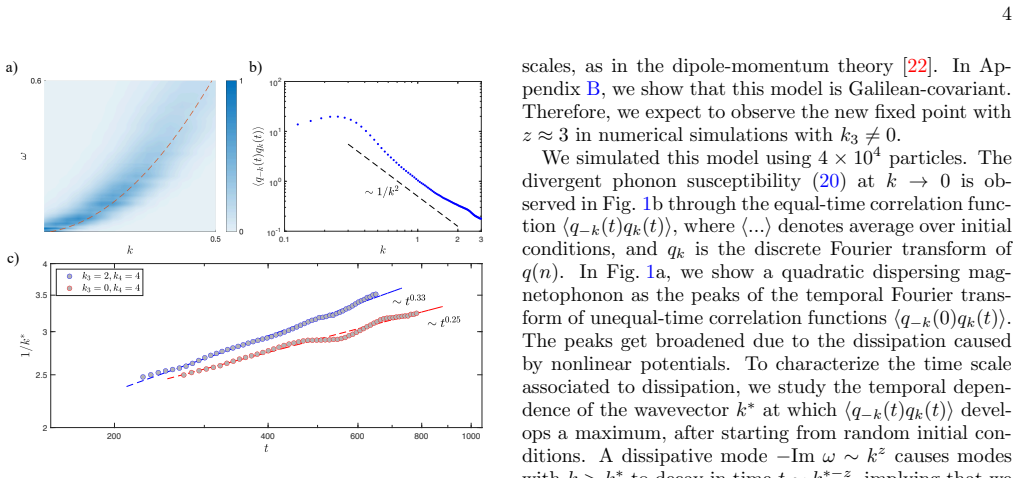
- [Fig. 1(c)] The plots have no error bars or scatter of individual realizations; providing them would allow the reader to assess the significance of the difference between 1/z ≈ 0.33 and 1/4.
- [Instabilities of hydrodynamics] The phrase 'Nonlinearities cubic in ∂iφi in e.g. the pressure are marginal at tree-level' is cryptic; please specify which terms are meant and show their scaling explicitly.
- [Experimental probes, Eq. (26)] The experimental estimate uses a dimensionless coupling \tilde{λ} without connecting it to the model parameters k3 or k4; a brief derivation of this coupling would be helpful.
- [Abstract and Introduction] The abstract and introduction state the result for 'a Galilean quantum Hall crystal' without the caveat that the instability requires short-range or screened interactions (α < 2/3); the title and claims should be qualified or the text should clarify the regime from the outset.
Circularity Check
No circular reduction found: the EFT is constructed from symmetries and independently power-counted; self-citations are not load-bearing. The GaAs extrapolation conflicts with App. A.4, but that is an internal consistency and correctness issue, not a circularity.
full rationale
The central derivation is self-contained: the linear-response magnetophonon ω ∼ ±k^2 − ik^4 follows from the coset/Schwinger-Keldysh construction and the normal-mode solution in Appendix A, not from the claimed z ≈ 3. The relevance criterion λ ∼ k^{(4−d)/2} is a standard power-counting argument, and the estimate z* ≈ d/2 + 2 is an explicit approximate fixed-point condition, not a restatement of the simulation output. The numerics are a controlled test: the k3 = 0 case recovers z ≈ 4 and the k3 ≠ 0 case produces z ≈ 3, so the exponent is not fit or inserted into the Hamiltonian. Self-citations [22, 23, 31, 39, 44] are present, but the load-bearing symmetry statements are rederived in Appendix A, and [44] is used only to motivate why thermodynamic fields should not renormalize, with the numerical result providing independent support. Two caveats flagged in the manuscript itself are correctness risks, not circularities: (i) energy conservation is explicitly neglected, with the authors relying on the same accessible-timescale argument as [22]; and (ii) Appendix A.4 states that for unscreened Coulomb α = 1 the linear response theory at d = 2 is stable (ω ∼ ±k^{3/2} − ik^3), while the Outlook asserts the phenomenon should occur in GaAs heterostructures as studied in [11] without specifying the α < 2/3 screening required by the theory. This is an experimental-validity gap, not a reduction of the derivation to its inputs.
Assumptions & free parameters
free parameters (2)
- k3 (cubic potential coefficient) =
2 (nonzero runs), 0 (control runs)
- k4 (quartic potential coefficient) =
4
assumptions (5)
- domain assumption A finite-temperature quantum Hall crystal spontaneously breaks translation symmetry and retains order on experimental scales despite Mermin-Wagner fluctuations.
- domain assumption Energy is not a conserved quantity for the hydrodynamic dynamics, or relaxes fast enough to be irrelevant.
- domain assumption The modified Galilean algebra [Pi, Pj] = i B Q epsilon_ij with the boost commutator in Appendix A describes the quantum Hall crystal.
- domain assumption The boost Goldstone mode eta_i relaxes quickly and can be integrated out, so momentum density equals mass current.
- domain assumption The numerical lattice Hamiltonian in Eq. (22) captures the relevant low-energy nonlinearities of the Galilean quantum Hall crystal.
Cite this review
Pith. "Pith review of Breakdown of hydrodynamics in a Galilean quantum Hall crystal." pith.science (2026). https://pith.science/paper/JRVGOV23
@misc{pith2026241212535,
  author       = {Pith},
  title        = {Pith review of: Breakdown of hydrodynamics in a Galilean quantum Hall crystal},
  year         = {2026},
  howpublished = {\url{https://pith.science/paper/JRVGOV23}},
  note         = {Machine review of arXiv:2412.12535}
}
abstract
We construct a nonlinear fluctuating hydrodynamic effective field theory for Galilean-invariant quantum Hall systems with spontaneously broken translational symmetry. Neglecting the role of energy conservation in a low-temperature regime, the hydrodynamic mode is a magnetophonon with quartic attenuation: $\omega\sim \pm k^2-\mathrm{i} k^z$ with $z=4$. However, this linear response theory is unstable, and flows to a non-trivial dynamical universality class with $z\approx 3$. We observe this scaling in numerical simulations of many-body classical Hamiltonian dynamics, in a model of an electronic crystal in the lowest Landau level. Observing this magnetophonon decay rate in a quantum Hall crystal represents a promising setting to detect an analogue of a "fractonic dynamical universality class" in a solid-state system, e.g. using microwave impedance microscopy.
Figures
Reference graph
Works this paper leans on
-
[11]
Observation of a magnetically induced wigner solid,
E. Y. Andrei, G. Deville, D. C. Glattli, F. I. B. Williams, E. Paris, and B. Etienne, “Observation of a magnetically induced wigner solid,” Phys. Rev. Lett. 60, 2765–2768 (1988)
work page 1988
-
[1]
Topological orders and edge excita- tions in fractional quantum hall states,
Xiao-Gang Wen, “Topological orders and edge excita- tions in fractional quantum hall states,” Advances In Physics 44, 405–473 (1995)
work page 1995
- [2]
-
[3]
The quantum hall fluid and non- commutative chern simons theory,
L. Susskind, “The quantum hall fluid and non- commutative chern simons theory,” (2001), arXiv:hep- th/0101029 [hep-th]
arXiv 2001
-
[4]
Quantum Hall states as matrix Chern-Simons theory,
Alexios P. Polychronakos, “Quantum Hall states as matrix Chern-Simons theory,” JHEP 04, 011 (2001), arXiv:hep-th/0103013
arXiv 2001
-
[5]
Quan- tum Hall physics equals noncommutative field theory,
Simeon Hellerman and Mark Van Raamsdonk, “Quan- tum Hall physics equals noncommutative field theory,” JHEP 10, 039 (2001), arXiv:hep-th/0103179
arXiv 2001
-
[6]
Two- dimensional magnetotransport in the extreme quantum limit,
D. C. Tsui, H. L. Stormer, and A. C. Gossard, “Two- dimensional magnetotransport in the extreme quantum limit,” Phys. Rev. Lett. 48, 1559–1562 (1982)
work page 1982
-
[7]
R. B. Laughlin, “Anomalous quantum hall effect: An incompressible quantum fluid with fractionally charged excitations,” Phys. Rev. Lett. 50, 1395–1398 (1983)
work page 1983
Show all 58 references
-
[8]
“hall crystal
Zlatko Teˇ sanovi´ c, Fran ¸ coise Axel, and B. I. Halperin, ““hall crystal” versus wigner crystal,” Phys. Rev. B 39, 8525–8551 (1989)
1989
-
[9]
Nonabelions in the fractional quantum hall effect,
Gregory Moore and Nicholas Read, “Nonabelions in the fractional quantum hall effect,” Nuclear Physics B 360, 362–396 (1991)
1991
-
[10]
Jainendra K Jain, Composite fermions (Cambridge Uni- versity Press, 2007)
2007
-
[12]
Dynamic scaling of growing interfaces,
Mehran Kardar, Giorgio Parisi, and Yi-Cheng Zhang, “Dynamic scaling of growing interfaces,” Phys. Rev. Lett. 56, 889–892 (1986)
1986
-
[13]
Nonlinear fluctuating hydrodynamics for anharmonic chains,
Herbert Spohn, “Nonlinear fluctuating hydrodynamics for anharmonic chains,” Journal of Statistical Physics 154, 1191–1227 (2014)
2014
-
[14]
Breakdown of Diffusion on Chiral Edges,
Luca V. Delacretaz and Paolo Glorioso, “Breakdown of Diffusion on Chiral Edges,” Phys. Rev. Lett. 124, 236802 (2020), arXiv:2002.08365 [cond-mat.str-el]
2020 arXiv
-
[15]
Fracton hydrodynamics,
Andrey Gromov, Andrew Lucas, and Rahul M. Nand- kishore, “Fracton hydrodynamics,” Phys. Rev. Res. 2, 033124 (2020)
2020
-
[16]
Anomalous diffu- sion in dipole- and higher-moment-conserving systems,
Johannes Feldmeier, Pablo Sala, Giuseppe De Tomasi, Frank Pollmann, and Michael Knap, “Anomalous diffu- sion in dipole- and higher-moment-conserving systems,” Phys. Rev. Lett. 125, 245303 (2020)
2020
-
[17]
Kinetically constrained freezing transition in a dipole- conserving system,
Alan Morningstar, Vedika Khemani, and David A. Huse, “Kinetically constrained freezing transition in a dipole- conserving system,” Phys. Rev. B 101, 214205 (2020)
2020
-
[18]
Subdiffusion in strongly tilted lattice systems,
Pengfei Zhang, “Subdiffusion in strongly tilted lattice systems,” Phys. Rev. Res. 2, 033129 (2020)
2020
-
[19]
Vortices as fractons,
Darshil Doshi and Andrey Gromov, “Vortices as fractons,” Communications Physics 4 (2021), 10.1038/s42005-021-00540-4
2021 doi
-
[20]
Towards classification of Fracton phases: the multipole algebra,
Andrey Gromov, “Towards classification of Fracton phases: the multipole algebra,” Phys. Rev. X 9, 031035 (2019), arXiv:1812.05104 [cond-mat.str-el]
2019 arXiv
-
[21]
A Chern-Simons theory for dipole symmetry,
Xiaoyang Huang, “A Chern-Simons theory for dipole symmetry,” SciPost Phys. 15, 153 (2023), arXiv:2305.02492 [cond-mat.str-el]
2023 arXiv
-
[22]
Breakdown of hydrody- namics below four dimensions in a fracton fluid,
Paolo Glorioso, Jinkang Guo, Joaquin F. Rodriguez- Nieva, and Andrew Lucas, “Breakdown of hydrody- namics below four dimensions in a fracton fluid,” Na- ture Phys. 18, 912–917 (2022), arXiv:2105.13365 [cond- mat.str-el]
2022 arXiv
-
[23]
Gold- stone bosons and fluctuating hydrodynamics with dipole and momentum conservation,
Paolo Glorioso, Xiaoyang Huang, Jinkang Guo, Joaquin F. Rodriguez-Nieva, and Andrew Lucas, “Gold- stone bosons and fluctuating hydrodynamics with dipole and momentum conservation,” JHEP 05, 022 (2023), arXiv:2301.02680 [hep-th]
2023 arXiv
-
[24]
Volume-preserving diffeomorphism as 6 nonabelian higher-rank gauge symmetry,
Yi-Hsien Du, Umang Mehta, Dung Xuan Nguyen, and Dam Thanh Son, “Volume-preserving diffeomorphism as 6 nonabelian higher-rank gauge symmetry,” SciPost Phys. 12, 050 (2022), arXiv:2103.09826 [cond-mat.str-el]
2022 arXiv
-
[25]
Theory of the Nernst effect near quantum phase transitions in condensed matter, and in dyonic black holes,
Sean A. Hartnoll, Pavel K. Kovtun, Markus Muller, and Subir Sachdev, “Theory of the Nernst effect near quantum phase transitions in condensed matter, and in dyonic black holes,” Phys. Rev. B 76, 144502 (2007), arXiv:0706.3215 [cond-mat.str-el]
2007 arXiv
-
[26]
Mag- netophonons & type-B Goldstones from Hydrodynamics to Holography,
Matteo Baggioli, Sebastian Grieninger, and Li Li, “Mag- netophonons & type-B Goldstones from Hydrodynamics to Holography,” JHEP 09, 037 (2020), arXiv:2005.01725 [hep-th]
2020 arXiv
-
[27]
Damping of Pseudo-Goldstone Fields,
Luca V. Delacr´ etaz, Blaise Gout´ eraux, and Vaios Ziogas, “Damping of Pseudo-Goldstone Fields,” Phys. Rev. Lett. 128, 141601 (2022), arXiv:2111.13459 [hep-th]
2022 arXiv
-
[28]
Theory of collective magne- tophonon resonance and melting of a field-induced wigner solid,
Luca V. Delacr´ etaz, Blaise Gout´ eraux, Sean A. Hart- noll, and Anna Karlsson, “Theory of collective magne- tophonon resonance and melting of a field-induced wigner solid,” Phys. Rev. B 100, 085140 (2019)
2019
-
[29]
Dipole superfluid hydrodynamics,
Akash Jain, Kristan Jensen, Ruochuan Liu, and Eric Mefford, “Dipole superfluid hydrodynamics,” JHEP 09, 184 (2023), arXiv:2304.09852 [hep-th]
2023 arXiv
-
[30]
Ideal fracton superfluids,
Jay Armas and Emil Have, “Ideal fracton superfluids,” SciPost Phys. 16, 039 (2024), arXiv:2304.09596 [hep-th]
2024 arXiv
-
[31]
Electronic hy- drodynamics and the breakdown of the wiedemann-franz and mott laws in interacting metals,
Andrew Lucas and Sankar Das Sarma, “Electronic hy- drodynamics and the breakdown of the wiedemann-franz and mott laws in interacting metals,” Phys. Rev. B 97, 245128 (2018)
2018
-
[32]
Ef- fective field theory of dissipative fluids,
Michael Crossley, Paolo Glorioso, and Hong Liu, “Ef- fective field theory of dissipative fluids,” JHEP 09, 095 (2017), arXiv:1511.03646 [hep-th]
2017 arXiv
-
[33]
Effec- tive field theory of dissipative fluids (II): classical limit, dynamical KMS symmetry and entropy current,
Paolo Glorioso, Michael Crossley, and Hong Liu, “Effec- tive field theory of dissipative fluids (II): classical limit, dynamical KMS symmetry and entropy current,” JHEP 09, 096 (2017), arXiv:1701.07817 [hep-th]
2017 arXiv
-
[34]
Relativistic Fluids, Superfluids, Solids and Supersolids from a Coset Construction,
Alberto Nicolis, Riccardo Penco, and Rachel A. Rosen, “Relativistic Fluids, Superfluids, Solids and Supersolids from a Coset Construction,” Phys. Rev. D 89, 045002 (2014), arXiv:1307.0517 [hep-th]
2014 arXiv
-
[35]
Non-equilibrium effective field theory and second sound,
Michael J. Landry, “Non-equilibrium effective field theory and second sound,” JHEP 04, 213 (2021), arXiv:2008.11725 [hep-th]
2021 arXiv
-
[36]
Alex Kamenev, Field Theory of Non-Equilibrium Systems (Cambridge University Press, 2011)
2011
-
[37]
Effective field theory for hydrody- namics: thermodynamics, and the derivative expansion,
Sergei Dubovsky, Lam Hui, Alberto Nicolis, and Dam Thanh Son, “Effective field theory for hydrody- namics: thermodynamics, and the derivative expansion,” Phys. Rev. D 85, 085029 (2012), arXiv:1107.0731 [hep- th]
2012 arXiv
-
[38]
The Schwinger-Keldysh coset construction,
Can Onur Akyuz, Garrett Goon, and Riccardo Penco, “The Schwinger-Keldysh coset construction,” JHEP 06, 004 (2024), arXiv:2306.17232 [hep-th]
2024 arXiv
-
[39]
Hydrodynamics as the effective field the- ory of strong-to-weak spontaneous symmetry breaking,
Xiaoyang Huang, Marvin Qi, Jian-Hao Zhang, and An- drew Lucas, “Hydrodynamics as the effective field the- ory of strong-to-weak spontaneous symmetry breaking,” (2024), arXiv:2407.08760 [cond-mat.str-el]
2024 arXiv
-
[40]
Redundan- cies in nambu-goldstone bosons,
Haruki Watanabe and Hitoshi Murayama, “Redundan- cies in nambu-goldstone bosons,” Phys. Rev. Lett. 110, 181601 (2013)
2013
-
[41]
Zoology of condensed matter: Framids, ordinary stuff, extra-ordinary stuff,
Alberto Nicolis, Riccardo Penco, Federico Piazza, and Riccardo Rattazzi, “Zoology of condensed matter: Framids, ordinary stuff, extra-ordinary stuff,” JHEP 06, 155 (2015), arXiv:1501.03845 [hep-th]
2015 arXiv
-
[42]
The coset construction for non-equilibrium systems,
Michael J. Landry, “The coset construction for non-equilibrium systems,” JHEP 07, 200 (2020), arXiv:1912.12301 [hep-th]
2020 arXiv
-
[43]
The second law of ther- modynamics from symmetry and unitarity,
Paolo Glorioso and Hong Liu, “The second law of ther- modynamics from symmetry and unitarity,” (2016), arXiv:1612.07705 [hep-th]
2016 arXiv
-
[44]
Gen- eralized time-reversal symmetry and effective theories for nonequilibrium matter,
Xiaoyang Huang, Jack H. Farrell, Aaron J. Friedman, Is- abella Zane, Paolo Glorioso, and Andrew Lucas, “Gen- eralized time-reversal symmetry and effective theories for nonequilibrium matter,” (2023), arXiv:2310.12233 [cond-mat.stat-mech]
2023 arXiv
-
[45]
Crystalline order in two dimensions,
N. D. Mermin, “Crystalline order in two dimensions,” Phys. Rev. 176, 250–254 (1968)
1968
-
[46]
Mi- crowave impedance microscopy and its application to quantum materials,
Mark E Barber, Eric Yue Ma, and Zhi-Xun Shen, “Mi- crowave impedance microscopy and its application to quantum materials,” Nature Reviews Physics 4, 61–74 (2021)
2021
-
[47]
Probing the edge states of chern insulators using microwave impedance mi- croscopy,
Taige Wang, Chen Wu, Masataka Mogi, Minoru Kawa- mura, Yoshinori Tokura, Zhi-Xun Shen, Yi-Zhuang You, and Monica T. Allen, “Probing the edge states of chern insulators using microwave impedance mi- croscopy,” Phys. Rev. B 108, 235432 (2023)
2023
-
[48]
Dy- namic response of wigner crystals,
Lili Zhao, Wenlu Lin, Yoon Jang Chung, Adbhut Gupta, Kirk W. Baldwin, Loren N. Pfeiffer, and Yang Liu, “Dy- namic response of wigner crystals,” Phys. Rev. Lett.130, 246401 (2023)
2023
-
[49]
Melting of a 2d quantum electron solid in high magnetic field,
Yong P Chen, G. Sambandamurthy, Z H Wang, R M Lewis, L W Engel, D C Tsui, P D Ye, L N Pfeiffer, and K W West, “Melting of a 2d quantum electron solid in high magnetic field,” Nature Physics 2, 452–455 (2006)
2006
-
[50]
Tkachenko waves,
E. B. Sonin, “Tkachenko waves,” JETP Letters 98, 758– 768 (2014)
2014
-
[51]
Noncommutative field theory of the Tkachenko mode: Symmetries and decay rate,
Yi-Hsien Du, Sergej Moroz, Dung Xuan Nguyen, and Dam Thanh Son, “Noncommutative field theory of the Tkachenko mode: Symmetries and decay rate,” Phys. Rev. Res. 6, L012040 (2024), arXiv:2212.08671 [cond- mat.str-el]
2024 arXiv
-
[52]
Cyclotron resonance and de haas-van alphen oscillations of an interacting electron gas,
Walter Kohn, “Cyclotron resonance and de haas-van alphen oscillations of an interacting electron gas,” Phys. Rev. 123, 1242–1244 (1961)
1961
-
[53]
Pinning and conductivity of two-dimensional charge-density waves in magnetic fields,
Hidetoshi Fukuyama and Patrick A. Lee, “Pinning and conductivity of two-dimensional charge-density waves in magnetic fields,” Phys. Rev. B 18, 6245–6252 (1978)
1978
-
[54]
Some static and dy- namical properties of a two-dimensional wigner crystal,
Lynn Bonsall and A. A. Maradudin, “Some static and dy- namical properties of a two-dimensional wigner crystal,” Phys. Rev. B 15, 1959–1973 (1977). 7 Appendix A: Hydrodynamic effective field theory In this appendix, we present a detailed construction of the hydrodynamic effecti...
1977
-
[55]
boost density
Coset construction In the presence of a magnetic field, we have a modified Galilean algebra [Pi, Pj] = iBQϵij, (A1a) [Ki, Pj] = imQδij, (A1b) [Ki, P0] = −i(Pi − (B/m)ϵijKj), (A1c) where Ki is the boost generator and m is the single particle mass. The algebra is closed, and com...
-
[56]
We have Lideal = pδj i + πiuj + κj k∂iσk Ei a,j + mnuiE′ a,0i + nCa,0, (A20) with πi + κ0 j ∂iσj = mnui, which comes from (A14)
Ideal hydrodynamics The most general ideal Lagrangian corresponds to terms where T µ i and J µ contain as few derivatives as possible, as hydrodynamics is a gradient expansion in derivatives. We have Lideal = pδj i + πiuj + κj k∂iσk Ei a,j + mnuiE′ a,0i + nCa,0, (A20) with πi ...
-
[57]
Suppose we have the first order dissipative Lagrangian as L(1) ∼ −AiE′ a,0i − BCa,0
Next-to-leading-order hydrodynamics The dissipative Lagrangian involving E′ a,0i and Ca,0 can be removed by field redefinitions [32]. Suppose we have the first order dissipative Lagrangian as L(1) ∼ −AiE′ a,0i − BCa,0. (A24) Consider a shift of the r-fields, µ → µ + δµ and ui ...
-
[58]
fixed charge
Long-range Coulomb interactions We briefly discuss how long-range Coulomb interactions modify the EFT above. Density-dependent interactions with a potential 1 /r2−α effectively cause the bulk modulus and charge susceptibility to scale as a1 ∼ χ−1 ∼ k−α [53]. In the linear resp...
Reviewed August 11, 2026 · model on record in the stance chip above.
Discussion (0). Continue with ORCID to comment.