REVIEW 3 major objections 6 minor 87 references
Finite-dimensional boson sampling needs only near-optimal modes once leakage norms concentrate at √n.
Reviewed by Pith at T0; open to challenge. T0 means a machine referee read the full paper against a public rubric. the ladder, T0–T4 →
Bunching leakage for finite-d Lie-algebraic boson sampling concentrates at Õ(√n), tightening modes from Ω(n⁴) to Õ(n^{1+2/(d-1)}), with d=3 matching the collision-free threshold.
T0 review reviewed 2026-07-14 challenge →
load-bearing objection Unconditional Gaussian Õ(√n) leakage bound and d-dependent mode law that nearly settles the Peropadre conjecture; Haar transfer still rests on an open genus-ordering conjecture checked only at leading order. the 3 major comments →
Near-Optimal Mode Scaling for Finite-Dimensional Boson Sampling via Lie-Algebraic Leakage Bounds
The pith
A machine-rendered reading of the paper's core claim, the machinery that carries it, and where it could break.
The reading
Core claim
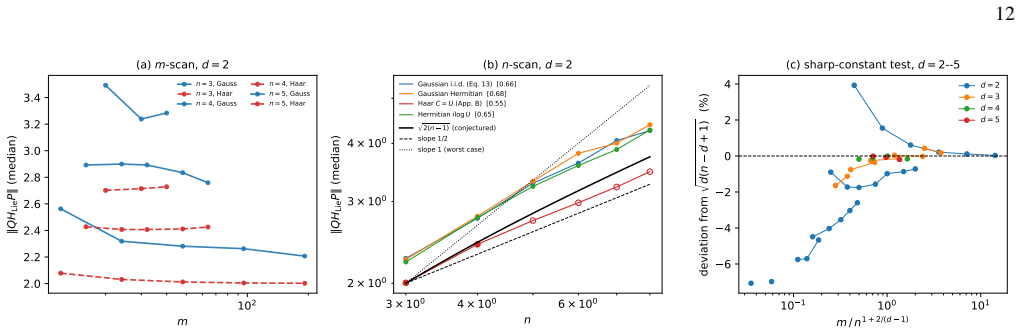
In a Gaussian model of the single-particle couplings, the spectral norm of the bunching-leakage operator concentrates at Õ(√n) rather than the prior worst-case O(n). Combined with the birthday-paradox collision amplitude, this yields the mode-scaling law m=Õ(n^{1+2/(d-1)}) that keeps total-variation distance to ideal boson sampling below any fixed δ. The same law holds for physical Haar generators once a single Haar-to-Gaussian comparison (Conjecture 1) is granted; numerics match the sharp form √[d(n-d+1)] to sub-percent accuracy.
What carries the argument
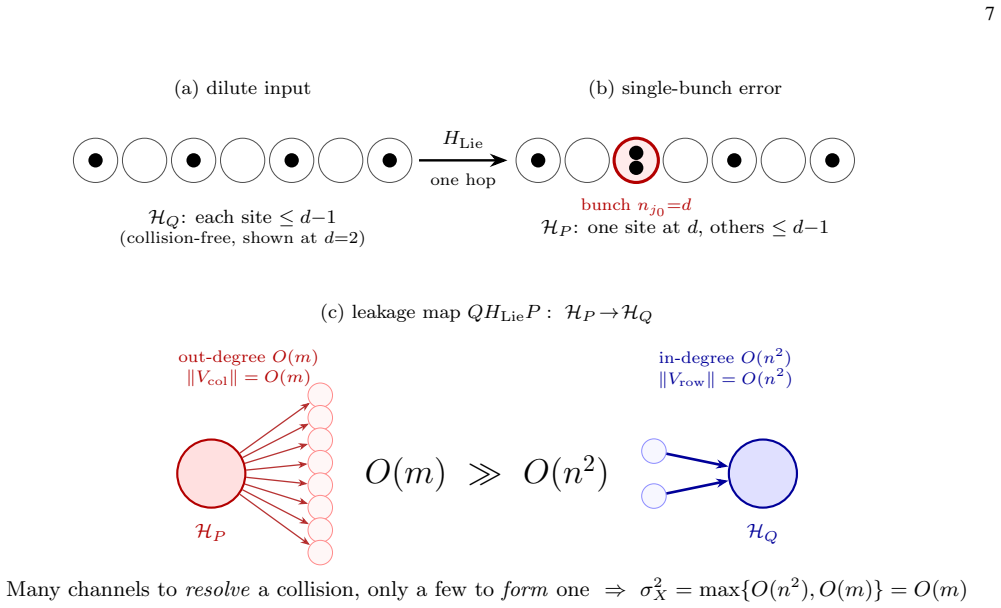
Dyson-series leakage bound via operator decomposition: the correlated many-body map QH_Lie P is written as a sum of deterministic combinatorial matrices weighted by independent Gaussians, so non-commutative matrix concentration applies and the variance statistic is O(m) rather than O(n^{2}).
Load-bearing premise
The transfer from the proved Gaussian model to the physical Haar unitary rests on an unproved comparison that the projectors and local operators do not spoil the topological power counting of the Weingarten remainder for all distances.
What would settle it
Exact construction of the leakage operator for larger n (say n=12–20) under Haar unitaries: if the measured median norm systematically exceeds √[d(n-d+1)] by more than a few percent, or fails to track √n, the claimed concentration and the resulting mode law are false.
Editorial analysis
A structured set of objections, weighed in public.
Referee Report
Summary. The paper places finite-dimensional boson, fermion, and spin sampling in a unified Lie-algebraic framework where transition amplitudes are immanants of single-particle submatrices (permanents in the bosonic case). It analyzes bunching leakage out of the local truncation of dimension d via a Dyson expansion of the state deviation, decomposes the correlated leakage operator QH_Lie P into deterministic combinatorial matrices weighted by independent Gaussians, and applies non-commutative matrix concentration (after Paulsen dilation) to prove that, in the Gaussian model A_vu = Z_vu/√m, ∥QH_Lie P∥ concentrates at Õ(√n) rather than the O(n) worst-case bound of prior spin-based work. Combined with a birthday-paradox collision amplitude this yields the mode-scaling law m = Õ(n^{1+2/(d−1)}) for total-variation error ≤ δ (Theorem 1/2). Transfer to the physical Haar ensemble is reduced to a single structural input (Conjecture 1 on decorated Weingarten genus ordering), verified only at leading order. Exact numerics for d=2–5 show the Haar norm matching √[d(n−d+1)] to sub-percent accuracy. Platform implications under the τ=O(1) non-local-connectivity premise are discussed.
Significance. If the Gaussian concentration and the resulting mode law hold as stated, the work substantially improves the resource estimate for deterministic matter-based emulations of boson sampling, resolving (in the Gaussian model, and conditionally for Haar) the long-standing Peropadre et al. conjecture and identifying d=3 as the point where the truncation floor meets the collision-free threshold m∼n². Strengths that should be credited: (i) a clean operator decomposition that restores applicability of matrix concentration despite strong entry correlations; (ii) a fully proved Hermitian reduction (Lemma 3); (iii) explicit isolation of the single analytical gap (Conjecture 1) rather than burying it; (iv) reproducible, seed-deterministic numerics with sparse-vs-brute-force validation (Table II) and a sharp-constant conjecture √[d(n−d+1)] that is falsifiable; (v) honest scope limits (unitary family only; hardness inherited, not re-proved). The result is of clear interest for analog quantum simulation and quantum-advantage hardware design.
major comments (3)
- Theorem 1 and Lemma 4 make the physical (Haar) mode law conditional on Conjecture 1 (App. B): that projectors P,Q and the local M_vu preserve the uniform Weingarten power counting L_Γ(σ,π) ≤ L_0 − |π| + 2g for all distances ℓ, so the off-diagonal remainder is O(k⁴/m²) at the operating order k∼n log m. Only |π|≤2 is verified; the same n/m loop heterogeneity already visible in the variance asymmetry of Lemmas 1–2 (∥V_row∥=O(n²) vs ∥V_col∥=O(m)) is left open for higher ℓ. This is load-bearing for the claim that recovers the physical conjecture of Ref. [14]. Either a fuller proof (or a controlled counterexample) of Conjecture 1, or a restructuring that makes the unconditional Gaussian theorem the primary result and the Haar statement clearly secondary, is needed before the physical mode law can be stated at the strength of the abstract and title.
- Section III F and Eq. (31): the sub-percent match of the Haar-ensemble norm to √[d(n−d+1)] is strong evidence that ∥QH_Lie P∥_Haar = Θ(√n), but it does not constitute numerical support for Conjecture 1. Conjecture 1 concerns high-moment Weingarten remainders at order k∼n log m, not the spectral norm itself. The manuscript should state explicitly that the numerics corroborate the concentration scale for Haar while leaving the moment-comparison input untested, and ideally add a small-k numerical check of the Haar-vs-Gaussian moment ratio (or of R/E_Gauss) at accessible (n,m) to give direct evidence on the remainder.
- Section III A–D, Eqs. (11)–(12) and (26): the total-variation bound multiplies the operator-norm concentration by a birthday-paradox collision amplitude that is itself only high-probability over the coupling ensemble. The text notes a union bound and that the failure probability remains e^{−Ω(n)}, but the composition of constants, the precise event on which both hold simultaneously, and the dependence of c_{d,δ} on that union are not written out. A short lemma stating the joint high-probability event and the resulting explicit (or asymptotic) form of c_{d,δ} would make Theorem 1 fully self-contained.
minor comments (6)
- Table I: the prior spin-S row cites m=Ω(n^{1+3/(2S)}); the Lie-algebraic row improves the exponent via concentration. A one-line note that the improvement is n^{1/2} in the operator norm (worst-case O(n) → Õ(√n)) would help readers map the table to Theorem 2.
- Figure 2 caption and panel (b): open markers for sub-dilute points are explained, but the fitted slopes [0.55]–[0.68] in the legend would be clearer if the fitting window (e.g. 3≤n≤8) were stated in the caption rather than only in the main text.
- Eq. (5) and the paragraph on W(k,Λ): the structure constant c is introduced without a uniform convention across su(2) and higher-rank cases; a short table of (c,Λ,d) for the representations used later would reduce ambiguity.
- Appendix B, Eq. (B17): the cosh series bound is standard, but the absolute constant C absorbing Möbius and operator factors is never estimated. Even a crude C=O(1) or C=poly(d) statement would clarify the regime m≫k².
- Data availability: the Zenodo DOI is still a placeholder (“to be inserted”). Please supply the actual DOI or repository link before acceptance.
- Typographical: “ann-photon” / “ann-fold” spacing glitches appear in the Introduction and Sec. III (likely from line breaks around n); also “dimen-sion” hyphenation in III C. Minor copy-edit pass recommended.
Circularity Check
No significant circularity: Gaussian concentration is an independent matrix-concentration argument; hardness is inherited from AA; Haar transfer is openly conditional on Conjecture 1; numerics do not feed the main theorem.
full rationale
The load-bearing chain is: (i) decompose the correlated leakage operator as X=∑ Z_vu M_vu with independent Gaussians (Eq. 13); (ii) bound the matrix variance by combinatorial counting, σ²_X=O(m) (Lemmas 1–2); (iii) apply an external non-commutative Gaussian tail bound to get ∥X∥=O(√(m n log m)), hence ∥QH_Lie P∥=Õ(√n) after rescaling (Theorem 2); (iv) multiply by the independent birthday-paradox collision amplitude and constant τ to obtain the mode law (Theorem 1). None of these steps is defined in terms of its conclusion. Hardness is explicitly inherited from Aaronson–Arkhipov permanents, not re-derived. Self-citations to the authors’ prior generalized-boson/spin-S papers supply the framework and a standard combinatorial birthday amplitude; that amplitude is also stated independently in the text and does not include the √n concentration target, so it is ordinary prior-work input rather than a circular load-bearing premise. The sharp form √[d(n−d+1)] is a numerical observation recorded as a conjecture and is not used to prove Theorem 1 or 2. Conjecture 1 (Haar-to-Gaussian genus ordering) is flagged as an open gap verified only at leading order; that is incompleteness, not circularity. The derivation is therefore self-contained against external matrix-concentration and Weingarten machinery, with no prediction forced by definition or by a self-citation chain.
Axiom & Free-Parameter Ledger
free parameters (2)
- c_d, c_{d,δ}
- τ = O(1) evolution time
axioms (6)
- standard math Non-commutative matrix Gaussian concentration (Tropp) applies to the dilated independent-sum form of the leakage operator.
- standard math Weingarten expansion and genus power counting for unitary moments.
- ad hoc to paper Conjecture 1: decorated genus ordering L_Γ(σ,π) ≤ L_0 − |π| + 2g for projector-constrained M_vu.
- domain assumption #P-hardness of the permanent and AA average-case / PH-collapse conjectures.
- domain assumption Generalized birthday-paradox bound on single-bunch amplitude ∥P|ϵ⟩∥ = O(n^{d/2}/m^{(d-1)/2}).
- domain assumption Single-particle matrix can be scrambled in time independent of m (non-local connectivity).
Cite this review
Pith. "Pith review of Near-Optimal Mode Scaling for Finite-Dimensional Boson Sampling via Lie-Algebraic Leakage Bounds." pith.science (2026). https://pith.science/paper/JSFTO7GG
@misc{pith2026260711708,
  author       = {Pith},
  title        = {Pith review of: Near-Optimal Mode Scaling for Finite-Dimensional Boson Sampling via Lie-Algebraic Leakage Bounds},
  year         = {2026},
  howpublished = {\url{https://pith.science/paper/JSFTO7GG}},
  note         = {Machine review of arXiv:2607.11708}
}
read the original abstract
Boson sampling demonstrates quantum advantage through the interference of indistinguishable particles, with output probabilities governed by matrix permanents. Realizing it on deterministic, matter-based platforms requires encoding the bosonic modes in finite-dimensional local Hilbert spaces, which introduces a leakage channel absent in linear optics: multi-particle bunching beyond the local truncation $d$. We develop a unified framework for non-interacting sampling on the irreducible representations of compact Lie groups, in which the transition amplitude is the immanant of a submatrix of the single-particle transition matrix, recovering the permanent in the bosonic case. Within this framework we bound the bunching leakage through a Dyson-series analysis: decomposing the correlated many-body leakage operator into independent random matrices and applying non-commutative concentration inequalities, we prove, in a Gaussian model of the transition matrix, that its spectral norm concentrates at $\tilde{O}(\sqrt{n})$ rather than the $O(n)$ worst-case of prior spin-based emulations; the passage to the physical Haar ensemble is reduced to a single submatrix-comparison input, verified at leading order. Exact numerics across local dimensions $d=2$--$5$ indicate that the bound is tight, the Haar-ensemble norm matching the closed form $\sqrt{d(n-d+1)}$ to sub-percent accuracy. This tightens the required mode number from $m=\Omega(n^4)$ to the near-optimal $m=\tilde{\Omega}(n^{1+2/(d-1)})$; for a spin-1 representation ($d=3$) the overhead falls to $m=\tilde{\Omega}(n^2)$, matching the collision-free threshold. The result is independent of particle statistics and applies across finite-dimensional Lie-symmetric architectures, quantifying the spatial resources needed to preserve sampling hardness.
Figures
Reference graph
Works this paper leans on
-
[1]
The unsymmetrized N-particle space isV ⊗N
Tensor action of the algebra Letgbe a compact Lie algebra andV C M its defining module, on whichH∈gacts asπ def(H). The unsymmetrized N-particle space isV ⊗N. On a tensor product the algebra acts through the primitive coproduct, i.e. as a derivation distribut- ing over the factors, π⊗N(H)= NX k=1 H(k),H (k) =I⊗· · ·⊗π def(H)| {z } k-th slot ⊗ · · ·⊗I.(A1)...
-
[2]
Exponentiation to a tensor power Because the summands in Eq. (A1) commute, the exponen- tial factorizes, ˆUfull(t)=exp −iπ ⊗N(H)t = NY k=1 exp −i H (k)t .(A2) Each factor is the identity on every slot but thek-th, where it equals the single-particle propagatorU=exp[−iπ def(H)t], anM×Mmatrix. The product is therefore the tensor power ˆUfull(t)=U⊗U⊗ · · · ⊗...
-
[3]
Schur–Weyl projection and the amplitude (unitary family) Physical states occupy a symmetry subspace fixed by the exchange statistics. For the unitary familyG=U(M), the commutant ofU ⊗N onV ⊗N is the group algebraC[S N] acting by slot permutations ˆPσ, and [U⊗N , ˆPσ]=0,∀σ∈S N,(A4) soV ⊗N = L λ⊢N, ℓ(λ)≤M Sλ ⊗W λ, withS λ the Specht module (dimd λ) andW λ t...
-
[4]
non- interacting amplitude=immanant of anN×Nsubmatrix
Scope: other classical families The reduction (A4)–(A6) is specific toG=U(M), where the commutant ofU ⊗N isC[S N]. For the orthogonal and sym- plectic families the relevant module is not the fullV ⊗N but its trace-free part, and the commutant is the Brauer algebra BN(±M), whose basis includes contraction (pairing) diagrams in addition to permutations. The...
-
[5]
Reduction to a moment comparison The leakage operator is linear in the single-particle matrix, X= √m QHLieP= mX u=1 X v,u Avu Mvu,M vu =Q E (v) + E(u) − P, (B1) withA vu = √m Uvu forUHaar onU(m) (the Haar model) and Avu =Z vu,Z vu ∼ CN(0,1) independent (the Gaussian model). For anyk∈Nthe operator norm is dominated by thek-th moment of the squared singular...
-
[6]
The Weingarten function admits the exact convergent series [75], valid form≥k, Wg(ν,m)=m −k X ℓ≥0 (−1)ℓm−ℓ #{(ρ1,
Weingarten and Wick expansions For index sequencesi,jof lengthq=k, the exact Haar integral is the Weingarten formula [75, 76], Z U(m) kY a=1 Uia ja kY a=1 U∗ i′a j′a dµ(U)= X σ,τ∈S k δi,i′σ δj,j′τ Wg(σ−1τ,m), (B6) 18 whereδ i,i′σ = Q a δia,i′ σ(a). The Weingarten function admits the exact convergent series [75], valid form≥k, Wg(ν,m)=m −k X ℓ≥0 (−1)ℓm−ℓ #...
-
[7]
Genus-resolved bound on the remainder Setπ=σ −1τ,e. The magnitude ofW σ,τ relative to the diagonalW σ,σ is governed by the number of free index loops of the glued ribbon diagram: each independent loop is an un- constrained index summation contributing a factorm. For the bare gluing of theUindices, the loop count obeys the Euler relation L(σ, π)=L 0(σ)− |π...
-
[8]
all 4”={gauss iid, gauss Herm, Haar, Herm.ilogU}; “Haar
Uniformity inkand conclusion At the operating orderk∼nlogm, the relative correction (B17) is |R| EGauss[· · ·] =O k4 m2 = ˜O n4 m2 ,(B18) with convergence conditionm≫k 2, i.e.m≫n 2 log2 m, hencem= ˜Ω(n2). We must check this correction does not accumulate as the operator norm is extracted. The point is that the bound (B17) is controlled by the topological ...
-
[9]
A. W. Harrow and A. Montanaro, Nature549, 203 (2017)
2017
-
[10]
Aaronson and A
S. Aaronson and A. Arkhipov, inProceedings of the 43rd An- nual ACM Symposium on Theory of Computing (STOC)(2011) pp. 333–342
2011
-
[11]
C. S. Hamilton, R. Kruse, L. Sansoni, S. Barkhofen, C. Silber- horn, and I. Jex, Physical Review Letters119, 170501 (2017)
2017
-
[12]
Zhong, H
H.-S. Zhong, H. Wang, Y .-H. Deng, M.-C. Chen, L.-C. Peng, Y .-H. Luo, J. Qin, D. Wu, X. Ding, Y . Hu,et al., Science370, 1460 (2020)
2020
-
[13]
L. S. Madsen, F. Laudenbach, M. F. Askarani, F. Rortais, T. Vincent, J. F. Bulmer, F. M. Miatto, L. Neuhaus, L. G. Helt, M. J. Collins,et al., Nature606, 75 (2022)
2022
-
[14]
L. G. Valiant, Theor. Comput. Sci.8, 189 (1979)
1979
-
[15]
Aaronson and D
S. Aaronson and D. J. Brod, Physical Review A93, 012335 (2016)
2016
-
[16]
Bouland, B
A. Bouland, B. Fefferman, C. Nirkhe, and U. Vazirani, Nature Physics15, 159 (2019)
2019
-
[17]
García-Patrón, J
R. García-Patrón, J. J. Renema, and V . Shchesnovich, Quantum 3, 169 (2019). 21
2019
-
[18]
J. J. Renema, A. Menssen, W. R. Clements, G. Triginer, W. S. Kolthammer, and I. A. Walmsley, Physical Review Letters120, 220502 (2018)
2018
-
[19]
C. Oh, M. Liu, Y . Alexeev, B. Fefferman, and L. Jiang, Nature Physics20, 1461 (2024)
2024
-
[20]
Oszmaniec and D
M. Oszmaniec and D. J. Brod, New Journal of Physics20, 092002 (2018)
2018
-
[21]
Clifford and R
P. Clifford and R. Clifford, inProceedings of the Twenty- Ninth Annual ACM-SIAM Symposium on Discrete Algorithms (SODA)(SIAM, 2018) pp. 146–155
2018
-
[22]
Peropadre, A
B. Peropadre, A. Aspuru-Guzik, and J. J. García-Ripoll, Phys- ical Review A95, 032327 (2017)
2017
-
[23]
Bürgisser, SIAM Journal on Computing30, 1023 (2000)
P. Bürgisser, SIAM Journal on Computing30, 1023 (2000)
2000
-
[24]
E.-J. Kuo, Y . Xu, D. Hangleiter, A. Grankin, and M. Hafezi, Physical Review Research4, 043096 (2022)
2022
-
[25]
C.-F. Kam and E.-J. Kuo, npj Quantum Information (2026), 10.1038/s41534-026-01246-7
-
[26]
Oszmaniec, N
M. Oszmaniec, N. Dangniam, M. E. S. Morales, and Z. Zim- borás, PRX Quantum3, 020328 (2022)
2022
-
[27]
J. A. Troppet al., Foundations and Trends®in Machine Learn- ing8, 1 (2015)
2015
-
[28]
J. A. Tropp, Foundations of Computational Mathematics12, 389 (2012)
2012
-
[29]
Throughout, ˜Oand ˜Ωsuppress polylogarithmic factors:f= ˜O(g) meansf=O(gpolylog(n,m)), with ˜Ωdefined dually
-
[30]
A. Bouland, D. J. Brod, I. Datta, B. Fefferman, D. Grier, F. Hernández, and M. Oszmaniec, Physical Review X16, 021059 (2026), arXiv:2312.00286
Pith/arXiv arXiv 2026
-
[31]
Richermeet al., Nature511, 198 (2014)
P. Richermeet al., Nature511, 198 (2014)
2014
-
[32]
A. M. Childs, D. Gosset, and Z. Webb, inAutomata, Lan- guages, and Programming: 41st International Colloquium, ICALP 2014, Copenhagen, Denmark, July 8-11, 2014, Pro- ceedings, Part I 41(Springer, 2014) pp. 308–319
2014
-
[33]
Zhanget al., Nature508, 91 (2014)
J. Zhanget al., Nature508, 91 (2014)
2014
-
[34]
Leghtas, S
Z. Leghtas, S. Touzard, I. M. Pop, A. Kou, B. Vlastakis, A. Pe- trenko, K. M. Sliwa, A. Narla, S. Shankar, M. J. Hatridge,et al., Science347, 853 (2015)
2015
-
[35]
Mirrahimi, Z
M. Mirrahimi, Z. Leghtas, V . V . Albert, S. Touzard, R. J. Schoelkopf, L. Jiang, and M. H. Devoret, New Journal of Physics16, 045014 (2014)
2014
-
[36]
Touzard, A
S. Touzard, A. Kou, N. Frattini, V . Sivak, S. Puri, A. Grimm, L. Frunzio, S. Shankar, and M. Devoret, Physical review letters 122, 080502 (2019)
2019
-
[37]
Kam, W.-M
C.-F. Kam, W.-M. Zhang, D.-H. Feng,et al.,Coherent States: New Insights into Quantum Mechanics with Applica- tions(Springer, 2023)
2023
-
[38]
Kam and E.-J
C.-F. Kam and E.-J. Kuo, New Journal of Physics27, 124509 (2025)
2025
-
[39]
Leverrier, Journal of Mathematical Physics59(2018)
A. Leverrier, Journal of Mathematical Physics59(2018)
2018
-
[40]
D. Grier, D. J. Brod, J. M. Arrazola, M. B. de Andrade Alonso, and N. Quesada, Quantum6, 863 (2022), arXiv:2110.06964
Pith/arXiv arXiv 2022
-
[41]
B. Go, C. Oh, and H. Jeong, Quantum10, 2026 (2026), arXiv:2405.01786
arXiv 2026
-
[42]
Blatt and C
R. Blatt and C. F. Roos, Nature Physics8, 277 (2012)
2012
-
[43]
T. P. Harty, D. T. C. Allcock, C. J. Ballance, L. Guidoni, H. A. Janacek, N. M. Linke, D. N. Stacey, and D. M. Lucas, Physical Review Letters113, 220501 (2014)
2014
-
[44]
Wang, C.-Y
P. Wang, C.-Y . Luan, M. Qiao, M. Um, J. Zhang, Y . Wang, X. Yuan, M. Gu, J. Zhang, and K. Kim, Nature Communica- tions12, 233 (2021)
2021
-
[45]
Porras and J
D. Porras and J. I. Cirac, Physical Review Letters92, 207901 (2004)
2004
-
[46]
Monroe, W
C. Monroe, W. C. Campbell, L.-M. Duan, Z.-X. Gong, A. V . Gorshkov, P. W. Hess, R. Islam, K. Kim, N. M. Linke, G. Pagano, P. Richerme, C. Senko, and N. Y . Yao, Reviews of Modern Physics93, 025001 (2021)
2021
-
[47]
J. W. Britton, B. C. Sawyer, A. C. Keith, C.-C. J. Wang, J. K. Freericks, H. Uys, M. J. Biercuk, and J. J. Bollinger, Nature 484, 489 (2012)
2012
-
[48]
Zhang, G
J. Zhang, G. Pagano, P. W. Hess, A. Kyprianidis, P. Becker, H. Kaplan, A. V . Gorshkov, Z.-X. Gong, and C. Monroe, Na- ture551, 601 (2017)
2017
-
[49]
M. K. Joshi, F. Kranzl, A. Schuckert, I. Lovas, C. Maier, R. Blatt, M. Knap, and C. F. Roos, Science376, 720 (2022)
2022
-
[50]
Guo, Y .-K
S.-A. Guo, Y .-K. Wu, J. Ye, L. Zhang, W.-Q. Lian, R. Yao, Y . Wang, R.-Y . Yan, Y .-J. Yi, Y .-L. Xu, B.-W. Li, Y .-H. Hou, Y .-Z. Xu, W.-X. Guo, C. Zhang, B.-X. Zhang, Z.-C. Xu, Z.-Q. Cheng, and L.-M. Duan, Nature630, 613 (2024)
2024
-
[51]
J. G. Bohnet, B. C. Sawyer, J. W. Britton, M. L. Wall, A. M. Rey, M. Foss-Feig, and J. J. Bollinger, Science352, 1297 (2016)
2016
-
[52]
J. Koch, T. M. Yu, J. Gambetta, A. A. Houck, D. I. Schuster, J. Majer, A. Blais, M. H. Devoret, S. M. Girvin, and R. J. Schoelkopf, Physical Review A76, 042319 (2007)
2007
-
[53]
R. W. Heeres, B. Vlastakis, E. Holland, S. Krastanov, V . V . Al- bert, L. Frunzio, L. Jiang, and R. J. Schoelkopf, Physical Re- view Letters115, 137002 (2015)
2015
-
[54]
Reagor, W
M. Reagor, W. Pfaff, C. Axline, R. W. Heeres, N. Ofek, K. Sliwa, E. Holland, C. Wang, J. Blumoff, K. Chou, M. J. Hatridge, L. Frunzio, M. H. Devoret, L. Jiang, and R. J. Schoelkopf, Physical Review B94, 014506 (2016)
2016
-
[55]
Milul, B
O. Milul, B. Guttel, U. Goldblatt, S. Hazanov, L. M. Joshi, D. Chausovsky, N. Kahn, E. Çiftyürek, F. Lafont, and S. Rosen- blum, PRX Quantum4, 030336 (2023)
2023
-
[56]
Krinner, N
S. Krinner, N. Lacroix, A. Remm, A. Di Paolo, E. Genois, C. Leroux, C. Hellings, S. Lazar, F. Swiadek, J. Herrmann, G. J. Norris, C. K. Andersen, M. Müller, A. Blais, C. Eichler, and A. Wallraff, Nature605, 669 (2022)
2022
-
[57]
Chakram, A
S. Chakram, A. E. Oriani, R. K. Naik, A. V . Dixit, K. He, A. Agrawal, H. Kwon, and D. I. Schuster, Physical Review Letters127, 107701 (2021)
2021
-
[58]
R. K. Naik, N. Leung, S. Chakram, P. Groszkowski, Y . Lu, N. Earnest, D. C. McKay, J. Koch, and D. I. Schuster, Nature Communications8, 1904 (2017)
1904
-
[59]
Barredo, S
D. Barredo, S. de Léséleuc, V . Lienhard, T. Lahaye, and A. Browaeys, Science354, 1021 (2016)
2016
-
[60]
Endres, H
M. Endres, H. Bernien, A. Keesling, H. Levine, E. R. An- schuetz, A. Krajenbrink, C. Senko, V . Vuletic, M. Greiner, and M. D. Lukin, Science354, 1024 (2016)
2016
-
[61]
H. J. Manetsch, G. Nomura, E. Bataille, K. H. Leung, X. Lv, and M. Endres, Nature647, 60 (2025)
2025
-
[62]
Cooper, J
A. Cooper, J. P. Covey, I. S. Madjarov, S. G. Porsev, M. S. Safronova, and M. Endres, Physical Review X8, 041055 (2018)
2018
-
[63]
M. A. Norcia, A. W. Young, and A. M. Kaufman, Physical Review X8, 041054 (2018)
2018
-
[64]
Saskin, J
S. Saskin, J. T. Wilson, B. Grinkemeyer, and J. D. Thompson, Physical Review Letters122, 143002 (2019)
2019
-
[65]
Saffman, T
M. Saffman, T. G. Walker, and K. Mølmer, Reviews of Modern Physics82, 2313 (2010)
2010
-
[66]
Browaeys and T
A. Browaeys and T. Lahaye, Nature Physics16, 132 (2020)
2020
-
[67]
Barredo, H
D. Barredo, H. Labuhn, S. Ravets, T. Lahaye, A. Browaeys, and C. S. Adams, Physical Review Letters114, 113002 (2015)
2015
-
[68]
Periwal, E
A. Periwal, E. S. Cooper, P. Kunkel, J. F. Wienand, E. J. Davis, and M. Schleier-Smith, Nature600, 630 (2021)
2021
-
[69]
Bloch, J
I. Bloch, J. Dalibard, and S. Nascimbène, Nature Physics8, 267 (2012). 22
2012
-
[70]
C. Chin, R. Grimm, P. Julienne, and E. Tiesinga, Reviews of Modern Physics82, 1225 (2010)
2010
-
[71]
Gross and I
C. Gross and I. Bloch, Science357, 995 (2017)
2017
-
[72]
Greiner, O
M. Greiner, O. Mandel, T. Esslinger, T. W. Hänsch, and I. Bloch, Nature415, 39 (2002)
2002
-
[73]
M. Reck, A. Zeilinger, H. J. Bernstein, and P. Bertani, Physical Review Letters73, 58 (1994)
1994
-
[74]
W. R. Clements, P. C. Humphreys, B. J. Metcalf, W. S. Kolthammer, and I. A. Walmsley, Optica3, 1460 (2016)
2016
-
[75]
Carolan, C
J. Carolan, C. Harrold, C. Sparrow, E. Martín-López, N. J. Rus- sell, J. W. Silverstone, P. J. Shadbolt, N. Matsuda, M. Oguma, M. Itoh, G. D. Marshall, M. G. Thompson, J. C. F. Matthews, T. Hashimoto, J. L. O’Brien, and A. Laing, Science349, 711 (2015)
2015
-
[76]
Johansson and G
K. Johansson and G. Lambert, Annals of Probability49, 2961 (2021)
2021
-
[77]
S. Aaronson and A. Arkhipov, Quantum Information and Com- putation14, 1383 (2014), arXiv:1309.7460
Pith/arXiv arXiv 2014
-
[78]
Spagnolo, C
N. Spagnolo, C. Vitelli, M. Bentivegna, D. J. Brod, A. Crespi, F. Flamini, S. Giacomini, G. Milani, R. Ramponi, P. Mataloni, R. Osellame, E. F. Galvão, and F. Sciarrino, Nature Photonics 8, 615 (2014)
2014
-
[79]
Carolan, J
J. Carolan, J. D. A. Meinecke, P. J. Shadbolt, N. J. Russell, N. Ismail, K. Wörhoff, T. Rudolph, M. G. Thompson, J. L. O’Brien, J. C. F. Matthews, and A. Laing, Nature Photonics 8, 621 (2014)
2014
-
[80]
M. C. Tichy, K. Mayer, A. Buchleitner, and K. Mølmer, Physi- cal Review Letters113, 020502 (2014)
2014
This paper was first reviewed by grok-4.5 on July 14, 2026.
discussion (0)
Sign in with ORCID, Apple, or X to comment. Anyone can read and Pith papers without signing in.