Detection of a parsec-scale, compact, and fading ejecta from an accreting massive black hole
Pith reviewed 2026-06-27 08:54 UTC · model grok-4.3
The pith
A compact radio source near the center of a dwarf galaxy emerged after 2015, showed a steep spectrum, and faded over the following years.
A machine-rendered reading of the paper's core claim, the machinery that carries it, and where it could break.
Core claim
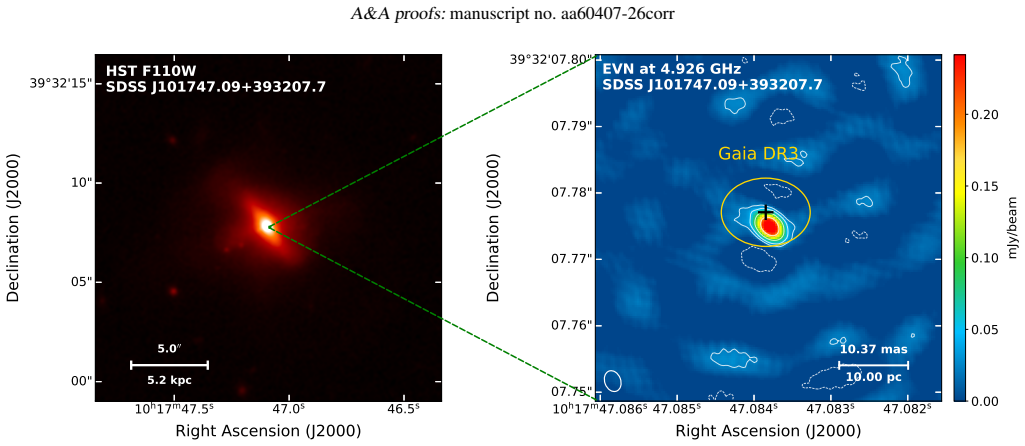
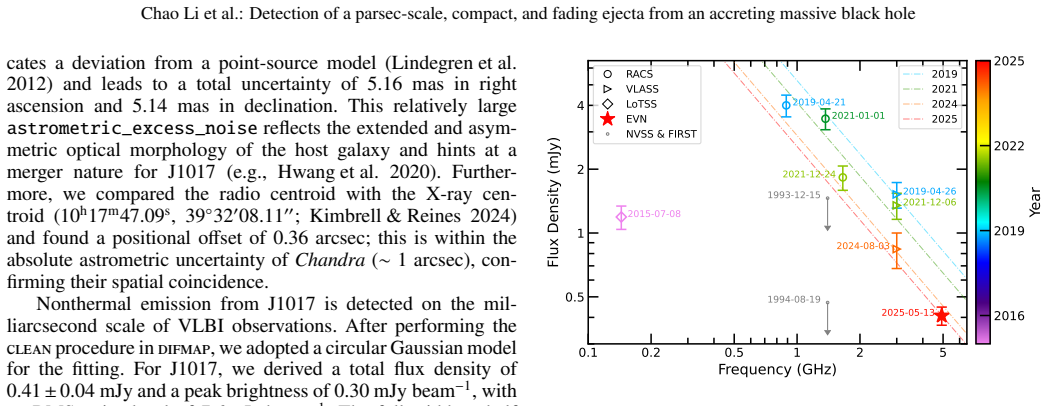
VLBI observations detect a parsec-scale compact radio component near the optical center of a dwarf galaxy that was absent before 2015. The source exhibits a steep radio spectrum and has shown declining flux across multiple frequencies from 2019 to 2025. It is identified as a fading ejecta produced by unstable accretion onto a massive black hole.
What carries the argument
The VLBI-detected milliarcsecond-scale compact radio component, identified through its position, recent appearance, spectral properties, and flux decline as a short-lived ejecta from black hole accretion.
Load-bearing premise
The detected radio component is physically connected to the galaxy's central black hole and is an ejecta from accretion rather than an unrelated background object or different emission process.
What would settle it
If high-resolution imaging shows the radio position is significantly offset from the optical centroid or if the flux stops declining and remains constant, the ejecta interpretation would be challenged.
Figures
read the original abstract
Dwarf galaxies, characterized by their low luminosities and masses, are excellent candidates for searches for intermediate-mass black holes (IMBHs), particularly when they show strong accretion and ejection activity. The dwarf galaxy SDSS J101747.09+393207.7 has recently been found to display a very high X-ray luminosity and an X-shaped optical structure, possibly caused by a dwarf--dwarf merger. To explore its potential IMBH ejection activity, we performed very long baseline interferometry (VLBI) observations at 4.9 GHz. In this work, we present the detection of a milliarcsecond-scale, compact, sub-microjansky radio component near the optical centroid. According to some existing radio sky survey data, the radio component was not detected until 2015; it displayed an optically thin steep radio spectrum and declining flux densities across 0.8--5 GHz from 2019 to 2025. Therefore, we identify it as a short-lived and rarely seen ejecta that was produced by unstable accretion onto a massive black hole and likely faded away in a few decades. These results indicate that short-lived, episodic jet activity from accreting IMBHs in dwarf galaxies might exist.
Editorial analysis
A structured set of objections, weighed in public.
Referee Report
Summary. The manuscript reports a VLBI detection at 4.9 GHz of a compact milliarcsecond-scale radio component near the optical centroid of dwarf galaxy SDSS J101747.09+393207.7. The source was undetected in pre-2015 radio surveys, shows an optically thin steep spectrum, and exhibits declining flux densities from 2019 to 2025; the authors interpret it as a short-lived fading ejecta launched by unstable accretion onto an IMBH, implying episodic jet activity in such systems.
Significance. If the positional association with the optical centroid and the ejecta interpretation are robust, the result would provide rare observational evidence for short-lived, episodic jet activity from accreting IMBHs in dwarf galaxies. The multi-frequency and multi-epoch data offer a concrete example that could be tested with continued monitoring, strengthening the case for transient accretion/ejection in low-mass black holes.
major comments (3)
- [Abstract] Abstract: the radio component is described only as 'near the optical centroid' with no reported angular offset in mas, combined 1-sigma astrometric uncertainties, or chance-alignment probability; this quantification is required to establish physical association rather than a background source.
- [Abstract] Abstract: non-detection 'until 2015' is stated without survey names, frequencies, or flux-density upper limits, so the absence cannot be converted into a quantitative constraint on prior activity or the claimed few-decade fading timescale.
- [Abstract] Abstract: the steep spectrum and flux decline are presented as diagnostic of an ejecta, but no explicit exclusion of alternatives (e.g., background AGN, supernova remnant, or unrelated transient) with quantitative tests is given; the central claim that the source was 'produced by unstable accretion onto a massive black hole' therefore rests on untested assumptions.
minor comments (1)
- [Abstract] Abstract: the phrase 'some existing radio sky survey data' should name the specific surveys and their relevant sensitivities to allow readers to assess the non-detection claim.
Simulated Author's Rebuttal
We thank the referee for the constructive comments on the abstract. We have revised the manuscript to incorporate the requested quantitative details and to make the discussion of alternative interpretations more explicit.
read point-by-point responses
-
Referee: [Abstract] Abstract: the radio component is described only as 'near the optical centroid' with no reported angular offset in mas, combined 1-sigma astrometric uncertainties, or chance-alignment probability; this quantification is required to establish physical association rather than a background source.
Authors: We agree that these quantities belong in the abstract. The body of the manuscript reports the VLBI and optical positions; we have updated the abstract to state the measured angular offset, the combined 1-sigma astrometric uncertainty, and the chance-alignment probability calculated from the surface density of microJy radio sources. revision: yes
-
Referee: [Abstract] Abstract: non-detection 'until 2015' is stated without survey names, frequencies, or flux-density upper limits, so the absence cannot be converted into a quantitative constraint on prior activity or the claimed few-decade fading timescale.
Authors: We accept that naming the surveys and limits improves clarity. We have revised the abstract to identify the specific radio surveys, their frequencies, and the flux-density upper limits that establish the non-detection prior to 2015, thereby quantifying the onset and fading timescale. revision: yes
-
Referee: [Abstract] Abstract: the steep spectrum and flux decline are presented as diagnostic of an ejecta, but no explicit exclusion of alternatives (e.g., background AGN, supernova remnant, or unrelated transient) with quantitative tests is given; the central claim that the source was 'produced by unstable accretion onto a massive black hole' therefore rests on untested assumptions.
Authors: The positional coincidence, transient behavior, steep spectrum, and rapid fading already disfavor a steady background AGN. We nevertheless agree that explicit quantitative tests strengthen the paper. We have added to the abstract and expanded in the discussion section estimates of background source density, comparison of the observed properties and timescale to supernova remnants, and arguments against an unrelated transient, while retaining the IMBH-ejecta interpretation as the most consistent explanation. revision: yes
Circularity Check
No circularity: purely observational detection and interpretation with no derivations or self-referential reductions.
full rationale
The paper reports VLBI detection of a compact radio source, its non-detection in prior surveys, spectral index, and flux decline, then interprets it as a fading ejecta from IMBH accretion. No equations, fitted parameters, predictions, or derivations are present. The central claim rests on direct positional and temporal data rather than any reduction to inputs by construction, self-citation chains, or ansatzes. This matches the default expectation for an observational report; the association with the optical centroid is an interpretive step but does not involve the enumerated circularity patterns.
Axiom & Free-Parameter Ledger
axioms (2)
- domain assumption The detected radio source is physically associated with the optical centroid of the dwarf galaxy
- domain assumption Steep spectrum and declining flux indicate optically thin synchrotron emission from a fading ejecta
Reference graph
Works this paper leans on
-
[1]
A small and vigorous black hole in the early Universe. , keywords =. doi:10.1038/s41586-024-07052-5 , archivePrefix =. 2305.12492 , primaryClass =
-
[2]
A dormant overmassive black hole in the early Universe. , keywords =. doi:10.1038/s41586-024-08210-5 , archivePrefix =. 2403.03872 , primaryClass =
-
[3]
JWST Reveals a Possible z 11 Galaxy Merger in Triply Lensed MACS0647 JD. , keywords =. doi:10.3847/2041-8213/acc94b , archivePrefix =. 2210.14123 , primaryClass =
-
[4]
Low-mass Galaxy Interactions Trigger Black Hole Activity. , keywords =. doi:10.3847/2041-8213/ad5345 , archivePrefix =. 2405.18685 , primaryClass =
-
[5]
Intermediate-Mass Black Holes. , keywords =. doi:10.1146/annurev-astro-032620-021835 , archivePrefix =. 1911.09678 , primaryClass =
work page internal anchor Pith review Pith/arXiv arXiv doi:10.1146/annurev-astro-032620-021835 1911
-
[6]
Hunting for massive black holes in dwarf galaxies. Nature Astronomy , keywords =. doi:10.1038/s41550-021-01556-0 , archivePrefix =. 2201.10569 , primaryClass =
-
[7]
Tripling the Census of Dwarf AGN Candidates Using DESI Early Data. , keywords =. doi:10.3847/1538-4357/adb1dd , archivePrefix =. 2411.00091 , primaryClass =
-
[8]
O Corona, where art thou? eROSITA's view of UV-optical-IR variability-selected massive black holes in low-mass galaxies. , keywords =. doi:10.1051/0004-6361/202347531 , archivePrefix =. 2311.16220 , primaryClass =
-
[9]
Active Dwarf Galaxy Database. I. Overlap between Active Galactic Nuclei Selected by Different Techniques. , keywords =. doi:10.3847/1538-4357/ad5442 , archivePrefix =. 2405.20312 , primaryClass =
-
[10]
Star-Forming Nuclear Clusters in Dwarf Galaxies Mimicking AGN Signatures in the Mid-Infrared. arXiv e-prints , keywords =. doi:10.48550/arXiv.2501.09791 , archivePrefix =. 2501.09791 , primaryClass =
-
[11]
Intermediate-mass black holes: finding of episodic, large-scale, and powerful jet activity in a dwarf galaxy. , keywords =. doi:10.1093/mnras/stad493 , archivePrefix =. 2302.06214 , primaryClass =
-
[12]
The SFXC software correlator for Very Long Baseline Interferometry: Algorithms and Implementation
The SFXC software correlator for very long baseline interferometry: algorithms and implementation. Experimental Astronomy , keywords =. doi:10.1007/s10686-015-9446-1 , archivePrefix =. 1502.00467 , primaryClass =
work page internal anchor Pith review Pith/arXiv arXiv doi:10.1007/s10686-015-9446-1
-
[13]
Information Handling in Astronomy - Historical Vistas , year = 2003, editor =
AIPS, the VLA, and the VLBA. Information Handling in Astronomy - Historical Vistas , year = 2003, editor =. doi:10.1007/0-306-48080-8_7 , adsurl =
-
[14]
Bulletin of the American Astronomical Society , year = 1994, volume =
DIFMAP: an interactive program for synthesis imaging. Bulletin of the American Astronomical Society , year = 1994, volume =
1994
-
[15]
A Luminous X-Ray Active Galactic Nucleus in the Dwarf Dwarf Galaxy Merger RGG 66. , keywords =. doi:10.3847/1538-4357/ad712d , archivePrefix =. 2409.10630 , primaryClass =
-
[16]
Strong radio sources in bright spiral galaxies. II. Rapid star formation and galaxy-galaxy interactions. , keywords =. doi:10.1086/159538 , adsurl =
-
[17]
Summary of the content and survey properties
Gaia Data Release 3. Summary of the content and survey properties. , keywords =. doi:10.1051/0004-6361/202243940 , archivePrefix =. 2208.00211 , primaryClass =
-
[18]
Dwarf Galaxies with Optical Signatures of Active Massive Black Holes
Dwarf Galaxies with Optical Signatures of Active Massive Black Holes. , keywords =. doi:10.1088/0004-637X/775/2/116 , archivePrefix =. 1308.0328 , primaryClass =
work page internal anchor Pith review Pith/arXiv arXiv doi:10.1088/0004-637x/775/2/116
-
[19]
Dwarf Galaxies with Radio-excess Active Galactic Nuclei in the Very Large Array Sky Survey. , keywords =. doi:10.3847/1538-4357/ad9584 , adsurl =
-
[20]
The LOFAR Two-metre Sky Survey. V. Second data release. , keywords =. doi:10.1051/0004-6361/202142484 , archivePrefix =. 2202.11733 , primaryClass =
-
[21]
The Rapid ASKAP Continuum Survey I: Design and first results. , keywords =. doi:10.1017/pasa.2020.41 , archivePrefix =. 2012.00747 , primaryClass =
-
[22]
Publications of the Astronomical Society of Australia , author =
The Rapid ASKAP Continuum Survey Paper II: First Stokes I Source Catalogue Data Release. , keywords =. doi:10.1017/pasa.2021.47 , archivePrefix =. 2109.00956 , primaryClass =
-
[23]
The Rapid ASKAP Continuum Survey (RACS) VI: The RACS-high 1655.5 MHz images and catalogue. , keywords =. doi:10.1017/pasa.2025.2 , archivePrefix =. 2501.04978 , primaryClass =
-
[24]
Jansky Very Large Array Sky Survey (VLASS)
The Karl G. Jansky Very Large Array Sky Survey (VLASS). Science Case and Survey Design. , keywords =. doi:10.1088/1538-3873/ab63eb , archivePrefix =. 1907.01981 , primaryClass =
-
[25]
On the origin of radio emission in radio-quiet quasars. , keywords =. doi:10.1111/j.1365-2966.2008.13806.x , archivePrefix =. 0808.0637 , primaryClass =
-
[26]
A Fundamental Plane of black hole activity. , keywords =. doi:10.1046/j.1365-2966.2003.07017.x , archivePrefix =. astro-ph/0305261 , primaryClass =
-
[27]
Intermediate-mass black holes and the Fundamental Plane of black hole accretion. , keywords =. doi:10.1093/mnras/stac2608 , archivePrefix =. 2209.09890 , primaryClass =
-
[28]
Radio Observations of Four Active Galactic Nuclei Hosting Intermediate-mass Black Hole Candidates: Studying the Outflow Activity and Evolution. , keywords =. doi:10.3847/1538-4357/ac9e9d , archivePrefix =. 2211.00050 , primaryClass =
-
[29]
15-GHz radio emission from nearby low-luminosity active galactic nuclei
15-GHz radio emission from nearby low-luminosity active galactic nuclei. , keywords =. doi:10.1051/0004-6361/201833233 , archivePrefix =. 1805.06696 , primaryClass =
work page internal anchor Pith review Pith/arXiv arXiv doi:10.1051/0004-6361/201833233
-
[30]
Is there a sub-parsec-scale jet base in the nearby dwarf galaxy NGC 4395?. , keywords =. doi:10.1093/mnras/stac1753 , archivePrefix =. 2206.10964 , primaryClass =
-
[31]
The Intermediate-mass Black Hole Candidate in the Center of NGC 404: New Evidence from Radio Continuum Observations. , keywords =. doi:10.1088/0004-637X/753/2/103 , archivePrefix =. 1204.3089 , primaryClass =
work page internal anchor Pith review Pith/arXiv arXiv doi:10.1088/0004-637x/753/2/103
-
[32]
Probing the Active Massive Black Hole Candidate in the Center of NGC 404 with VLBI
Probing the Active Massive Black Hole Candidate in the Center of NGC 404 with VLBI. , keywords =. doi:10.1088/0004-637X/791/1/2 , archivePrefix =. 1406.4752 , primaryClass =
work page internal anchor Pith review Pith/arXiv arXiv doi:10.1088/0004-637x/791/1/2
-
[33]
The NRAO VLA Sky Survey. , keywords =. doi:10.1086/300337 , adsurl =
-
[34]
The FIRST Survey: Faint Images of the Radio Sky at Twenty Centimeters. , keywords =. doi:10.1086/176166 , adsurl =
-
[35]
First Detection of Radio Emission from the Intermediate-mass Black Hole in POX 52: Deep Multiband Observations with ATCA and VLA. , keywords =. doi:10.3847/1538-4357/ada946 , archivePrefix =. 2412.03316 , primaryClass =
-
[36]
A scheme to unify low-power accreting black holes. Jet-dominated accretion flows and the radio/X-ray correlation. , keywords =. doi:10.1051/0004-6361:20031683 , archivePrefix =. astro-ph/0305335 , primaryClass =
work page internal anchor Pith review Pith/arXiv arXiv doi:10.1051/0004-6361:20031683
-
[37]
The M-sigma and M-L Relations in Galactic Bulges and Determinations of their Intrinsic Scatter
The M- and M-L Relations in Galactic Bulges, and Determinations of Their Intrinsic Scatter. , keywords =. doi:10.1088/0004-637X/698/1/198 , archivePrefix =. 0903.4897 , primaryClass =
work page internal anchor Pith review Pith/arXiv arXiv doi:10.1088/0004-637x/698/1/198
-
[38]
Radio emission as a test of the existence of intermediate-mass black holes in globular clusters and dwarf spheroidal galaxies. , keywords =. doi:10.1111/j.1365-2966.2004.07859.x , archivePrefix =. astro-ph/0403530 , primaryClass =
-
[39]
The Diverse Morphologies and Structures of Dwarf Galaxies Hosting Optically Selected Active Massive Black Holes. , keywords =. doi:10.3847/1538-4357/abec40 , archivePrefix =. 2103.06289 , primaryClass =
-
[40]
Calibrating Extinction-Free Star Formation Rate Diagnostics with 33GHz Free-Free Emission in NGC6946
Calibrating Extinction-free Star Formation Rate Diagnostics with 33 GHz Free-free Emission in NGC 6946. , keywords =. doi:10.1088/0004-637X/737/2/67 , archivePrefix =. 1105.4877 , primaryClass =
work page internal anchor Pith review Pith/arXiv arXiv doi:10.1088/0004-637x/737/2/67
-
[41]
The Gaia mission. , keywords =. doi:10.1051/0004-6361/201629272 , archivePrefix =. 1609.04153 , primaryClass =
work page internal anchor Pith review Pith/arXiv arXiv doi:10.1051/0004-6361/201629272
-
[42]
Radio Emission from Supernovae and Gamma-Ray Bursters. , keywords =. doi:10.1146/annurev.astro.40.060401.093744 , adsurl =
-
[43]
A survey for transients and variables with the Murchison Widefield Array 32-tile prototype at 154 MHz. , keywords =. doi:10.1093/mnras/stt2200 , archivePrefix =. 1311.2989 , primaryClass =
work page internal anchor Pith review Pith/arXiv arXiv doi:10.1093/mnras/stt2200
-
[44]
The Rapid ASKAP Continuum Survey IV: continuum imaging at 1367.5 MHz and the first data release of RACS-mid. , keywords =. doi:10.1017/pasa.2023.31 , archivePrefix =. 2306.07194 , primaryClass =
-
[45]
The Rapid ASKAP Continuum Survey V: Cataloguing the sky at 1 367.5 MHz and the second data release of RACS-mid. , keywords =. doi:10.1017/pasa.2023.60 , archivePrefix =. 2311.12369 , primaryClass =
-
[46]
Radio Scrutiny of the X-Ray-weak Tail of Low-mass Active Galactic Nuclei: A Novel Signature of High-Eddington Accretion?. , keywords =. doi:10.3847/1538-4357/ad67d1 , archivePrefix =. 2404.02423 , primaryClass =
-
[47]
Compact steep-spectrum and peaked-spectrum radio sources. , keywords =. doi:10.1007/s00159-021-00131-w , archivePrefix =. 2009.02750 , primaryClass =
-
[48]
Formation and destruction of jets in X-ray binaries. , keywords =. doi:10.1051/0004-6361/201117052 , adsurl =
-
[49]
title Supermassive Black Holes in X-Rays: From Standard Accretion to Extreme Transients
Supermassive Black Holes in X-Rays: From Standard Accretion to Extreme Transients. , keywords =. doi:10.1146/annurev-astro-071221-052844 , archivePrefix =. 2503.22791 , primaryClass =
-
[50]
The powerful jet of an off-nuclear intermediate-mass black hole in the spiral galaxy NGC 2276
The powerful jet of an off-nuclear intermediate-mass black hole in the spiral galaxy NGC 2276. , keywords =. doi:10.1093/mnras/stv143 , archivePrefix =. 1501.04897 , primaryClass =
work page internal anchor Pith review Pith/arXiv arXiv doi:10.1093/mnras/stv143
-
[51]
The Nature of the IMBH Candidate CXO J133815.6+043255: High-frequency Radio Emission. , keywords =. doi:10.3847/1538-4357/acf4f8 , archivePrefix =. 2309.00051 , primaryClass =
-
[52]
Compact jets dominate the continuum emission in low-luminosity active galactic nuclei. , keywords =. doi:10.1051/0004-6361/202243547 , archivePrefix =. 2211.09828 , primaryClass =
-
[53]
A compact core-jet structure in the changing-look Seyfert NGC 2617. , keywords =. doi:10.1093/mnras/stab706 , archivePrefix =. 2103.04309 , primaryClass =
-
[54]
A unified model for AGN feedback in cosmological simulations of structure formation. , keywords =. doi:10.1111/j.1365-2966.2007.12153.x , archivePrefix =. 0705.2238 , primaryClass =
-
[55]
The X-ray and Radio Connection in Low-luminosity Active Nuclei
The X-ray and radio connection in low-luminosity active nuclei. , keywords =. doi:10.1051/0004-6361:20066943 , archivePrefix =. astro-ph/0701546 , primaryClass =
work page internal anchor Pith review Pith/arXiv arXiv doi:10.1051/0004-6361:20066943
-
[56]
Chandra Snapshot Observations of Low-Luminosity AGNs with a Compact Radio Source
Chandra Snapshot Observations of Low-Luminosity Active Galactic Nuclei with a Compact Radio Source. , keywords =. doi:10.1086/345339 , archivePrefix =. astro-ph/0209607 , primaryClass =
work page internal anchor Pith review Pith/arXiv arXiv doi:10.1086/345339
-
[57]
The astrometric core solution for the Gaia mission. Overview of models, algorithms, and software implementation. , keywords =. doi:10.1051/0004-6361/201117905 , archivePrefix =. 1112.4139 , primaryClass =
work page internal anchor Pith review Pith/arXiv arXiv doi:10.1051/0004-6361/201117905
-
[58]
Varstrometry for Off-nucleus and Dual Subkiloparsec AGN (VODKA): Methodology and Initial Results with Gaia DR2. , keywords =. doi:10.3847/1538-4357/ab5c1a , archivePrefix =. 1908.02292 , primaryClass =
-
[59]
Multiwavelength Monitoring of the Dwarf Seyfert 1 Galaxy NGC 4395. I. A Reverberation-based Measurement of the Black Hole Mass. , keywords =. doi:10.1086/444494 , archivePrefix =. astro-ph/0506665 , primaryClass =
work page internal anchor Pith review Pith/arXiv arXiv doi:10.1086/444494
-
[60]
A 10,000-solar-mass black hole in the nucleus of a bulgeless dwarf galaxy
A 10,000-solar-mass black hole in the nucleus of a bulgeless dwarf galaxy. Nature Astronomy , keywords =. doi:10.1038/s41550-019-0790-3 , archivePrefix =. 1905.00145 , primaryClass =
work page internal anchor Pith review Pith/arXiv arXiv doi:10.1038/s41550-019-0790-3 1905
-
[61]
The Intermediate-Mass Black Hole Reverberation Mapping Project: Stable Optical Continuum Lags of an IMBH in the Dwarf Galaxy NGC 4395 Over Years. arXiv e-prints , keywords =. doi:10.48550/arXiv.2601.14787 , archivePrefix =. 2601.14787 , primaryClass =
work page internal anchor Pith review Pith/arXiv arXiv doi:10.48550/arxiv.2601.14787
-
[62]
Observational appearance
Black holes in binary systems. Observational appearance. , year = 1973, month = jan, volume =
1973
-
[63]
Radiatively Inefficient Accretion in Nearby Galaxies
Radiatively Inefficient Accretion in Nearby Galaxies. , keywords =. doi:10.1088/0004-637X/699/1/626 , archivePrefix =. 0906.4104 , primaryClass =
work page internal anchor Pith review Pith/arXiv arXiv doi:10.1088/0004-637x/699/1/626
-
[64]
Radio Activity of Supermassive Black Holes with Extremely High Accretion Rates. , keywords =. doi:10.3847/1538-4357/abb775 , archivePrefix =. 2007.11327 , primaryClass =
-
[65]
Radio spectra of narrow-line Seyfert 1 galaxies observed with Australia Telescope Compact Array and Very Large Array Sky Survey. , keywords =. doi:10.1093/mnras/stac530 , archivePrefix =. 2202.11065 , primaryClass =
-
[66]
emcee: The MCMC Hammer. , keywords =. doi:10.1086/670067 , archivePrefix =. 1202.3665 , primaryClass =
work page internal anchor Pith review Pith/arXiv arXiv doi:10.1086/670067
-
[67]
, year = 1966, month = sep, volume =
A Model for Variable Extragalactic Radio Sources. , year = 1966, month = sep, volume =. doi:10.1038/2111131a0 , adsurl =
-
[68]
A Critical Evaluation of the Physical Nature of the Little Red Dots. arXiv e-prints , keywords =. doi:10.48550/arXiv.2512.03130 , archivePrefix =. 2512.03130 , primaryClass =
-
[69]
Radio Emission on Sub-Parsec Scales from the Intermediate-Mass Black Hole in NGC 4395
Radio Emission on Subparsec Scales from the Intermediate-Mass Black Hole in NGC 4395. , keywords =. doi:10.1086/507102 , archivePrefix =. astro-ph/0606600 , primaryClass =
work page internal anchor Pith review Pith/arXiv arXiv doi:10.1086/507102
-
[70]
LOFAR: The LOw-Frequency ARray
LOFAR: The LOw-Frequency ARray. , keywords =. doi:10.1051/0004-6361/201220873 , archivePrefix =. 1305.3550 , primaryClass =
work page internal anchor Pith review Pith/arXiv arXiv doi:10.1051/0004-6361/201220873
-
[71]
Towards a unified model for black hole X-ray binary jets. , keywords =. doi:10.1111/j.1365-2966.2004.08384.x , archivePrefix =. astro-ph/0409360 , primaryClass =
-
[72]
A New Sample of (Wandering) Massive Black Holes in Dwarf Galaxies from High-resolution Radio Observations. , keywords =. doi:10.3847/1538-4357/ab4999 , archivePrefix =. 1909.04670 , primaryClass =
discussion (0)
Sign in with ORCID, Apple, or X to comment. Anyone can read and Pith papers without signing in.