REVIEW 3 major objections 5 minor 44 references
Automata-Conditioned Cooperative Multi-Agent Reinforcement Learning
T0 review · 3 major / 5 minor · reviewed 2026-08-04 · deepseek-v4-flash
Pith's one-line read By feeding each agent the minimized automaton remaining for every task, the paper turns a non-Markovian cooperative planning problem into a Markovian game and proves the reformulation is optimal in the infinite-horizon limit.
desk verdict Solid empirical framework for automata-conditioned MARL, but the optimality proof for reward shaping has a real gap. read the letter →
The pith
A machine-rendered reading of the paper's core claim, the machinery that carries it, and where it could break.
The reading
What carries the argument
The load-bearing construction is the product DFA space D^n with the progression operation A/σ, which maps a vector of assigned DFAs to a vector of minimized residual DFAs after reading the latest labels. This turns the non-Markovian history-tracking problem into an MDP over (state, DFA-vector) pairs. Carrying the argument are: (i) the potential-based shaped reward R_D^n + γΦ_i(T)−Φ_i for each agent, where Φ_i=1 exactly when agent i's residual DFA is trivially accepting; (ii) RAD embeddings, a pretrained encoder Ψ that is injective up to DFA minimization, so the MDP can be compressed to a latent product space Z^n without changing rewards or transitions; and (iii) the induced value function V(
What would settle it
Take a two-agent grid world where one agent's sub-task is reachable by a shortcut that permanently blocks the other agent's path; train with the shaped reward and with the sparse team reward, and check whether the shaped policy converges to the same success probability as the sparse policy as γ→1. Alternatively, evaluate the term γ^T Φ(s_T) − Φ(s_0) under two policies with identical team-success probability but different completion times; if the shaped return differs, the shaping is not policy-invariant and Theorem 1 does not extend to the shaped reward.
Extended reading notes
Core claim
The central claim is Theorem 1: for a Markov game with n agents and n DFAs drawn from a prior, the joint policy that maximizes the discounted expected reward of the Markovian product game, where each agent observes its current minimized DFA progression, is also optimal for the original problem of maximizing the probability that all agents' traces satisfy their assigned DFAs, in the limit as the discount factor approaches 1. The paper further claims that this remains true after applying potential-based reward shaping with per-agent potential functions that fire when an individual DFA becomes accepting, and that using pretrained, provably correct RAD embeddings in place of the DFAs themselves
Load-bearing premise
The argument that potential-based reward shaping preserves optimality in this multi-agent episodic setting is inherited from the single-agent, zero-terminal-potential theorem in reference [5]; here the terminal potential is nonzero—an agent completing its own DFA receives 1—so the telescoping term γ^T Φ(s_T) − Φ(s_0) is policy-dependent, and the paper provides no proof that the shaped objective has the same optima as the original team-success objective.
Editorial extensions
If this is right
- In the γ→1 limit, training on the shaped Markovian objective is equivalent to training on the sparse team-success objective, so the framework inherits optimality with respect to the ACC-MARL problem.
- Because RAD embeddings uniquely represent minimized DFAs, policies trained on them can be reused across task classes; experiments show generalization to Reach and ReachAvoid tasks and to out-of-distribution DFAs with up to 10 states.
- Learned value functions rank task assignments, so at test time the team can enumerate permutations and pick a Pareto-optimal assignment, improving success probability in asymmetric environments like Rooms.
- The ablation results show that either removing reward shaping or learning embeddings from scratch degrades performance, particularly in four-agent settings, identifying the two ingredients as necessary for feasibility.
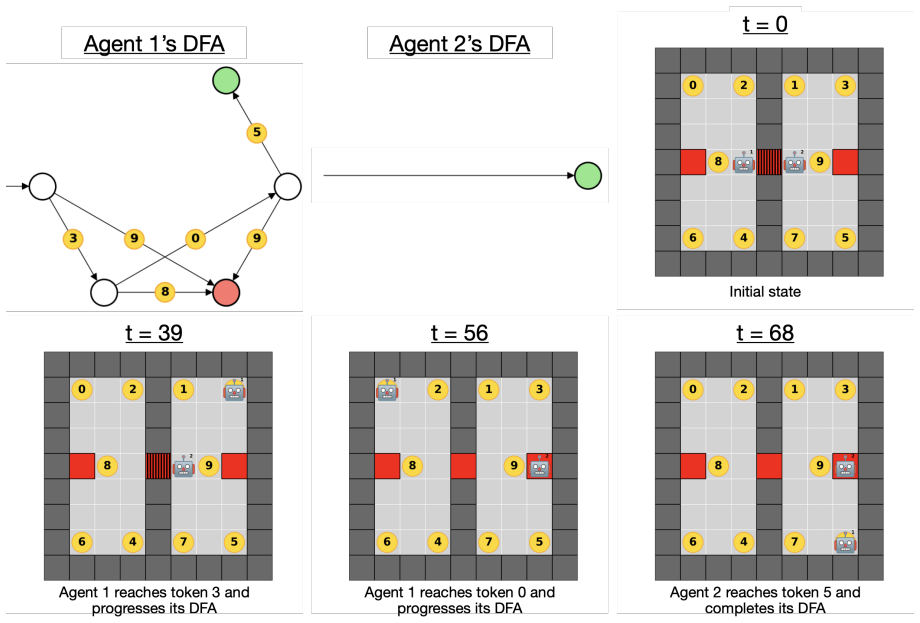
- The framework produces emergent cooperative behaviors—button-pressing to unlock doors, door-holding, and task short-circuiting—that are not explicitly rewarded beyond the shaped sub-task signal.
Reading between the lines
- The progression-based Markovian trick is not limited to DFAs; it should transfer to reward machines, LTL, or any automaton with a progression operation, potentially giving a unified treatment for symbolic multi-agent RL.
- A natural testable extension is to use the same value functions to reassign tasks mid-episode, not just at the start; the paper leaves this unexplored, but the framework's state already contains all residual DFAs.
- The optimal-assignment argument relies on full observability and enumeration; for larger teams, the RAD embedding space could be searched directly, which the paper itself notes as future work.
- If the shaping preservation fails in the multi-agent case (see weakest assumption), the practical gains might still hold but the optimality guarantee would break; a direct test would be to compute shaped versus unshaped returns in a small grid world.
Editorial analysis
A structured set of objections, weighed in public.
Referee Report
Summary. The paper proposes ACC-MARL, a framework for multi-task cooperative multi-agent reinforcement learning with tasks specified as deterministic finite automata (DFAs). The authors identify three challenges — history dependency, sparse team reward, and a representation bottleneck — and propose three corresponding remedies: (i) a Markovian reformulation in which agents observe the current minimal DFA of every agent's task; (ii) per-agent potential-based reward shaping designed to densify the team reward; and (iii) the use of pretrained RAD embeddings for DFA representations. The paper gives a formal problem statement (Problem 1), proves a Theorem 1 that the Markovian reformulation is asymptotically optimal as the discount factor tends to 1, asserts that the reward shaping preserves optimality, asserts that RAD embeddings carry over to a modified encoder, and proposes using learned value functions for optimal task assignment at test time. Experiments on Button and Room environments with two and four agents are reported, including ablations and a qualitative analysis of coordinated behaviors.
Significance. If the theoretical claims were correct, the paper would make a useful contribution to multi-agent RL with symbolic temporal specifications: it would provide a principled way to convert a non-Markovian team task into a Markovian one, a dense reward that provably does not change the optimal policy, and a scalable latent representation for DFA-conditioned policies. The empirical results, particularly the four-agent experiments and the qualitative demonstrations of door-holding and short-circuiting, are suggestive and the code release (DFAx, ACC-MARL) is a practical asset. The main source of value is the combination of a formal framework with a working implementation. However, the formal claims are currently under-supported, and one of them — the optimality of the shaped reward — is undermined by a standard and well-known failure mode of potential-based shaping with nonzero terminal potentials.
major comments (3)
- [Section 3.4, Eq. (7) and Appendix B.4] The claim that the per-agent shaped reward preserves optimality is not correct for the given potential. Summing the shaping term over an episode gives γ^T Φ_i(A_T) − Φ_i(A_0), and since terminal states of the product DFA space include all-trivial vectors, an agent whose task is satisfied has Φ_i(A_T)=1. Thus the shaped return differs from the original return by a policy-dependent quantity that rewards both faster completion and the agent's own success rather than team success. For example, a helper agent whose DFA is initially A_top receives −(1−γ) at every nonterminal step, penalizing longer episodes even when they are necessary for team success. The cited result [5] is for a common potential and, in the general case, assumes zero (or asymptotically vanishing) terminal potential. This is a load-bearing error: the proof that ACC-MARL solves Problem 1 relies on this step. The authors must
- [Section 3.5] The paper asserts that the RAD encoder Ψ satisfies the injectivity condition (7), and then uses this condition to claim that the latent-space reformulation over Z^n is equivalent to the DFA-space reformulation. However, the actual encoder is a modified GATv2 with a different featurization: DFA transitions are treated as edges rather than nodes, and the update rule (Appendix B.4) differs from the architecture in the cited works. No proof or reference is provided that this modified encoder preserves injectivity up to DFA minimization. Since the optimality of the π'' policies depends on this equivalence, the assertion is load-bearing. The authors should either supply a theorem for the new architecture, reduce it to the earlier results with explicit conditions, or state the injectivity as an assumption and verify it empirically.
- [Appendix B.1] The statement that the value-based assignment A★ maximizes the team success probability is not established. The functions V_i are the value functions of policies trained on the shaped objective, which (even ignoring the first concern) are not guaranteed to be optimal for Problem 1. Maximizing a sum of per-agent value functions over assignments does not imply maximizing the joint success probability; a Pareto-optimal point with respect to per-agent values is not necessarily one that maximizes J(π). The formal inequality asserted for all A′ in perm(A) needs a proof. As stated, this is an unsupported theoretical claim, although the experimental results in Rooms-2/Rooms-4 provide some empirical support.
minor comments (5)
- [Appendix B.1] The proof of Theorem 1 interchanges the limit γ→1− with the maximization over policies. Since episodes can in principle be unbounded and the objective is a discounted sum, the authors should justify this interchange (e.g., by bounded rewards and a properness condition) or state the result under an explicit finite-horizon/absorbing assumption.
- [Section 3.3] The paper uses 'potential-based reward shaping' and cites [5] without noting that the standard policy-invariance result applies to the sum of shaping terms over infinite horizons or with zero terminal potential. The text should be explicit about the terminal potential issue, even if a fix is adopted.
- [Section 4.2] Helper agents (trivially accepting DFAs) are sampled with positive probability. With the current shaping potential, these agents receive a negative reward at each step before termination. This artifact is not mentioned and can affect learning. Rewriting the potential as suggested would also eliminate this artifact.
- [Section 3.2] In Eq. (5), the terminal condition includes A_{t+1}∈D_T^n, but the reward R_D^n only fires when the vector equals A_top. It may be useful to distinguish all-trivial states with some rejecting entries from the all-accepting state; the current notation is slightly ambiguous.
- [Table 1] The table formatting is dense; the distinction between random and optimal assignment results is not as clear as it could be. Consider using separate rows or a clearer header.
Circularity Check
No by-construction circularity: the central Markovian reformulation theorem is proved directly; the main caveats are unproven imported optimality claims, not input-output equivalences.
full rationale
The paper's central derivation, Theorem 1, is an explicit equivalence proof (App. B.1) that constructs a history-to-state mapping and verifies matching rewards and transition probabilities; it does not assume the conclusion. The PBRS claim in Sec. 3.3 is imported from [5] and is a potential correctness gap because the per-agent potentials can be nonzero at terminal states, so the usual policy-invariance telescoping argument does not automatically apply; but this is an unsupported theorem transfer, not a reduction of the output to the input. Similarly, Sec. 3.4 imports Eq. (7) from the authors' prior [36,37] and applies it to a modified edge-featurized GATv2 encoder described in App. B.4 without re-proof; this is a self-citation with a missing verification step, but the central reformulation and the empirical ablations stand independently. The task-assignment section uses learned value functions as a heuristic proxy; it is underproved but not definitionally circular. Overall, no step in the paper equates its conclusion with its assumptions by construction, so circularity is minor at most.
Assumptions & free parameters
free parameters (4)
- Discount factor γ =
0.99
- Max states in training DFA prior =
5 states (10 for OOD and pretraining)
- Entropy coefficient =
0.02 (2-agent), 0.05 (4-agent)
- Shaping potential Φ_i =
1 if A[i]=A_top else 0
assumptions (7)
- domain assumption All tasks are plan DFAs, i.e., accepting states are sink states.
- domain assumption The product game M|_L M_D^n is Markovian and its optimal policy coincides with Problem 1 as γ→1.
- ad hoc to paper PBRS with per-agent potentials preserves team-optimality in episodic multi-agent games with nonzero terminal potentials.
- ad hoc to paper RAD embeddings Ψ satisfy Eq. (7): minimized DFAs are equal iff embeddings are equal, for all DFAs in the induced space, with the modified edge-featurized GATv2.
- domain assumption Labeling functions L_i are known, static, and partition each agent's observation space into alphabet symbols.
- domain assumption IPPO in the independent-learning setting converges to a near-optimal joint policy.
- standard math DFA minimization returns a unique canonical representative (minimize(A)).
Cite this review
Pith. "Pith review of Automata-Conditioned Cooperative Multi-Agent Reinforcement Learning." pith.science (2026). https://pith.science/paper/JVV5I46Q
@misc{pith2026251102304,
  author       = {Pith},
  title        = {Pith review of: Automata-Conditioned Cooperative Multi-Agent Reinforcement Learning},
  year         = {2026},
  howpublished = {\url{https://pith.science/paper/JVV5I46Q}},
  note         = {Machine review of arXiv:2511.02304}
}
read the original abstract
We study learning multi-task, multi-agent policies for cooperative, temporal objectives, under centralized training, decentralized execution. In this setting, using automata to represent tasks assigned to agents enables breaking down a team-level objective into simpler, smaller sub-tasks. However, existing approaches remain sample-inefficient and are limited to the single-task case, requiring retraining policies for each new task. In this work, we present Automata-Conditioned Cooperative Multi-Agent Reinforcement Learning (ACC-MARL), a framework for learning task-conditioned, decentralized team policies. We identify challenges to the feasibility of ACC-MARL, propose solutions, and prove that our approach is optimal. We further show that learned value functions can be used to assign tasks optimally at test time. Experiments demonstrate emergent task-aware, multi-step coordination among agents, such as pressing a button to unlock a door, holding the door, and short-circuiting tasks.
Figures


Figures from the paper (11 more)



Reference graph
Works this paper leans on
-
[5]
Sam Devlin and Daniel Kudenko. 2011. Theoretical considerations of potential- based reward shaping for multi-agent systems. InInternational Conference on Autonomous Agents and Multiagent Systems. 225–232
2011
-
[1]
Adrian K Agogino and Kagan Tumer. 2004. Unifying temporal and structural credit assignment problems. InInternational Conference on Autonomous Agents and Multiagent Systems
2004
-
[2]
2018.JAX: composable transformations of Python+NumPy programs
James Bradbury, Roy Frostig, Peter Hawkins, Matthew James Johnson, Chris Leary, Dougal Maclaurin, George Necula, Adam Paszke, Jake VanderPlas, Skye Wanderman-Milne, and Qiao Zhang. 2018.JAX: composable transformations of Python+NumPy programs. http://github.com/jax-ml/jax
2018
-
[3]
Shaked Brody, Uri Alon, and Eran Yahav. 2021. How attentive are graph attention networks?arXiv preprint arXiv:2105.14491(2021)
arXiv 2021
-
[4]
Christian Schroeder De Witt, Tarun Gupta, Denys Makoviichuk, Viktor Makoviy- chuk, Philip HS Torr, Mingfei Sun, and Shimon Whiteson. 2020. Is independent learning all you need in the starcraft multi-agent challenge?arXiv preprint arXiv:2011.09533(2020)
arXiv 2020
-
[6]
Zijian Guo, İlker Işık, HM Ahmad, and Wenchao Li. 2025. One Subgoal at a Time: Zero-Shot Generalization to Arbitrary Linear Temporal Logic Requirements in Multi-Task Reinforcement Learning.arXiv preprint arXiv:2508.01561(2025)
arXiv 2025
-
[7]
Mohammadhosein Hasanbeig, Daniel Kroening, and Alessandro Abate. 2020. Deep reinforcement learning with temporal logics. InInternational Conference on Formal Modeling and Analysis of Timed Systems. Springer, 1–22
2020
-
[8]
John Hopcroft. 1971. An n log n algorithm for minimizing states in a finite automaton. InTheory of machines and computations. Elsevier, 189–196
1971
Show all 44 references
-
[9]
Siyi Hu, Fengda Zhu, Xiaojun Chang, and Xiaodan Liang. 2021. Updet: Universal multi-agent reinforcement learning via policy decoupling with transformers. arXiv preprint arXiv:2101.08001(2021)
2021 arXiv
-
[10]
Shariq Iqbal, Robby Costales, and Fei Sha. 2022. ALMA: Hierarchical Learning for Composite Multi-Agent Tasks. InAdvances in Neural Information Processing Systems, Vol. 35. 7155–7166. https://proceedings.neurips.cc/paper_files/paper/ 2022/file/2f27964513a28d034530bfdd117ea31d-P...
2022
-
[11]
Shariq Iqbal, Christian A Schroeder De Witt, Bei Peng, Wendelin Böhmer, Shimon Whiteson, and Fei Sha. 2021. Randomized entity-wise factorization for multi- agent reinforcement learning. InInternational Conference on Machine Learning. 4596–4606
2021
-
[12]
Mathias Jackermeier and Alessandro Abate. 2024. DeepLTL: Learning to Effi- ciently Satisfy Complex LTL Specifications for Multi-Task RL.arXiv preprint arXiv:2410.04631(2024)
2024 arXiv
-
[13]
Kishor Jothimurugan, Rajeev Alur, and Osbert Bastani. 2019. A composable specification language for reinforcement learning tasks.Advances in Neural Information Processing Systems32 (2019)
2019
-
[14]
Kishor Jothimurugan, Suguman Bansal, Osbert Bastani, and Rajeev Alur. 2021. Compositional reinforcement learning from logical specifications.Advances in Neural Information Processing Systems34 (2021), 10026–10039
2021
-
[15]
Mohammad Karimadini, Hai Lin, and Ali Karimoddini. 2016. Cooperative tasking for deterministic specification automata.Asian Journal of Control18, 6 (2016), 2078–2087
2016
-
[16]
Xianglong Li, Yuan Li, Jieyuan Zhang, Xinhai Xu, and Donghong Liu. 2024. A hierarchical multi-agent allocation-action learning framework for multi-subtask games.Complex & Intelligent Systems10, 2 (2024), 1985–1995
2024
-
[17]
Chris Lu, Jakub Kuba, Alistair Letcher, Luke Metz, Christian Schroeder de Witt, and Jakob Foerster. 2022. Discovered policy optimisation.Advances in Neural Information Processing Systems35 (2022), 16455–16468
2022
-
[18]
Yuxiang Mai, Yifan Zang, Qiyue Yin, Wancheng Ni, and Kaiqi Huang. 2023. Deep Multitask Multiagent Reinforcement Learning With Knowledge Transfer.IEEE Transactions on Games16, 3 (2023), 566–576
2023
-
[19]
Jan Martens and Anton Wijs. 2024. An Evaluation of Massively Parallel Algo- rithms for DFA Minimization.arXiv preprint arXiv:2410.22764(2024)
2024 arXiv
-
[20]
Kanefumi Matsuyama, Kefan Su, Jiangxing Wang, Deheng Ye, and Zongqing Lu. 2025. CORD: Generalizable Cooperation via Role Diversity.arXiv preprint arXiv:2501.02221(2025)
2025 arXiv
-
[21]
Cyrus Neary, Zhe Xu, Bo Wu, and Ufuk Topcu. 2020. Reward machines for cooperative multi-agent reinforcement learning.arXiv preprint arXiv:2007.01962 (2020)
2020 arXiv
-
[22]
Andrew Y Ng, Daishi Harada, and Stuart Russell. 1999. Policy Invariance Un- der Reward Transformations: Theory and Application to Reward Shaping. In International Conference on Machine Learning. 278—-287
1999
-
[23]
Shayegan Omidshafiei, Jason Pazis, Christopher Amato, Jonathan P How, and John Vian. 2017. Deep decentralized multi-task multi-agent reinforcement learn- ing under partial observability. InInternational Conference on Machine Learning. PMLR, 2681–2690
2017
-
[24]
Wenjie Qiu, Wensen Mao, and He Zhu. 2023. Instructing goal-conditioned reinforcement learning agents with temporal logic objectives.Advances in Neural Information Processing Systems36 (2023), 39147–39175
2023
-
[25]
Alexander Rutherford, Benjamin Ellis, Matteo Gallici, Jonathan Cook, Andrei Lupu, Garðar Ingvarsson Juto, Timon Willi, Ravi Hammond, Akbir Khan, Chris- tian Schroeder de Witt, et al. 2024. Jaxmarl: Multi-agent rl environments and algorithms in jax.Advances in Neural Informatio...
2024
-
[26]
Philipp Schillinger, Mathias Bürger, and Dimos V Dimarogonas. 2018. Decompo- sition of finite LTL specifications for efficient multi-agent planning. InDistributed Autonomous Robotic Systems: The 13th International Symposium. Springer, 253– 267
2018
-
[27]
Philipp Schillinger, Mathias Bürger, and Dimos V Dimarogonas. 2018. Simulta- neous task allocation and planning for temporal logic goals in heterogeneous multi-robot systems.The international journal of robotics research37, 7 (2018), 818–838
2018
-
[28]
Ameesh Shah, Niklas Lauffer, Thomas Chen, Nikhil Pitta, and Sanjit A Seshia
-
[29]
Ameesh Shah, Cameron Voloshin, Chenxi Yang, Abhinav Verma, Swarat Chaud- huri, and Sanjit A. Seshia. 2025. LTL-Constrained Policy Optimization with Cycle Experience Replay.Transactions on Machine Learning Research(2025)
2025
-
[30]
Sophia Smith, Cyrus Neary, and Ufuk Topcu. 2023. Automatic Decomposition of Reward Machines for Decentralized Multiagent Reinforcement Learning. In IEEE Conference on Decision and Control (CDC). 5423–5430
2023
-
[31]
Klassen, Richard Valenzano, and Sheila A
Rodrigo Toro Icarte, Toryn Q. Klassen, Richard Valenzano, and Sheila A. McIlraith
-
[32]
Pashootan Vaezipoor, Andrew C Li, Rodrigo A Toro Icarte, and Sheila A Mcil- raith. 2021. LTL2Action: Generalizing LTL instructions for multi-task RL. In International Conference on Machine Learning. 10497–10508
2021
-
[33]
Cameron Voloshin, Abhinav Verma, and Yisong Yue. 2023. Eventual Dis- counting Temporal Logic Counterfactual Experience Replay.arXiv preprint arXiv:2303.02135(2023)
2023 arXiv
-
[34]
Tonghan Wang, Tarun Gupta, Anuj Mahajan, Bei Peng, Shimon Whiteson, and Chongjie Zhang. 2021. {RODE}: Learning Roles to Decompose Multi-Agent Tasks. InInternational Conference on Learning Representations. https://openreview.net/ forum?id=TTUVg6vkNjK
2021
-
[35]
Beyazit Yalcinkaya, Niklas Lauffer, Marcell Vazquez-Chanlatte, and Sanjit Seshia
-
[36]
Beyazit Yalcinkaya, Niklas Lauffer, Marcell Vazquez-Chanlatte, and Sanjit A Seshia. 2024. Compositional Automata Embeddings for Goal-Conditioned Rein- forcement Learning. InNeural Information Processing Systems, Vol. 38
2024
-
[37]
Beyazit Yalcinkaya, Niklas Lauffer, Marcell Vazquez-Chanlatte, and Sanjit A Seshia. 2025. Provably Correct Automata Embeddings for Optimal Automata- Conditioned Reinforcement Learning. InProceedings of the International Confer- ence on Neuro-symbolic Systems. 661–675
2025
-
[38]
Yang Yu, Qiyue Yin, Junge Zhang, and Kaiqi Huang. 2023. Prioritized tasks mining for multi-task cooperative multi-agent reinforcement learning. InInternational Conference on Autonomous Agents and Multiagent Systems. 1615–1623
2023
-
[39]
Fuxiang Zhang, Chengxing Jia, Yi-Chen Li, Lei Yuan, Yang Yu, and Zongzhang Zhang. 2022. Discovering generalizable multi-agent coordination skills from multi-task offline data. InThe Eleventh International Conference on Learning Representations
2022
-
[40]
Guobin Zhu, Rui Zhou, Wenkang Ji, Hongyin Zhang, Donglin Wang, and Shiyu Zhao. 2025. Multi-Task Multi-Agent Reinforcement Learning via Skill Graphs. IEEE Robotics and Automation Letters(2025)
2025
-
[41]
𝑛Û 𝑖=1 𝜏|= 𝐿𝑖 A0[𝑖] # =E 𝑠0∼𝜄 A0∼𝜄𝑛 𝐷
Xiaofei Zhu, Jiazhong Xu, Jianghua Ge, Yaping Wang, and Zhiqiang Xie. 2023. Multi-task multi-agent reinforcement learning for real-time scheduling of a dual-resource flexible job shop with robots.Processes11, 1 (2023), 267. B APPENDIX B.1 Proof of Theorem 1 Theorem 1.Maximizin...
2023
-
[2022]
Reward Machines: Exploiting Reward Function Structure in Reinforcement Learning.J. Artif. Int. Res.73 (2022). https://doi.org/10.1613/jair.1.12440
2022 doi
-
[2023]
In NeurIPS 2023 Workshop on Goal-Conditioned Reinforcement Learning
Automata conditioned reinforcement learning with experience replay. In NeurIPS 2023 Workshop on Goal-Conditioned Reinforcement Learning
2023
-
[2025]
InInter- national Conference on Autonomous Agents and Multiagent Systems
Learning Symbolic Task Decompositions for Multi-Agent Teams. InInter- national Conference on Autonomous Agents and Multiagent Systems. 1904––1913
1904
Reviewed August 4, 2026 · model on record in the stance chip above.
Discussion (0). Continue with ORCID to comment.