REVIEW 3 major objections 5 minor 25 references
Variable Rate Neural Compression for Sparse Detector Data
T0 review · 3 major / 5 minor · reviewed 2026-08-12 · deepseek-v4-flash
Pith's one-line read BCAE-VS compresses sparse TPC data by saving only key signal voxels, reporting a 75% gain in reconstruction accuracy, a 10% higher compression ratio, and a 382-parameter encoder.
desk verdict Honest architectural advance for sparse TPC compression, but treat the 10% compression-ratio claim as storage-format-dependent; the reconstruction-accuracy gain is the solid result. read the letter →
The pith
A machine-rendered reading of the paper's core claim, the machinery that carries it, and where it could break.
The reading
What carries the argument
The mechanism is key-point identification by sparse submanifold convolution coupled with a bicephalous decoder. The encoder has five 3D convolution layers (kernel 3, dilations 1,2,4,2,1) and only two output channels: probability p and value v; submanifold sparse convolution computes only at existing signal coordinates, so computation scales with occupancy. Random thresholding with φ(p,θ) = sigmoid(α[logit(p,ε) − logit(θ,ε)]) turns importance scores into differentiable masks during training, and hard thresholding selects saved entries at inference. The compression ratio is governed by the storage identity C = 16·input size / (36·input size·o·k) = 4/(9ok), where o is occupancy, k the retention fraction, 36 bits per saved entry (4+8+8 coordinate plus 16 value), and 16 bits per dense input element. The bicephalous decoders split segmentation and regression so the network can handle the bimodal, zero-suppressed log-ADC distribution.
What would settle it
Measure BCAE-VS's throughput and compression ratio at occupancies of 0.1% and 1% on proton-proton-like TPC data; if the sparse encoder is not faster than the dense BCAEs, or if the 34:1 ratio disappears under a different sparse coordinate encoding (e.g., delta-encoded coordinates), the paper's core claims fail.
Extended reading notes
Core claim
The central discovery is that a particle trajectory encoded in TPC signal voxels can be faithfully reconstructed from a small subset of key points selected by a learned importance network, so compression becomes a down-selection problem rather than a down-sizing problem. BCAE-VS's sparse encoder outputs an importance probability p and a neural value v for every signal voxel; during training, a random threshold θ steers p toward a sparse, polarized assignment through a soft gate, and the two decoders (segmentation and regression, the bicephalous head) provide reconstruction losses. At inference, the retained sparse entries, stored as coordinates plus half-precision values, suffice to regenerate the wedge, with an average retention of 13.3% of signal voxels and a wedge-averaged compression ratio of 33.9. Relative to the best dense BCAE model, this yields the reported reconstruction-accuracy gain, the compression-ratio gain, and a roughly 590-fold reduction in encoder parameters.
Load-bearing premise
The load-bearing premise is that a trained importance network can pick a small enough subset of signal voxels to reconstruct trajectories, and that the storage-accounting convention of 36 bits per saved key point is fair to both sparse and dense codes; if either the subset quality or the bit accounting gives way, the claimed compression advantage shrinks.
Editorial extensions
If this is right
- BCAE-VS adapts its code size to each wedge: retention rises slightly with occupancy while the compression ratio falls, so denser events get more saved points and sparser events get more compression.
- At the ~10^-3 occupancies of proton-proton collisions, the throughput advantage of sparse convolution over dense models should be much larger than the 5.6k wedges/s measured on the Au+Au test set, since fewer matrix multiplications are needed.
- The 382-parameter encoder is small enough for real-time streaming data acquisition; the decoders are only needed for offline reconstruction.
- Track positions are preserved even in high-occupancy regions where dense BCAEs blur trajectories, improving recall and precision (0.988/0.996 vs 0.936/0.934).
- The approach is data-driven and makes no assumptions about the underlying physics, so it could transfer to other sparse 3D detectors such as those proposed for future electron-ion colliders.
Reading between the lines
- The reported 34 vs 31 ratio advantage depends on the paper's accounting: every saved key point costs 36 bits in COO format while dense codes pay only 16 bits per float16 element; a more compact sparse format, or entropy coding of dense codes, could close or reverse the gap.
- The throughput extrapolation to 10^-3 occupancy is an inference, not a measurement: the benchmarks stop near 5% occupancy, and sparse-convolution kernel-map overhead could erode the gain at extreme sparsity in other implementations.
- The key-point idea could be tested on other sparse scientific arrays, such as LIDAR point clouds or sparse tomography, because the random-threshold training needs no labels and may transfer directly.
- A direct downstream test—reconstructing particle tracks from BCAE-VS output and comparing physics quantities—would be the natural next validation, since L1/PSNR do not guarantee tracking fidelity.
Editorial analysis
A structured set of objections, weighed in public.
Referee Report
Summary. The paper proposes BCAE-VS, a sparse-convolution-based bicephalous autoencoder for compressing highly sparse TPC detector data. Instead of encoding the full input into a dense code, the encoder assigns each signal voxel an importance score and a corrected value, retaining only high-importance voxels as a sparse COO code. A random-threshold soft mask is used during training, and a compression loss penalizes the average importance score. The authors report a 75% improvement in reconstruction L1 error over BCAE++ (0.028 vs 0.112), a 10% higher average compression ratio (34 vs 31), an encoder with 382 parameters versus 226k, and throughput that increases as occupancy decreases. Evaluation is on simulated sPHENIX TPC wedges with average occupancy 10.8%, comparing against the authors' earlier BCAE variants. Code, pretrained models, and data are publicly released.
Significance. If the results hold, the paper addresses a real bottleneck for streaming DAQ in nuclear and high-energy physics. The reconstruction-accuracy gain is large and is supported by several metrics and by qualitative visualizations, and the idea of treating compression as key-point selection via sparse convolution is a useful contribution. The public release of code, models, and data is a strength, as is the explicit discussion of limitations. However, the headline compression-ratio advantage rests on a storage-accounting convention that is not benchmarked, and the practical throughput claim for proton-proton occupancies is extrapolated rather than measured. These issues affect the paper's central quantitative claims and need to be resolved before publication.
major comments (3)
- [Section 4.2, Eq. (3)] The reported 10% compression-ratio advantage is not established independently of a storage-format assumption. Equation (3) charges 36 bits per retained entry (4+8+8 coordinate plus 16 value). If the sparse code is stored in a byte-aligned 40-bit record, C is multiplied by 36/40 = 0.9, turning the reported average of 33.9 into about 30.5, below the dense BCAE++ ratio of 31; a standard 32-bit-index COO format would be far worse. The paper does not implement or benchmark the bit-packed format it assumes. In addition, the aggregate numbers need clarification: inserting the stated average occupancy o = 0.108 and retention fraction k = 0.133 into Eq. (3) gives C ≈ 30.9, not 33.9; if 33.9 is a mean of per-wedge values of 4/(9 o_i k_i), the text should say so explicitly, because the comparison with the constant ratio 31 is then sensitive to how the average is taken. Since the paper's own limitations section states that k is not directly controllable, the rate is emergent rather than a tunable operating point, so the '10% increase in compression ratio' claim in the abstract and conclusion needs either a concrete storage implementation with measured sizes or a substantial softening.
- [Section 4.3 and Conclusion] The throughput claim is extrapolated beyond the measured regime. Figure 12 measures occupancies in the range 0.05-0.25 and shows BCAE-VS faster than BCAE-2D and BCAE-HT only in part of that range; the abstract's claim that 'as sparsity increases, so does the model's throughput' is supported only within that tested range. The conclusion then states the method has 'outstanding throughput within the operational occupancy range of sPHENIX,' citing proton-proton occupancies of 10^-3-10^-2, which are not measured. Sparse-convolution overhead can behave non-monotonically relative to saved computation at extreme sparsity, so the authors should either benchmark at 10^-2 and 10^-3 occupancy or clearly present the current result as low-occupancy trend evidence rather than a verified proton-proton rate claim.
- [Table 1 and Section 4.1] No uncertainty or repeated-run information is reported, and the compression-ratio margin is small (34 vs 31). The L1/PSNR differences are large and likely robust, but a single-run comparison cannot support a 10% rate claim, especially when the rate is an emergent property of random thresholding. Please report standard deviations or confidence intervals over test wedges and over at least a few training seeds, and state explicitly how the inference threshold is chosen.
minor comments (5)
- [Appendix A] The reported encoder size of 382 parameters in Table 1 appears inconsistent with the architecture description. Five 3-D convolutions with kernel size 3, 2 output channels, and a 1-channel input contain about 496 trainable parameters including biases; please verify both the parameter count and the architecture text.
- [Section 3.2.1] The phrase 'random hard thresholding' at inference is unclear; a random threshold at inference would make the retention fraction and hence the compression ratio stochastic. Please clarify whether the threshold is fixed at inference and how its value is set.
- [Figures 8 and 9] The captions say 'dense BCAE models' but the plots include BCAE-VS; please reword the captions.
- [Section 1.1] The phrase 'state of art' should be 'state of the art'.
- [Title and Section 3.2.4] Given the limitations bullet on exact control of retention fraction, the term 'Variable Rate' in the title may overstate the method's rate-control capability; consider clarifying that the rate varies with occupancy rather than being user-controllable.
Circularity Check
No circular derivation: central claims are empirical comparisons on a held-out test split.
full rationale
The paper's claimed improvements (75% reconstruction-accuracy gain, 10% compression-ratio gain, and throughput scaling with sparsity) are all measured quantities, not derived from the model definition. The compression ratio in Eq. (3) uses an explicit storage convention (36 bits per retained sparse entry, with 4+8+8 coordinate bits plus 16 value bits), and the retention fraction k is measured from the trained model's output on the test split; the ratio is not fitted to produce the headline number. The BCAE-VS encoder output is compared against dense BCAE baselines that are prior published models; these are external benchmarks, not restatements of the present result. The paper's self-citations to [14,15] supply the baseline architecture and training conventions (e.g., λseg adjustment, float16 code precision), but the central performance comparison is computed from the authors' own test-set evaluation. The acknowledged lack of direct retention control and the unmeasured extrapolation to 10^-3 occupancy are experimental limitations, not circular reasoning. No load-bearing step reduces to its input by definition or by self-citation.
Assumptions & free parameters
free parameters (4)
- lprob =
0.1
- lambda_comp =
30
- alpha =
4
- epsilon =
1e-8
assumptions (4)
- domain assumption Particle trajectories can be reconstructed from a subset of their signal voxels
- domain assumption Simulated HIJING plus Geant4 Au+Au data is representative of real sPHENIX TPC data for reconstruction accuracy
- domain assumption Submanifold sparse convolution via MinkowskiEngine remains efficient enough relative to kernel-map overhead in the operational occupancy range
- domain assumption The compression-ratio formula in Eq. 3 is a fair way to compare dense and sparse code sizes
Cite this review
Pith. "Pith review of Variable Rate Neural Compression for Sparse Detector Data." pith.science (2026). https://pith.science/paper/JW2627SE
@misc{pith2026241111942,
  author       = {Pith},
  title        = {Pith review of: Variable Rate Neural Compression for Sparse Detector Data},
  year         = {2026},
  howpublished = {\url{https://pith.science/paper/JW2627SE}},
  note         = {Machine review of arXiv:2411.11942}
}
abstract
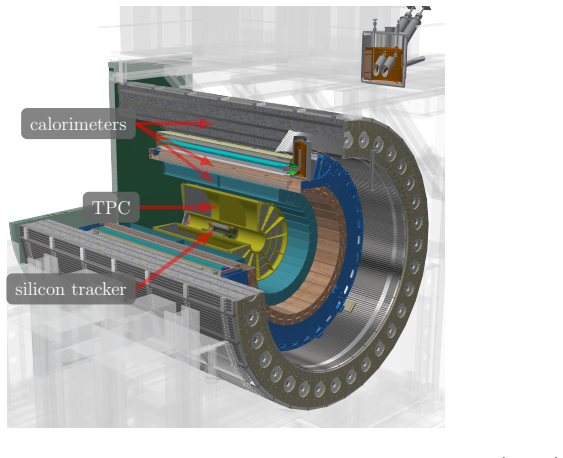
High-energy large-scale particle colliders generate data at extraordinary rates. Developing real-time high-throughput data compression algorithms to reduce data volume and meet the bandwidth requirement for storage has become increasingly critical. Deep learning is a promising technology that can address this challenging topic. At the newly constructed sPHENIX experiment at the Relativistic Heavy Ion Collider, a Time Projection Chamber (TPC) serves as the main tracking detector, which records three-dimensional particle trajectories in a volume of a gas-filled cylinder. In terms of occupancy, the resulting data flow can be very sparse reaching $10^{-3}$ for proton-proton collisions. Such sparsity presents a challenge to conventional learning-free lossy compression algorithms, such as SZ, ZFP, and MGARD. In contrast, emerging deep learning-based models, particularly those utilizing convolutional neural networks for compression, have outperformed these conventional methods in terms of compression ratios and reconstruction accuracy. However, research on the efficacy of these deep learning models in handling sparse datasets, like those produced in particle colliders, remains limited. Furthermore, most deep learning models do not adapt their processing speeds to data sparsity, which affects efficiency. To address this issue, we propose a novel approach for TPC data compression via key-point identification facilitated by sparse convolution. Our proposed algorithm, BCAE-VS, achieves a $75\%$ improvement in reconstruction accuracy with a $10\%$ increase in compression ratio over the previous state-of-the-art model. Additionally, BCAE-VS manages to achieve these results with a model size over two orders of magnitude smaller. Lastly, we have experimentally verified that as sparsity increases, so does the model's throughput.
Figures


Figures from the paper (9 more)


Reference graph
Works this paper leans on
-
[1]
L. Evans, P. Bryant, LHC machine 3 (8) S08001. doi:10.1088/ 1748-0221/3/08/S08001. URL https://dx.doi.org/10.1088/1748-0221/3/08/S08001
-
[2]
URL https://indico.bnl.gov/event/5905/
sPHENIX Collaboration, Technical design report: sphenix experiment at rhic (2019). URL https://indico.bnl.gov/event/5905/
work page 2019
- [3]
-
[4]
URL https://indico.bnl.gov/event/20373/
sPHENIX Collaboration, sphenix 2023 beam use proposal (2023). URL https://indico.bnl.gov/event/20373/
work page 2023
- [5]
-
[6]
R. Abdul Khalek, et al., Science Requirements and Detector Concepts for the Electron-Ion Collider: EIC Yellow Report, Nucl. Phys. A 1026 (2022) 122447. arXiv:2103.05419, doi:10.1016/j.nuclphysa.2022. 122447
arXiv 2022
-
[7]
D. Rohr, Gpu-based reconstruction and data compression at alice during lhc run 3, in: EPJ Web of Conferences, Vol. 245, EDP Sciences, 2020, p. 10005
work page 2020
-
[8]
S. Di, F. Cappello, Fast error-bounded lossy HPC data compression with SZ, in: 2016 IEEE International Parallel and Distributed Processing Symposium (IPDPS), pp. 730–739, ISSN: 1530-2075. doi:10.1109/ IPDPS.2016.11
work page 2016
Show all 25 references
-
[9]
D. Tao, S. Di, Z. Chen, F. Cappello, Significantly improving lossy com- pression for scientific data sets based on multidimensional prediction and error-controlled quantization, in: 2017 IEEE International Parallel and Distributed Processing Symposium (IPDPS), pp. 1129–1139, I...
2017 doi
-
[10]
Y. Liu, S. Di, K. Zhao, S. Jin, C. Wang, K. Chard, D. Tao, I. Foster, F. Cappello, Optimizing error-bounded lossy compression for scientific data with diverse constraints 33 (12) 4440–4457, conference Name: IEEE Transactions on Parallel and Distributed Systems. doi:10.1109/TPD...
-
[11]
Lindstrom, Fixed-rate compressed floating-point arrays 20 (12) 2674– 33 2683, conference Name: IEEE Transactions on Visualization and Com- puter Graphics
P. Lindstrom, Fixed-rate compressed floating-point arrays 20 (12) 2674– 33 2683, conference Name: IEEE Transactions on Visualization and Com- puter Graphics. doi:10.1109/TVCG.2014.2346458
2014
-
[12]
Ainsworth, O
M. Ainsworth, O. Tugluk, B. Whitney, S. Klasky, Multilevel techniques for compression and reduction of scientific data—the multivariate case 41 (2) A1278–A1303, publisher: Society for Industrial and Applied Mathematics. doi:10.1137/18M1166651. URL https://epubs.siam.org/doi/10...
-
[13]
Liang, B
X. Liang, B. Whitney, J. Chen, L. Wan, Q. Liu, D. Tao, J. Kress, D. Pugmire, M. Wolf, N. Podhorszki, S. Klasky, MGARD+: Optimizing multilevel methods for error-bounded scientific data reduction 71 (7) 1522–1536, conference Name: IEEE Transactions on Computers. doi: 10.1109/TC....
-
[14]
Huang, Y
Y. Huang, Y. Ren, S. Yoo, J. Huang, Efficient data compression for 3d sparse tpc via bicephalous convolutional autoencoder, in: 2021 20th IEEE International Conference on Machine Learning and Applica- tions (ICMLA), 2021, pp. 1094–1099. doi:10.1109/ICMLA52953.2021. 00179
2021
-
[15]
Huang, Y
Y. Huang, Y. Ren, S. Yoo, J. Huang, Fast 2d bicephalous convolutional autoencoder for compressing 3d time projection chamber data, in: Pro- ceedings of the SC’23 Workshops of The International Conference on High Performance Computing, Network, Storage, and Analysis, 2023, pp. 298–305
2023
-
[16]
Avola, L
D. Avola, L. Cinque, A. Fagioli, G. L. Foresti, A. Fragomeni, D. Pan- 34 none, 3d hand pose and shape estimation from rgb images for keypoint- based hand gesture recognition, Pattern Recognition 129 (2022) 108762
2022
-
[17]
Y. Lin, W. Chi, W. Sun, S. Liu, D. Fan, Human action recognition algorithm based on improved resnet and skeletal keypoints in single image, Mathematical Problems in Engineering 2020 (1) (2020) 6954174
2020
-
[18]
Y. You, Y. Lou, C. Li, Z. Cheng, L. Li, L. Ma, C. Lu, W. Wang, Key- pointnet: A large-scale 3d keypoint dataset aggregated from numerous human annotations, in: Proceedings of the IEEE/CVF Conference on Computer Vision and Pattern Recognition, 2020, pp. 13647–13656
2020
-
[19]
Moskvyak, F
O. Moskvyak, F. Maire, F. Dayoub, M. Baktashmotlagh, Keypoint- aligned embeddings for image retrieval and re-identification, in: Pro- ceedings of the IEEE/CVF winter conference on applications of com- puter vision, 2021, pp. 676–685
2021
-
[20]
X.-N. Wang, M. Gyulassy, HIJING: A Monte Carlo model for multiple jet production in p p, p A and A A collisions, Phys. Rev. D 44 (1991) 3501–3516. doi:10.1103/PhysRevD.44.3501
1991 doi
-
[21]
Allison, et al., Recent developments in Geant4, Nucl
J. Allison, et al., Recent developments in Geant4, Nucl. Instrum. Meth. A 835 (2016) 186–225. doi:10.1016/j.nima.2016.06.125
2016 doi
-
[22]
URL https://github.com/sPHENIX-Collaboration
sPHENIX, sphenix software repositories https://github.com/sphenix- collaboration (2019). URL https://github.com/sPHENIX-Collaboration
2019
-
[23]
Alanazi, N
Y. Alanazi, N. Sato, T. Liu, W. Melnitchouk, M. P. Kuchera, 35 E. Pritchard, M. Robertson, R. Strauss, L. Velasco, Y. Li, Simula- tion of electron-proton scattering events by a feature-augmented and transformed generative adversarial network (fat-gan), arXiv preprint arXiv:200...
2020 arXiv
-
[24]
Hashemi, N
B. Hashemi, N. Amin, K. Datta, D. Olivito, M. Pierini, Lhc analysis- specific datasets with generative adversarial networks, arXiv e-prints (2019) arXiv–1901
2019
-
[25]
T.-Y. Lin, P. Goyal, R. Girshick, K. He, P. Doll´ ar, Focal loss for dense object detection, in: Proceedings of the IEEE international conference on computer vision, 2017, pp. 2980–2988. 36
2017
Reviewed August 12, 2026 · model on record in the stance chip above.
Discussion (0). Continue with ORCID to comment.