Study of ZZ and ZH production in the bbττ final state and search for high-mass spin-0 and spin-1 resonances in proton-proton collisions at sqrt{s} = 13 TeV
Pith reviewed 2026-07-03 03:29 UTC · model grok-4.3
The pith
CMS sets upper limits on high-mass spin-0 and spin-1 resonances decaying to ZZ and ZH in the bbττ channel.
A machine-rendered reading of the paper's core claim, the machinery that carries it, and where it could break.
Core claim
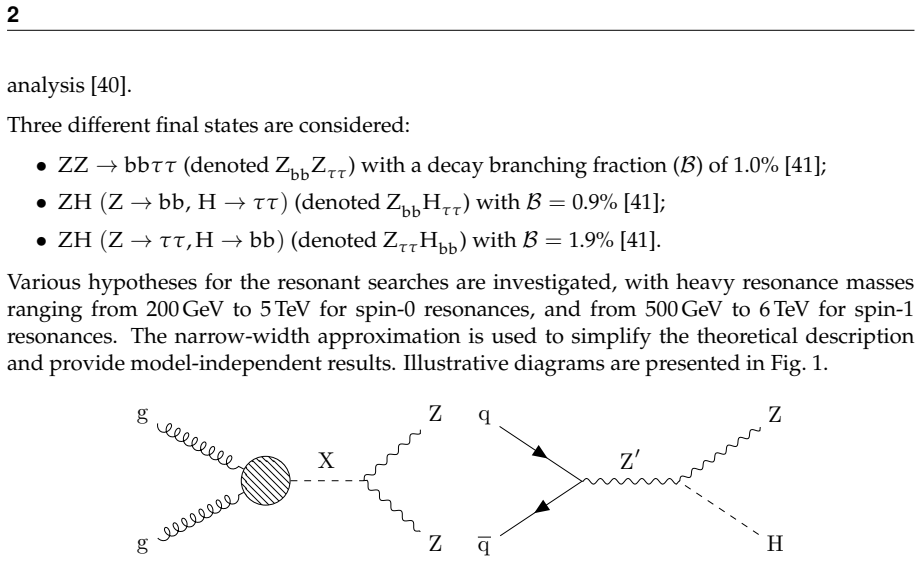
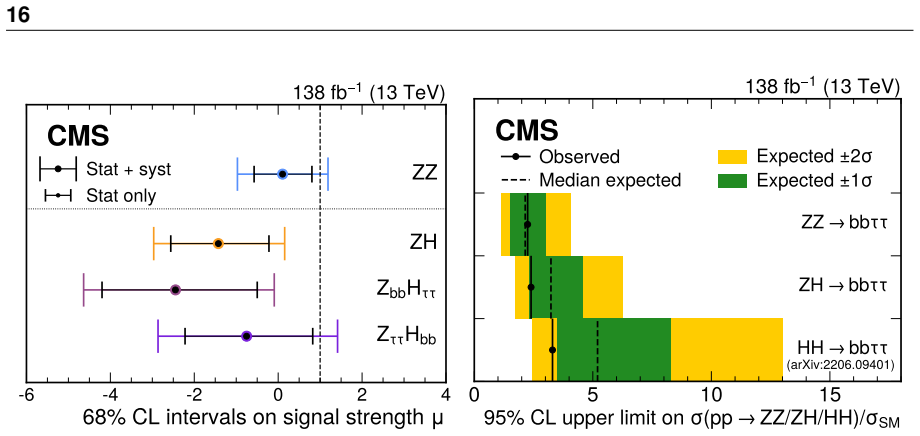
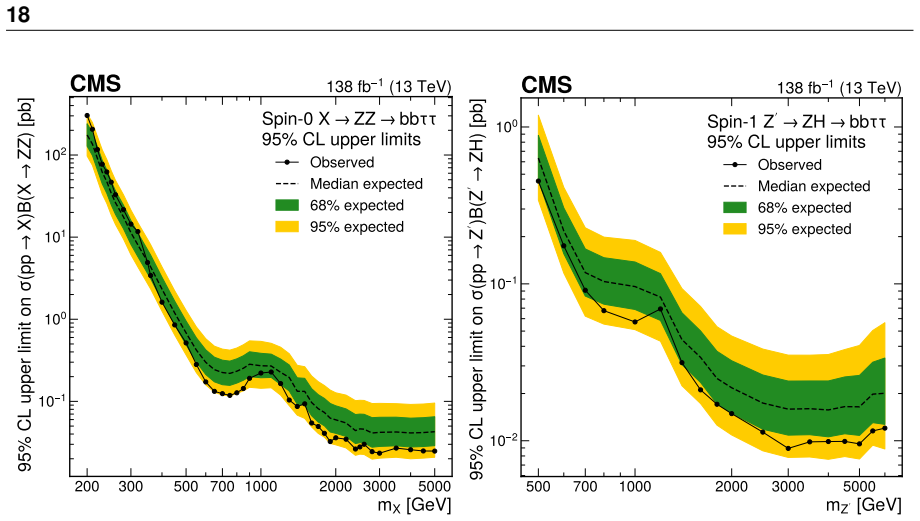
The analysis establishes the first probe of ZZ and ZH production in the bbττ final state and sets upper limits at 95% confidence level on σ(X)B(X → ZZ) ranging from 300 pb to 24 fb for masses 0.2-5 TeV and on σ(Z')B(Z' → ZH) ranging from 0.4 pb to 12 fb for masses 0.5-6 TeV, with no observed excess over standard model predictions.
What carries the argument
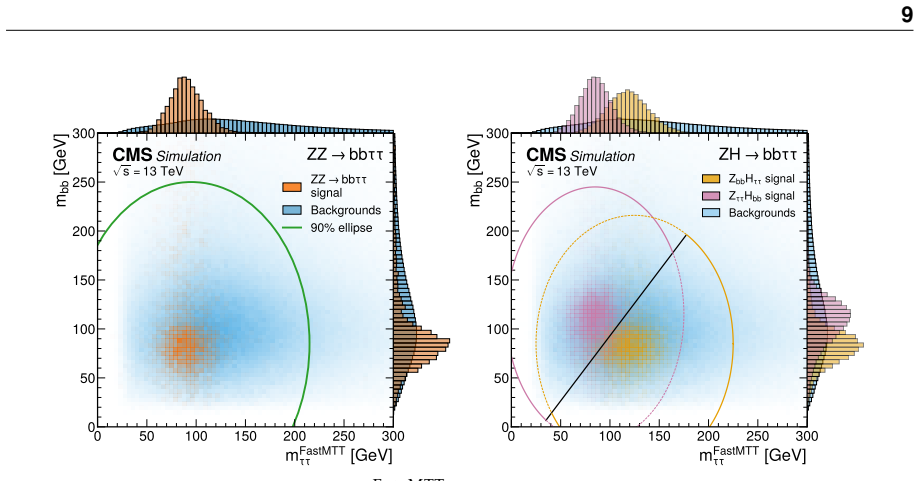
The resonant search strategy in the bbττ final state that separates potential signals from backgrounds using kinematic selections and discriminants.
If this is right
- The limits constrain the parameter space of models predicting heavy spin-0 and spin-1 particles.
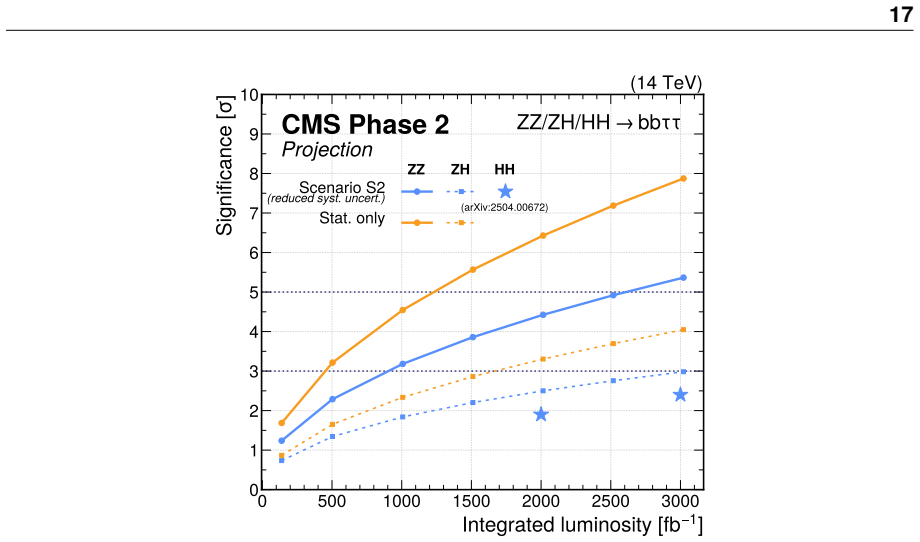
- The bbττ reconstruction methods support related searches such as nonresonant Higgs pair production.
- Increased integrated luminosity will extend the sensitivity to smaller production cross sections.
- The results provide reference points for interpreting data in complementary final states.
Where Pith is reading between the lines
- The channel may gain importance for lower-mass resonance searches as luminosity grows.
- Reinterpretation in specific models such as extended Higgs sectors could yield tighter bounds on couplings.
- Combining with other decay modes like four leptons would strengthen overall constraints on new physics.
Load-bearing premise
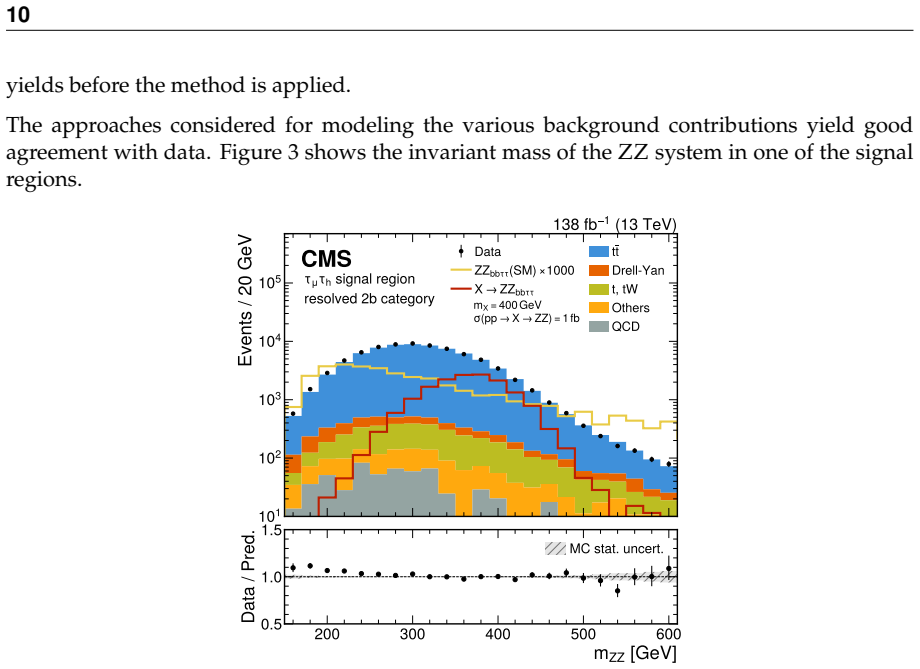
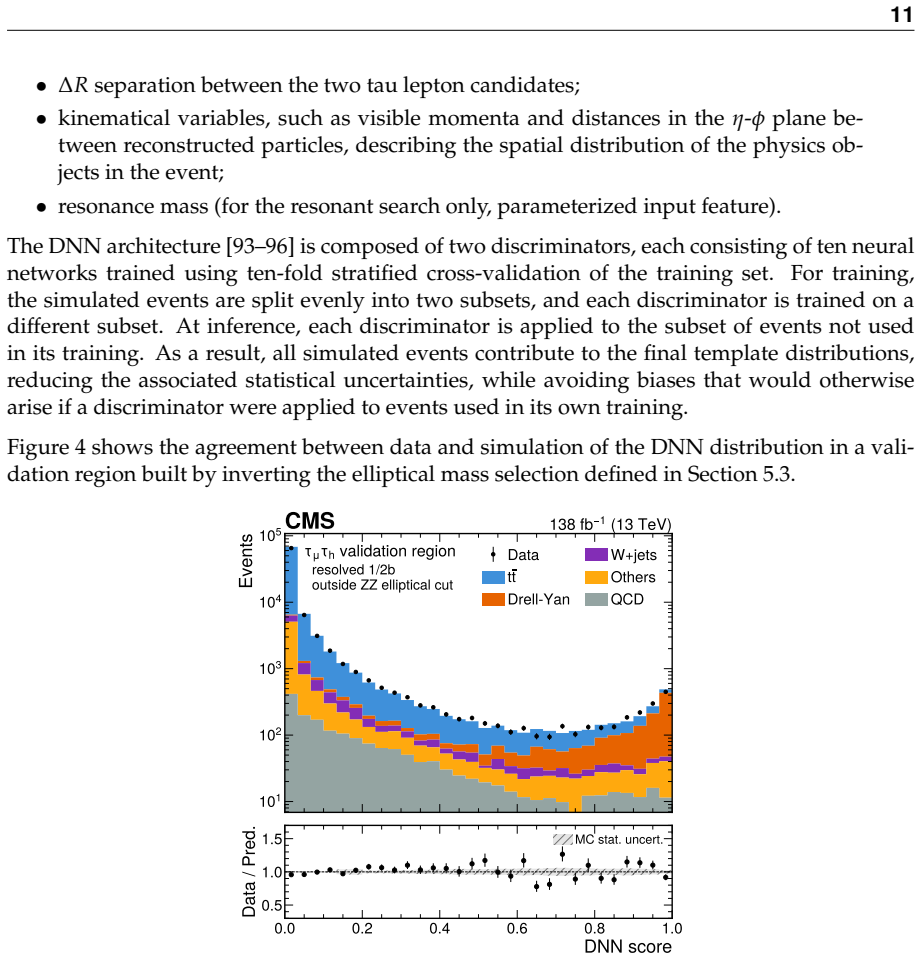
Standard model backgrounds and detector response including b-tagging and tau identification are accurately modeled by simulation and control samples.
What would settle it
A statistically significant excess in the reconstructed resonance mass distributions above the predicted background that persists after accounting for systematic uncertainties would indicate new resonances.
Figures
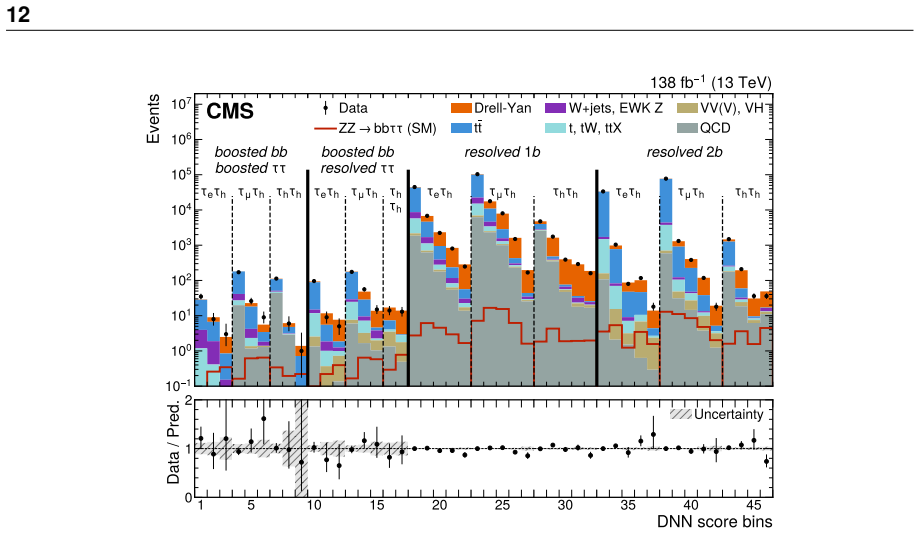
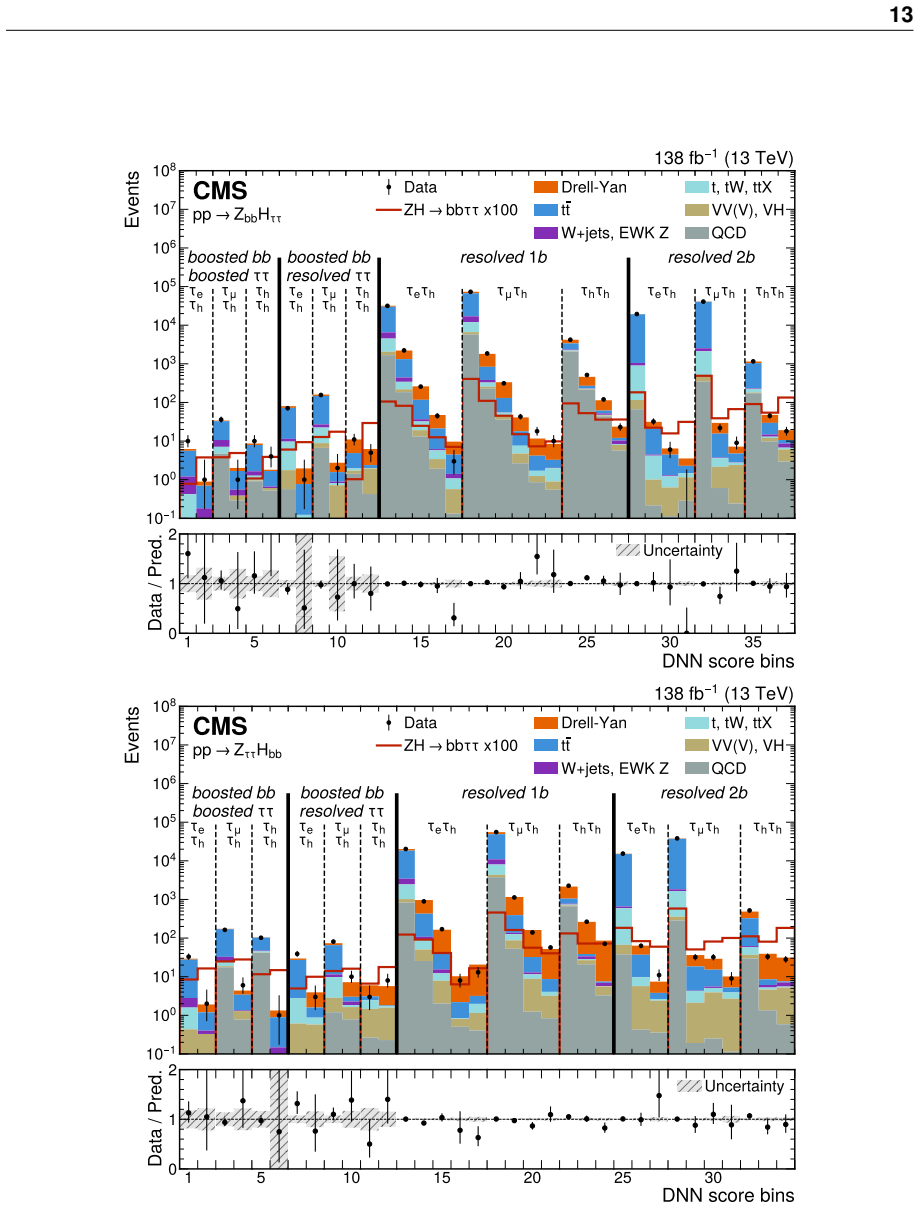
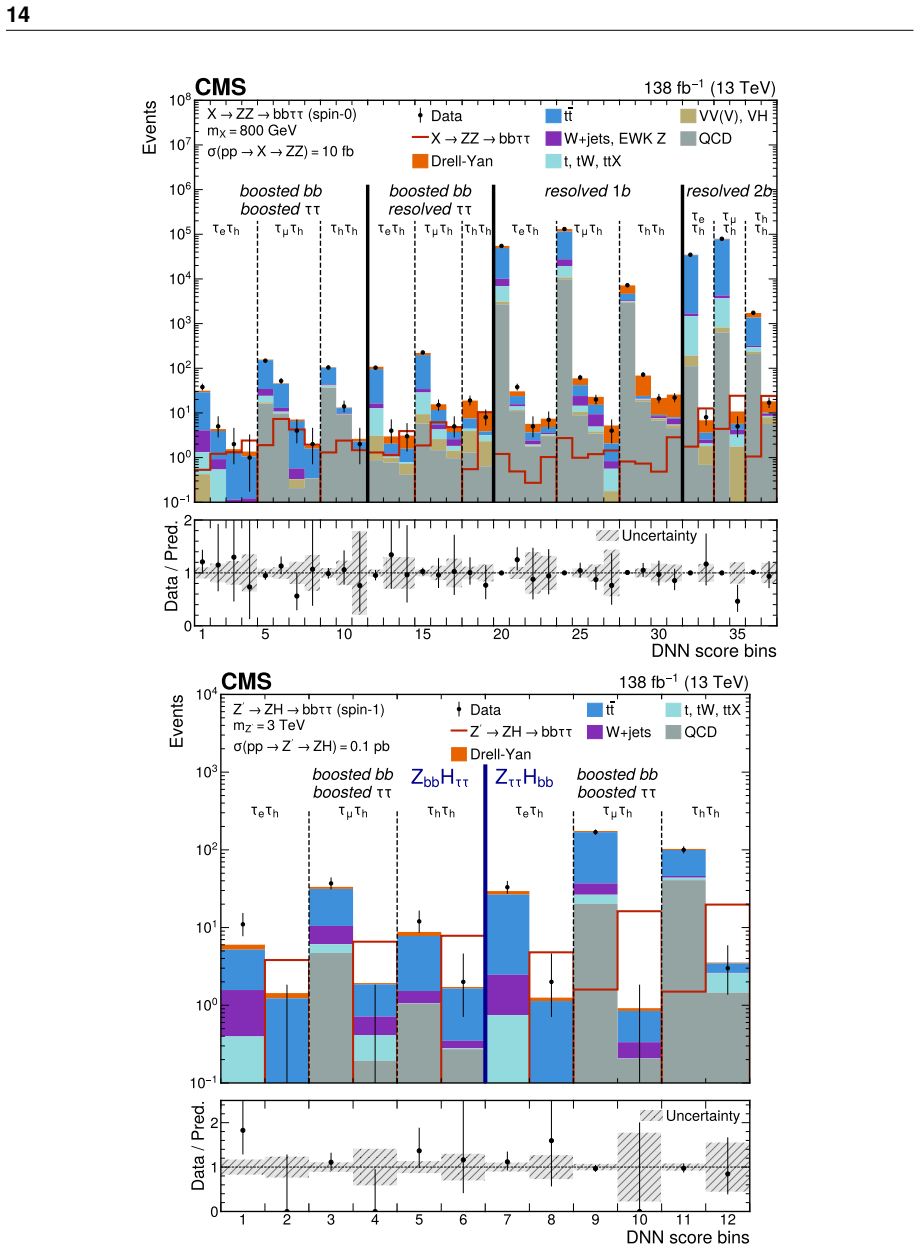
read the original abstract
A study of the production of pairs of Z bosons (ZZ) and of the associated production of a Z boson and a Higgs boson (ZH) in final states containing two b quarks and two tau leptons (bb$\tau\tau$) is presented. The analysis is based on proton-proton collisions collected at $\sqrt{s}$ = 13 TeV by the CMS experiment at the LHC, corresponding to an integrated luminosity of 138 fb$^{-1}$. The nonresonant analysis targets the standard model ZZ and ZH processes in the bb$\tau\tau$ final state, motivated by the prominent role of this channel in searches for nonresonant Higgs boson pair production. The resonant searches target physics beyond the standard model, probing heavy spin-0 resonances X that decay into ZZ and spin-1 resonances Z' that decay into ZH, with masses in the 0.2$-$5 and 0.5$-$6 TeV ranges, respectively. Upper limits at 95% confidence level are set on the product of production rate and branching fraction $\sigma$(X)$\mathcal{B}$(X $\to$ ZZ), ranging from 300 pb to 24 fb, and $\sigma$(Z')$\mathcal{B}$(Z' $\to$ ZH), ranging from 0.4 pb to 12 fb. These are the first measurements to probe the ZZ/ZH $\to$ bb$\tau\tau$ processes. No deviation from standard model expectations is observed.
Editorial analysis
A structured set of objections, weighed in public.
Referee Report
Summary. The manuscript presents an analysis of ZZ and ZH production in the bbττ final state using 138 fb⁻¹ of 13 TeV pp collision data collected by CMS. It performs a non-resonant measurement of the standard model ZZ and ZH processes and searches for high-mass spin-0 resonances X decaying to ZZ (masses 0.2–5 TeV) and spin-1 resonances Z' decaying to ZH (masses 0.5–6 TeV). Upper limits at 95% CL are reported on σ(X)B(X→ZZ) ranging from 300 pb to 24 fb and on σ(Z')B(Z'→ZH) ranging from 0.4 pb to 12 fb, with no deviations from SM expectations observed. These are stated to be the first measurements in the ZZ/ZH → bbττ channels.
Significance. If the results hold, the work provides the first experimental constraints on ZZ and ZH production in the bbττ final state at the LHC, extending resonance searches into a channel motivated by Higgs-pair production studies. The reported limits on high-mass resonances constitute a useful addition to the BSM search program, particularly given the use of 138 fb⁻¹ of data and the combination of resonant and non-resonant interpretations.
minor comments (3)
- [Abstract / §1] The abstract states that these are the 'first measurements to probe the ZZ/ZH → bbττ processes,' but the introduction or §1 should explicitly compare to any prior related searches in other final states (e.g., 4ℓ or bbℓℓ) to clarify the novelty of the channel choice.
- [Results section (limit plots)] Figure captions for the limit plots (presumably in §6 or §7) should include the exact mass ranges and the functional form of the interpolation used between mass points to allow readers to assess the smoothness of the reported limits.
- [§4 or §5 (background estimation)] The description of background estimation in control regions should clarify whether the same control-region definitions are used for both the non-resonant and resonant analyses or if they differ, as this affects the interpretation of the systematic uncertainties.
Simulated Author's Rebuttal
We thank the referee for the careful review of our manuscript and for the positive assessment of its significance. The recommendation for minor revision is noted. No specific major comments were provided in the report.
Circularity Check
No significant circularity
full rationale
This is a standard experimental hep-ex search paper reporting limits on resonant and non-resonant ZZ/ZH production from 138 fb⁻¹ of 13 TeV collision data. The central claims (upper limits on σB, no deviation from SM) are extracted directly from observed events after background estimation in control regions and systematic uncertainties on efficiencies and scales. No derivation chain, equations, or predictions reduce by construction to fitted inputs, self-definitions, or self-citation load-bearing premises. The result is benchmarked against external data and is self-contained.
Axiom & Free-Parameter Ledger
axioms (1)
- domain assumption Standard model backgrounds and detector response are correctly modeled by simulation and control samples
Reference graph
Works this paper leans on
-
[1]
ATLAS Collaboration, “Observation of a new particle in the search for the standard model Higgs boson with the ATLAS detector at the LHC”,Phys. Lett. B716(2012) 1, doi:10.1016/j.physletb.2012.08.020,arXiv:1207.7214
work page internal anchor Pith review Pith/arXiv arXiv doi:10.1016/j.physletb.2012.08.020 2012
-
[2]
Observation of a new boson at a mass of 125 GeV with the CMS experiment at the LHC
CMS Collaboration, “Observation of a new boson at a mass of 125 GeV with the CMS experiment at the LHC”,Phys. Lett. B716(2012) 30, doi:10.1016/j.physletb.2012.08.021,arXiv:1207.7235. References 19
work page internal anchor Pith review Pith/arXiv arXiv doi:10.1016/j.physletb.2012.08.021 2012
-
[3]
Observation of a new boson with mass near 125 GeV in pp collisions at sqrt(s) = 7 and 8 TeV
CMS Collaboration, “Observation of a new boson with mass near 125 GeV in pp collisions at √s=7 and 8 TeV”,JHEP06(2013) 081, doi:10.1007/JHEP06(2013)081,arXiv:1303.4571
work page internal anchor Pith review Pith/arXiv arXiv doi:10.1007/jhep06(2013)081 2013
-
[4]
A portrait of the Higgs boson by the CMS experiment ten years after the discovery
CMS Collaboration, “A portrait of the Higgs boson by the CMS experiment ten years after the discovery”,Nature607(2022) 60,doi:10.1038/s41586-022-04892-x, arXiv:2207.00043. [Erratum:doi:10.1038/s41586-023-06164-8]
-
[5]
Higgs Physics at the HL-LHC and HE-LHC
M. Cepeda et al., “Report from working group 2: Higgs physics at the HL-LHC and HE-LHC”, CERN Yellow Rep. Monogr., 2019.doi:10.23731/CYRM-2019-007.221, arXiv:1902.00134
work page internal anchor Pith review Pith/arXiv arXiv doi:10.23731/cyrm-2019-007.221 2019
-
[6]
CMS Collaboration, “Combination of searches for nonresonant Higgs boson pair production in proton-proton collisions at √s=13 TeV”, 2025.arXiv:2510.07527. Submitted toJ. Phys. G
-
[7]
Highlights of the HL-LHC physics projections by ATLAS and CMS
ATLAS and CMS Collaborations, “Highlights of the HL-LHC physics projections by ATLAS and CMS”, 2025.arXiv:2504.00672.doi:10.48550/arXiv.2504.00672
-
[8]
CMS Collaboration, “Measurements of pp→ZZ production cross sections and constraints on anomalous triple gauge couplings at √s=13 TeV”,Eur. Phys. J. C81 (2021) 200,doi:10.1140/epjc/s10052-020-08817-8,arXiv:2009.01186
-
[9]
ATLAS Collaboration, “Measurements of differential cross-sections in four-lepton events in 13 TeV proton-proton collisions with the ATLAS detector”,JHEP07(2021) 005,doi:10.1007/JHEP07(2021)005,arXiv:2103.01918
-
[10]
ATLAS Collaboration, “Measurement of ZZ production cross-sections in the four-lepton final state in pp collisions at √s=13.6 TeV with the ATLAS experiment”,Phys. Lett. B 855(2024) 138764,doi:10.1016/j.physletb.2024.138764,arXiv:2311.09715
-
[11]
CMS Collaboration, “Measurement of simplified template cross sections of the Higgs boson produced in association with W or Z bosons in the H→b b decay channel in proton-proton collisions at √s=13 TeV”,Phys. Rev. D109(2024) 092011, doi:10.1103/PhysRevD.109.092011,arXiv:2312.07562
-
[12]
CMS Collaboration, “Search for ZZ and ZH production in the b bb b final state using proton-proton collisions at √s=13 TeV”,Eur. Phys. J. C84(2024) 712, doi:10.1140/epjc/s10052-024-13021-z,arXiv:2403.20241
-
[13]
Influence of strongly coupled, hidden scalars on Higgs signals
T. Binoth and J. J. van der Bij, “Influence of strongly coupled, hidden scalars on Higgs signals”,Z. Phys. C75(1997) 17,doi:10.1007/s002880050442, arXiv:hep-ph/9608245
work page internal anchor Pith review Pith/arXiv arXiv doi:10.1007/s002880050442 1997
-
[14]
R. M. Schabinger and J. D. Wells, “A minimal spontaneously broken hidden sector and its impact on Higgs boson physics at the large hadron collider”,Phys. Rev. D72(2005) 093007,doi:10.1103/PhysRevD.72.093007,arXiv:hep-ph/0509209
work page internal anchor Pith review Pith/arXiv arXiv doi:10.1103/physrevd.72.093007 2005
-
[15]
Higgs-field Portal into Hidden Sectors
B. Patt and F. Wilczek, “Higgs-field portal into hidden sectors”, 2006. arXiv:hep-ph/0605188.doi:10.48550/arXiv.hep-ph/0605188
work page internal anchor Pith review Pith/arXiv arXiv doi:10.48550/arxiv.hep-ph/0605188 2006
-
[16]
Theory and phenomenology of two-Higgs-doublet models
G. C. Branco et al., “Theory and phenomenology of two-Higgs-doublet models”,Phys. Rept.516(2012) 1,doi:10.1016/j.physrep.2012.02.002,arXiv:1106.0034. 20
work page internal anchor Pith review Pith/arXiv arXiv doi:10.1016/j.physrep.2012.02.002 2012
-
[17]
Heavy Vector Triplets: Bridging Theory and Data
D. Pappadopulo, A. Thamm, R. Torre, and A. Wulzer, “Heavy vector triplets: Bridging theory and data”,JHEP09(2014) 060,doi:10.1007/JHEP09(2014)060, arXiv:1402.4431
work page internal anchor Pith review Pith/arXiv arXiv doi:10.1007/jhep09(2014)060 2014
-
[18]
Supergauge invariant extension of the Higgs mechanism and a model for the electron and its neutrino
P . Fayet, “Supergauge invariant extension of the Higgs mechanism and a model for the electron and its neutrino”,Nucl. Phys. B90(1975) 104, doi:10.1016/0550-3213(75)90636-7
-
[19]
Spontaneously broken supersymmetric theories of weak, electromagnetic and strong interactions
P . Fayet, “Spontaneously broken supersymmetric theories of weak, electromagnetic and strong interactions”,Phys. Lett. B69(1977) 489, doi:10.1016/0370-2693(77)90852-8
-
[20]
Warped Gravitons at the LHC and Beyond
K. Agashe, H. Davoudiasl, G. Perez, and A. Soni, “Warped gravitons at the LHC and beyond”,Phys. Rev. D76(2007) 036006,doi:10.1103/PhysRevD.76.036006, arXiv:hep-ph/0701186
work page internal anchor Pith review Pith/arXiv arXiv doi:10.1103/physrevd.76.036006 2007
-
[21]
Searching for the Kaluza-Klein Graviton in Bulk RS Models
A. L. Fitzpatrick, J. Kaplan, L. Randall, and L.-T. Wang, “Searching for the Kaluza-Klein graviton in Bulk RS models”,JHEP09(2007) 013, doi:10.1088/1126-6708/2007/09/013,arXiv:hep-ph/0701150
work page internal anchor Pith review Pith/arXiv arXiv doi:10.1088/1126-6708/2007/09/013 2007
-
[22]
ATLAS Collaboration, “Search for heavy resonances decaying into a pair of Z bosons in theℓ +ℓ−ℓ′+ℓ′− andℓ +ℓ−ννfinal states using 139 fb −1 of proton-proton collisions at√s=13 TeV with the ATLAS detector”,Eur. Phys. J. C81(2021) 332, doi:10.1140/epjc/s10052-021-09013-y,arXiv:2009.14791
-
[23]
CMS Collaboration, “Search for a new scalar resonance decaying to a pair of Z bosons in proton-proton collisions at √s=13 TeV”,JHEP06(2018) 127, doi:10.1007/JHEP06(2018)127,arXiv:1804.01939. [Erratum: doi:10.1007/JHEP03(2019)128]
work page internal anchor Pith review Pith/arXiv arXiv doi:10.1007/jhep06(2018)127 2018
-
[24]
ATLAS Collaboration, “Search for heavy diboson resonances in semileptonic final states in pp collisions at √s=13 TeV with the ATLAS detector”,Eur. Phys. J. C80(2020) 1165,doi:10.1140/epjc/s10052-020-08554-y,arXiv:2004.14636
-
[25]
CMS Collaboration, “Search for heavy resonances decaying to ZZ or ZW and axion-like particles mediating nonresonant ZZ or ZH production at √s=13 TeV”,JHEP04(2022) 087,doi:10.1007/JHEP04(2022)087,arXiv:2111.13669
-
[26]
Search for heavy resonances decaying to Z(ν ν)V(q q ′)in proton-proton collisions at √s=13 TeV
CMS Collaboration, “Search for heavy resonances decaying to Z(ν ν)V(q q ′)in proton-proton collisions at √s=13 TeV”,Phys. Rev. D106(2022) 012004, doi:10.1103/PhysRevD.106.012004,arXiv:2109.08268
-
[27]
ATLAS Collaboration, “Search for diboson resonances in hadronic final states in 139 fb−1 of pp collisions at √s=13 TeV with the ATLAS detector”,JHEP09(2019) 091, doi:10.1007/JHEP09(2019)091,arXiv:1906.08589. [Erratum: doi:10.1007/JHEP06(2020)042]
-
[28]
CMS Collaboration, “Search for new heavy resonances decaying to WW, WZ, ZZ, WH, or ZH boson pairs in the all-jets final state in proton-proton collisions at √s=13 TeV”, Phys. Lett. B844(2023) 137813,doi:10.1016/j.physletb.2023.137813, arXiv:2210.00043
-
[29]
CMS Collaboration, “Search for narrow high-mass resonances in proton-proton collisions at √s=8 TeV decaying to a Z and a Higgs boson”,Phys. Lett. B748(2015) 255,doi:10.1016/j.physletb.2015.07.011,arXiv:1502.04994. References 21
work page internal anchor Pith review Pith/arXiv arXiv doi:10.1016/j.physletb.2015.07.011 2015
-
[30]
CMS Collaboration, “Search for heavy resonances decaying into two Higgs bosons or into a Higgs boson and a W or Z boson in proton-proton collisions at 13 TeV”,JHEP01 (2019) 051,doi:10.1007/JHEP01(2019)051,arXiv:1808.01365
work page internal anchor Pith review Pith/arXiv arXiv doi:10.1007/jhep01(2019)051 2019
-
[31]
ATLAS Collaboration, “Search for resonances decaying into a weak vector boson and a Higgs boson in the fully hadronic final state produced in proton-proton collisions at√s=13 TeV with the ATLAS detector”,Phys. Rev. D102(2020) 112008, doi:10.1103/PhysRevD.102.112008,arXiv:2007.05293
-
[32]
ATLAS Collaboration, “Study of high-transverse-momentum Higgs boson production in association with a vector boson in the qqbb final state with the ATLAS detector”, Phys. Rev. Lett.132(2024) 131802,doi:10.1103/PhysRevLett.132.131802, arXiv:2312.07605
-
[33]
ATLAS Collaboration, “Search for heavy resonances decaying into a Z or W boson and a Higgs boson in final states with leptons and b-jets in 139 fb−1 of pp collisions at√s=13 TeV with the ATLAS detector”,JHEP06(2023) 016, doi:10.1007/JHEP06(2023)016,arXiv:2207.00230
-
[34]
CMS Collaboration, “Search for a heavy resonance decaying into a Z and a Higgs boson in events with an energetic jet and two electrons, two muons, or missing transverse momentum in proton-proton collisions at √s=13 TeV”,JHEP02(2025) 089, doi:10.1007/JHEP02(2025)089,arXiv:2411.00202
-
[35]
A heavy neutral gauge boson near the Z boson mass pole via third generation fermions at the LHC
M. Abdullah et al., “A heavy neutral gauge boson near the Z boson mass pole via third generation fermions at the LHC”,Phys. Lett. B803(2020) 135326, doi:10.1016/j.physletb.2020.135326,arXiv:1912.00102
-
[36]
ATLAS Collaboration, “Search for resonant and non-resonant Higgs boson pair production in the bbτ +τ − decay channel using 13 TeV pp collision data from the ATLAS detector”,JHEP07(2023) 40,doi:10.1007/JHEP07(2023)040, arXiv:2209.10910
-
[37]
ATLAS Collaboration, “Reconstruction and identification of boosted di-τsystems in a search for Higgs boson pairs using 13 TeV proton-proton collision data in ATLAS”, JHEP11(2020) 163,doi:10.1007/JHEP11(2020)163,arXiv:2007.14811
-
[38]
CMS Collaboration, “Search for Higgs boson pair production in events with two bottom quarks and two tau leptons in proton-proton collisions at √s=13 TeV”,Phys. Lett. B 778(2018) 101,doi:10.1016/j.physletb.2018.01.001,arXiv:1707.02909
work page internal anchor Pith review Pith/arXiv arXiv doi:10.1016/j.physletb.2018.01.001 2018
-
[39]
CMS Collaboration, “Search for heavy resonances decaying into two Higgs bosons in the bbτ τfinal state in proton-proton collisions at √s=13 TeV”, 2026. arXiv:2601.20011. Accepted byEur. Phys. J. C
-
[40]
CMS Collaboration, “Search for nonresonant Higgs boson pair production in final state with two bottom quarks and two tau leptons in proton-proton collisions at√s=13 TeV”,Phys. Lett. B842(2023) 137531, doi:10.1016/j.physletb.2022.137531,arXiv:2206.09401
-
[41]
Handbook of LHC Higgs Cross Sections: 4. Deciphering the Nature of the Higgs Sector
LHC Higgs Cross Section Working Group, “Handbook of LHC Higgs cross sections: 4. Deciphering the nature of the Higgs sector”, CERN Report CERN-2017-002-M, 2016. doi:10.23731/CYRM-2017-002,arXiv:1610.07922. 22
work page internal anchor Pith review Pith/arXiv arXiv doi:10.23731/cyrm-2017-002 2017
-
[42]
HEPData record for this analysis, 2026.doi:10.17182/hepdata.169547
-
[43]
The CMS experiment at the CERN LHC
CMS Collaboration, “The CMS experiment at the CERN LHC”,JINST3(2008) S08004, doi:10.1088/1748-0221/3/08/S08004
-
[44]
Development of the CMS detector for the CERN LHC Run 3
CMS Collaboration, “Development of the CMS detector for the CERN LHC Run 3”, JINST19(2024) P05064,doi:10.1088/1748-0221/19/05/P05064, arXiv:2309.05466
-
[45]
Performance of the CMS Level-1 trigger in proton-proton collisions at √s=13 TeV
CMS Collaboration, “Performance of the CMS Level-1 trigger in proton-proton collisions at √s=13 TeV”,JINST15(2020) P10017, doi:10.1088/1748-0221/15/10/P10017,arXiv:2006.10165
-
[46]
CMS Collaboration, “The CMS trigger system”,JINST12(2017) P01020, doi:10.1088/1748-0221/12/01/P01020,arXiv:1609.02366
work page internal anchor Pith review Pith/arXiv arXiv doi:10.1088/1748-0221/12/01/p01020 2017
-
[47]
Performance of the CMS high-level trigger during LHC Run 2
CMS Collaboration, “Performance of the CMS high-level trigger during LHC Run 2”, JINST19(2024) P11021,doi:10.1088/1748-0221/19/11/P11021, arXiv:2410.17038
-
[48]
Electron and photon reconstruction and identification with the CMS experiment at the CERN LHC
CMS Collaboration, “Electron and photon reconstruction and identification with the CMS experiment at the CERN LHC”,JINST16(2021) P05014, doi:10.1088/1748-0221/16/05/P05014,arXiv:2012.06888
-
[49]
CMS Collaboration, “Performance of the CMS muon detector and muon reconstruction with proton-proton collisions at √s=13 TeV”,JINST13(2018) P06015, doi:10.1088/1748-0221/13/06/P06015,arXiv:1804.04528
work page internal anchor Pith review Pith/arXiv arXiv doi:10.1088/1748-0221/13/06/p06015 2018
-
[50]
Description and performance of track and primary-vertex reconstruction with the CMS tracker
CMS Collaboration, “Description and performance of track and primary-vertex reconstruction with the CMS tracker”,JINST9(2014) P10009, doi:10.1088/1748-0221/9/10/P10009,arXiv:1405.6569
work page internal anchor Pith review Pith/arXiv arXiv doi:10.1088/1748-0221/9/10/p10009 2014
-
[51]
J. Alwall et al., “The automated computation of tree-level and next-to-leading order differential cross sections, and their matching to parton shower simulations”,JHEP07 (2014) 79,doi:10.1007/jhep07(2014)079,arXiv:1405.0301
work page internal anchor Pith review Pith/arXiv arXiv doi:10.1007/jhep07(2014)079 2014
-
[52]
ZZ production at hadron colliders in NNLO QCD
F. Cascioli et al., “ZZ production at hadron colliders in NNLO QCD”,Phys. Lett. B735 (2014) 311,doi:10.1016/j.physletb.2014.06.056,arXiv:1405.2219
work page internal anchor Pith review Pith/arXiv arXiv doi:10.1016/j.physletb.2014.06.056 2014
-
[53]
A New Method for Combining NLO QCD with Shower Monte Carlo Algorithms
P . Nason, “A new method for combining NLO QCD with shower Monte Carlo algorithms”,JHEP11(2004) 040,doi:10.1088/1126-6708/2004/11/040, arXiv:hep-ph/0409146
work page internal anchor Pith review Pith/arXiv arXiv doi:10.1088/1126-6708/2004/11/040 2004
-
[54]
Matching NLO QCD computations with Parton Shower simulations: the POWHEG method
S. Frixione, P . Nason, and C. Oleari, “Matching NLO QCD computations with parton shower simulations: the POWHEG method”,JHEP11(2007) 070, doi:10.1088/1126-6708/2007/11/070,arXiv:0709.2092
work page internal anchor Pith review Pith/arXiv arXiv doi:10.1088/1126-6708/2007/11/070 2007
-
[55]
A general framework for implementing NLO calculations in shower Monte Carlo programs: the POWHEG BOX
S. Alioli, P . Nason, C. Oleari, and E. Re, “A general framework for implementing NLO calculations in shower Monte Carlo programs: the POWHEG BOX”,JHEP06(2010) 043,doi:10.1007/JHEP06(2010)043,arXiv:1002.2581
work page internal anchor Pith review Pith/arXiv arXiv doi:10.1007/jhep06(2010)043 2010
-
[56]
NLO QCD+EW predictions for HV and HV+jet production including parton-shower effects
F. Granata, J. M. Lindert, C. Oleari, and S. Pozzorini, “NLO QCD+EW predictions for HV and HV+jet production including parton-shower effects”,JHEP09(2017) 012, doi:10.1007/JHEP09(2017)012,arXiv:1706.03522. References 23
work page internal anchor Pith review Pith/arXiv arXiv doi:10.1007/jhep09(2017)012 2017
-
[57]
Higgs production via gluon fusion in the POWHEG approach in the SM and in the MSSM
E. Bagnaschi, G. Degrassi, P . Slavich, and A. Vicini, “Higgs production via gluon fusion in the POWHEG approach in the SM and in the MSSM”,JHEP02(2012) 088, doi:10.1007/JHEP02(2012)088,arXiv:1111.2854
work page internal anchor Pith review Pith/arXiv arXiv doi:10.1007/jhep02(2012)088 2012
-
[58]
A Positive-Weight Next-to-Leading-Order Monte Carlo for Heavy Flavour Hadroproduction
S. Frixione, P . Nason, and G. Ridolfi, “A positive-weight next-to-leading-order Monte Carlo for heavy flavour hadroproduction”,JHEP09(2007) 126, doi:10.1088/1126-6708/2007/09/126,arXiv:0707.3088
work page internal anchor Pith review Pith/arXiv arXiv doi:10.1088/1126-6708/2007/09/126 2007
-
[59]
Merging meets matching in MC@NLO
R. Frederix and S. Frixione, “Merging meets matching in MC@NLO”,JHEP12(2012) 61,doi:10.1007/jhep12(2012)061,arXiv:1209.6215
work page internal anchor Pith review Pith/arXiv arXiv doi:10.1007/jhep12(2012)061 2012
-
[60]
J. Alwall et al., “Comparative study of various algorithms for the merging of parton showers and matrix elements in hadronic collisions”,Eur. Phys. J. C53(2007) 473, doi:10.1140/epjc/s10052-007-0490-5,arXiv:0706.2569
work page internal anchor Pith review Pith/arXiv arXiv doi:10.1140/epjc/s10052-007-0490-5 2007
-
[61]
T. Sj ¨ostrand et al., “An introduction toPYTHIA8.2”,Comp. Phys. Commun.191(2015) 159,doi:10.1016/j.cpc.2015.01.024,arXiv:1410.3012
work page internal anchor Pith review Pith/arXiv arXiv doi:10.1016/j.cpc.2015.01.024 2015
-
[62]
Extraction and validation of a new set of CMSPYTHIA8 tunes from underlying-event measurements
CMS Collaboration, “Extraction and validation of a new set of CMSPYTHIA8 tunes from underlying-event measurements”,Eur. Phys. J. C80(2020) 4, doi:10.1140/epjc/s10052-019-7499-4,arXiv:1903.12179
-
[63]
Parton distributions from high-precision collider data
NNPDF Collaboration, “Parton distributions from high-precision collider data”,Eur. Phys. J. C77(2017) 663,doi:10.1140/epjc/s10052-017-5199-5, arXiv:1706.00428
work page internal anchor Pith review Pith/arXiv arXiv doi:10.1140/epjc/s10052-017-5199-5 2017
-
[64]
GEANT4 Collaboration, “GEANT4—a simulation toolkit”,Nucl. Instrum. Meth. A506 (2003) 250,doi:10.1016/S0168-9002(03)01368-8
-
[65]
Particle-flow reconstruction and global event description with the CMS detector
CMS Collaboration, “Particle-flow reconstruction and global event description with the CMS detector”,JINST12(2017) P10003,doi:10.1088/1748-0221/12/10/P10003, arXiv:1706.04965
work page internal anchor Pith review Pith/arXiv arXiv doi:10.1088/1748-0221/12/10/p10003 2017
-
[66]
Technical proposal for the Phase-II upgrade of the Compact Muon Solenoid
CMS Collaboration, “Technical proposal for the Phase-II upgrade of the Compact Muon Solenoid”, CMS Technical Proposal CERN-LHCC-2015-010, CMS-TDR-15-02, 2015. doi:10.17181/CERN.VU8I.D59J
-
[67]
ECAL 2016 refined calibration and Run2 summary plots
CMS Collaboration, “ECAL 2016 refined calibration and Run2 summary plots”, CMS Detector Performance Summary CMS-DP-2020-021, 2020
2016
-
[68]
The anti-k_t jet clustering algorithm
M. Cacciari, G. P . Salam, and G. Soyez, “The anti-kT jet clustering algorithm”,JHEP04 (2008) 063,doi:10.1088/1126-6708/2008/04/063,arXiv:0802.1189
work page internal anchor Pith review Pith/arXiv arXiv doi:10.1088/1126-6708/2008/04/063 2008
-
[69]
M. Cacciari, G. P . Salam, and G. Soyez, “FastJet user manual”,Eur. Phys. J. C72(2012) 1896,doi:10.1140/epjc/s10052-012-1896-2,arXiv:1111.6097
work page internal anchor Pith review Pith/arXiv arXiv doi:10.1140/epjc/s10052-012-1896-2 2012
-
[70]
Pileup mitigation at CMS in √s=13 TeV data
CMS Collaboration, “Pileup mitigation at CMS in √s=13 TeV data”,JINST15(2020) P09018,doi:10.1088/1748-0221/15/09/p09018,arXiv:2003.00503
-
[71]
Pileup Per Particle Identification
D. Bertolini, P . Harris, M. Low, and N. Tran, “Pileup per particle identification”,JHEP 10(2014) 059,doi:10.1007/JHEP10(2014)059,arXiv:1407.6013
work page internal anchor Pith review Pith/arXiv arXiv doi:10.1007/jhep10(2014)059 2014
-
[72]
Jet energy scale and resolution in the CMS experiment in pp collisions at 8 TeV
CMS Collaboration, “Jet energy scale and resolution in the CMS experiment in proton-proton collisions at √s=8 TeV”,JINST12(2017) P02014, doi:10.1088/1748-0221/12/02/P02014,arXiv:1607.03663. 24
work page internal anchor Pith review Pith/arXiv arXiv doi:10.1088/1748-0221/12/02/p02014 2017
-
[73]
Jet energy scale and resolution measurement with Run-2 legacy data collected by CMS at √s=13 TeV
CMS Collaboration, “Jet energy scale and resolution measurement with Run-2 legacy data collected by CMS at √s=13 TeV”, CMS Detector Performance Summary CMS-DP-2021-033, 2021
2021
-
[74]
CMS Collaboration, “Performance of missing transverse momentum reconstruction in proton-proton collisions at √s=13 TeV using the CMS detector”,JINST14(2019) P07004,doi:10.1088/1748-0221/14/07/P07004,arXiv:1903.06078
work page internal anchor Pith review Pith/arXiv arXiv doi:10.1088/1748-0221/14/07/p07004 2019
-
[75]
Jet flavour classification using DeepJet
E. Bols et al., “Jet flavour classification using DeepJet”,JINST15(2020) P12012, doi:10.1088/1748-0221/15/12/p12012,arXiv:2008.10519
-
[76]
Performance summary of AK4 jet b tagging with data from proton-proton collisions at 13 TeV with the CMS detector
CMS Collaboration, “Performance summary of AK4 jet b tagging with data from proton-proton collisions at 13 TeV with the CMS detector”, CMS Detector Performance Summary CMS-DP-2023-005, 2023
2023
-
[77]
Identification of heavy-flavour jets with the CMS detector in pp collisions at 13 TeV
CMS Collaboration, “Identification of heavy-flavour jets with the CMS detector in pp collisions at 13 TeV”,JINST13(2018) P05011, doi:10.1088/1748-0221/13/05/P05011,arXiv:1712.07158
work page internal anchor Pith review Pith/arXiv arXiv doi:10.1088/1748-0221/13/05/p05011 2018
-
[78]
Jet tagging via particle clouds
H. Qu and L. Gouskos, “Jet tagging via particle clouds”,Phys. Rev. D101(2020) 056019, doi:10.1103/physrevd.101.056019,arXiv:1902.08570
-
[79]
CMS Collaboration, “Performance of heavy-flavour jet identification in Lorentz-boosted topologies in proton-proton collisions at √s=13 TeV”,JINST20(2025) P11006, doi:10.1088/1748-0221/20/11/P11006,arXiv:2510.10228
-
[80]
Better Jet Clustering Algorithms
Y. L. Dokshitzer, G. D. Leder, S. Moretti, and B. R. Webber, “Better jet clustering algorithms”,JHEP08(1997) 001,doi:10.1088/1126-6708/1997/08/001, arXiv:hep-ph/9707323
work page internal anchor Pith review Pith/arXiv arXiv doi:10.1088/1126-6708/1997/08/001 1997
discussion (0)
Sign in with ORCID, Apple, or X to comment. Anyone can read and Pith papers without signing in.