REVIEW 2 major objections 5 minor 100 references
This paper claims that Nesterov's accelerated gradient method can be transplanted from Euclidean space to optimization over probability measures—preserving its classic rates—via two complementary lifts: a phase-space momentum lift and a Hil
Reviewed by Pith at T0; open to challenge. T0 means a machine referee read the full paper against a public rubric. the ladder, T0–T4 →
T0 review · deepseek-v4-flash
2026-08-01 03:54 UTC pith:JZXIVRNU
load-bearing objection Elegant dual-lifting framework for accelerated Wasserstein optimization, but the strong-convexity theorem leans on a lifting equivalence that appears false as stated for non-Dirac minimizers. the 2 major comments →
Nesterov acceleration in optimizing over probability measures
The pith
A machine-rendered reading of the paper's core claim, the machinery that carries it, and where it could break.
Core claim
The paper claims that the phase-space Nesterov iteration over probability measures (3.12), when analyzed through the L²(ν) lift, converges at exactly the Euclidean Nesterov rates: linear convergence F[ρ_k]−m_F ≤ O((1−√(m/L))^k) for m-strongly geodesically convex functionals and O(1/k²) for geodesically convex ones, under a global Wasserstein-gradient regularity condition. The finite-particle version (3.13), initialized by N independent samples, is shown to track the continuous trajectory with expected Wasserstein error bounded by C e^{(3+L)t} N^{−1/d} for d>4, so iteration error and Monte Carlo error add without destroying the acceleration. The whole argument reduces the nonlinear measure-sp
What carries the argument
The central device is a double lift. First, a phase-space lift inserts velocity variables so momentum is encoded in a joint position–velocity measure. Second, a Hilbert-space lift represents any probability measure ρ as X#ν for a random variable X ∈ L²(ν), pulling the functional back to eF(X)=F[X#ν]. This restores a single flat geometry in which the Wasserstein gradient becomes an ordinary Fréchet gradient, geodesic convexity becomes m-convexity, and gradient smoothness becomes L-Lipschitz continuity. The lifted Nesterov updates are then two linear operators S and R acting on (X,V), whose pushforwards reproduce the measure iteration; particle implementations apply the same operators to empir
Load-bearing premise
The load-bearing premise is a cited equivalence—geodesic convexity of the functional on probability space is equivalent to ordinary convexity of its lifted version—and it is imported, not proven here; if that equivalence fails or needs extra conditions, the main rates do not follow.
What would settle it
Run the particle Nesterov scheme (3.13) on a smooth, strongly geodesically convex functional in dimension d=5, with N ranging from 10^3 to 10^5. If the expected W2 error at a fixed time t does not decay roughly like N^{−1/5}, Theorem 3.3 is wrong. Also, construct a functional where the cited geodesic-convexity-to-L²-convexity equivalence can be tested directly; a counterexample would collapse the proof of Theorem 3.2.
If this is right
- In the strongly geodesically convex case, the continuous phase-space Nesterov iterates satisfy F[ρ_k]−m_F = O((1−√(m/L))^k), the Euclidean Nesterov rate, not the slower gradient-descent rate.
- In the merely geodesically convex case, the same scheme achieves O(1/k²), matching Nesterov's convex rate.
- The interacting-particle implementation tracks the ideal measure trajectory: expected W2 error after time t is at most C e^{(3+L)t} N^{−1/d} for d>4, so iteration and sampling errors decouple.
- Heavy-ball momentum, by contrast, only reaches the slower O((1+m/(16L))^{-k}) rate, reproducing the Euclidean gap.
- Because the lifted sequence is exactly the classical Nesterov sequence in Hilbert space, all dimension-free Euclidean proof techniques transfer automatically to the measure setting.
Where Pith is reading between the lines
- Editorial inference: the N^{−1/d} particle error means that for high-dimensional problems the sampling error will quickly dominate the iteration error; structured or quasi-Monte Carlo sampling could be tested as a way to soften the curse of dimension.
- Editorial inference: the same two-step lifting recipe might transplant other Euclidean accelerated schemes—for example accelerated proximal methods—to measure spaces, provided convexity and smoothness are preserved by the lift.
- Editorial inference: the numerical experiments include settings that only satisfy the paper's assumptions locally or approximately, suggesting the rates may hold beyond the stated global geodesic-convexity hypothesis; a dedicated local-convexity analysis would be a natural extension.
Editorial analysis
A structured set of objections, weighed in public.
Referee Report
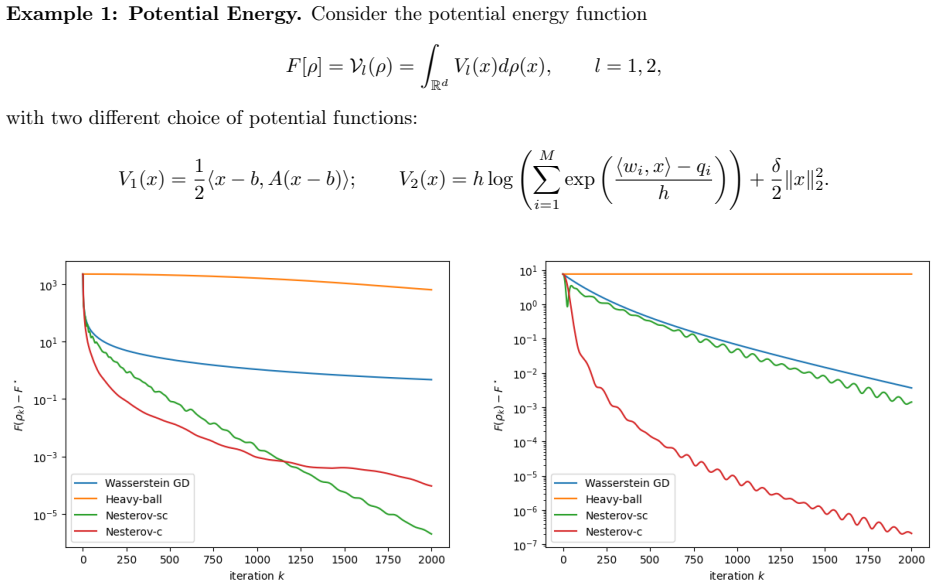
Summary. The paper proposes heavy-ball and Nesterov-type accelerated algorithms for minimizing functionals over the Wasserstein space P2(R^d). Two lifts are used: a phase-space lift adding velocity marginals, and an L2(ν) lift representing measures as pushforwards of a reference measure. The main theoretical results are Theorems 3.1–3.2, which claim that the continuous measure-level iterates converge at the Euclidean rates (1 + m/(16L))^{-k} (heavy-ball), (1 − √(m/L))^k (Nesterov, strongly convex), and O(1/k²) (Nesterov, convex). Theorem 3.3 bounds the particle approximation error by C e^{(3+L)t} N^{-1/d} for d > 4. The proofs reduce the measure-space update to a Euclidean Nesterov sequence in L2(ν) by invoking structural equivalences between geodesic convexity/smoothness of F and Hilbert-space convexity/smoothness of the lift eF (Propositions 2.3–2.4), cited to prior work. Numerical experiments on potential energies, regularized KL sampling, mean-field neural networks, and porous-media flow compare the proposed methods with Wasserstein gradient descent.
Significance. Should the results be correct, the paper would provide a conceptually clean template for momentum methods on P2 and the first end-to-end non-asymptotic guarantee tracking both iteration and particle number. The phase-space/L2 dual lift is attractive, and the finite-particle tracking argument in Theorem 3.3 is a simple and elegant Lipschitz-stability argument. The paper also presents numerical comparisons across four problems. However, the central structural Proposition 2.3 is not proved and is false for m > 0 as stated; since the convergence theorems rely on it, the advertised generality of the rates is not established. The contribution is therefore presently a heuristic algorithm with encouraging numerics, not a proven acceleration theory.
major comments (2)
- [§2.3 (Prop. 2.3); §3.2.1, proof of Thm. 3.2(i)] Proposition 2.3 (m > 0 direction) is internally inconsistent. For every measure-preserving map φ of (Ω,ν), eF(X∘φ)=eF(X). If eF were m-strongly convex on L2(ν), its minimizer X⋆ would be unique; invariance would force X⋆∘φ=X⋆ a.e. for all φ, hence X⋆ constant a.e. and ρ⋆=X⋆#ν a Dirac. Thus Prop. 2.3 can hold for m > 0 only when the minimizer of F is a Dirac. This contradicts the stated scope of Theorem 3.2(i) and excludes the regularized KL functional (4.1) used in Example 2, which has a non-Dirac minimizer. The proof at Eq. (3.24) therefore does not establish the claimed rate for general m-strongly geodesically convex F.
- [§2.3 (Prop. 2.3, m = 0 direction)] The m = 0 direction of Prop. 2.3 is also unproved. Definition 2.4 gives the convexity inequality only along optimal couplings, while (2.27) must hold for arbitrary X,Y ∈ L2(ν); the linear interpolation (1−t)X + tY is not an optimal coupling in general. No argument or precise quoted theorem is provided for this implication. This gap is independent of the m > 0 obstruction.
minor comments (5)
- [Thm. 3.3, Eq. (3.26)] The constant C is said to depend on dimension only, but the proof via Fournier–Guillin also depends on M3(µ0) and on the growth of the initial measure; these dependencies should be stated explicitly.
- [§4] The numerical experiments do not validate the N^{-1/d} particle rate. In Example 1, N=100 in d=500 gives N^{-1/d}≈0.99, so the bound is vacuous there; a scaling plot in N would be needed.
- [Thm. 3.3] The notation M3(µ0) is used without definition. Also, the bound (L')^{t/√s} ≤ e^{(3+L)t} in Eq. (3.34) absorbs an e^{2√s(L+1)t} factor into the constant; this should be acknowledged or s should be fixed.
- [§2.3, Props. 2.2–2.4] All three structural propositions are cited to prior papers without proofs or precise theorem numbers. For a self-contained journal submission, the exact statements and proofs (or precise references) should be included, especially because the main theorems rest on them.
- [§4, Example 1] The estimates m≈10^{-5} and L≈1 are asserted without derivation. Please specify how the strong-convexity and smoothness parameters are estimated in the experiments.
Circularity Check
Main rates depend on a load-bearing, unproved lift-convexity equivalence cited to a paper co-authored by the present authors; no fitted prediction or definitional tautology elsewhere.
specific steps
-
self citation load bearing
[Proposition 2.3 (Section 2.3), used in Proof of Theorem 3.2(i) (Section 3.2.1)]
"Proposition 2.3 (Gangbo and Mészáros [2022]). Let F and eF be defined according to (2.25), and assume F satisfies Assumption 2.1. Then F is m-geodesically convex on P2(R^d) if and only if eF is m-convex on L2(ν)."
This equivalence is the step that converts the nonlinear measure-space update into the Hilbert-space Nesterov sequence: the proof states 'By Proposition 2.3 and Proposition 2.4, the structural convexity and smoothness constants of F map identically to the lifted objective eF, enabling us to carry out the derivation via dimension-free optimization analysis.' The proposition is not proved in the manuscript; it is cited to Gangbo–Mészáros [2022], which shares an author with the present paper. Consequently the central convergence claim is not derived here but is forced by this imported equivalence: accept the self-cited bridge and the rates are exactly Nesterov's Euclidean theorem; reject it and the main theorem has no independent derivation in this paper.
full rationale
Apart from the load-bearing lift-convexity/smoothness equivalences cited to the authors' own prior work, the derivation is a direct and legitimate reduction: the phase-space measure update is pushed forward to L2(ν), where it is the standard Nesterov iteration, and the rates are then inherited from Nesterov's dimension-free theorem. The finite-particle bound is obtained from Lipschitz composition plus Fournier–Guillin empirical measure concentration, not from any fit. The numerical L/m estimates are standard parameter estimation and are not presented as predictions of the fitted quantities. The skeptical objection that Proposition 2.3(m>0) forces a Dirac minimizer under rearrangement invariance is a correctness concern about the cited equivalence, not a circularity of the present derivation; if true it would invalidate the theorem, not make it tautological. The self-citation is central rather than decorative, hence the score 4 rather than 0-2.
Axiom & Free-Parameter Ledger
free parameters (2)
- strong convexity constant m =
assumed known in the theorems; estimated from the potential in Section 4
- Lipschitz smoothness constant L =
assumed known in the theorems; estimated empirically in Section 4
axioms (7)
- domain assumption F is globally finite on P₂ and Wasserstein differentiable at every ρ (Assumption 2.1 (A1)(A2))
- ad hoc to paper The Wasserstein gradient is jointly (x,ρ)-Lipschitz: ∥∇W2F[ρ0](x)−∇W2F[ρ1](y)∥ ≤ (L/2)(∥x−y∥+W2(ρ0,ρ1)) (condition (2.30))
- domain assumption F is m-geodesically convex on P₂ if and only if the lifted eF is m-convex on L²(ν) (Proposition 2.3)
- domain assumption Condition (2.30) implies eF is L-smooth on L²(ν) (Proposition 2.4)
- domain assumption The lifted objective eF attains a minimizer X⋆ ∈ L²(ν)
- standard math Classical Nesterov convergence bounds hold in Hilbert spaces
- standard math Empirical-measure concentration: W₂(μ0,μ^N_0) ≤ C N^{−1/d} for d>4 (Fournier–Guillin)
read the original abstract
Optimization over probability measures has become an increasingly important paradigm in modern machine learning, scientific computing, and uncertainty quantification. Motivated by Nesterov's accelerated gradient method in Euclidean space, we develop Heavy-ball and Nesterov acceleration methods over the probability measure space $\mathcal{P}_2$ and establish non-asymptotic convergence guarantees that match their Euclidean counterparts. In particular, we derive convergence rates with respect to both the number of iterations and the number of particles used to represent the underlying probability distributions. Extending accelerated optimization from Euclidean space to probability measures is challenging. The natural notion of momentum requires concepts such as tangent bundles of the set of probability space and they are hard to operate numerically. To overcome these difficulties, we introduce two complementary lifting procedures. The first lifts probability measures to phase space through a Hamiltonian formulation, introducing momentum variables into the dynamics. The second lifts probability measures to a common Hilbert space, restoring the linear structure required for convergence analysis while simultaneously yielding executable particle dynamics. Together, these two complementary lifting procedures provide a systematic methodology for designing, analyzing, and implementing momentum-based accelerated optimization methods over probability measure spaces.
Figures


Reference graph
Works this paper leans on
-
[1]
and Mou, Chenchen and Zhang, Jianfeng , year=
Gangbo, Wilfrid and M\'esz\'aros, Alp\'ar R. and Mou, Chenchen and Zhang, Jianfeng , year=. Mean field games master equations with nonseparable Hamiltonians and displacement monotonicity , volume=. The Annals of Probability , publisher=. doi:10.1214/22-AOP1580 , number=
-
[2]
Gangbo, Wilfrid and M\'esz\'aros, Alp\'ar R. , year=. Global well-posedness of master equations for deterministic displacement convex potential mean field games , volume=. Communications on Pure and Applied Mathematics , publisher=. doi:10.1002/cpa.22069 , number=
-
[3]
The master equation and the convergence problem in mean field games , volume=
Cardaliaguet, Pierre and Delarue, Francois and Lasry, Jean-Michel and Lions, Pierre-Louis , year=. The master equation and the convergence problem in mean field games , volume=. Probability Theory and Related Fields , publisher=
-
[4]
2024 , eprint=
Parameterized Wasserstein Gradient Flow , author=. 2024 , eprint=
2024
-
[5]
2024 , eprint=
Numerical Analysis on Neural Network Projected Schemes for Approximating One Dimensional Wasserstein Gradient Flows , author=. 2024 , eprint=
2024
-
[6]
2023 , eprint=
Parameterized Wasserstein Hamiltonian Flow , author=. 2023 , eprint=
2023
-
[7]
International conference on machine learning , pages=
Variational inference with normalizing flows , author=. International conference on machine learning , pages=. 2015 , organization=
2015
-
[8]
On differentiability in the Wasserstein space and well-posedness for Hamilton–Jacobi equations , journal =. 2019 , issn =. doi:https://doi.org/10.1016/j.matpur.2018.09.003 , url =
-
[9]
Cavagnari, Giulia and Savar\'e, Giuseppe and Sodini, Giacomo Enrico , year=. Dissipative probability vector fields and generation of evolution semigroups in Wasserstein spaces , volume=. Probability Theory and Related Fields , publisher=. doi:10.1007/s00440-022-01148-7 , number=
-
[10]
2023 , eprint=
Some Convexity Criteria for Differentiable Functions on the 2-Wasserstein Space , author=. 2023 , eprint=
2023
-
[11]
Wright , title =
Shi Chen and Qin Li and Oliver Tse and Stephen J. Wright , title =. Journal of Machine Learning Research , year =
-
[12]
2025 , eprint=
A Lagrangian approach to totally dissipative evolutions in Wasserstein spaces , author=. 2025 , eprint=
2025
-
[13]
2025 , eprint=
Forward Euler for Wasserstein Gradient Flows: Breakdown and Regularization , author=. 2025 , eprint=
2025
-
[14]
2018 , eprint=
Understanding the Acceleration Phenomenon via High-Resolution Differential Equations , author=. 2018 , eprint=
2018
-
[15]
2013 , publisher=
Introductory lectures on convex optimization: A basic course , author=. 2013 , publisher=
2013
-
[16]
Wilson and Michael I
Andre Wibisono and Ashia C. Wilson and Michael I. Jordan , title =. Proceedings of the National Academy of Sciences , volume =. 2016 , doi =
2016
-
[17]
SIAM Journal on Optimization , volume =
Lessard, Laurent and Recht, Benjamin and Packard, Andrew , title =. SIAM Journal on Optimization , volume =. 2016 , doi =
2016
-
[18]
Some methods of speeding up the convergence of iteration methods , journal =. 1964 , issn =. doi:https://doi.org/10.1016/0041-5553(64)90137-5 , url =
-
[19]
Gradient Flows in Metric Spaces and in the Space of Probability Measures , edition =
Ambrosio, Luigi and Gigli, Nicola and Savar\'e, Giuseppe , file =. Gradient Flows in Metric Spaces and in the Space of Probability Measures , edition =
-
[20]
2009 , publisher=
Optimal Transport: Old and New , author=. 2009 , publisher=
2009
-
[21]
A differential equation for modeling Nesterov's accelerated gradient method: theory and insights , year =
Su, Weijie and Boyd, Stephen and Cand\`. A differential equation for modeling Nesterov's accelerated gradient method: theory and insights , year =. J. Mach. Learn. Res. , month = jan, pages =
-
[22]
arXiv preprint arXiv:2510.13640 , year=
The first Fundamental Theorem of Calculus for functions defined on Wasserstein space , author=. arXiv preprint arXiv:2510.13640 , year=
-
[23]
Probability Theory and Related Fields , volume =
Fournier, Nicolas and Guillin, Arnaud , title =. Probability Theory and Related Fields , volume =
-
[24]
A blob method for diffusion , journal =
Carrillo, Jos. A blob method for diffusion , journal =
-
[25]
Wright , title =
Zhiyan Ding and Shi Chen and Qin Li and Stephen J. Wright , title =. Journal of Machine Learning Research , year =
-
[26]
Journal of Machine Learning Research , year =
Yuchen Li and Laura Balzano and Deanna Needell and Hanbaek Lyu , title =. Journal of Machine Learning Research , year =
-
[27]
and Seiringer, Robert , year=
Lieb, Elliott H. and Seiringer, Robert , year=. The Stability of Matter in Quantum Mechanics , publisher=
-
[28]
Journal of Physics: Condensed Matter , abstract =
Evans, Robert and Oettel, Martin and Roth, Roland and Kahl, Gerhard , title =. Journal of Physics: Condensed Matter , abstract =. doi:10.1088/0953-8984/28/24/240401 , year =
-
[29]
Morrison, Philip J , year=
-
[30]
Mathematical Methods in the Applied Sciences , volume =
Rein, Gerhard , title =. Mathematical Methods in the Applied Sciences , volume =. doi:10.1002/mma.1670171404 , year =
-
[31]
From Optimization to Sampling Through Gradient Flows , journal =
Garc. From Optimization to Sampling Through Gradient Flows , journal =. 2023 , volume =. doi:10.1090/noti2708 , publisher =
-
[32]
SIAM Journal on Mathematical Analysis , volume =
Rein, Gerhard , title =. SIAM Journal on Mathematical Analysis , volume =. 2001 , doi =
2001
-
[33]
2013 , publisher =
Theory of Simple Liquids , author =. 2013 , publisher =
2013
-
[34]
Gradient flows in metric spaces and in the space of probability measures , publisher=
Ambrosio, Luigi and Gigli, Nicola and Savare\'e, Giuseppe , year=. Gradient flows in metric spaces and in the space of probability measures , publisher=
-
[35]
Journal of Machine Learning Research , year =
Rentian Yao and Xiaohui Chen and Yun Yang , title =. Journal of Machine Learning Research , year =
-
[36]
Journal of Differential Equations , volume =. 2020 , issn =. doi:10.1016/j.jde.2019.08.046 , author =
-
[37]
Bulletin of the London Mathematical Society , volume =
Parker, Guy , title =. Bulletin of the London Mathematical Society , volume =
-
[38]
SIAM Journal on Optimization , volume =
Lavenant, Hugo and Zanella, Giacomo , title =. SIAM Journal on Optimization , volume =. 2024 , doi =
2024
-
[39]
SIAM Journal on Numerical Analysis , volume =
Wu, Hao and Liu, Shu and Ye, Xiaojing and Zhou, Haomin , title =. SIAM Journal on Numerical Analysis , volume =. 2025 , doi =
2025
-
[40]
and Recht, Benjamin , year=
Wright, Stephen J. and Recht, Benjamin , year=. Optimization for Data Analysis , publisher=
-
[41]
Stephen J. Wright , title =. Mathematical Programming , year =. doi:10.1007/s10107-015-0892-3 , issn =
-
[42]
Linear Convergence of Gradient and Proximal-Gradient Methods Under the
Karimi, Hamed and Nutini, Julie and Schmidt, Mark , editor =. Linear Convergence of Gradient and Proximal-Gradient Methods Under the. Machine Learning and Knowledge Discovery in Database , year=
-
[43]
Foundations and Trends in Optimization , volume =
Parikh, Neal and Boyd, Stephen , title =. Foundations and Trends in Optimization , volume =. 2014 , month =
2014
-
[44]
SIAM Journal on Optimization , volume =
Chorobura, Flavia and Necoara, Ion , title =. SIAM Journal on Optimization , volume =. 2023 , doi =
2023
-
[45]
Mathematical Programming , year =
Peter Richtárik and Martin Takáč , title =. Mathematical Programming , year =. doi:10.1007/s10107-012-0614-z , issn =
-
[46]
Optimization in High Dimensions via Accelerated, Parallel, and Proximal Coordinate Descent , journal =
Fercoq, Olivier and Richt\'. Optimization in High Dimensions via Accelerated, Parallel, and Proximal Coordinate Descent , journal =. 2016 , doi =
2016
-
[47]
Salim, Adil and Korba, Anna and Luise, Giulia , booktitle =. The
-
[48]
Random Coordinate Underdamped
Ding, Zhiyan and Li, Qin and Lu, Jianfeng and Wright, Stephen , booktitle =. Random Coordinate Underdamped. 2021 , editor =
2021
-
[49]
2025 , eprint=
Guaranteeing Higher Order Convergence Rates for Accelerated Wasserstein Gradient Flow Schemes , author=. 2025 , eprint=
2025
-
[50]
Journal of Scientific Computing , volume =
Yifei Wang and Wuchen Li , title =. Journal of Scientific Computing , volume =. 2021 , doi =
2021
-
[51]
Nabarun Deb and Young-Heon Kim and Soumik Pal and Geoffrey Schiebinger , year=. 2307.16421 , archivePrefix=
-
[52]
SIAM Journal on Mathematical Analysis , volume =
Jordan, Richard and Kinderlehrer, David and Otto, Felix , title =. SIAM Journal on Mathematical Analysis , volume =. 1998 , doi =
1998
-
[53]
Mirror and Preconditioned Gradient Descent in
Bonet, Cl\'. Mirror and Preconditioned Gradient Descent in. Advances in Neural Information Processing Systems , editor =
-
[54]
The back-and-forth method for
Jacobs, Matt and Lee, Wonjun and L. The back-and-forth method for. ESAIM: Control, Optimisation and Calculus of Variations , year =
-
[55]
Mathematics of Computation , shortjournal =
Sampling via gradient flows in the space of probability measures , author =. Mathematics of Computation , shortjournal =. 2026 , doi =
2026
-
[56]
Stochastic Processes and their Applications , volume =
Solving a class of. Stochastic Processes and their Applications , volume =. 2024 , issn =. doi:https://doi.org/10.1016/j.spa.2024.104374 , author =
arXiv 2024
-
[57]
Computing Optimal Transport Plans via Min-Max Gradient Flows , year=
Conger, Lauren and Hoffmann, Franca and Baptista, Ricardo and Mazumdar, Eric , booktitle=. Computing Optimal Transport Plans via Min-Max Gradient Flows , year=
-
[58]
Lauren Conger and Franca Hoffmann and Eric Mazumdar and Lillian J. Ratliff , year=. Coupled. 2411.07403 , archivePrefix=
-
[59]
Conditional simulation via entropic optimal transport: Toward non-parametric estimation of conditional
Baptista, Ricardo and Pooladian, Aram-Alexandre and Brennan, Michael and Marzouk, Youssef and Niles-Weed, Jonathan , booktitle =. Conditional simulation via entropic optimal transport: Toward non-parametric estimation of conditional. 2025 , editor =
2025
-
[60]
Statistical Science , number =
Jeremy Heng and Valentin De Bortoli and Arnaud Doucet , title =. Statistical Science , number =. 2024 , doi =
2024
-
[61]
NeurIPS 2023 Workshop Optimal Transport and Machine Learning , year=
A generative flow model for conditional sampling via optimal transport , author=. NeurIPS 2023 Workshop Optimal Transport and Machine Learning , year=
2023
-
[62]
Variational and Information Flows in Machine Learning and Optimal Transport , series =
Wuchen Li and Bernhard Schmitzer and Gabriele Steidl and Fran. Variational and Information Flows in Machine Learning and Optimal Transport , series =. 2025 , doi =
2025
-
[63]
Accelerated, Parallel, and Proximal Coordinate Descent , journal =
Fercoq, Olivier and Richt\'. Accelerated, Parallel, and Proximal Coordinate Descent , journal =. 2015 , doi =
2015
-
[64]
Proceedings of the National Academy of Sciences , volume =
Song Mei and Andrea Montanari and Phan-Minh Nguyen , title =. Proceedings of the National Academy of Sciences , volume =. 2018 , doi =
2018
-
[65]
, title =
Nesterov, Yu. , title =. SIAM Journal on Optimization , volume =. 2012 , doi =
2012
-
[66]
Craig, Katy and Liu, Jian-Guo and Lu, Jianfeng and Marzuola, Jeremy L. and Wang, Li , title =. Numerische Mathematik , year =. doi:10.1007/s00211-022-01320-0 , issn =
-
[67]
and Richt\'
Chambolle, Antonin and Ehrhardt, Matthias J. and Richt\'. Stochastic Primal-Dual Hybrid Gradient Algorithm with Arbitrary Sampling and Imaging Applications , journal =. 2018 , doi =
2018
-
[68]
Carrillo, Jos\'e Antonio and Craig, Katy and Patacchini, Francesco S. , title =. Calculus of Variations and Partial Differential Equations , year =. doi:10.1007/s00526-019-1486-3 , issn =
-
[69]
First-Order Conditions for Optimization in the
Lanzetti, Nicolas and Bolognani, Saverio and D\". First-Order Conditions for Optimization in the. SIAM Journal on Mathematics of Data Science , volume =. 2025 , doi =
2025
-
[70]
29th Annual Conference on Learning Theory , pages =
First-order Methods for Geodesically Convex Optimization , author =. 29th Annual Conference on Learning Theory , pages =. 2016 , editor =
2016
-
[71]
, title =
Lee, John M. , title =. 2018 , doi =
2018
-
[72]
Annali della Scuola Normale Superiore di Pisa - Classe di Scienze, Serie 5 , year =
Kloeckner, Benoît , title =. Annali della Scuola Normale Superiore di Pisa - Classe di Scienze, Serie 5 , year =
-
[73]
2010 , address =
Dahl, Jonathan , title =. 2010 , address =
2010
-
[74]
doi:10.1088/1361-6544/acf988 , year =
Lu, Yulong and Slepčev, Dejan and Wang, Lihan , title =. doi:10.1088/1361-6544/acf988 , year =
-
[75]
Statistical Optimal Transport , subtitle =
Chewi, Sinho and Niles-Weed, Jonathan and Rigollet, Philippe , year =. Statistical Optimal Transport , subtitle =. doi:10.1007/978-3-031-85160-5 , isbn =
-
[76]
and Mahony, Robert and Sepulchre, Rodolphe , title =
Absil, P.-A. and Mahony, Robert and Sepulchre, Rodolphe , title =. 2008 , isbn =
2008
-
[77]
Ferreira, O. P. and Louzeiro, M. S. and Prudente, L. F. , title =. SIAM Journal on Optimization , volume =. 2019 , doi =
2019
-
[78]
2024 , eprint=
Convergence of coordinate ascent variational inference for log-concave measures via optimal transport , author=. 2024 , eprint=
2024
-
[79]
Annales de l'Institut Henri Poincar\'e, Probabilit\'es et Statistiques , number =
Daniel Lacker , title =. Annales de l'Institut Henri Poincar\'e, Probabilit\'es et Statistiques , number =. 2026 , doi =
2026
-
[80]
Randomized Coordinate Descent Methods for Big Data Optimization , school =
Tak. Randomized Coordinate Descent Methods for Big Data Optimization , school =. 2014 , address =
2014
discussion (0)
Sign in with ORCID, Apple, or X to comment. Anyone can read and Pith papers without signing in.