REVIEW 5 major objections 6 minor 34 references
Point-LN: A Lightweight Framework for Efficient Point Cloud Classification Using Non-Parametric Positional Encoding
T0 review · 5 major / 6 minor · reviewed 2026-08-10 · deepseek-v4-flash
Pith's one-line read Point-LN claims a 0.8M-parameter point-cloud classifier can match a 12.6M-parameter network.
desk verdict Point-LN is a plausible but thinly documented hybrid of existing non-parametric encoders plus a small learned classifier, and the paper's own equations don't support the prose describing the core mechanism. read the letter →
The pith
A machine-rendered reading of the paper's core claim, the machinery that carries it, and where it could break.
The reading
What carries the argument
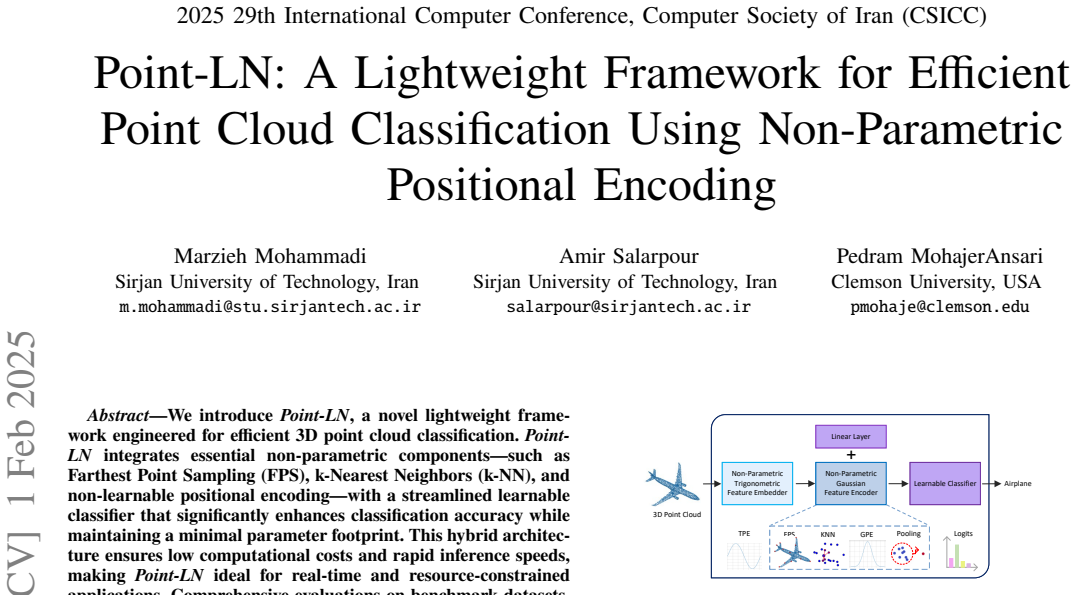
The load-bearing mechanism is the pair of non-parametric positional encodings placed around local neighborhood aggregation. Trigonometric Positional Encoding (TPE) maps each point's Cartesian coordinates through sine and cosine functions at multiple frequencies, giving an initial geometric embedding that passes through one linear layer. Gaussian Positional Encoding (GPE) maps coordinates against fixed reference points with a Gaussian kernel and is used inside each of the four encoder stages after k-NN grouping; the paper describes an element-wise combination of the Gaussian-encoded geometry with the gathered neighbor features, followed by mean and max pooling to produce permutation-invariant descriptors. The descriptors from all stages are concatenated and fed to the small learned classifier.
What would settle it
Run the architecture exactly as Eq. (11) is printed—updating each gathered feature set by adding the squared Gaussian encoding of the neighbor coordinates, with no fusion of the gathered neighbor features—on ModelNet40 and check whether it reaches 94.0%; comparing that run with the text's described element-wise fusion of $\gamma(P_j)$ with $F_j$ would settle whether the printed formula is the source of the reported accuracy. A reader could also inspect the released code to see which operation is actually implemented.
Extended reading notes
Core claim
The central claim is that a mostly non-parametric encoder—FPS for downsampling, k-NN for local grouping, trigonometric positional encoding at the input, and Gaussian positional encoding inside each local aggregation stage—can produce feature representations good enough for a small linear classifier to reach accuracies that larger parametric models achieve with an order of magnitude more parameters. The paper asserts that this design captures both local and global geometric structure without learned feature extraction, and that the small learned component, about 0.8M parameters, is enough to map those representations to class labels. On ModelNet40 the reported accuracy is 94.0%, and on ScanObjectNN every subset is higher than the comparable Point-PN and the much larger PointMLP.
Load-bearing premise
The load-bearing premise is that Eq. (11) faithfully describes the aggregation actually run: the printed update adds the squared Gaussian-encoded neighbor coordinates to the feature set and never fuses the gathered neighbor features, so if that formula is a typo the reported accuracies cannot be attributed to the architecture as written.
Editorial extensions
If this is right
- If the reported numbers are correct, classification at 94.0% on ModelNet40 no longer requires a 12.6M-parameter network; a 0.8M-parameter model is within 0.1 points.
- On the noisy, occluded ScanObjectNN subsets, the method reports higher accuracy than large parametric baselines, suggesting the fixed geometric encoding is especially helpful when the input is imperfect.
- A mostly non-parametric encoder plus a linear head could make point-cloud classification practical on embedded and real-time systems, since the expensive feature extraction has no weights to store or update.
- The architecture's four stages with mixed mean and max pooling give a template for building lightweight multi-scale encoders from sampling and positional encoding alone.
- The paper's stated future direction—extending the encoder to segmentation and detection—is a direct test of whether the same fixed geometric features transfer beyond classification.
Reading between the lines
- Editorial inference: if Eq. (11) is a typo and the intended operation fuses $\gamma(P_j)$ with the gathered neighbor features $F_j$, then the reported accuracies depend on that fusion; a reader reproducing the paper's formula as printed would not be running the architecture the text describes.
- Editorial inference: the comparison in Table I lumps all learned parameters together, but the reported 0.8M includes linear layers at each stage plus the classifier; the core geometric encoder is non-parametric, so the headline accuracy should be attributed to the whole hybrid rather than to non-parametric encoding alone.
- Editorial inference: a direct ablation—removing the Gaussian positional encoding from the aggregation and retraining—would quantify how much of the 94.0% comes from the fixed geometry term versus the linear layers; the paper does not report such an ablation.
- Editorial inference: a natural testable extension is to apply the same encoder to part segmentation, where per-point labels require a denser output head; if the fixed GPE features carry enough geometry, the model should transfer with only a small head retrained.
Signed reviews
Editorial analysis
A structured set of objections, weighed in public.
Referee Report
Summary. Point-LN is a point-cloud classification architecture that combines non-parametric trigonometric and Gaussian positional encodings (TPE and GPE) with a small number of linear layers and a lightweight classifier. The feature encoder performs FPS downsampling, k-NN grouping, GPE-based local aggregation, and multi-stage mean/max pooling. On ModelNet40, the method reports 94.0% accuracy with 0.8M parameters; on ScanObjectNN it reports 92.2/92.1/91.7% on OBJ-BG/OBJ-ONLY/PB-T50-RS, the last being 4.6 points above the closely related Point-PN baseline. The paper concludes that a mostly non-parametric geometric encoder plus a slim learnable head can match or exceed much larger parametric models.
Significance. If the reported numbers are reproducible, the result is practically significant: a 0.8M-parameter model matching PointMLP on ModelNet40 and exceeding it on ScanObjectNN would be a strong accuracy/efficiency trade-off. The design is simple, builds on public components, and is evaluated on two standard benchmarks, with code made available. However, the contribution is incremental relative to Point-NN/Point-PN, and the load-bearing equations and missing experimental details currently prevent the reader from attributing the reported accuracy to the architecture as described. The efficiency claim is supported only by parameter counts, not by runtime, FLOPs, or latency measurements.
major comments (5)
- [Section III-C.3, Eq. (11)] The prose states that "spatially encoded features are combined with the neighborhood features through element-wise multiplication," but Eq. (11) gives F_j ← F_j + γ(P_j) ⊙ γ(P_j). Taken literally, the update adds a coordinate-only bias; the gathered neighbor features F_j are neither multiplied nor gated by γ(P_j). If the code implements Eq. (11), the GPE aggregation does not fuse neighbor features with the geometric encoding, so the reported accuracies cannot be attributed to the described architecture. If this is a typo, the intended operation (for example F_j ← F_j ⊙ γ(P_j) or F_j ← F_j + γ(P_j)) must be stated explicitly and matched to the released code.
- [Section III-B, Eq. (5)] The Gaussian positional encoding uses exponents ||x_i^2 − v_j||^2, ||y_i^2 − v_j||^2, and ||z_i^2 − v_j||^2. The standard GPE used in Point-GN and in the text's description is exp(−||x_i − v_j||^2/(2σ^2)); squaring the coordinate before subtracting v_j changes the radial profile and the reference-point semantics. Please correct the equation or explicitly justify the squared-coordinate variant and align it with the code.
- [Section IV-A, Experimental Setup] The setup section describes only the GPU. The paper never reports the values of α, β, σ, V, K, C_I, the number of FPS stages, the hidden dimensions of the per-stage linear layers, the training epochs, batch size, optimizer, learning rate, weight decay, or data-augmentation settings. Without these values, the experiments cannot be reproduced and the claimed efficiency cannot be quantified. Please supply a full configuration table or appendix.
- [Section IV-D, Table II] Point-LN improves over Point-PN by 1.2, 1.9, and 4.6 points on OBJ-BG, OBJ-ONLY, and PB-T50-RS. Because Point-PN already contains the trigonometric encoding and a learnable classifier, the source of the gain is not identified. An ablation study that removes or replaces the GPE aggregation, the per-stage linear layers, and the multi-stage FPS/k-NN pipeline is needed to support the claim that the proposed architecture, rather than unintended implementation details, produces these results.
- [Title, Abstract, and Section IV] The paper repeatedly claims "low computational costs" and "rapid inference speeds," but reports only parameter counts. No FLOPs, training time, inference latency, or throughput are provided, and the results were obtained on an RTX 4090. Please add efficiency measurements so the lightweight claim can be evaluated directly.
minor comments (6)
- [Section III-B, Eq. (3)] The index n and its range are not defined; specify n = 0, ..., C_I/6 − 1 (or the equivalent) and clarify how the C_I dimensions are split among the three coordinate axes.
- [Section III-A and III-C] The Introduction states that the network extracts features "without relying on learnable parameters for feature extraction," yet the initial embedding and the per-stage linear layers in Section III-C are learnable. Rephrase to say that the geometric encodings are non-parametric and that the learnable linear layers are kept very small.
- [Section IV-D] The statement that Point-LN achieves "state-of-the-art accuracy across all subsets" is an overclaim, as the comparison table omits several recent strong baselines on ScanObjectNN. Please qualify the statement to match the methods actually compared.
- [Section III-C.2] The normalization of gathered coordinates and features is described only verbally. Provide the exact normalization formula or cite the specific operation used in Point-NN/Point-GN so that the preprocessing is unambiguous.
- [Section III-B, Eq. (5)] The reference points v_j are not defined. Specify their range and spacing (e.g., a uniform grid over the normalized coordinate range) and how V is chosen in the experiments.
- [Throughout] There are several typos and grammatical issues, including "non-parameteric" (Section III), "we also, we evaluate" (Section IV-D), and inconsistent spacing around equations. A careful proofread is needed.
Circularity Check
No significant circularity: Point-LN is an empirical hybrid architecture evaluated on external benchmarks; the only self-citation (Point-GN) supplies a building block, not a validation source.
full rationale
The paper's central claim is that a lightweight encoder combining non-parametric FPS, k-NN, TPE/GPE, and a small linear classifier reaches 94.0% on ModelNet40 and 91.7-92.2% on ScanObjectNN. This claim is supported by experiments against external benchmarks and published baselines, not by deriving the result from its own assumptions. The GPE is attributed to the authors' prior Point-GN (ref [16]), but that self-citation is used only to identify the encoding scheme; the reported accuracy is measured on independent datasets and compared with PointMLP, PointNet++, DGCNN, and other published methods, so the citation is not load-bearing. No prediction is obtained by fitting then renaming a fit; no uniqueness theorem from the authors' prior work is invoked; no known result is merely renamed as a new contribution. The internal inconsistency in Eq. (11) (the written update F_j <- F_j + gamma(P_j) ⊙ gamma(P_j) does not multiply by the gathered features despite the prose saying element-wise multiplication) is a correctness and reproducibility concern, not a circularity: it does not make the output equal to the input by construction, and it does not reduce the reported benchmark numbers to a fitted parameter. Accordingly, the circularity score is low.
Assumptions & free parameters
free parameters (7)
- alpha (TPE scale) =
not reported
- beta (TPE wavelength) =
not reported
- sigma (GPE standard deviation) =
not reported
- V (number of reference points per axis for GPE) =
not reported
- K (nearest neighbors) =
not reported
- C_I (initial feature dimension) =
not reported
- number of stages =
4
assumptions (3)
- domain assumption FPS and k-NN provide a meaningful local grouping of unordered point clouds without learned parameters.
- standard math Mean and max pooling preserve permutation invariance and sufficient information for classification.
- ad hoc to paper Combining TPE and GPE with per-stage linear layers increases representational power without a dedicated mechanism.
Cite this review
Pith. "Pith review of Point-LN: A Lightweight Framework for Efficient Point Cloud Classification Using Non-Parametric Positional Encoding." pith.science (2026). https://pith.science/paper/K243H4CZ
@misc{pith2026250114238,
  author       = {Pith},
  title        = {Pith review of: Point-LN: A Lightweight Framework for Efficient Point Cloud Classification Using Non-Parametric Positional Encoding},
  year         = {2026},
  howpublished = {\url{https://pith.science/paper/K243H4CZ}},
  note         = {Machine review of arXiv:2501.14238}
}
read the original abstract
We introduce Point-LN, a novel lightweight framework engineered for efficient 3D point cloud classification. Point-LN integrates essential non-parametric components-such as Farthest Point Sampling (FPS), k-Nearest Neighbors (k-NN), and non-learnable positional encoding-with a streamlined learnable classifier that significantly enhances classification accuracy while maintaining a minimal parameter footprint. This hybrid architecture ensures low computational costs and rapid inference speeds, making Point-LN ideal for real-time and resource-constrained applications. Comprehensive evaluations on benchmark datasets, including ModelNet40 and ScanObjectNN, demonstrate that Point-LN achieves competitive performance compared to state-of-the-art methods, all while offering exceptional efficiency. These results establish Point-LN as a robust and scalable solution for diverse point cloud classification tasks, highlighting its potential for widespread adoption in various computer vision applications.
Figures

Reference graph
Works this paper leans on
-
[1]
L. Zhang, L. Sun, W. Li, J. Zhang, W. Cai, C. Cheng, and X. Ning, “A joint bayesian framework based on partial least squares discriminant analysis for finger vein recognition,”IEEE Sensors Journal, vol. 22, no. 1, pp. 785–794, 2021
work page 2021
-
[2]
Hcfnn: high- order coverage function neural network for image classification,
X. Ning, W. Tian, Z. Yu, W. Li, X. Bai, and Y. Wang, “Hcfnn: high- order coverage function neural network for image classification,”Pattern Recognition, vol. 131, p. 108873, 2022
work page 2022
-
[3]
Jwsaa: joint weak saliency and attention aware for person re-identification,
X. Ning, K. Gong, W. Li, and L. Zhang, “Jwsaa: joint weak saliency and attention aware for person re-identification,”Neurocomputing, vol. 453, pp. 801–811, 2021
work page 2021
-
[4]
Long-term estimation of human spatial interactions through multiple laser ranging sensors,
A. Salarpour, H. Khotanlou, and N. Mavridis, “Long-term estimation of human spatial interactions through multiple laser ranging sensors,” in 2014 International Conference on Robotics and Emerging Allied Technologies in Engineering (iCREATE). IEEE, 2014, pp. 109–114
work page 2014
-
[5]
Beyond triplet loss: person re-identification with fine-grained difference-aware pairwise loss,
C. Yan, G. Pang, X. Bai, C. Liu, X. Ning, L. Gu, and J. Zhou, “Beyond triplet loss: person re-identification with fine-grained difference-aware pairwise loss,” IEEE Transactions on Multimedia, vol. 24, pp. 1665– 1677, 2021
work page 2021
-
[6]
A camera and lidar data fusion method for railway object detection,
W. Zhangyu, Y. Guizhen, W. Xinkai, L. Haoran, and L. Da, “A camera and lidar data fusion method for railway object detection,”IEEE Sensors Journal, vol. 21, no. 12, pp. 13442–13454, 2021
work page 2021
-
[7]
B. Yang, R. Huang, J. Li, M. Tian, W. Dai, and R. Zhong, “Automated reconstruction of building lods from airborne lidar point clouds using an improved morphological scale space,”Remote Sensing, vol. 9, no. 1, p. 14, 2016
work page 2016
-
[8]
Discov- ering new shadow patterns for black-box attacks on lane detection of autonomous vehicles,
P. MohajerAnsari, A. Domeke, J. de Voor, A. Mitra, G. Johnson, A. Salarpour, H. Olufowobi, M. Hamad, and M. D. Pesé, “Discov- ering new shadow patterns for black-box attacks on lane detection of autonomous vehicles,”arXiv preprint arXiv:2409.18248, 2024
arXiv 2024
Show all 34 references
-
[9]
Wip: A first look at employing large multimodal models against autonomous vehicle attacks,
M. Aldeen, P. MohajerAnsari, J. Ma, M. Chowdhury, L. Cheng, and M. D. Pesé, “Wip: A first look at employing large multimodal models against autonomous vehicle attacks,” inISOC Symposium on Vehicle Security and Privacy (VehicleSec ’24), 2024
2024
-
[10]
An initial exploration of employing large multimodal models in defending against autonomous vehicles attacks,
M. Aldeen, P. MohajerAnsari, J. Ma, M. Chowdhury, L. Cheng, and M. D. Pesé, “An initial exploration of employing large multimodal models in defending against autonomous vehicles attacks,” in2024 IEEE Intelligent Vehicles Symposium (IV), 2024, pp. 3334–3341
2024
-
[11]
Pointnet: Deep learning on point sets for 3d classification and segmentation,
C. R. Qi, H. Su, K. Mo, and L. J. Guibas, “Pointnet: Deep learning on point sets for 3d classification and segmentation,” inProceedings of the IEEE conference on computer vision and pattern recognition, 2017, pp. 652–660
2017
-
[12]
Pointnet++: Deep hierarchical feature learning on point sets in a metric space,
C. R. Qi, L. Yi, H. Su, and L. J. Guibas, “Pointnet++: Deep hierarchical feature learning on point sets in a metric space,”Advances in neural information processing systems, vol. 30, 2017
2017
-
[13]
Pointconv: Deep convolutional networks on 3d point clouds,
W. Wu, Z. Qi, and L. Fuxin, “Pointconv: Deep convolutional networks on 3d point clouds,” inProceedings of the IEEE/CVF Conference on computer vision and pattern recognition, 2019, pp. 9621–9630
2019
-
[14]
Rethinking network design and local geometry in point cloud: A simple residual mlp framework,
X. Ma, C. Qin, H. You, H. Ran, and Y. Fu, “Rethinking network design and local geometry in point cloud: A simple residual mlp framework,” arXiv preprint arXiv:2202.07123, 2022
2022 arXiv
-
[15]
Parameter is not all you need: Starting from non-parametric networks for 3d point cloud analysis,
R. Zhang, L. Wang, Z. Guo, Y. Wang, P. Gao, H. Li, and J. Shi, “Parameter is not all you need: Starting from non-parametric networks for 3d point cloud analysis,”arXiv preprint arXiv:2303.08134, 2023
2023 arXiv
-
[16]
Point-gn: A non-parametric network using gaussian positional encoding for point cloud classification,
M. Mohammadi and A. Salarpour, “Point-gn: A non-parametric network using gaussian positional encoding for point cloud classification,”arXiv preprint arXiv:2412.03056, 2024
2024 arXiv
-
[17]
3d shapenets: A deep representation for volumetric shapes,
Z. Wu, S. Song, A. Khosla, F. Yu, L. Zhang, X. Tang, and J. Xiao, “3d shapenets: A deep representation for volumetric shapes,” inProceedings of the IEEE conference on computer vision and pattern recognition, 2015, pp. 1912–1920
2015
-
[18]
Re- visiting point cloud classification: A new benchmark dataset and clas- sification model on real-world data,
M. A. Uy, Q.-H. Pham, B.-S. Hua, T. Nguyen, and S.-K. Yeung, “Re- visiting point cloud classification: A new benchmark dataset and clas- sification model on real-world data,” inProceedings of the IEEE/CVF international conference on computer vision, 2019, pp. 1588–1597
2019
-
[19]
Gift: A real- time and scalable 3d shape search engine,
S. Bai, X. Bai, Z. Zhou, Z. Zhang, and L. Jan Latecki, “Gift: A real- time and scalable 3d shape search engine,” inProceedings of the IEEE conference on computer vision and pattern recognition, 2016, pp. 5023– 5032
2016
-
[20]
Mvtn: Multi-view transforma- tion network for 3d shape recognition,
A. Hamdi, S. Giancola, and B. Ghanem, “Mvtn: Multi-view transforma- tion network for 3d shape recognition,” inProceedings of the IEEE/CVF International Conference on Computer Vision, 2021, pp. 1–11
2021
-
[21]
Voxelnet: End-to-end learning for point cloud based 3d object detection,
Y. Zhou and O. Tuzel, “Voxelnet: End-to-end learning for point cloud based 3d object detection,” inProceedings of the IEEE conference on computer vision and pattern recognition, 2018, pp. 4490–4499
2018
-
[22]
Fpnn: Field probing neural networks for 3d data,
Y. Li, S. Pirk, H. Su, C. R. Qi, and L. J. Guibas, “Fpnn: Field probing neural networks for 3d data,”Advances in neural information processing systems, vol. 29, 2016
2016
-
[23]
Multi-view convolutional neural networks for 3d shape recognition,
H. Su, S. Maji, E. Kalogerakis, and E. Learned-Miller, “Multi-view convolutional neural networks for 3d shape recognition,” inProceedings of the IEEE international conference on computer vision, 2015, pp. 945– 953
2015
-
[24]
Voxnet: A 3d convolutional neural net- work for real-time object recognition,
D. Maturana and S. Scherer, “Voxnet: A 3d convolutional neural net- work for real-time object recognition,” in2015 IEEE/RSJ international conference on intelligent robots and systems (IROS). IEEE, 2015, pp. 922–928
2015
-
[25]
Pointcnn: Convolution on x-transformed points,
Y. Li, R. Bu, M. Sun, W. Wu, X. Di, and B. Chen, “Pointcnn: Convolution on x-transformed points,”Advances in neural information processing systems, vol. 31, 2018
2018
-
[26]
Kpconv: Flexible and deformable convolution for point clouds,
H. Thomas, C. R. Qi, J.-E. Deschaud, B. Marcotegui, F. Goulette, and L. J. Guibas, “Kpconv: Flexible and deformable convolution for point clouds,” in Proceedings of the IEEE/CVF international conference on computer vision, 2019, pp. 6411–6420
2019
-
[27]
Point-planenet: Plane kernel based convolutional neural network for point clouds analysis,
S. M. Peyghambarzadeh, F. Azizmalayeri, H. Khotanlou, and A. Salarpour, “Point-planenet: Plane kernel based convolutional neural network for point clouds analysis,”Digital Signal Processing, vol. 98, p. 102633, 2020
2020
-
[28]
Pointngcnn: Deep convolutional networks on 3d point clouds with neighborhood graph filters,
Q. Lu, C. Chen, W. Xie, and Y. Luo, “Pointngcnn: Deep convolutional networks on 3d point clouds with neighborhood graph filters,”Comput- ers & Graphics, vol. 86, pp. 42–51, 2020
2020
-
[29]
Dynamic graph cnn for learning on point clouds,
Y. Wang, Y. Sun, Z. Liu, S. E. Sarma, M. M. Bronstein, and J. M. Solomon, “Dynamic graph cnn for learning on point clouds,” ACM Transactions on Graphics (tog), vol. 38, no. 5, pp. 1–12, 2019
2019
-
[30]
Modeling point clouds with self-attention and gumbel subset sampling,
J. Yang, Q. Zhang, B. Ni, L. Li, J. Liu, M. Zhou, and Q. Tian, “Modeling point clouds with self-attention and gumbel subset sampling,” in Proceedings of the IEEE/CVF conference on computer vision and pattern recognition, 2019, pp. 3323–3332
2019
-
[31]
Point transformer,
N. Engel, V. Belagiannis, and K. Dietmayer, “Point transformer,”IEEE access, vol. 9, pp. 134826–134840, 2021
2021
-
[32]
Attention is all you need,
A. Vaswani, “Attention is all you need,”Advances in Neural Information Processing Systems, 2017
2017
-
[33]
Geometric back-projection net- work for point cloud classification,
S. Qiu, S. Anwar, and N. Barnes, “Geometric back-projection net- work for point cloud classification,”IEEE Transactions on Multimedia, vol. 24, pp. 1943–1955, 2021
1943
-
[34]
Walk in the cloud: Learning curves for point clouds shape analysis,
T. Xiang, C. Zhang, Y. Song, J. Yu, and W. Cai, “Walk in the cloud: Learning curves for point clouds shape analysis,” inProceedings of the IEEE/CVF international conference on computer vision, 2021, pp. 915– 924
2021
Reviewed August 10, 2026 · model on record in the stance chip above.
Discussion (0). Continue with ORCID to comment.