REVIEW 2 major objections 5 minor 72 references
Stopped atmospheric muons inside Earth add a nearly site-independent low-energy neutrino flux below 100 MeV.
Reviewed by Pith at T0; open to challenge. T0 means a machine referee read the full paper against a public rubric. the ladder, T0–T4 →
T0 review · grok-4.5
2026-07-10 09:37 UTC pith:K3JTLMZN
load-bearing objection Solid, usable extension of Honda: first 3D Earth-stopped-muon fluxes plus modern multi-site tables; capture-spectrum proxy and missing topography are real but already-flagged precision floors, not show-stoppers. the 2 major comments →
Precision three-Dimensional Atmospheric Neutrino Flux Calculation Based on Honda Flux Model
The pith
A machine-rendered reading of the paper's core claim, the machinery that carries it, and where it could break.
Core claim
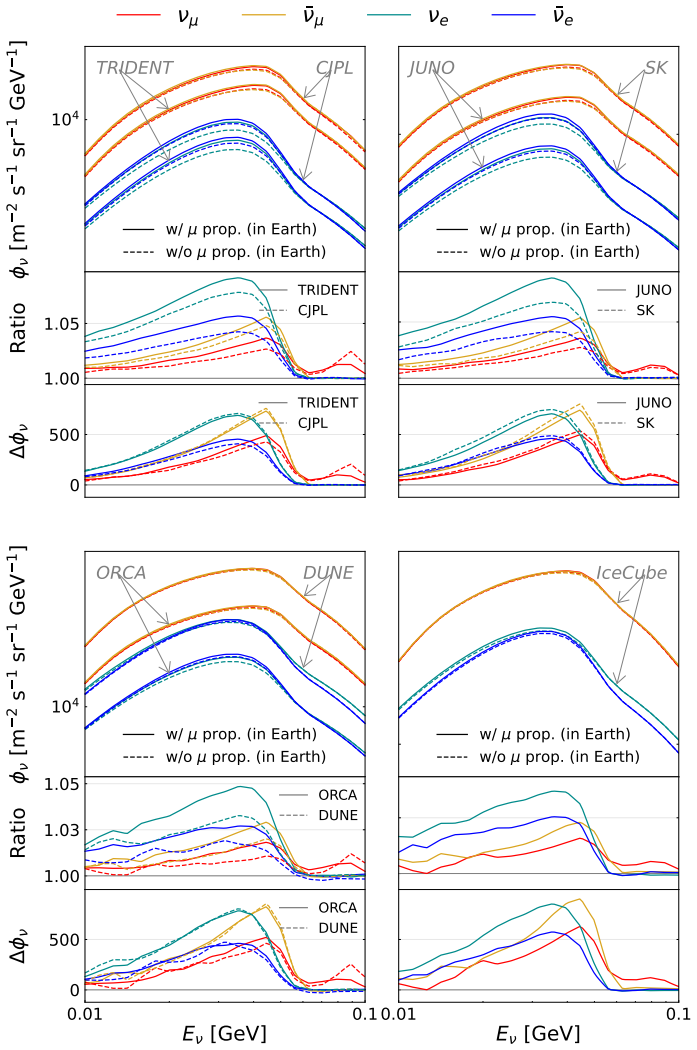
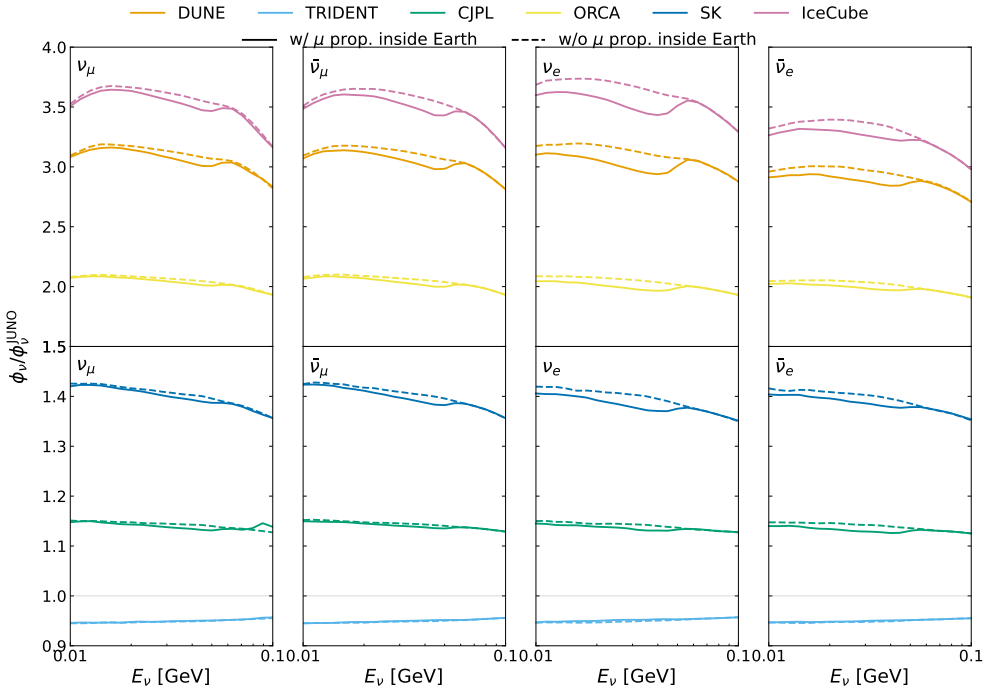
When atmospheric muons that penetrate the ground are allowed to stop and decay or undergo nuclear capture, they produce an additional neutrino flux below about 100 MeV whose absolute size is approximately the same at every geographic site; the fractional enhancement is therefore largest at high-cutoff sites and follows the flavor ordering νe ≈ ν̄µ > νµ > ν̄e.
What carries the argument
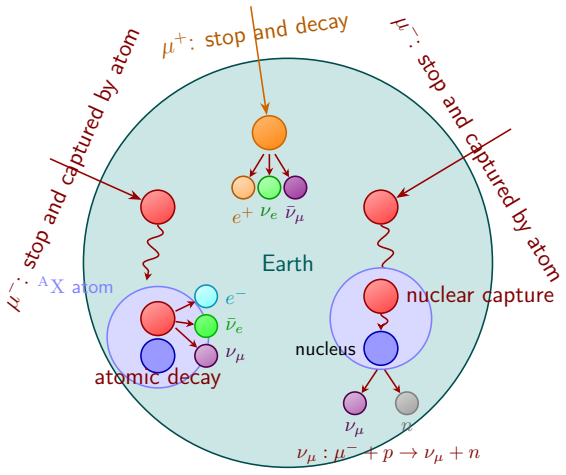
Three-dimensional Monte Carlo cascade simulation extended by an Earth-propagation module that tracks muons through CRUST1.0 media until they stop, then applies free decay for µ+ and element-dependent atomic capture versus nuclear capture for µ−, generating Michel and capture neutrino spectra.
Load-bearing premise
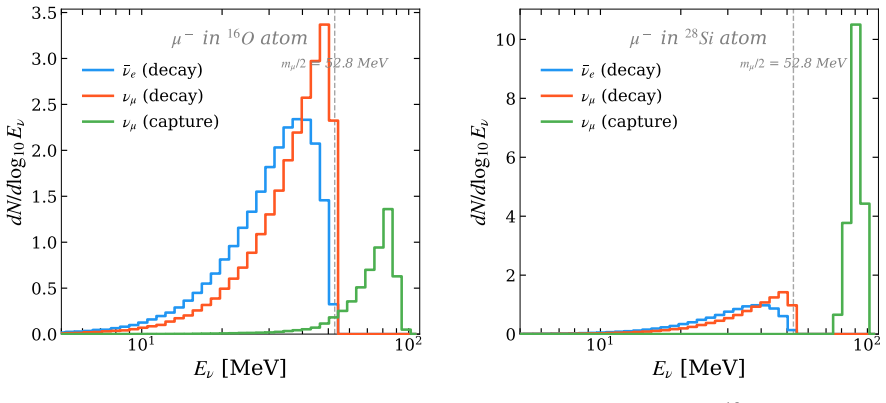
The energy spectrum of neutrinos from nuclear capture of stopped muons is taken from measured gamma-ray spectra of pion capture on oxygen and silicon, with the silicon spectrum used as a stand-in for all heavier crustal nuclei, and local mountain overburden is still ignored.
What would settle it
A direct measurement or ab-initio calculation of the neutrino energy spectrum from muon nuclear capture on silicon or iron that differs substantially from the adopted pion-capture proxy spectra would change the high-energy tail of the predicted νµ excess above 60 MeV.
If this is right
- DSNB and low-mass dark-matter analyses at every site must now include an extra absolute neutrino component of comparable size below 100 MeV.
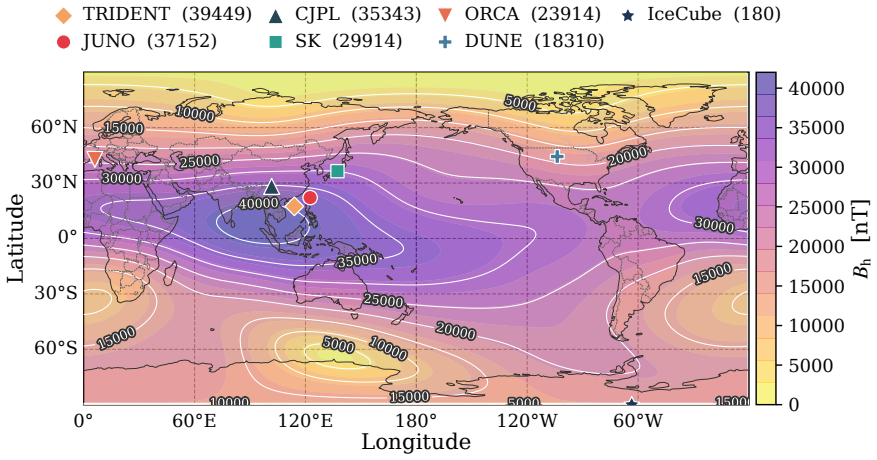
- Inter-site flux ratios below 1 GeV remain dominated by geomagnetic cutoff differences of up to a factor of four, not by the new muon-propagation term.
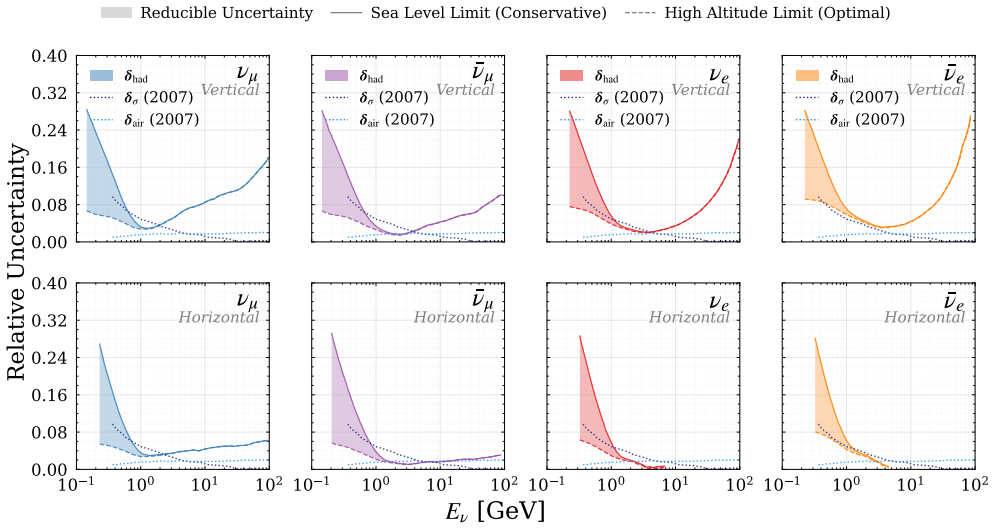
- Hadronic systematic uncertainty in the 1–10 GeV horizontal band drops to a few percent, tightening oscillation-parameter extractions that use atmospheric neutrinos.
- Nuclear-capture νµ extends to ~95 MeV, overlapping the upper end of the DSNB window and requiring updated background templates.
Where Pith is reading between the lines
- Because the absolute increment is nearly universal, a single low-energy correction table could be shared among experiments once mountain-profile effects are added.
- Future multi-site dark-matter searches could use the residual site-to-site difference in fractional enhancement as an independent cross-check of the geomagnetic baseline flux.
- The same stopped-muon source will also generate a small but calculable flux of low-energy electrons and positrons that could appear as a surface or near-surface background in shallow detectors.
Editorial analysis
A structured set of objections, weighed in public.
Referee Report
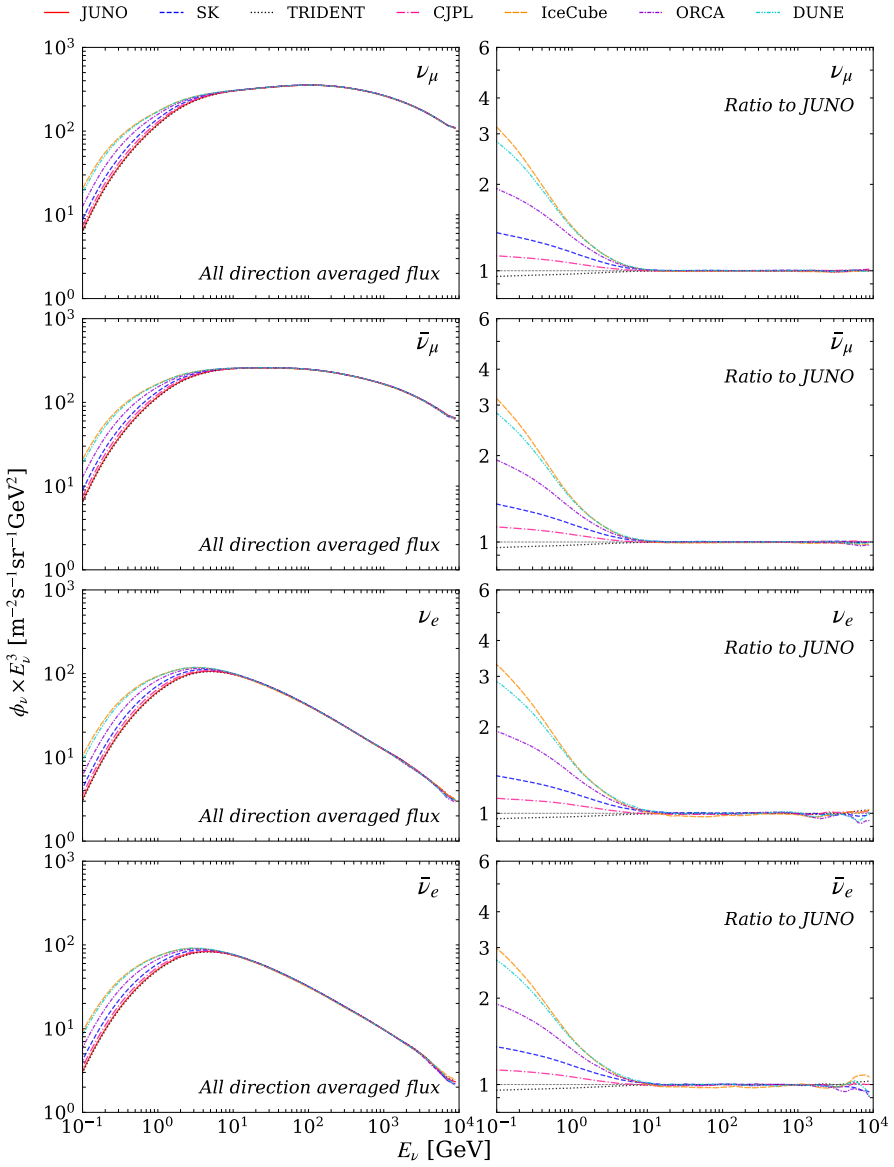
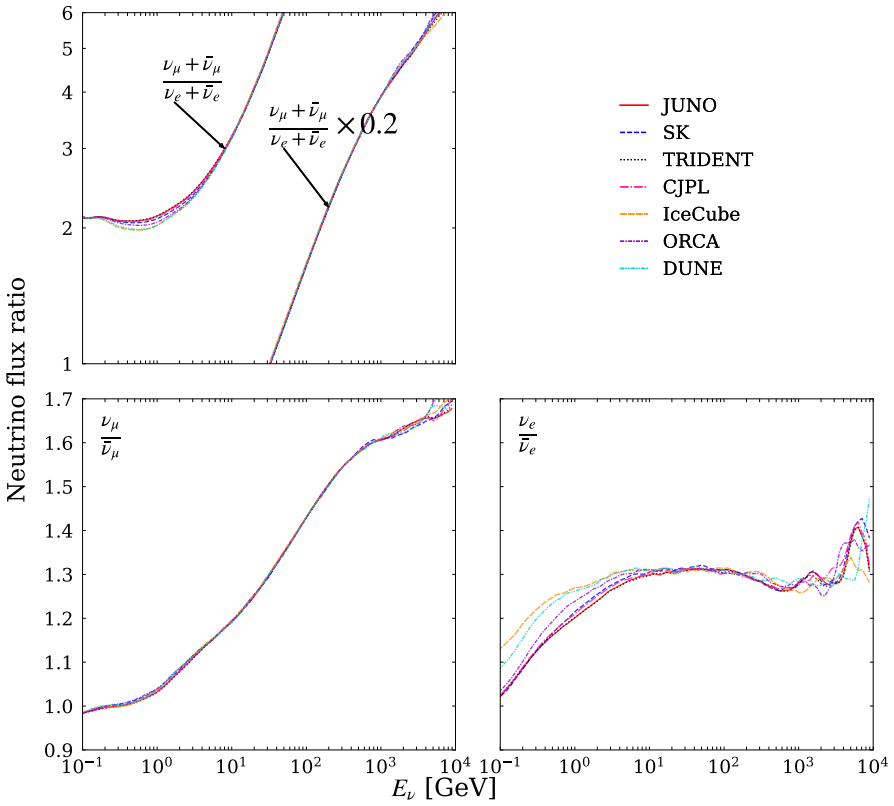
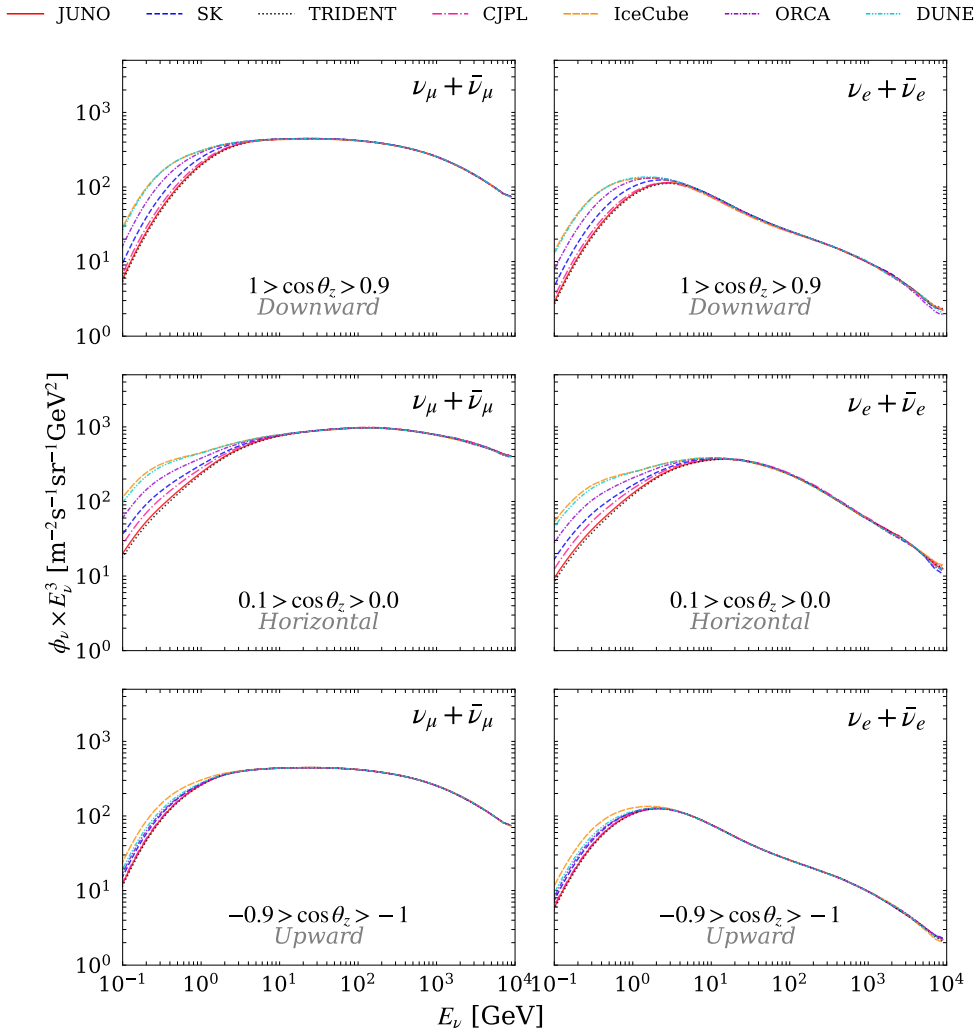
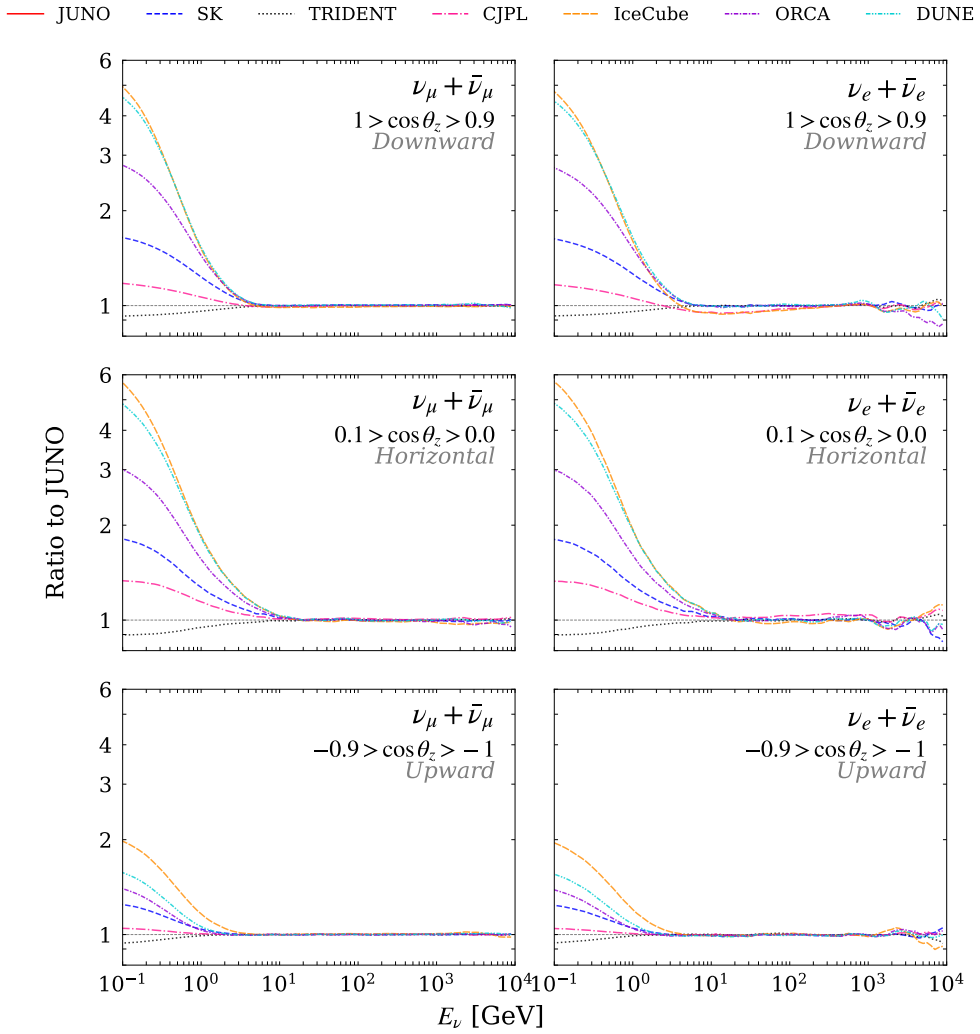
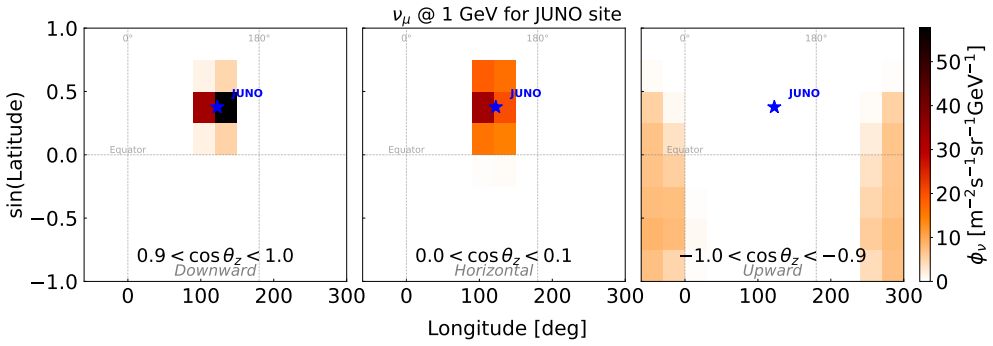
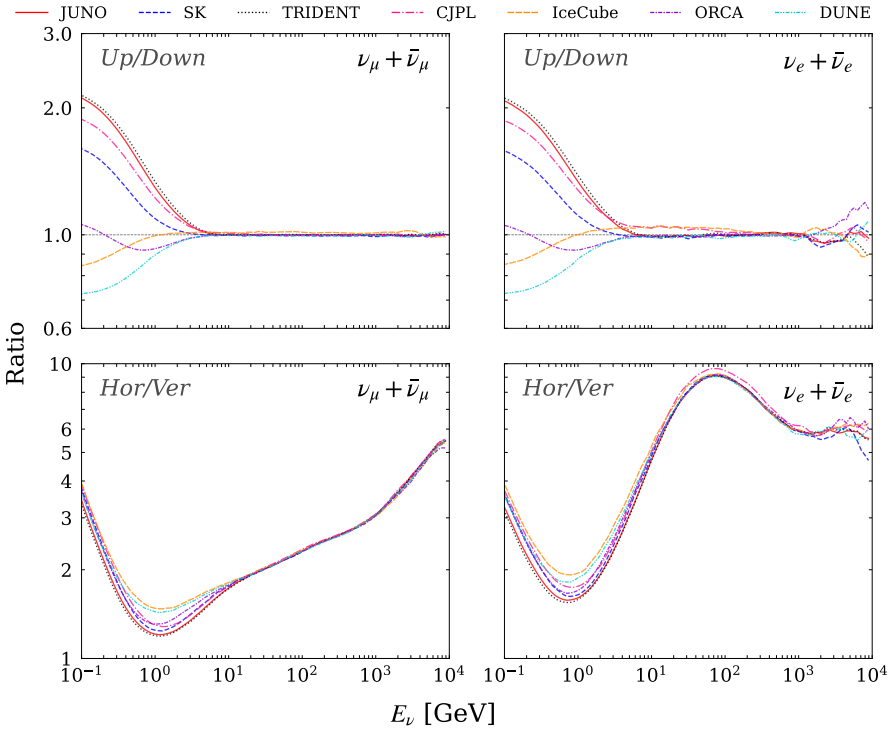
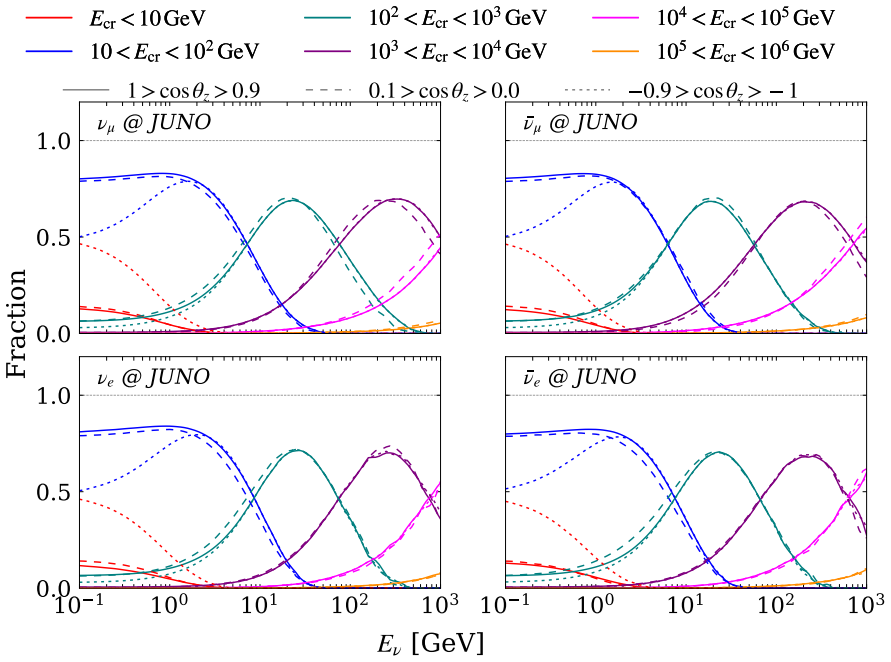
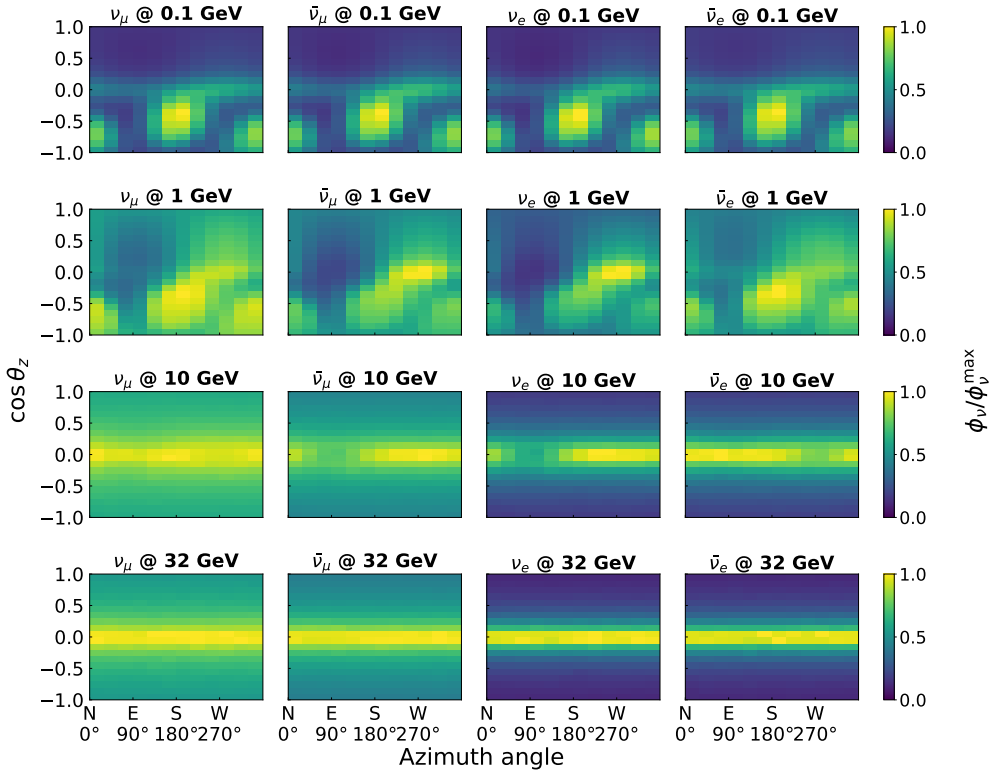
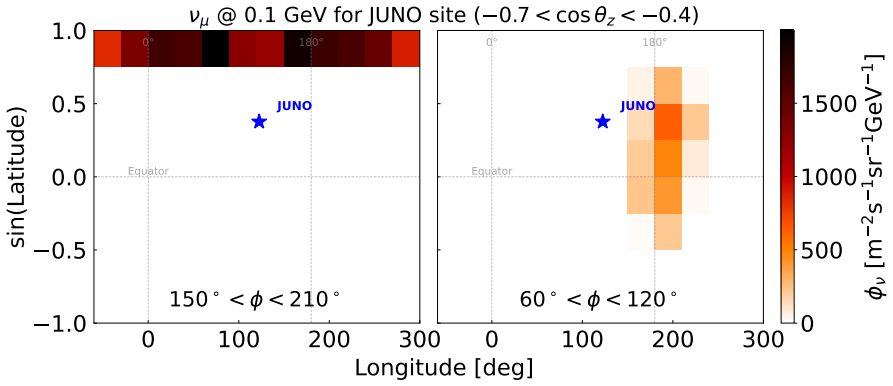
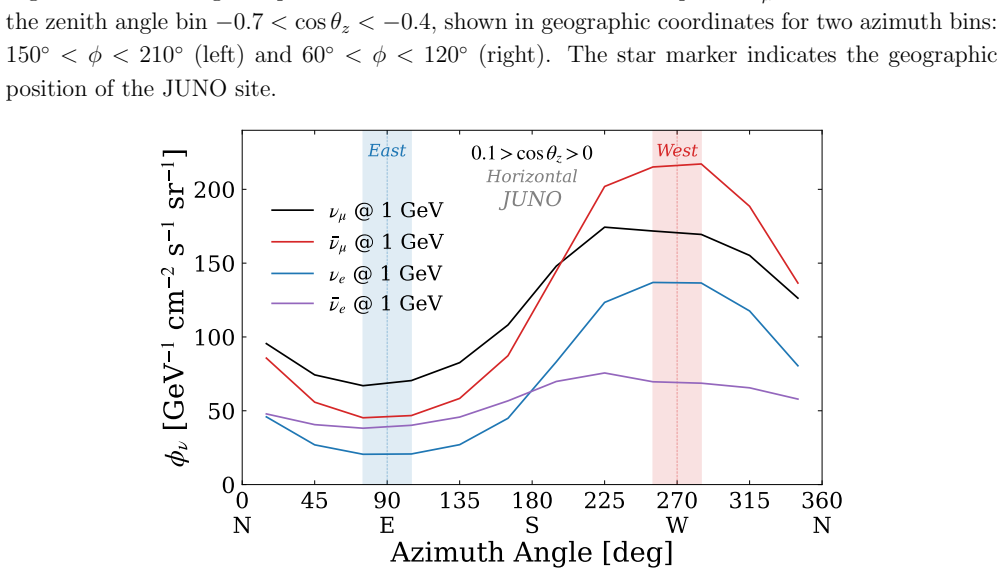
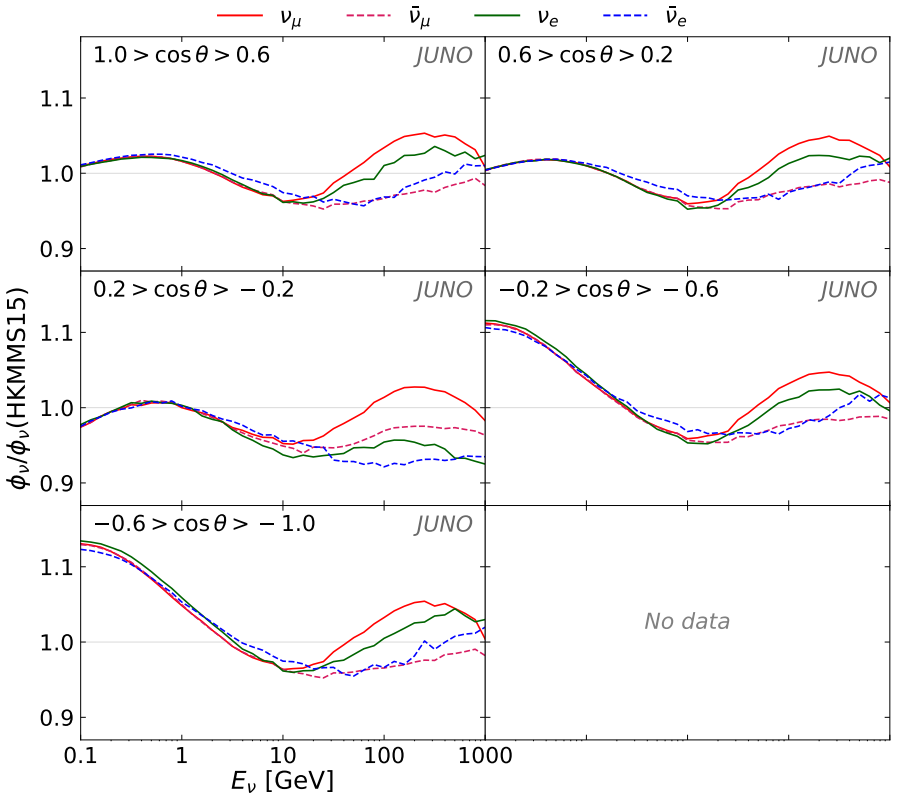
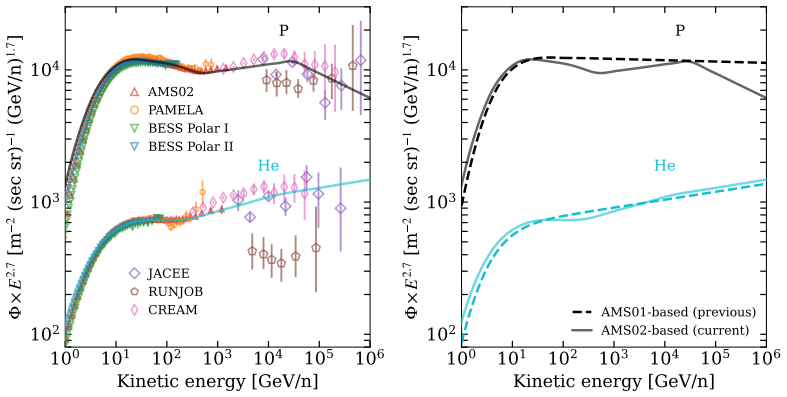
Summary. The manuscript presents a three-dimensional atmospheric neutrino flux calculation built on the HKKMS15 Monte-Carlo framework, extended for the first time to include atmospheric-muon propagation inside the Earth and the subsequent free decay or nuclear capture of stopped muons. Essential inputs are updated (AMS02-based primary cosmic-ray spectra, IGRF2020 geomagnetic field, muon-recalibrated JAM/DPMJET-III hadronic model, NRLMSISE-00 atmosphere, CRUST1.0 crust). Fluxes are computed for seven detector sites spanning a wide range of geomagnetic cutoffs, from 10 MeV to 10^4 GeV. For E_ν > 100 MeV the authors report 2–10 % shifts relative to HKKMS15 and strong site dependence below ~10 GeV; below 100 MeV they find that Earth-stopped muons supply a globally significant, approximately site-independent absolute flux increment with flavor hierarchy ν_e ≈ ν̄_µ > ν_µ > ν̄_e. Hadronic uncertainties are re-evaluated with the muon-constraint method of Honda et al., yielding a few-percent total uncertainty in the 1–10 GeV horizontal band.
Significance. If the results hold, the work supplies the first multi-site 3D atmospheric-neutrino fluxes that include the Earth-stopped-muon channel below 100 MeV—the energy window that dominates DSNB and low-mass dark-matter backgrounds—and simultaneously reduces the hadronic systematic error that has limited oscillation analyses. The public data release for seven sites (JUNO, SK, CJPL, ORCA, IceCube, DUNE, TRIDENT) and the quantitative comparison with HKKMS15 make the calculation immediately usable by the experimental community. The central technical advance (muon propagation + nuclear capture) is cleanly isolated and its absolute contribution is shown to be roughly site-independent, a non-trivial and falsifiable prediction.
major comments (2)
- Appendix A.5 and Fig. 20: the ν_µ spectrum from nuclear capture of stopped µ− is taken from measured γ spectra of π− radiative capture on 16O and 28Si, with the Si spectrum used as a proxy for all heavier crustal nuclei. No direct µ−-capture neutrino data exist. Because the capture channel is the only source of ν_µ above the Michel endpoint (~53 MeV) and produces the high-energy tail visible in the bottom row of Fig. 13, the absolute size of the claimed “globally significant” increment above ~60 MeV rests on this untested proxy. A quantitative sensitivity study (varying the capture spectrum shape within the O–Si difference, or quoting an additional systematic band) is needed before the absolute increment can be treated as precision input for DSNB analyses.
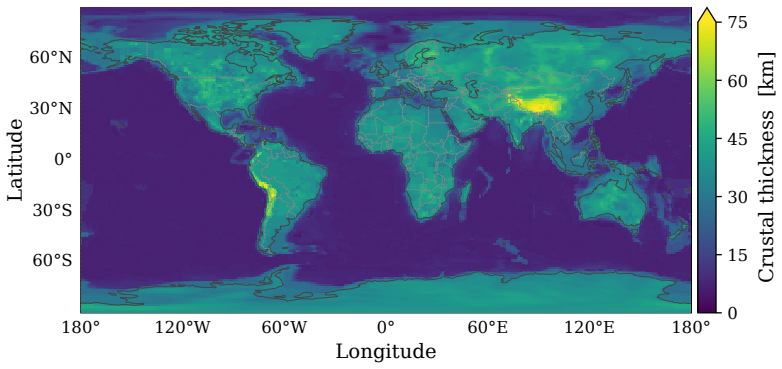
- Sec. 3.2 and Sec. 5: local mountain topography is omitted; path lengths and stopping media are taken solely from the CRUST1.0 global crustal model. For mountain sites (CJPL, JUNO) the overburden can change the stopping probability and the rock/water fraction for near-horizontal muons by tens of percent. While the paper correctly notes this as future work, the absolute difference Δϕ_ν shown in Fig. 13 is presented without an associated topography systematic. A simple estimate of the possible bias (e.g., using SRTM/ASTER DEM for one mountain site) would strengthen the claim that the absolute increment is “approximately site-independent.”
minor comments (5)
- Abstract and throughout: “develeped” → “developed”; several other minor typos (e.g., “atm µ/2” missing m_µ).
- Fig. 13 bottom row: absolute difference curves would be clearer if plotted on a common vertical scale or with an explicit unit label for the peak height.
- Table 1: the check-mark for muon propagation is useful; adding a one-line note that mountain profiles are still omitted would avoid over-reading the “✓”.
- Sec. 4: the comparison with Sato et al. (accelerator-tuned) is welcome; a short sentence on whether the two uncertainty bands are statistically independent would help readers combine them.
- Data-availability statement: the GitHub link is given; confirming that the files include the with/without-muon-propagation pairs for all seven sites would increase usability.
Circularity Check
No circularity: 3D Monte Carlo fluxes are forward predictions from independent external inputs (AMS02 primaries, IGRF2020, muon-calibrated hadronics, CRUST1.0) plus standard decay/capture physics; nothing is fitted to the neutrino fluxes themselves.
full rationale
The paper computes atmospheric neutrino fluxes via a 3D Monte Carlo cascade simulation (Honda HKKMS framework) whose inputs are all external and independent of the final neutrino results: AMS02/BESS/PAMELA primary spectra, public IGRF2020 geomagnetic field, NRLMSISE-00 atmosphere, and a hadronic model (JAM+DPMJET-III) recalibrated solely against independent atmospheric-muon data sets (BESS, L3+C, MUTRON). The novel low-energy contribution is obtained by propagating those same muons into the Earth (CRUST1.0 medium), applying free Michel decay for µ+ and literature branching fractions plus π-capture γ-spectrum proxies for µ- nuclear capture; no free parameter is adjusted to any neutrino measurement. Uncertainty bands are likewise derived from the muon-constraint method of Honda et al., not from the neutrino fluxes. Comparison to HKKMS15 simply quantifies the effect of the updated external inputs. There is therefore no self-definitional loop, no fitted-input-called-prediction, and no load-bearing self-citation that forces the central claims. The known limitations (capture-spectrum proxy, omitted local topography) are openly stated as future work and do not create circularity.
Axiom & Free-Parameter Ledger
free parameters (2)
- muon-recalibrated JAM/DPMJET-III parameters
- Si proxy spectrum for nuclei heavier than silicon
axioms (4)
- domain assumption Stopped µ+ decays freely with the standard Michel spectrum; stopped µ− forms a muonic atom and either decays in orbit or undergoes nuclear capture with element-dependent branching ratios Dµ− taken from Guo 2019 / Measday 2001.
- ad hoc to paper νµ energy spectrum from µ− nuclear capture can be approximated by the measured γ spectrum of π− radiative capture on the same nucleus.
- domain assumption Primary cosmic-ray spectra, geomagnetic field and atmospheric density are given by the AMS-02-based model, IGRF2020 and NRLMSISE-00 respectively.
- domain assumption Muons lose energy only electromagnetically and stop without nuclear interactions before decaying or capturing.
Cite this review
Pith. "Pith review of Precision three-Dimensional Atmospheric Neutrino Flux Calculation Based on Honda Flux Model." pith.science (2026). https://pith.science/paper/K3JTLMZN
@misc{pith2026260708310,
  author       = {Pith},
  title        = {Pith review of: Precision three-Dimensional Atmospheric Neutrino Flux Calculation Based on Honda Flux Model},
  year         = {2026},
  howpublished = {\url{https://pith.science/paper/K3JTLMZN}},
  note         = {Machine review of arXiv:2607.08310}
}
read the original abstract
We present a comprehensive three-dimensional atmospheric neutrino flux calculation based on the well-recognized simulation framework develeped by Honda and his collaborators, incorporating for the first time the muon propagation inside the Earth and its subsequent decay or nuclear capture. Other updates of essential input models include: the AMS02-based primary cosmic ray model, IGRF2020 geomagnetic field, and muon-recalibrated hadronic interaction model. The calculation covers seven detector sites across diverse geomagnetic environments, spanning 10~MeV to $10^4$~GeV. Significant site-dependent differences appear at $E_\nu < 10$~GeV, with $\nu_\mu$ flux at IceCube approximately twice that at JUNO below 1~GeV. Compared to HKKMS15, deviations of 2\%--10\% are attributed to the updated input models. Below 100~MeV, we present precise flux results, revealing that muon propagation contributes a globally significant component to the low-energy neutrino flux at all sites, with an approximately site-independent absolute increment. The hadronic uncertainty is re-estimated across the energy range using the updated hadronic interaction model, with significant reduction of the systematic error compared to previous calculations. These results provide essential inputs for neutrino oscillation and rare-event search experiments including JUNO, Super-Kamiokande/Hyper-Kamiokande, DUNE, KM3NeT/ORCA, and IceCube, as well as direct dark matter detection experiments facing the neutrino fog.
Figures



Reference graph
Works this paper leans on
-
[1]
Atmospheric neutrino oscillation analysis with external constraints in Super-Kamiokande I-IV,
K. Abeet al.[Super-Kamiokande], “Atmospheric neutrino oscillation analysis with external constraints in Super-Kamiokande I-IV,” Phys. Rev. D97(2018) no.7, 072001
work page 2018
-
[2]
T. Westeret al.[Super-Kamiokande], “Atmospheric neutrino oscillation analysis with neutron tagging and an expanded fiducial volume in Super-Kamiokande I–V,” Phys. Rev. D109 (2024) no.7, 072014
work page 2024
-
[3]
E. Richardet al.[Super-Kamiokande], “Measurements of the atmospheric neutrino flux by Super-Kamiokande: energy spectra, geomagnetic effects, and solar modulation,” Phys. Rev. D94(2016) no.5, 052001
work page 2016
-
[4]
M. G. Aartsenet al.[IceCube], “Determining neutrino oscillation parameters from atmo- spheric muon neutrino disappearance with three years of IceCube DeepCore data,” Phys. Rev. D91(2015) no.7, 072004
work page 2015
-
[5]
A. Albertet al.[ANTARES], “Measuring the atmospheric neutrino oscillation parameters and constraining the 3+1 neutrino model with ten years of ANTARES data,” JHEP06(2019), 113
work page 2019
-
[6]
P. Adamsonet al.[MINOS], “Combined analysis ofν µ disappearance andν µ →ν e appearance in MINOS using accelerator and atmospheric neutrinos,” Phys. Rev. Lett.112(2014), 191801 33
work page 2014
-
[7]
Measurement of neutrino oscillation parameters with the first six detection units of KM3NeT/ORCA,
S. Aielloet al.[KM3NeT], “Measurement of neutrino oscillation parameters with the first six detection units of KM3NeT/ORCA,” JHEP10(2024), 206
work page 2024
-
[8]
K. Abeet al.[Super-Kamiokande], “Search for Diffuse Supernova Neutrino Background with 956.2 Days of Super-Kamiokande Gadolinium Dataset,” Astrophys. J.1005, no.1, 101 (2026)
work page 2026
-
[9]
Limits on Astrophysical Antineutrinos with the KamLAND Experiment,
S. Abeet al.[KamLAND], “Limits on Astrophysical Antineutrinos with the KamLAND Experiment,” Astrophys. J.925(2022) no.1, 14
work page 2022
-
[10]
Search for low-energy neutrinos from astrophysical sources with Borexino,
M. Agostiniet al.[Borexino], “Search for low-energy neutrinos from astrophysical sources with Borexino,” Astropart. Phys.125(2021), 102509
work page 2021
-
[11]
A. Abuslemeet al.[JUNO], JCAP10(2022), 033 doi:10.1088/1475-7516/2022/10/033 [arXiv:2205.08830 [hep-ex]]
-
[12]
New Definition of the Neutrino Floor for Direct Dark Matter Searches,
C. A. J. O’Hare, “New Definition of the Neutrino Floor for Direct Dark Matter Searches,” Phys. Rev. Lett.127(2021) no.25, 251802
work page 2021
-
[13]
Search for annihilating dark matter in the Sun with 3 years of IceCube data,
M. G. Aartsenet al.[IceCube], “Search for annihilating dark matter in the Sun with 3 years of IceCube data,” Eur. Phys. J. C77(2017) no.3, 146 [erratum: Eur. Phys. J. C79(2019) no.3, 214]
work page 2017
-
[14]
JUNO sensitivity to the annihilation of MeV dark matter in the galactic halo,
A. Abuslemeet al.[JUNO], “JUNO sensitivity to the annihilation of MeV dark matter in the galactic halo,” JCAP09(2023), 001
work page 2023
-
[15]
K. Abeet al.[Super-Kamiokande], “Indirect search for dark matter from the Galactic Center and halo with the Super-Kamiokande detector,” Phys. Rev. D102(2020) no.7, 072002
work page 2020
-
[16]
A. Takenakaet al.[Super-Kamiokande], “Search for proton decay viap→e +π0 andp→µ +π0 with an enlarged fiducial volume in Super-Kamiokande I-IV,” Phys. Rev. D102(2020) no.11, 112011
work page 2020
-
[17]
JUNO Sensitivity on Proton Decayp→¯νK + Searches,
A. Abuslemeet al.[JUNO], “JUNO Sensitivity on Proton Decayp→¯νK + Searches,” Chin. Phys. C47(2023) no.11, 113002
work page 2023
-
[18]
Hyper-Kamiokande Design Report
K. Abeet al.[Hyper-Kamiokande], “Hyper-Kamiokande Design Report,” [arXiv:1805.04163 [physics.ins-det]]
work page internal anchor Pith review Pith/arXiv arXiv
-
[19]
B. Abiet al.[DUNE], “Deep Underground Neutrino Experiment (DUNE), Far Detector Technical Design Report, Volume II: DUNE Physics,” [arXiv:2002.03005 [hep-ex]]
-
[20]
A New calculation of the atmospheric neutrino flux in a 3-dimensional scheme,
M. Honda, T. Kajita, K. Kasahara and S. Midorikawa, “A New calculation of the atmospheric neutrino flux in a 3-dimensional scheme,” Phys. Rev. D70(2004), 043008
work page 2004
-
[21]
M. Honda, T. Kajita, K. Kasahara, S. Midorikawa and T. Sanuki, “Calculation of atmospheric neutrino flux using the interaction model calibrated with atmospheric muon data,” Phys. Rev. D75(2007), 043006 34
work page 2007
-
[22]
M. Honda, T. Kajita, K. Kasahara and S. Midorikawa, “Improvement of low energy atmo- spheric neutrino flux calculation using the JAM nuclear interaction model,” Phys. Rev. D83 (2011), 123001
work page 2011
-
[23]
Atmospheric neutrino flux calculation using the NRLMSISE-00 atmospheric model,
M. Honda, M. Sajjad Athar, T. Kajita, K. Kasahara and S. Midorikawa, “Atmospheric neutrino flux calculation using the NRLMSISE-00 atmospheric model,” Phys. Rev. D92 (2015) no.2, 023004
work page 2015
-
[24]
A Three - dimensional calculation of atmospheric neutrinos,
G. D. Barr, T. K. Gaisser, P. Lipari, S. Robbins and T. Stanev, “A Three - dimensional calculation of atmospheric neutrinos,” Phys. Rev. D70(2004), 023006
work page 2004
-
[25]
The FLUKA atmospheric neutrino flux calculation,
G. Battistoni, A. Ferrari, T. Montaruli and P. R. Sala, “The FLUKA atmospheric neutrino flux calculation,” Astropart. Phys.19(2003), 269-290 [erratum: Astropart. Phys.19(2003), 291-294]
work page 2003
-
[26]
Hadronic interaction model sibyll 2.3c and inclusive lepton fluxes,
A. Fedynitch, F. Riehn, R. Engel, T. K. Gaisser and T. Stanev, “Hadronic interaction model sibyll 2.3c and inclusive lepton fluxes,” Phys. Rev. D100(2019) no.10, 103018
work page 2019
-
[27]
Atmospheric lepton fluxes via two- dimensional matrix cascade equations,
T. Kozynets, A. Fedynitch and D. J. Koskinen, “Atmospheric lepton fluxes via two- dimensional matrix cascade equations,” Phys. Rev. D108(2023) no.10, 103040
work page 2023
-
[28]
Study of cosmic ray interaction model based on atmospheric muons for the neutrino flux calculation,
T. Sanuki, M. Honda, T. Kajita, K. Kasahara and S. Midorikawa, “Study of cosmic ray interaction model based on atmospheric muons for the neutrino flux calculation,” Phys. Rev. D75(2007), 043005
work page 2007
-
[29]
Low-energy atmospheric neutrino flux calculation with accelerator-data-driven tuning
K. Sato, H. Menjo, Y. Itow and M. Honda, “Low-energy atmospheric neutrino flux calculation with accelerator-data-driven tuning,” [arXiv:2603.09334 [astro-ph.HE]]
work page internal anchor Pith review Pith/arXiv arXiv
-
[30]
Low energy neutrinos from stopped muons in the Earth,
W. L. Guo, “Low energy neutrinos from stopped muons in the Earth,” Phys. Rev. D99 (2019) no.7, 073007
work page 2019
-
[31]
International Geomagnetic Reference Field: the thirteenth generation,
P. Alken, E. Th´ ebault, C. D. Beggan,et al.“International Geomagnetic Reference Field: the thirteenth generation,” Earth Planets Space73, 49 (2021).https://doi.org/10.1186/ s40623-020-01288-x
work page 2021
-
[32]
A. Abuslemeet al.[JUNO], “JUNO physics and detector,” Prog. Part. Nucl. Phys.123 (2022), 103927
work page 2022
-
[33]
The China Jinping Underground Laboratory and its Early Science,
J. P. Cheng, K. J. Kang, J. M. Li, J. Li, Y. J. Li, Q. Yue, Z. Zeng, Y. H. Chen, S. Y. Wu and X. D. Ji,et al.“The China Jinping Underground Laboratory and its Early Science,” Ann. Rev. Nucl. Part. Sci.67(2017), 231-251
work page 2017
-
[34]
A multi-cubic-kilometre neutrino telescope in the western Pacific Ocean,
Z. P. Ye, F. Hu, W. Tian, Q. C. Chang, Y. L. Chang, Z. S. Cheng, J. Gao, T. Ge, G. H. Gong and J. Guo,et al.“A multi-cubic-kilometre neutrino telescope in the western Pacific Ocean,” Nature Astron.7(2023) no.12, 1497-1505 35
work page 2023
-
[35]
M. Honda, M. Sajjad Athar, T. Kajita, K. Kasahara and S. Midorikawa, “Reduction of the uncertainty in the atmospheric neutrino flux prediction below 1 GeV using accurately measured atmospheric muon flux,” Phys. Rev. D100(2019) no.12, 123022
work page 2019
-
[36]
M. Aguilaret al.[AMS], “Precision Measurement of the Proton Flux in Primary Cosmic Rays from Rigidity 1 GV to 1.8 TV with the Alpha Magnetic Spectrometer on the International Space Station,” Phys. Rev. Lett.114(2015), 171103
work page 2015
-
[37]
M. Aguilaret al.[AMS], “Precision Measurement of the Helium Flux in Primary Cosmic Rays of Rigidities 1.9 GV to 3 TV with the Alpha Magnetic Spectrometer on the International Space Station,” Phys. Rev. Lett.115(2015) no.21, 211101
work page 2015
-
[38]
K. Abe, H. Fuke, S. Haino, T. Hams, M. Hasegawa, A. Horikoshi, A. Itazaki, K. C. Kim, T. Kumazawa and A. Kusumoto,et al.“Measurements of cosmic-ray proton and helium spectra from the BESS-Polar long-duration balloon flights over Antarctica,” Astrophys. J. 822(2016) no.2, 65
work page 2016
-
[39]
PAMELA Measurements of Cosmic-ray Proton and Helium Spectra,
O. Adrianiet al.[PAMELA], “PAMELA Measurements of Cosmic-ray Proton and Helium Spectra,” Science332(2011), 69-72
work page 2011
-
[40]
Cosmic-ray proton and helium spectra: Results from the JACEE Experiment,
M. J. Christ, S. Dake, J. H. Derrickson, W. F. Fountain, M. Fuki, J. C. Gregory, T. Hayashi, R. Holynski, J. Iwai and A. Iyono,et al.“Cosmic-ray proton and helium spectra: Results from the JACEE Experiment,” Astrophys. J.502(1998), 278-283
work page 1998
-
[41]
V. A. Derbinaet al.[RUNJOB], “Cosmic-ray spectra and composition in the energy range of 10-TeV - 1000-TeV per particle obtained by the RUNJOB experiment,” Astrophys. J. Lett. 628(2005), L41-L44
work page 2005
-
[42]
Proton and Helium Spectra from the CREAM- III Flight,
Y. S. Yoon, T. Anderson, A. Barrau, N. B. Conklin, S. Coutu, L. Derome, J. H. Han, J. A. Jeon, K. C. Kim and M. H. Kim,et al.“Proton and Helium Spectra from the CREAM- III Flight,” Astrophys. J.839(2017) no.1, 5
work page 2017
-
[43]
Seehttps://ccmc.gsfc.nasa.gov/models/NRLMSIS ~00/
-
[44]
Update on CRUST1.0 – A 1-degree global model of Earth’s crust,
L, Gabi, M, Guy, M, Zhitu and P, Mike, “Update on CRUST1.0 – A 1-degree global model of Earth’s crust,” Geophys. Res. Abstracts15(2013), EGU2013-2658
work page 2013
-
[45]
The Shuttle Radar Topography Mission,
T. G. Farret al., “The Shuttle Radar Topography Mission,” Rev. Geophys.45, RG2004 (2007)
work page 2007
-
[46]
The ASTER Global Digital Elevation Model Version 3,
M. Abrams, R. Crippen and H. Fujisada, “The ASTER Global Digital Elevation Model Version 3,” ISPRS Int. Arch. Photogramm. Remote Sens. Spat. Inf. Sci.XL-7/W3, 391 (2015)
work page 2015
-
[47]
M. Aguilaret al.[AMS], “Periodicities in the Daily Proton Fluxes from 2011 to 2019 Measured by the Alpha Magnetic Spectrometer on the International Space Station from 1 to 100 GV,” Phys. Rev. Lett.127(2021) no.27, 271102 36
work page 2011
-
[48]
Properties of Daily Helium Fluxes,
M. Aguilaret al.[AMS], “Properties of Daily Helium Fluxes,” Phys. Rev. Lett.128(2022) no.23, 231102
work page 2022
-
[49]
Solar Modulation of Cosmic Nuclei over a Solar Cycle: Results from the Alpha Magnetic Spectrometer,
M. Aguilaret al.[AMS], “Solar Modulation of Cosmic Nuclei over a Solar Cycle: Results from the Alpha Magnetic Spectrometer,” Phys. Rev. Lett.134(2025) no.5, 051001
work page 2025
-
[50]
S. Mauset al., “EMAG2: A 2-arc min resolution Earth Magnetic Anomaly Grid compiled from satellite, airborne, and marine magnetic measurements,” Geochem. Geophys. Geosyst. 10, Q08005 (2009)
work page 2009
-
[51]
Building the second version of the World Digital Magnetic Anomaly Map (WDMAM),
V. Lesuret al., “Building the second version of the World Digital Magnetic Anomaly Map (WDMAM),” Earth Planets Space68, 27 (2016)
work page 2016
-
[52]
NRLMSISE-2.0: A Whole-Atmosphere Empirical Model of Temperature and Neutral Species Densities,
J. T. Emmertet al., “NRLMSISE-2.0: A Whole-Atmosphere Empirical Model of Temperature and Neutral Species Densities,” J. Geophys. Res. Space Phys.126, no.3, e2020JA028532 (2021)
work page 2021
-
[53]
N. Abgrallet al.[NA61/SHINE], “Measurements of production properties ofK 0 S mesons and Λ hyperons in proton-carbon interactions at 31 GeV/ c,” Phys. Rev. C89(2014) no.2, 025205
work page 2014
-
[54]
N. Abgrallet al.[NA61/SHINE], “Measurement of Production Properties of Positively Charged Kaons in Proton-Carbon Interactions at 31 GeV/c,” Phys. Rev. C85(2012), 035210
work page 2012
-
[55]
O. Adrianiet al.[LHCf], “Measurement of forward photon production cross-section in pro- ton–proton collisions at √s= 13 TeV with the LHCf detector,” Phys. Lett. B780(2018), 233-239
work page 2018
-
[56]
F. Anet al.[JUNO], “Neutrino Physics with JUNO,” J. Phys. G43(2016) no.3, 030401
work page 2016
-
[57]
First Gadolinium Loading to Super-Kamiokande,
K. Abeet al.[Super-Kamiokande], “First Gadolinium Loading to Super-Kamiokande,” Nucl. Instrum. Meth. A1027(2022), 166248
work page 2022
-
[58]
First Dark Matter Search Results from the LUX-ZEPLIN (LZ) Ex- periment,
J. Aalberset al.[LZ], “First Dark Matter Search Results from the LUX-ZEPLIN (LZ) Ex- periment,” Phys. Rev. Lett.131(2023) no.4, 041002
work page 2023
-
[59]
First Dark Matter Search with Nuclear Recoils from the XENONnT Experiment,
E. Aprileet al.[XENON], “First Dark Matter Search with Nuclear Recoils from the XENONnT Experiment,” Phys. Rev. Lett.131(2023) no.4, 041003
work page 2023
-
[60]
Dark Matter Search Results from the PandaX-4T Commis- sioning Run,
Y. Menget al.[PandaX-4T], “Dark Matter Search Results from the PandaX-4T Commis- sioning Run,” Phys. Rev. Lett.127(2021) no.26, 261802
work page 2021
-
[61]
J. Alcarazet al.[AMS], “Cosmic protons,” Phys. Lett. B490(2000), 27-35
work page 2000
-
[62]
J. Alcarazet al.[AMS], “Helium in near Earth orbit,” Phys. Lett. B494(2000), 193-202
work page 2000
-
[63]
Measurements of primary and atmospheric cosmic - ray spectra with the BESS-TeV spectrometer,
S. Haino, T. Sanuki, K. Abe, K. Anraku, Y. Asaoka, H. Fuke, M. Imori, A. Itasaki, T. Maeno and Y. Makida,et al.“Measurements of primary and atmospheric cosmic - ray spectra with the BESS-TeV spectrometer,” Phys. Lett. B594(2004), 35-46 37
work page 2004
-
[64]
Precise measurement of cosmic ray proton and helium spectra with the BESS spectrometer,
T. Sanuki, M. Motoki, H. Matsumoto, E. S. Seo, J. Z. Wang, K. Abe, K. Anraku, Y. Asaoka, M. Fujikawa and M. Imori,et al.“Precise measurement of cosmic ray proton and helium spectra with the BESS spectrometer,” Astrophys. J.545(2000), 1135
work page 2000
-
[65]
Flux of atmospheric neutrinos,
T. K. Gaisser and M. Honda, “Flux of atmospheric neutrinos,” Ann. Rev. Nucl. Part. Sci. 52(2002), 153-199
work page 2002
- [66]
-
[67]
Measurements of atmospheric muon spectra at mountain altitude,
T. Sanuki, M. Fujikawa, K. Abe, K. Anraku, Y. Asaoka, H. Fuke, S. Haino, M. Imori, K. Izumi and T. Maeno,et al.“Measurements of atmospheric muon spectra at mountain altitude,” Phys. Lett. B541(2002), 234-242 [erratum: Phys. Lett. B581(2004), 272-273]
work page 2002
-
[68]
Measurement of the atmospheric muon spectrum from 20-GeV to 3000-GeV,
P. Achardet al.[L3], “Measurement of the atmospheric muon spectrum from 20-GeV to 3000-GeV,” Phys. Lett. B598(2004), 15-32
work page 2004
-
[69]
COSMIC RAY MUON SPECTRUM UP TO 20-TEV AT 89-degrees ZENITH ANGLE,
S. Matsuno, F. Kajino, Y. Kawashima, T. Kitamura, K. Mitsui, Y. Muraki, Y. Ohashi, A. Okada, T. Suda and Y. Minorikawa,et al.“COSMIC RAY MUON SPECTRUM UP TO 20-TEV AT 89-degrees ZENITH ANGLE,” Phys. Rev. D29(1984), 1-23
work page 1984
-
[70]
PHITS: A particle and heavy ion transport code system,
K. Niita, T. Sato, H. Nakashima, H. Iwase, H. Nose and L. Sihver, “PHITS: A particle and heavy ion transport code system,” Radiat. Meas.41(2006), 1080-1090
work page 2006
-
[71]
The nuclear physics of muon capture,
D. F. Measday, “The nuclear physics of muon capture,” Phys. Rept.354(2001), 243-409
work page 2001
-
[72]
EXCITATION OF E1 AND M2 RESONANCES VIA (PI-, GAMMA) REACTIONS ON O-16, O-18,
G. Strassner, P. Truoel, J. C. Alder, B. Gabioud, C. Joseph, J. F. Loude, N. Morel, A. Perre- noud, J. P. Perroud and M. T. Tran,et al.“EXCITATION OF E1 AND M2 RESONANCES VIA (PI-, GAMMA) REACTIONS ON O-16, O-18,” Phys. Rev. C20(1979), 248-261 38 100 101 102 103 104 105 106 Kinetic energy [GeV/n] 102 103 104 × E2.7 [m 2 (sec sr) 1 (GeV/n)1.7] P He AMS02 P...
work page 1979
discussion (0)
Sign in with ORCID, Apple, or X to comment. Anyone can read and Pith papers without signing in.