REVIEW 5 major objections 6 minor 1 cited by
Diffusion-Inspired Cold Start with Sufficient Prior in Computerized Adaptive Testing
T0 review · 5 major / 6 minor · reviewed 2026-08-12 · deepseek-v4-flash
Pith's one-line read Diffusion model seeds adaptive tests with cross-course prior.
desk verdict DCSR applies diffusion to CAT cold start with a real transfer idea, but the inference-time substitution of the warm-start mean for each cold-start examinee's target ability creates a train/test shift the paper never quantifies. read the letter →
The pith
A machine-rendered reading of the paper's core claim, the machinery that carries it, and where it could break.
The reading
What carries the argument
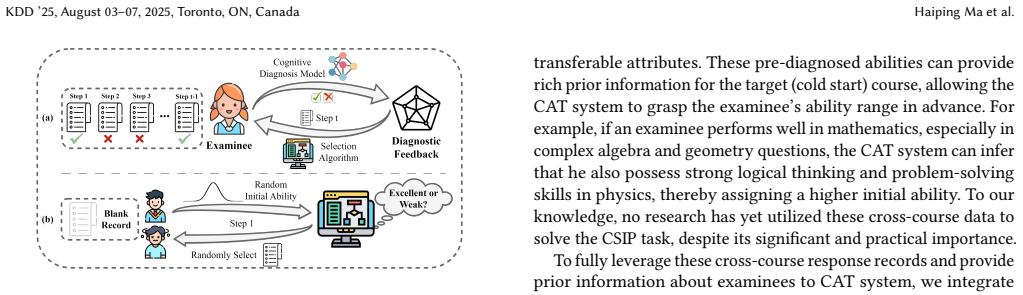
At the center of DCSR is a conditional denoising diffusion model. During training, target-domain ability vectors are corrupted by Gaussian noise (the forward process) and then reconstructed by a denoiser that is conditioned on the examinee's source-domain cognitive state (the reverse process). The Cognitive State Unification Module (CSUM) separates the conditioning signal into domain-shared cognition and domain-specific cognition, and adds an orthogonal-gradient term so that learning the shared representation does not absorb the specific one; in the paper's causal graph, this blocks two backdoor paths that would let redundant or counterproductive cognition contaminate the generated ability. The Harmonization and Calibration Module (HCM) then imposes a consistency constraint (the generated ability should stay close to the pretrained target-domain ability) and a task-oriented constraint (the generated ability should predict warm-start responses through a frozen cognitive diagnosis model). At inference, a fast solver (DPM-Solver) converts pure noise plus the cold-start examinee's shared cognitive features into an initial ability vector $\theta_i^0$, which is passed to any existing question-selection algorithm as the starting state $\theta_0$.
What would settle it
Construct a subgroup of cold-start examinees whose source-domain scores are extreme relative to their true target-domain ability (for example, bottom-decile math but top-decile programming). Run the CAT loop at test length 1 with DCSR's initialization and with Random initialization; if DCSR's AUC or ACC is not above Random's for that subgroup, the warm-start average proxy is the point at which the central claim fails.
Extended reading notes
Core claim
The paper's central claim is that the cold-start-with-insufficient-prior (CSIP) problem that plagues CAT systems—random initial probing, poorly matched questions, lengthened tests—can be recast as a cross-domain generation task. The latent ability of an examinee in the target domain is a noisy observation that a diffusion model can reconstruct, conditioned on the examinee's pretrained ability in source domains, because cognitive states are partially shared across courses. DCSR does this reconstruction and then feeds the generated ability vector as the initial state of the CAT loop, so that the first selected question is already informed. The paper reports that DCSR outperforms Random and a meta-learning baseline for both strategy-based selectors (Fisher, MAAT, BECAT) and a learning-based selector (NCAT) across six single-source scenarios and three multi-source scenarios, approaching the Oracle upper bound in course pairs with strong conceptual overlap such as C and C++.
Load-bearing premise
The load-bearing premise is that cold-start examinees are representative of the warm-start students whose target-domain ability is averaged as the substitute in Eq. (16); if that proxy is biased, the generated initial ability is biased and the claimed improvement can shrink or reverse.
Editorial extensions
If this is right
- DCSR is a plug-in: any existing question-selection algorithm, strategy-based or learning-based, can start from the generated initial ability without retraining, so the reported improvement is available to current CAT systems.
- If the reported gains hold, the number of probing questions needed before the system settles on an examinee's ability range can drop, shortening tests and reducing the chance that early mismatched questions derail later selections for greedy selectors.
- Using multiple source courses strengthens the initialization: the paper reports that multi-domain sharing of common cognition performs better than single-domain transfer and narrows the gap to the Oracle upper bound.
- The same generated initial ability also benefits cognitive diagnosis models directly, meaning the framework addresses the cold-start problem in both components of a CAT system.
- Even with weakly correlated source-target course pairs, the paper reports that DCSR reaches the accuracy of Random initialization in fewer test steps, indicating faster convergence rather than only a better first step.
Reading between the lines
- Inference: the paper leaves implicit that the inference-time proxy in Eq. (16)—replacing the unknown target-domain ability of a cold-start examinee with the average cognitive state of warm-start examinees—is a representativeness assumption; cold-start examinees who are atypical within the warm-start population are the case most likely to break the claimed gains.
- Inference: a testable extension the paper does not explore is to weight warm-start examinees by their similarity to the cold-start examinee's source-domain profile when forming that average, which would make the proxy personal and might improve the method precisely where it is weakest.
- Inference: the causal framing is best read as a regularization design; the three decoupling losses and gradient orthogonalization separate representations in feature space rather than identify a full structural causal model, so part of the reported gain may be a regularization effect rather than a demonstrated causal transfer mechanism.
Signed reviews
Editorial analysis
A structured set of objections, weighed in public.
Referee Report
Summary. This paper presents DCSR, a diffusion-based framework for generating initial target-domain ability estimates for cold-start examinees in computerized adaptive testing. The method pretrains cognitive diagnosis models in source and target domains, extracts domain-shared and domain-specific features, and conditions a denoising diffusion module on source-domain abilities. Consistency and task-oriented constraints are added to reduce generation randomness. The authors evaluate DCSR on five programming-course datasets from PTADisc, with four CAT question-selection algorithms and two CDMs, and report that it outperforms Random and MLCCM baselines.
Significance. The CSIP problem is practically relevant, and a plug-in initialization that works with existing selectors would be valuable. The paper's strengths include a concrete problem formulation, a code release, and experiments across several datasets and CAT variants. However, as written the technical derivation has internal inconsistencies and the empirical support lacks statistical rigor, so the central claims require verification before publication.
major comments (5)
- [Section 4.3] Equation (11) is not a valid statement of the diffusion ELBO for the model defined in the paper: the reconstruction term is written as an expectation over q(theta^{T_specific}_{i0} | theta^{T_specific}_{i1}) rather than over the forward transition q(theta^{T_specific}_{i1} | theta^{T_specific}_{i0}), and the KL term compares q(...) with p_delta(theta^{T_specific}_{it-1} | theta^{T_specific}_{it}) without the source-guidance variable theta^{share}_i that appears in the reverse process of Eq. (4). Please rewrite the derivation so that the optimized objective matches the conditioned reverse process.
- [Section 4.3.1] Equation (13) defines the generated ability using epsilon in (0,1), whereas the forward process in Eq. (3) and the standard reverse sampler require Gaussian noise epsilon ~ N(0,I). The coefficient beta_t is also inconsistent with the usual reverse-variance scaling. As printed, the inference procedure cannot be the reverse of the Gaussian corruption used in training. Please correct the sampling formula and confirm that the reported experiments use the corrected form.
- [Section 5.1.4] The hyperparameter paragraph states that in the DCSR training phase 'the batch size and learning rate are fixed at 256 and 0, respectively.' A zero learning rate is incompatible with training; the actual learning rate, the loss weights for L_cc and L_tc, and the diffusion time-step schedule should be reported. Without these, the training setup is not reproducible.
- [Section 4.4] Equation (16) replaces each cold-start examinee's unknown target-domain ability theta^T_i with the average cognitive state of warm-start examinees. During training, Eq. (6) computes the shared feature from the true per-examinee theta^T_i, so at inference every cold-start examinee is mapped through the feature extractor using the same mean vector. This train/inference distribution shift biases the generated initial ability toward the warm-start population mean. The paper does not stratify the results by deviation from that mean or report per-examinee accuracy; Figure 8's systematic underestimation is consistent with this bias but is not analyzed. Please provide experiments that examine the effect for atypical examinees, or explicitly restrict the claim.
- [Tables 2 and Figures 3-8] All reported AUC/ACC values are point estimates without standard deviations, confidence intervals, or significance tests, although the abstract and Section 5.2 claim that DCSR 'significantly outperforms' baselines. Please report means and standard deviations over multiple random seeds, and perform paired significance tests across examinees or datasets.
minor comments (6)
- [Keywords] The keyword 'Intellegent Education' is misspelled and should read 'Intelligent Education'.
- [Equation (7)] In the second sum of Eq. (7), the response variable and question are indexed by k while the summation is over j; this is presumably a typo and should be made consistent.
- [Section 5.3] The acronym DSCR is used in place of DCSR in the ablation discussion; please standardize the spelling throughout.
- [Section 4.2] The causal variables A1 and B1 are introduced in Figure 2 and the text but never formally defined; a precise definition and a formal statement of the assumed graph would improve clarity.
- [Equation (16)] The notation M_{\psi_T}^{\nabla\theta}(e_j) is not explained; please define the operator that extracts the cognitive state from the CDM.
- [Section 5.1.1] The paper should state the number of overlapping examinees used for training DCSR, since the transfer performance may depend heavily on the overlap size.
Circularity Check
Training objective is self-referential: the denoiser is conditioned on the same pre-trained target ability it is trained to output, so the warm-start 'reconstruction' reduces to regression onto an input; cold-start evaluation remains an independent transfer test.
-
self definitional
[Section 4.2 Eq. (6), Section 4.3.1 Eq. (14), and Section 4.4 Eq. (16)]
"θshare_i = f_φ2(σ(f_φ1(θT_i ∥ E_m∼S_M W_m θS_m_i))) ... L_cc = E_{e_i∈EO}(θT_i − θ̂T_i)^2 ... since the original θT_i is unknown, the average cognitive state of the target domain is used as a substitute: θT_cold_i = E_{e_j∈R_warm_T} M_ψT∇θ(e_j)."
The conditioning input in Eq. (6) contains the very quantity θT_i that the consistency constraint in Eq. (14) trains the generated θ̂T_i to match, so the 'reconstruction' of the target ability is an identity-like regression onto a fitted parameter rather than a transfer derived from source-domain cognition. The network can minimize L_cc by reading θT_i out of θshare_i, which makes the diffusion/decoupling losses a roundabout way of copying the pre-trained ability. For cold-start examinees, Eq.
full rationale
The central cold-start claim is evaluated on held-out cold examinees whose target ability is not among the model inputs, so the headline comparison to Random, MLCCM, and Oracle is not circular by itself. However, the internal training loop is: Eq. (6) builds the conditioning feature θshare from the pre-trained target ability θT, Eq. (8) derives θspecific from θT, and Eq. (14) minimizes (θT − θ̂T)^2, so the denoiser can satisfy the consistency constraint by copying θT from its conditioning rather than by learning a source-to-target transfer. The task-oriented constraint in Eq. (15) further fits the generated ability to the same pre-trained target CDM used in evaluation, which is a legitimate surrogate but means warm-start agreement is baked into the objective. At inference, Eq. (16) replaces the unknown θT with the warm-start mean, so the cold-start initial ability is a function of source abilities and a fitted average; this is an acknowledged approximation rather than a circular prediction, but it means the paper's transfer mechanism is not isolated from target-side fitted values. Overall, there is one self-definitional training shortcut while the central cold-start evaluation retains independent content, so the score is 4 rather than higher.
Assumptions & free parameters
free parameters (6)
- DCSR training learning rate =
0 (as printed, likely typo)
- Loss weighting coefficients for L_cc and L_tc =
Not specified
- Diffusion steps T =
1000
- DPM-Solver sampling steps =
30
- Examinee response threshold =
100
- Train/test split ratio =
80:20
assumptions (6)
- domain assumption Commonality of cognitive states across knowledge domains (domain-shared cognition exists and is transferable).
- ad hoc to paper The causal graph in Figure 2 (right) is correct (X, A1, B, B1, Y with the stated edges).
- domain assumption No unobserved confounders beyond the modeled A, A1, B, B1.
- domain assumption CDM pre-training (IRT/NCD) produces a faithful estimate of examinee ability.
- ad hoc to paper The average target-domain cognitive state is a valid proxy for a cold-start examinee's unknown target ability.
- standard math Standard diffusion model assumptions (Gaussian forward process, ELBO training with a learned mean and fixed variance).
invented entities (3)
-
Domain-shared cognitive state θ_share
-
Domain-specific cognitive state θ_specific
-
Causal variables A1, B1 (redundant/domain-specific cognition and target-specific ability)
Cite this review
Pith. "Pith review of Diffusion-Inspired Cold Start with Sufficient Prior in Computerized Adaptive Testing." pith.science (2026). https://pith.science/paper/K3WPETTP
@misc{pith2026241112182,
  author       = {Pith},
  title        = {Pith review of: Diffusion-Inspired Cold Start with Sufficient Prior in Computerized Adaptive Testing},
  year         = {2026},
  howpublished = {\url{https://pith.science/paper/K3WPETTP}},
  note         = {Machine review of arXiv:2411.12182}
}
read the original abstract
Computerized Adaptive Testing (CAT) aims to select the most appropriate questions based on the examinee's ability and is widely used in online education. However, existing CAT systems often lack initial understanding of the examinee's ability, requiring random probing questions. This can lead to poorly matched questions, extending the test duration and negatively impacting the examinee's mindset, a phenomenon referred to as the Cold Start with Insufficient Prior (CSIP) task. This issue occurs because CAT systems do not effectively utilize the abundant prior information about the examinee available from other courses on online platforms. These response records, due to the commonality of cognitive states across different knowledge domains, can provide valuable prior information for the target domain. However, no prior work has explored solutions for the CSIP task. In response to this gap, we propose Diffusion Cognitive States TransfeR Framework (DCSR), a novel domain transfer framework based on Diffusion Models (DMs) to address the CSIP task. Specifically, we construct a cognitive state transition bridge between domains, guided by the common cognitive states of examinees, encouraging the model to reconstruct the initial ability state in the target domain. To enrich the expressive power of the generated data, we analyze the causal relationships in the generation process from a causal perspective. Redundant and extraneous cognitive states can lead to limited transfer and negative transfer effects. Our DCSR can seamlessly apply the generated initial ability states in the target domain to existing question selection algorithms, thus improving the cold start performance of the CAT system. Extensive experiments conducted on five real-world datasets demonstrate that DCSR significantly outperforms existing baseline methods in addressing the CSIP task.
Figures


Figures from the paper (3 more)


Forward citations
Cited by 1 Pith paper
-
Just Read the Question: Enabling Generalization to New Assessment Items with Text Awareness
Text-LENS, a text-aware version of the LENS variational autoencoder, improves predictions on unseen test items while matching LENS on items seen during training.
Reference graph
Works this paper leans on
-
[1]
Haoyang Bi, Haiping Ma, Zhenya Huang, Yu Yin, Qi Liu, Enhong Chen, Yu Su, and Shijin Wang. 2020. Quality meets diversity: A model-agnostic framework for computerized adaptive testing. In 2020 IEEE International Conference on Data Mining (ICDM). IEEE, 42–51
work page 2020
-
[2]
Andrew P Bradley. 1997. The use of the area under the ROC curve in the evaluation of machine learning algorithms. Pattern recognition 30, 7 (1997), 1145–1159
1997
-
[3]
Shang Chai, Liansheng Zhuang, and Fengying Yan. 2023. Layoutdm: Transformer- based diffusion model for layout generation. In Proceedings of the IEEE/CVF Conference on Computer Vision and Pattern Recognition . 18349–18358
work page 2023
-
[4]
Hua-Hua Chang and Zhiliang Ying. 1996. A global information approach to computerized adaptive testing. Applied Psychological Measurement 20, 3 (1996), 213–229
work page 1996
-
[5]
Susan E Embretson and Steven P Reise. 2013. Item response theory. Psychology Press
work page 2013
-
[6]
Mehrdad Farajtabar, Navid Azizan, Alex Mott, and Ang Li. 2020. Orthogonal gradient descent for continual learning. In International Conference on Artificial Intelligence and Statistics. PMLR, 3762–3773
2020
-
[7]
Weibo Gao, Qi Liu, Zhenya Huang, Yu Yin, Haoyang Bi, Mu-Chun Wang, Jianhui Ma, Shijin Wang, and Yu Su. 2021. RCD: Relation map driven cognitive diagnosis for intelligent education systems. In Proceedings of the 44th international ACM SIGIR conference on research and development in information retrieval . 501–510
work page 2021
-
[8]
Weibo Gao, Qi Liu, Hao Wang, Linan Yue, Haoyang Bi, Yin Gu, Fangzhou Yao, Zheng Zhang, Xin Li, and Yuanjing He. 2024. Zero-1-to-3: Domain-Level Zero- Shot Cognitive Diagnosis via One Batch of Early-Bird Students towards Three KDD ’25, August 03–07, 2025, Toronto, ON, Canada Haiping Ma et al. Diagnostic Objectives. In Proceedings of the AAAI Conference on ...
work page 2024
Show all 54 references
-
[9]
Aritra Ghosh and Andrew Lan. 2021. Bobcat: Bilevel optimization-based com- puterized adaptive testing. arXiv preprint arXiv:2108.07386 (2021)
2021 arXiv
-
[10]
Xavier Glorot and Yoshua Bengio. 2010. Understanding the difficulty of training deep feedforward neural networks. In Proceedings of the thirteenth international conference on artificial intelligence and statistics . JMLR Workshop and Conference Proceedings, 249–256
2010
-
[11]
Jonathan Ho, Ajay Jain, and Pieter Abbeel. 2020. Denoising diffusion probabilistic models. Advances in neural information processing systems 33 (2020), 6840–6851
2020
-
[12]
Yuting Hong, Shiwei Tong, Wei Huang, Yan Zhuang, Qi Liu, Enhong Chen, Xin Li, and Yuanjing He. 2023. Search-Efficient Computerized Adaptive Testing. In Proceedings of the 32nd ACM International Conference on Information and Knowledge Management. 773–782
2023
-
[13]
Yu Hou, Jin-Duk Park, and Won-Yong Shin. 2024. Collaborative Filtering Based on Diffusion Models: Unveiling the Potential of High-Order Connectivity. In Proceedings of the 47th International ACM SIGIR Conference on Research and Development in Information Retrieval . 1360–1369
2024
-
[14]
Liya Hu, Zhiang Dong, Jingyuan Chen, Guifeng Wang, Zhihua Wang, Zhou Zhao, and Fei Wu. 2023. PTADisc: a cross-course dataset supporting personalized learn- ing in cold-start scenarios. Advances in Neural Information Processing Systems 36 (2023), 44976–44996
2023
-
[15]
Yangqin Jiang, Yuhao Yang, Lianghao Xia, and Chao Huang. 2024. Diffkg: Knowl- edge graph diffusion model for recommendation. In Proceedings of the 17th ACM International Conference on Web Search and Data Mining . 313–321
2024
-
[16]
Diederik Kingma and Jimmy Ba. 2014. Adam: A Method for Stochastic Optimiza- tion. Computer Science (2014)
2014
-
[17]
Zihao Li, Aixin Sun, and Chenliang Li. 2023. Diffurec: A diffusion model for sequential recommendation. ACM Transactions on Information Systems 42, 3 (2023), 1–28
2023
-
[18]
Qidong Liu, Fan Yan, Xiangyu Zhao, Zhaocheng Du, Huifeng Guo, Ruiming Tang, and Feng Tian. 2023. Diffusion augmentation for sequential recommendation. In Proceedings of the 32nd ACM International Conference on Information and Knowledge Management. 1576–1586
2023
-
[19]
Qi Liu, Yan Zhuang, Haoyang Bi, Zhenya Huang, Weizhe Huang, Jiatong Li, Junhao Yu, Zirui Liu, Zirui Hu, Yuting Hong, et al . 2024. Survey of Com- puterized Adaptive Testing: A Machine Learning Perspective. arXiv preprint arXiv:2404.00712 (2024)
2024
-
[20]
Shuhuan Liu, Xiaoshan Yu, Haiping Ma, Ziwen Wang, Chuan Qin, and Xingyi Zhang. 2023. Homogeneous Cohort-Aware Group Cognitive Diagnosis: A Multi- grained Modeling Perspective. In Proceedings of the 32nd ACM International Conference on Information and Knowledge Management . 4094–4098
2023
-
[21]
Frederic M Lord. 2012. Applications of item response theory to practical testing problems. Routledge
2012
-
[22]
Cheng Lu, Yuhao Zhou, Fan Bao, Jianfei Chen, Chongxuan Li, and Jun Zhu
-
[23]
Haiping Ma, Siyu Song, Chuan Qin, Xiaoshan Yu, Limiao Zhang, Xingyi Zhang, and Hengshu Zhu. 2024. DGCD: An Adaptive Denoising GNN for Group-level Cognitive Diagnosis. In The 33rd International Joint Conference on Artificial Intel- ligence (IJCAI-24)
2024
-
[24]
Haiping Ma, Changqian Wang, Hengshu Zhu, Shangshang Yang, Xiaoming Zhang, and Xingyi Zhang. 2024. Enhancing cognitive diagnosis using un- interacted exercises: A collaboration-aware mixed sampling approach. In Pro- ceedings of the AAAI Conference on Artificial Intelligence , V...
2024
-
[25]
Haokai Ma, Ruobing Xie, Lei Meng, Xin Chen, Xu Zhang, Leyu Lin, and Zhan- hui Kang. 2024. Plug-in diffusion model for sequential recommendation. In Proceedings of the AAAI Conference on Artificial Intelligence , Vol. 38. 8886–8894
2024
-
[26]
Haiping Ma, Yong Yang, Chuan Qin, Xiaoshan Yu, Shangshang Yang, Xingyi Zhang, and Hengshu Zhu. 2024. HD-KT: Advancing Robust Knowledge Tracing via Anomalous Learning Interaction Detection. In Proceedings of the ACM on Web Conference 2024. 4479–4488
2024
-
[27]
Haiping Ma, Yi Zeng, Shangshang Yang, Chuan Qin, Xingyi Zhang, and Limiao Zhang. 2023. A novel computerized adaptive testing framework with decoupled learning selector. Complex & Intelligent Systems 9, 5 (2023), 5555–5566
2023
-
[28]
Wim J Van der Linden and Cees AW Glas. 2000. Computerized adaptive testing: Theory and practice. Springer
2000
-
[29]
Jill-Jênn Vie, Fabrice Popineau, Éric Bruillard, and Yolaine Bourda. 2017. A review of recent advances in adaptive assessment. Learning analytics: Fundaments, applications, and trends: A view of the current state of the art to enhance e-learning (2017), 113–142
2017
-
[30]
Howard Wainer, Neil J Dorans, Ronald Flaugher, Bert F Green, and Robert J Mislevy. 2000. Computerized adaptive testing: A primer . Routledge
2000
-
[31]
Joojo Walker, Ting Zhong, Fengli Zhang, Qiang Gao, and Fan Zhou. 2022. Rec- ommendation via collaborative diffusion generative model. In International Con- ference on Knowledge Science, Engineering and Management . Springer, 593–605
2022
-
[32]
Fei Wang, Qi Liu, Enhong Chen, Zhenya Huang, Yuying Chen, Yu Yin, Zai Huang, and Shijin Wang. 2020. Neural cognitive diagnosis for intelligent education systems. In Proceedings of the AAAI conference on artificial intelligence , Vol. 34. 6153–6161
2020
-
[33]
Fei Wang, Qi Liu, Enhong Chen, Zhenya Huang, Yu Yin, Shijin Wang, and Yu Su
-
[34]
Hangyu Wang, Ting Long, Liang Yin, Weinan Zhang, Wei Xia, Qichen Hong, Dingyin Xia, Ruiming Tang, and Yong Yu. 2023. GMOCAT: A Graph-Enhanced Multi-Objective Method for Computerized Adaptive Testing. In Proceedings of the 29th ACM SIGKDD Conference on Knowledge Discovery and D...
2023
-
[35]
IEEE Transactions on Knowledge and Data Engineering 35, 8 (2022), 8312–8327
NeuralCD: a general framework for cognitive diagnosis. IEEE Transactions on Knowledge and Data Engineering 35, 8 (2022), 8312–8327
2022
-
[36]
Yuner Xuan. 2024. Diffusion Cross-domain Recommendation. arXiv preprint arXiv:2402.02182 (2024)
2024 arXiv
-
[37]
Wenjie Wang, Yiyan Xu, Fuli Feng, Xinyu Lin, Xiangnan He, and Tat-Seng Chua
-
[38]
Shangshang Yang, Haiping Ma, Ying Bi, Ye Tian, Limiao Zhang, Yaochu Jin, and Xingyi Zhang. 2024. An evolutionary multi-objective neural architecture search approach to advancing cognitive diagnosis in intelligent education. IEEE Transactions on Evolutionary Computation (2024)
2024
-
[39]
Shangshang Yang, Linrui Qin, and Xiaoshan Yu. 2024. Endowing Interpretability for Neural Cognitive Diagnosis by Efficient Kolmogorov-Arnold Networks.arXiv preprint arXiv:2405.14399 (2024)
2024 arXiv
-
[40]
Shangshang Yang, Mingyang Chen, Ziwen Wang, Xiaoshan Yu, Panpan Zhang, Haiping Ma, and Xingyi Zhang. 2024. DisenGCD: A Meta Multigraph-assisted Disentangled Graph Learning Framework for Cognitive Diagnosis.arXiv preprint arXiv:2410.17564 (2024)
2024 arXiv
-
[41]
Shangshang Yang, Haoyu Wei, Haiping Ma, Ye Tian, Xingyi Zhang, Yunbo Cao, and Yaochu Jin. 2023. Cognitive diagnosis-based personalized exercise group assembly via a multi-objective evolutionary algorithm. IEEE Transactions on Emerging Topics in Computational Intelligence 7, 3 ...
2023
-
[42]
Shangshang Yang, Xiaoshan Yu, Ye Tian, Xueming Yan, Haiping Ma, and Xingyi Zhang. 2024. Evolutionary neural architecture search for transformer in knowl- edge tracing. Advances in Neural Information Processing Systems 36 (2024)
2024
-
[43]
Shangshang Yang, Ye Tian, Cheng He, Xingyi Zhang, Kay Chen Tan, and Yaochu Jin. 2021. A gradient-guided evolutionary approach to training deep neural networks. IEEE Transactions on Neural Networks and Learning Systems 33, 9 (2021), 4861–4875
2021
-
[44]
Zhengyi Yang, Jiancan Wu, Zhicai Wang, Xiang Wang, Yancheng Yuan, and Xiangnan He. 2024. Generate what you prefer: Reshaping sequential recommen- dation via guided diffusion. Advances in Neural Information Processing Systems 36 (2024)
2024
-
[45]
Xiaoshan Yu, Chuan Qin, Dazhong Shen, Haiping Ma, Le Zhang, Xingyi Zhang, Hengshu Zhu, and Hui Xiong. 2024. Rdgt: enhancing group cognitive diagnosis with relation-guided dual-side graph transformer.IEEE Transactions on Knowledge and Data Engineering (2024)
2024
-
[46]
Shangshang Yang, Cheng Zhen, Ye Tian, Haiping Ma, Yuanchao Liu, Panpan Zhang, and Xingyi Zhang. 2023. Evolutionary multi-objective neural architec- ture search for generalized cognitive diagnosis models. In 2023 5th International Conference on Data-driven Optimization of Compl...
2023
-
[47]
Xiaoshan Yu, Chuan Qin, Qi Zhang, Chen Zhu, Haiping Ma, Xingyi Zhang, and Hengshu Zhu. 2024. DISCO: A Hierarchical Disentangled Cognitive Di- agnosis Framework for Interpretable Job Recommendation. arXiv preprint arXiv:2410.07671 (2024)
2024 arXiv
-
[48]
Jujia Zhao, Wang Wenjie, Yiyan Xu, Teng Sun, Fuli Feng, and Tat-Seng Chua. 2024. Denoising diffusion recommender model. In Proceedings of the 47th International ACM SIGIR Conference on Research and Development in Information Retrieval . 1370–1379
2024
-
[49]
Xiaoshan Yu, Chuan Qin, Dazhong Shen, Shangshang Yang, Haiping Ma, Hengshu Zhu, and Xingyi Zhang. 2024. Rigl: A unified reciprocal approach for tracing the independent and group learning processes. In Proceedings of the 30th ACM SIGKDD Conference on Knowledge Discovery and Dat...
2024
-
[50]
Yan Zhuang, Qi Liu, GuanHao Zhao, Zhenya Huang, Weizhe Huang, Zachary Pardos, Enhong Chen, Jinze Wu, and Xin Li. 2024. A bounded ability estimation for computerized adaptive testing. Advances in Neural Information Processing Systems 36 (2024)
2024
-
[52]
Yan Zhuang, Qi Liu, Zhenya Huang, Zhi Li, Shuanghong Shen, and Haiping Ma
-
[53]
In Proceedings of the AAAI conference on artificial intelligence , Vol
Fully adaptive framework: Neural computerized adaptive testing for online education. In Proceedings of the AAAI conference on artificial intelligence , Vol. 36. 4734–4742
-
[2022]
Advances in Neural Information Processing Systems 35 (2022), 5775–5787
Dpm-solver: A fast ode solver for diffusion probabilistic model sampling in around 10 steps. Advances in Neural Information Processing Systems 35 (2022), 5775–5787
2022
-
[2023]
In Proceedings of the 46th International ACM SIGIR Conference on Research and Development in Information Retrieval
Diffusion recommender model. In Proceedings of the 46th International ACM SIGIR Conference on Research and Development in Information Retrieval . 832–841
Reviewed August 12, 2026 · model on record in the stance chip above.
Discussion (0). Continue with ORCID to comment.