Scattering, bound states, and resonances in the one-dimensional Dirac equation via supersymmetric quantum mechanics
Pith reviewed 2026-07-02 12:53 UTC · model grok-4.3
The pith
Spin symmetry reduces the one-dimensional Dirac equation to an effective shape-invariant Schrödinger problem whose transmission amplitude gives both scattering and bound states in closed form.
A machine-rendered reading of the paper's core claim, the machinery that carries it, and where it could break.
Core claim
Under the spin-symmetry condition the coupled Dirac system maps exactly onto an effective Sturm-Liouville problem for a single spinor component. Supersymmetric quantum mechanics and shape invariance then supply a closed-form expression for the transmission probability of hyperbolic Pöschl-Teller potentials. The bound-state spectrum is recovered from the poles of the analytically continued transmission amplitude, reproducing known results, and the chiral transformation relates the spin- and pseudospin-symmetry sectors.
What carries the argument
The exact reduction under spin symmetry of the coupled first-order Dirac equations to a single effective Sturm-Liouville equation that admits supersymmetric shape-invariant factorization.
If this is right
- A closed-form transmission probability is obtained for hyperbolic Pöschl-Teller potentials.
- Bound states are recovered from the poles of the transmission amplitude without separate diagonalization.
- The pole pattern in the complex momentum plane connects to resonance and quasi-normal-mode behavior.
- Results in the spin-symmetry sector translate directly to the pseudospin-symmetry sector via the chiral transformation.
Where Pith is reading between the lines
- The same reduction may extend to other shape-invariant potentials that satisfy the required symmetry condition.
- Analytic continuation of the transmission amplitude offers a route to resonances in related relativistic models.
- The unified scattering-bound treatment suggests analogous mappings for time-dependent or higher-dimensional Dirac systems.
Load-bearing premise
The spin-symmetry condition holds exactly and reduces the coupled Dirac system to one effective equation whose potential admits shape-invariant supersymmetric factorization.
What would settle it
A direct numerical computation of the transmission coefficient for a specific hyperbolic Pöschl-Teller potential that deviates from the derived closed-form expression would falsify the mapping.
Figures
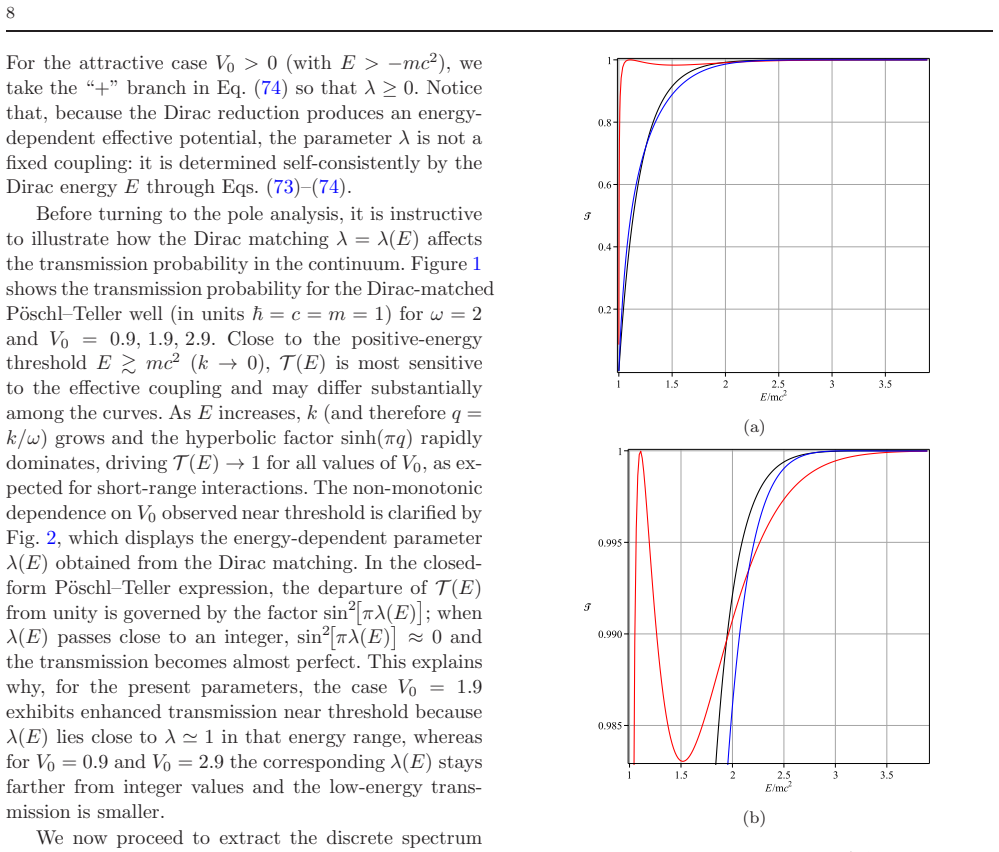
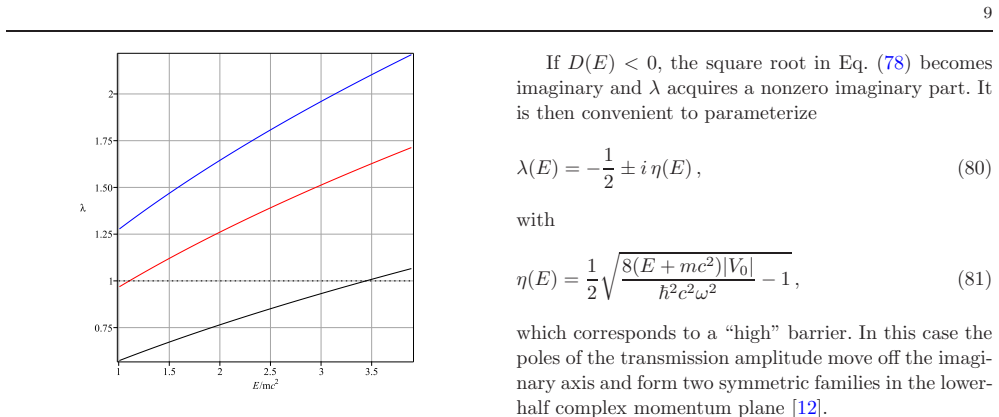
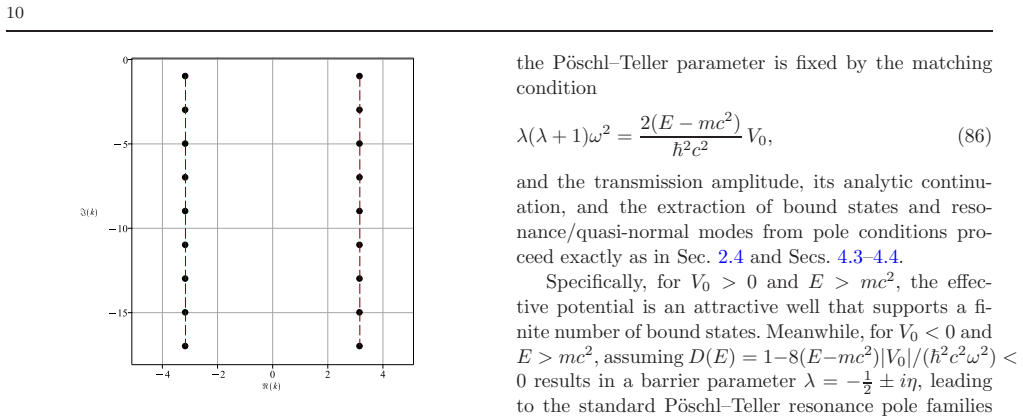
read the original abstract
We develop a unified treatment of scattering and discrete spectra for the one-dimensional Dirac equation with scalar and vector interactions. Under the spin-symmetry condition, the coupled first-order Dirac system maps exactly onto an effective Sturm--Liouville (Schr\"o\-din\-ger-like) problem for a single spinor component. This mapping provides a convenient framework for analyzing transmission, reflection, and analytic continuation. As an explicit application, we consider effective interactions of hyperbolic P\"oschl--Teller type and exploit supersymmetric quantum mechanics and shape invariance to obtain a closed-form expression for the transmission probability. The bound-state spectrum is then recovered from the poles of the analytically continued transmission amplitude, reproducing known results and offering a unified description of scattering and bound states. For the barrier configuration, we briefly comment on the resulting pole pattern in the complex momentum plane and its connection with resonance and quasi-normal-mode behavior. Moreover, we use the chiral transformation to relate the spin- and pseudospin-symmetry sectors and translate results between them without repeating the full derivation.
Editorial analysis
A structured set of objections, weighed in public.
Referee Report
Summary. The manuscript develops a unified treatment of scattering, bound states, and resonances for the one-dimensional Dirac equation with scalar and vector interactions. Under the spin-symmetry condition, the coupled Dirac system is mapped exactly onto an effective Sturm-Liouville problem; supersymmetric quantum mechanics and shape invariance are then applied to hyperbolic Pöschl-Teller potentials to derive a closed-form transmission probability. Bound-state energies are recovered from the poles of the analytically continued transmission amplitude (reproducing known spectra), and a chiral transformation is used to relate the spin- and pseudospin-symmetry sectors.
Significance. If the derivations hold, the work supplies a systematic analytic framework that unifies continuous and discrete spectra for a class of exactly solvable relativistic potentials. The explicit closed-form transmission amplitude obtained via SUSY QM and shape invariance, together with the reproduction of known bound-state results and the translation between symmetry sectors, constitutes a clear strength that may prove useful for both pedagogical exposition and extensions to related potentials.
minor comments (2)
- [Abstract] Abstract: the statement that the method 'reproduces known results' is made without naming the specific spectra or providing even a brief comparison; a short sentence or reference to the relevant equation/table would make the claim more concrete.
- [Barrier configuration discussion] The section discussing the barrier configuration and pole pattern in the complex plane: the connection to resonances and quasi-normal modes is noted only briefly; adding one explicit example of pole locations (with numerical values or a small table) would clarify the claimed link without lengthening the manuscript substantially.
Simulated Author's Rebuttal
We thank the referee for the positive assessment of the manuscript, the recognition of its unified analytic framework, and the recommendation for minor revision. No specific major comments appear in the report.
Circularity Check
No circularity; derivation applies standard SUSY QM to known shape-invariant potential
full rationale
The paper maps the Dirac equation under exact spin symmetry to a Schrödinger-like equation with hyperbolic Pöschl-Teller potential, then applies textbook supersymmetric factorization and shape invariance to obtain the transmission amplitude whose poles yield the bound states. All steps rely on externally established properties of this potential class and reproduce known spectra without introducing fitted parameters, self-definitional relations, or load-bearing self-citations that reduce the central claims to the paper's own inputs. The chiral mapping between sectors is a linear transformation preserving the structure, with no hidden redefinition of quantities.
Axiom & Free-Parameter Ledger
axioms (1)
- domain assumption Spin-symmetry condition allows the coupled first-order Dirac system to map exactly onto an effective Sturm-Liouville problem for a single spinor component
Reference graph
Works this paper leans on
-
[1]
J.N. Ginocchio, Phys. Rev. Lett. 78, 436 (1997). DOI 10.1103/PhysRevLett.78.436
-
[2]
J.N. Ginocchio, Phys. Rep. 414, 165 (2005). DOI http://dx.doi.org/10.1016/j.physrep.2005.04.003
-
[3]
Alberto, M
P. Alberto, M. Malheiro, T. Frederico, A. de Castro, Phys. Rev. A 92, 062137 (2015). DOI 10.1103/ PhysRevA.92.062137
2015
-
[4]
Castro, A.S
L.B. Castro, A.S. de Castro, P. Alberto, Ann. Phys. (N.Y.) 356, 83 (2015). DOI http://dx.doi.org/10. 1016/j.aop.2015.02.033
2015
-
[5]
C.S. Jia, P. Guo, Y.F. Diao, L.Z. Yi, X.J. Xie, Eur. Phys. J. A 34(1), 41 (2007). DOI 10.1140/epja/ i2007-10486-2
-
[6]
F. Ta¸ skın, G. Ko¸ cak, Chinese Phys. B 20(7), 070302 (2011). DOI 10.1088/1674-1056/20/7/ 070302
-
[7]
H. Hassanabadi, E. Maghsoodi, S. Zarrinkamar, H. Rahimov, J. Math. Phys. 53(2), 022104 (2012). DOI 10.1063/1.3683078
-
[8]
F. Cannata, A. Ventura, J. Phys. A: Math. Theor. 43(7), 075305 (2010). DOI 10.1088/1751-8113/43/ 7/075305
-
[9]
L.B. Castro, A.S. de Castro, M.B. Hott, EPL 77(2), 20009 (2007). DOI 10.1209/0295-5075/77/20009
-
[10]
Castro, A.S
L.B. Castro, A.S. de Castro, M. Hott, Int. J. Mod. Phys. E 16, 3002 (2007). DOI 10.1142/ S0218301307008914
2007
-
[11]
V. Ferrari, B. Mashhoon, Phys. Rev. D 30, 295 (1984). DOI 10.1103/PhysRevD.30.295
-
[12]
D. C ¸ evik, M. Gadella, S ¸. Kuru, J. Negro, Phys. Lett. A 380(18), 1600 (2016). DOI https://doi. org/10.1016/j.physleta.2016.03.003
-
[13]
A. Zhidenko, Class. Quantum Grav. 21(1), 273 (2003). DOI 10.1088/0264-9381/21/1/019
-
[14]
C. Molina, Phys. Rev. D 68, 064007 (2003). DOI 10.1103/PhysRevD.68.064007
-
[15]
J. Skakala, M. Visser, Phys. Rev. D 81, 125023 (2010). DOI 10.1103/PhysRevD.81.125023
-
[16]
P.J. Nee, S.H. V¨ olkel, H.P. Pfeiffer, Phys. Rev. D 108, 044032 (2023). DOI 10.1103/PhysRevD.108. 044032
-
[17]
G.R. Li, W.L. Qian, R.G. Daghigh, Phys. Rev. D 110, 064076 (2024). DOI 10.1103/PhysRevD.110. 064076
-
[18]
N. Herceg, T. Juri´ c, A.N. Kumara, A. Samsarov, I. Smoli´ c, J. High Energ. Phys.2025(5), 83 (2025). DOI 10.1007/JHEP05(2025)083
-
[19]
H. Han, B. Gwak, Phys. Rev. D 112, 024031 (2025). DOI 10.1103/8hkr-n975
-
[20]
Gendenshteın, JETP Letters 38, 356 (1983)
L.E. Gendenshteın, JETP Letters 38, 356 (1983)
1983
-
[21]
A. Khare, U.P. Sukhatme, J. Phys. A: Math. Gen. 21(9), L501 (1988). DOI 10.1088/0305-4470/21/9/ 005
-
[22]
Cooper, A
F. Cooper, A. Khare, U. Sukhatme, Phys. Rep. 251(5), 267 (1995). DOI https://doi.org/10.1016/ 0370-1573(94)00080-M
1995
-
[23]
Junker, Supersymmetric Methods in Quantum and Statistical Physics (Springer, Berlin, 1996)
G. Junker, Supersymmetric Methods in Quantum and Statistical Physics (Springer, Berlin, 1996)
1996
-
[24]
Bagchi, Supersymmetry in Quantum and Clas- sical Mechanics
B. Bagchi, Supersymmetry in Quantum and Clas- sical Mechanics . Monographs and Textbooks in Physical Science (Chapman and Hall/CRC, Boca Raton, 2000)
2000
-
[25]
Dong, Factorization Method in Quantum Me- chanics, Fundamental Theories of Physics , vol
S.H. Dong, Factorization Method in Quantum Me- chanics, Fundamental Theories of Physics , vol. 150 (Springer, Dordrecht, 2007)
2007
-
[26]
S. Zarrinkamar, A. Rajabi, H. Hassanabadi, Ann. Phys. (N.Y.) 325(8), 1720 (2010). DOI https:// doi.org/10.1016/j.aop.2010.04.010
-
[27]
S. Zarrinkamar, A. Rajabi, H. Hassanabadi, Ann. Phys. (N.Y.) 325(11), 2522 (2010). DOI https:// doi.org/10.1016/j.aop.2010.05.013
-
[28]
G. P¨ oschl, E. Teller, Z. Physik 83(3), 143 (1933). DOI 10.1007/BF01331132
-
[29]
Fl¨ ugge, Practical Quantum Mechanics
S. Fl¨ ugge, Practical Quantum Mechanics . Classics in Mathematics (Springer Berlin Heidelberg, 1999)
1999
-
[30]
J. Lekner, Am. J. Phys. 75(12), 1151 (2007). DOI 10.1119/1.2787015
-
[31]
J.I. D ´ ıaz, J. Negro, L.M. Nieto, O. Rosas-Ortiz, J. Phys. A: Math. and Gen. 32(48), 8447 (1999). DOI 10.1088/0305-4470/32/48/308. 13
-
[32]
Thaller, The Dirac equation (Springer–Verlag, Berlin, 1992)
B. Thaller, The Dirac equation (Springer–Verlag, Berlin, 1992)
1992
-
[33]
Berti, V
E. Berti, V. Cardoso, A.O. Starinets, Class. Quan- tum Grav. 26(16), 163001 (2009). DOI 10.1088/ 0264-9381/26/16/163001
2009
-
[34]
Olver, D.W
F.W.J. Olver, D.W. Lozier, R.F. Boisvert, C.W. Clark, NIST Handbook of Mathematical Functions (Cambridge University Press, Cambridge, 2010)
2010
discussion (0)
Sign in with ORCID, Apple, or X to comment. Anyone can read and Pith papers without signing in.