REVIEW 4 major objections 5 minor 47 references
Steering between Level Repulsion and Attraction: Broad tunability of Two-Port Driven Cavity Magnon-Polaritons
T0 review · 4 major / 5 minor · reviewed 2026-08-14 · deepseek-v4-flash
Pith's one-line read Adding a second microwave port turns the cavity-magnon coupling strength complex, so a single phase knob sweeps the system from level repulsion through complete level merging into level attraction.
desk verdict A plausible two-port cavity-magnon control knob, but Eq. (5) is read off an ad hoc non-Hermitian Hamiltonian and the experiments are only qualitative; worth refereeing, not desk-rejecting. read the letter →
The pith
A machine-rendered reading of the paper's core claim, the machinery that carries it, and where it could break.
The reading
What carries the argument
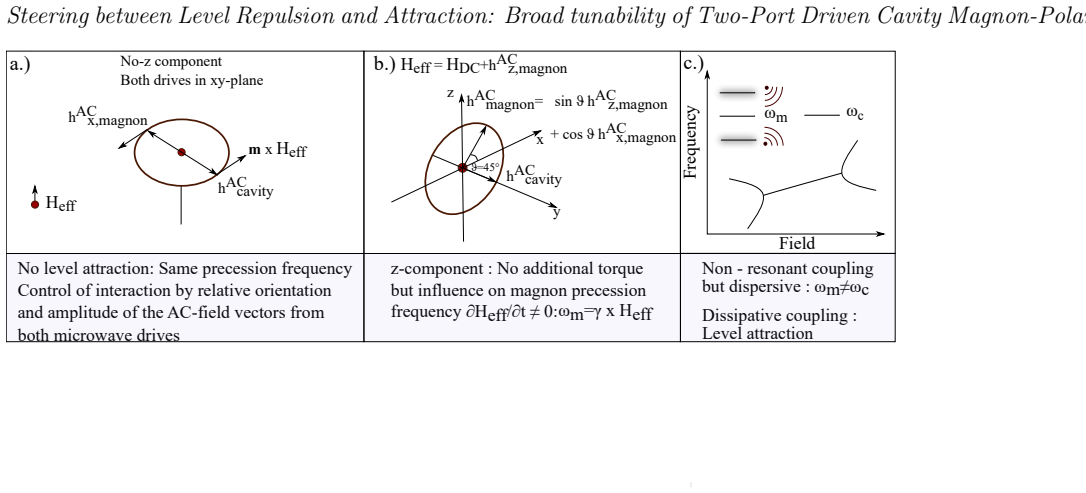
The load-bearing object is the complex effective coupling $g'(\delta_0,\phi)=g_{\mathrm{eff}}\sqrt{1+\delta_0 e^{i\phi}}$, obtained from a non-Hermitian Hamiltonian in which the magnon-port drive adds a term $\hbar g_{\mathrm{eff}}\delta_0 e^{i\phi} a^\dagger m$ without its Hermitian conjugate, the latter being identified with unwanted crosstalk. This single formula carries the argument: its real part is assigned to level repulsion, its imaginary part to level attraction, and its zero at $\delta_0=1,\phi=\pi$ produces level merging. The same term enters the derived reflection coefficient through the substitution $g_{\mathrm{eff}}^2 \to g_{\mathrm{eff}}^2(1+\delta_0 e^{i\phi})$ plus a second contribution proportional to the magnon-port coupling. Physically the mechanism is an additional torque on the magnetization that, depending on phase and amplitude, compensates or overdrives the dissipative channels, moving the system between coherent and dissipative coupling regimes.
What would settle it
Measure the dispersion of the two-port system with independently calibrated internal AC fields at the sample position, for instance by locally probing the microwave magnetic field, and check whether the gap closes at exactly $\delta_0=1$ and $\phi=\pi$; any systematic shift or residual splitting at that point would falsify the formula $g'=g_{\mathrm{eff}}\sqrt{1+\delta_0 e^{i\phi}}$.
Extended reading notes
Core claim
The central claim is that the two-port drive makes the coupling strength complex: $g'(\delta_0,\phi)=g_{\mathrm{eff}}\sqrt{1+\delta_0 e^{i\phi}}$, where $\delta_0$ is the ratio of the AC magnetic fields at the magnon port and cavity port and $\phi$ their relative phase. For $\phi=0$ the coupling stays real and grows with $\delta_0$, so the spectrum keeps its avoided crossing. For $\phi=\pi$ the real part vanishes once $\delta_0\ge 1$; the coupling becomes purely imaginary, which is the signature of level attraction, and at $\delta_0=1,\phi=\pi$ the gap closes entirely (level merging). At intermediate phases both real and imaginary parts are present, so repulsion and attraction coexist in one spectrum. Experimentally the paper observes that coexistence and, at high $\delta_0$ with $\phi=\pi$, a broadened coalesced region whose width grows with $\delta_0$, limited at $\delta_0\approx 11.8$ by crosstalk. The paper also identifies the microscopic mechanism as a transition from coherent coupling to dissipative coupling: the tilted magnon port produces an AC field component along the effective field that modulates the magnon frequency, detuning it from the cavity photon.
Load-bearing premise
The derivation assumes that the second port's effect is fully captured by setting the ratio of the drive amplitudes entering the equations to $\delta_0 e^{i\phi}$, with $\delta_0$ equal to the internal AC-field ratio, while the omitted Hermitian-conjugate term is exactly the crosstalk and can be dropped; if the mapping from external amplitudes to internal fields is wrong, the central formula for the coupling strength does not follow.
Editorial extensions
If this is right
- At $\phi=\pi$ and $\delta_0$ just above 1, the gap closure widens into a finite coalesced region; the paper observes about 0.5 mT of width at $\delta_0=11.8$.
- Intermediate phases allow continuous control of the relative weight of repulsion and attraction in the same spectrum, which the paper describes as a way to set the transmitted information flow between cavity photon and magnon.
- The complex coupling formula implies that the scattering parameter contains both real and imaginary contributions, so phase-resolved measurements are needed to identify level attraction reliably, especially at high $\delta_0$.
- The two-port control requires no mechanical changes to the resonator, so in-situ tuning could be transferred to cryogenic or quantum-coherent settings, such as coupling to a superconducting circuit.
Reading between the lines
- Beyond the paper, the identity $g'=g_{\mathrm{eff}}\sqrt{1+\delta_0 e^{i\phi}}$ suggests that the two-port drive engineers a synthetic imaginary coupling; a direct test would be to extract the complex phase of the reflection coefficient as a function of $\phi$ and compare it with the predicted argument of $g'$.
- Beyond the paper, the non-Hermitian structure hints at an exceptional point: fixing $\delta_0=1$ and sweeping $\phi$ through $\pi$ should make the real frequency splitting vanish while the eigenmodes coalesce, which could be probed experimentally with the same two-port setup.
- Beyond the paper, crosstalk at high $\delta_0$ acts as a parasitic real coupling; a natural extension is to design a compensating orthogonal coupler for the magnon port to suppress this term and push further into the level-attraction regime.
- Beyond the paper, the same complex-coupling mechanism should apply to other hybrid systems with two coherent drives, provided the second port couples to only one subsystem, so the result could transfer to optomechanical or superconducting-circuit platforms.
Signed reviews
Editorial analysis
A structured set of objections, weighed in public.
Referee Report
Summary. The manuscript studies a two-port driven cavity-magnon-polariton system in which a second microwave port couples directly to the magnons. It extends the single-port input-output treatment by proposing a non-Hermitian Hamiltonian that adds the term ħ g_eff δ0 e^{iφ} a†m and omits its Hermitian conjugate. From this model the authors derive a reflection coefficient S11(ω) (Eq. (4)) and introduce an effective complex coupling g′(δ0,φ) = g_eff sqrt(1 + δ0 e^{iφ}) (Eq. (5)). They predict level merging at δ0 = 1, φ = π and level attraction for δ0 > 1, φ = π, and they present numerical plots of the real and imaginary parts of g′ as functions of δ0 and φ. Experimentally, they report spectra showing intermediate phases between attraction and repulsion (Fig. 5) and a high-δ0 measurement with δ0 = 11.79 ± 1.97 (Fig. 6), discussing crosstalk limitations. The framing is that the relative phase and amplitude of the second port provide broad in-situ control over the coherent information exchange between cavity photons and magnons.
Significance. If the central formula and mechanism are correct, the work would be a valuable step toward in-situ control of the coherent versus dissipative character of cavity-magnon coupling, including intermediate coexistence regimes. The paper also deserves credit for clearly identifying crosstalk as a practical limitation, for emphasizing the role of the tilted magnon-port geometry, and for extending the authors' earlier level-merging observation into intermediate-phase and high-δ0 regimes. However, the central theoretical step is an asserted non-Hermitian Hamiltonian rather than a derived input-output or coupled-mode result, and the experimental spectra are not quantitatively fitted to Eq. (4). The significance of the claim is therefore conditional on a derivation and a quantitative comparison that are not yet present.
major comments (4)
- [§3.2, Hamiltonian before Eq. (4)] The central formula hinges on adding the term ħ g_eff δ0 e^{iφ} a†m and omitting its Hermitian conjugate, with the statement that the conjugate 'would correspond to the crosstalk.' This is not a derivation: crosstalk is direct port-to-port microwave leakage, whereas the omitted m†a term would change the coherent cavity–magnon exchange. The equations of motion consequently contain asymmetric off-diagonal terms (−i g_eff a in dm/dt, −i g_eff(1+δ0 e^{iφ}) m in da/dt) that are posited rather than obtained from a microscopic torque or coupled-mode calculation. Because Eq. (5) is read directly from the denominator generated by this asymmetric Hamiltonian, the main prediction is not independently established. Please derive the effective coupling from a standard two-port input-output treatment or from the Landau-Lifshitz torque mechanism, and specify how the bath and crosstalk terms are treated.
- [§3.2, Eq. (4)] The third term of Eq. (4) implicitly uses b_in2/b_in1 = δ0 e^{iφ}, but δ0 is defined in §4.2 as the ratio of internal AC magnetic fields at the sample, obtained from external amplitudes through a calibration factor ζ. The equality of the external-input ratio and the internal-field ratio is not derived. Different ports have different mode overlaps and coupling efficiencies, and a complex calibration factor could enter. Moreover, Eq. (4) as written contains no explicit b_in2/b_in1 ratio, so it is unclear how the third term was normalized. Without this mapping, Eq. (4) is not a closed expression and the quantitative prediction of level merging at δ0 = 1, φ = π is not justified.
- [§4.1, Eq. (5)] The effective coupling g′ = g_eff sqrt(1 + δ0 e^{iφ}) is obtained by replacing g_eff² with g_eff²(1 + δ0 e^{iφ}) in the reflection denominator. This is a restatement of the model rather than an independent consequence of input-output theory. It is also incomplete: the full expression Eq. (4) contains a third term proportional to 2i g_eff δ0 e^{iφ}(1 + δ0 e^{iφ}) sqrt(κ_e1 κ_e2) divided by X times the denominator. The pole structure of Eq. (4) is not computed. A claim that complete merging occurs exactly at δ0 = 1, φ = π should be checked against the full denominator of Eq. (4), including κ_e2 and crosstalk contributions, not only against the simplified factor in Eq. (5).
- [§4.4 and §4.5, Figs. 5 and 6] The experimental validation is qualitative. No fits to Eq. (4) are reported, no extracted values of Re g′ or Im g′ are shown as functions of φ or δ0, and the quoted uncertainties in δ0 are not propagated into the claimed coupling behavior. The asserted coexistence of repulsion and attraction in Fig. 5 is based on visual inspection of line shapes and phase jumps, and in Fig. 6 the level-merging signal and the crosstalk anticrossing are separated by eye. A quantitative fit of the full S11 expression to all spectra would directly test Eq. (5) and is needed to support the central claim of broad, quantitative tunability.
minor comments (5)
- [Fig. 3] The axis labels and panel annotations contain corrupted characters (e.g., '/uni00000003/...'), making the plots difficult to read; please regenerate them with clean LaTeX labels.
- [Eq. (4)] The displayed formula has unbalanced parentheses in the denominator of the third term and appears malformed; please correct the typography.
- [§3.1, Eq. (2) and preceding Hamiltonian] There are operator-ordering and prefactor typos: the cavity term should be a†a rather than aa†, and the magnon number term is missing the factor ħ.
- [§4.3] The main text contains a stray 'ß If hAC...' passage, and several instances of 'e.f.' should read 'e.g.'; please proofread the text.
- [§4.5] The statement that crosstalk 'has to be considered in the calculation of ℑ(g′(δ0,φ))' is not accompanied by an explicit formula; please give the concrete procedure used to extract the imaginary part of the coupling from the measured spectra.
Circularity Check
Eq. (5) restates the ad hoc non-Hermitian a†m term; the level-merging condition δ0=1, φ=π is built into the Hamiltonian.
-
self definitional
[Sec. 3.2 (non-Hermitian Hsys and Hint,2) and Sec. 4.1, Eq. (5)]
"The addition of a second interaction term Hint,2 = ¯hgeffδ0eiφ(a†m) considers the impact of the magnon port ... The first two terms can be mapped to Eq. (3) except a change in the term for the coupling strength from g2eff→g2eff(1+δ0eiφ). ... g′(δ0,φ ) =geff √1+δ0eiφ, (5)"
The factor (1+δ0eiφ) in Eq. (4) is produced solely by inserting Hint,2 = ħgeffδ0eiφ a†m into Hsys and omitting its Hermitian conjugate. Eq. (5) is the square root of that same inserted factor, so the predicted merging at δ0=1, φ=π (1+e^{iπ}=0) is the zero of the ansatz rather than an independent consequence of Input-Output theory. The paper even argues beforehand that level merging requires the off-diagonal product to change sign, and Hint,2 is chosen to do exactly that. No derivation connects δ0 and φ to the magnon-port drive amplitude or the torque mechanism; δ0 is calibrated externally through ζ. The central tunability claim therefore reduces by construction to the assumed non-Hermitian term.
full rationale
The central theoretical claim, Eq. (5), is not an independent output of the Input-Output formalism: it is obtained by taking the square root of the coupling factor g_eff^2(1+δ0 e^{iφ}) that appears in Eq. (4) only because the paper added Hint,2 = ħg_effδ0 e^{iφ} a†m and dropped its conjugate. Thus the level-merging condition at δ0=1, φ=π is encoded in the model from the start. I do not flag the self-citations (Refs. [28], [38]) as load-bearing circularity: prior observation and external mechanism are cited but the formula itself is not justified by them. The experimental phase sweeps, coexistence data, and high-δ0 measurements are not fitted to Eq. (4) and provide partial independent content, so the paper is not wholly circular; however, the derivation of the central coupling formula is circular by construction. Score 6 reflects one or more central predictions reducing to the model input.
Assumptions & free parameters
free parameters (2)
- delta0 (relative amplitude ratio) =
1.31 +/- 0.22 (intermediate), 11.79 +/- 1.97 (high)
- phi (relative phase) =
varied 0 to pi
assumptions (5)
- standard math Input-output formalism with standard assumptions: magnons not coupled to external bath in the single-port case; photons coupled to one bath port.
- ad hoc to paper The two-port system is modeled by the Tavis-Cummings Hamiltonian plus a non-Hermitian drive term hbar g_eff delta0 e^{i phi} a-dagger m, with the Hermitian conjugate omitted because it is said to correspond to crosstalk.
- domain assumption The magnon port couples directly to the magnons only, with negligible direct coupling to the cavity photons for delta0 near 1.
- ad hoc to paper The external input amplitude ratio maps to the internal AC field ratio delta0 through a single factor zeta determined by circle fits, and the derivation implicitly sets b_in2 / b_in1 = delta0 e^{i phi}.
- domain assumption The 45 degree tilt of the magnon port produces a z-component of the AC field that modulates the magnon frequency, causing a transition from coherent to dissipative coupling and hence level attraction.
Cite this review
Pith. "Pith review of Steering between Level Repulsion and Attraction: Broad tunability of Two-Port Driven Cavity Magnon-Polaritons." pith.science (2026). https://pith.science/paper/KAOETOOV
@misc{pith2026190805439,
  author       = {Pith},
  title        = {Pith review of: Steering between Level Repulsion and Attraction: Broad tunability of Two-Port Driven Cavity Magnon-Polaritons},
  year         = {2026},
  howpublished = {\url{https://pith.science/paper/KAOETOOV}},
  note         = {Machine review of arXiv:1908.05439}
}
abstract
Cavity-magnon polaritons (CMPs) are the associated quasiparticles of the hybridization between cavity photons and magnons in a magnetic sample placed in a microwave resonator. In the strong coupling regime, where the macroscopic coupling strength exceeds the individual dissipation, there is a coherent exchange of information. This renders CMPs as promising candidates for future applications such as in information processing. Recent advances on the study of the CMP now allow not only for creation of CMPs on demand, but also for tuning of the coupling strength - this can be thought of as enhancing or suppressing of information exchange. Here, we go beyond standard single-port driven CMPs and employ a two-port driven CMP. We control the coupling strength by the relative phase $\phi$ and amplitude field ratio $\delta_0$ between both ports. Specifically, we derive a new expression from Input-Output theory for the study of the two-port driven CMP and discuss the implications on the coupling strength. Furthermore, we examine intermediate cases where the relative phase is tuned between its maximal and minimal value and, in particular, the high $\delta_0$ regime, which has not been yet explored.
Figures


Figures from the paper (3 more)


Reference graph
Works this paper leans on
-
[1]
Soykal ¨O O and Flatt´ e M E 2010Physical Review Letters 104 077202
-
[2]
Hans Huebl Christoph W Zollitsch J L F H M G A M R G and Goennenwein S T B 2013 Physical Review Letters 111 127003
work page 2013
-
[3]
M Goryachev, W G Farr, D L Creedon, Y Fan, M Kostylev, and M E Tobar 2014 Phys. Rev. Appl. 2 054002
work page 2014
-
[4]
Y Tabuchi, , S Ishino, T Ishikawa, R Yamazaki, K Usami, and Y Nakamura 2014 Phys. Rev. Lett. 113 083603
work page 2014
-
[5]
X Zhang, C-L Zou, L Jiang, and H X Tang 2014 Phys. Rev. Lett. 113 156401
work page 2014
-
[6]
Zhang X, Zou C L, Zhu N, Marquardt F, Jiang L and Tang H X 2015Nat. Commun. 6 8914
-
[7]
Harder M and Hu C M 2018 Cavity spintronics: An early review of recent progress in the study of magnon–photon level repulsion Solid State Physics (Elsevier) pp 47–121
work page 2018
-
[8]
Lachance-Quirion D, Tabuchi Y, Gloppe A, Usami K and Nakamura Y 2019Applied Physics Express 12 070101
Show all 47 references
-
[9]
Pfirrmann M, Boventer I, Schneider A, Wolz T, Kl¨ aui M, Ustinov A V and Weides M 2019 arXiv (Preprint http://arxiv.org/abs/1903.03981v1)
2019 arXiv
-
[10]
Sharma S, Blanter Y M and Bauer G E W 2017 Physical Review B 96 094412
2017
-
[11]
Kusminskiy S V, Tang H X and Marquardt F 2016 Physical Review A 94 033821
2016
-
[12]
Graf J, Pfeifer H, Marquardt F and Kusminskiy S V 2018 Physical Review B 98 241406 REFERENCES 20
2018
-
[13]
Zhang X, Zou C L, Jiang L and Tang H X 2016 Science Advances 2 e1501286
2016
-
[14]
Hisatomi R, Osada A, Tabuchi Y, Ishikawa T, Noguchi A, Yamazaki R, Usami K and Nakamura Y 2016 Physical Review B 93 174427
2016
-
[15]
Y Tabuchi, S Ishino, A Noguchi, T Ishikawa, R Yamazaki, K Usami, Y Nakamura 2015 Science 349 405–408
2015
-
[16]
Haigh J, Nunnenkamp A, Ramsay A and Ferguson A 2016 Physical Review Letters 117 133602
2016
-
[17]
Yao B, Gui Y S, Rao J W, Kaur S, Chen X S, Lu W, Xiao Y, Guo H, Marzlin K P and Hu C M 2017 Nat. Commun. 8 1437
2017
-
[18]
Rao J W, Kaur S, Yao B M, Edwards E R J, Zhao Y T, Fan X, Xue D, Silva T J, Gui Y S and Hu C M 2019 Nature Communications 10 2934
2019
-
[19]
Wang Y P, Zhang G Q, Xu D, Li T F, Zhu S Y, Tsai J S and You J Q 2019 (Preprint http://arxiv.org/abs/1903.12498v1)
2019 arXiv
-
[20]
Zhang D, Luo X Q, Wang Y P, Li T F and You J Q 2017 Nat. Commun. 8 1368
2017
-
[21]
D F Walls and G F Milburn 2008 Quantum Optics (Springer-Verlag GmbH)
2008
-
[22]
N R Bernier, L D T´ oth, A K Feofanov, and T J Kippenberg 2018 Phys. Rev. A 98 023841
2018
-
[23]
Grigoryan V L and Xia K 2019 Physical Review B 100 014415
2019
-
[24]
Harder M, Yang Y, Yao B, Yu C, Rao J, Gui Y, Stamps R and Hu C M 2018 Phys. Rev. Lett. 121 137203
2018
-
[25]
Grigoryan V L, Shen K and Xia K 2018 Phys. Rev. B 98 024406
2018
-
[26]
11570v1)
Proskurin I, Macˆ edo R and Stamps R L (Preprint http://arxiv.org/abs/1904. 11570v1)
1904
-
[27]
Bhoi B, Kim B, Jang S H, Kim J, Yang J, Cho Y J and Kim S K 2019 Physical Review B 99 134426
2019
-
[28]
Boventer I, D¨ orflinger C, Wolz T, Macˆ edo R, Lebrun R, Kl¨ aui M and Weides M (Preprint http://arxiv.org/abs/1904.00393v1)
1904 arXiv
-
[29]
Alexander G Gurevich G A M 2000 Magnetization Oscillations and Waves (CRC PR INC) ISBN 0849394600 URL https://www.ebook.de/de/product/4297668/ alexander_g_gurevich_gennadii_a_melkov_magnetization_oscillations_ and_waves.html
2000
-
[30]
China Phys
M Harder, L Bai, C Match, and C-M Hu 2016 Sci. China Phys. Mech. 59 117511
2016
-
[31]
Y Cao, P Yan, H Huebl, S T B Goennenwein, and G E W Bauer 2015 Phys. Rev. B 91 094423
2015
-
[32]
L Bai, M Harder, Y P Chen, X Fan, J Q Xiao, and C-M Hu 2015 Phys. Rev. Lett. 114 227201
2015
-
[33]
Osada A, Hisatomi R, Noguchi A, Tabuchi Y, Yamazaki R, Usami K, Sadgrove M, Yalla R, Nomura M and Nakamura Y 2016 Physical Review Letters 116 REFERENCES 21
2016
-
[34]
Boventer I, Pfirrmann M, Krause J, Sch¨ on Y, Kl¨ aui M and Weides M 2018Phys. Rev. B 97 184420
-
[35]
Flanders, NJ 07836
Ferrisphere Inc 15 Falcon Rd. Flanders, NJ 07836. United States
-
[36]
Bender C M 2018 Basics of PTsymmetry PT Symmetry (WORLD SCIENTIFIC (EUROPE)) pp 3–38
2018
-
[37]
S Probst, F B Song, P A Bushev, A V Ustinov, and M Weides 2015 Rev. Sci. Instr. 86
2015
-
[38]
Yao B, Yu T, Zhang X, Lu W, Gui Y, Hu C M and Blanter Y M ( Preprint http://arxiv.org/abs/1906.12142v2)
1906 arXiv
-
[39]
Yuan H Y, Yan P, Zheng S, He Q Y, Xia K and Yung M H ( Preprint http: //arxiv.org/abs/1905.11117v1)
1905 arXiv
-
[40]
Bender C M, Brody D C and Jones H F 2002 Physical Review Letters 89 270401
2002
-
[41]
Bender C M, Dorey P E, Dunning C, Fring A, Hook D W, Jones H F, Kuzhel S, L´ evai G and Tateo R 2018PT Symmetry (WORLD SCIENTIFIC (EUROPE))
-
[42]
Bender C M and Boettcher S 1998 Physical Review Letters 80 5243–5246
1998
-
[43]
Wen J, Jiang X, Jiang L and Xiao M 2018 Journal of Physics B: Atomic, Molecular and Optical Physics 51 222001
2018
-
[44]
Galda A and Vinokur V M 2018 Physical Review B 97 201411
2018
-
[45]
Harder M, Bai L, Hyde P and Hu C M 2017 Physical Review B 95 214411
2017
-
[46]
Cao Y and Yan P 2019 Physical Review B 99 214415
2019
-
[47]
Wolz T, Stehli A, Schneider A, Boventer I, Macˆ edo R, Ustinov A V, Kl¨ aui M and Weides M (Preprint http://arxiv.org/abs/1906.08103v2)
1906 arXiv
Reviewed August 14, 2026 · model on record in the stance chip above.
Discussion (0). Continue with ORCID to comment.