REVIEW 3 major objections 5 minor 53 references
T2UE: Generating Unlearnable Examples from Text Descriptions
T0 review · 3 major / 5 minor · reviewed 2026-08-06 · deepseek-v4-flash
Pith's one-line read T2UE generates unlearnable noise from text captions alone, so users can protect images from CLIP training without ever exposing the images.
desk verdict Novel zero-contact UE method with real evidence of protective effect, but the missing no-text control and the Table 7 failure undercut the central text-conditioning claim. read the letter →
The pith
A machine-rendered reading of the paper's core claim, the machinery that carries it, and where it could break.
The reading
What carries the argument
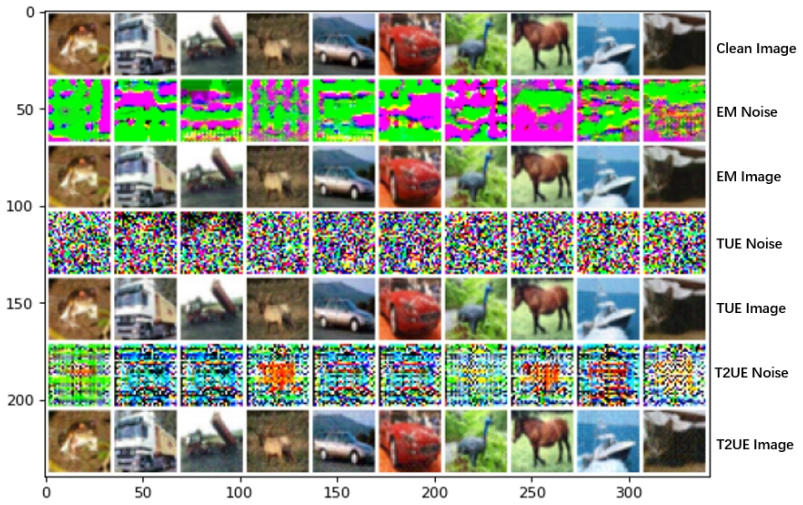
The machinery is a text-guided generator adapted from Semantic-Space-Aware GAN (SSA-GAN), whose Semantic-Space Conditional Batch Normalization (SSCBN) blocks let a text embedding predict per-channel scale and shift parameters that modulate intermediate feature maps. A frozen CLIP image-text encoder pair serves as the surrogate: the generator is trained to minimize the symmetric InfoNCE loss on protected pairs, producing image-independent noise that is semantically tied to the caption. The generated perturbation is bounded by $\epsilon = 8/255$ and is added directly to any target image at protection time.
What would settle it
Train a CLIP model from scratch on T2UE-protected data where each image is paired with a randomly mismatched caption, or where the protected images come from a dataset disjoint from the generator's training data, such as medical or satellite images. If retrieval and classification accuracy stays near the no-protection level, the claim that text-only noise transfers to arbitrary images is refuted. Similarly, if paraphrasing the captions at protection time restores performance, the semantic link between text and noise is not load-bearing.
Extended reading notes
Core claim
The paper's central claim is that a mapping from text semantics to unlearnable perturbation space is sufficient to render multimodal data unexploitable. The generator $G$ takes a CLIP text embedding and a random latent, outputs a noise $\delta_u = G(\mathrm{emb}_t, z; \theta_G)$ with $\|\delta_u\|_\infty \le \epsilon$, and never sees the image $I$. Training minimizes the surrogate InfoNCE loss over protected pairs $(I+\delta_u, T)$, which teaches downstream models to latch onto the text-conditioned noise as a shortcut instead of the true image-text relationship. The paper demonstrates this protection on Flickr8k, Flickr30k, and Tiny-MSCOCO for CLIP-style contrastive pretraining, and shows the same noise transfers to supervised classification on CIFAR-10, CIFAR-100, and STL-10.
Load-bearing premise
The load-bearing premise is that image-independent noise, generated from a caption alone, reliably creates a strong shortcut for any image and for models trained from scratch on unseen datasets; if the noise only works when caption and image match, or only on the generator's training distribution, the zero-contact claim weakens.
Editorial extensions
If this is right
- A user can generate protective noise from a text caption alone, so the original image never needs to leave the user's device or be uploaded to a third party.
- Noise produced for CLIP also degrades standard supervised classifiers, so the same generator protects against multiple training paradigms.
- The protection transfers across ResNet, VGG, GoogLeNet, DenseNet, and ViT backbones, not just the surrogate used to train the generator.
- The effect survives data augmentations like CutOut, MixUp, and AutoAugment, and remains strong as the poisoning ratio increases.
- Generating noise with T2UE is cheaper than existing UE methods, for example 0.3 hours versus 1.1-10.2 hours on Flickr8k in the reported setup.
Reading between the lines
- A practical corollary the paper leaves implicit is that the trained generator itself becomes the sensitive artifact: whoever holds it can produce protective noise for captions it has never seen, so distributing the generator is itself a privacy decision.
- The same text-to-perturbation mechanism could extend to other contrastive modalities such as audio-text or video-text, provided a frozen surrogate contrastive model and a text encoder exist.
- The paper's results also imply an adversary could use guessed or scraped captions to poison images without access to the images, shifting the practical threat from image leakage to caption leakage.
- A testable consequence of the transfer claim is that the noise should remain potent on images whose content does not match the text; the paper only tests this indirectly through dataset-level transfer.
Editorial analysis
A structured set of objections, weighed in public.
Referee Report
Summary. The paper proposes T2UE, a framework for generating unlearnable examples (UEs) for multimodal data using only text descriptions. A generator network maps a frozen CLIP text embedding and a random latent to an image perturbation, trained on MSCOCO by minimizing the InfoNCE loss of a frozen CLIP surrogate (Eq. 4). The resulting noise is applied to arbitrary images without access to them, giving the claimed “zero-contact” protection. Experiments evaluate CLIP retrieval on Flickr8k, Flickr30k, and Tiny-MSCOCO, supervised classification on CIFAR-10/100 and STL-10, transfer across architectures, robustness to augmentations and mixed poisoning ratios, and generation time compared with baselines. The core claim is that text-only, image-independent perturbations can render protected data unexploitable for contrastive pre-training and supervised learning.
Significance. If substantiated, the contribution is practically relevant: it decouples UE generation from the original image, removing a privacy paradox in which users must expose data to obtain protection. The paper provides extensive tables, a useful efficiency comparison, and cross-architecture transfer results. The central idea is plausible and the evaluation is broad. However, the evidence is currently incomplete in load-bearing ways: no control isolates whether text conditioning is the operative mechanism, the varied-text experiment contradicts the robustness claim, and one evaluation dataset overlaps with the generator training data. These issues prevent acceptance as is, but they are addressable within the manuscript's scope.
major comments (3)
- [§3.2, Tables 2 and 3] The central claim is that the learned text-to-perturbation mapping (Eq. 4) is what makes protected data unexploitable. However, no experiment compares T2UE against a control with text conditioning removed, e.g., δ = G(z) with emb_t replaced by a constant or random vector, or against random noise at the same ε = 8/255 bound. Without such a control, the degradations in Tables 2 and 3 could plausibly be caused by the mere presence of a bounded perturbation rather than by semantic alignment with the text. This is load-bearing because random noise would also be zero-contact and much cheaper, and it would undermine the necessity of the proposed text-guided generator. Please add these control conditions to the main retrieval and classification tables.
- [§4.2, Table 7] Table 7 is the experiment for “varying text descriptions” and is claimed to show that T2UE is robust to text variations. The Flickr8k row contradicts this: for image-to-text retrieval, Hit@10 with T2UE is 5.6 versus 5.4 for clean data, i.e., the protected model is no worse than the clean model (and slightly better), and the text-to-image Hit@10 drop is only 5.2 to 4.92. This means the protective effect essentially disappears under GIT-generated varied captions on this dataset. The paper needs to explain this failure, report variance or significance, or narrow the robustness claim accordingly.
- [§4, Table 2] The generator is trained on MSCOCO, and the main evaluation in Table 2 includes Tiny-MSCOCO. If Tiny-MSCOCO is a subset drawn from MSCOCO, this row is not an out-of-distribution transfer test and overstates the generalization of the method; the transfer claim should be based on Flickr8k and Flickr30k or on a disjoint held-out MSCOCO split. Please clarify the exact relationship between Tiny-MSCOCO and the generator training data; if there is overlap, remove or re-label the Tiny-MSCOCO result.
minor comments (5)
- [§3.2, Eq. (4)] The notation is inconsistent: Eq. (4) defines δ_u, but the following paragraph uses δ′, and δ and δ_u are used interchangeably. Please unify the notation.
- [§4.2, Table 5] The Table 5 caption says the experiments use ResNet-50, while the text in §4.2 says ResNet-18. One of these is incorrect and should be fixed.
- [Table 2 and Figure 2] There are typos: Table 2 has “Flick8k” instead of “Flickr8k”, and Figure 2 repeats “A phot of cat”. Please proofread.
- [Table 4] In the ResNet-50 block for T2UE(ViT/B-32) on CIFAR-10, the class-wise and sample-wise columns both list 10.41; this is likely a typo and should be checked against the raw results.
- [§4.2, Table 7] Table 7 reports no baselines, no confidence intervals, and no details on the GIT-generated descriptions (how many per image, how they were matched to images, whether results are averaged over runs). Please specify the protocol and, ideally, report standard deviations.
Circularity Check
No significant circularity: the Eq. 4 optimization is a training objective, and the main claims are checked by training fresh models out-of-sample.
full rationale
The paper's derivation chain has three load-bearing moves. First, it defines a text-conditioned generator delta_u = G(emb_t, z; theta_G) (Eq. 1) and trains it with Eq. 4 to minimize a surrogate CLIP InfoNCE loss on protected image-text pairs. This is a training objective, not an evaluation outcome; nothing in Eq. 4 forces the later retrieval or classification numbers by construction. Second, the protected data are evaluated by training new CLIP models from scratch on Flickr8k, Flickr30k, and Tiny-MSCOCO, and by training ResNet/VGG/GoogLeNet/DenseNet models on CIFAR-10/100 and STL-10; these are datasets and architectures not used in optimizing theta_G, so the reported degradations are out-of-sample empirical measurements. Third, the use of the error-minimization framework and hyperparameters cites [16], whose author list overlaps with the present paper, but [16] is a published, externally evaluated method used as a component, not as an authority that forecloses alternatives; no uniqueness theorem is imported. The class-wise supervised variant uses fixed text templates and fixed z, so it produces a per-class constant perturbation; this is the known shortcut mechanism cited in prior work, but the paper does not present a derivation that assumes the conclusion. The paper's own limitation section acknowledges sensitivity to prompt quality, but that is an effectiveness limitation, not a circular step. The skeptic's point about the absence of a text-ablated or random-noise control is a legitimate experimental-attribution gap: the paper has not shown that semantic text conditioning, rather than mere perturbation magnitude, is the operative cause. However, it is not an equation-level circularity. Under the required standard of exhibiting a specific reduction of a prediction to its inputs, no such reduction is present in the manuscript.
Assumptions & free parameters
free parameters (3)
- Noise bound epsilon =
8/255
- CIFAR text prompts =
Not specified
- Generator hyperparameters =
batch 128, lr 1e-4, 300/500 epochs
assumptions (3)
- standard math InfoNCE is the attacker's training objective
- domain assumption A frozen pre-trained CLIP is a faithful proxy for a model trained from scratch on protected data
- domain assumption Noise delta_u independent of the image content still creates a learnable shortcut
Cite this review
Pith. "Pith review of T2UE: Generating Unlearnable Examples from Text Descriptions." pith.science (2026). https://pith.science/paper/KCSTSFI2
@misc{pith2026250803091,
  author       = {Pith},
  title        = {Pith review of: T2UE: Generating Unlearnable Examples from Text Descriptions},
  year         = {2026},
  howpublished = {\url{https://pith.science/paper/KCSTSFI2}},
  note         = {Machine review of arXiv:2508.03091}
}
read the original abstract
Large-scale pre-training frameworks like CLIP have revolutionized multimodal learning, but their reliance on web-scraped datasets, frequently containing private user data, raises serious concerns about misuse. Unlearnable Examples (UEs) have emerged as a promising countermeasure against unauthorized model training, employing carefully crafted unlearnable noise to disrupt the learning of meaningful representations from protected data. Current approaches typically generate UEs by jointly optimizing unlearnable noise for both images and their associated text descriptions (or labels). However, this optimization process is often computationally prohibitive for on-device execution, forcing reliance on external third-party services. This creates a fundamental privacy paradox: users must initially expose their data to these very services to achieve protection, thereby compromising privacy in the process. Such a contradiction has severely hindered the development of practical, scalable data protection solutions. To resolve this paradox, we introduce \textbf{Text-to-Unlearnable Example (T2UE)}, a novel framework that enables users to generate UEs using only text descriptions. T2UE circumvents the need for original image data by employing a text-to-image (T2I) model to map text descriptions into the image (noise) space, combined with an error-minimization framework to produce effective unlearnable noise. Extensive experiments show that T2UE-protected data substantially degrades performance in downstream tasks (e.g., cross-modal retrieval) for state-of-the-art models. Notably, the protective effect generalizes across diverse architectures and even to supervised learning settings. Our work demonstrates the feasibility of "zero-contact data protection", where personal data can be safeguarded based solely on their textual descriptions, eliminating the need for direct data exposure.
Figures


Figures from the paper (3 more)


Reference graph
Works this paper leans on
-
[1]
Large image datasets: A pyrrhic win for computer vision? In WACV, 2021
Abeba Birhane and Vinay Uday Prabhu. Large image datasets: A pyrrhic win for computer vision? In WACV, 2021
2021
-
[2]
Microsoft coco captions: Data collection and evaluation server.arXiv preprint arXiv:1504.00325, 2015
Xinlei Chen, Hao Fang, Tsung-Yi Lin, Ramakrishna Vedantam, Saurabh Gupta, Piotr Dollár, and C Lawrence Zitnick. Microsoft coco captions: Data collection and evaluation server.arXiv preprint arXiv:1504.00325, 2015
arXiv 2015
-
[3]
An analysis of single-layer networks in unsuper- vised feature learning
Adam Coates, Andrew Ng, and Honglak Lee. An analysis of single-layer networks in unsuper- vised feature learning. In Proceedings of the fourteenth international conference on artificial intelligence and statistics, 2011
work page 2011
-
[4]
Cubuk, Barret Zoph, Dandelion Mané, Vijay Vasudevan, and Quoc V
Ekin D. Cubuk, Barret Zoph, Dandelion Mané, Vijay Vasudevan, and Quoc V . Le. Autoaug- ment: Learning augmentation strategies from data. In CVPR, 2019
work page 2019
-
[5]
Improved regularization of convolutional neural networks with cutout
Terrance DeVries and Graham W Taylor. Improved regularization of convolutional neural networks with cutout. arXiv preprint arXiv:1708.04552, 2017
arXiv 2017
-
[6]
An image is worth 16x16 words: Transformers for image recognition at scale
Alexey Dosovitskiy, Lucas Beyer, Alexander Kolesnikov, Dirk Weissenborn, Xiaohua Zhai, Thomas Unterthiner, Mostafa Dehghani, Matthias Minderer, Georg Heigold, Sylvain Gelly, Jakob Uszkoreit, and Neil Houlsby. An image is worth 16x16 words: Transformers for image recognition at scale. ICLR, 2021
2021
-
[7]
Adversarial examples make strong poisons
Liam Fowl, Micah Goldblum, Ping-yeh Chiang, Jonas Geiping, Wojciech Czaja, and Tom Goldstein. Adversarial examples make strong poisons. NeurIPS, 2021
work page 2021
-
[8]
Robust unlearnable exam- ples: Protecting data against adversarial learning
Shaopeng Fu, Fengxiang He, Yang Liu, Li Shen, and Dacheng Tao. Robust unlearnable exam- ples: Protecting data against adversarial learning. In ICLR, 2022
work page 2022
Show all 53 references
-
[9]
Datacomp: In search of the next generation of multimodal datasets
Samir Yitzhak Gadre, Gabriel Ilharco, Alex Fang, Jonathan Hayase, Georgios Smyrnis, Thao Nguyen, Ryan Marten, Mitchell Wortsman, Dhruba Ghosh, Jieyu Zhang, et al. Datacomp: In search of the next generation of multimodal datasets. In NeurIPS, 2023
2023
-
[10]
Armor: Shielding unlearnable examples against data augmentation
Xueluan Gong, Yuji Wang, Yanjiao Chen, Haocheng Dong, Yiming Li, Mengyuan Sun, Shuaike Li, Qian Wang, and Chen Chen. Armor: Shielding unlearnable examples against data augmentation. arXiv preprint arXiv:2501.08862, 2025
2025 arXiv
-
[11]
Medgan: An adaptive gan approach for medical image generation
Kehua Guo, Jie Chen, Tian Qiu, Shaojun Guo, Tao Luo, Tianyu Chen, and Sheng Ren. Medgan: An adaptive gan approach for medical image generation. Computers in Biology and Medicine, 163:107119, 2023
2023
-
[12]
Indiscriminate poisoning attacks on unsupervised contrastive learning
Hao He, Kaiwen Zha, and Dina Katabi. Indiscriminate poisoning attacks on unsupervised contrastive learning. In ICLR, 2023
2023
-
[13]
Deep residual learning for image recognition
Kaiming He, Xiangyu Zhang, Shaoqing Ren, and Jian Sun. Deep residual learning for image recognition. In CVPR, 2016
2016
-
[14]
The secretive company that might end privacy as we know it
Kashmir Hill. The secretive company that might end privacy as we know it. In Ethics of Data and Analytics, pages 170–177. Auerbach Publications, 2022
2022
-
[15]
Densely con- nected convolutional networks
Gao Huang, Zhuang Liu, Laurens Van Der Maaten, and Kilian Q Weinberger. Densely con- nected convolutional networks. InProceedings of the IEEE conference on computer vision and pattern recognition, pages 4700–4708, 2017
2017
-
[16]
Un- learnable examples: Making personal data unexploitable
Hanxun Huang, Xingjun Ma, Sarah Monazam Erfani, James Bailey, and Yisen Wang. Un- learnable examples: Making personal data unexploitable. In ICLR, 2021. 12
2021
-
[17]
Unlearnable examples: Protecting open-source software from unauthorized neural code learning
Zhenlan Ji, Pingchuan Ma, and Shuai Wang. Unlearnable examples: Protecting open-source software from unauthorized neural code learning. In SEKE, 2022
2022
-
[18]
Scaling up visual and vision-language representation learning with noisy text supervision
Chao Jia, Yinfei Yang, Ye Xia, Yi-Ting Chen, Zarana Parekh, Hieu Pham, Quoc Le, Yun- Hsuan Sung, Zhen Li, and Tom Duerig. Scaling up visual and vision-language representation learning with noisy text supervision. In ICML, 2021
2021
-
[19]
Unlearnable examples for time series
Yujing Jiang, Xingjun Ma, Sarah Monazam Erfani, and James Bailey. Unlearnable examples for time series. In PAKDD, 2024
2024
-
[20]
Understanding black-box predictions via influence functions
Pang Wei Koh and Percy Liang. Understanding black-box predictions via influence functions. In ICML. PMLR, 2017
2017
-
[21]
Learning multiple layers of features from tiny images
Alex Krizhevsky. Learning multiple layers of features from tiny images. 2009
2009
-
[22]
Text to image generation with semantic-spatial aware gan
Wentong Liao, Kai Hu, Michael Ying Yang, and Bodo Rosenhahn. Text to image generation with semantic-spatial aware gan. arXiv preprint arXiv:2104.00567, 2021
2021 arXiv
-
[23]
Text to image generation with semantic-spatial aware gan
Wentong Liao, Kai Hu, Michael Ying Yang, and Bodo Rosenhahn. Text to image generation with semantic-spatial aware gan. In CVPR, 2022
2022
-
[24]
Microsoft coco: Common objects in context
Tsung-Yi Lin, Michael Maire, Serge Belongie, James Hays, Pietro Perona, Deva Ramanan, Piotr Dollár, and C Lawrence Zitnick. Microsoft coco: Common objects in context. In ECCV, 2014
2014
-
[25]
Multimodal unlearnable examples: Protecting data against multimodal contrastive learning
Xinwei Liu, Xiaojun Jia, Yuan Xun, Siyuan Liang, and Xiaochun Cao. Multimodal unlearnable examples: Protecting data against multimodal contrastive learning. In MM, 2024
2024
-
[26]
Stable unlearnable example: Enhancing the robustness of unlearnable examples via stable error-minimizing noise
Yixin Liu, Kaidi Xu, Xun Chen, and Lichao Sun. Stable unlearnable example: Enhancing the robustness of unlearnable examples via stable error-minimizing noise. In AAAI, volume 38, pages 3783–3791, 2024
2024
-
[27]
The data provenance initiative: A large scale audit of dataset licensing & attribution in ai
Shayne Longpre, Robert Mahari, Anthony Chen, Naana Obeng-Marnu, Damien Sileo, William Brannon, Niklas Muennighoff, Nathan Khazam, Jad Kabbara, Kartik Perisetla, et al. The data provenance initiative: A large scale audit of dataset licensing & attribution in ai. Nature Machine ...
2023
-
[28]
Safety at scale: A comprehensive survey of large model safety
Xingjun Ma, Yifeng Gao, Yixu Wang, Ruofan Wang, Xin Wang, Ye Sun, Yifan Ding, Hengyuan Xu, Yunhao Chen, Yunhan Zhao, et al. Safety at scale: A comprehensive survey of large model safety. arXiv preprint arXiv:2502.05206, 2025
2025 arXiv
-
[29]
Conditional generative adversarial nets
Mehdi Mirza and Simon Osindero. Conditional generative adversarial nets. Computer Science, pages 2672–2680, 2014
2014
-
[30]
Learning transferable visual models from natural language supervision
Alec Radford, Jong Wook Kim, Chris Hallacy, Aditya Ramesh, Gabriel Goh, Sandhini Agar- wal, Girish Sastry, Amanda Askell, Pamela Mishkin, Jack Clark, et al. Learning transferable visual models from natural language supervision. In ICML, 2021
2021
-
[31]
Transferable unlearnable examples
Jie Ren, Han Xu, Yuxuan Wan, Xingjun Ma, Lichao Sun, and Jiliang Tang. Transferable unlearnable examples. arXiv preprint arXiv:2210.10114, 2022
2022 arXiv
-
[32]
Cuda: Convolution-based unlearnable datasets
Vinu Sankar Sadasivan, Mahdi Soltanolkotabi, and Soheil Feizi. Cuda: Convolution-based unlearnable datasets. In CVPR, 2023
2023
-
[33]
Autoregressive perturbations for data poisoning
Pedro Sandoval-Segura, Vasu Singla, Jonas Geiping, Micah Goldblum, Tom Goldstein, and David Jacobs. Autoregressive perturbations for data poisoning. NeurIPS, 2022
2022
-
[34]
What can we learn from unlearnable datasets? NeurIPS, 2023
Pedro Sandoval-Segura, Vasu Singla, Jonas Geiping, Micah Goldblum, and Tom Goldstein. What can we learn from unlearnable datasets? NeurIPS, 2023
2023
-
[35]
Laion-400m: Open dataset of clip-filtered 400 million image-text pairs
Christoph Schuhmann, Richard Vencu, Romain Beaumont, Robert Kaczmarczyk, Clayton Mullis, Aarush Katta, Theo Coombes, Jenia Jitsev, and Aran Komatsuzaki. Laion-400m: Open dataset of clip-filtered 400 million image-text pairs. arXiv preprint arXiv:2111.02114, 2021. 13
2021 arXiv
-
[36]
Laion- 5b: An open large-scale dataset for training next generation image-text models.NeurIPS, 2022
Christoph Schuhmann, Romain Beaumont, Richard Vencu, Cade Gordon, Ross Wightman, Mehdi Cherti, Theo Coombes, Aarush Katta, Clayton Mullis, Mitchell Wortsman, et al. Laion- 5b: An open large-scale dataset for training next generation image-text models.NeurIPS, 2022
2022
-
[37]
Very deep convolutional networks for large-scale image recognition
Karen Simonyan and Andrew Zisserman. Very deep convolutional networks for large-scale image recognition. arXiv preprint arXiv:1409.1556, 2014
2014 arXiv
-
[38]
Unseg: One universal unlearnable example generator is enough against all image segmentation
Ye Sun, Hao Zhang, Tiehua Zhang, Xingjun Ma, and Yu-Gang Jiang. Unseg: One universal unlearnable example generator is enough against all image segmentation. In NeurIPS, 2024
2024
-
[39]
Going deeper with convolutions
Christian Szegedy, Wei Liu, Yangqing Jia, Pierre Sermanet, Scott Reed, Dragomir Anguelov, Dumitru Erhan, Vincent Vanhoucke, and Andrew Rabinovich. Going deeper with convolutions. In CVPR, 2015
2015
-
[40]
Generating videos with scene dy- namics
Carl V ondrick, Hamed Pirsiavash, and Antonio Torralba. Generating videos with scene dy- namics. NeurIPS, 29, 2016
2016
-
[41]
Provably unlearnable data examples
Derui Wang, Minhui Xue, Bo Li, Seyit Camtepe, and Liming Zhu. Provably unlearnable data examples. arXiv preprint arXiv:2405.03316, 2024
2024 arXiv
-
[42]
Git: A generative image-to-text transformer for vision and language
Jianfeng Wang, Zhengyuan Yang, Xiaowei Hu, Linjie Li, Kevin Lin, Zhe Gan, Zicheng Liu, Ce Liu, and Lijuan Wang. Git: A generative image-to-text transformer for vision and language. arXiv preprint arXiv:2205.14100, 2022
2022 arXiv
-
[43]
Unlearnable 3d point clouds: Class-wise transformation is all you need
Xianlong Wang, Minghui Li, Wei Liu, Hangtao Zhang, Shengshan Hu, Yechao Zhang, Ziqi Zhou, and Hai Jin. Unlearnable 3d point clouds: Class-wise transformation is all you need. In NeurIPS, 2024
2024
-
[44]
Dcgan-based data augmentation for tomato leaf disease identification
Qiufeng Wu, Yiping Chen, and Jun Meng. Dcgan-based data augmentation for tomato leaf disease identification. IEEE access, 8:98716–98728, 2020
2020
-
[45]
Demystifying clip data
Hu Xu, Saining Xie, Xiaoqing Tan, Po-Yao Huang, Russell Howes, Vasu Sharma, Shang-Wen Li, Gargi Ghosh, Luke Zettlemoyer, and Christoph Feichtenhofer. Demystifying clip data. In ICLR, 2024
2024
-
[46]
Robust contrastive language-image pretraining against data poisoning and backdoor attacks
Wenhan Yang, Jingdong Gao, and Baharan Mirzasoleiman. Robust contrastive language-image pretraining against data poisoning and backdoor attacks. NeurIPS, 2024
2024
-
[47]
Data poisoning attacks against multimodal encoders
Ziqing Yang, Xinlei He, Zheng Li, Michael Backes, Mathias Humbert, Pascal Berrang, and Yang Zhang. Data poisoning attacks against multimodal encoders. In ICML. PMLR, 2023
2023
-
[48]
How far are we from true unlearnability? In ICLR, 2025
Kai Ye, Liangcai Su, and Chenxiong Qian. How far are we from true unlearnability? In ICLR, 2025
2025
-
[49]
From image descriptions to visual denotations: New similarity metrics for semantic inference over event descriptions
Peter Young, Alice Lai, Micah Hodosh, and Julia Hockenmaier. From image descriptions to visual denotations: New similarity metrics for semantic inference over event descriptions. Transactions of the Association for Computational Linguistics, 2:67–78, 2014
2014
-
[50]
Availability attacks create shortcuts
Da Yu, Huishuai Zhang, Wei Chen, Jian Yin, and Tie-Yan Liu. Availability attacks create shortcuts. In SIGKDD, 2022
2022
-
[51]
Stackgan: Text to photo-realistic image synthesis with stacked generative adversarial networks
Han Zhang, Tao Xu, Hongsheng Li, Shaoting Zhang, Xiaogang Wang, Xiaolei Huang, and Dimitris N Metaxas. Stackgan: Text to photo-realistic image synthesis with stacked generative adversarial networks. In ICCV, 2017
2017
-
[52]
mixup: Beyond empirical risk minimization
Hongyi Zhang. mixup: Beyond empirical risk minimization. arXiv preprint arXiv:1710.09412, 2017
2017 arXiv
-
[53]
Unlearnable clusters: Towards label-agnostic unlearnable examples
Jiaming Zhang, Xingjun Ma, Qi Yi, Jitao Sang, Yu-Gang Jiang, Yaowei Wang, and Chang- sheng Xu. Unlearnable clusters: Towards label-agnostic unlearnable examples. In CVPR, 2023. 14 A More Ablation Results A.1 Impact of Generator Training Duration (a) ViT-B/16 (b) ViT-B/32 Figur...
2023
Reviewed August 6, 2026 · model on record in the stance chip above.
Discussion (0). Sign in to comment.