Revisiting the role of saturation in diffractive vector meson production
Pith reviewed 2026-06-26 16:38 UTC · model grok-4.3
The pith
Electromagnetic dissociation correction resolves tension between proton and nuclear diffractive J/ψ data in the Color Glass Condensate framework.
A machine-rendered reading of the paper's core claim, the machinery that carries it, and where it could break.
Core claim
The authors find that the γ+Pb data with EMD correction substantially reduce the previously observed tension between proton and nuclear datasets, enabling a consistent simultaneous description of diffractive J/ψ production in γ+p and γ+Pb collisions within the CGC framework.
What carries the argument
Gaussian-process emulators of the CGC calculations, used within a Bayesian global analysis to infer model parameters from combined HERA and LHC data.
If this is right
- Saturation effects in nuclear targets can be extracted without dataset inconsistencies dominating the fit.
- The same CGC parameters describe both coherent and incoherent production channels across proton and nuclear targets.
- Predictions for vector meson production in future ultraperipheral collision runs gain reliability from the joint constraint.
- The role of gluon saturation in diffractive processes receives stronger support from the unified description.
Where Pith is reading between the lines
- The same Bayesian emulator approach could be extended to other vector mesons to test whether consistency holds beyond J/ψ.
- Higher-luminosity LHC data might allow separation of EMD effects from genuine saturation signals in nuclear collisions.
- If the reduced tension persists under alternative nuclear breakup models, it would strengthen the case that saturation governs the nuclear modification.
Load-bearing premise
The electromagnetic dissociation correction is accurate and does not introduce systematic biases that artificially improve agreement with the CGC model.
What would settle it
An independent reanalysis of the same LHC γ+Pb data that finds persistent tension with proton data after applying the EMD correction would falsify the claim that the correction enables consistency.
Figures
read the original abstract
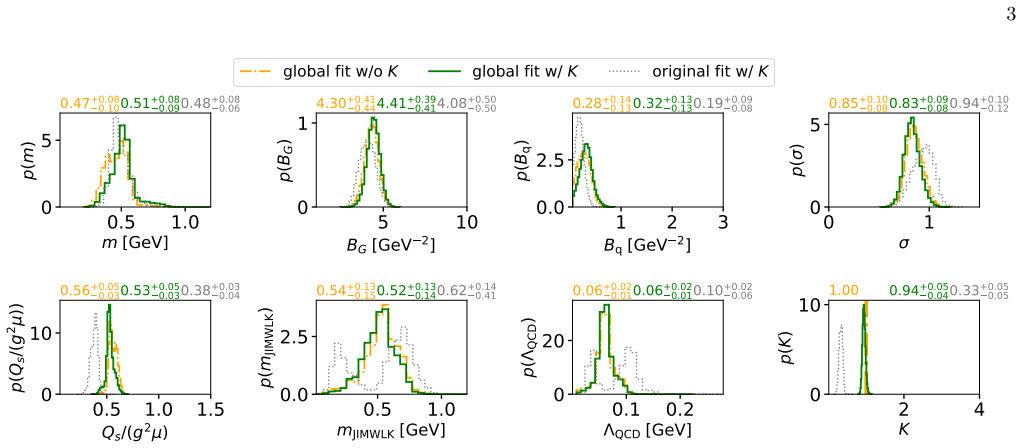
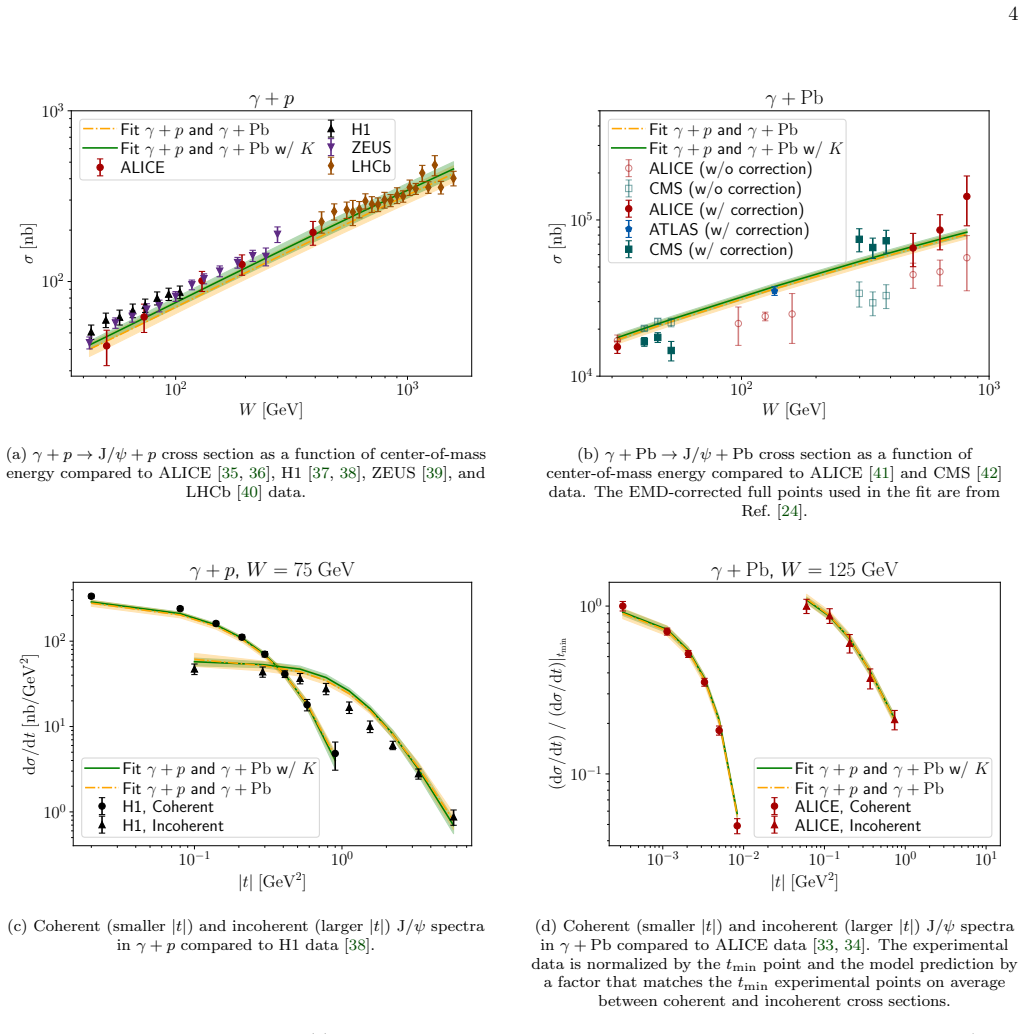
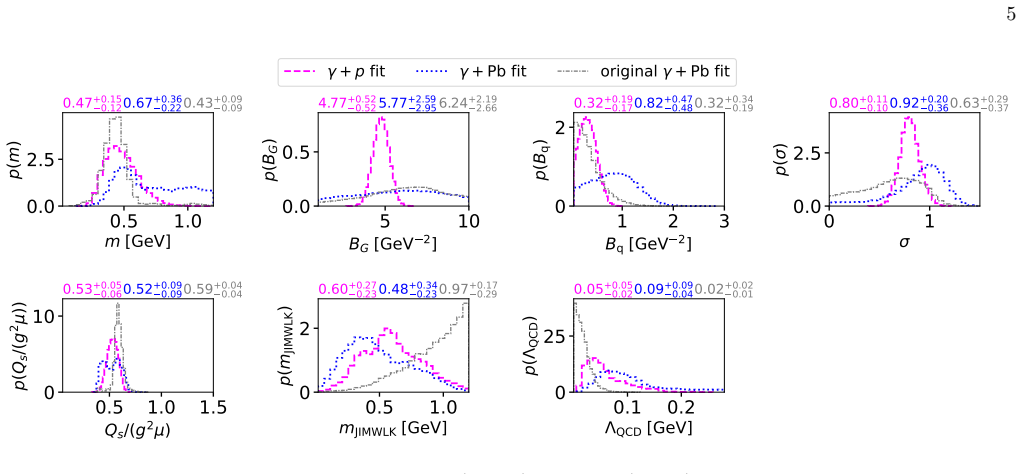
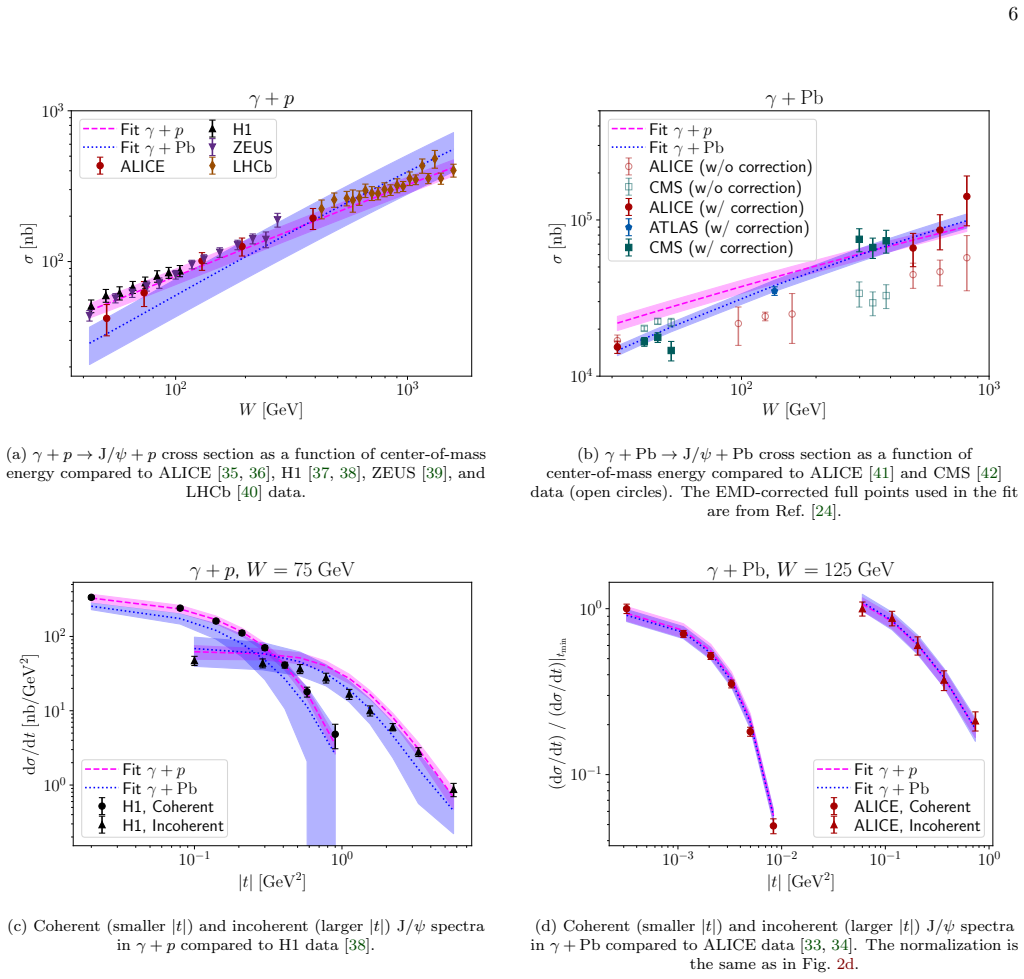
We perform a global Bayesian analysis of coherent and incoherent diffractive $\mathrm{J}/\psi$ photoproduction in $\gamma+p$ and $\gamma+\mathrm{Pb}$ collisions using a Color Glass Condensate (CGC)-based framework and ultraperipheral collision data from the Large Hadron Collider (LHC), corrected for the expected effect of electromagnetic dissociation (EMD). Using Gaussian-process emulators of the underlying CGC calculations, we infer model parameters from a combined set of HERA and LHC measurements. We find that the $\gamma+\mathrm{Pb}$ data with EMD correction substantially reduce the previously observed tension between proton and nuclear datasets, enabling a consistent simultaneous description of diffractive $\mathrm{J}/\psi$ production in $\gamma+p$ and $\gamma+\mathrm{Pb}$ collisions within the CGC framework.
Editorial analysis
A structured set of objections, weighed in public.
Referee Report
Summary. The paper performs a global Bayesian analysis of coherent and incoherent diffractive J/ψ photoproduction in γ+p and γ+Pb collisions within a CGC framework. It uses Gaussian-process emulators trained on CGC calculations and incorporates an electromagnetic dissociation (EMD) correction to LHC ultraperipheral collision data. Model parameters are inferred from a combined HERA and LHC dataset, with the central claim being that the EMD-corrected γ+Pb data substantially reduce the previously observed tension between proton and nuclear datasets, enabling a consistent simultaneous description.
Significance. If the central claim holds after validation of the key assumptions, the result would be significant for the field: it would demonstrate that saturation effects in the CGC can simultaneously describe diffractive vector meson production across proton and nuclear targets once a standard nuclear correction is applied. The methodological use of Gaussian-process emulators for efficient Bayesian inference on expensive CGC computations is a clear strength that enables the global fit.
major comments (2)
- [Abstract and Methods] The headline claim that EMD-corrected γ+Pb data enable consistent simultaneous description rests on the accuracy of the EMD correction and the fidelity of the Gaussian-process emulators. The manuscript provides no quantitative validation (e.g., cross-validation error or comparison to exact CGC calculations in the incoherent channel) or propagation of theoretical uncertainty from the EMD model, both of which are load-bearing for the tension-reduction result.
- [Results and Bayesian analysis sections] Because CGC model parameters are inferred from the joint HERA+LHC dataset whose consistency is being asserted, the reported reduction in tension is at least partly a consequence of the joint fit itself. No held-out validation, fit to proton data alone followed by prediction for Pb, or explicit demonstration that the EMD term is the dominant reconciler (rather than parameter adjustment) is shown.
minor comments (1)
- Notation for the incoherent cross section and the precise kinematic cuts applied to the LHC data should be clarified for reproducibility.
Simulated Author's Rebuttal
We thank the referee for the positive evaluation of the work's significance and for the detailed, constructive comments. We address each major comment below and will revise the manuscript to incorporate additional validations as outlined.
read point-by-point responses
-
Referee: [Abstract and Methods] The headline claim that EMD-corrected γ+Pb data enable consistent simultaneous description rests on the accuracy of the EMD correction and the fidelity of the Gaussian-process emulators. The manuscript provides no quantitative validation (e.g., cross-validation error or comparison to exact CGC calculations in the incoherent channel) or propagation of theoretical uncertainty from the EMD model, both of which are load-bearing for the tension-reduction result.
Authors: We agree that quantitative validation of the emulators and explicit propagation of EMD uncertainties would strengthen the presentation. The current manuscript emphasizes the global fit results rather than these technical validations. In the revised version we will add cross-validation error metrics for the Gaussian-process emulators (including for the incoherent channel) together with a comparison to a limited set of exact CGC calculations, and we will include a brief propagation of theoretical uncertainty arising from variations in the EMD model. revision: yes
-
Referee: [Results and Bayesian analysis sections] Because CGC model parameters are inferred from the joint HERA+LHC dataset whose consistency is being asserted, the reported reduction in tension is at least partly a consequence of the joint fit itself. No held-out validation, fit to proton data alone followed by prediction for Pb, or explicit demonstration that the EMD term is the dominant reconciler (rather than parameter adjustment) is shown.
Authors: This observation is correct: a joint fit necessarily allows parameters to accommodate both datasets simultaneously. To isolate the role of the EMD correction we will add, in the revision, (i) posterior distributions and predictions obtained from a fit to the HERA proton data alone, followed by forward predictions for the γ+Pb data with and without the EMD correction, and (ii) a quantitative comparison of fit quality and tension metrics before and after inclusion of the EMD term while holding other aspects fixed. These additions will clarify the extent to which the EMD correction, rather than parameter readjustment alone, drives the improved consistency. revision: yes
Circularity Check
Joint Bayesian fit to combined proton+nuclear datasets renders the 'consistent description' claim a direct outcome of parameter inference
specific steps
-
fitted input called prediction
[Abstract]
"Using Gaussian-process emulators of the underlying CGC calculations, we infer model parameters from a combined set of HERA and LHC measurements. We find that the γ+Pb data with EMD correction substantially reduce the previously observed tension between proton and nuclear datasets, enabling a consistent simultaneous description of diffractive J/ψ production in γ+p and γ+Pb collisions within the CGC framework."
Parameters are inferred from the joint dataset whose mutual consistency is then presented as the principal finding. The consistency is enforced by the Bayesian posterior on the combined data; the EMD correction is applied upstream but the tension reduction is reported as a post-fit observation rather than a parameter-free test.
full rationale
The paper's headline result is obtained by performing a global Bayesian analysis that infers CGC model parameters from the combined HERA (proton) and LHC (nuclear, EMD-corrected) datasets using Gaussian-process emulators. The reported reduction in tension and 'consistent simultaneous description' therefore follows by construction from the joint fit rather than from an independent cross-validation or out-of-sample prediction. No quoted equation or section in the provided text demonstrates an a-priori parameter set (fixed from proton data alone) that then successfully describes the nuclear data after EMD correction without re-fitting. This matches the 'fitted_input_called_prediction' pattern at the level of the central claim.
Axiom & Free-Parameter Ledger
free parameters (1)
- CGC model parameters
axioms (2)
- domain assumption The Color Glass Condensate effective theory correctly captures the gluon saturation dynamics relevant to diffractive vector meson production
- domain assumption Electromagnetic dissociation effects in nuclear targets can be corrected for without introducing large uncontrolled systematics
Reference graph
Works this paper leans on
-
[1]
L. V. Gribov, E. M. Levin and M. G. Ryskin,Semihard Processes in QCD,Phys. Rept.100(1983) 1
1983
-
[2]
A. H. Mueller and J.-w. Qiu,Gluon Recombination and Shadowing at Small Values of x,Nucl. Phys. B268 (1986) 427
1986
-
[3]
L. D. McLerran and R. Venugopalan,Computing quark and gluon distribution functions for very large nuclei, Phys. Rev. D49(1994) 2233 [arXiv:hep-ph/9309289]
Pith/arXiv arXiv 1994
-
[4]
L. D. McLerran and R. Venugopalan,Gluon distribution functions for very large nuclei at small transverse 7 momentum,Phys. Rev. D49(1994) 3352 [arXiv:hep-ph/9311205]
Pith/arXiv arXiv 1994
-
[5]
E. Iancu and R. Venugopalan,The Color glass condensate and high-energy scattering in QCD, pp. 249–3363. 3, 2003.arXiv:hep-ph/0303204
Pith/arXiv arXiv 2003
-
[6]
A. Morreale and F. Salazar,Mining for Gluon Saturation at Colliders,Universe7(2021) no. 8 312 [arXiv:2108.08254 [hep-ph]]
arXiv 2021
-
[7]
O. Garcia-Montero and S. Schlichting,Effective theories for nuclei at high energies,Eur. Phys. J. A61 (2025) no. 3 54 [arXiv:2502.09721 [hep-ph]]
arXiv 2025
-
[8]
M. G. Ryskin,DiffractiveJ/ψelectroproduction in LLA QCD,Z. Phys. C57(1993) 89
1993
-
[9]
H. M¨ antysaari and B. Schenke,Evidence of strong proton shape fluctuations from incoherent diffraction, Phys. Rev. Lett.117(2016) no. 5 052301 [arXiv:1603.04349 [hep-ph]]
Pith/arXiv arXiv 2016
-
[10]
M¨ antysaari,Review of proton and nuclear shape fluctuations at high energy,Rept
H. M¨ antysaari,Review of proton and nuclear shape fluctuations at high energy,Rept. Prog. Phys.83 (2020) no. 8 082201 [arXiv:2001.10705 [hep-ph]]
arXiv 2020
-
[11]
H. M¨ antysaari, B. Schenke, C. Shen and P. Tribedy, Imprints of fluctuating proton shapes on flow in proton-lead collisions at the LHC,Phys. Lett. B772 (2017) 681 [arXiv:1705.03177 [nucl-th]]
Pith/arXiv arXiv 2017
-
[12]
H. M¨ antysaari and B. Schenke,Confronting impact parameter dependent JIMWLK evolution with HERA data,Phys. Rev. D98(2018) no. 3 034013 [arXiv:1806.06783 [hep-ph]]
Pith/arXiv arXiv 2018
-
[13]
H. M¨ antysaari, B. Schenke, C. Shen and W. Zhao, Multiscale Imaging of Nuclear Deformation at the Electron-Ion Collider,Phys. Rev. Lett.131(2023) no. 6 062301 [arXiv:2303.04866 [nucl-th]]
arXiv 2023
- [14]
-
[15]
R. Abdul Khaleket. al.,Science Requirements and Detector Concepts for the Electron-Ion Collider: EIC Yellow Report,Nucl. Phys. A1026(2022) 122447 [arXiv:2103.05419 [physics.ins-det]]
Pith/arXiv arXiv 2022
-
[16]
C. A. Bertulani, S. R. Klein and J. Nystrand,Physics of ultra-peripheral nuclear collisions,Ann. Rev. Nucl. Part. Sci.55(2005) 271 [arXiv:nucl-ex/0502005]
Pith/arXiv arXiv 2005
-
[17]
S. R. Klein and H. M¨ antysaari,Imaging the nucleus with high-energy photons,Nature Rev. Phys.1 (2019) no. 11 662 [arXiv:1910.10858 [hep-ex]]
arXiv 2019
-
[18]
H. M¨ antysaari, H. Roch, B. Schenke, C. Shen and W. Zhao,Nuclear structure and saturation effects from diffractive vector meson production,arXiv:2605.00454 [hep-ph]
-
[19]
T. Lappi and H. Mantysaari, J/ψproduction in ultraperipheral Pb+Pb andp+Pb collisions at energies available at the CERN Large Hadron Collider,Phys. Rev. C87(2013) no. 3 032201 [arXiv:1301.4095 [hep-ph]]
Pith/arXiv arXiv 2013
-
[20]
H. M¨ antysaari, F. Salazar and B. Schenke,Nuclear geometry at high energy from exclusive vector meson production,Phys. Rev. D106(2022) no. 7 074019 [arXiv:2207.03712 [hep-ph]]
arXiv 2022
-
[21]
H. M¨ antysaari, F. Salazar and B. Schenke,Energy dependent nuclear suppression from gluon saturation in exclusive vector meson production,Phys. Rev. D109 (2024) no. 7 L071504 [arXiv:2312.04194 [hep-ph]]
arXiv 2024
-
[22]
H. M¨ antysaari, J. Penttala, F. Salazar and B. Schenke, Finite-size effects on small-x evolution and saturation in proton and nuclear targets,Phys. Rev. D111 (2025) no. 5 054033 [arXiv:2411.13533 [hep-ph]]
arXiv 2025
-
[23]
H. M¨ antysaari, H. Roch, F. Salazar, B. Schenke, C. Shen and W. Zhao,Global Bayesian analysis of J/ψ photoproduction on proton and lead targets,Phys. Rev. D113(2026) no. 1 014038 [arXiv:2507.14087 [hep-ph]]
arXiv 2026
-
[24]
M. Dyndal and L. A. Harland-Lang,A First Account of the Impact of Ion Electromagnetic Dissociation on Event Exclusivity in Ultraperipheral LHC Collisions, arXiv:2604.19879 [hep-ph]
-
[25]
H. M¨ antysaari, H. Roch, F. Salazar, B. Schenke, C. Shen and W. Zhao,Nuclear suppression in diffractive vector meson production within the color glass condensate framework,EPJ Web Conf.364(2026) 13007 [arXiv:2508.21562 [hep-ph]]
arXiv 2026
-
[26]
H. M¨ antysaari, H. Roch, F. Salazar, B. Schenke, C. Shen and W. Zhao in2nd International Workshop on the Physics of Ultra Peripheral Collisions, 9, 2025. arXiv:2509.13015 [hep-ph]
arXiv 2025
-
[27]
A. Caldwell and H. Kowalski,Investigating the gluonic structure of nuclei viaJ/ψscattering,Phys. Rev.C81 (2010) 025203 [arXiv:0909.1254]
Pith/arXiv arXiv 2010
-
[28]
H. Kowalski, L. Motyka and G. Watt,Exclusive diffractive processes at HERA within the dipole picture, Phys. Rev. D74(2006) 074016 [arXiv:hep-ph/0606272]
Pith/arXiv arXiv 2006
-
[29]
A. H. Mueller,A Simple derivation of the JIMWLK equation,Phys. Lett. B523(2001) 243 [arXiv:hep-ph/0110169]
Pith/arXiv arXiv 2001
-
[30]
T. Lappi and H. M¨ antysaari,On the running coupling in the JIMWLK equation,Eur. Phys. J. C73 (2013) no. 2 2307 [arXiv:1212.4825 [hep-ph]]
Pith/arXiv arXiv 2013
-
[31]
M. Karamanis, F. Beutler, J. A. Peacock, D. Nabergoj and U. Seljak,Accelerating astronomical and cosmological inference with preconditioned Monte Carlo, Mon. Not. Roy. Astron. Soc.516(2022) no. 2 1644 [arXiv:2207.05652 [astro-ph.IM]]
arXiv 2022
-
[32]
M. Karamanis, D. Nabergoj, F. Beutler, J. A. Peacock and U. Seljak,pocoMC: A Python package for accelerated Bayesian inference in astronomy and cosmology,J. Open Source Softw.7(2022) no. 79 4634 [arXiv:2207.05660 [astro-ph.IM]]. [33]ALICEcollaboration, S. Acharyaet. al.,First measurement of the —t—-dependence of coherentJ/ψ photonuclear production,Phys. L...
arXiv 2022
-
[33]
C. Gordon and R. Trotta,Bayesian Calibrated Significance Levels Applied to the Spectral Tilt and Hemispherical Asymmetry,Mon. Not. Roy. Astron. Soc. 382(2007) 1859 [arXiv:0706.3014 [astro-ph]]
Pith/arXiv arXiv 2007
-
[34]
Trotta,Bayes in the sky: Bayesian inference and model selection in cosmology,Contemp
R. Trotta,Bayes in the sky: Bayesian inference and model selection in cosmology,Contemp. Phys.49(2008) 71 [arXiv:0803.4089 [astro-ph]]
Pith/arXiv arXiv 2008
-
[35]
JIMWLK + IP-Glasma
H. M¨ antysaari, B. Schenke, C. Shen and W. Zhao, “JIMWLK + IP-Glasma.”https://github.com/ schenke/ipglasma/tree/ipglasma_jimwlk, 2025. GitHub repository
2025
-
[36]
Subnucleondiffraction
H. M¨ antysaari, “Subnucleondiffraction.”https: //github.com/hejajama/subnucleondiffraction,
-
[37]
IPGlasmaFramework
C. Shen, “IPGlasmaFramework.”https: //github.com/chunshen1987/IPGlasmaFramework,
-
[38]
H. Roch, H. M¨ antysaari, B. Schenke, C. Shen and W. Zhao,Revisiting the role of saturation in diffractive vector meson production, June, 2026. https://doi.org/10.5281/zenodo.20696856
-
[39]
Pordeset
R. Pordeset. al.,The Open Science Grid,J. Phys. Conf. Ser.78(2007) 012057
2007
-
[40]
Sfiligoi, D
I. Sfiligoi, D. C. Bradley, B. Holzman, P. Mhashilkar, S. Padhi and F. Wurthwrin,The pilot way to Grid resources using glideinWMS,WRI World Congress2 (2009) 428
2009
-
[41]
OSG,Ospool, 2006.https: //osg-htc.org/services/open_science_pool.html
2006
-
[42]
https://osdf.osg-htc.org/
OSG,Open science data federation, 2015. https://osdf.osg-htc.org/
2015
discussion (0)
Sign in with ORCID, Apple, or X to comment. Anyone can read and Pith papers without signing in.