REVIEW 4 major objections 7 minor 4 cited by
DreamDPO: Aligning Text-to-3D Generation with Human Preferences via Direct Preference Optimization
T0 review · 4 major / 7 minor · reviewed 2026-08-09 · deepseek-v4-flash
Pith's one-line read DreamDPO integrates human preferences into text-to-3D generation through direct preference optimization over pairwise comparisons, reporting the best quantitative scores among 13 benchmarked methods.
desk verdict A well-motivated preference-alignment idea for text-to-3D, but the low-gap branch of Eq. (6) is not a gradient of the stated loss and the ranking input is ambiguous. read the letter →
The pith
A machine-rendered reading of the paper's core claim, the machinery that carries it, and where it could break.
The reading
What carries the argument
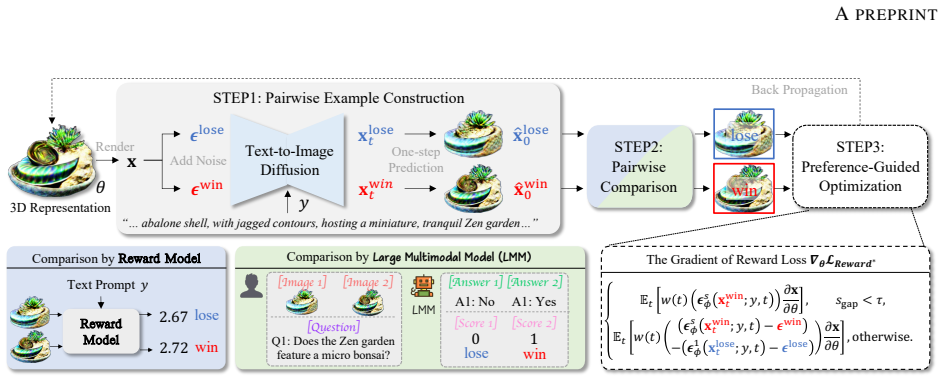
The load-bearing machinery is the pairwise preference gradient in Eq. (6): two noisy renderings $x_t^1$ and $x_t^2$ are computed from the same rendered image, a rank model $r(\cdot)$ selects $x_t^{\text{win}}$ and $x_t^{\text{lose}}$, and the gradient pulls the win prediction toward the diffusion model's denoised target while pushing the lose prediction away only when the preference score gap $s_{\text{gap}}$ exceeds a threshold $\tau$. When $s_{\text{gap}} < \tau$, the loss reduces to a winner-only SDS-style pull, which the paper shows is necessary to avoid chaotic gradients from near-tie pairs. The threshold $\tau$ is the mechanism that makes pairwise preferences usable as a stable training signal for 3D representations.
What would settle it
Compute the rank model's accuracy on pairs whose score gap falls below $\tau$: if HPSv2, ImageReward, or QwenVL is near chance on those near-tie pairs, then the small-gap branch in Eq. (6) is steering with noise; equally, an ablation that removes the threshold and observes diverged training would confirm that the winner-only branch, rather than the preference signal itself, is the true stabilizer.
Extended reading notes
Core claim
On the paper's own terms, the central discovery is that relative preference signals, obtained from cheap pairwise comparisons of noisy renderings, are sufficient to align a 3D representation with a text prompt, and that a piecewise loss with a score-gap threshold prevents overly similar or noisy pairs from destabilizing optimization. The paper derives a reference-free differentiable objective from SimPO-style preference optimization, converts it into a score-distillation gradient, and uses it to update NeRF or Gaussian-splatting parameters. The demonstrated result is that this preference-guided gradient improves text-asset alignment, plausibility, texture-geometry coherence, and instruction following compared to score-only reward regularization.
Load-bearing premise
The whole pipeline depends on the reward model or large multimodal model correctly ranking two very similar noisy views of the same 3D asset, so that the win and lose labels carry real preference information rather than noise.
Editorial extensions
If this is right
- Because only pairwise ordering is needed, DreamDPO can use existing image reward models and off-the-shelf large multimodal models as preference judges, without training a 3D-specific reward model.
- Fine-grained controllability follows from phrasing instruction questions: asking an LMM whether a required object or attribute is present pushes the asset toward that requirement, and designated lose examples can enforce poses such as a dancing elephant.
- The same reward loss can replace the score-distillation loss in other optimization-based generation stacks, demonstrated on text-to-avatar generation with a Gaussian-splatting avatar framework.
- On the GPTEval3D benchmark, DreamDPO ranks first on all six evaluated aspects, with the largest reported gains in texture and geometry details.
Reading between the lines
- Beyond the paper's claims, the same three-step loop should transfer to other optimization-based 3D representations and to 4D or scene generation, because the gradient formula depends only on rendered images and a preference oracle, not on the specific NeRF or Gaussian representation.
- Beyond the paper's claims, an adaptive threshold based on rank-model confidence could replace the fixed $\tau = 0.001$, since the paper's ablation shows $\tau$ controls a detail-versus-stability trade-off but the optimal value likely shifts with the reward model and prompt distribution.
- Beyond the paper's claims, a human rating study on the final assets would test whether the preference signal, which comes from AI judges, translates to true human preference rather than only agreement with ImageReward or GPT-4V evaluations.
Editorial analysis
A structured set of objections, weighed in public.
Referee Report
Summary. The paper proposes DreamDPO, an optimization-based method for text-to-3D generation that aligns a 3D representation with human preferences by (1) constructing on-the-fly pairs of differently noised renderings, (2) ranking them with a reward model or a large multimodal model, and (3) optimizing the 3D representation with a piecewise 'preference-driven' loss derived by analogy to SimPO/DPO. The authors report that DreamDPO outperforms 13 baselines on 110 prompts from GPTEval3D, achieving the best ImageReward score and the best GPTEval3D Elo ratings across all six criteria, and they demonstrate additional controllability when using QwenVL-based comparisons. The empirical section includes ablations of the score-gap threshold, backbone, reward model, and pair-construction strategy, as well as a text-to-avatar application.
Significance. If the method works as claimed, the contribution is meaningful: it replaces pointwise reward maximization with pairwise preference optimization for 3D generation, avoids training a domain-specific 3D reward model as in DreamReward, and shows that LMM-based pairwise feedback can steer generation toward explicit user instructions. The evaluation design is largely non-circular: HPSv2 is used for optimization, while ImageReward and GPTEval3D (GPT-4V) are used as external evaluators, and the threshold tau is ablated rather than tuned to the test set. However, the central update rule contains an unjustified branch that is not derived from the stated objective, and the manuscript leaves the method under-specified at exactly the point that determines which branch is active. These issues prevent the central claim from being fully verified as written.
major comments (4)
- [§3.1, Eq. (6)] The low-gap branch of Eq. (6) is not the gradient of the preference loss in Eq. (4) and is not a special case of Eq. (5). It reads E_t[w(t) ε^s_φ(x_win_t; y, t) ∂x/∂θ], which omits the '−ε_win' term that appears both in the SDS gradient Eq. (1) and in the high-gap branch's Δ_win^t. No derivation explains this branch; the text only says that pushing x_lose away when scores are close produces chaotic gradients, which does not justify dropping the noise term from the x_win pull. Since the paper uses τ to filter small-gap pairs and describes this regime as common, the update in that regime is not preference-driven as claimed. In addition, in the high-gap branch the win term uses CFG scale s while the lose term uses scale 1; the relationship of these scales to Eq. (5) is not stated. Please provide a corrected derivation or an explicit justification (e.g., a variance-reduction argument) for omitting ε_win and for the differing CFG scales.
- [§3.1 vs Algorithm 1] The ranking model r(·) is defined on noisy images x_t in Section 3.1 ('compare x1_t and x2_t'), but Algorithm 1 step 7 computes the comparison on the one-step predicted clean images (x̂1_0, x̂2_0). Because s_gap = r(x_win, y) − r(x_lose, y) selects the branch of Eq. (6), the algorithm as printed is not uniquely specified. Please align the text and the pseudo-code. Also, Algorithm 1 line 6 uses ε_θ for the diffusion model prediction, although θ denotes the 3D representation parameters and the diffusion model is ε_φ in the input list; this should be corrected.
- [§4.3, Fig. 6 and Algorithm 1] No evidence is provided that the pairwise rankings are reliable for the inputs actually scored. The paper's own τ threshold concedes that many pairs are too similar to rank, yet it does not report (i) the fraction of iterations that fall into the low-gap branch, (ii) the agreement of the ranker (HPSv2 or QwenVL) with human judgment on these noisy or predicted-clean pairs, or (iii) the sensitivity of the final 3D quality to that fraction. The 2D toy experiment in Fig. 6 only shows threshold sensitivity, not that the low-gap branch preserves preference information. Please add such an analysis, or explicitly state what signal the low-gap branch is intended to convey and why the update remains preference-driven in that regime.
- [§4.2, Table 1 and Fig. 7] The most directly related prior work, DreamReward [12], is compared only qualitatively (Fig. 7) and is absent from the quantitative table. Since DreamDPO is positioned as a preference-guided alternative to DreamReward and the abstract claims the best quantitative performance, a quantitative comparison (e.g., ImageReward and GPTEval3D for DreamReward on the same 110 prompts) is needed to support the headline claim. Without it, the claim 'outperforms 13 state-of-the-art methods' does not cover the most relevant baseline.
minor comments (7)
- [§3.1, Eq. (2)] In Eq. (2), the boundary conditions 'α0 ≈ 1, σ0 ≈ 0, α0 ≈ 0, σ0 ≈ 1' should read 'α_T ≈ 0, σ_T ≈ 1' for the second pair.
- [§1, Introduction] The first paragraph contains a typo: 'archives remarkable advancements' should be 'achieves remarkable advancements'.
- [§4.3, 'Evaluation on different score gaps'] The text says 'the last column in fig. 4' when referring to the τ = 0 result; the correct figure is Fig. 6.
- [§4.2.1, Qualitative Comparisons] The sentence describing 'two qualitative evaluations' that 'include comparing 13 benchmarks of GPTEval3D, MVDream [7], and DreamReward [12]' is confusing, since Table 1 lists 13 baselines but does not include DreamReward.
- [Figure 1 caption] The caption says '3D presentation' where it should say '3D representation'.
- [Algorithm 1] Algorithm 1 has a duplicated line number '13:' before the parameter update; renumber the steps.
- [References [3] and [6]] References [3] and [6] are the same ProlificDreamer work cited with different venues; please unify the citation.
Circularity Check
No circularity: the optimization signal and evaluation benchmarks are distinct, and the only author-overlapping citation is non-load-bearing.
full rationale
DreamDPO's derivation chain is self-contained with respect to its central claim. The preference gradient in Eq. (5) follows from the SimPO/DPO-style objective in Eq. (4) by the standard SDS-type approximation of omitting the U-Net Jacobian, which the paper states explicitly. Eq. (6) is an additional piecewise design choice: the low-gap branch is SDS-like rather than strictly preference-driven, but this is a correctness and derivation concern, not an equivalence between input and output by construction. The ranking model used inside optimization (HPSv2 by default, or QwenVL for the LMM variant) is distinct from both evaluation measures (ImageReward and GPTEval3D/GPT-4V Elo), so the reported quantitative gains are not generated by the same scorer that drives the update. The threshold tau is a fixed hyperparameter explored by ablation, not fitted to the evaluation set. The only author-overlapping citation is HeadStudio [48], used in the further-application section to demonstrate transfer to avatar generation; it does not support the main claim and is non-load-bearing. No fitted parameter is renamed as a prediction, no uniqueness theorem is imported from the authors' prior work, and no known result is merely relabeled. Thus no circular step can be exhibited with a specific equation-to-equation reduction.
Assumptions & free parameters
free parameters (1)
- score gap threshold tau =
0.001 (default)
assumptions (3)
- domain assumption SDS gradient approximation omits the U-Net Jacobian term
- domain assumption HPSv2 reward model approximates human preferences for rendered images
- ad hoc to paper Pairwise noisy renderings at the same timestep with different noise are comparable by the reward model
Cite this review
Pith. "Pith review of DreamDPO: Aligning Text-to-3D Generation with Human Preferences via Direct Preference Optimization." pith.science (2026). https://pith.science/paper/KDB5WWRX
@misc{pith2026250204370,
  author       = {Pith},
  title        = {Pith review of: DreamDPO: Aligning Text-to-3D Generation with Human Preferences via Direct Preference Optimization},
  year         = {2026},
  howpublished = {\url{https://pith.science/paper/KDB5WWRX}},
  note         = {Machine review of arXiv:2502.04370}
}
read the original abstract
Text-to-3D generation automates 3D content creation from textual descriptions, which offers transformative potential across various fields. However, existing methods often struggle to align generated content with human preferences, limiting their applicability and flexibility. To address these limitations, in this paper, we propose DreamDPO, an optimization-based framework that integrates human preferences into the 3D generation process, through direct preference optimization. Practically, DreamDPO first constructs pairwise examples, then compare their alignment with human preferences using reward or large multimodal models, and lastly optimizes the 3D representation with a preference-driven loss function. By leveraging pairwise comparison to reflect preferences, DreamDPO reduces reliance on precise pointwise quality evaluations while enabling fine-grained controllability through preference-guided optimization. Experiments demonstrate that DreamDPO achieves competitive results, and provides higher-quality and more controllable 3D content compared to existing methods. The code and models will be open-sourced.
Figures


Figures from the paper (7 more)


Forward citations
Cited by 4 Pith papers
-
Let Language Constrain Geometry: Vision-Language Models as Semantic and Spatial Critics for 3D Generation
A frozen VLM's dual-query Yes/No log-odds act as a differentiable semantic-and-spatial critic, improving alignment and geometry in both SDS-based and feed-forward text-to-3D pipelines.
-
Nabla-R2D3: Effective and Efficient 3D Diffusion Alignment with 2D Rewards
Nabla-R2D3 aligns 3D-native diffusion models with human preferences by backpropagating multi-view 2D reward gradients through the denoising process, improving reward without destroying the pretrained 3D prior.
-
MPO: Multilingual Safety Alignment via Reward Gap Optimization
MPO reduces jailbreak success in multilingual LLMs by regressing target-language reward gaps onto the English reward gap, outperforming DPO and related methods while preserving utility.
-
Point Cloud Compression and Objective Quality Assessment: A Survey
A survey of point cloud compression and objective quality assessment that benchmarks representative methods on standard datasets and distills design insights.
Reference graph
Works this paper leans on
-
[12]
Dreamreward: Text-to-3d generation with human preference
Junliang Ye, Fangfu Liu, Qixiu Li, Zhengyi Wang, Yikai Wang, Xinzhou Wang, Yueqi Duan, and Jun Zhu. Dreamreward: Text-to-3d generation with human preference. In ECCV, pages 259–276, 2025
2025
-
[2]
Dreamfusion: Text-to-3d using 2d diffusion
Ben Poole, Ajay Jain, Jonathan T Barron, and Ben Mildenhall. Dreamfusion: Text-to-3d using 2d diffusion. arXiv preprint arXiv:2209.14988, 2022
arXiv 2022
-
[3]
Zhengyi Wang, Cheng Lu, Yikai Wang, Fan Bao, Chongxuan Li, Hang Su, and Jun Zhu. Prolificdreamer: High-fidelity and diverse text-to-3d generation with variational score distillation.arXiv preprint arXiv:2305.16213, 2023
arXiv 2023
-
[4]
Yeh, and Greg Shakhnarovich
Haochen Wang, Xiaodan Du, Jiahao Li, Raymond A. Yeh, and Greg Shakhnarovich. Score jacobian chaining: Lifting pretrained 2d diffusion models for 3d generation. In CVPR, 2022
2022
-
[5]
Text-to-3d with classifier score distillation
Xin Yu, Yuan-Chen Guo, Yangguang Li, Ding Liang, Song-Hai Zhang, and Xiaojuan Qi. Text-to-3d with classifier score distillation. arXiv preprint arXiv:2310.19415, 2023
arXiv 2023
-
[6]
Prolificdreamer: High-fidelity and diverse text-to-3d generation with variational score distillation
Zhengyi Wang, Cheng Lu, Yikai Wang, Fan Bao, Chongxuan Li, Hang Su, and Jun Zhu. Prolificdreamer: High-fidelity and diverse text-to-3d generation with variational score distillation. In NeurIPS, 2024
2024
-
[7]
Mvdream: Multi-view diffusion for 3d generation
Yichun Shi, Peng Wang, Jianglong Ye, Mai Long, Kejie Li, and Xiao Yang. Mvdream: Multi-view diffusion for 3d generation. arXiv preprint arXiv:2308.16512, 2023
arXiv 2023
-
[8]
Oren Katzir, Or Patashnik, Daniel Cohen-Or, and Dani Lischinski. Noise-free score distillation. arXiv preprint arXiv:2310.17590, 2023
arXiv 2023
Show all 92 references
-
[9]
Luciddreamer: Domain-free generation of 3d gaussian splatting scenes
Jaeyoung Chung, Suyoung Lee, Hyeongjin Nam, Jaerin Lee, and Kyoung Mu Lee. Luciddreamer: Domain-free generation of 3d gaussian splatting scenes. In CVPR, 2024
2024
-
[10]
Consistent3d: Towards consistent high-fidelity text-to-3d generation with deterministic sampling prior
Zike Wu, Pan Zhou, Xuanyu Yi, Xiaoding Yuan, and Hanwang Zhang. Consistent3d: Towards consistent high-fidelity text-to-3d generation with deterministic sampling prior. In CVPR, 2024
2024
-
[11]
Carve3d: Improving multi-view reconstruction consistency for diffusion models with rl finetuning
Desai Xie, Jiahao Li, Hao Tan, Xin Sun, Zhixin Shu, Yi Zhou, Sai Bi, S¨oren Pirk, and Arie E Kaufman. Carve3d: Improving multi-view reconstruction consistency for diffusion models with rl finetuning. In CVPR, 2024
2024
-
[13]
Srinivasan, Matthew Tancik, Jonathan T
Ben Mildenhall, Pratul P. Srinivasan, Matthew Tancik, Jonathan T. Barron, Ravi Ramamoorthi, and Ren Ng. Nerf: Representing scenes as neural radiance fields for view synthesis. In ECCV, 2020
2020
-
[14]
3d gaussian splatting for real-time radiance field rendering
Bernhard Kerbl, Georgios Kopanas, Thomas Leimk¨uhler, and George Drettakis. 3d gaussian splatting for real-time radiance field rendering. ACM Transactions on Graphics, 42(4), July 2023
2023
-
[16]
Generating chain-of-thoughts with a direct pairwise-comparison approach to searching for the most promising intermediate thought
Zhen-Yu Zhang, Siwei Han, Huaxiu Yao, Gang Niu, and Masashi Sugiyama. Generating chain-of-thoughts with a direct pairwise-comparison approach to searching for the most promising intermediate thought. In ICML, 2024
2024
-
[18]
Deep marching tetrahedra: a hybrid representation for high-resolution 3d shape synthesis
Tianchang Shen, Jun Gao, Kangxue Yin, Ming-Yu Liu, and Sanja Fidler. Deep marching tetrahedra: a hybrid representation for high-resolution 3d shape synthesis. In NeurIPS, pages 6087–6101, 2021
2021
-
[19]
Deep unsupervised learning using nonequilibrium thermodynamics
Jascha Sohl-Dickstein, Eric Weiss, Niru Maheswaranathan, and Surya Ganguli. Deep unsupervised learning using nonequilibrium thermodynamics. In ICML, pages 2256–2265, 2015
2015
-
[20]
Diffusion guided domain adaptation of image generators
Kunpeng Song, Ligong Han, Bingchen Liu, Dimitris Metaxas, and Ahmed Elgammal. Diffusion guided domain adaptation of image generators. arXiv preprint arXiv:2212.04473, 2022
2022 arXiv
-
[21]
Analytic-dpm: an analytic estimate of the optimal reverse variance in diffusion probabilistic models
Fan Bao, Chongxuan Li, Jun Zhu, and Bo Zhang. Analytic-dpm: an analytic estimate of the optimal reverse variance in diffusion probabilistic models. In ICLR, 2022
2022
-
[22]
Scalable diffusion models with transformers
William Peebles and Saining Xie. Scalable diffusion models with transformers. In ICCV, pages 4195–4205, 2023
2023
-
[23]
Vividdreamer: invariant score distillation for hyper-realistic text-to-3d generation
Wenjie Zhuo, Fan Ma, Hehe Fan, and Yi Yang. Vividdreamer: invariant score distillation for hyper-realistic text-to-3d generation. In ECCV, 2024
2024
-
[24]
Classifier-free diffusion guidance
Jonathan Ho and Tim Salimans. Classifier-free diffusion guidance. arXiv preprint arXiv:2207.12598, 2022. 10 A PREPRINT
2022 arXiv
-
[25]
Gpt-4v (ision) is a human-aligned evaluator for text-to-3d generation
Tong Wu, Guandao Yang, Zhibing Li, Kai Zhang, Ziwei Liu, Leonidas Guibas, Dahua Lin, and Gordon Wetzstein. Gpt-4v (ision) is a human-aligned evaluator for text-to-3d generation. In CVPR, pages 22227–22238, 2024
2024
-
[26]
Imagereward: Learning and evaluating human preferences for text-to-image generation
Jiazheng Xu, Xiao Liu, Yuchen Wu, Yuxuan Tong, Qinkai Li, Ming Ding, Jie Tang, and Yuxiao Dong. Imagereward: Learning and evaluating human preferences for text-to-image generation. In NeurIPS, 2024
2024
-
[27]
Learning transferable visual models from natural language supervision
Alec Radford, Jong Wook Kim, Chris Hallacy, Aditya Ramesh, Gabriel Goh, Sandhini Agarwal, Girish Sastry, Amanda Askell, Pamela Mishkin, Jack Clark, et al. Learning transferable visual models from natural language supervision. In ICML, pages 8748–8763, 2021
2021
-
[28]
Dreamgaussian: Generative gaussian splatting for efficient 3d content creation
Jiaxiang Tang, Jiawei Ren, Hang Zhou, Ziwei Liu, and Gang Zeng. Dreamgaussian: Generative gaussian splatting for efficient 3d content creation. arXiv preprint arXiv:2309.16653, 2023
2023 arXiv
-
[29]
Fantasia3d: Disentangling geometry and appearance for high-quality text-to-3d content creation
Rui Chen, Yongwei Chen, Ningxin Jiao, and Kui Jia. Fantasia3d: Disentangling geometry and appearance for high-quality text-to-3d content creation. In ICCV, pages 22246–22256, 2023
2023
-
[30]
Instant3d: Fast text-to-3d with sparse-view generation and large reconstruction model
Jiahao Li, Hao Tan, Kai Zhang, Zexiang Xu, Fujun Luan, Yinghao Xu, Yicong Hong, Kalyan Sunkavalli, Greg Shakhnarovich, and Sai Bi. Instant3d: Fast text-to-3d with sparse-view generation and large reconstruction model. arXiv preprint arXiv:2311.06214, 2023
2023 arXiv
-
[31]
Latent-nerf for shape-guided generation of 3d shapes and textures
Gal Metzer, Elad Richardson, Or Patashnik, Raja Giryes, and Daniel Cohen-Or. Latent-nerf for shape-guided generation of 3d shapes and textures. In CVPR, pages 12663–12673, 2023
2023
-
[32]
Magic3d: High-resolution text-to-3d content creation
Chen-Hsuan Lin, Jun Gao, Luming Tang, Towaki Takikawa, Xiaohui Zeng, Xun Huang, Karsten Kreis, Sanja Fidler, Ming-Yu Liu, and Tsung-Yi Lin. Magic3d: High-resolution text-to-3d content creation. In CVPR, pages 300–309, 2023
2023
-
[33]
Point-e: A system for generating 3d point clouds from complex prompts
Alex Nichol, Heewoo Jun, Prafulla Dhariwal, Pamela Mishkin, and Mark Chen. Point-e: A system for generating 3d point clouds from complex prompts. arXiv preprint arXiv:2212.08751, 2022
2022 arXiv
-
[34]
Shap-e: Generating conditional 3d implicit functions
Heewoo Jun and Alex Nichol. Shap-e: Generating conditional 3d implicit functions. arXiv preprint arXiv:2305.02463, 2023
2023 arXiv
-
[35]
Score jacobian chaining: Lifting pretrained 2d diffusion models for 3d generation
Haochen Wang, Xiaodan Du, Jiahao Li, Raymond A Yeh, and Greg Shakhnarovich. Score jacobian chaining: Lifting pretrained 2d diffusion models for 3d generation. In CVPR, pages 12619–12629, 2023
2023
-
[36]
Syncdreamer: Generating multiview-consistent images from a single-view image
Yuan Liu, Cheng Lin, Zijiao Zeng, Xiaoxiao Long, Lingjie Liu, Taku Komura, and Wenping Wang. Syncdreamer: Generating multiview-consistent images from a single-view image. arXiv preprint arXiv:2309.03453, 2023
2023 arXiv
-
[37]
Wonder3d: Single image to 3d using cross-domain diffusion
Xiaoxiao Long, Yuan-Chen Guo, Cheng Lin, Yuan Liu, Zhiyang Dou, Lingjie Liu, Yuexin Ma, Song-Hai Zhang, Marc Habermann, Christian Theobalt, et al. Wonder3d: Single image to 3d using cross-domain diffusion. In CVPR, pages 9970–9980, 2024
2024
-
[38]
Denoising diffusion probabilistic models
Jonathan Ho, Ajay Jain, and Pieter Abbeel. Denoising diffusion probabilistic models. In NeurIPS, volume 33, pages 6840–6851, 2020
2020
-
[39]
Denoising diffusion implicit models
Jiaming Song, Chenlin Meng, and Stefano Ermon. Denoising diffusion implicit models. In ICLR, 2021
2021
-
[40]
Human preference score v2: A solid benchmark for evaluating human preferences of text-to-image synthesis
Xiaoshi Wu, Yiming Hao, Keqiang Sun, Yixiong Chen, Feng Zhu, Rui Zhao, and Hongsheng Li. Human preference score v2: A solid benchmark for evaluating human preferences of text-to-image synthesis. arXiv preprint arXiv:2306.09341, 2023
2023 arXiv
-
[41]
Qwen-vl: A frontier large vision-language model with versatile abilities
Jinze Bai, Shuai Bai, Shusheng Yang, Shijie Wang, Sinan Tan, Peng Wang, Junyang Lin, Chang Zhou, and Jingren Zhou. Qwen-vl: A frontier large vision-language model with versatile abilities. arXiv preprint arXiv:2308.12966, 2023
2023 arXiv
-
[42]
The dawn of lmms: Preliminary explorations with gpt-4v (ision)
Zhengyuan Yang, Linjie Li, Kevin Lin, Jianfeng Wang, Chung-Ching Lin, Zicheng Liu, and Lijuan Wang. The dawn of lmms: Preliminary explorations with gpt-4v (ision). arXiv preprint arXiv:2309.17421, 2023
2023 arXiv
-
[43]
Direct preference optimization: Your language model is secretly a reward model
Rafael Rafailov, Archit Sharma, Eric Mitchell, Christopher D Manning, Stefano Ermon, and Chelsea Finn. Direct preference optimization: Your language model is secretly a reward model. In NeurIPS, 2024
2024
-
[44]
Simpo: Simple preference optimization with a reference-free reward
Yu Meng, Mengzhou Xia, and Danqi Chen. Simpo: Simple preference optimization with a reference-free reward. arXiv preprint arXiv:2405.14734, 2024
2024 arXiv
-
[45]
Diffusion model alignment using direct preference optimization
Bram Wallace, Meihua Dang, Rafael Rafailov, Linqi Zhou, Aaron Lou, Senthil Purushwalkam, Stefano Ermon, Caiming Xiong, Shafiq Joty, and Nikhil Naik. Diffusion model alignment using direct preference optimization. In CVPR, 2024
2024
-
[46]
Pytorch: An imperative style, high-performance deep learning library
Adam Paszke, Sam Gross, Francisco Massa, Adam Lerer, James Bradbury, Gregory Chanan, Trevor Killeen, Zeming Lin, Natalia Gimelshein, Luca Antiga, et al. Pytorch: An imperative style, high-performance deep learning library. In NeurIPS, 2019. 11 A PREPRINT
2019
-
[47]
threestudio: A unified framework for 3d content generation
Yuan-Chen Guo, Ying-Tian Liu, Ruizhi Shao, Christian Laforte, Vikram V oleti, Guan Luo, Chia-Hao Chen, Zi-Xin Zou, Chen Wang, Yan-Pei Cao, and Song-Hai Zhang. threestudio: A unified framework for 3d content generation. https://github.com/threestudio-project/threestudio, 2023
2023
-
[48]
Headstudio: Text to animatable head avatars with 3d gaussian splatting
Zhenglin Zhou, Fan Ma, Hehe Fan, Zongxin Yang, and Yi Yang. Headstudio: Text to animatable head avatars with 3d gaussian splatting. In ECCV, 2024
2024
-
[49]
Visionreward: Fine-grained multi-dimensional human preference learning for image and video generation, 2024
Jiazheng Xu, Yu Huang, Jiale Cheng, Yuanming Yang, Jiajun Xu, Yuan Wang, Wenbo Duan, Shen Yang, Qunlin Jin, Shurun Li, Jiayan Teng, Zhuoyi Yang, Wendi Zheng, Xiao Liu, Ming Ding, Xiaohan Zhang, Xiaotao Gu, Shiyu Huang, Minlie Huang, Jie Tang, and Yuxiao Dong. Visionreward: Fin...
2024
-
[50]
4d-fy: Text-to-4d generation using hybrid score distillation sampling
Sherwin Bahmani, Ivan Skorokhodov, Victor Rong, Gordon Wetzstein, Leonidas Guibas, Peter Wonka, Sergey Tulyakov, Jeong Joon Park, Andrea Tagliasacchi, and David B Lindell. 4d-fy: Text-to-4d generation using hybrid score distillation sampling. In CVPR, pages 7996–8006, 2024
2024
-
[51]
Text2nerf: Text-driven 3d scene generation with neural radiance fields
Jingbo Zhang, Xiaoyu Li, Ziyu Wan, Can Wang, and Jing Liao. Text2nerf: Text-driven 3d scene generation with neural radiance fields. IEEE Transactions on Visualization and Computer Graphics, 2024
2024
-
[52]
Vp3d: Unleashing 2d visual prompt for text-to-3d generation
Yang Chen, Yingwei Pan, Haibo Yang, Ting Yao, and Tao Mei. Vp3d: Unleashing 2d visual prompt for text-to-3d generation. In CVPR, pages 4896–4905, 2024
2024
-
[53]
Detecting everything in the open world: Towards universal object detection
Zhenyu Wang, Yali Li, Xi Chen, Ser-Nam Lim, Antonio Torralba, Hengshuang Zhao, and Shengjin Wang. Detecting everything in the open world: Towards universal object detection. In CVPR, pages 11433–11443, 2023
2023
-
[54]
Dinov2: Learning robust visual features without supervision
Maxime Oquab, Timoth´ee Darcet, Th´eo Moutakanni, Huy V o, Marc Szafraniec, Vasil Khalidov, Pierre Fernandez, Daniel Haziza, Francisco Massa, Alaaeldin El-Nouby, et al. Dinov2: Learning robust visual features without supervision. arXiv preprint arXiv:2304.07193, 2023
2023 arXiv
-
[55]
Diffuse attend and segment: Unsupervised zero-shot segmentation using stable diffusion
Junjiao Tian, Lavisha Aggarwal, Andrea Colaco, Zsolt Kira, and Mar Gonzalez-Franco. Diffuse attend and segment: Unsupervised zero-shot segmentation using stable diffusion. In CVPR, pages 3554–3563, 2024
2024
-
[56]
Glide: Towards photorealistic image generation and editing with text-guided diffusion models
Alex Nichol, Prafulla Dhariwal, Aditya Ramesh, Pranav Shyam, Pamela Mishkin, Bob McGrew, Ilya Sutskever, and Mark Chen. Glide: Towards photorealistic image generation and editing with text-guided diffusion models. arXiv preprint arXiv:2112.10741, 2021
2021 arXiv
-
[57]
Imagen video: High definition video generation with diffusion models
Jonathan Ho, William Chan, Chitwan Saharia, Jay Whang, Ruiqi Gao, Alexey Gritsenko, Diederik P Kingma, Ben Poole, Mohammad Norouzi, David J Fleet, et al. Imagen video: High definition video generation with diffusion models. arXiv preprint arXiv:2210.02303, 2022
-
[58]
Text-to-image diffusion model in generative ai: A survey
Chenshuang Zhang, Chaoning Zhang, Mengchun Zhang, and In So Kweon. Text-to-image diffusion model in generative ai: A survey. arXiv preprint arXiv:2303.07909, 2023
2023 arXiv
-
[59]
High-resolution image synthesis with latent diffusion models
Robin Rombach, Andreas Blattmann, Dominik Lorenz, Patrick Esser, and Bj¨orn Ommer. High-resolution image synthesis with latent diffusion models. In CVPR, pages 10684–10695, 2022
2022
-
[60]
Sketch-guided text-to-image diffusion models
Andrey V oynov, Kfir Aberman, and Daniel Cohen-Or. Sketch-guided text-to-image diffusion models. In SIGGRAPH, pages 1–11, 2023
2023
-
[61]
Adding conditional control to text-to-image diffusion models
Lvmin Zhang, Anyi Rao, and Maneesh Agrawala. Adding conditional control to text-to-image diffusion models. In ICCV, 2023
2023
-
[62]
An image is worth one word: Personalizing text-to-image generation using textual inversion
Rinon Gal, Yuval Alaluf, Yuval Atzmon, Or Patashnik, Amit H Bermano, Gal Chechik, and Daniel Cohen-Or. An image is worth one word: Personalizing text-to-image generation using textual inversion. arXiv preprint arXiv:2208.01618, 2022
2022 arXiv
-
[63]
Dreambooth: Fine tuning text-to-image diffusion models for subject-driven generation
Nataniel Ruiz, Yuanzhen Li, Varun Jampani, Yael Pritch, Michael Rubinstein, and Kfir Aberman. Dreambooth: Fine tuning text-to-image diffusion models for subject-driven generation. arXiv preprint arxiv:2208.12242, 2022
2022 arXiv
-
[64]
Instructpix2pix: Learning to follow image editing instructions
Tim Brooks, Aleksander Holynski, and Alexei A Efros. Instructpix2pix: Learning to follow image editing instructions. In CVPR, pages 18392–18402, 2023
2023
-
[65]
Mip-nerf 360: Unbounded anti-aliased neural radiance fields
Jonathan T Barron, Ben Mildenhall, Dor Verbin, Pratul P Srinivasan, and Peter Hedman. Mip-nerf 360: Unbounded anti-aliased neural radiance fields. In CVPR, pages 5470–5479, 2022
2022
-
[66]
Barron, Pieter Abbeel, and Ben Poole
Ajay Jain, Ben Mildenhall, Jonathan T. Barron, Pieter Abbeel, and Ben Poole. Zero-shot text-guided object generation with dream fields. In CVPR, 2022
2022
-
[67]
Generative ai meets 3d: A survey on text-to-3d in aigc era
Chenghao Li, Chaoning Zhang, Atish Waghwase, Lik-Hang Lee, Francois Rameau, Yang Yang, Sung-Ho Bae, and Choong Seon Hong. Generative ai meets 3d: A survey on text-to-3d in aigc era. arXiv preprint arXiv:2305.06131, 2023. 12 A PREPRINT
2023 arXiv
-
[68]
Hifa: High-fidelity text-to-3d generation with advanced diffusion guidance
Junzhe Zhu, Peiye Zhuang, and Sanmi Koyejo. Hifa: High-fidelity text-to-3d generation with advanced diffusion guidance. arXiv preprint arXiv:2305.18766, 2023
2023 arXiv
-
[69]
Objaverse: A universe of annotated 3d objects
Matt Deitke, Dustin Schwenk, Jordi Salvador, Luca Weihs, Oscar Michel, Eli VanderBilt, Ludwig Schmidt, Kiana Ehsani, Aniruddha Kembhavi, and Ali Farhadi. Objaverse: A universe of annotated 3d objects. In CVPR, pages 13142–13153, 2023
2023
-
[70]
Objaverse-xl: A universe of 10m+ 3d objects
Matt Deitke, Ruoshi Liu, Matthew Wallingford, Huong Ngo, Oscar Michel, Aditya Kusupati, Alan Fan, Christian Laforte, Vikram V oleti, Samir Yitzhak Gadre, et al. Objaverse-xl: A universe of 10m+ 3d objects. InNeurIPS, volume 36, 2024
2024
-
[71]
Zero-1-to-3: Zero-shot one image to 3d object
Ruoshi Liu, Rundi Wu, Basile Van Hoorick, Pavel Tokmakov, Sergey Zakharov, and Carl V ondrick. Zero-1-to-3: Zero-shot one image to 3d object. In ICCV, pages 9298–9309, 2023
2023
-
[72]
One-2-3-45: Any single image to 3d mesh in 45 seconds without per-shape optimization
Minghua Liu, Chao Xu, Haian Jin, Linghao Chen, Mukund Varma T, Zexiang Xu, and Hao Su. One-2-3-45: Any single image to 3d mesh in 45 seconds without per-shape optimization. In NeurIPS, volume 36, 2024
2024
-
[73]
Set-the-scene: Global-local training for generating controllable nerf scenes
Dana Cohen-Bar, Elad Richardson, Gal Metzer, Raja Giryes, and Daniel Cohen-Or. Set-the-scene: Global-local training for generating controllable nerf scenes. arXiv preprint arXiv:2303.13450, 2023
2023 arXiv
-
[74]
Text2room: Extracting textured 3d meshes from 2d text-to-image models
Lukas H¨ollein, Ang Cao, Andrew Owens, Justin Johnson, and Matthias Nießner. Text2room: Extracting textured 3d meshes from 2d text-to-image models. arXiv preprint arXiv:2303.11989, 2023
2023 arXiv
-
[75]
Instruct-nerf2nerf: Editing 3d scenes with instructions
Ayaan Haque, Matthew Tancik, Alexei Efros, Aleksander Holynski, and Angjoo Kanazawa. Instruct-nerf2nerf: Editing 3d scenes with instructions. In ICCV, 2023
2023
-
[76]
Instruct 3d-to-3d: Text instruction guided 3d-to-3d conversion
Hiromichi Kamata, Yuiko Sakuma, Akio Hayakawa, Masato Ishii, and Takuya Narihira. Instruct 3d-to-3d: Text instruction guided 3d-to-3d conversion. arXiv preprint arXiv:2303.15780, 2023
2023 arXiv
-
[77]
Dreamavatar: Text-and-shape guided 3d human avatar generation via diffusion models
Yukang Cao, Yan-Pei Cao, Kai Han, Ying Shan, and Kwan-Yee K Wong. Dreamavatar: Text-and-shape guided 3d human avatar generation via diffusion models. arXiv preprint arXiv:2304.00916, 2023
2023 arXiv
-
[78]
Avatarcraft: Transforming text into neural human avatars with parameterized shape and pose control
Ruixiang Jiang, Can Wang, Jingbo Zhang, Menglei Chai, Mingming He, Dongdong Chen, and Jing Liao. Avatarcraft: Transforming text into neural human avatars with parameterized shape and pose control. arXiv preprint arXiv:2303.17606, 2023
2023 arXiv
-
[79]
Headsculpt: Crafting 3d head avatars with text
Xiao Han, Yukang Cao, Kai Han, Xiatian Zhu, Jiankang Deng, Yi-Zhe Song, Tao Xiang, and Kwan-Yee K Wong. Headsculpt: Crafting 3d head avatars with text. arXiv preprint arXiv:2306.03038, 2023
2023 arXiv
-
[80]
Training a helpful and harmless assistant with reinforcement learning from human feedback
Yuntao Bai, Andy Jones, Kamal Ndousse, Amanda Askell, Anna Chen, Nova DasSarma, Dawn Drain, Stanislav Fort, Deep Ganguli, Tom Henighan, et al. Training a helpful and harmless assistant with reinforcement learning from human feedback. arXiv preprint arXiv:2204.05862, 2022
2022 arXiv
-
[81]
Constitutional ai: Harmlessness from ai feedback
Yuntao Bai, Saurav Kadavath, Sandipan Kundu, Amanda Askell, Jackson Kernion, Andy Jones, Anna Chen, Anna Goldie, Azalia Mirhoseini, Cameron McKinnon, et al. Constitutional ai: Harmlessness from ai feedback. arXiv preprint arXiv:2212.08073, 2022
2022 arXiv
-
[82]
Rlaif vs
Harrison Lee, Samrat Phatale, Hassan Mansoor, Thomas Mesnard, Johan Ferret, Kellie Ren Lu, Colton Bishop, Ethan Hall, Victor Carbune, Abhinav Rastogi, et al. Rlaif vs. rlhf: Scaling reinforcement learning from human feedback with ai feedback. In ICML, 2024
2024
-
[83]
Aligning large multimodal models with factually augmented rlhf
Zhiqing Sun, Sheng Shen, Shengcao Cao, Haotian Liu, Chunyuan Li, Yikang Shen, Chuang Gan, Liang-Yan Gui, Yu-Xiong Wang, Yiming Yang, Kurt Keutzer, and Trevor Darrell. Aligning large multimodal models with factually augmented rlhf. arXiv:2309.14525, 2023
2023 arXiv
-
[84]
Rlhf-v: Towards trustworthy mllms via behavior alignment from fine-grained correctional human feedback
Tianyu Yu, Yuan Yao, Haoye Zhang, Taiwen He, Yifeng Han, Ganqu Cui, Jinyi Hu, Zhiyuan Liu, Hai-Tao Zheng, Maosong Sun, et al. Rlhf-v: Towards trustworthy mllms via behavior alignment from fine-grained correctional human feedback. In CVPR, pages 13807–13816, 2024
2024
-
[85]
Rlaif-v: Aligning mllms through open-source ai feedback for super gpt-4v trustworthiness
Tianyu Yu, Haoye Zhang, Yuan Yao, Yunkai Dang, Da Chen, Xiaoman Lu, Ganqu Cui, Taiwen He, Zhiyuan Liu, Tat-Seng Chua, and Maosong Sun. Rlaif-v: Aligning mllms through open-source ai feedback for super gpt-4v trustworthiness. arXiv preprint arXiv:2405.17220, 2024
2024
-
[86]
Training diffusion models with reinforcement learning
Kevin Black, Michael Janner, Yilun Du, Ilya Kostrikov, and Sergey Levine. Training diffusion models with reinforcement learning. arXiv preprint arXiv:2305.13301, 2023
2023 arXiv
-
[87]
Aligning text-to-image models using human feedback
Kimin Lee, Hao Liu, Moonkyung Ryu, Olivia Watkins, Yuqing Du, Craig Boutilier, Pieter Abbeel, Mohammad Ghavamzadeh, and Shixiang Shane Gu. Aligning text-to-image models using human feedback. arXiv preprint arXiv:2302.12192, 2023
2023 arXiv
-
[88]
Directly fine-tuning diffusion models on differentiable rewards
Kevin Clark, Paul Vicol, Kevin Swersky, and David J Fleet. Directly fine-tuning diffusion models on differentiable rewards. arXiv preprint arXiv:2309.17400, 2023. 13 A PREPRINT
2023 arXiv
-
[89]
Reinforcement learning for fine-tuning text-to-image diffusion models
Ying Fan, Olivia Watkins, Yuqing Du, Hao Liu, Moonkyung Ryu, Craig Boutilier, Pieter Abbeel, Mohammad Ghavamzadeh, Kangwook Lee, and Kimin Lee. Reinforcement learning for fine-tuning text-to-image diffusion models. In NeurIPS, 2024
2024
-
[90]
Hive: Harnessing human feedback for instructional visual editing
Shu Zhang, Xinyi Yang, Yihao Feng, Can Qin, Chia-Chih Chen, Ning Yu, Zeyuan Chen, Huan Wang, Silvio Savarese, Stefano Ermon, et al. Hive: Harnessing human feedback for instructional visual editing. In CVPR, pages 9026–9036, 2024
2024
-
[91]
Deep reinforcement learning from human preferences
Paul F Christiano, Jan Leike, Tom Brown, Miljan Martic, Shane Legg, and Dario Amodei. Deep reinforcement learning from human preferences. In NeurIPS, volume 30, 2017
2017
-
[92]
Training language models to follow instructions with human feedback
Long Ouyang, Jeffrey Wu, Xu Jiang, Diogo Almeida, Carroll Wainwright, Pamela Mishkin, Chong Zhang, Sandhini Agarwal, Katarina Slama, Alex Ray, et al. Training language models to follow instructions with human feedback. In NeurIPS, 2022. 14 A PREPRINT Appendix 1 Introduction 1 ...
2022
-
[93]
qwen-vl-plus-latest
online via a rank model r, yielding the pairwise comparison (xwin t , xlose t ). 8: Compute the score gap: sgap = r(xwin t , y) − r(xlose t , y). 9: if sgap < τ then 10: ∇θLReward = Et w(t) ϵs ϕ(xwin t ; y, t) ∂x ∂θ , 11: else 12: ∇θLReward = Et w(t) ϵs ϕ(xwin t ; y, t) − ϵwin...
-
[94]
Carefully analyze the provided image and answer questions based on the image
-
[95]
Yes” or “No
For each question, answer with either “Yes” or “No”. Do not provide explanations or additional information. [Evaluation Question(s)]: Q1: {Question} ... [Output Format]: A1: [Yes/No] ... 17 A PREPRINT B.3 Details of Text-to-Avatar Generation We detail the toy exploration of te...
Reviewed August 9, 2026 · model on record in the stance chip above.
Discussion (0). Continue with ORCID to comment.