REVIEW 4 major objections 6 minor 61 references
Multiconfigurational Mixed Quantum-Classical Approach for Correlated Many-Body Dynamics
T0 review · 4 major / 6 minor · reviewed 2026-07-30 · grok-4.5
Pith's one-line read A multiconfigurational mixed quantum-classical method captures multi-exciton spatial correlations that mean-field misses, while a mean-field path shortcut recovers early-time correlations cheaply.
desk verdict Solid beyond-mean-field MQC method for multi-exciton pair correlations; the phonon-coupled decay claims rest on unbenchmarked Ehrenfest averaging, but the core methodological step is real and worth refereeing. read the letter →
The pith
A machine-rendered reading of the paper's core claim, the machinery that carries it, and where it could break.
The reading
What carries the argument
Multiconfigurational many-body Ehrenfest: the excitonic state is expanded in time-dependent permanents built from M single-particle modes (recovering MCTDHB without phonons and multi-trajectory Ehrenfest at N_ex=1), with nuclear forces taken from the multiconfigurational one-body density ρ⁽¹⁾.
What would settle it
On a phonon-coupled multi-exciton chain small enough for a fully quantum or higher-level nuclear treatment, compare multi-mode multiconfigurational pair densities and MSD against that benchmark; a large mismatch would falsify the claim that the quasi-classical multiconfigurational forces and MFPA are reliable.
Extended reading notes
Core claim
A multiconfigurational mixed quantum-classical ansatz—excitons as a sum of permanents over M time-dependent bosonic modes, phonons quasi-classical with forces from the multiconfigurational one-body density—captures phonon-coupled multi-exciton spatial pair correlations that the mean-field (M=1) limit misses, while mean-field still yields semi-quantitatively accurate diffusive transport; the mean-field path approximation reproduces early-time spatial correlations to good accuracy.
Load-bearing premise
That treating the phonons as classical harmonic trajectories driven by the instantaneous multiconfigurational density is accurate enough for the finite-temperature transport and correlation claims on large lattices, even though exact checks exist only for pure excitonic dynamics on small systems.
Editorial extensions
If this is right
- Mean-field mixed quantum-classical runs remain usable for excitation-dependent diffusion constants when only transport, not correlations, is required.
- Early-time spatial pair correlations in multi-exciton systems can be computed by reusing precomputed mean-field nuclear paths (MFPA) instead of full multi-mode back-reaction.
- Increasing the number of modes systematically improves pair-density maps and modestly corrects diffusion when repulsion competes with phonon disorder.
- The same multiconfigurational mixed framework is positioned to treat correlated exciton-polariton dynamics under phonon disorder.
Reading between the lines
- If MFPA holds more generally, screening multi-exciton or polariton materials for short-time quantum correlations becomes feasible on device-scale lattices without multi-mode nuclear forces on every trajectory.
- The reported crossover—from diffusion falling with N_ex at weak U to rising with N_ex at strong U—suggests a practical knob (density versus interaction) for tuning whether phonon disorder or repulsion dominates transport.
- Failure of classical-path and mean-field-force approximations on MSD implies that any polariton extension will still need some form of excited-state nuclear back-reaction for long-time transport.
Signed reviews
Editorial analysis
A structured set of objections, weighed in public.
Referee Report
Summary. The manuscript introduces a multiconfigurational mixed quantum-classical method for finite-temperature multi-exciton dynamics coupled to phonons. The excitonic subsystem is propagated as a linear combination of bosonic permanents over M time-dependent single-particle functions (MCTDHB-like), derived via the Dirac–Frenkel variational principle with gauge fixing, while the phonons evolve quasi-classically under a mean force built from the multiconfigurational one-body density (Eq. 20). The method reduces to multi-trajectory Ehrenfest at Nex=1 and to MCTDHB without phonons. Benchmarks against exact Schrödinger propagation for 3 excitons on 21 sites, with and without static disorder (Figs. 1–2), show systematic convergence in M. On 400-site phonon-coupled systems, the authors report that mean-field (M=1) gives semi-quantitative MSD/diffusion but misses spatial pair correlations, that M>1 captures transient ρ⁽²⁾/g⁽²⁾ cross-peaks that decay on a sub-ps timescale under phonon-induced disorder (Figs. 3–6), and that a mean-field path approximation (MFPA) reproduces the early-time pair correlations at reduced cost even though it fails the MSD.
Significance. If the phonon-coupled results hold, the work is a useful and timely contribution: it provides a systematic, convergent-in-M route to many-body correlations in exciton transport beyond Gross–Pitaevskii/mean-field treatments, with direct relevance to multi-exciton phenomena in organic semiconductors and, prospectively, polaritonic systems. Specific strengths: the EOMs are derived cleanly from the Dirac–Frenkel principle with explicit gauge fixing and a stated regularization of the inverse one-body density matrix; the method has the correct reduction limits (MTE at Nex=1; MCTDHB without phonons); and the excitonic propagator is benchmarked against exact Schrödinger dynamics with demonstrated M-convergence, with and without static disorder (Figs. 1–2). The finding that MFPA reproduces early-time pair correlations from precomputed mean-field trajectories, if quantitatively established, would be a practically valuable cost-saving result. However, the phonon-coupled half of the claims currently rests entirely on internal cross-M comparisons within an unvalidated Ehrenfest nuclear treatment, which caps the present evidentiary weight of Figs. 3–6.
major comments (4)
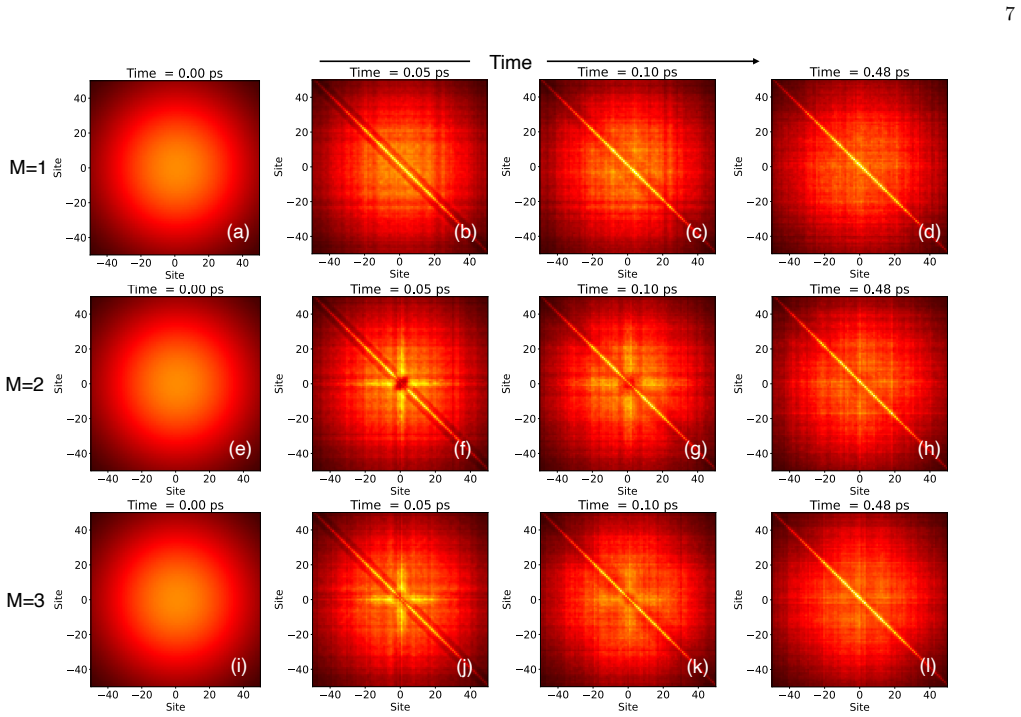
- [§III, Figs. 3–6; Eq. (20)] The physical content of Figs. 4–6 is the ~sub-ps decay of the pair-density cross-peaks, explicitly attributed to 'phonon-induced dynamical disorder and decoherence.' Within multi-trajectory Ehrenfest, however, there is no true decoherence mechanism: ensemble averaging over Wigner-sampled classical nuclear trajectories produces dephasing that is classical disorder dressed as decoherence, and mean-field Ehrenfest is documented to give quantitatively inaccurate coherence-decay times in Holstein/spin-boson-type models. Moreover, the nuclear force in Eq. (20) depends only on the one-body density ρ⁽¹⁾ᵢᵢ, so the nuclear back-reaction is blind to the two-body correlations whose decay is the claimed observable. Every phonon-coupled result (Figs. 3–6) is benchmarked only against other runs of the same framework (M=1 vs 2 vs 3 vs 6, MFPA vs M=3). This is load-bearing for half of the central claim.
- [§III, Fig. 5 and Fig. 6; Eq. (29)] The abstract and §IV state that MFPA 'can reproduce the spatial correlations to a good accuracy,' and this is the paper's main practical deliverable. The supporting evidence (Fig. 5(d) window-averaged ρ⁽²⁾, Fig. 5(e)–(l) maps, Fig. 6) is qualitative. Two gaps: (a) no quantitative error metric is given for 'good accuracy' (e.g., relative L2 error of g⁽²⁾ or of the windowed ρ⁽²⁾ trace vs. the M=3/M=6 reference as a function of time), and Fig. 5(d) itself shows visible deviations that are not characterized; (b) no mechanistic explanation is offered for why MFPA — which demonstrably fails the MSD (Fig. 5(a)) — nonetheless succeeds for ρ⁽²⁾, i.e., why early-time pair correlations are insensitive to the nuclear back-reaction error that corrupts transport. Since MFPA is an ad-hoc approximation introduced in this paper, its domain of validity should be established quantitatively (at minimum, the
- [§III, Figs. 3–6] Fig. 3 (MSD and diffusion coefficients on 400 sites) and Figs. 4–5 use M=3 as the de facto reference, and Fig. 6 uses M=6, but convergence in M for the phonon-coupled observables is asserted only by cross-M comparison within Ehrenfest: no M-dependence beyond M=3 is shown for the MSD/diffusion coefficients, and M=6 is shown only for g⁽²⁾ at two times. For Nex=15–20 with U=0.01 a.u., the statement (Fig. 4 caption text) that 'M=2 produces reasonably converged results' is not demonstrated for the transport observables. Please show M=4 (or M=6) MSD and diffusion-coefficient curves for at least the largest Nex, or state clearly which observables are converged at which M. Relatedly, the number of nuclear trajectories used in the phonon-coupled simulations is not stated anywhere I can find, and no statistical error bars appear on the MSD, D(Nex) curves, or Fig. 5(d); these are essential for judg
- [§II, Eqs. (9) and (25)] The normalization of the initial Gaussian SPF, ϕ₀ᵢ(0) = (1/√N)exp[−(i−i_mid)²/2σ²], writes the total excitation population implicitly; it should be stated explicitly how Nex excitations are distributed (i.e., that the permanent coefficient carries all Nex in mode 0) and how ρ⁽¹⁾ᵢᵢ(0) relates to Nex|ϕ₀ᵢ|². Also, in Eq. (9) the symbol Ĥ is redefined as Ĥ − Ĥ_p ('refers to the matrix element of the many-body Hamiltonian Ĥ = Ĥ − Ĥ_p'), overloading the Hamiltonian symbol defined in Eq. (1); a distinct symbol would avoid confusion, particularly because the coupling term Ĥ_e−p must still contribute through the classical Ri(t) in h_ij.
minor comments (6)
- [§I] Typo: 'forin silicoinvestigation' — missing spaces around 'in silico.'
- [Fig. 3 caption] Hopping parameter τ is quoted in a.u. in Figs. 1–2 but in cm⁻¹ (300 cm⁻¹) in Fig. 3; please use consistent units or give the conversion. Similarly 'σ = 50 units' should read '50 lattice sites' with the lattice constant a defined (used later in MSD units of a²).
- [Fig. 5(d)] The averaging window in Fig. 5(d) (half-width 5, centered at (0,−10)) appears arbitrary; please motivate the choice (e.g., centered on the dominant cross-peak) and show that conclusions are insensitive to window placement.
- [§III] Fig. 4 uses Nex=10 while Fig. 5 uses Nex=15 and Fig. 3 varies Nex; a short table summarizing parameters (N, Nex, M, U, number of trajectories/realizations) per figure would greatly aid readability and reproducibility.
- [§I] The clarification that the method is unrelated to Shalashilin's 'Multiconfigurational Ehrenfest' [52] is helpful; consider also citing ML-MCTDH-based exciton-phonon dynamics work as alternative fully quantum benchmarks to motivate the requested validation.
- [§II, Eq. (12)] Eq. (12): the projector P is defined on |ϕk⟩ while the sum runs over eigenstates |ϕ̃k⟩; please make the notation consistent.
Circularity Check
No significant circularity: variational multiconfigurational-Ehrenfest derivation is self-contained; benchmarks and MFPA comparisons are internal consistency checks, not predictions forced by fit or self-citation.
full rationale
The paper derives SPF and coefficient EOMs from the Dirac–Frenkel variational principle on a permanent expansion (Eqs. 5–9), with nuclear forces from the multiconfigurational one-body density (Eq. 20). That chain does not define the claimed observables (MSD, D, ρ⁽²⁾, g⁽²⁾) in terms of themselves. Model parameters (τ, U, γ, ω₀, T, Wigner sampling) are stated inputs, not inverted from the transport or pair-density results. Convergence is checked against exact pure-excitonic Schrödinger dynamics on small lattices (Figs. 1–2) and by increasing M; phonon-coupled Figs. 3–6 compare M and MFPA only within the same framework—an internal method comparison, not a fitted quantity renamed as a prediction. The self-citation to the authors’ prior mean-field MQC work [27] is used as background (limitation of M=1), not as a uniqueness theorem or load-bearing premise that forces the new correlation claims. Structural fact that M=1 factorizes ρ⁽²⁾ is acknowledged as expected, not smuggled in as a novel derivation. No circular step meets the quote-and-reduce standard.
Assumptions & free parameters
free parameters (6)
- On-site interaction U =
0.001, 0.005, 0.01 a.u. (and 0.006 in small benchmarks)
- Exciton-phonon coupling γ =
1.24e-5 a.u.
- Phonon frequency ω0 =
5 meV
- Hopping τ =
0.004 a.u. (small); 300 cm^-1 (large)
- Mode count M and occupation threshold ε =
M up to 10 (small), 3–6 (large); ε small numerical threshold
- Initial Gaussian width σ and temperature T =
σ=50 sites; T=150 K
assumptions (6)
- standard math Dirac–Frenkel variational principle on the multiconfigurational permanent ansatz yields the SPF and coefficient EOMs (Eqs. 8–9).
- domain assumption Nuclear degrees of freedom may be replaced by classical trajectories with forces from the instantaneous multiconfigurational excitonic density (Ehrenfest/MTE closure).
- domain assumption The system is described by a 1D Bose-Hubbard-Holstein Hamiltonian with on-site U and local Holstein coupling only.
- domain assumption Initial nuclear (R,P) may be sampled from Wigner (≈ classical Boltzmann for T>100 K) distributions on undisplaced oscillators.
- domain assumption Total excitation number Nex is conserved and dynamics stay in a fixed bosonic excitation subspace.
- ad hoc to paper MFPA: replacing multiconfigurational back-reaction by precomputed M=1 paths is a controlled approximation for early-time spatial correlations.
invented entities (2)
-
Multiconfigurational many-body Ehrenfest approach (permanents + quasi-classical phonons)
-
Mean-field path approximation (MFPA)
Cite this review
Pith. "Pith review of Multiconfigurational Mixed Quantum-Classical Approach for Correlated Many-Body Dynamics." pith.science (2026). https://pith.science/paper/KDEAVRSN
@misc{pith2026260723414,
  author       = {Pith},
  title        = {Pith review of: Multiconfigurational Mixed Quantum-Classical Approach for Correlated Many-Body Dynamics},
  year         = {2026},
  howpublished = {\url{https://pith.science/paper/KDEAVRSN}},
  note         = {Machine review of arXiv:2607.23414}
}
read the original abstract
In this work, we introduce a multiconfigurational mixed quantum-classical many-body approach for simulating the finite-temperature correlated multi-exciton dynamics in the presence of phonon-induced static and dynamic disorder. In this mixed quantum-classical approach, the excitonic subsystem is described using a multiconfigurational wavefunction that extends beyond the mean-field limit, while the phonons are evolved quasi-classically. Using this approach, we simulate a multi-excitonic dissipative system and show how the interplay between phonon-induced dynamic disorder and exciton-exciton many-body interactions determines excitation-dependent excitonic transport and spatial correlations. Our results show that while the mean-field approach produces semi-quantitatively accurate diffusive dynamics, it does not capture the spatial correlations as expected. We find that a mean-field path approximation, where we generate pre-computed trajectories using our mean-field mixed quantum-classical approach and then perform multiconfigurational dynamics, can reproduce the spatial correlations to a good accuracy, positioning this approach as an efficient method for capturing spatial correlations in complex systems.
Figures


Figures from the paper (3 more)


Reference graph
Works this paper leans on
-
[1]
O. P. Dimitriev, Dynamics of excitons in conjugated molecules and organic semiconductor systems, Chemical Reviews122, 8487 (2022)
2022
-
[2]
G. S. Engel, T. R. Calhoun, E. L. Read, T.-K. Ahn, T. Mancal, Y.-C. Cheng, R. E. Blankenship, and G. R. Fleming, Evidence for wavelike energy transfer through quantum coherence in photosynthetic systems, Nature 446, 782 (2007)
2007
-
[3]
G. M. Akselrod, P. B. Deotare, N. J. Thompson, J.-H. Lee, W. A. Tisdale, and V. Bulovi´ c, Visualization of exci- ton transport in ordered and disordered molecular solids, Nature Communications5, 3646 (2014)
2014
-
[4]
S. Deng, E. Shi, L. Yuan, L. Jin, L. Dou, and L. Huang, Long-range exciton transport and slow annihilation in two-dimensional hybrid perovskites, Nature Communi- cations11, 664 (2020)
2020
-
[5]
X.-H. Jin, M. B. Price, J. R. Finnegan, C. E. Boott, J. M. Richter, A. Rao, S. M. Menke, R. H. Friend, G. R. Whit- tell, and I. Manners, Long-range exciton transport in con- jugated polymer nanofibers prepared by seeded growth, Science360, 897 (2018)
2018
-
[6]
Najafov, B
H. Najafov, B. Lee, Q. Zhou, L. C. Feldman, and V. Pod- zorov, Observation of long-range exciton diffusion in highly ordered organic semiconductors, Nature Materi- als9, 938 (2010)
2010
-
[7]
C. Zhu, T. Nguyen, S. C. Boehme, A. Moskalenko, D. N. Dirin, M. I. Bodnarchuk, C. Katan, J. Even, G. Rain` o, and M. V. Kovalenko, Many-body correlations and exci- ton complexes in cspbbr 3 quantum dots, Advanced Ma- terials35, 2208354 (2023)
2023
-
[8]
Balasubrahmaniyam, A
M. Balasubrahmaniyam, A. Simkhovich, A. Golombek, G. Ankonina, Y. Tsurimaki, O. Bar-Elli, Y. Preezant, E. I. Rosenthal, R. Rapaport, Y. Roichman, and E. Lustig, From enhanced diffusion to ultrafast ballistic motion of hybrid light–matter excitations, Nature Mate- rials22, 338 (2023)
2023
Show all 61 references
-
[9]
Khazanov, S
T. Khazanov, S. Gunasekaran, A. George, R. Lomlu, S. Mukherjee, and A. J. Musser, Embrace the dark- ness: An experimental perspective on organic exciton– polaritons, Chemical Physics Reviews4, 041305 (2023)
2023
-
[10]
Krupp, G
N. Krupp, G. Groenhof, and O. Vendrell, Quantum dy- namics simulation of exciton–polariton transport, Nature Communications16, 5431 (2025)
2025
-
[11]
Y. Guo, G. Han, J. Guo, H. Guo, Y. Fu, X. Miao, Z. Wang, D. Li, S. Li, X. Xu, X. Lu, H. Chen, Y. Yi, and P. C. Y. Chow, Engineering ultrafast exciton dynam- ics to boost organic photovoltaic performance, Energy & Environmental Science17, 8776 (2024)
2024
-
[12]
M. B. Price, P. A. Hume, A. Ilina, M. Wagner, A. Ruseckas, I. D. W. Samuel, R. H. Friend, and A. Rao, Free charge photogeneration in a single component high photovoltaic efficiency organic semiconductor, Nature Communications13, 2827 (2022)
2022
-
[13]
J.-D. Baek, S. J. Yang, H. Yang, W. Shao, Y.-T. Yang, and L. Dou, Exciton dynamics in layered halide per- ovskite light-emitting diodes, Advanced Materials37, 2411998 (2025)
2025
-
[14]
N. C. Giebink, B. W. D’Andrade, M. S. Weaver, P. B. Mackenzie, J. J. Brown, M. E. Thompson, and S. R. For- rest, Intrinsic luminance loss in phosphorescent small- molecule organic light-emitting devices due to bimolec- ular annihilation reactions, Journal of Applied Physics 10...
2008
-
[15]
Grosso, J
G. Grosso, J. C. Graves, A. T. Hammack, A. A. High, L. V. Butov, M. Hanson, and A. C. Gossard, Excitonic switches operating at around 100 k, Nature Photonics3, 577 (2009)
2009
-
[16]
S. W. Lee, J. S. Lee, W. H. Choi, D. Choi, and S.-H. Gong, Ultra-compact exciton polariton modulator based on van der waals semiconductors, Nature communica- tions15, 2331 (2024)
2024
-
[17]
F. Xuan, M. Lai, Y. Wu, and S. Y. Quek, Exciton- enhanced spontaneous parametric down-conversion in two-dimensional crystals, Phys. Rev. Lett.132, 246902 (2024)
2024
-
[18]
Sohoni, I
S. Sohoni, I. Ghosh, G. T. Nash, J. Feng, K. Badu, X. Ma, and C. J. Bardeen, Optically accessible long-lived electronic biexcitons at room temperature in strongly coupled h-aggregates, Nature Communications15, 8280 (2024)
2024
-
[19]
Kumar, I
S. Kumar, I. S. Dunn, S. Deng, H. Choi, K. Badu, L. Dou, and C. J. Bardeen, Exciton annihilation in molecular ag- gregates suppressed through quantum interference, Na- ture Chemistry15, 1118 (2023)
2023
-
[20]
L. V. Butov, A. C. Gossard, and D. S. Chemla, Macro- scopically ordered state in an exciton system, Nature 418, 751 (2002)
2002
-
[21]
A. A. High, J. R. Leonard, A. T. Hammack, M. M. Fogler, L. V. Butov, A. V. Kavokin, K. L. Campman, and A. C. Gossard, Spontaneous coherence in a cold exciton gas, Nature483, 584 (2012)
2012
-
[22]
Z. Wang, D. A. Rhodes, K. Watanabe, T. Taniguchi, J. C. Hone, J. Shan, and K. F. Mak, Evidence of high- temperature exciton condensation in two-dimensional atomic double layers, Nature574, 76 (2019)
2019
-
[23]
Huang and T
L. Huang and T. D. Krauss, Quantized bimolecular auger recombination of excitons in single-walled carbon nan- otubes, Phys. Rev. Lett.96, 057407 (2006)
2006
-
[24]
T. C. Berkelbach, M. S. Hybertsen, and D. R. Reichman, Microscopic theory of singlet exciton fission. ii. applica- tion to pentacene dimers and the role of superexchange, The Journal of Chemical Physics138, 114103 (2013). 12
2013
-
[25]
Tempelaar and D
R. Tempelaar and D. R. Reichman, Vibronic exciton the- ory of singlet fission. iii. how vibronic coupling and ther- modynamics promote rapid triplet generation in pen- tacene crystals, The Journal of Chemical Physics148, 102309 (2018)
2018
-
[26]
Amini, J
A. Amini, J. Cerda, L. Mej ´ ıa, and A. Mandal, Many- body second order green’s function theory for ab ini- tio molecular quantum electrodynamics, arXiv preprint arXiv:2606.26076 (2026)
2026 arXiv
-
[27]
Ghosh, A
P. Ghosh, A. Manjalingal, S. Wickramasinghe, S. R. Koshkaki, and A. Mandal, Mean-field mixed quantum- classical approach for many-body quantum dynamics of exciton polaritons, Physical Review B112, 104319 (2025)
2025
-
[28]
T. E. Li, H.-T. Chen, and J. E. Subotnik, Comparison of different classical, semiclassical, and quantum treatments of light–matter interactions: Understanding energy con- servation, Journal of Chemical Theory and Computation 15, 1957 (2019)
1957
-
[29]
Crespo-Otero and M
R. Crespo-Otero and M. Barbatti, Recent advances and perspectives on nonadiabatic mixed quantum–classical dynamics, Chemical Reviews118, 7026 (2018)
2018
-
[30]
J. C. Tully, Molecular dynamics with electronic transi- tions, The Journal of Chemical Physics93, 1061 (1990)
1990
-
[31]
J. E. Subotnik, A. Jain, B. Landry, A. Petit, W. Ouyang, and N. Bellonzi, Understanding the surface hopping view of electronic transitions and decoherence, Annual Review of Physical Chemistry67, 387 (2016)
2016
-
[32]
T. E. Li, A. Nitzan, S. Hammes-Schiffer, and J. E. Subot- nik, Quantum simulations of vibrational strong coupling via path integrals, The Journal of Physical Chemistry Letters13, 3890 (2022)
2022
-
[33]
Mandal, M
A. Mandal, M. A. Taylor, B. M. Weight, E. R. Koessler, X. Li, and P. Huo, Theoretical advances in polariton chemistry and molecular cavity quantum electrodynam- ics, Chemical Reviews123, 9786 (2023)
2023
-
[34]
J. Liu, S. V. Kilina, S. Tretiak, and O. V. Prezhdo, Lig- ands slow down pure-dephasing in semiconductor quan- tum dots, ACS nano9, 9106 (2015)
2015
-
[35]
L. Wang, D. Beljonne, L. Chen, and Q. Shi, Mixed quantum-classical simulations of charge transport in organic materials: Numerical benchmark of the su- schrieffer-heeger model, The Journal of chemical physics 134(2011)
2011
-
[36]
A. J. Sneyd, D. Beljonne, and A. Rao, A new frontier in exciton transport: transient delocalization, The Journal of Physical Chemistry Letters13, 6820 (2022)
2022
-
[37]
Stippell, C
E. Stippell, C. Mora Perez, N. Favate, L. Huang, C. W. Li, and O. V. Prezhdo, Computational screening of lig- ands for enhanced interactions between lead halide per- ovskite quantum dots, The Journal of Physical Chemistry Letters16, 5666 (2025)
2025
-
[38]
Einsele and R
R. Einsele and R. Mitric, Nonadiabatic exciton dynamics and energy gradients in the framework of fmo-lc-tddftb, Journal of Chemical Theory and Computation20, 6587 (2024)
2024
-
[39]
Troisi and G
A. Troisi and G. Orlandi, Charge-transport regime of crystalline organic semiconductors: Diffusion limited by thermal off-diagonal electronic disorder, Phys. Rev. Lett. 96, 086601 (2006)
2006
-
[40]
O. V. Prezhdo, Modeling non-adiabatic dynamics in nanoscale and condensed matter systems, Accounts of Chemical Research54, 4239 (2021), pMID: 34756013, https://doi.org/10.1021/acs.accounts.1c00525
2021 doi
-
[41]
A. V. Akimov and O. V. Prezhdo, Nonadiabatic dy- namics of charge transfer and singlet fission at the pen- tacene/c60 interface, Journal of the American Chemical Society136, 1599 (2014)
2014
-
[42]
Morita, K
Y. Morita, K. Yoshioka, and M. Kuwata-Gonokami, Ob- servation of bose-einstein condensates of excitons in a bulk semiconductor, Nature Communications13, 5388 (2022)
2022
-
[43]
A. D. Alliluev, D. V. Makarov, N. A. Asriyan, A. A. Elistratov, and Y. E. Lozovik, Non-markovian stochastic gross–pitaevskii equation for the exciton–polariton bose– einstein condensate, Journal of Low Temperature Physics 214, 331 (2024)
2024
-
[44]
Carusotto and C
I. Carusotto and C. Ciuti, Quantum fluids of light, Rev. Mod. Phys.85, 299 (2013)
2013
-
[45]
Nespolo and I
J. Nespolo and I. Carusotto, Generalized gross-pitaevskii model for intersubband polariton lasing, Physical Review B100, 035305 (2019)
2019
-
[46]
J. C. Tully, Mixed quantum–classical dynamics, Faraday Discussions110, 407 (1998)
1998
-
[47]
S. R. Koshkaki, A. Manjalingal, L. Blackham, and A. Mandal, Exciton-polariton dynamics in multilayered materials, Nature Communications17, 1 (2026)
2026
-
[48]
Blackham, A
L. Blackham, A. Manjalingal, S. R. Koshkaki, and A. Mandal, Microscopic theory of polaron-polariton dis- persion and propagation, Nano Letters25, 15874 (2025)
2025
-
[49]
O. E. Alon, A. I. Streltsov, and L. S. Cederbaum, Multiconfigurational time-dependent hartree method for bosons: Many-body dynamics of bosonic systems, Phys- ical Review A—Atomic, Molecular, and Optical Physics 77, 033613 (2008)
2008
-
[50]
A. I. Streltsov, O. E. Alon, and L. S. Cederbaum, Role of excited states in the splitting of a trapped interacting bose–einstein condensate by a time-dependent barrier, Physical Review Letters99, 030402 (2007)
2007
-
[51]
Meyer, F
H.-D. Meyer, F. Gatti, and G. A. Worth, Multidimen- sional quantum dynamics: Mctdh theory and applica- tions, Wiley-VCH (2009)
2009
-
[52]
D. V. Shalashilin, Multiconfigurational ehrenfest ap- proach to quantum coherent dynamics in large molecular systems, Faraday Discussions153, 105 (2011)
2011
-
[53]
Sakmann,Many-body Schr¨ odinger dynamics of Bose- Einstein condensates(Springer Science & Business Me- dia, 2011)
K. Sakmann,Many-body Schr¨ odinger dynamics of Bose- Einstein condensates(Springer Science & Business Me- dia, 2011)
2011
-
[54]
Giannini, W.-T
S. Giannini, W.-T. Peng, L. Cupellini, S. Jurinovich, B. Mennucci, and D. Beljonne, Exciton transport in molecular organic semiconductors boosted by transient quantum delocalization, Nature Communications13, 2755 (2022)
2022
-
[55]
Cheneau, P
M. Cheneau, P. Barmettler, D. Poletti, M. Endres, P. Schauß, T. Fukuhara, C. Gross, I. Bloch, C. Kollath, and S. Kuhr, Light-cone-like spreading of correlations in a quantum many-body system, Nature481, 484 (2012)
2012
-
[56]
Sakmann, A
K. Sakmann, A. I. Streltsov, O. E. Alon, and L. S. Cederbaum, Reduced density matrices and coherence of trapped interacting bosons, Physical Review A78, 023615 (2008)
2008
-
[57]
S. Bera, B. Chakrabarti, A. Gammal, M. C. Tsat- sos, M. L. Lekala, B. Chatterjee, C. L´ evˆ eque, and A. U. J. Lode, Sorting fermionization from crystalliza- tion in many-boson wavefunctions, Scientific Reports9, 17873 (2019)
2019
-
[58]
Mandal, A
B. Mandal, A. Semenov, and D. Babikov, Adiabatic tra- jectory approximation within the framework of mixed 13 quantum/classical theory, Journal of Physical Chemistry A124, 9877 (2020)
2020
-
[59]
R. S. Mattos, S. Mukherjee, and M. Barbatti, Quantum dynamics from classical trajectories, Journal of Chemical Theory and Computation20, 7728 (2024)
2024
-
[60]
B. X. Chng, M. E. Mondal, W. Ying, and P. Huo, Quan- tum dynamics simulations of exciton polariton transport, Nano Letters (2025)
2025
-
[61]
A. V. Akimov and O. V. Prezhdo, The pyxaid program for non-adiabatic molecular dynamics in condensed mat- ter systems, Journal of chemical theory and computation 9, 4959 (2013)
2013
Reviewed July 30, 2026 · model on record in the stance chip above.
Discussion (0). Continue with ORCID to comment.