REVIEW 3 major objections 5 minor 12 references
Element-Aware Group Learning for E-Commerce Image Generation
T0 review · 3 major / 5 minor · reviewed 2026-08-05 · deepseek-v4-flash
Pith's one-line read The paper claims that splitting a GRPO group's image reward into per-element credits, computed in closed form from the reward variation already present in the group, produces better e-commerce product images than whole-prompt credit, with n
desk verdict Useful idea and honest experiments, but the central closed-form credit formula is asserted rather than derived, and the kernel-ridge objective as written does not produce it. read the letter →
The pith
A machine-rendered reading of the paper's core claim, the machinery that carries it, and where it could break.
The reading
What carries the argument
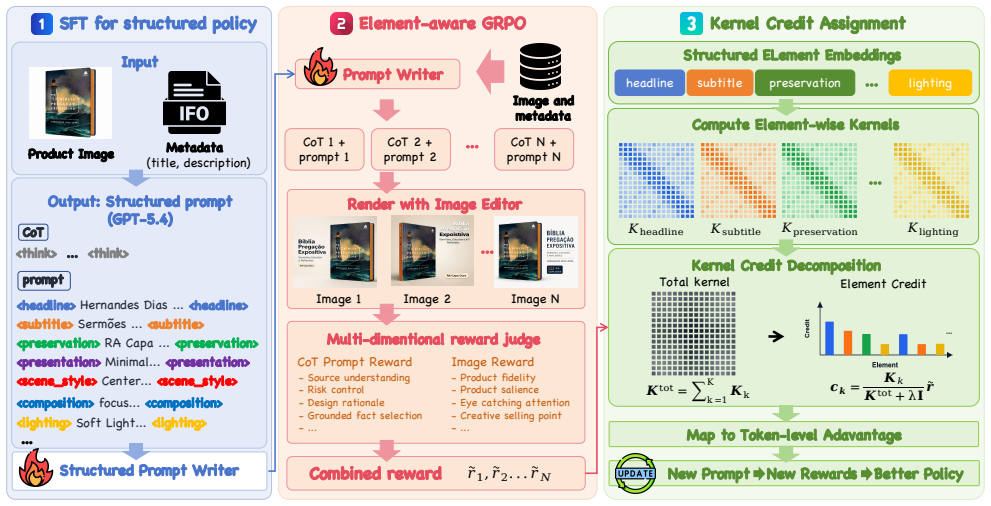
The load-bearing object is the closed-form kernel-ridge credit decomposition. Each of the 16 credit-bearing prompt elements gets a reproducing kernel built from within-group centered pooled token embeddings (capturing both presence versus absence and semantic variation); the total kernel is the sum of the element kernels, and the shared ridge solution ω = (K_tot + λI)^{-1} rtilde is used to set each element's credit to c_k = K_k ω. A residual-preserving rescaling distributes these rewards over the element's token span so the token average recovers the standard GRPO advantage. This mechanism converts the natural within-group element variation into a per-token, per-element credit signal at no
What would settle it
Evaluate the first-order optimality conditions of Eq. (9) at the claimed solution c_k = K_k (K_tot + λI)^{-1} rtilde: substituting into the derivative gives (K_k + εI)^{-1} K_k ω = ω for every element k, which holds only if ε ω = 0. A direct derivative check on a logged rollout group with ε > 0 therefore decides whether the implemented credits are the true minimizer of the printed objective.
Extended reading notes
Core claim
The central claim is that a GRPO group already contains enough free variation to assign credit to individual prompt elements, without counterfactual rollouts or learned critics. For each group, the paper builds a fixed 18-field representation of every sampled prompt, forms an element kernel Kk from within-group centered token embeddings, and estimates each element's contribution vector ck as c_k = K_k (K_tot + λI)^{-1} rtilde, where K_tot is the sum of the element kernels and rtilde is the centered image reward. Because the element credits sum, up to a residual, to the centered reward, mapping them back to token spans gives a token-level advantage whose average over a rollout exactly equals
Load-bearing premise
The load-bearing step is the derivation of Eq. (11): it assumes the minimizer of the regularized objective has the tied form c_k = K_k ω for a shared ω, and if the printed regularizer does not force that form, the element credits used in training are not the solution of the stated optimization problem.
Editorial extensions
If this is right
- Structured-prompt GRPO can be made element-sensitive while keeping the group-level reward signal unchanged, since the per-token average of the element credits equals the standard advantage.
- The method needs no extra image rollouts, no learned critic, and no step-level labels, so it can be layered onto existing GRPO pipelines for any tag-delimited output.
- Training curves in the paper suggest element-level credit sustains reward growth longer than uniform credit, delaying the plateau seen with standard GRPO.
- The per-element credits are inspectable: category-level diagnostics can show which elements co-vary with image reward, such as feature callouts in health and sports products.
- Human raters prefer EAGLE-GRPO outputs over standard GRPO and strong prompt writers in blind pairwise comparisons, on both image editors tested.
Reading between the lines
- Because the credit is correlational, fit to variation inside the group, the per-element credits should not be read as causal effects; a natural test is to intervene on a single element while holding others fixed and compare the observed reward change with the kernel-ridge attribution.
- The same closed-form decomposition is not tied to 18 fixed e-commerce fields: any structured output with stable token boundaries, such as code with function spans or documents with section tags, could receive the same element-level credit.
- The derivation gap between Eq. (9) and Eq. (11) suggests a repair: with a different per-element regularizer, for example c_k^T K_k^+ c_k, the tied form c_k = K_k ω would be the exact minimizer, making implementation match derivation.
- Category-level credit-reward correlations could support adapting the element granularity and the ridge penalty per product category, a direction the paper lists as future work.
Editorial analysis
A structured set of objections, weighed in public.
Referee Report
Summary. The paper introduces EAGLE-GRPO, an element-level credit assignment method for GRPO-based post-training of a VLM prompt writer for e-commerce image generation. Structured prompts are decomposed into 18 tagged elements; after rendering rollouts and obtaining image rewards, the centered reward is regressed on per-element kernel features via a regularized additive model (Eq. 9), yielding per-element credits in closed form (Eq. 11). These credits are rescaled and mapped to token spans so that the token average equals the standard GRPO advantage (Lemma 1), then blended with the image-level advantage. Experiments compare against prompt-writing baselines and Standard GRPO under two image editors, with benchmark scores, human pairwise evaluation, ablations, and diagnostics. The paper claims improved image quality and more sustained training gains.
Significance. If the derivation were correct, EAGLE-GRPO would be a useful, low-cost alternative to Shapley-style credit assignment: it requires no extra rollouts or learned critics, preserves the GRPO group mean by construction, and provides interpretable element-level signals. The evaluation is comparatively careful in several respects: the benchmark is held-out and uses a different judge model from training (Gemini-2.5-Pro vs Flash), human evaluation is blind and pairwise, and the Standard GRPO comparison is controlled. The ablation against fine-grained scoring helps isolate the credit-assignment mechanism. However, the central mathematical claim is currently unsupported, and the reported effect sizes are small without uncertainty quantification; these issues materially affect the strength of the contribution.
major comments (3)
- [Methodology, Element-Level Credit Decomposition, Eqs. (9)–(11)] The stated closed form is not the minimizer of Eq. (9). Setting A_k = K_k + ε_K I, the first-order condition from Eq. (9) is A_k^{-1} c_k = (r̃ − Σ_j c_j)/λ for every k, which gives c_k = A_k(A_tot + λ I)^{-1} r̃ with A_tot = K_tot + K ε_K I. This reduces to Eq. (11) only in the limit ε_K→0 and after dropping the K ε_K I term; but ε_K→0 is not admissible because the centered kernels K_k have a zero eigenvalue. Thus the implemented credit formula is not the solution of the stated optimization, and the 'closed-form kernel-ridge' claim is unsupported. The authors should either derive a correct objective whose minimizer is Eq. (11) (e.g., min_ω ‖r̃−K_totω‖² + λ ω^T K_totω, with c_k=K_kω) or revise the method and its justification accordingly.
- [Experiments, Main Results, Tables 4–5] The headline comparisons rest on small differences. On FLUX.2, the overall score goes from 7.924 (Standard GRPO) to 7.966 (EAGLE-GRPO), a 0.042-point gap; the human win rate versus Standard GRPO is 54%. No confidence intervals, p-values, or numbers of human ratings are reported. The claim that EAGLE-GRPO 'outperforms' every comparator in both settings is therefore not yet supported with appropriate uncertainty quantification. Please report standard errors or confidence intervals for benchmark scores (e.g., bootstrap over the 700 products), the number of human pairwise comparisons, and ideally results across multiple training seeds for Figure 4.
- [Methodology, Element-Level Credit Decomposition, and Element-Level Diagnostics] With N=20 rollouts per group and 16 element kernels, the centered reward vector has at most 19 degrees of freedom, but the model has 16×20 element-credit coefficients. The quadratic regularizer selects a unique solution, but the paper does not analyze how much of the resulting element credits is determined by data versus by the regularizer. The identifiability fallbacks are described only qualitatively ('near-zero reward variance or ill-conditioned kernels fallback'; 'highly aligned kernels are down-weighted'). This matters because the method's interpretability and its advantage over sequence-level credit rest on element credits reflecting actual element contributions. Please report kernel condition numbers, sensitivity of credits to λ and ε_K, and a synthetic or permutation experiment with known element effects to show that the decomposition recovers them.
minor comments (5)
- [Experimental Setup, Eq. (5)] The value of η used in the experiments is not reported in Table 2 or the text. Please specify it, as the method's behavior depends on the blend between image-level and element-level advantage.
- [Training Objective, Eq. (18)] The objective includes a KL term with coefficient β, but the text states that DAPO is used with β=0. Clarify whether KL regularization is active and, if so, its value.
- [Experiments, Table 4] The 'Overall' score is described as a weighted mean across 11 quality dimensions, but the weights are not defined. Please provide the weighting scheme.
- [Experiments, Figure 4] The validation-reward curves appear to come from a single run. State the number of seeds and, if only one, add a caveat about run-to-run variance in RL training.
- [Conclusion] The sentence 'We proved that EAGLE-GRPO beats Standard GRPO' overstates the evidence; the empirical comparison is not a proof. Please rephrase.
Circularity Check
No circularity; Eq. (9)-(11) is an unsupported algebraic step but not a circular reduction.
full rationale
EAGLE-GRPO's derivation chain is not circular. The element credits c_k are computed by a proposed formula from pooled hidden-state embeddings and group-centered rewards; the benchmark evaluation uses held-out products, a different judge (Gemini-2.5-Pro vs Gemini-2.5-Flash for training), and blind human pairwise comparisons (Table 5). Thus the central claim (higher-quality e-commerce images) is an externally tested outcome, not a restatement of the training reward or of the credit formula. Lemma 1 is explicitly a by-construction identity: Eq. (12) defines the residual so that sum_k c_{i,k}+nu_i=rtilde_i, and Eq. (14) is defined so that the token average equals that sum. The paper itself calls this 'by construction'; it is a design invariant, not a discovered prediction, so it is not circular. No load-bearing self-citations or imported uniqueness theorems appear; the RKHS references (Wahba, Gu, Kimeldorf-Wahba) are independent external classical results used as background. Flagged per reviewing rule: the step from Eq. (9) to Eq. (11) omits the normal equations; for the stated regularizer the minimizer would be c_k=(K_k+eps I)(K_tot+(lambda+K eps)I)^{-1}rtilde, which equals Eq. (11) only when eps=0 and the K eps shift is dropped. This is an omitted-proof/derivation gap and a correctness risk, but it is not circularity: Eq. (11) is not defined to be the output it predicts, and the downstream evaluation is independent. Hence score 1.
Assumptions & free parameters
free parameters (5)
- lambda (kernel ridge regularization) =
not reported
- eta (image/element advantage blend) =
not reported
- epsilon_r (reward variance offset) =
not reported
- epsilon_K (kernel jitter) =
not reported
- identifiability fallback thresholds =
not reported
assumptions (4)
- ad hoc to paper A shared coefficient vector omega across all element kernels gives the minimizer of Eq. (9).
- domain assumption Element embeddings from last-layer hidden states capture semantic variation that drives image reward.
- domain assumption Within-group variation from N=20 sampled prompts is sufficient to separate 16 element contributions.
- standard math Additive RKHS regression theory and the representer theorem apply to this credit assignment.
Cite this review
Pith. "Pith review of Element-Aware Group Learning for E-Commerce Image Generation." pith.science (2026). https://pith.science/paper/KDUTNEVM
@misc{pith2026260800584,
  author       = {Pith},
  title        = {Pith review of: Element-Aware Group Learning for E-Commerce Image Generation},
  year         = {2026},
  howpublished = {\url{https://pith.science/paper/KDUTNEVM}},
  note         = {Machine review of arXiv:2608.00584}
}
read the original abstract
Recent advances in image generation and editing have made prompt quality a key bottleneck for e-commerce creatives. Vision-language models (VLMs) can generate image-editing prompts from product images and metadata, but further improving their prompt-writing capabilities requires post-training with feedback from the generated images. Group Relative Policy Optimization (GRPO) is a natural framework for such outcome-level reward optimization. However, it assigns credit only at the full-prompt level, even though image quality often depends on specific design elements such as composition, background, and the presentation of selling points. Existing fine-grained credit assignment methods typically require step-level supervision or learned critics. To address this, we propose EAGLE-GRPO (Element-Aware Group Learning for E-Commerce Image Generation), which decomposes the group-centered reward over predefined elements. We cast element-level credit assignment as a kernel ridge regression problem and derive a closed-form solution, without additional rollouts or separate credit-assignment models. This yields interpretable per-element advantages and more precise policy updates. Experiments show that EAGLE-GRPO sustains performance gains over more training steps before plateauing and generates prompts that produce higher-quality e-commerce images than competitive VLM prompt-writing baselines.
Figures


Figures from the paper (3 more)


Reference graph
Works this paper leans on
-
[3]
Rethinking Token- LevelCreditAssignmentinRLVR:APolarity-EntropyAnal- ysis.arXiv preprint arXiv:2604.11056. Kandasamy, K.; and Yu, Y
-
[4]
Process Reward Models That Think.arXiv preprint arXiv:2504.16828. Kimeldorf, G.; and Wahba, G
-
[9]
GTPO and GRPO-S: Token and Sequence-LevelRewardShapingwithPolicyEntropy.arXiv preprint arXiv:2508.04349. Wahba, G. 1990.Spline Models for Observational Data, volume59ofCBMS-NSFRegionalConferenceSeriesinAp- plied Mathematics. Philadelphia, PA: Society for Industrial and Applied Mathematics. ISBN 9780898712445. Wang, L.; Xing, X.; Cheng, Y.; Zhao, Z.; Li, D...
arXiv 1990
-
[10]
Yang, H.; Zhou, Y.; Han, W.; and Shen, J
PromptEn- hancer:ASimpleApproachtoEnhanceText-to-ImageMod- els via Chain-of-Thought Prompt Rewriting.arXiv preprint arXiv:2509.04545. Yang, H.; Zhou, Y.; Han, W.; and Shen, J
-
[11]
InFindingsoftheAs- sociation for Computational Linguistics: ACL 2025, 7332–
Self- Rewarding Large Vision-Language Models for Optimizing PromptsinText-to-ImageGeneration. InFindingsoftheAs- sociation for Computational Linguistics: ACL 2025, 7332–
work page 2025
-
[12]
DAPO: An Open-Source LLM Re- inforcement Learning System at Scale.arXiv preprint arXiv:2503.14476. Zheng, C.; Zhu, J.; Ou, Z.; Chen, Y.; Zhang, K.; Shan, R.; Zheng,Z.;Yang,M.;Lin,J.;Yu,Y.;andZhang,W.2025. A Survey of Process Reward Models: From Outcome Signals to Process Supervisions for Large Language Models.arXiv preprint arXiv:2510.08049
arXiv 2025
-
[1971]
Some Results on Tchebycheffian Spline Functions.Journal of Mathematical Analysis and Applications, 33(1): 82–95. Li, Y.; Zhang, X.; Lu, W.; Tang, Z.; Wu, M.; Luo, H.; Wu, T.; Peng, Z.; Mi, H.; Feng, Y.; Tan, N.; Huang, C.; Chen, H.;andShen,L.2026. WhoDeservestheReward?SHARP: ShapleyCredit-basedOptimizationforMulti-AgentSystem. arXiv preprint arXiv:2602.08...
arXiv 2026
-
[2016]
InInternational Conference on Learning Representations
High-Dimensional Continuous Control Using Generalized Advantage Estimation. InInternational Conference on Learning Representations. Schulman, J.; Wolski, F.; Dhariwal, P.; Radford, A.; and Klimov,O.2017. ProximalPolicyOptimizationAlgorithms. arXiv preprint arXiv:1707.06347. Setlur, A.; Nagpal, C.; Fisch, A.; Geng, X.; Eisenstein, J.; Agarwal, R.; Agarwal,...
arXiv 2017
Show all 12 references
-
[2023]
arXiv:2305.20050
Let’s Verify Step by Step. arXiv:2305.20050. Schulman, J.; Moritz, P.; Levine, S.; Jordan, M. I.; and Abbeel, P
-
[2024]
arXiv:2402.03300
DeepSeekMath: Pushing the Limits of Mathematical Rea- soning in Open Language Models. arXiv:2402.03300. Shapley, L. S
-
[2025]
arXiv preprint arXiv:2505.20417
SCAR:ShapleyCreditAssignmentforMoreEfficientRLHF. arXiv preprint arXiv:2505.20417. Feng,X.;Jiang,Y.;Feng,X.;Yin,D.;Qin,L.;Ye,Y.;Huang, L.; Ma, W.; Gu, Y.; Qin, C.; Qin, B.; and Kong, L
-
[2026]
InFindings of ACL
SAVOIR: Learning Social Savoir-Faire via Shapley-based Reward Attribution. InFindings of ACL. Gu, C. 2002.Smoothing Spline ANOVA Models. Springer Series in Statistics. New York, NY: Springer. ISBN 9780387953533. Hao, Y.; Chi, Z.; Dong, L.; and Wei, F
2002
Reviewed August 5, 2026 · model on record in the stance chip above.
Discussion (0). Sign in to comment.