Probing hot QCD medium with heavy quarkonium in small and large collision systems
Pith reviewed 2026-07-03 04:01 UTC · model grok-4.3
The pith
Yield ratios of heavy quarkonium states indicate formation of hot QCD medium in small collision systems.
A machine-rendered reading of the paper's core claim, the machinery that carries it, and where it could break.
Core claim
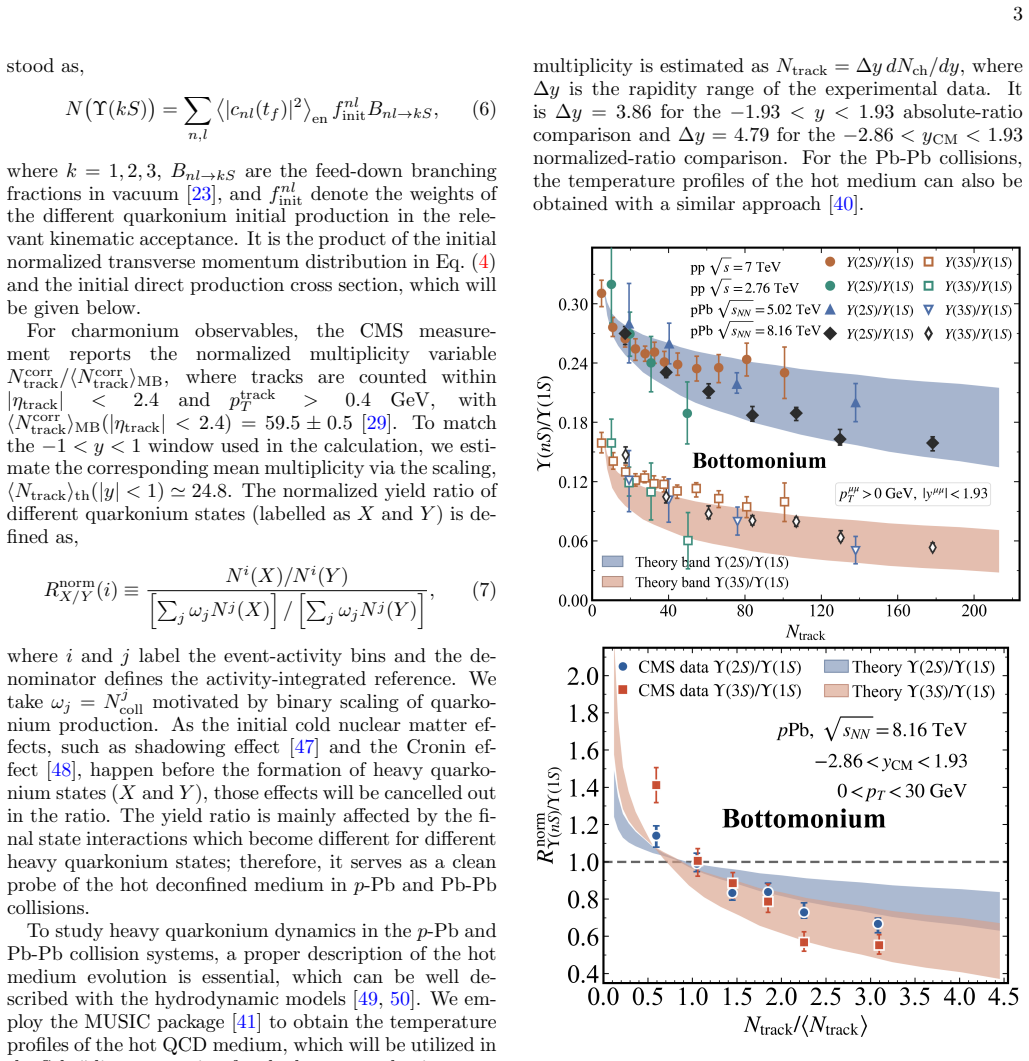
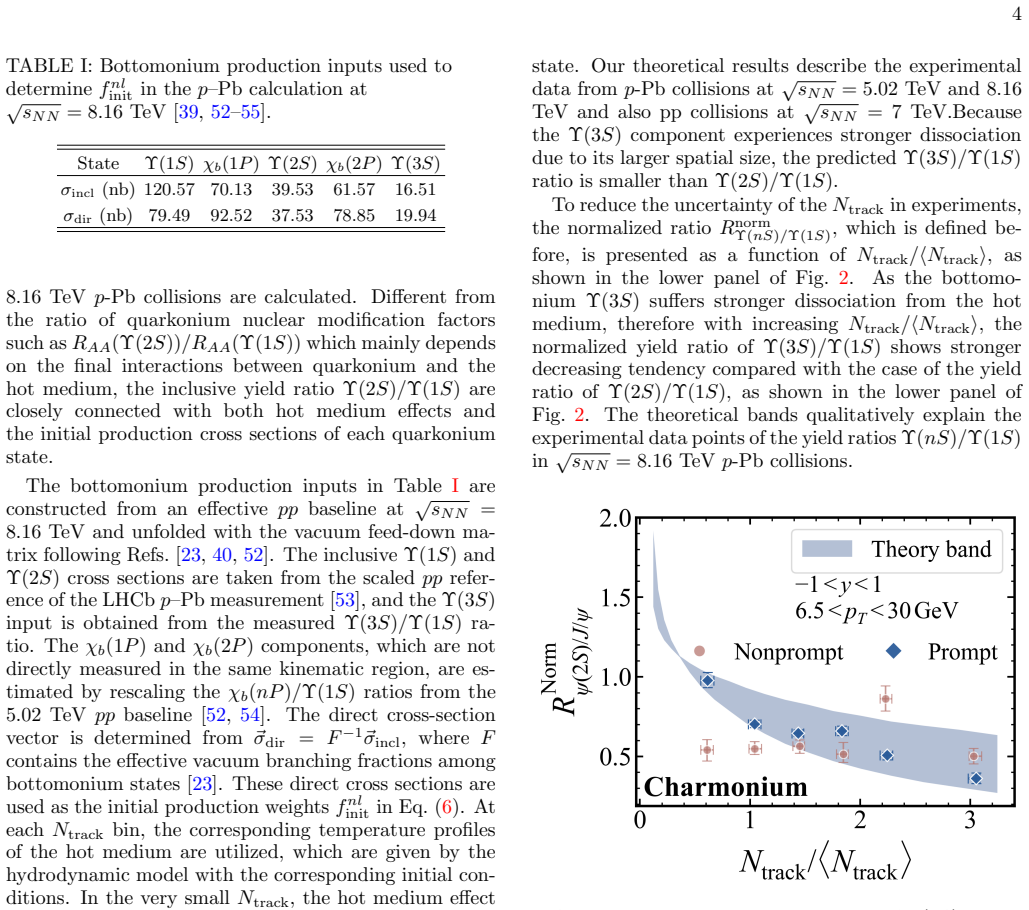
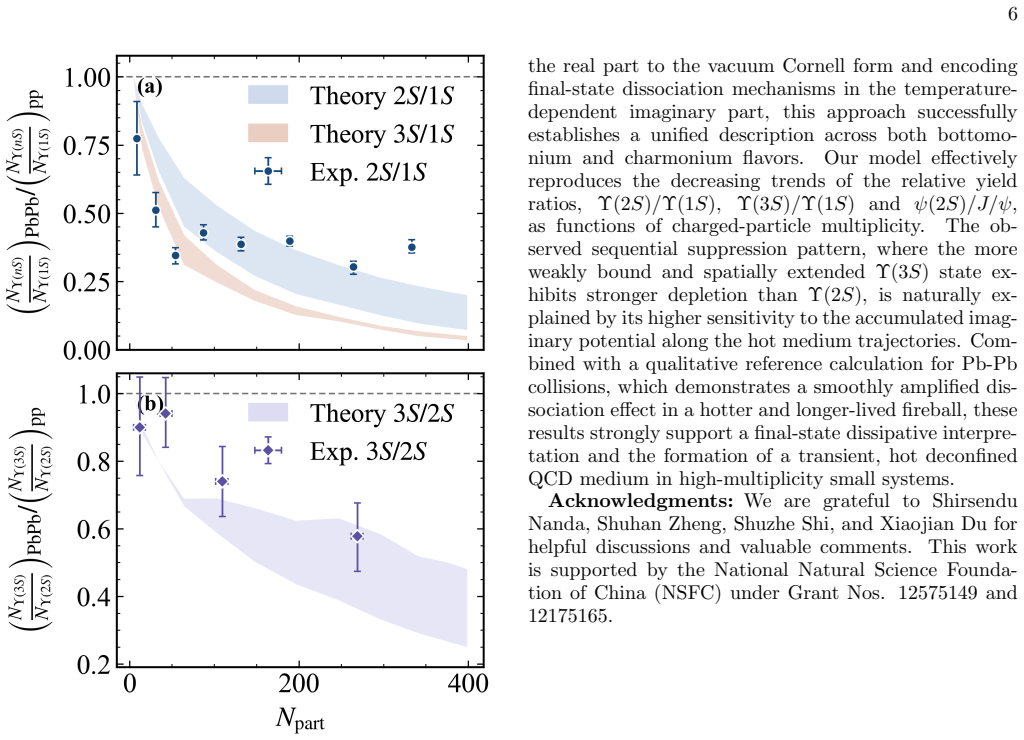
The time-dependent Schrödinger equation with complex heavy-quark potentials reproduces the observed multiplicity-dependent suppression in Υ(nS)/Υ(1S) and ψ(2S)/J/ψ ratios in p-Pb collisions at 8.16 TeV, indicating that a hot QCD medium forms in small systems and can be probed consistently across charmonium and bottomonium in both small and large collision systems.
What carries the argument
Time-dependent Schrödinger equation framework incorporating complex in-medium heavy-quark potentials to simulate real-time evolution of quarkonium wave functions.
If this is right
- The suppression pattern in yield ratios directly reflects hot medium interactions rather than cold nuclear effects.
- Bottomonium yield ratios provide a clean probe applicable across different collision systems.
- The framework unifies descriptions for both charmonium and bottomonium flavors.
- Hot medium effects intensify in larger systems like Pb-Pb collisions.
Where Pith is reading between the lines
- If the model holds, multiplicity serves as an indicator of medium density affecting quarkonium survival.
- Similar probes could be applied to other small systems like pp collisions at high multiplicity.
- Future measurements of higher excited states could test the potential models further.
Load-bearing premise
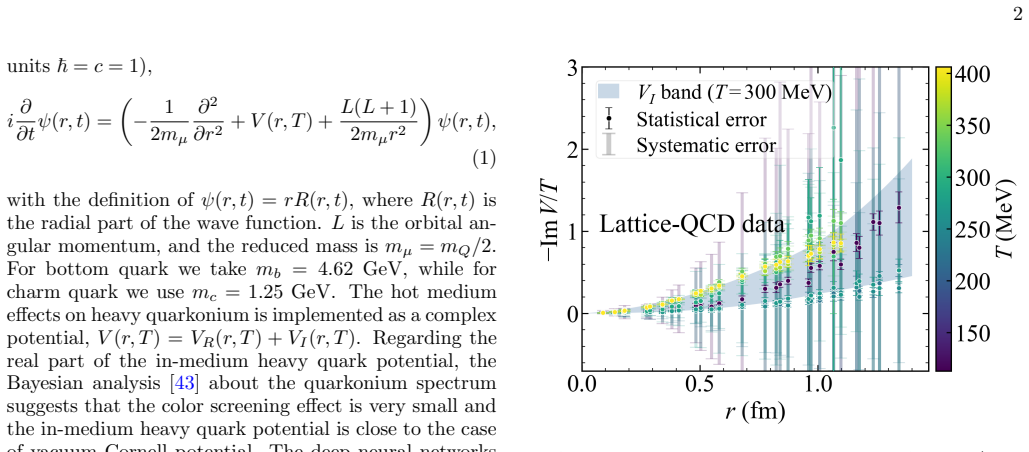
The complex heavy-quark potentials employed in the time-dependent Schrödinger equation correctly capture the dominant final-state interactions in the medium without requiring additional corrections that would alter the multiplicity dependence.
What would settle it
If the measured yield ratios in p-Pb collisions show no dependence on charged-particle multiplicity or deviate significantly from the model's predictions at high multiplicities.
Figures
read the original abstract
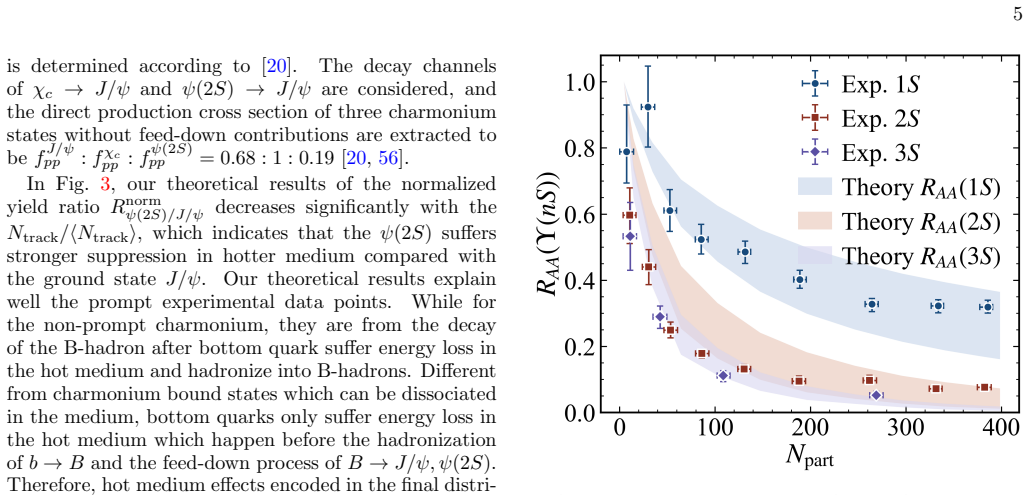
The yield ratios of different heavy quarkonium states serve as sensitive probes of final-state interactions in relativistic nuclear collisions, as they effectively cancel out common cold-nuclear-matter effects. To quantify hot QCD medium effects in small collision systems, such as proton-nucleus collisions, we employ a time-dependent Schrodinger equation framework to consistently simulate the real-time evolution of both bottomonium and charmonium states in the presence of in-medium complex heavy-quark potentials. In $p$-Pb collisions at $\sqrt{s_{\rm NN}}=8.16$ TeV, our model successfully describes the observed suppression in the yield ratios of excited-to-ground states-specifically $\Upsilon(nS)/\Upsilon(1S)$ and $\psi(2S)/J/\psi$-as a function of charged-particle multiplicity. This agreement supports the formation of a transient, hot QCD medium in small systems. Furthermore, the framework is employed to study the ratio of bottomonium nuclear modification factors in $\sqrt{s_{\rm NN}}=5.02$ TeV Pb-Pb collisions, where hot medium effects become stronger. By establishing a unified description across two distinct heavy-quark flavors and different collision systems, our study indicates that the yield ratio of bottomonium states serves as a clean probe of the hot QCD medium generated in small collision systems.
Editorial analysis
A structured set of objections, weighed in public.
Referee Report
Summary. The manuscript claims that a time-dependent Schrödinger equation framework with in-medium complex heavy-quark potentials reproduces the observed suppression of excited-to-ground state yield ratios (Υ(nS)/Υ(1S) and ψ(2S)/J/ψ) versus charged-particle multiplicity in p-Pb collisions at √s_NN=8.16 TeV. This agreement is presented as evidence for a transient hot QCD medium in small systems; the same framework is applied to bottomonium nuclear modification factor ratios in Pb-Pb collisions at 5.02 TeV, arguing for a unified description across quark flavors and system sizes.
Significance. If the complex potentials are fixed independently of the p-Pb multiplicity data and the medium mapping is physically motivated without additional multiplicity-dependent corrections, the work would provide a valuable cross-flavor test of hot-medium effects using observables that cancel cold-nuclear-matter contributions.
major comments (2)
- [§3] §3 (complex potential definition and medium mapping): the central claim requires that the potentials encode the dominant real-time dissociation/regeneration effects such that their multiplicity scaling matches data without extra adjustments. The text does not state whether the potential parameters (real and imaginary parts, screening lengths) are taken from a single lattice calculation without retuning or whether any overall normalization is adjusted to the p-Pb yield ratios; this directly affects whether the agreement is predictive or post-hoc.
- [§4] §4 (p-Pb yield-ratio results): the reported agreement with data is load-bearing for the small-system hot-medium conclusion, yet no quantitative fit quality (e.g., χ² per degree of freedom), variation under potential parameter changes, or comparison to a real-potential-only baseline is shown to demonstrate that the imaginary part is required for the multiplicity trend.
minor comments (2)
- [Abstract] The abstract and introduction should explicitly reference the specific form of the time-dependent Schrödinger equation and the initial wave-function construction.
- Figure captions for the multiplicity-dependent ratios should include the precise kinematic cuts and feed-down assumptions used in the comparison to data.
Simulated Author's Rebuttal
We thank the referee for the careful reading and constructive comments. We respond to each major comment below and will revise the manuscript to address the identified omissions and strengthen the quantitative support for our conclusions.
read point-by-point responses
-
Referee: [§3] §3 (complex potential definition and medium mapping): the central claim requires that the potentials encode the dominant real-time dissociation/regeneration effects such that their multiplicity scaling matches data without extra adjustments. The text does not state whether the potential parameters (real and imaginary parts, screening lengths) are taken from a single lattice calculation without retuning or whether any overall normalization is adjusted to the p-Pb yield ratios; this directly affects whether the agreement is predictive or post-hoc.
Authors: The referee correctly identifies an important omission. The complex potentials are taken from a single lattice QCD calculation without retuning or any overall normalization adjusted to the p-Pb yield ratios; the multiplicity dependence enters only through the physically motivated mapping of medium properties to charged-particle multiplicity. We will revise §3 to state this explicitly, cite the lattice source, and confirm the absence of data-driven adjustments, thereby establishing that the agreement is predictive. revision: yes
-
Referee: [§4] §4 (p-Pb yield-ratio results): the reported agreement with data is load-bearing for the small-system hot-medium conclusion, yet no quantitative fit quality (e.g., χ² per degree of freedom), variation under potential parameter changes, or comparison to a real-potential-only baseline is shown to demonstrate that the imaginary part is required for the multiplicity trend.
Authors: We agree that these quantitative elements are needed to support the conclusions. In the revised manuscript we will report the χ² per degree of freedom for the p-Pb yield-ratio comparisons, show the sensitivity of the results to reasonable variations in the potential parameters, and add an explicit comparison to a real-potential-only baseline to demonstrate the role of the imaginary part in reproducing the multiplicity dependence. revision: yes
Circularity Check
No significant circularity detected
full rationale
The provided abstract and context describe a time-dependent Schrödinger equation model using in-medium complex potentials to evolve quarkonium states and compare yield ratios versus multiplicity in p-Pb and Pb-Pb systems. No equations, parameter-fitting procedure, or self-citation chain is quoted that reduces the reported agreement to a tautology or forces the multiplicity dependence by construction. The central claim rests on the assumption that the potentials capture dominant effects, but this is presented as an input rather than derived from the data being explained. This is a standard model-to-data comparison without load-bearing self-referential steps.
Axiom & Free-Parameter Ledger
free parameters (1)
- parameters defining the complex heavy-quark potentials
axioms (1)
- domain assumption The time-dependent Schrödinger equation with complex potentials accurately models quarkonium evolution in a hot QCD medium.
Reference graph
Works this paper leans on
-
[1]
Matsui and H
T. Matsui and H. Satz, Phys. Lett. B178, 416 (1986)
1986
-
[2]
Heavy-flavour and quarkonium production in the LHC era: from proton-proton to heavy-ion collisions
A. Andronic et al., Eur. Phys. J. C76, 107 (2016), arXiv:1506.03981 [nucl-ex]
work page internal anchor Pith review Pith/arXiv arXiv 2016
-
[3]
R. Rapp, D. Blaschke, and P. Crochet, Prog. Part. Nucl. Phys.65, 209 (2010), arXiv:0807.2470 [hep-ph]
work page internal anchor Pith review Pith/arXiv arXiv 2010
-
[4]
Bottomonia in the Quark-Gluon Plasma and their Production at RHIC and LHC
A. Emerick, X. Zhao, and R. Rapp, Eur. Phys. J. A48, 72 (2012), arXiv:1111.6537 [hep-ph]
work page internal anchor Pith review Pith/arXiv arXiv 2012
-
[5]
X. Du, M. He, and R. Rapp, Phys. Rev. C96, 054901 (2017), arXiv:1706.08670 [hep-ph]
work page internal anchor Pith review Pith/arXiv arXiv 2017
-
[6]
L. Yan, P. Zhuang, and N. Xu, Phys. Rev. Lett.97, 232301 (2006), arXiv:nucl-th/0608010
work page internal anchor Pith review Pith/arXiv arXiv 2006
-
[7]
B. Chen, T. Guo, Y. Liu, and P. Zhuang, Phys. Lett. B 765, 323 (2017), arXiv:1607.07927 [nucl-th]
work page internal anchor Pith review Pith/arXiv arXiv 2017
-
[8]
Detailed Rapidity Dependence of $J/\psi$ Production at LHC
B. Chen, Phys. Rev. C93, 054905 (2016), arXiv:1510.07466 [hep-ph]
work page internal anchor Pith review Pith/arXiv arXiv 2016
-
[9]
Strong Diffusion Effect of Charm Quarks on $J/\psi$ Production in Pb-Pb collisions at the LHC
J. Zhao and B. Chen, Phys. Lett. B776, 17 (2018), arXiv:1705.04558 [nucl-th]
work page internal anchor Pith review Pith/arXiv arXiv 2018
-
[10]
K. Zhou, N. Xu, Z. Xu, and P. Zhuang, Phys. Rev. C 89, 054911 (2014), arXiv:1401.5845 [nucl-th]
work page internal anchor Pith review Pith/arXiv arXiv 2014
-
[11]
A. Andronic, P. Braun-Munzinger, K. Redlich, and J. Stachel, Phys. Lett. B571, 36 (2003), arXiv:nucl- th/0303036
- [12]
-
[13]
Real-time static potential in hot QCD
M. Laine, O. Philipsen, P. Romatschke, and M. Tassler, JHEP03, 054 (2007), arXiv:hep-ph/0611300
work page internal anchor Pith review Pith/arXiv arXiv 2007
-
[14]
M. Laine, O. Philipsen, and M. Tassler, JHEP09, 066 (2007), arXiv:0707.2458 [hep-lat]
work page internal anchor Pith review Pith/arXiv arXiv 2007
-
[15]
Y. Akamatsu, Prog. Part. Nucl. Phys.123, 103932 (2022), arXiv:2009.10559 [nucl-th]
-
[16]
Complex Heavy-Quark Potential at Finite Temperature from Lattice QCD
A. Rothkopf, T. Hatsuda, and S. Sasaki, Phys. Rev. Lett.108, 162001 (2012), arXiv:1108.1579 [hep-lat]
work page internal anchor Pith review Pith/arXiv arXiv 2012
-
[17]
Static quark-antiquark potential in the quark-gluon plasma from lattice QCD
Y. Burnier, O. Kaczmarek, and A. Rothkopf, Phys. Rev. Lett.114, 082001 (2015), arXiv:1410.2546 [hep-lat]
work page internal anchor Pith review Pith/arXiv arXiv 2015
-
[18]
Quarkonium states in a complex-valued potential
M. Margotta, K. McCarty, C. McGahan, M. Strick- land, and D. Yager-Elorriaga, Phys. Rev. D83, 105019 (2011), [Erratum: Phys.Rev.D 84, 069902 (2011)], arXiv:1101.4651 [hep-ph]. 7
work page internal anchor Pith review Pith/arXiv arXiv 2011
-
[19]
Bottomonium suppression using a lattice QCD vetted potential
B. Krouppa, A. Rothkopf, and M. Strickland, Phys. Rev. D97, 016017 (2018), arXiv:1710.02319 [hep-ph]
work page internal anchor Pith review Pith/arXiv arXiv 2018
- [20]
- [21]
-
[22]
Quarkonium suppression in heavy-ion collisions: an open quantum system approach
N. Brambilla, M. A. Escobedo, J. Soto, and A. Vairo, Phys. Rev. D96, 034021 (2017), arXiv:1612.07248 [hep- ph]
work page internal anchor Pith review Pith/arXiv arXiv 2017
-
[23]
N. Brambilla, M. ´A. Escobedo, M. Strickland, A. Vairo, P. Vander Griend, and J. H. Weber, JHEP05, 136 (2021), arXiv:2012.01240 [hep-ph]
-
[24]
Sequential Quarkonium Suppression
S. Digal, P. Petreczky, and H. Satz, Phys. Rev. D64, 094015 (2001), arXiv:hep-ph/0110406
work page internal anchor Pith review Pith/arXiv arXiv 2001
-
[25]
Heavy quarkonium: progress, puzzles, and opportunities
N. Brambilla et al., Eur. Phys. J. C71, 1534 (2011), arXiv:1010.5827 [hep-ph]
work page internal anchor Pith review Pith/arXiv arXiv 2011
-
[26]
Thermal Bottomonium Suppression at RHIC and LHC
M. Strickland and D. Bazow, Nucl. Phys. A879, 25 (2012), arXiv:1112.2761 [nucl-th]
work page internal anchor Pith review Pith/arXiv arXiv 2012
-
[27]
B. B. Abelev et al. (ALICE), Phys. Lett. B738, 361 (2014), arXiv:1405.4493 [nucl-ex]
work page internal anchor Pith review Pith/arXiv arXiv 2014
-
[28]
A. Tumasyan et al. (CMS), Phys. Rev. Lett.133, 022302 (2024), arXiv:2303.17026 [hep-ex]
-
[29]
V. Chekhovsky et al. (CMS), Phys. Rev. Lett.135, 092301 (2025), arXiv:2503.02139 [hep-ex]
-
[30]
Observation of Long-Range Near-Side Angular Correlations in Proton-Proton Collisions at the LHC
V. Khachatryan et al. (CMS), JHEP09, 091 (2010), arXiv:1009.4122 [hep-ex]
work page internal anchor Pith review Pith/arXiv arXiv 2010
-
[31]
Observation of long-range near-side angular correlations in proton-lead collisions at the LHC
S. Chatrchyan et al. (CMS), Phys. Lett. B718, 795 (2013), arXiv:1210.5482 [nucl-ex]
work page internal anchor Pith review Pith/arXiv arXiv 2013
-
[32]
B. B. Abelev et al. (ALICE), Phys. Lett. B719, 29 (2013), arXiv:1212.2001 [nucl-ex]
work page internal anchor Pith review Pith/arXiv arXiv 2013
-
[33]
J. L. Nagle and W. A. Zajc, Ann. Rev. Nucl. Part. Sci. 68, 211 (2018), arXiv:1801.03477 [nucl-ex]
work page internal anchor Pith review Pith/arXiv arXiv 2018
-
[34]
W. Zhao, Y. Zhou, H. Xu, W. Deng, and H. Song, Phys. Lett. B780, 495 (2018), arXiv:1801.00271 [nucl-th]
work page internal anchor Pith review Pith/arXiv arXiv 2018
- [35]
-
[36]
J/psi suppression in p-A collisions from parton energy loss in cold QCD matter
F. Arleo and S. Peigne, Phys. Rev. Lett.109, 122301 (2012), arXiv:1204.4609 [hep-ph]
work page internal anchor Pith review Pith/arXiv arXiv 2012
-
[37]
E. G. Ferreiro, Phys. Lett. B749, 98 (2015), arXiv:1411.0549 [hep-ph]
work page internal anchor Pith review Pith/arXiv arXiv 2015
-
[38]
In-Medium Charmonium Production in Proton-Nucleus Collisions
X. Du and R. Rapp, JHEP03, 015 (2019), arXiv:1808.10014 [nucl-th]
work page internal anchor Pith review Pith/arXiv arXiv 2019
- [39]
-
[40]
J. Liu, K. Zhou, and B. Chen, arXiv e-prints (2026), arXiv:2604.09198 [nucl-th]
work page internal anchor Pith review Pith/arXiv arXiv 2026
-
[41]
C. Shen, Z. Qiu, H. Song, J. Bernhard, S. Bass, and U. Heinz, Comput. Phys. Commun.199, 61 (2016), arXiv:1409.8164 [nucl-th]
work page internal anchor Pith review Pith/arXiv arXiv 2016
- [42]
- [43]
-
[44]
Complex heavy-quark potential and Debye mass in a gluonic medium from lattice QCD
Y. Burnier and A. Rothkopf, Phys. Rev. D95, 054511 (2017), arXiv:1607.04049 [hep-lat]
work page internal anchor Pith review Pith/arXiv arXiv 2017
- [45]
- [46]
-
[47]
K. J. Eskola, P. Paakkinen, H. Paukkunen, and C. A. Salgado, Eur. Phys. J. C77, 163 (2017), arXiv:1612.05741 [hep-ph]
work page internal anchor Pith review Pith/arXiv arXiv 2017
-
[48]
J. W. Cronin, H. J. Frisch, M. J. Shochet, J. P. Boymond, R. Mermod, P. A. Piroue, and R. L. Sumner (E100), Phys. Rev. D11, 3105 (1975)
1975
-
[49]
3+1D hydrodynamic simulation of relativistic heavy-ion collisions
B. Schenke, S. Jeon, and C. Gale, Phys. Rev. C82, 014903 (2010), arXiv:1004.1408 [hep-ph]
work page internal anchor Pith review Pith/arXiv arXiv 2010
-
[50]
Elliptic and triangular flow in event-by-event (3+1)D viscous hydrodynamics
B. Schenke, S. Jeon, and C. Gale, Phys. Rev. Lett.106, 042301 (2011), arXiv:1009.3244 [hep-ph]
work page internal anchor Pith review Pith/arXiv arXiv 2011
-
[51]
S. Chatrchyan et al. (CMS), JHEP04, 103 (2014), arXiv:1312.6300 [nucl-ex]
work page internal anchor Pith review Pith/arXiv arXiv 2014
- [52]
-
[53]
R. Aaij et al. (LHCb), JHEP11, 194 (2018), [Erratum: JHEP 02, 093 (2020)], arXiv:1810.07655 [hep-ex]
-
[54]
R. Aaij et al. (LHCb), Eur. Phys. J. C74, 3092 (2014), arXiv:1407.7734 [hep-ex]
work page internal anchor Pith review Pith/arXiv arXiv 2014
-
[55]
Measurement of the Y(1S), Y(2S), and Y(3S) cross sections in pp collisions at sqrt(s) = 7 TeV
S. Chatrchyan et al. (CMS), Phys. Lett. B727, 101 (2013), arXiv:1303.5900 [hep-ex]
work page internal anchor Pith review Pith/arXiv arXiv 2013
-
[56]
Tanabashi et al
M. Tanabashi et al. (Particle Data Group), Phys. Rev. D98, 030001 (2018)
2018
-
[57]
A. M. Sirunyan et al. (CMS), Phys. Lett. B790, 270 (2019), arXiv:1805.09215 [hep-ex]
work page internal anchor Pith review Pith/arXiv arXiv 2019
discussion (0)
Sign in with ORCID, Apple, or X to comment. Anyone can read and Pith papers without signing in.