REVIEW 4 major objections 4 minor 32 references
The paper reconstructs the force on quarks inside the proton without assuming a form-factor shape and finds an attractive, roughly constant force near -0.3 GeV/fm, strengthening the force-based case for confinement.
Reviewed by Pith at T0; open to challenge. T0 means a machine referee read the full paper against a public rubric. the ladder, T0–T4 →
T0 review · deepseek-v4-flash
2026-08-01 06:13 UTC pith:KE2G577C
load-bearing objection A worthwhile inverse-problem reformulation of the Ji-Miller-Yang force extraction, but the uncertainty reduction is over-sold and the regularization choice needs a closure test. the 4 major comments →
Revisiting Quark Confinement in the Proton through the Force on Quarks
The pith
A machine-rendered reading of the paper's core claim, the machinery that carries it, and where it could break.
Core claim
The paper's central claim is that the transverse color-Lorentz force on quarks in the proton can be reconstructed directly from a finite set of quark scalar form-factor constraints by solving a regularized inverse problem. Using the low-|q^2| experimental/lattice extractions supplemented by light-cone QCD sum-rule results over 1 <= -q^2 <= 10 GeV^2, the reconstructed force is attractive and approximately constant, averaging about -0.3 GeV/fm for 0.7 <= r_perp <= 1.1 fm. This is consistent with the force implied by a linear QCD potential and with a previously proposed force-based framework for confinement. The paper also claims that the inclusion of the large-momentum sum-rule inputs substant
What carries the argument
The central object is the quark scalar form factor G_s,q(q^2), the Lorentz-scalar coefficient in the non-conserved part of the quark energy-momentum tensor matrix element. The transverse quark force density is related to G_s,q via a first-order Hankel transform; the paper rewrites this relation as a linear integral equation in which the force itself is the unknown. Because the resulting discretized matrix is severely ill-conditioned (condition number ~10^16), the inversion is stabilized with Tikhonov regularization using a third-derivative smoothness penalty and an L-curve choice of the regularization parameter. This machinery lets the force be reconstructed directly from discrete, uncertain
Load-bearing premise
The load-bearing assumption is that each light-cone sum-rule input point carries a relative uncertainty of about 10%; if the true uncertainties are larger or correlated, the error bands widen and the claim of a firmly attractive force at small transverse distances weakens.
What would settle it
Re-run the inversion using published, correlated uncertainty estimates for the light-cone sum-rule form factors rather than the assumed 10% error bars; if the 1-sigma band crosses zero in the 0.5-1.0 fm region, or if the central force deviates strongly from a flat profile, the central claim fails. Likewise, new lattice or experimental data points in the 0.35-1 GeV^2 gap that disagree with the synthetic values used here would shift the reconstruction and could overturn the conclusion.
If this is right
- If the reconstruction is correct, the force on light quarks in the proton is inward and roughly distance-independent over the intermediate transverse region, matching the linear part of the QCD potential and providing a direct force-level signature of confinement.
- The reduced uncertainty at 0.5-1.0 fm would make the attractive character of the force more firmly established than in earlier parametrization-based determinations.
- The demonstration that synthetic constraints in the 0.35-1 GeV^2 gap substantially shrink the uncertainty identifies a concrete target for future experimental and lattice measurements.
- The inverse-problem formulation, if robust, can be applied to other hadronic form-factor reconstructions, including forces in mesons, exotic hadrons, and gluon distributions inside hadrons.
- Improved precision in the light-cone sum-rule inputs, as illustrated by the 5% uncertainty case, would tighten the reconstructed force over the full transverse-distance range.
Where Pith is reading between the lines
- A natural next test would be to replace the ad hoc 10% LCSR uncertainty with the full correlated error budget from the sum-rule calculation; if the true uncertainties are substantially larger, the claimed improvement at small r_perp may largely evaporate.
- The flatness of the force over 0.7-1.1 fm and its consistency with a linear potential suggest that the transverse force could be connected to an effective string tension; comparing the extracted value with the Wilson-loop string tension would provide a quantitative cross-check.
- The inverse-problem method could be turned around: instead of assuming G_s,q, one could simultaneously constrain the form factors and the force, potentially reducing model dependence in the LCSR extraction itself as the authors suggest for future work.
Editorial analysis
A structured set of objections, weighed in public.
Referee Report
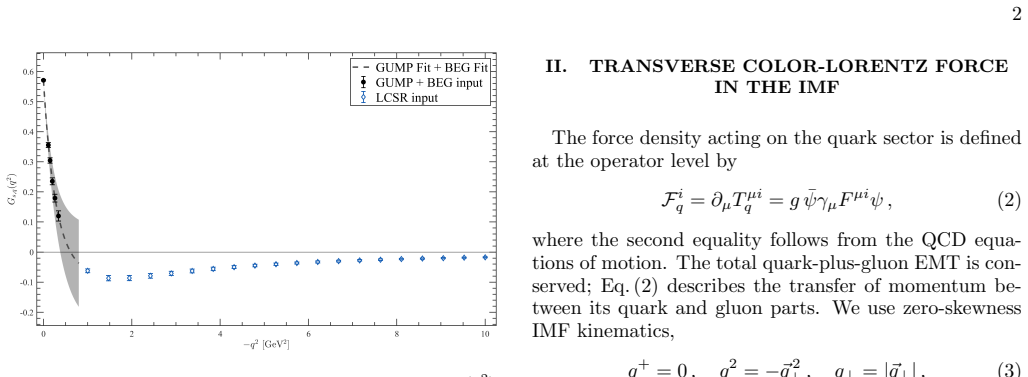
Summary. The paper revisits the quark-force framework of Ji et al. by reconstructing the transverse color-Lorentz force on quarks in the proton from the scalar EMT form factor G_{s,q}(q^2). The authors supplement low-|q^2| phenomenological and lattice constraints (GUMP, BEG) with 20 sampled light-cone QCD sum rule (LCSR) points in the range 1 ≤ -q^2 ≤ 10 GeV^2, and formulate the extraction as a regularized inverse problem. The Hankel transform is discretized into a linear system (Eqs. 10–13); because the system is severely ill-conditioned, Tikhonov regularization with a third-derivative penalty and an L-curve choice of α = 2.1×10^-3 is used. The resulting force is attractive and approximately constant, averaging about -0.3 GeV/fm over 0.7 ≤ r⊥ ≤ 1.1 fm, consistent with the result of Ref. [1] and with a linear QCD potential. The authors also study the sensitivity to the assigned LCSR uncertainty (10%, 20%, 5%) and to two synthetic constraints in the uncovered transition region.
Significance. If the reconstruction is robust, this is a useful cross-check of the force-based picture of confinement that avoids a fully prescribed functional form for G_{s,q}(q^2). The paper is transparent in setting up the inverse problem: the linear algebra is explicit, the ill-conditioning is quantified, and the regularization parameter is chosen by a standard, data-driven method. The prospective sensitivity tests are also informative. However, the central quantitative claims—that the force is attractive in 0.5–1.0 fm with reduced uncertainty—depend directly on an unvalidated regularization scheme and on ad hoc input uncertainties. The paper's own Sec. IV acknowledges that a systematic comparison of regularization schemes is missing. The stress-test concern about the absence of a closure test is therefore well-founded and load-bearing.
major comments (4)
- [Sec. III, Eqs. (12)–(16), Fig. 2] The linear system has condition number ~10^16, so an infinite family of force profiles fits the 26 input points within their errors. The L-curve selects α=2.1×10^-3, but no closure test is shown: the authors do not demonstrate that the inversion recovers a known force from the same sparse q² sampling and noise. Without such a test, the smoothness penalty in Eq. (14) is itself a functional-form prior, and the claim that the result is 'less parametrization-dependent' is not established. Please add closure tests (e.g., reconstruct a model force from the same q² grid and noise) and compare with alternative regularization choices or α-selection criteria, as Sec. IV itself calls for.
- [Sec. III, Fig. 1 and Fig. 4(a)–(c)] The 10% relative uncertainty assigned to each LCSR point is explicitly an 'exploratory benchmark' and is not derived from the uncertainty estimates of Ref. [19]. The main quantitative improvement—reduced force uncertainty in the 0.5–1.0 fm region—follows directly from this assumption. At 20% LCSR uncertainty (Fig. 4b) the band already extends above zero at larger r⊥, and at 5% it shrinks substantially. The paper should either propagate the actual uncertainties from Ref. [19], including possible correlations between the sampled points, or clearly present the 10% case as an illustrative exercise rather than a quantitative result.
- [Sec. III, Fig. 4(d)] The two synthetic constraints at -q² = 0.6 and 0.8 GeV² are assigned central values and errors by hand, using the parametrization of Ref. [1]. Adding them and finding reduced uncertainty is a sensitivity study, not evidence about the physical force. The text should not imply that these synthetic points improve the actual determination; they only illustrate where future data would be most helpful. Please reword the discussion so that these points are not presented as part of the physical extraction.
- [Sec. II, Eqs. (7)–(9), and Sec. IV] The final force F_q(r⊥) is obtained by dividing the reconstructed force density by the transverse quark-number density ρ_q, which itself is reconstructed from the proton and neutron Dirac form factors. The uncertainty in this denominator is not propagated into the error bands of Fig. 4. The paper acknowledges this in Sec. IV, but it is load-bearing for the quantitative uncertainty claims: excluding the ρ_q uncertainty makes the quoted errors incomplete. Please propagate this uncertainty or justify why it is negligible.
minor comments (4)
- [Fig. 1] The LCSR input is said to be 20 sampled points, but no table or explicit list of (q², G_s,q) values is given. A small table or ancillary file would aid reproducibility.
- [References] DOIs for Refs. [13] and [14] appear malformed ('10.1103/3x7r-ythq' and '10.1103/qct5-y7rp'); please verify them.
- [Fig. 2] The L-curve figure would benefit from labels identifying the residual norm and penalty norm axes, and from a marker indicating the selected corner.
- [Sec. II, Eq. (10)] The symbol F_q is used for both the radial force density in Eq. (6) and the effective force per quark after division by ρ_q in Eq. (7). A clearer notation, e.g., f_q for the density, would avoid confusion.
Circularity Check
No significant circularity: the force is an honest regularized inversion of externally supplied form-factor inputs, with limitations acknowledged.
full rationale
The central derivation is not circular. The inputs G_s,q(q^2) come from independent sources (DVCS/GPD extractions in Refs. [14,15] and LCSR in Ref. [19]), none of which is defined in terms of the output transverse force. The force is obtained from these inputs by the defining transform Eq. (6), inverted through the explicit linear system Eqs. (10)-(13). Tikhonov regularization is used because the matrix is ill-conditioned, and the regularization strength is chosen by the L-curve from the data itself, not tuned to produce the claimed -0.3 GeV/fm plateau. The statement that the result is 'consistent with that implied by a linear QCD potential' is a comparison, not an input assumption. The prospective synthetic constraints at -q^2 = 0.6 and 0.8 GeV^2 are explicitly labeled as a prospective test and follow the parametrization of Ref. [1], but they are not used to establish the main result; the paper instead identifies the gap 0.35-1.0 GeV^2 as a limitation. Self-citations to Refs. [23]-[26] support the adopted regularization methodology and analogue LaMET applications, but the method is standard and not load-bearing for the central physical conclusion. The paper itself acknowledges remaining methodological dependence ('a systematic comparison of different regularization schemes is needed') and LCSR model dependence, but these are honest limitations, not circularity. No step in the derivation reduces the output to the input by construction beyond the defining relation between the quark scalar form factor and the force, which is the physical quantity being reconstructed rather than a hidden fitted assumption.
Axiom & Free-Parameter Ledger
free parameters (4)
- Tikhonov regularization parameter α =
2.1×10^-3
- LCSR input relative uncertainty =
10% (default), 20% and 5% in tests
- Integral truncation r⊥max =
10 GeV^-1
- Synthetic transition-region constraints =
G_s,q = 0.000±0.002 at Q²=0.6 GeV²; −0.040±0.002 at Q²=0.8 GeV²
axioms (5)
- domain assumption The transverse force on quarks in the proton is given by F_q(r⊥) = (M/4)(d/dr⊥) G̃_s,q(r⊥) divided by the transverse quark-number density (Eqs. 5-9).
- domain assumption G_s,q(q²) = A_q(q²) + (q²/4M²)B_q(q²) − (3q²/M²)C_q(q²) (Eq. 1) and that G_s,q is a scalar form factor of the nonconserved quark EMT piece.
- domain assumption ρ_q(r⊥) ≈ 3∫(F1p+F1n) with form factors from Kelly [29], neglecting strange/other flavors.
- standard math Tikhonov regularization with third-derivative penalty and L-curve α-selection yields a trustworthy solution despite condition number ~10^16.
- domain assumption The LCSR calculation of Ref. [19] reliably gives valence-quark EMT form factors for 1≤−q²≤10 GeV² even though it omits explicit gluon contributions.
read the original abstract
Quark confinement, the fact that colored quarks are permanently bound inside color-neutral hadrons and have never been observed as isolated particles, remains one of the central issues of the Standard Model. Recently, Ji et al.\,\cite{Ji:2026lyj} proposed a framework to define and measure the force on quarks in the proton, obtaining strong evidence for a net confining force and thus opening a new perspective on the study of confinement. In this work, we improve this analysis by incorporating light-cone QCD sum rule results to supplement the limited experimental and lattice QCD information in the large-$|q^2|$ region. We further formulate the reconstruction of the quark force as a regularized inverse problem, thereby reducing the model dependence associated with the prescribed functional parametrizations used before. The resulting quark force provides a complementary, less parametrization-dependent determination and remains consistent with that implied by a linear QCD potential, which also supports the robustness of the framework proposed in Ref.\,\cite{Ji:2026lyj}. We also show that improved future inputs can substantially reduce the uncertainty in the reconstructed quark force.
Figures


Reference graph
Works this paper leans on
-
[1]
X. Ji, G. A. Miller and C. Yang, [arXiv:2605.00339 [hep- ph]]
-
[2]
X. D. Ji, Phys. Rev. Lett.78, 610-613 (1997) doi:10.1103/PhysRevLett.78.610 [arXiv:hep-ph/9603249 [hep-ph]]
Pith/arXiv arXiv 1997
-
[3]
M. V. Polyakov, Phys. Lett. B555, 57-62 (2003) doi:10.1016/S0370-2693(03)00036-4 [arXiv:hep- ph/0210165 [hep-ph]]
arXiv 2003
-
[4]
M. V. Polyakov and P. Schweitzer, Int. J. Mod. Phys. A33, no.26, 1830025 (2018) doi:10.1142/S0217751X18300259 [arXiv:1805.06596 [hep-ph]]
Pith/arXiv arXiv 2018
-
[5]
P. E. Shanahan and W. Detmold, Phys. Rev. Lett.122, no.7, 072003 (2019) 7 doi:10.1103/PhysRevLett.122.072003 [arXiv:1810.07589 [nucl-th]]
Pith/arXiv arXiv 2019
-
[6]
K. Tanaka, Phys. Rev. D98, no.3, 034009 (2018) doi:10.1103/PhysRevD.98.034009 [arXiv:1806.10591 [hep-ph]]
Pith/arXiv arXiv 2018
-
[7]
Hagleret al.[LHPC and SESAM], Phys
P. Hagleret al.[LHPC and SESAM], Phys. Rev. D68, 034505 (2003) doi:10.1103/PhysRevD.68.034505 [arXiv:hep-lat/0304018 [hep-lat]]
Pith/arXiv arXiv 2003
-
[8]
J. W. Chen and X. d. Ji, Phys. Rev. Lett.88, 052003 (2002) doi:10.1103/PhysRevLett.88.052003 [arXiv:hep- ph/0111048 [hep-ph]]
arXiv 2002
-
[9]
M. Gockeleret al.[QCDSF], Phys. Rev. Lett.92, 042002 (2004) doi:10.1103/PhysRevLett.92.042002 [arXiv:hep- ph/0304249 [hep-ph]]
arXiv 2004
-
[10]
G. S. Bali, Phys. Rept.343, 1-136 (2001) doi:10.1016/S0370-1573(00)00079-X [arXiv:hep- ph/0001312 [hep-ph]]
arXiv 2001
-
[11]
T. Kawanai and S. Sasaki, Phys. Rev. Lett.107, 091601 (2011) doi:10.1103/PhysRevLett.107.091601 [arXiv:1102.3246 [hep-lat]]
Pith/arXiv arXiv 2011
-
[12]
P. Leal Ferreira, J. A. Helayel and N. Zagury, Nuovo Cim. A55, 215 (1980) doi:10.1007/BF02899966
-
[13]
Y. Guo, F. Yuan and W. Zhao, Phys. Rev. Lett.135, no.11, 111902 (2025) doi:10.1103/3x7r-ythq [arXiv:2501.10532 [hep-ph]]
Pith/arXiv arXiv 2025
-
[14]
Y. Guo, F. P. Aslan, X. Ji and M. G. Santiago, Phys. Rev. Lett.135, no.26, 261903 (2025) doi:10.1103/qct5- y7rp [arXiv:2509.08037 [hep-ph]]
Pith/arXiv arXiv 2025
-
[15]
The red curve in panel (c) is obtained using the GUMP and BEG data supplemented with LCSR inputs assigned a 5% relative uncertainty
data supplemented with LCSR [19] inputs, to which relative uncertainties of 10% and 20%, respectively, are assigned. The red curve in panel (c) is obtained using the GUMP and BEG data supplemented with LCSR inputs assigned a 5% relative uncertainty. The red curve in panel (d) is obtained by additionally including two synthetic data points at−q 2 = 0.6 and...
2023
-
[16]
V. D. Burkert, L. Elouadrhiri and F. X. Girod, Na- ture557, no.7705, 396-399 (2018) doi:10.1038/s41586- 018-0060-z
doi:10.1038/s41586- 2018
-
[17]
I. I. Balitsky, V. M. Braun and A. V. Kolesnichenko, Nucl. Phys. B312, 509-550 (1989) doi:10.1016/0550- 3213(89)90570-1
doi:10.1016/0550- 1989
-
[18]
P. Colangelo and A. Khodjamirian, doi:10.1142/9789812810458 0033 [arXiv:hep-ph/0010175 [hep-ph]]
-
[19]
K. Azizi and U. ¨Ozdem, Eur. Phys. J. C80, no.2, 104 (2020) doi:10.1140/epjc/s10052-020-7676-5 [arXiv:1908.06143 [hep-ph]]
Pith/arXiv arXiv 2020
-
[20]
Z. Dehghan, F. Almaksusi and K. Azizi, JHEP06, 025 (2025) doi:10.1007/JHEP06(2025)025 [arXiv:2502.16689 [hep-ph]]
Pith/arXiv arXiv 2025
-
[21]
I. V. Anikin, Phys. Rev. D99, no.9, 094026 (2019) doi:10.1103/PhysRevD.99.094026 [arXiv:1902.00094 [hep-ph]]
Pith/arXiv arXiv 2019
-
[22]
An introduction to the mathematical theory of inverse problems
A. Kirsch, “An introduction to the mathematical theory of inverse problems”, second ed., Applied Mathematical Sciences, vol. 120, Springer, New York, 2011
2011
-
[23]
H. N. Li, H. Umeeda, F. Xu and F. S. Yu, Phys. Lett. B810, 135802 (2020) doi:10.1016/j.physletb.2020.135802 [arXiv:2001.04079 [hep-ph]]
arXiv 2020
-
[24]
A. S. Xiong, F. S. Yu, Y. Zheng and T. Wei, [arXiv:2211.13753 [hep-th]]
-
[25]
A. S. Xiong, Q. W. Yuan, M. Z. Liu, F. S. Yu, Z. W. Liu and L. S. Geng, Chin. Phys. C50, no.8, 081001 (2026) doi:10.1088/1674-1137/ae6310 [arXiv:2512.06904 [hep-ph]]
Pith/arXiv arXiv 2026
-
[26]
A. S. Xiong, J. Hua, Y. F. Ling, T. Wei, F. S. Yu, Q. A. Zhang and Y. Zheng, Eur. Phys. J. C85, no.12, 1409 (2025) doi:10.1140/epjc/s10052-025-15130-9 [arXiv:2506.16689 [hep-lat]]
Pith/arXiv arXiv 2025
-
[27]
Y. F. Ling, M. H. Chu, J. Liang, J. Hua, A. S. Xiong and Q. A. Zhang, Eur. Phys. J. C86(2026) no.4, 379 doi:10.1140/epjc/s10052-026-15528-z [arXiv:2511.03593 [hep-lat]]
arXiv 2026
-
[28]
H. n. Li and H. Umeeda, Phys. Rev. D102, 114014 (2020) doi:10.1103/PhysRevD.102.114014 [arXiv:2006.16593 [hep-ph]]
Pith/arXiv arXiv 2020
-
[29]
H. n. Li, Phys. Rev. D104, no.11, 114017 (2021) doi:10.1103/PhysRevD.104.114017 [arXiv:2109.04956 [hep-ph]]
Pith/arXiv arXiv 2021
-
[30]
J. J. Kelly, Phys. Rev. C70, 068202 (2004) doi:10.1103/PhysRevC.70.068202
-
[31]
”Singular values and condition numbers of Galerkin matrices arising from linear integral equations of the first kind.” J
Allen Jr, Richard C., et al. ”Singular values and condition numbers of Galerkin matrices arising from linear integral equations of the first kind.” J. Math. Anal. Appl.;(United States) 109.2 (1985)
1985
-
[32]
D. C. Hackett, D. A. Pefkou and P. E. Shana- han, Phys. Rev. Lett.132, no.25, 251904 (2024) doi:10.1103/PhysRevLett.132.251904 [arXiv:2310.08484 [hep-lat]]
Pith/arXiv arXiv 2024
discussion (0)
Sign in with ORCID, Apple, or X to comment. Anyone can read and Pith papers without signing in.