REVIEW 3 major objections 5 minor 1 cited by
A proper distributional energy—the squared energy distance—can supervise a one-step generator through constant-size three-body interactions, reaching ImageNet-256 FID 2.23 (pixel) and 1.63 (latent).
Reviewed by Pith at T0; open to challenge. T0 means a machine referee read the full paper against a public rubric. the ladder, T0–T4 →
T0 review · deepseek-v4-flash
2026-08-01 15:41 UTC pith:KE6ZIQ6C
load-bearing objection TBSM has a clean local-gradient identity and an honest appendix, but the headline ImageNet numbers come from the λ=0.9 surrogate, so the 'proper energy' framing overreaches the experiments. the 3 major comments →
Three-Body Scattering for Generative Modeling
The pith
A machine-rendered reading of the paper's core claim, the machinery that carries it, and where it could break.
Core claim
The central discovery is that the energy distance reduces to a constant-size per-sample interaction: for a projectile x_p, a real source x_r, and an independent generated source x_s, the bearing difference b = (x_r-x_p)/||x_r-x_p|| - (x_s-x_p)/||x_s-x_p|| has conditional expectation equal to the 2-Wasserstein gradient-flow velocity of 1/2 D_E^2(P_theta, Q). Frozen-target regression toward x_p + b therefore has the same gradient as the energy-distance objective at current parameters (Theorem 1). Tracked scattering estimates E[b | x_p] online, removing source-sampling noise at the exact endpoint with exact error decompositions. In frozen representation spaces this reaches one-step ImageNet-256
What carries the argument
The load-bearing object is the three-body scattering vector field v(x) = E_real[(x_r-x)/||x_r-x||] - E_generated[(x_s-x)/||x_s-x||], whose one-draw estimator b = b_r - b_s is a constant-size per-projectile interaction. Its expectation recovers the negative 2-Wasserstein gradient-flow velocity of the squared energy distance (1/2 D_E^2), and frozen-target regression toward x_p + b pulls this field back through the generator Jacobian, giving Theorem 1's local gradient equivalence. The companion machinery is the online scattering tracker, a network regressed to the instant vector and queried at the projectile (lambda=1) or along a fake-to-real corridor (lambda<1); it estimates the conditional ex
Load-bearing premise
The load-bearing premise is that training in frozen feature spaces with lambda=0.9 (as used in the best latent run) behaves like the theoretically proper lambda=1 energy-distance endpoint for projected distributions, and that the pretrained multi-step initialization is only a warm start—if the encoder drops pixel-critical information or the lambda=0.9 reweighting is what drives the FID gains, the experiments do not isolate the claimed proper-energy mechanism.
What would settle it
Train TBSM from random initialization (no pretrained multi-step checkpoint) at ImageNet scale at the exact lambda=1 endpoint and monitor the squared energy distance in the representation space; if the energy distance fails to decrease while one-step FID improves, or if competitive FID requires lambda<1 reweighting or a teacher-initialized warm start, then the paper's central claim that the proper energy-distance objective drives the results is falsified. A smaller-scale version: compare the parameter gradient of frozen-target three-body regression with the gradient of the squared energy distan
If this is right
- One-step generators can be trained with per-sample supervision that needs only one real reference per condition, so the interface suits text-to-image data with one image per caption and avoids minibatch-wide pairwise fields.
- At the exact lambda=1 endpoint, a sufficiently accurate tracker preserves the population energy-distance field and removes source-sampling variance; under explicit slope conditions the population flow drives the energy distance to zero.
- The (rho, lambda) design map gives a common vocabulary for relating energy-distance motion to drift-like particle dynamics, diffusion-related denoising supervision, and GAN-like learned fields, with matched-update comparisons favoring tracked scattering at the energy-distance endpoint.
- The method is reported to scale: one-step FID 2.23 (pixel) and 1.63 (latent) on ImageNet-256, a one-step conversion at ImageNet-512, and single-step text-to-image fine-tuning—all without classifier-free guidance, adversarial critics, or teacher queries.
Where Pith is reading between the lines
- The representation-space framing suggests a testable division of labour: any frozen encoder defines a projected energy-distance objective, so choosing encoders is an explicit statement about which distributional projections matter; combining several encoders at lambda=1 descends the sum of proper projected discrepancies, which the paper notes does not guarantee full-image matching unless the encod
- The single-real-source interface implies a concrete prediction about conditional data: on datasets with many images per caption, TBSM should suffer less from same-condition reference scarcity than methods needing same-condition minibatches, while on one-image-per-caption data the paper's own limitation predicts a need for augmentation or regularization to avoid collapsing to the single paired samp
- The two-draw tracker diagnostic in the paper—paired Monte Carlo estimates of source variance and tracker error—could be turned into a practical scheduling rule for the mixing weight rho, because it estimates the MSE-optimal mixture without access to the true field; this is an engineering extension the paper does not claim.
- If the lambda<1 tuning effect is genuinely CFG-like (the paper labels it an empirical analogy only), then the same reweighting trick may transfer to other energy-based one-step objectives, but nothing in the proof supports that transfer; it is an extrapolation, not a paper claim.
Editorial analysis
A structured set of objections, weighed in public.
Referee Report
Summary. The paper proposes Three-Body Scattering Modeling (TBSM), a one-step generative modeling method built on the squared energy distance. The generator is trained by regressing each generated sample toward a detached target obtained from a three-body scattering vector: attraction to one real sample minus repulsion from one independently generated sample. The central theoretical result (Theorem 1, Eq. 10) states that, at the current parameters, this frozen-target regression has the same parameter gradient as the squared energy distance, and the conditional expectation of the scattering vector is the 2-Wasserstein gradient-flow velocity of the energy-distance functional (Eqs. 4, 7). An online tracker approximates this conditional expectation, with exact bias-variance decompositions (Corollary 1, Theorem 2), population-flow convergence under a slope condition and relative tracker error (Theorem 3), and finite-generator stationarity (Proposition 2, Corollary 3). Experiments report one-step ImageNet-256 FID 2.23 with PixelDiT-XL and 1.63 with DiT-XL/2, plus a (ρ, λ) design map and a text-to-image demonstration. The paper is transparent that ImageNet runs initialize from pretrained multi-step checkpoints and that the best latent results use λ=0.9.
Significance. If the claim holds, TBSM is a meaningful contribution: it offers a non-adversarial, non-path-indexed, sample-level supervision signal for one-step generators, with a clean local gradient identity and a useful design map. The theoretical derivation of Theorem 1 is correct under the stated regularity assumptions, and the tracker decompositions are genuine identities rather than hidden circularities. The paper is unusually explicit about what is not proven, including the absence of general convergence guarantees and the restriction of properness to projected distributions. The empirical results are competitive but not state-of-the-art, and the paper does not claim numerical superiority over the strongest baselines. The main gap is that the headline large-scale results do not actually exercise the exact proper energy-distance endpoint: the best latent run uses λ=0.9, the full tracking endpoint (ρ=1, λ=1) is only run on a small JiT-B model, and all ImageNet runs start from pretrained multi-step checkpoints. These gaps are acknowledged in the limitations but need to be resolved or reflected in the abstract's claims.
major comments (3)
- [§4.3, Tab. 3; §2.4, Eq. (11); App. A] The headline latent result (FID 1.63, DiT-XL/2) and the ImageNet-512 conversion use (ρ=0.9, λ=0.9), not the proper λ=1 endpoint. At λ<1 the objective is Fλ = F1 + ((1−λ)/2) E[||x−x'||], which is non-proper and shifts the optimum away from Q. The paper's own JiT-B numbers show λ=0.9 improves FID over λ=1 (2.92 vs 3.35), so the reported gains may be due to the dispersion penalty or the corridor-conditioned tracker rather than the energy-distance mechanism emphasized in the abstract. No large-scale run at (ρ=1, λ=1) is reported; the only full-endpoint run is JiT-B. A matched-budget λ=1 latent experiment, ideally also with ρ=1, is needed to support the claim that the proper energy-distance endpoint drives the results; otherwise the abstract should explicitly restrict the claim to the non-proper surrogate.
- [App. B, Generator initialization; §6, Limitation 3] All ImageNet-1K TBSM runs except the FD-loss refinement initialize the generator from a pretrained multi-step diffusion or flow-matching checkpoint. Thus NFE=1 demonstrates conversion of an already-trained multi-step generator, not that TBSM can train a one-step generator from random initialization. The paper acknowledges this in Limitation 3 and in App. B, but the abstract's 'route to high-dimensional one-step generation' and the comparison with from-scratch methods such as StyleGAN, Drift, and FD-loss are not controlled for this difference. A from-scratch result, even at reduced scale, or a controlled warm-start ablation with the same initialization for comparator methods, would substantially strengthen the claim that the proposed supervision itself supports one-step generation.
- [§2.6, Representation-space scattering; §6, Limitation 4] Even at λ=1, the theory guarantees properness only for the projected distributions f#Pθ and f#Q, not for the full image law. ImageNet scattering is computed in three frozen feature spaces (ResNet-18, SigLIP2-B, MAE-B) and summed; the text-to-image setup uses three further feature spaces. The paper acknowledges that full-image matching requires measure-determining representations, which are not established. The abstract and §5 nevertheless claim that 'a proper distributional energy can induce sample-level motion' without this representational scope. Please either add evidence on the informativeness of the representation fields (for example, a reconstruction or measure-determining test) or revise the abstract and conclusion to state explicitly that the proper energy operates on projected distributions.
minor comments (5)
- [Fig. 3] The caption and axis labels are difficult to parse. The corner FID/IS values should be explicitly associated with the (ρ, λ) settings and with the model and training budget used for the design-map comparison.
- [App. A] The t=0.5 stage of the high-resolution curriculum uses paired noisy inputs and therefore violates real-source–projectile independence. This is acknowledged as an empirical stabilization heuristic, but it should be flagged more prominently in the main text near the ImageNet-512 results so that readers do not take the conversion experiment as a test of the theoretical field.
- [References] There are formatting/encoding artifacts in a few references, e.g., 'W ondraˇcek' in the Schilling et al. entry. Please check all author names for similar issues.
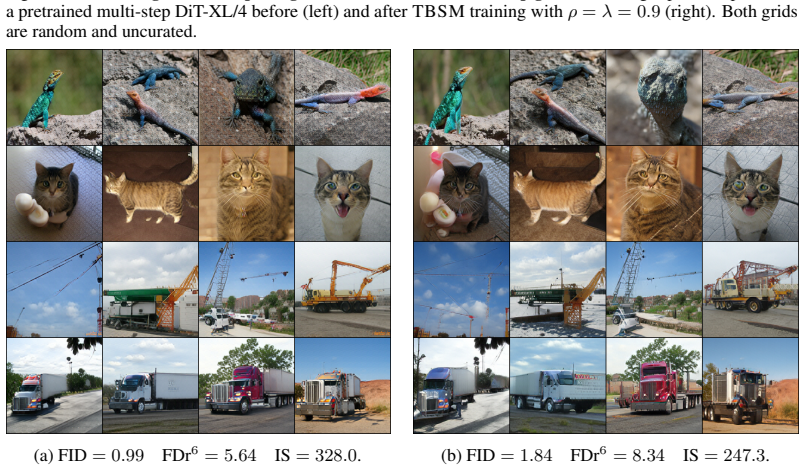
- [Fig. 5] The FD-loss checkpoint case study reports that aggregate metrics worsen (FID 0.99→1.84) while the displayed grid appears cleaner. The text says this is illustrative of a metric–artifact mismatch; this should be stated as a qualitative observation on a single case, not as a general property of FD-loss.
- [Eq. (23)] The two-draw diagnostic gives unbiased estimates of S1 and Eφ, but the plug-in ratio ρ* is not unbiased and may require clipping. The text already notes this, but the distinction should be repeated in the main text if the diagnostic is used to set ρ.
Circularity Check
No circularity: the central gradient identity is proven from the energy-distance first variation, and the disclosed experimental gaps are external-validity caveats, not reductions to inputs.
full rationale
Walking the claimed derivation chain: Eq. (4) defines the scattering field as the difference of expected inter- and intra-source bearings; Eq. (7)'s statement that the triplet estimator has this as its conditional expectation follows directly from definition and source independence. The load-bearing result is Theorem 1 / Eq. (10), which proves that the frozen-target regression loss Lgen has, at current parameters, exactly the generator gradient of F = (1/2)D_E^2(Ptheta,Q). This is a genuine chain-rule identity (App. E.1, Eq. 19), not a fitted parameter renamed as a prediction. Corollary 1 / Theorem 2 are exact bias-variance decompositions around the conditional expectation; they are proven consequences of L2 projection and do not presuppose the conclusion. The tracker is trained on the same bearing vectors it smooths, but the paper claims only the conditional-expectation projection and the explicit condition that tracking helps when tracker excess risk is below source variance (Cor. 1), which is a self-contained tradeoff statement rather than circularity. The empirical ImageNet numbers are external FID/FDr6/IS evaluations, so the paper is not predicting its own training targets. The clearest gaps are disclosed by the paper itself: Sec. 6 concedes random-init ImageNet training is untested and that lambda=1 properness holds only for projected distributions; Sec. 2.4 (Eq. 11) notes lambda<1 shifts the optimum; App. B says all ImageNet runs warm-start from multi-step checkpoints. These are theory-practice mismatches or external-validity caveats, not circular reductions. The only self-citation of note (UCGM checkpoints, App. B) is used solely to initialize parameters and, per the paper, supplies no consistency target, teacher prediction, score, or noise-time target to the TBSM update, so it is not load-bearing. No step in the derivation reduces to its own input by construction.
Axiom & Free-Parameter Ledger
free parameters (4)
- λ (intra-source weight) =
0.9 (best latent DiT-XL/2 run), 1.0 or 0.9 in pixel runs
- ρ (tracked-supervision weight) =
0.9 (ImageNet benchmarks), 1.0 (text-to-image)
- ε (bearing denominator smoothing) =
1e-6
- Training hyperparameters (generator LR 1e-5, tracker LR 1e-3, EMA decay 0.999) =
As stated
axioms (5)
- domain assumption Finite first moments, zero collision probability, and valid differentiation under expectation for bearing identities
- standard math 2-Wasserstein chain rule holds for the energy-distance flow
- ad hoc to paper Trajectory-wise slope inequality ∥vt∥2 ≥ cF(Pt)^q and relative tracker error bound (Eq. 27)
- domain assumption Realizability, PL inequality, gradient dominance, bounded variance for finite-generator convergence
- domain assumption Frozen representation encoders retain enough information for full image matching
read the original abstract
Modern generative models typically rely on an adversarial critic, a prescribed noise-to-data path, or an autoregressive factorization. Instead, we show that a proper distributional energy can induce sample-level motion and provide direct regression supervision for a one-step generator. Three-Body Scattering Modeling (TBSM) for generation turns the energy distance into a constant-size per-projectile interaction: each projectile is attracted toward one real source and repelled from one independently generated source. Conditioned on the projectile and its condition, its expectation equals the $2$-Wasserstein gradient-flow velocity of $\frac12D_E^2(P_{\theta},Q)$. A batch of $B$ frozen-target events yields $O(B)$ sample-level losses, each using one reference for its condition instead of the minibatch-wide all-pairs field used by methods such as Drifting Models. Tracking this conditional expectation online can reduce field noise. Using scattering in frozen image features, TBSM trains one-step generators on ImageNet-256, achieving FID${}=2.23$ with pixel-space PixelDiT-XL and FID${}=1.63$ with latent-space DiT-XL at NFE${}=1$. We provide a design map relating diffusion-related supervision, Drift-like dynamics, and GAN-like objectives. These results establish tracked scattering as a route to high-dimensional one-step generation. Code: https://github.com/sp12138/TBSM.
Figures



Forward citations
Cited by 1 Pith paper
-
Amortized Moment Matching for Visual Generation
Amortized Fréchet Distance uses neural nets to match conditional means and covariances, yielding stronger one-step visual generators than explicit FD-loss or multi-step teachers.
Reference graph
Works this paper leans on
-
[1]
Gradient Flows in Metric Spaces and in the Space of Probability Measures
Luigi Ambrosio, Nicola Gigli, and Giuseppe Savar \'e . Gradient Flows in Metric Spaces and in the Space of Probability Measures. Birkh \"a user, 2 edition, 2008
2008
-
[2]
Maximum mean discrepancy gradient flow
Michael Arbel, Anna Korba, Adil Salim, and Arthur Gretton. Maximum mean discrepancy gradient flow. In Advances in Neural Information Processing Systems, volume 32, 2019
2019
-
[3]
Shuai Bai, Keqin Chen, Xuejing Liu, Jialin Wang, Wenbin Ge, Sibo Song, Kai Dang, Peng Wang, Shijie Wang, Jun Tang, Humen Zhong, Yuanzhi Zhu, Mingkun Yang, Zhaohai Li, Jianqiang Wan, Pengfei Wang, Wei Ding, Zheren Fu, Yiheng Xu, Jiabo Ye, Xi Zhang, Tianbao Xie, Zesen Cheng, Hang Zhang, Zhibo Yang, Haiyang Xu, and Junyang Lin. Qwen2.5-VL technical report. a...
Pith/arXiv arXiv 2025
-
[4]
Marc G. Bellemare, Ivo Danihelka, Will Dabney, Shakir Mohamed, Balaji Lakshminarayanan, Stephan Hoyer, and R \'e mi Munos. The Cram \'e r distance as a solution to biased Wasserstein gradients. arXiv preprint arXiv:1705.10743, 2017
Pith/arXiv arXiv 2017
-
[5]
On the global convergence of Wasserstein gradient flow of the Coulomb discrepancy
Siwan Boufad \`e ne and Fran c ois-Xavier Vialard. On the global convergence of Wasserstein gradient flow of the Coulomb discrepancy. SIAM Journal on Mathematical Analysis, 57 0 (4): 0 4556--4587, 2025
2025
-
[6]
Large scale gan training for high fidelity natural image synthesis
Andrew Brock, Jeff Donahue, and Karen Simonyan. Large scale gan training for high fidelity natural image synthesis. arXiv preprint arXiv:1809.11096, 2018
Pith/arXiv arXiv 2018
-
[7]
A unifying view of variational generative wasserstein flows
Paul Caucheteux, Cl \'e ment Bonet, and Anna Korba. A unifying view of variational generative wasserstein flows. arXiv preprint arXiv:2605.31369, 2026
Pith/arXiv arXiv 2026
-
[8]
Quantitative convergence of Wasserstein gradient flows of kernel mean discrepancies
L \'e na \"i c Chizat, Maria Colombo, Roberto Colombo, and Xavier Fern \'a ndez-Real. Quantitative convergence of Wasserstein gradient flows of kernel mean discrepancies. arXiv preprint arXiv:2603.01977, 2026
arXiv 2026
-
[9]
Imagenet: A large-scale hierarchical image database
Jia Deng, Wei Dong, Richard Socher, Li-Jia Li, Kai Li, and Li Fei-Fei. Imagenet: A large-scale hierarchical image database. In 2009 IEEE conference on computer vision and pattern recognition, pp.\ 248--255. Ieee, 2009
2009
-
[10]
Generative modeling via drifting
Mingyang Deng, He Li, Tianhong Li, Yilun Du, and Kaiming He. Generative modeling via drifting. arXiv preprint arXiv:2602.04770, 2026
Pith/arXiv arXiv 2026
-
[11]
Diffusion models beat gans on image synthesis
Prafulla Dhariwal and Alex Nichol. Diffusion models beat gans on image synthesis. Advances in neural information processing systems, 34: 0 8780--8794, 2021
2021
-
[12]
Richard Duong, Viktor Stein, Robert Beinert, Johannes Hertrich, and Gabriele Steidl. Wasserstein gradient flows of MMD functionals with distance kernel and cauchy problems on quantile functions. ESAIM: Control, Optimisation and Calculus of Variations, 32: 0 10, 2026. doi:10.1051/cocv/2025097
arXiv 2026
-
[13]
Maria Esteban-Casadevall, Jorge Carrasco-Pollo, Max Welling, Jan-Willem van de Meent, Erik J. Bekkers, and Floor Eijkelboom. Kernel-gradient drifting models. arXiv preprint arXiv:2605.10727, 2026
Pith/arXiv arXiv 2026
-
[14]
Representation distribution matching for one-step visual generation
Lan Feng, Wuyang Li, Eloi Zablocki, Matthieu Cord, and Alexandre Alahi. Representation distribution matching for one-step visual generation. arXiv preprint arXiv:2607.02375, 2026
Pith/arXiv arXiv 2026
-
[15]
One step diffusion via shortcut models
Kevin Frans, Danijar Hafner, Sergey Levine, and Pieter Abbeel. One step diffusion via shortcut models. arXiv preprint arXiv:2410.12557, 2024
Pith/arXiv arXiv 2024
-
[16]
Drifting fields are not conservative
Leonard T Franz, Sebastian Hoffmann, Tim Weiland, Bernhard Sch \"o lkopf, and Georg Martius. Drifting fields are not conservative. arXiv preprint arXiv:2604.06333, 2026
Pith/arXiv arXiv 2026
-
[17]
Deep MMD gradient flow without adversarial training
Alexandre Galashov, Valentin de Bortoli, and Arthur Gretton. Deep MMD gradient flow without adversarial training. In International Conference on Learning Representations, 2025
2025
-
[18]
Zhengyang Geng, Mingyang Deng, Xingjian Bai, J. Zico Kolter, and Kaiming He. Mean flows for one-step generative modeling. arXiv preprint arXiv:2505.13447, 2025
Pith/arXiv arXiv 2025
-
[19]
Generative adversarial nets
Ian Goodfellow, Jean Pouget-Abadie, Mehdi Mirza, Bing Xu, David Warde-Farley, Sherjil Ozair, Aaron Courville, and Yoshua Bengio. Generative adversarial nets. Advances in neural information processing systems, 27, 2014
2014
-
[20]
Borgwardt, Malte J
Arthur Gretton, Karsten M. Borgwardt, Malte J. Rasch, Bernhard Sch \"o lkopf, and Alexander Smola. A kernel two-sample test. Journal of Machine Learning Research, 13 0 (25): 0 723--773, 2012
2012
-
[21]
Posterior sampling based on gradient flows of the MMD with negative distance kernel
Paul Hagemann, Johannes Hertrich, Fabian Altekr \"u ger, Robert Beinert, Jannis Chemseddine, and Gabriele Steidl. Posterior sampling based on gradient flows of the MMD with negative distance kernel. In International Conference on Learning Representations, 2024
2024
-
[22]
Jiaqi Han, Puheng Li, Qiushan Guo, Renyuan Xu, Stefano Ermon, and Emmanuel J. Cand \`e s. One-step generative modeling via wasserstein gradient flows. arXiv preprint arXiv:2605.11755, 2026
Pith/arXiv arXiv 2026
-
[23]
Deep residual learning for image recognition
Kaiming He, Xiangyu Zhang, Shaoqing Ren, and Jian Sun. Deep residual learning for image recognition. In Proceedings of the IEEE conference on computer vision and pattern recognition, pp.\ 770--778, 2016
2016
-
[24]
Masked autoencoders are scalable vision learners
Kaiming He, Xinlei Chen, Saining Xie, Yanghao Li, Piotr Doll \'a r, and Ross Girshick. Masked autoencoders are scalable vision learners. In Proceedings of the IEEE/CVF Conference on Computer Vision and Pattern Recognition, pp.\ 16000--16009, 2022
2022
-
[25]
Sinkhorn-drifting generative models
Ping He, Om Khangaonkar, Hamed Pirsiavash, Yikun Bai, and Soheil Kolouri. Sinkhorn-drifting generative models. arXiv preprint arXiv:2603.12366, 2026
arXiv 2026
-
[26]
Generative sliced MMD flows with Riesz kernels
Johannes Hertrich, Christian Wald, Fabian Altekr \"u ger, and Paul Hagemann. Generative sliced MMD flows with Riesz kernels. In International Conference on Learning Representations, 2024
2024
-
[27]
Gans trained by a two time-scale update rule converge to a local nash equilibrium
Martin Heusel, Hubert Ramsauer, Thomas Unterthiner, Bernhard Nessler, and Sepp Hochreiter. Gans trained by a two time-scale update rule converge to a local nash equilibrium. Advances in neural information processing systems, 30, 2017
2017
-
[28]
Classifier-free diffusion guidance
Jonathan Ho and Tim Salimans. Classifier-free diffusion guidance. arXiv preprint arXiv:2207.12598, 2022
Pith/arXiv arXiv 2022
-
[29]
Denoising diffusion probabilistic models
Jonathan Ho, Ajay Jain, and Pieter Abbeel. Denoising diffusion probabilistic models. Advances in neural information processing systems, 33: 0 6840--6851, 2020
2020
-
[30]
The variational formulation of the Fokker--Planck equation
Richard Jordan, David Kinderlehrer, and Felix Otto. The variational formulation of the Fokker--Planck equation. SIAM Journal on Mathematical Analysis, 29 0 (1): 0 1--17, 1998
1998
-
[31]
Scaling up gans for text-to-image synthesis
Minguk Kang, Jun-Yan Zhu, Richard Zhang, Jaesik Park, Eli Shechtman, Sylvain Paris, and Taesung Park. Scaling up gans for text-to-image synthesis. In Proceedings of the IEEE/CVF conference on computer vision and pattern recognition, pp.\ 10124--10134, 2023
2023
-
[32]
Analyzing and improving the training dynamics of diffusion models
Tero Karras, Miika Aittala, Jaakko Lehtinen, Janne Hellsten, Timo Aila, and Samuli Laine. Analyzing and improving the training dynamics of diffusion models. In Proceedings of the IEEE/CVF Conference on Computer Vision and Pattern Recognition, pp.\ 24174--24184, 2024
2024
-
[33]
Kingma and Ruiqi Gao
Diederik P. Kingma and Ruiqi Gao. Understanding diffusion objectives as the ELBO with simple data augmentation. In Advances in Neural Information Processing Systems, 2023
2023
-
[34]
MMD GAN : Towards deeper understanding of moment matching network
Chun-Liang Li, Wei-Cheng Chang, Yu Cheng, Yiming Yang, and Barnab \'a s P \'o czos. MMD GAN : Towards deeper understanding of moment matching network. In Advances in Neural Information Processing Systems, volume 30, 2017
2017
-
[35]
Back to basics: Let denoising generative models denoise
Tianhong Li and Kaiming He. Back to basics: Let denoising generative models denoise. arXiv preprint arXiv:2511.13720, 2025
Pith/arXiv arXiv 2025
-
[36]
Autoregressive image generation without vector quantization
Tianhong Li, Yonglong Tian, He Li, Mingyang Deng, and Kaiming He. Autoregressive image generation without vector quantization. Advances in Neural Information Processing Systems, 37: 0 56424--56445, 2024
2024
-
[37]
Generative moment matching networks
Yujia Li, Kevin Swersky, and Richard Zemel. Generative moment matching networks. In Proceedings of the 32nd International Conference on Machine Learning, volume 37 of Proceedings of Machine Learning Research, pp.\ 1718--1727, 2015
2015
-
[38]
Shanchuan Lin, Ceyuan Yang, Zhijie Lin, Hao Chen, and Haoqi Fan. Adversarial flow models. arXiv preprint arXiv:2511.22475, 2025
Pith/arXiv arXiv 2025
-
[39]
Continuous adversarial flow models
Shanchuan Lin, Ceyuan Yang, Zhijie Lin, Hao Chen, and Haoqi Fan. Continuous adversarial flow models. arXiv preprint arXiv:2604.11521, 2026
Pith/arXiv arXiv 2026
-
[40]
Flow matching for generative modeling
Yaron Lipman, Ricky TQ Chen, Heli Ben-Hamu, Maximilian Nickel, and Matt Le. Flow matching for generative modeling. arXiv preprint arXiv:2210.02747, 2022
Pith/arXiv arXiv 2022
-
[41]
Stein variational gradient descent: A general purpose Bayesian inference algorithm
Qiang Liu and Dilin Wang. Stein variational gradient descent: A general purpose Bayesian inference algorithm. In Advances in Neural Information Processing Systems, volume 29, 2016
2016
-
[42]
Decoupled weight decay regularization
Ilya Loshchilov and Frank Hutter. Decoupled weight decay regularization. arXiv preprint arXiv:1711.05101, 2017
Pith/arXiv arXiv 2017
-
[43]
Simplifying, stabilizing and scaling continuous-time consistency models
Cheng Lu and Yang Song. Simplifying, stabilizing and scaling continuous-time consistency models. arXiv preprint arXiv:2410.11081, 2024
Pith/arXiv arXiv 2024
-
[44]
One-step latent-free image generation with pixel mean flows
Yiyang Lu, Susie Lu, Qiao Sun, Hanhong Zhao, Zhicheng Jiang, Xianbang Wang, Tianhong Li, Zhengyang Geng, and Kaiming He. One-step latent-free image generation with pixel mean flows. arXiv preprint arXiv:2601.22158, 2026
Pith/arXiv arXiv 2026
-
[45]
Sit: Exploring flow and diffusion-based generative models with scalable interpolant transformers
Nanye Ma, Mark Goldstein, Michael S Albergo, Nicholas M Boffi, Eric Vanden-Eijnden, and Saining Xie. Sit: Exploring flow and diffusion-based generative models with scalable interpolant transformers. In European Conference on Computer Vision, pp.\ 23--40. Springer, 2024
2024
-
[46]
PixelGen : Improving pixel diffusion with perceptual supervision
Zehong Ma, Ruihan Xu, and Shiliang Zhang. PixelGen : Improving pixel diffusion with perceptual supervision. arXiv preprint arXiv:2602.02493, 2026
Pith/arXiv arXiv 2026
-
[47]
PyTorch : An imperative style, high-performance deep learning library
Adam Paszke, Sam Gross, Francisco Massa, Adam Lerer, James Bradbury, Gregory Chanan, Trevor Killeen, Zeming Lin, Natalia Gimelshein, Luca Antiga, Alban Desmaison, Andreas K \"o pf, Edward Yang, Zach DeVito, Martin Raison, Alykhan Tejani, Sasank Chilamkurthy, Benoit Steiner, Lu Fang, Junjie Bai, and Soumith Chintala. PyTorch : An imperative style, high-per...
Pith/arXiv arXiv 1912
-
[48]
Scalable diffusion models with transformers
William Peebles and Saining Xie. Scalable diffusion models with transformers. In Proceedings of the IEEE/CVF international conference on computer vision, pp.\ 4195--4205, 2023
2023
-
[49]
High-resolution image synthesis with latent diffusion models
Robin Rombach, Andreas Blattmann, Dominik Lorenz, Patrick Esser, and Bj \"o rn Ommer. High-resolution image synthesis with latent diffusion models. In Proceedings of the IEEE/CVF conference on computer vision and pattern recognition, pp.\ 10684--10695, 2022
2022
-
[50]
Smoothed distance kernels for MMD s and applications in Wasserstein gradient flows
Nicolaj Rux, Michael Quellmalz, and Gabriele Steidl. Smoothed distance kernels for MMD s and applications in Wasserstein gradient flows. Advances in Computational Mathematics, 52: 0 24, 2026
2026
-
[51]
Progressive distillation for fast sampling of diffusion models
Tim Salimans and Jonathan Ho. Progressive distillation for fast sampling of diffusion models. arXiv preprint arXiv:2202.00512, 2022
Pith/arXiv arXiv 2022
-
[52]
Stylegan-xl: Scaling stylegan to large diverse datasets
Axel Sauer, Katja Schwarz, and Andreas Geiger. Stylegan-xl: Scaling stylegan to large diverse datasets. In ACM SIGGRAPH 2022 conference proceedings, pp.\ 1--10, 2022
2022
-
[53]
Schilling, Renming Song, and Zoran Vondra c ek
Ren \'e L. Schilling, Renming Song, and Zoran Vondra c ek. Bernstein Functions: Theory and Applications. De Gruyter, 2 edition, 2012. doi:10.1515/9783110269338
-
[54]
Equivalence of distance-based and RKHS -based statistics in hypothesis testing
Dino Sejdinovic, Bharath Sriperumbudur, Arthur Gretton, and Kenji Fukumizu. Equivalence of distance-based and RKHS -based statistics in hypothesis testing. The Annals of Statistics, 41 0 (5): 0 2263--2291, 2013
2013
-
[55]
Oriane Sim \'e oni, Huy V. Vo, Maximilian Seitzer, Federico Baldassarre, Maxime Oquab, Cijo Jose, Vasil Khalidov, Marc Szafraniec, Seungeun Yi, Micha \"e l Ramamonjisoa, Francisco Massa, Daniel Haziza, Luca Wehrstedt, Jianyuan Wang, Timoth \'e e Darcet, Th \'e o Moutakanni, Leonel Sentana, Claire Roberts, Andrea Vedaldi, Jamie Tolan, John Brandt, Camille ...
2025
-
[56]
Denoising diffusion implicit models
Jiaming Song, Chenlin Meng, and Stefano Ermon. Denoising diffusion implicit models. arXiv preprint arXiv:2010.02502, 2020 a
Pith/arXiv arXiv 2010
-
[57]
Improved techniques for training consistency models
Yang Song and Prafulla Dhariwal. Improved techniques for training consistency models. arXiv preprint arXiv:2310.14189, 2023
Pith/arXiv arXiv 2023
-
[58]
Score-based generative modeling through stochastic differential equations
Yang Song, Jascha Sohl-Dickstein, Diederik P Kingma, Abhishek Kumar, Stefano Ermon, and Ben Poole. Score-based generative modeling through stochastic differential equations. arXiv preprint arXiv:2011.13456, 2020 b
Pith/arXiv arXiv 2011
-
[59]
Yang Song, Prafulla Dhariwal, Mark Chen, and Ilya Sutskever. Consistency models. arXiv preprint arXiv:2303.01469, 2023
Pith/arXiv arXiv 2023
-
[60]
Autoregressive model beats diffusion: Llama for scalable image generation
Peize Sun, Yi Jiang, Shoufa Chen, Shilong Zhang, Bingyue Peng, Ping Luo, and Zehuan Yuan. Autoregressive model beats diffusion: Llama for scalable image generation. arXiv preprint arXiv:2406.06525, 2024
Pith/arXiv arXiv 2024
-
[61]
Unified continuous generative models
Peng Sun, Yi Jiang, and Tao Lin. Unified continuous generative models. arXiv preprint arXiv:2505.07447, 2025
Pith/arXiv arXiv 2025
-
[62]
Sz \'e kely and Maria L
G \'a bor J. Sz \'e kely and Maria L. Rizzo. Energy statistics: A class of statistics based on distances. Journal of Statistical Planning and Inference, 143 0 (8): 0 1249--1272, 2013
2013
-
[63]
Sriperumbudur, Arthur Gretton, and Zonghao Chen
Chenyang Tian, Bharath K. Sriperumbudur, Arthur Gretton, and Zonghao Chen. Sobolev regularized MMD gradient flow. arXiv preprint arXiv:2605.11884, 2026
Pith/arXiv arXiv 2026
-
[64]
Visual autoregressive modeling: Scalable image generation via next-scale prediction
Keyu Tian, Yi Jiang, Zehuan Yuan, Bingyue Peng, and Liwei Wang. Visual autoregressive modeling: Scalable image generation via next-scale prediction. Advances in neural information processing systems, 37: 0 84839--84865, 2024
2024
-
[65]
Michael Tschannen, Alexey Gritsenko, Xiao Wang, Muhammad Ferjad Naeem, Ibrahim Alabdulmohsin, Nikhil Parthasarathy, Talfan Evans, Lucas Beyer, Ye Xia, Basil Mustafa, Olivier H \'e naff, Jeremiah Harmsen, Andreas Steiner, and Xiaohua Zhai. SigLIP 2 : Multilingual vision-language encoders with improved semantic understanding, localization, and dense feature...
Pith/arXiv arXiv 2025
-
[66]
Coulomb GAN s: Provably optimal Nash equilibria via potential fields
Thomas Unterthiner, Bernhard Nessler, Calvin Seward, G \"u nter Klambauer, Martin Heusel, Hubert Ramsauer, and Sepp Hochreiter. Coulomb GAN s: Provably optimal Nash equilibria via potential fields. In International Conference on Learning Representations, 2018
2018
-
[67]
Pixel recurrent neural networks
A \"a ron van den Oord, Nal Kalchbrenner, and Koray Kavukcuoglu. Pixel recurrent neural networks. In Proceedings of the 33rd International Conference on Machine Learning, volume 48 of Proceedings of Machine Learning Research, pp.\ 1747--1756, 2016
2016
-
[68]
Qwen-image technical report, 2025
Chenfei Wu, Jiahao Li, Jingren Zhou, Junyang Lin, Kaiyuan Gao, Kun Yan, Sheng ming Yin, Shuai Bai, Xiao Xu, Yilei Chen, Yuxiang Chen, Zecheng Tang, Zekai Zhang, Zhengyi Wang, An Yang, Bowen Yu, Chen Cheng, Dayiheng Liu, Deqing Li, Hang Zhang, Hao Meng, Hu Wei, Jingyuan Ni, Kai Chen, Kuan Cao, Liang Peng, Lin Qu, Minggang Wu, Peng Wang, Shuting Yu, Tingkun...
Pith/arXiv arXiv 2025
-
[69]
Representation Fr \'e chet loss for visual generation
Jiawei Yang, Zhengyang Geng, Xuan Ju, Yonglong Tian, and Yue Wang. Representation Fr \'e chet loss for visual generation. arXiv preprint arXiv:2604.28190, 2026
Pith/arXiv arXiv 2026
-
[70]
Improved distribution matching distillation for fast image synthesis
Tianwei Yin, Micha \"e l Gharbi, Taesung Park, Richard Zhang, Eli Shechtman, Fredo Durand, and William T Freeman. Improved distribution matching distillation for fast image synthesis. arXiv preprint arXiv:2405.14867, 2024 a
Pith/arXiv arXiv 2024
-
[71]
One-step diffusion with distribution matching distillation
Tianwei Yin, Micha \"e l Gharbi, Richard Zhang, Eli Shechtman, Fredo Durand, William T Freeman, and Taesung Park. One-step diffusion with distribution matching distillation. In Proceedings of the IEEE/CVF conference on computer vision and pattern recognition, pp.\ 6613--6623, 2024 b
2024
-
[72]
Lijun Yu, Jos \'e Lezama, Nitesh B. Gundavarapu, Luca Versari, Kihyuk Sohn, David Minnen, Yong Cheng, Vighnesh Birodkar, Agrim Gupta, Xiuye Gu, Alexander G. Hauptmann, Boqing Gong, Ming-Hsuan Yang, Irfan Essa, David A. Ross, and Lu Jiang. Language model beats diffusion--tokenizer is key to visual generation. arXiv preprint arXiv:2310.05737, 2023
Pith/arXiv arXiv 2023
-
[73]
Autoregressive image generation with masked bit modeling
Qihang Yu, Qihao Liu, Ju He, Xinyang Zhang, Yang Liu, Liang-Chieh Chen, and Xi Chen. Autoregressive image generation with masked bit modeling. arXiv preprint arXiv:2602.09024, 2026
arXiv 2026
-
[74]
PixelDiT : Pixel diffusion transformers for image generation
Yongsheng Yu, Wei Xiong, Weili Nie, Yichen Sheng, Shiqiu Liu, and Jiebo Luo. PixelDiT : Pixel diffusion transformers for image generation. arXiv preprint arXiv:2511.20645, 2025
Pith/arXiv arXiv 2025
-
[75]
Sigmoid loss for language image pre-training
Xiaohua Zhai, Basil Mustafa, Alexander Kolesnikov, and Lucas Beyer. Sigmoid loss for language image pre-training. arXiv preprint arXiv:2303.15343, 2023
Pith/arXiv arXiv 2023
-
[76]
Perceptual flow matching for few-step generative modeling
Chuyang Zhao, Yifei Song, Hongfa Wang, Jianlong Yuan, Yuan Zhang, Siming Fu, Zhineng Chen, Huilin Deng, Haoyang Huang, and Nan Duan. Perceptual flow matching for few-step generative modeling. arXiv preprint arXiv:2607.03524, 2026
Pith/arXiv arXiv 2026
discussion (0)
Sign in with ORCID, Apple, or X to comment. Anyone can read and Pith papers without signing in.