REVIEW 3 major objections 4 minor 1 cited by
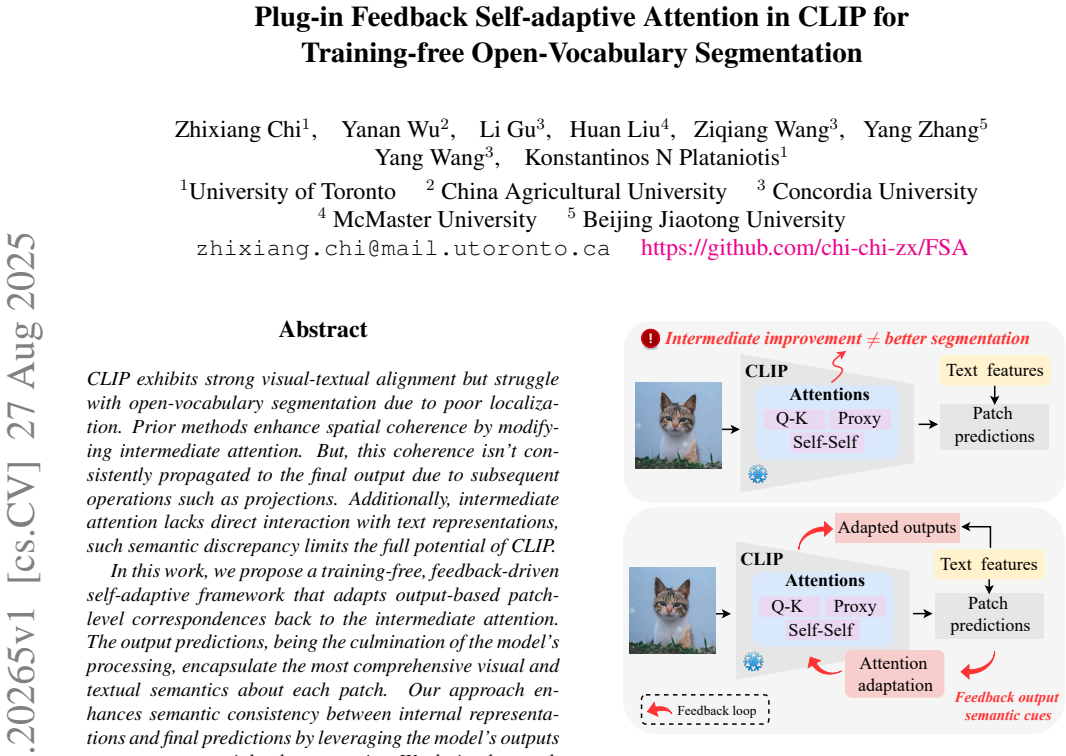
CLIP's own output predictions, fed back into its last-layer attention, improve open-vocabulary segmentation without training.
Reviewed by Pith at T0; open to challenge. T0 means a machine referee read the full paper against a public rubric. the ladder, T0–T4 →
A feedback self-adaptive attention module uses CLIP's own output predictions as a spatial coherence prior to reweight intermediate attention, improving training-free open-vocabulary segmentation across 8 benchmarks.
T0 review reviewed 2026-08-05 challenge →
load-bearing objection Genuinely useful plug-in for training-free CLIP segmentation with strong experiments, but the 'consistent improvement' claim is overstated and the mechanism needs a logit-space control to separate attention feedback from output self-smoothing. the 3 major comments →
Plug-in Feedback Self-adaptive Attention in CLIP for Training-free Open-Vocabulary Segmentation
The pith
A machine-rendered reading of the paper's core claim, the machinery that carries it, and where it could break.
The reading
Core claim
The paper's central claim is that the final patch logits carry the most complete visual and textual semantics, so pairwise KL divergence between those logits is a stronger spatial-coherence prior than any intermediate attention map. To feed that prior back faithfully, the paper isolates the initial attention's contribution by subtracting logits produced by a parallel uniform-attention branch (Eq. 6), then sparsifies the resulting similarity map with a cumulative-confidence threshold and exponential scaling to form Af. Three adaptations—Af applied before, after, or instead of Attninit·V—are ensembled as (Af·Attninit + Attninit·Af + Af)/3 · V. The paper reports this ensemble improves MaskCLIP,
What carries the argument
The feedback attention Af is the load-bearing object. For every patch pair, it converts the KL divergence between their class-prediction distributions (after uniform-attention isolation) into a similarity, keeps only the highest-confidence entries by cumulative probability threshold p, and scales survivors exponentially with λ before a softmax. It is then inserted into the last attention block as an ensemble, (Af·Attninit + Attninit·Af + Af)/3 · V, so that value aggregation follows semantic cues derived from the model's own outputs rather than only from Q-K or proxy patterns.
Load-bearing premise
The load-bearing premise is that subtracting the uniform-attention branch's logits from the original logits isolates exactly what the learned attention contributes, so the feedback similarity reflects only the initial attention maps and not downstream projection, FFN, or text-alignment effects.
What would settle it
Replace the isolated logits Y_iso in Eq. 7 with logits whose patch order has been randomly permuted per image, keeping the marginal class distribution intact; if mIoU gains persist or barely drop, the feedback is not carrying class-coherent spatial information. A second check: on an image set where intermediate attention and final predictions already agree (retention near 100%), FSA should give near-zero improvement; large gains there would indicate it is fixing something other than attention-output inconsistency.
If this is right
- Adding FSA to a training-free CLIP segmentation method requires no training and no change to model weights, so CLIP's zero-shot generalization is preserved.
- The reported 3–5% per-image overhead means the feedback loop can serve as a drop-in last-layer upgrade in deployment.
- Methods with weak intermediate priors (plain Q-K attention, MaskCLIP) gain the most, suggesting feedback compensates for missing spatial coherence rather than re-ranking already-good attention.
- Because the feedback is computed from class predictions, it injects text-aligned class information into the attention layer, which pure self-self or proxy attention cannot do.
- Consistent gains across ViT-B/L/H and VFM proxies (MAE, SAM, DINO) indicate the principle transfers across model scales and auxiliary feature sources.
Where Pith is reading between the lines
- A natural extension is to apply the same output-to-attention feedback at multiple layers or iteratively, though the paper reports no gain from iteration; deeper layers may need a different sparsification schedule.
- The isolation-by-subtraction trick could be reused in other zero-shot dense tasks such as depth, saliency, or referring segmentation, where CLIP logits are the only supervision, to separate attention's contribution from downstream projections.
- The feedback metric need not be KL divergence; replacing it with a learned or calibrated similarity could test whether the gains come from distributional comparison or simply from patch-pair class agreement.
- Since FSA only touches the last block, it should compose with fine-tuned or prompt-tuned CLIP variants, giving a test-time adaptation layer that requires no gradient updates.
Editorial analysis
A structured set of objections, weighed in public.
Referee Report
Summary. The paper proposes Feedback-driven Self-adaptive Attention (FSA), a training-free plug-in for CLIP-based open-vocabulary segmentation. FSA computes patch-level semantic similarities from the model's own output logits after an 'attention isolation' step that subtracts a uniform-attention forward pass (Eq. 6), prunes this similarity map using cumulative-confidence thresholding (Eqs. 9-10), and re-injects the resulting feedback attention Af into the last-layer attention block through three adaptations that are ensembled in Eq. 14. The method is evaluated by plugging it into MaskCLIP, SCLIP, ClearCLIP, and ProxyCLIP across ViT-B/L/H, multiple attention types (Q-K, self-self, Proxy with MAE/SAM/DINO), and eight benchmarks. The paper claims consistent improvement across all configurations and datasets.
Significance. If the causal claim holds, FSA is a useful and practical plug-in: it is training-free, has only two fixed hyperparameters, adds modest overhead, and shows consistent average gains, with particularly large improvements on weak baselines such as MaskCLIP. The evaluation is unusually broad — 4 methods, 3 backbones, 8 benchmarks, 3 attention families — and the authors provide code. The main weakness is that the experiments do not include a logit-space control, so the distinctive claim that feedback improves the intermediate attention, rather than simply smoothing output logits, is not yet supported. The paper also overstates consistency, as several individual benchmark cells decrease. These are correctable issues, but they affect the paper's central interpretation and should be addressed before publication.
major comments (3)
- [Sec. 4.3, Eqs. 11-14] Missing logit-space control. Af is derived from the output logits and then applied to V or Attninit·V. The reported gains could equally be obtained by treating Af as a spatial smoothing kernel on the output probabilities themselves, e.g., Y_final = softmax(Af · softmax(Y_dense)). Such a baseline would directly test whether the improvement comes from re-injecting feedback into the attention block or from output-space self-smoothing. Without this control, the central claim that FSA 'enhances semantic consistency between internal representations and final predictions' is underdetermined. The large gains on MaskCLIP (+18.7 mIoU on ViT-L) are exactly what a strong output-space post-processor would produce.
- [Sec. 4.1, Eq. 6] The attention-isolation assumption is not justified. Because Eq. 2 contains a residual connection and a nonlinear FFN, Y_dense − Y_dense_uni is not a pure function of Attn_init; it also depends on x and on the interaction between the attention output and the FFN. The statement that the subtraction 'allows us to isolate the learned attention's net effect' is therefore an assumption, not a consequence of the equations. The ablation in Table 6 shows that the isolation procedure helps empirically, but it does not verify that the subtracted logits isolate the contribution of the initial attention map. A direct test — for example, perturbing Attn_init and measuring how Y_dense_iso changes, or comparing with a randomized-attention control — would be needed to support the mechanism.
- [Abstract, Sec. 5.2, Tables 2-4] The claim of 'consistent improvement across all datasets' is contradicted by the reported numbers. In Table 2, ClearCLIP with ViT-B/16 drops on Context59 (35.9 → 33.8). In Table 3, ProxyCLIP with SAM and ViT-H/14 drops on ADE (22.0 → 21.9). In Table 4, ProxyCLIP K-K with ViT-L/14 drops on Stuff (20.5 → 20.4) and Cityscapes (31.8 → 31.7). Please revise the abstract and Section 5.2 to describe average improvements or to report per-cell exceptions accurately.
minor comments (4)
- [Eq. 8] The text says 'KL divergence, bounded in [0, −∞]'. KL divergence is nonnegative and unbounded above, so the range should be [0, ∞); consequently S = 1/(D+1) lies in (0, 1].
- [Sec. 2, Related work] Duplicate word: 'minimizes entropy to to adapt models' should be 'to adapt models'.
- [Table 8 vs. Table S11] The main text says FSA adds only 3-5% overhead, but Table S11 reports up to 11.8% overhead for MaskCLIP ViT-B/16 (5.1 → 5.7 ms). Clarify that the 3-5% figure applies to ProxyCLIP, or update the cost claim.
- [Sec. 4.1, Eq. 6] Y_dense_uni is described in words but never defined in an equation. Please write the uniform-attention forward pass explicitly, including the softmax normalization, to make the isolation step reproducible.
Circularity Check
No central circularity: external mIoU benchmarks validate the method; one supporting 'semantic retention' metric is increased by construction because the feedback attention is defined from output predictions.
specific steps
-
self definitional
[Sec. 3 Eq. (5) and Fig. 3; Sec. 4.2 Eq. (10); Sec. 4.3 Eq. (14)]
"Retention = 1/L Σ_i max_{j∈Top-k(Attninit_i)} I(M_i = M_j) ... we propose an ensemble approach by isolating V in Eq. 11-13: (Af·Attninit + Attninit·Af + Af)/3 · V."
The retention metric counts whether the patches most attended by a row of the attention map share the predicted class of the reference patch. The feedback matrix Af is constructed directly from pairwise KL divergence of output class predictions (Eqs. 6-10), and Eq. 14 injects Af into the adapted attention. Consequently, the improved retention reported in Fig. 3 is a definitional consequence: the adapted attention is, by construction, biased toward patch pairs whose output predictions already agree. It is therefore not independent evidence for the paper's semantic-consistency mechanism. The central mIoU improvements on eight external benchmarks are not circular, since they are measured against ground-truth labels and no parameters are fit to them.
full rationale
The main derivation chain is self-contained. FSA computes a feedback attention Af from the model's own output logits and re-enters it into the last-layer attention (Eqs. 11-14); this is an explicit feedback/self-adaptation loop, not a disguised fit. No learned parameters are fitted to the target labels; the two hyperparameters (λ, p) are fixed globally and tested for sensitivity, and the evaluation is against external ground truth on eight benchmarks, so the central claim of improved open-vocabulary segmentation is not circular. The paper's own citations to prior author work (e.g., test-time adaptation references) are contextual and not load-bearing; no uniqueness theorem or ansatz is imported from self-citations. The only noticeable circular-adjacent element is the retention metric in Fig. 3, which is mechanically increased by the way Af is defined from output predictions; this affects a supporting explanatory metric, not the benchmark results. Overall circularity is therefore low.
Axiom & Free-Parameter Ledger
free parameters (2)
- lambda =
2.0
- p =
0.45
axioms (4)
- domain assumption Output logits of CLIP dense prediction capture refined patch-level semantic understanding and can serve as a spatial coherence prior.
- domain assumption Patches with similar class-prediction distributions are likely semantically related.
- ad hoc to paper Subtracting uniform-attention logits isolates the contribution of the initial attention map through the rest of the pipeline.
- ad hoc to paper The inverse-KL similarity S = 1/(D+1) monotonically reflects patch semantic correspondence.
Cite this review
Pith. "Pith review of Plug-in Feedback Self-adaptive Attention in CLIP for Training-free Open-Vocabulary Segmentation." pith.science (2026). https://pith.science/paper/KFP7OYYO
@misc{pith2026250820265,
  author       = {Pith},
  title        = {Pith review of: Plug-in Feedback Self-adaptive Attention in CLIP for Training-free Open-Vocabulary Segmentation},
  year         = {2026},
  howpublished = {\url{https://pith.science/paper/KFP7OYYO}},
  note         = {Machine review of arXiv:2508.20265}
}
read the original abstract
CLIP exhibits strong visual-textual alignment but struggle with open-vocabulary segmentation due to poor localization. Prior methods enhance spatial coherence by modifying intermediate attention. But, this coherence isn't consistently propagated to the final output due to subsequent operations such as projections. Additionally, intermediate attention lacks direct interaction with text representations, such semantic discrepancy limits the full potential of CLIP. In this work, we propose a training-free, feedback-driven self-adaptive framework that adapts output-based patch-level correspondences back to the intermediate attention. The output predictions, being the culmination of the model's processing, encapsulate the most comprehensive visual and textual semantics about each patch. Our approach enhances semantic consistency between internal representations and final predictions by leveraging the model's outputs as a stronger spatial coherence prior. We design key modules, including attention isolation, confidence-based pruning for sparse adaptation, and adaptation ensemble, to effectively feedback the output coherence cues. Our method functions as a plug-in module, seamlessly integrating into four state-of-the-art approaches with three backbones (ViT-B, ViT-L, ViT-H). We further validate our framework across multiple attention types (Q-K, self-self, and Proxy augmented with MAE, SAM, and DINO). Our approach consistently improves their performance across eight benchmarks.
Figures


Forward citations
Cited by 1 Pith paper
-
SPRITE: From Static Mockups to Engine-Ready Game UI
SPRITE converts static game UI screenshots into editable engine-ready assets by using VLMs to parse complex layouts into a YAML intermediate representation.
Reference graph
Works this paper leans on
-
[1]
Jimmy Lei Ba, Jamie Ryan Kiros, and Geoffrey E Hin- ton. Layer normalization. arXiv preprint arXiv:1607.06450,
-
[2]
Grounding everything: Emerging localization properties in vision-language transformers
Walid Bousselham, Felix Petersen, Vittorio Ferrari, and Hilde Kuehne. Grounding everything: Emerging localization properties in vision-language transformers. arXiv preprint arXiv:2312.00878, 2023. 2, 3
Pith/arXiv arXiv 2023
-
[3]
Coco- stuff: Thing and stuff classes in context
Holger Caesar, Jasper Uijlings, and Vittorio Ferrari. Coco- stuff: Thing and stuff classes in context. In Proceedings of the IEEE conference on computer vision and pattern recog- nition, pages 1209–1218, 2018. 5
work page 2018
-
[4]
Cascade r-cnn: Delv- ing into high quality object detection
Zhaowei Cai and Nuno Vasconcelos. Cascade r-cnn: Delv- ing into high quality object detection. In Proceedings of the IEEE Conference on Computer Vision and Pattern Recogni- tion (CVPR), pages 6154–6162, 2018. 3
work page 2018
-
[5]
Emerg- ing properties in self-supervised vision transformers
Mathilde Caron, Hugo Touvron, Ishan Misra, Herv ´e J´egou, Julien Mairal, Piotr Bojanowski, and Armand Joulin. Emerg- ing properties in self-supervised vision transformers. In Pro- ceedings of the IEEE/CVF international conference on com- puter vision, pages 9650–9660, 2021. 2, 5
work page 2021
-
[6]
Junbum Cha, Jonghwan Mun, and Byungseok Roh. Learn- ing to generate text-grounded mask for open-world semantic segmentation from only image-text pairs. In Proceedings of the IEEE/CVF Conference on Computer Vision and Pattern Recognition, pages 11165–11174, 2023. 1, 5
work page 2023
-
[7]
Exploring open-vocabulary semantic segmentation from clip vision encoder distillation only
Jun Chen, Deyao Zhu, Guocheng Qian, Bernard Ghanem, Zhicheng Yan, Chenchen Zhu, Fanyi Xiao, Sean Chang Cu- latana, and Mohamed Elhoseiny. Exploring open-vocabulary semantic segmentation from clip vision encoder distillation only. In Proceedings of the IEEE/CVF International Confer- ence on Computer Vision, pages 699–710, 2023. 1, 2
work page 2023
-
[8]
A simple framework for contrastive learn- ing of visual representations
Ting Chen, Simon Kornblith, Mohammad Norouzi, and Ge- offrey Hinton. A simple framework for contrastive learn- ing of visual representations. In International Conference on Machine Learning (ICML), pages 1597–1607. PMLR, 2020. 3
work page 2020
-
[9]
Reproducible scal- ing laws for contrastive language-image learning
Mehdi Cherti, Romain Beaumont, Ross Wightman, Mitchell Wortsman, Gabriel Ilharco, Cade Gordon, Christoph Schuh- mann, Ludwig Schmidt, and Jenia Jitsev. Reproducible scal- ing laws for contrastive language-image learning. In Pro- ceedings of the IEEE/CVF Conference on Computer Vision and Pattern Recognition, pages 2818–2829, 2023. 1, 5
work page 2023
-
[10]
All at once: Temporally adaptive multi-frame interpolation with advanced motion modeling
Zhixiang Chi, Rasoul Mohammadi Nasiri, Zheng Liu, Juwei Lu, Jin Tang, and Konstantinos N Plataniotis. All at once: Temporally adaptive multi-frame interpolation with advanced motion modeling. InEuropean conference on com- puter vision, pages 107–123. Springer, 2020. 3
work page 2020
-
[11]
Test- time fast adaptation for dynamic scene deblurring via meta- auxiliary learning
Zhixiang Chi, Yang Wang, Yuanhao Yu, and Jin Tang. Test- time fast adaptation for dynamic scene deblurring via meta- auxiliary learning. In Proceedings of the IEEE/CVF con- ference on computer vision and pattern recognition , pages 9137–9146, 2021. 3
work page 2021
-
[12]
Adapt- ing to distribution shift by visual domain prompt generation
Zhixiang Chi, Li Gu, Tao Zhong, Huan Liu, YUANHAO YU, Konstantinos N Plataniotis, and Yang Wang. Adapt- ing to distribution shift by visual domain prompt generation. In The Twelfth International Conference on Learning Repre- sentations, 2024. 1
work page 2024
-
[13]
Learning to adapt frozen clip for few-shot test-time domain adaptation
Zhixiang Chi, Li Gu, Huan Liu, Ziqiang Wang, Yanan Wu, Yang Wang, and Konstantinos N Plataniotis. Learning to adapt frozen clip for few-shot test-time domain adaptation. arXiv preprint arXiv:2506.17307, 2025. 1, 12
Pith/arXiv arXiv 2025
-
[14]
Mmsegmentation: Open- mmlab semantic segmentation toolbox and benchmark,
MMSegmentation Contributors. Mmsegmentation: Open- mmlab semantic segmentation toolbox and benchmark,
-
[15]
The cityscapes dataset for semantic urban scene understanding
Marius Cordts, Mohamed Omran, Sebastian Ramos, Timo Rehfeld, Markus Enzweiler, Rodrigo Benenson, Uwe Franke, Stefan Roth, and Bernt Schiele. The cityscapes dataset for semantic urban scene understanding. In Proceed- ings of the IEEE conference on computer vision and pattern recognition, pages 3213–3223, 2016. 5
work page 2016
-
[16]
An image is worth 16x16 words: Trans- formers for image recognition at scale
Alexey Dosovitskiy, Lucas Beyer, Alexander Kolesnikov, Dirk Weissenborn, Xiaohua Zhai, Thomas Unterthiner, Mostafa Dehghani, Matthias Minderer, Georg Heigold, Syl- vain Gelly, et al. An image is worth 16x16 words: Trans- formers for image recognition at scale. arXiv preprint arXiv:2010.11929, 2020. 3
Pith/arXiv arXiv 2010
-
[17]
The pascal visual object classes challenge 2012 (voc2012) development kit
Mark Everingham and John Winn. The pascal visual object classes challenge 2012 (voc2012) development kit. Pattern Anal. Stat. Model. Comput. Learn., Tech. Rep, 2007(1-45):5,
work page 2012
-
[18]
Bootstrap your own latent: A new ap- proach to self-supervised learning
Jean-Bastien Grill, Florian Strub, Florent Altch ´e, Corentin Tallec, Pierre H Richemond, Elena Buchatskaya, Carl Doer- sch, Bernardo Avila Pires, Zhaohan Daniel Guo, Mohammad Gheshlaghi Azar, et al. Bootstrap your own latent: A new ap- proach to self-supervised learning. Advances in Neural In- formation Processing Systems (NeurIPS) , 33:21271–21284,
-
[19]
On calibration of modern neural networks
Chuan Guo, Geoff Pleiss, Yu Sun, and Kilian Q Weinberger. On calibration of modern neural networks. In Proceedings of the 34th International Conference on Machine Learning (ICML), pages 1321–1330. PMLR, 2017. 3
work page 2017
-
[20]
How to train the teacher model for effective knowledge distillation
Shayan Mohajer Hamidi, Xizhen Deng, Renhao Tan, Lin- feng Ye, and Ahmed Hussein Salamah. How to train the teacher model for effective knowledge distillation. In Euro- pean Conference on Computer Vision, pages 1–18. Springer,
-
[21]
Masked autoencoders are scalable vision learners
Kaiming He, Xinlei Chen, Saining Xie, Yanghao Li, Piotr Doll´ar, and Ross Girshick. Masked autoencoders are scalable vision learners. In Proceedings of the IEEE/CVF conference on computer vision and pattern recognition , pages 16000– 16009, 2022. 2, 6
work page 2022
-
[22]
Distill- ing the knowledge in a neural network
Geoffrey Hinton, Oriol Vinyals, and Jeff Dean. Distill- ing the knowledge in a neural network. arXiv preprint arXiv:1503.02531, 2015. 2, 3, 12
Pith/arXiv arXiv 2015
-
[23]
Scaling up visual and vision-language representa- tion learning with noisy text supervision
Chao Jia, Yinfei Yang, Ye Xia, Yi-Ting Chen, Zarana Parekh, Hieu Pham, Quoc Le, Yun-Hsuan Sung, Zhen Li, and Tom Duerig. Scaling up visual and vision-language representa- tion learning with noisy text supervision. In International conference on machine learning, pages 4904–4916. PMLR,
-
[24]
Weakly supervised ground- ing for vqa in vision-language transformers
Aisha Urooj Khan, Hilde Kuehne, Chuang Gan, Niels Da Vi- toria Lobo, and Mubarak Shah. Weakly supervised ground- ing for vqa in vision-language transformers. In European Conference on Computer Vision , pages 652–670. Springer,
-
[25]
Alexander Kirillov, Eric Mintun, Nikhila Ravi, Hanzi Mao, Chloe Rolland, Laura Gustafson, Tete Xiao, Spencer White- head, Alexander C Berg, Wan-Yen Lo, et al. Segment any- thing. arXiv preprint arXiv:2304.02643, 2023. 2, 7
Pith/arXiv arXiv 2023
-
[26]
Clearclip: Decom- posing clip representations for dense vision-language infer- ence
Mengcheng Lan, Chaofeng Chen, Yiping Ke, Xinjiang Wang, Litong Feng, and Wayne Zhang. Clearclip: Decom- posing clip representations for dense vision-language infer- ence. arXiv preprint arXiv:2407.12442 , 2024. 1, 2, 3, 6, 12
Pith/arXiv arXiv 2024
-
[27]
Proxyclip: Proxy attention improves clip for open-vocabulary segmentation
Mengcheng Lan, Chaofeng Chen, Yiping Ke, Xinjiang Wang, Litong Feng, and Wayne Zhang. Proxyclip: Proxy attention improves clip for open-vocabulary segmentation. arXiv preprint arXiv:2408.04883, 2024. 1, 2, 3, 5, 6, 12
Pith/arXiv arXiv 2024
-
[28]
Junnan Li, Dongxu Li, Caiming Xiong, and Steven Hoi. Blip: Bootstrapping language-image pre-training for uni- fied vision-language understanding and generation. In In- ternational Conference on Machine Learning, pages 12888– 12900. PMLR, 2022. 1, 2
work page 2022
-
[29]
Clip surgery for better explainability with enhancement in open- vocabulary tasks
Yi Li, Hualiang Wang, Yiqun Duan, and Xiaomeng Li. Clip surgery for better explainability with enhancement in open- vocabulary tasks. arXiv preprint arXiv:2304.05653, 2023. 2, 3
Pith/arXiv arXiv 2023
-
[30]
Open-vocabulary semantic segmentation with mask-adapted clip
Feng Liang, Bichen Wu, Xiaoliang Dai, Kunpeng Li, Yinan Zhao, Hang Zhang, Peizhao Zhang, Peter Vajda, and Diana Marculescu. Open-vocabulary semantic segmentation with mask-adapted clip. In Proceedings of the IEEE/CVF Con- ference on Computer Vision and Pattern Recognition, pages 7061–7070, 2023. 2
work page 2023
-
[31]
Self-supervised spa- tiotemporal representation learning by exploiting video con- tinuity
Hanwen Liang, Niamul Quader, Zhixiang Chi, Lizhe Chen, Peng Dai, Juwei Lu, and Yang Wang. Self-supervised spa- tiotemporal representation learning by exploiting video con- tinuity. In Proceedings of the AAAI conference on artificial intelligence, 2022. 2
work page 2022
-
[32]
Refinenet: Multi-path refinement networks for high- resolution semantic segmentation
Guosheng Lin, Anton Milan, Chunhua Shen, and Ian Reid. Refinenet: Multi-path refinement networks for high- resolution semantic segmentation. In Proceedings of the IEEE Conference on Computer Vision and Pattern Recog- nition (CVPR), pages 1925–1934, 2017. 3
work page 1925
-
[33]
Few-shot class-incremental learning via entropy-regularized data-free replay
Huan Liu, Li Gu, Zhixiang Chi, Yang Wang, Yuanhao Yu, Jun Chen, and Jin Tang. Few-shot class-incremental learning via entropy-regularized data-free replay. In European Con- ference on Computer Vision, pages 146–162. Springer, 2022. 3
work page 2022
-
[34]
Meta-auxiliary learning for future depth pre- diction in videos
Huan Liu, Zhixiang Chi, Yuanhao Yu, Yang Wang, Jun Chen, and Jin Tang. Meta-auxiliary learning for future depth pre- diction in videos. In Proceedings of the IEEE/CVF Winter Conference on Applications of Computer Vision, 2023. 2
work page 2023
-
[35]
Grounding dino: Marrying dino with grounded pre-training for open-set object detection
Shilong Liu, Zhaoyang Zeng, Tianhe Ren, Feng Li, Hao Zhang, Jie Yang, Chunyuan Li, Jianwei Yang, Hang Su, Jun Zhu, et al. Grounding dino: Marrying dino with grounded pre-training for open-set object detection. arXiv preprint arXiv:2303.05499, 2023. 3
Pith/arXiv arXiv 2023
-
[36]
Yuejiang Liu, Parth Kothari, Bastien Van Delft, Baptiste Bellot-Gurlet, Taylor Mordan, and Alexandre Alahi. Ttt++: When does self-supervised test-time training fail or thrive? Advances in Neural Information Processing Systems , 34: 21808–21820, 2021. 12
work page 2021
-
[37]
The role of context for object detection and semantic segmentation in the wild
Roozbeh Mottaghi, Xianjie Chen, Xiaobai Liu, Nam-Gyu Cho, Seong-Whan Lee, Sanja Fidler, Raquel Urtasun, and Alan Yuille. The role of context for object detection and semantic segmentation in the wild. In Proceedings of the IEEE conference on computer vision and pattern recogni- tion, pages 891–898, 2014. 5
work page 2014
-
[38]
Open vocabulary semantic segmentation with patch aligned con- trastive learning
Jishnu Mukhoti, Tsung-Yu Lin, Omid Poursaeed, Rui Wang, Ashish Shah, Philip HS Torr, and Ser-Nam Lim. Open vocabulary semantic segmentation with patch aligned con- trastive learning. In Proceedings of the IEEE/CVF Con- ference on Computer Vision and Pattern Recognition, pages 19413–19423, 2023. 1
work page 2023
-
[39]
Dinov2: Learning robust visual features without supervision
Maxime Oquab, Timoth ´ee Darcet, Th ´eo Moutakanni, Huy V o, Marc Szafraniec, Vasil Khalidov, Pierre Fernandez, Daniel Haziza, Francisco Massa, Alaaeldin El-Nouby, et al. Dinov2: Learning robust visual features without supervision. arXiv preprint arXiv:2304.07193, 2023. 2, 7
Pith/arXiv arXiv 2023
-
[40]
Learning transferable visual models from natural language supervi- sion
Alec Radford, Jong Wook Kim, Chris Hallacy, Aditya Ramesh, Gabriel Goh, Sandhini Agarwal, Girish Sastry, Amanda Askell, Pamela Mishkin, Jack Clark, et al. Learning transferable visual models from natural language supervi- sion. In International conference on machine learning, pages 8748–8763. PMLR, 2021. 1, 5
work page 2021
-
[41]
Laion-5b: An open large-scale dataset for training next generation image-text models
Christoph Schuhmann, Romain Beaumont, Richard Vencu, Cade Gordon, Ross Wightman, Mehdi Cherti, Theo Coombes, Aarush Katta, Clayton Mullis, Mitchell Worts- man, et al. Laion-5b: An open large-scale dataset for training next generation image-text models. Advances in Neural In- formation Processing Systems, 35:25278–25294, 2022. 1
work page 2022
-
[42]
Test- time prompt tuning for zero-shot generalization in vision- language models
Manli Shu, Weili Nie, De-An Huang, Zhiding Yu, Tom Goldstein, Anima Anandkumar, and Chaowei Xiao. Test- time prompt tuning for zero-shot generalization in vision- language models. Advances in Neural Information Process- ing Systems, 35:14274–14289, 2022. 12
work page 2022
-
[43]
Test-time training with self- supervision for generalization under distribution shifts
Yu Sun, Xiaolong Wang, Zhuang Liu, John Miller, Alexei Efros, and Moritz Hardt. Test-time training with self- supervision for generalization under distribution shifts. In International conference on machine learning. PMLR, 2020. 2
work page 2020
-
[44]
Tent: Fully test-time adaptation by entropy minimization
Dequan Wang, Evan Shelhamer, Shaoteng Liu, Bruno Ol- shausen, and Trevor Darrell. Tent: Fully test-time adaptation by entropy minimization. arXiv preprint arXiv:2006.10726,
Pith/arXiv arXiv 2006
-
[45]
Tent: Fully test-time adaptation by entropy minimization
Dequan Wang, Evan Shelhamer, Shaoteng Liu, Bruno A Ol- shausen, and Trevor Darrell. Tent: Fully test-time adaptation by entropy minimization. In International Conference on Learning Representations (ICLR), 2021. 3
work page 2021
-
[46]
Sclip: Rethink- ing self-attention for dense vision-language inference
Feng Wang, Jieru Mei, and Alan Yuille. Sclip: Rethink- ing self-attention for dense vision-language inference. arXiv preprint arXiv:2312.01597, 2023. 1, 2, 3, 5, 6
Pith/arXiv arXiv 2023
-
[47]
SAM-CLIP: Merging vision foundation mod- els towards semantic and spatial understanding
Haoxiang Wang, Pavan Kumar Anasosalu Vasu, Fartash Faghri, Raviteja Vemulapalli, Mehrdad Farajtabar, Sachin Mehta, Mohammad Rastegari, Oncel Tuzel, and Hadi Pouransari. SAM-CLIP: Merging vision foundation mod- els towards semantic and spatial understanding. In UniReps: the First Workshop on Unifying Representations in Neural Models, 2023. 1, 2
work page 2023
-
[48]
Distribution align- ment for fully test-time adaptation with dynamic online data streams
Ziqiang Wang, Zhixiang Chi, Yanan Wu, Li Gu, Zhi Liu, Konstantinos Plataniotis, and Yang Wang. Distribution align- ment for fully test-time adaptation with dynamic online data streams. In European Conference on Computer Vision, pages 332–349. Springer, 2024. 3, 12
work page 2024
-
[49]
Robust fine-tuning of zero-shot models
Mitchell Wortsman, Gabriel Ilharco, Jong Wook Kim, Mike Li, Simon Kornblith, Rebecca Roelofs, Raphael Gon- tijo Lopes, Hannaneh Hajishirzi, Ali Farhadi, Hongseok Namkoong, et al. Robust fine-tuning of zero-shot models. In Proceedings of the IEEE/CVF conference on computer vi- sion and pattern recognition, pages 7959–7971, 2022. 1, 2
work page 2022
-
[50]
Clipself: Vision trans- former distills itself for open-vocabulary dense prediction
Size Wu, Wenwei Zhang, Lumin Xu, Sheng Jin, Xiangtai Li, Wentao Liu, and Chen Change Loy. Clipself: Vision trans- former distills itself for open-vocabulary dense prediction. arXiv preprint arXiv:2310.01403, 2023. 2
Pith/arXiv arXiv 2023
-
[51]
Metagcd: Learning to continually learn in generalized cat- egory discovery
Yanan Wu, Zhixiang Chi, Yang Wang, and Songhe Feng. Metagcd: Learning to continually learn in generalized cat- egory discovery. In Proceedings of the IEEE/CVF Interna- tional Conference on Computer Vision , pages 1655–1665,
-
[52]
Test-time domain adaptation by learning domain-aware batch normalization
Yanan Wu, Zhixiang Chi, Yang Wang, Konstantinos N Pla- taniotis, and Songhe Feng. Test-time domain adaptation by learning domain-aware batch normalization. In Proceed- ings of the AAAI Conference on Artificial Intelligence, pages 15961–15969, 2024. 12
work page 2024
-
[53]
Clip-dinoiser: Teaching clip a few dino tricks.arXiv preprint arXiv:2312.12359, 2023
Monika Wysocza ´nska, Oriane Sim´eoni, Micha¨el Ramamon- jisoa, Andrei Bursuc, Tomasz Trzci ´nski, and Patrick P ´erez. Clip-dinoiser: Teaching clip a few dino tricks.arXiv preprint arXiv:2312.12359, 2023. 5
Pith/arXiv arXiv 2023
-
[54]
Clip-diy: Clip dense infer- ence yields open-vocabulary semantic segmentation for-free
Monika Wysocza ´nska, Micha ¨el Ramamonjisoa, Tomasz Trzci´nski, and Oriane Sim ´eoni. Clip-diy: Clip dense infer- ence yields open-vocabulary semantic segmentation for-free. In Proceedings of the IEEE/CVF Winter Conference on Ap- plications of Computer Vision , pages 1403–1413, 2024. 1, 2
work page 2024
-
[55]
Hu Xu, Saining Xie, Xiaoqing Ellen Tan, Po-Yao Huang, Russell Howes, Vasu Sharma, Shang-Wen Li, Gargi Ghosh, Luke Zettlemoyer, and Christoph Feichtenhofer. Demystify- ing clip data. arXiv preprint arXiv:2309.16671, 2023. 1
Pith/arXiv arXiv 2023
-
[56]
Groupvit: Semantic segmentation emerges from text supervision
Jiarui Xu, Shalini De Mello, Sifei Liu, Wonmin Byeon, Thomas Breuel, Jan Kautz, and Xiaolong Wang. Groupvit: Semantic segmentation emerges from text supervision. In Proceedings of the IEEE/CVF Conference on Computer Vi- sion and Pattern Recognition, pages 18134–18144, 2022. 1
work page 2022
-
[57]
En-hui Yang and Linfeng Ye. Markov knowledge distil- lation: Make nasty teachers trained by self-undermining knowledge distillation fully distillable. In European Con- ference on Computer Vision, pages 154–171. Springer, 2024. 2
work page 2024
-
[58]
Conditional mutual information con- strained deep learning: Framework and preliminary results
En-Hui Yang, Shayan Mohajer Hamidi, Linfeng Ye, Renhao Tan, and Beverly Yang. Conditional mutual information con- strained deep learning: Framework and preliminary results. In 2024 IEEE International Symposium on Information The- ory (ISIT), pages 569–574. IEEE, 2024. 3
work page 2024
-
[59]
Linfeng Ye, Shayan Mohajer Hamidi, Renhao Tan, and EN- HUI Y ANG. Bayes conditional distribution estimation for knowledge distillation based on conditional mutual informa- tion. In The Twelfth International Conference on Learning Representations, 2020. 2
work page 2020
-
[60]
Towards undistillable models by minimizing conditional mu- tual information
Linfeng Ye, Shayan Mohajer Hamidi, and EN-HUI Y ANG. Towards undistillable models by minimizing conditional mu- tual information. Transactions on Machine Learning Re- search, 2025. 3
work page 2025
-
[61]
Coca: Contrastive captioners are image-text foundation models
Jiahui Yu, Zirui Wang, Vijay Vasudevan, Legg Yeung, Mo- jtaba Seyedhosseini, and Yonghui Wu. Coca: Contrastive captioners are image-text foundation models. arXiv preprint arXiv:2205.01917, 2022. 1, 2
Pith/arXiv arXiv 2022
-
[62]
Open-Vocabulary SAM: Segment and Recognize Twenty-thousand Classes Interactively
Haobo Yuan, Xiangtai Li, Chong Zhou, Yining Li, Kai Chen, and Chen Change Loy. Open-vocabulary sam: Segment and recognize twenty-thousand classes interactively. arXiv preprint arXiv:2401.02955, 2024. 1, 2
work page internal anchor Pith review Pith/arXiv arXiv 2024
-
[63]
Be your own teacher: Improve the performance of convolutional neural networks via self distillation
Linfeng Zhang, Jiebo Song, Anni Gao, Jingwei Chen, Chen- glong Bao, and Kaisheng Ma. Be your own teacher: Improve the performance of convolutional neural networks via self distillation. In Proceedings of the IEEE/CVF international conference on computer vision, pages 3713–3722, 2019. 3, 12
work page 2019
-
[64]
Self- distillation: Towards efficient and compact neural networks
Linfeng Zhang, Chenglong Bao, and Kaisheng Ma. Self- distillation: Towards efficient and compact neural networks. IEEE Transactions on Pattern Analysis and Machine Intelli- gence, 44(8):4388–4403, 2021. 2, 12
work page 2021
-
[65]
Meta-dmoe: Adapting to domain shift by meta- distillation from mixture-of-experts
Tao Zhong, Zhixiang Chi, Li Gu, Yang Wang, Yuanhao Yu, and Jin Tang. Meta-dmoe: Adapting to domain shift by meta- distillation from mixture-of-experts. Advances in Neural In- formation Processing Systems, 2022. 2, 12
work page 2022
-
[66]
Semantic under- standing of scenes through the ade20k dataset
Bolei Zhou, Hang Zhao, Xavier Puig, Tete Xiao, Sanja Fi- dler, Adela Barriuso, and Antonio Torralba. Semantic under- standing of scenes through the ade20k dataset. International Journal of Computer Vision, 127:302–321, 2019. 5
work page 2019
-
[67]
Extract free dense labels from clip
Chong Zhou, Chen Change Loy, and Bo Dai. Extract free dense labels from clip. In European Conference on Com- puter Vision, pages 696–712. Springer, 2022. 1, 2, 3, 6 A. Summary In this supplementary material, we present the following ad- ditional content to complement the main paper: • Additional qualitative comparisons on various datasets. • We present mo...
work page 2022
This paper was first reviewed by deepseek-v4-flash on August 5, 2026.
discussion (0)
Sign in with ORCID, Apple, or X to comment. Anyone can read and Pith papers without signing in.