REVIEW 1 major objections 1 cited by
The Standard Model can start its thermal history after a dark-sector-induced vacuum decay whose bubble walls source a stochastic gravitational-wave background reaching Ω_GW ∼ 3×10^{-8}.
Reviewed by Pith at T0; open to challenge. T0 means a machine referee read the full paper against a public rubric. the ladder, T0–T4 →
T0 review · grok-4.3
2026-06-28 00:13 UTC pith:KI5W46AI
load-bearing objection The paper sketches a dark-sector-triggered SM vacuum decay as the start of the thermal Big Bang and ties it to a GW background, but the whole thing rests on an asserted premise with no model or justification supplied. the 1 major comments →
A New Origin of the Big Bang from Dark-Sector-Induced Vacuum Decay and Its Gravitational-Wave Signal
The pith
A machine-rendered reading of the paper's core claim, the machinery that carries it, and where it could break.
Core claim
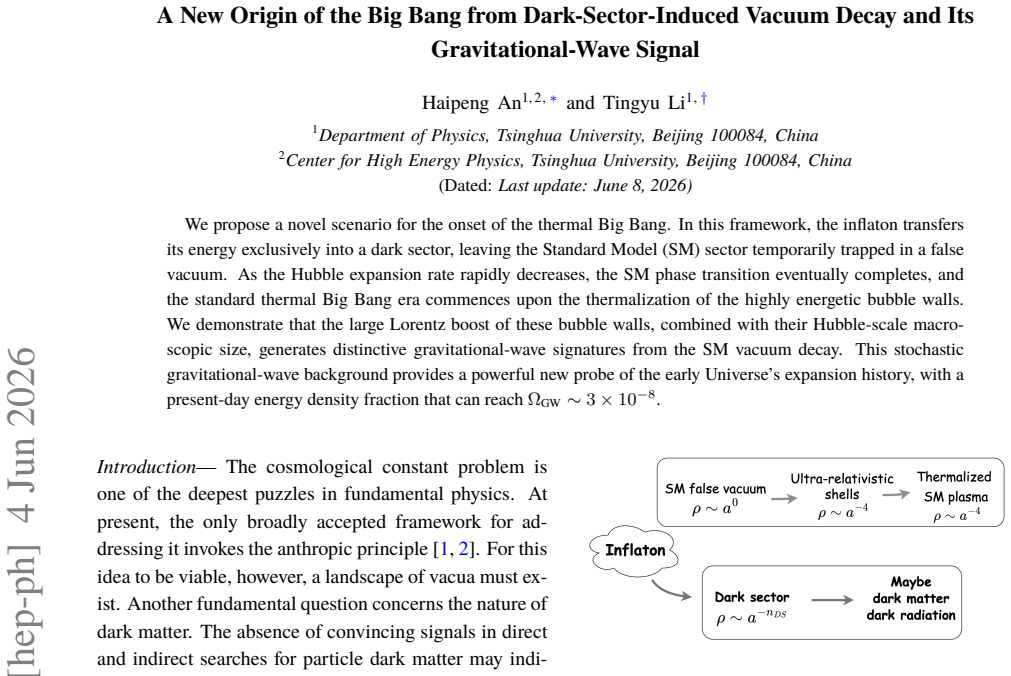
In this framework the inflaton transfers its energy exclusively into a dark sector, leaving the Standard Model temporarily trapped in a false vacuum. As the Hubble expansion rate rapidly decreases, the SM phase transition eventually completes, and the standard thermal Big Bang era commences upon the thermalization of the highly energetic bubble walls. The large Lorentz boost of these bubble walls, combined with their Hubble-scale macroscopic size, generates distinctive gravitational-wave signatures from the SM vacuum decay with a present-day energy density fraction that can reach Ω_GW ∼ 3×10^{-8}.
What carries the argument
Hubble-scale bubble walls from the SM false-vacuum decay carrying large Lorentz boosts, whose collisions source the gravitational waves.
Load-bearing premise
The inflaton transfers its energy exclusively into a dark sector, leaving the Standard Model temporarily trapped in a false vacuum.
What would settle it
Detection or non-detection of a stochastic gravitational-wave background whose amplitude reaches order 3×10^{-8} at frequencies set by the Hubble scale at the moment of the SM phase transition.
If this is right
- The gravitational-wave spectrum encodes the Hubble rate at the time the SM phase transition completes.
- Thermalization of the energetic bubble walls sets the initial temperature and conditions for the standard hot Big Bang.
- The mechanism allows the visible sector to remain out of equilibrium while the dark sector absorbs the inflaton energy.
- Future detectors sensitive to the predicted amplitude can directly test the expansion history before thermalization.
Where Pith is reading between the lines
- The visible-sector reheating temperature would be fixed by the vacuum energy released in the SM transition rather than by direct inflaton couplings.
- Analogous delayed transitions in other hidden sectors could generate similar but scaled signals at different frequencies.
- Upper limits from existing or planned gravitational-wave observatories would bound the lifetime of the SM false vacuum or the dark-sector energy transfer efficiency.
Editorial analysis
A structured set of objections, weighed in public.
Referee Report
Summary. The manuscript proposes a novel origin for the thermal Big Bang in which the inflaton decays exclusively into a dark sector, leaving the Standard Model temporarily trapped in a false vacuum. Once the Hubble rate drops sufficiently, the SM undergoes a phase transition via bubble nucleation; the resulting highly boosted, Hubble-scale bubble walls thermalize to initiate the hot Big Bang and are claimed to source a stochastic gravitational-wave background reaching Ω_GW ∼ 3×10^{-8} today.
Significance. If the selective energy-transfer premise can be realized in a concrete model, the scenario would link the end of inflation directly to SM vacuum decay and furnish a new, potentially observable GW signature of the post-inflationary expansion history. The numerical amplitude is presented without derivation or parameter scan in the supplied text, limiting immediate assessment of its robustness.
major comments (1)
- [Abstract / framework premise] Abstract and framework section: the central premise that the inflaton transfers its energy exclusively into a dark sector while the SM remains trapped in a false vacuum is stated as a framework assumption but is not supported by an explicit Lagrangian, coupling structure, or dynamical mechanism. This selective decoupling is load-bearing for the subsequent bubble-wall Lorentz factor, macroscopic size, and the quoted Ω_GW value; without it the timeline and signal cannot be realized.
Simulated Author's Rebuttal
We thank the referee for their careful reading and constructive feedback. We address the single major comment below. The manuscript presents the selective inflaton decay as a framework assumption to focus on phenomenological consequences; we will partially revise to better motivate this assumption without altering the core analysis.
read point-by-point responses
-
Referee: [Abstract / framework premise] Abstract and framework section: the central premise that the inflaton transfers its energy exclusively into a dark sector while the SM remains trapped in a false vacuum is stated as a framework assumption but is not supported by an explicit Lagrangian, coupling structure, or dynamical mechanism. This selective decoupling is load-bearing for the subsequent bubble-wall Lorentz factor, macroscopic size, and the quoted Ω_GW value; without it the timeline and signal cannot be realized.
Authors: The manuscript introduces the selective energy transfer as an explicit framework assumption rather than deriving it from a concrete Lagrangian. This allows a model-independent exploration of the post-inflationary timeline, bubble-wall dynamics, and gravitational-wave production that follow once the assumption is granted. Realizations are possible in extensions where symmetries or mass hierarchies suppress inflaton-SM couplings while permitting efficient inflaton-dark-sector interactions (e.g., via a dark U(1) or Z_2 under which SM fields are neutral). We agree that an explicit example would strengthen the presentation and will add a concise paragraph in the revised introduction and framework section discussing such UV-motivated portals. The main results on bubble nucleation, Lorentz boost, and Ω_GW remain unchanged. revision: partial
Circularity Check
No circularity: scenario premise is explicit modeling choice; GW signal follows from standard bubble dynamics applied to that premise.
full rationale
The paper introduces an explicit framework premise (inflaton energy transfer exclusively to dark sector, SM trapped in false vacuum) as the starting assumption, then applies standard Lorentz-boosted bubble-wall physics to derive the GW spectrum and the numerical value Ω_GW ∼ 3×10^{-8}. No equations reduce a claimed prediction back to a fitted parameter or self-citation by construction; the central result is a forward calculation from the stated initial conditions rather than a tautology. No self-citations, ansatzes smuggled via prior work, or renaming of known results appear in the supplied text. The derivation chain is therefore self-contained against external benchmarks of bubble nucleation and gravitational-wave production.
Axiom & Free-Parameter Ledger
axioms (1)
- domain assumption The inflaton transfers its energy exclusively into a dark sector, leaving the SM sector temporarily trapped in a false vacuum.
invented entities (1)
-
Dark sector that exclusively receives inflaton energy
no independent evidence
read the original abstract
We propose a novel scenario for the onset of the thermal Big Bang. In this framework, the inflaton transfers its energy exclusively into a dark sector, leaving the Standard Model (SM) sector temporarily trapped in a false vacuum. As the Hubble expansion rate rapidly decreases, the SM phase transition eventually completes, and the standard thermal Big Bang era commences upon the thermalization of the highly energetic bubble walls. We demonstrate that the large Lorentz boost of these bubble walls, combined with their Hubble-scale macroscopic size, generates distinctive gravitational-wave signatures from the SM vacuum decay. This stochastic gravitational-wave background provides a powerful new probe of the early Universe's expansion history, with a present-day energy density fraction that can reach $\Omega_{\text{GW}} \sim 3\times10^{-8}$.
Figures
Forward citations
Cited by 1 Pith paper
-
Particle productions during collisions of highly boosted bubble walls
Bubble-wall collisions produce ultra-heavy particles with a universal spectrum ∝ [V'(2vφ)]²/χ⁴, localized at the collision instant.
Reference graph
Works this paper leans on
-
[1]
Anthropic Bound on the Cosmological Constant,
S. Weinberg, “Anthropic Bound on the Cosmological Constant,”Phys. Rev. Lett.59(1987) 2607
1987
-
[2]
The Cosmological Constant Problem,
S. Weinberg, “The Cosmological Constant Problem,”Rev. Mod. Phys.61(1989) 1–23
1989
-
[3]
The Fate of the False Vacuum. 1. Semiclassical Theory,
S. R. Coleman, “The Fate of the False Vacuum. 1. Semiclassical Theory,”Phys. Rev. D15(1977) 2929–2936. [Erratum: Phys.Rev.D 16, 1248 (1977)]
1977
-
[4]
DESI 2024 VI: Cosmological Constraints from the Measurements of Baryon Acoustic Oscillations
C. G. Callan, Jr. and S. R. Coleman, “The Fate of the False Vacuum. 2. First Quantum Corrections,”Phys. Rev. D16(1977) 1762–1768. [5]DESICollaboration, A. G. Adameet al., “DESI 2024 VI: cosmological constraints from the measurements of baryon acoustic oscillations,”JCAP02(2025) 021,arXiv:2404.03002 [astro-ph.CO]
work page internal anchor Pith review Pith/arXiv arXiv 1977
-
[5]
Reduced Hubble tension in dark radiation models after DESI 2024,
I. J. Allali, A. Notari, and F. Rompineve, “Reduced Hubble tension in dark radiation models after DESI 2024,”JCAP03 (2025) 023,arXiv:2404.15220 [astro-ph.CO]
-
[6]
Deflationary Universe Scenario
B. Spokoiny, “Deflationary universe scenario,”Phys. Lett. B315(1993) 40–45,arXiv:gr-qc/9306008. 15
work page internal anchor Pith review Pith/arXiv arXiv 1993
-
[7]
Electroweak Baryogenesis and the Expansion Rate of the Universe
M. Joyce, “Electroweak Baryogenesis and the Expansion Rate of the Universe,”Phys. Rev. D55(1997) 1875–1878, arXiv:hep-ph/9606223
work page internal anchor Pith review Pith/arXiv arXiv 1997
-
[8]
P. Peebles and A. Vilenkin, “Quintessential inflation,”Phys. Rev. D59(1999) 063505,arXiv:astro-ph/9810509
work page internal anchor Pith review Pith/arXiv arXiv 1999
-
[9]
Non-Oscillatory No-Scale Inflation,
J. Ellis, D. V. Nanopoulos, K. A. Olive, and S. Verner, “Non-Oscillatory No-Scale Inflation,”JCAP03(2021) 052, arXiv:2008.09099 [hep-ph]
-
[10]
Gravitational wave and CMB probes of axion kination,
R. T. Co, D. Dunsky, N. Fernandez, A. Ghalsasi, L. J. Hall, K. Harigaya, and J. Shelton, “Gravitational wave and CMB probes of axion kination,”JHEP09(2022) 116,arXiv:2108.09299 [hep-ph]
-
[11]
¨uber die kr¨ummung des raumes,
A. Friedmann, “¨uber die kr¨ummung des raumes,”Zeitschrift f ¨ur Physik10(1922) 377–386
1922
-
[12]
¨uber die m¨oglichkeit einer welt mit konstanter negativer kr¨ummung des raumes,
A. Friedmann, “¨uber die m¨oglichkeit einer welt mit konstanter negativer kr¨ummung des raumes,”Zeitschrift f ¨ur Physik21 (1924) 326–332
1924
-
[13]
Gravitational Waves and Primordial Black Holes produced by Dark Meta Stable Vacuum Decay,
H. An, T. Li, and C. Yang, “Gravitational Waves and Primordial Black Holes produced by Dark Meta Stable Vacuum Decay,” arXiv:2601.14366 [hep-ph]
-
[14]
Derivation of Gauge Invariance from High-Energy Unitarity Bounds on the s Matrix,
J. M. Cornwall, D. N. Levin, and G. Tiktopoulos, “Derivation of Gauge Invariance from High-Energy Unitarity Bounds on the s Matrix,”Phys. Rev. D10(1974) 1145. [Erratum: Phys.Rev.D 11, 972 (1975)]
1974
-
[15]
Perturbative QCD Approach to Multiparticle Production
V. A. Khoze and W. Ochs, “Perturbative QCD approach to multiparticle production,”Int. J. Mod. Phys. A12(1997) 2949–3120,arXiv:hep-ph/9701421
work page internal anchor Pith review Pith/arXiv arXiv 1997
-
[16]
A Natural Left-Right Symmetry,
R. N. Mohapatra and J. C. Pati, “A Natural Left-Right Symmetry,”Phys. Rev. D11(1975) 2558
1975
-
[17]
Exact Left-Right Symmetry and Spontaneous Violation of Parity,
G. Senjanovic and R. N. Mohapatra, “Exact Left-Right Symmetry and Spontaneous Violation of Parity,”Phys. Rev. D12 (1975) 1502
1975
-
[18]
Gravitational radiation from a bulk flow model
T. Konstandin, “Gravitational radiation from a bulk flow model,”JCAP03(2018) 047,arXiv:1712.06869 [astro-ph.CO]
work page internal anchor Pith review Pith/arXiv arXiv 2018
- [19]
-
[20]
Cosmic Separation of Phases,
E. Witten, “Cosmic Separation of Phases,”Phys. Rev. D30(1984) 272–285
1984
-
[21]
C. J. Hogan, “Gravitational radiation from cosmological phase transitions,”Mon. Not. Roy. Astron. Soc.218no. 4, (1986) 629–636. [23]LIGO Scientific, VIRGO, KAGRACollaboration, A. G. Abacet al., “Cosmological and High Energy Physics implications from gravitational-wave background searches in LIGO-Virgo-KAGRA’s O1-O4a runs,”arXiv:2510.26848 [gr-qc]
-
[22]
New Sensitivity Curves for Gravitational-Wave Signals from Cosmological Phase Transitions
K. Schmitz, “New Sensitivity Curves for Gravitational-Wave Signals from Cosmological Phase Transitions,”JHEP01(2021) 097,arXiv:2002.04615 [hep-ph]
work page internal anchor Pith review Pith/arXiv arXiv 2021
-
[23]
Taiji Program: Gravitational-Wave Sources
W.-H. Ruan, Z.-K. Guo, R.-G. Cai, and Y.-Z. Zhang, “Taiji program: Gravitational-wave sources,”Int. J. Mod. Phys. A35 no. 17, (2020) 2050075,arXiv:1807.09495 [gr-qc]
work page Pith review arXiv 2020
-
[24]
Fundamental Physics and Cosmology with TianQin
J. Luoet al., “Fundamental Physics and Cosmology with TianQin,”arXiv:2502.20138 [gr-qc]
work page internal anchor Pith review Pith/arXiv arXiv
-
[25]
Fundamental quantum limits for detecting ultrahigh frequency gravitational waves,
X. Guo, H. Miao, Z.-W. Wang, H. Yang, and Y.-L. Zhou, “Fundamental quantum limits for detecting ultrahigh frequency gravitational waves,”Phys. Rev. D113no. 4, (2026) 044020,arXiv:2501.18146 [gr-qc]
-
[26]
Leptogenesis via bubble collisions,
M. Cataldi and B. Shakya, “Leptogenesis via bubble collisions,”JCAP11(2024) 047,arXiv:2407.16747 [hep-ph]
-
[27]
Particle production from phase transition bubbles,
H. Mansour and B. Shakya, “Particle production from phase transition bubbles,”Phys. Rev. D111no. 2, (2025) 023520, arXiv:2308.13070 [hep-ph]
-
[28]
K. Freese and M. W. Winkler, “Dark matter and gravitational waves from a dark big bang,”Phys. Rev. D107no. 8, (2023) 083522,arXiv:2302.11579 [astro-ph.CO]
-
[29]
Dark sector tunneling field potentials for a dark big bang,
R. Casey and C. Ilie, “Dark sector tunneling field potentials for a dark big bang,”Phys. Rev. D110no. 10, (2024) 103522, arXiv:2407.05752 [hep-ph]
-
[30]
Late-time Quantum Vacuum Decay and its Cosmological Implications
Y. Bai, S. Lu, and N. Orlofsky, “Late-time Quantum Vacuum Decay and its Cosmological Implications,” arXiv:2605.30259 [astro-ph.CO]
work page internal anchor Pith review Pith/arXiv arXiv
-
[31]
General Properties of the Gravitational Wave Spectrum from Phase Transitions
C. Caprini, R. Durrer, T. Konstandin, and G. Servant, “General Properties of the Gravitational Wave Spectrum from Phase Transitions,”Phys. Rev. D79(2009) 083519,arXiv:0901.1661 [astro-ph.CO]
work page internal anchor Pith review Pith/arXiv arXiv 2009
-
[32]
Universal infrared scaling of gravitational wave background spectra,
R.-G. Cai, S. Pi, and M. Sasaki, “Universal infrared scaling of gravitational wave background spectra,”Phys. Rev. D102 no. 8, (2020) 083528,arXiv:1909.13728 [astro-ph.CO]
-
[33]
Induced gravitational waves as a probe of thermal history of the universe,
G. Dom `enech, S. Pi, and M. Sasaki, “Induced gravitational waves as a probe of thermal history of the universe,”JCAP08 (2020) 017,arXiv:2005.12314 [gr-qc]
-
[34]
Gravitational waves from bubble dynamics: Beyond the Envelope,
R. Jinno and M. Takimoto, “Gravitational waves from bubble dynamics: Beyond the Envelope,”JCAP01(2019) 060, 16 arXiv:1707.03111 [hep-ph]
-
[35]
Primordial black hole production during first-order phase transitions,
J. Liu, L. Bian, R.-G. Cai, Z.-K. Guo, and S.-J. Wang, “Primordial black hole production during first-order phase transitions,” Phys. Rev. D105no. 2, (2022) L021303,arXiv:2106.05637 [astro-ph.CO]
-
[36]
K. Hashino, S. Kanemura, and T. Takahashi, “Primordial black holes as a probe of strongly first-order electroweak phase transition,”Phys. Lett. B833(2022) 137261,arXiv:2111.13099 [hep-ph]
- [37]
- [38]
-
[39]
and Breitbach, Moritz and Kopp, Joachim and Mittnacht, Lukas
M. J. Baker, M. Breitbach, J. Kopp, and L. Mittnacht, “Detailed calculation of primordial black hole formation during first-order cosmological phase transitions,”Phys. Rev. D111no. 6, (2025) 063544,arXiv:2110.00005 [astro-ph.CO]
-
[40]
Primordial black holes from bubble collisions during a first-order phase transition,
T. H. Jung and T. Okui, “Primordial black holes from bubble collisions during a first-order phase transition,”Phys. Rev. D 110no. 11, (2024) 115014,arXiv:2110.04271 [hep-ph]
-
[41]
Numerical simulations of primordial black hole formation via delayed first-order phase transitions
Z. Ning, X.-X. Zeng, R.-G. Cai, and S.-J. Wang, “Numerical simulations of primordial black hole formation via delayed first-order phase transitions,”arXiv:2601.21878 [gr-qc]
work page internal anchor Pith review Pith/arXiv arXiv
-
[42]
Primordial black holes from strong first-order phase transitions,
M. Lewicki, P. Toczek, and V. Vaskonen, “Primordial black holes from strong first-order phase transitions,”JHEP09(2023) 092,arXiv:2305.04924 [astro-ph.CO]
-
[43]
Black holes and the multiverse
J. Garriga, A. Vilenkin, and J. Zhang, “Black holes and the multiverse,”JCAP02(2016) 064,arXiv:1512.01819 [hep-th]
work page internal anchor Pith review Pith/arXiv arXiv 2016
-
[44]
Abundance of Primordial Holes Produced by Cosmological First Order Phase Transition,
H. Kodama, M. Sasaki, and K. Sato, “Abundance of Primordial Holes Produced by Cosmological First Order Phase Transition,”Prog. Theor. Phys.68(1982) 1979
1982
-
[45]
Constraints on Primordial Black Holes
B. Carr, K. Kohri, Y. Sendouda, and J. Yokoyama, “Constraints on primordial black holes,”Rept. Prog. Phys.84no. 11, (2021) 116902,arXiv:2002.12778 [astro-ph.CO]
work page internal anchor Pith review Pith/arXiv arXiv 2021
-
[46]
Primordial Black Holes as a dark matter candidate
A. M. Green and B. J. Kavanagh, “Primordial Black Holes as a dark matter candidate,”J. Phys. G48no. 4, (2021) 043001, arXiv:2007.10722 [astro-ph.CO]
work page internal anchor Pith review Pith/arXiv arXiv 2021
-
[47]
Constraints on Primordial Black Holes From Big Bang Nucleosynthesis Revisited,
C. Keith, D. Hooper, N. Blinov, and S. D. McDermott, “Constraints on Primordial Black Holes From Big Bang Nucleosynthesis Revisited,”Phys. Rev. D102no. 10, (2020) 103512,arXiv:2006.03608 [astro-ph.CO]
-
[48]
CMB and BBN constraints on evaporating primordial black holesrevisited,
S. K. Acharya and R. Khatri, “CMB and BBN constraints on evaporating primordial black holes revisited,”JCAP06(2020) 018,arXiv:2002.00898 [astro-ph.CO]
-
[49]
21cm Limits on Decaying Dark Matter and Primordial Black Holes
S. Clark, B. Dutta, Y. Gao, Y.-Z. Ma, and L. E. Strigari, “21 cm limits on decaying dark matter and primordial black holes,” Phys. Rev. D98no. 4, (2018) 043006,arXiv:1803.09390 [astro-ph.HE]
work page internal anchor Pith review Pith/arXiv arXiv 2018
-
[50]
New cosmological constraints on primordial black holes
B. J. Carr, K. Kohri, Y. Sendouda, and J. Yokoyama, “New cosmological constraints on primordial black holes,”Phys. Rev. D 81(2010) 104019,arXiv:0912.5297 [astro-ph.CO]
work page internal anchor Pith review Pith/arXiv arXiv 2010
-
[51]
INTEGRAL constraints on primordial black holes and particle dark matter,
R. Laha, J. B. Mu˜noz, and T. R. Slatyer, “INTEGRAL constraints on primordial black holes and particle dark matter,”Phys. Rev. D101no. 12, (2020) 123514,arXiv:2004.00627 [astro-ph.CO]
-
[52]
Subaru-HSC through a different lens: Microlens- ing by extended dark matter structures,
D. Croon, D. McKeen, N. Raj, and Z. Wang, “Subaru-HSC through a different lens: Microlensing by extended dark matter structures,”Phys. Rev. D102no. 8, (2020) 083021,arXiv:2007.12697 [astro-ph.CO]. [55]EROS-2Collaboration, P. Tisserandet al., “Limits on the Macho Content of the Galactic Halo from the EROS-2 Survey of the Magellanic Clouds,”Astron. Astrophy...
-
[53]
Constraints on Earth-mass primordial black holes from OGLE 5-year microlensing events
H. Niikura, M. Takada, S. Yokoyama, T. Sumi, and S. Masaki, “Constraints on Earth-mass primordial black holes from OGLE 5-year microlensing events,”Phys. Rev. D99no. 8, (2019) 083503,arXiv:1901.07120 [astro-ph.CO]
work page internal anchor Pith review Pith/arXiv arXiv 2019
discussion (0)
Sign in with ORCID, Apple, or X to comment. Anyone can read and Pith papers without signing in.