Improving low-latency multi-messenger follow-up of neutron star-black hole mergers with mode-by-mode filtering
Pith reviewed 2026-06-27 03:15 UTC · model grok-4.3
The pith
Mode-by-mode filtering of SNR time series lets low-latency NSBH analyses marginalize over higher-order modes at quadrupole-only cost.
A machine-rendered reading of the paper's core claim, the machinery that carries it, and where it could break.
Core claim
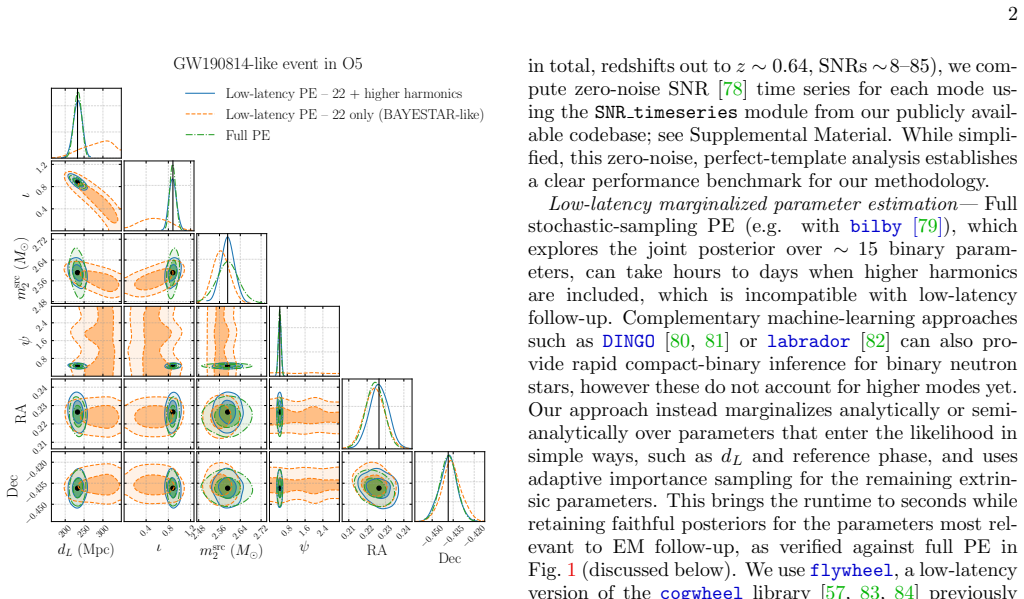
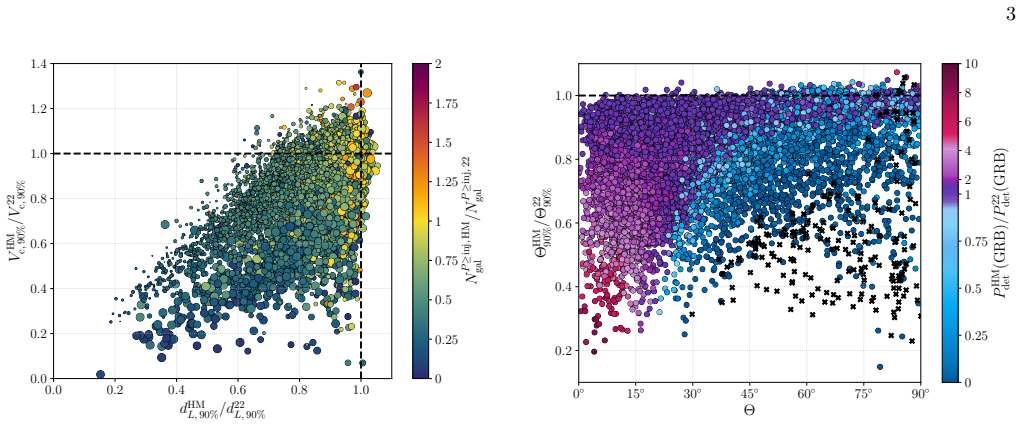
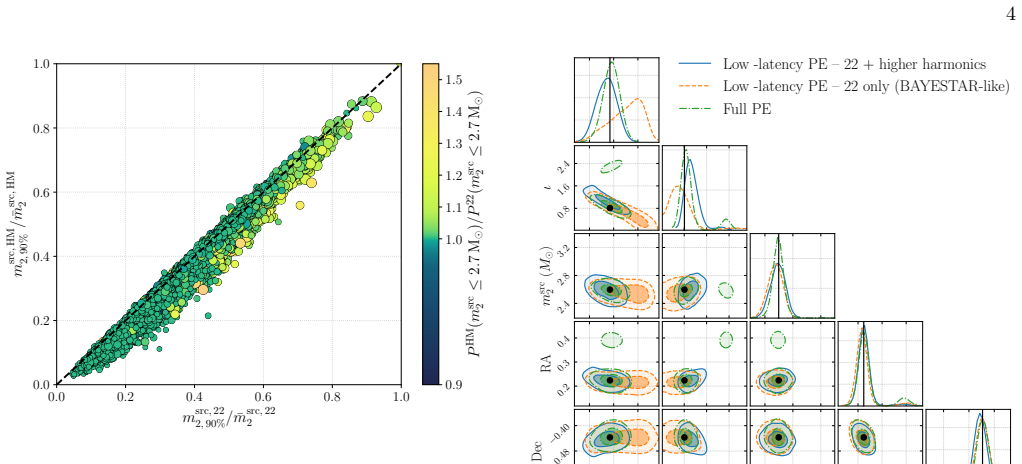
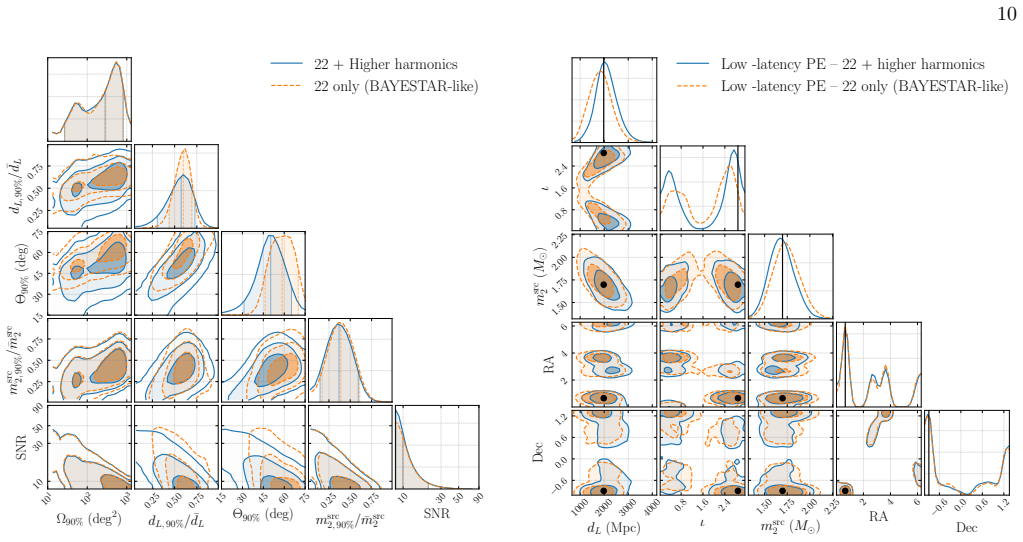
Mode-by-mode filtering of the (2,2), (3,3), and (4,4) signal-to-noise-ratio time series enables low-latency marginalization over higher-order-mode information at a computational cost comparable to quadrupole-only analyses. Applied to simulated NSBH detections in a LIGO-Virgo network at design sensitivity, the method improves constraints on luminosity distance, viewing angle, localization volume, and source-frame secondary mass, sharpening estimates of electromagnetic detectability and host-galaxy association.
What carries the argument
mode-by-mode filtering of the (2,2), (3,3), and (4,4) SNR time series, which isolates each mode's contribution so that higher-mode information can be marginalized independently and at low extra cost.
If this is right
- Tighter luminosity-distance and viewing-angle posteriors improve predictions of electromagnetic counterpart brightness.
- Smaller localization volumes raise the chance of correct host-galaxy identification.
- Better source-frame secondary-mass constraints help classify the remnant and decide follow-up strategy.
- The largest gains appear for asymmetric, high-SNR events such as GW190814.
Where Pith is reading between the lines
- The filtering approach could be ported to other low-latency pipelines that currently discard higher modes.
- Extending the same mode-by-mode treatment to binary-black-hole events with large mass ratios would test whether the computational saving holds more generally.
- Combining the filtered SNR series with rapid sky-localization maps could shorten the time from alert to targeted telescope pointing.
Load-bearing premise
Higher-order modes can be filtered independently from the dominant mode in the low-latency regime without introducing significant biases or unaccounted correlations.
What would settle it
A side-by-side comparison, on the same set of simulated NSBH signals with known injected parameters, of the posterior distributions obtained with mode-by-mode filtering versus a full higher-mode waveform analysis, checking for systematic shifts in recovered distance or secondary mass.
Figures
read the original abstract
Rapid parameter estimation for neutron star-black hole (NSBH) mergers is essential for deciding whether, where, and how electromagnetic facilities should follow up gravitational-wave alerts. Current low-latency analyses typically use only the dominant quadrupole harmonic, leaving strong degeneracies among luminosity distance, inclination, and intrinsic binary parameters. We show that mode-by-mode filtering of the $(2,2)$, $(3,3)$, and $(4,4)$ signal-to-noise-ratio (SNR) time series enables low-latency marginalization over higher-order-mode information at a computational cost comparable to quadrupole-only analyses. Applied to simulated NSBH detections in a LIGO-Virgo network at design sensitivity, our method improves constraints on luminosity distance, viewing angle, localization volume, and source-frame secondary mass, thereby sharpening crucial estimates of electromagnetic detectability and host-galaxy association. We also validate the approach on public data for previously detected NSBH events, finding the largest improvement for the asymmetric, higher-SNR event GW190814.
Editorial analysis
A structured set of objections, weighed in public.
Referee Report
Summary. The manuscript claims that mode-by-mode filtering of the (2,2), (3,3), and (4,4) SNR time series enables low-latency marginalization over higher-order-mode content for NSBH mergers at computational cost comparable to quadrupole-only analyses. Applied to simulated LIGO-Virgo detections, the approach improves constraints on luminosity distance, viewing angle, localization volume, and source-frame secondary mass; validation on public events (largest gain for GW190814) is also reported.
Significance. If the central claim holds without bias, the work would provide a practical advance for rapid multi-messenger follow-up by tightening low-latency posteriors relevant to EM detectability and host-galaxy association. The emphasis on computational parity and the use of both simulated and public data for validation are positive features.
major comments (1)
- [Abstract and method description] Abstract (method description): the claim that independent filtering of the three SNR time series permits valid marginalization assumes negligible cross-mode correlations. Because all modes are generated by the same intrinsic/extrinsic parameters (mass ratio, inclination, distance), statistical coupling exists; the manuscript must demonstrate that the filtering step does not introduce bias in the reported improvements for asymmetric NSBH systems, e.g., via direct comparison with full higher-mode runs on the same injections.
minor comments (2)
- [Abstract] Abstract: quantitative measures of improvement (e.g., factor by which distance or mass uncertainties shrink, or changes in 90% localization volume) are absent; adding them would make the claimed gains concrete.
- [Validation paragraph] Validation paragraph: the abstract states validation on public events but supplies no details on implementation, error bars, or checks for filtering-induced biases; the full text should supply these.
Simulated Author's Rebuttal
We thank the referee for their careful reading of the manuscript and for the constructive comment. We address the major point below.
read point-by-point responses
-
Referee: [Abstract and method description] Abstract (method description): the claim that independent filtering of the three SNR time series permits valid marginalization assumes negligible cross-mode correlations. Because all modes are generated by the same intrinsic/extrinsic parameters (mass ratio, inclination, distance), statistical coupling exists; the manuscript must demonstrate that the filtering step does not introduce bias in the reported improvements for asymmetric NSBH systems, e.g., via direct comparison with full higher-mode runs on the same injections.
Authors: We agree that the shared dependence on intrinsic and extrinsic parameters induces correlations among the modes. The mode-by-mode filtering operates on the SNR time series extracted independently for each harmonic from the data, allowing the low-latency pipeline to marginalize over mode content by combining per-mode likelihoods without recomputing full waveforms. To directly address the concern of possible bias in the reported improvements, particularly for asymmetric systems, we will add a comparison of the mode-by-mode results against full higher-mode parameter estimation on the same simulated injections. This validation will be included in the revised manuscript. revision: yes
Circularity Check
No significant circularity; method validated on external simulations and public data
full rationale
The provided abstract and text describe a mode-by-mode SNR filtering technique whose performance is assessed via application to simulated NSBH detections and public events (e.g., GW190814). No equations, parameter fits, or self-citations are exhibited that reduce the central claims (computational cost parity, improved posteriors) to inputs by construction. The derivation chain relies on external benchmarks rather than tautological redefinitions or load-bearing self-references, satisfying the criteria for a self-contained result.
Axiom & Free-Parameter Ledger
axioms (1)
- domain assumption General relativity accurately models the gravitational-wave emission from NSBH mergers including higher-order modes
Reference graph
Works this paper leans on
-
[1]
B. P. Abbottet al.(LIGO Scientific, Virgo), Phys. Rev. Lett.116, 061102 (2016), arXiv:1602.03837 [gr-qc]
Pith/arXiv arXiv 2016
-
[2]
Aasiet al.(LIGO Scientific), Class
J. Aasiet al.(LIGO Scientific), Class. Quant. Grav.32, 074001 (2015), arXiv:1411.4547 [gr-qc]
Pith/arXiv arXiv 2015
-
[3]
F. Acerneseet al.(Virgo), Class. Quant. Grav.32, 024001 (2015), arXiv:1408.3978 [gr-qc]
Pith/arXiv arXiv 2015
-
[4]
Y. Aso, Y. Michimura, K. Somiya, M. Ando, et al.(KAGRA), Phys. Rev. D88, 043007 (2013), arXiv:1306.6747 [gr-qc]
Pith/arXiv arXiv 2013
-
[5]
A. G. Abacet al.(LIGO Scientific, Virgo, KAGRA), (2025), arXiv:2508.18082 [gr-qc]
Pith/arXiv arXiv 2025
-
[6]
(LIGO Scientific, Virgo, KAGRA), (2026), arXiv:2605.27225 [gr-qc]
Pith/arXiv arXiv 2026
-
[7]
B. P. Abbottet al.(LIGO Scientific, Virgo), Phys. Rev. Lett.119, 161101 (2017), arXiv:1710.05832 [gr-qc]
Pith/arXiv arXiv 2017
-
[8]
B. P. Abbottet al.(LIGO Scientific, Virgo), Astrophys. J. Lett.892, L3 (2020), arXiv:2001.01761 [astro-ph.HE]
arXiv 2020
-
[9]
B. P. Abbottet al.(LIGO Scientific, Virgo, Fermi GBM, INTEGRAL, IceCube, AstroSat Cadmium Zinc Telluride Imager Team, IPN, Insight-Hxmt, ANTARES, Swift, AGILE Team, 1M2H Team, Dark Energy Camera GW-EM, DES, DLT40, GRAWITA, Fermi-LAT, ATCA, ASKAP, Las Cumbres Observa- tory Group, OzGrav, DWF (Deeper Wider Faster Program), AST3, CAASTRO, VINROUGE, MAS- TER,...
Pith/arXiv arXiv 2017
-
[10]
B. P. Abbottet al.(LIGO Scientific, Virgo), Phys. Rev. Lett.121, 161101 (2018), arXiv:1805.11581 [gr-qc]
Pith/arXiv arXiv 2018
-
[11]
B. P. Abbottet al.(LIGO Scientific, Virgo, 1M2H, Dark Energy Camera GW-E, DES, DLT40, Las Cumbres Observatory, VINROUGE, MASTER), Nature551, 85 (2017), arXiv:1710.05835 [astro-ph.CO]
Pith/arXiv arXiv 2017
-
[12]
Abbottet al.(LIGO Scientific, KAGRA, Virgo), Astrophys
R. Abbottet al.(LIGO Scientific, KAGRA, Virgo), Astrophys. J. Lett.915, L5 (2021), arXiv:2106.15163 [astro-ph.HE]
arXiv 2021
-
[13]
Abbottet al.(KAGRA, Virgo, LIGO Scientific), Phys
R. Abbottet al.(KAGRA, Virgo, LIGO Scientific), Phys. Rev. X13, 041039 (2023), arXiv:2111.03606 [gr- qc]
Pith/arXiv arXiv 2023
-
[14]
A. G. Abacet al.(LIGO Scientific, KAGRA, Virgo), Astrophys. J. Lett.970, L34 (2024), arXiv:2404.04248 [astro-ph.HE]
arXiv 2024
- [15]
-
[16]
Abbottet al.(LIGO Scientific, VIRGO), Phys
R. Abbottet al.(LIGO Scientific, VIRGO), Phys. Rev. D109, 022001 (2024), arXiv:2108.01045 [gr-qc]
Pith/arXiv arXiv 2024
-
[17]
A. Colomboet al., Astron. Astrophys.686, A265 (2024), arXiv:2310.16894 [astro-ph.HE]
arXiv 2024
-
[18]
S. Vitale and H.-Y. Chen, Phys. Rev. Lett.121, 021303 (2018), arXiv:1804.07337 [astro-ph.CO]
Pith/arXiv arXiv 2018
-
[19]
T. A. Clarke, L. Chastain, P. D. Lasky, and E. Thrane, Astrophys. J. Lett.949, L6 (2023), arXiv:2302.09711 [gr-qc]
arXiv 2023
-
[20]
F. S. Broekgaardenet al., Mon. Not. Roy. Astron. Soc. 516, 5737 (2022), arXiv:2112.05763 [astro-ph.HE]
arXiv 2022
-
[21]
Gehrelset al.(Swift Science), Astrophys
N. Gehrelset al.(Swift Science), Astrophys. J.611, 1005 (2004), [Erratum: Astrophys.J. 621, 558 (2005)], arXiv:astro-ph/0405233
Pith/arXiv arXiv 2004
-
[22]
Y. Shvartzvaldet al., Astrophys. J.964, 74 (2024), arXiv:2304.14482 [astro-ph.IM]
arXiv 2024
- [23]
-
[24]
Yuanet al.(Einstein Probe Team), PoSSWIFT10, 006 (2015), arXiv:1506.07735 [astro-ph.HE]
W. Yuanet al.(Einstein Probe Team), PoSSWIFT10, 006 (2015), arXiv:1506.07735 [astro-ph.HE]
Pith/arXiv arXiv 2015
-
[25]
Anandet al., Nature Astron.5, 46 (2021), arXiv:2009.07210 [astro-ph.HE]
S. Anandet al., Nature Astron.5, 46 (2021), arXiv:2009.07210 [astro-ph.HE]
arXiv 2021
-
[26]
I. Andreoniet al., Astrophys. J. Supp.260, 18 (2022), arXiv:2111.01945 [astro-ph.HE]
arXiv 2022
-
[27]
B. P. Gompertzet al., Mon. Not. Roy. Astron. Soc.497, 726 (2020), arXiv:2004.00025 [astro-ph.HE]
arXiv 2020
-
[28]
D. A. Goldsteinet al., Astrophys. J. Lett.881, L7 (2019), arXiv:1905.06980 [astro-ph.HE]
arXiv 2019
-
[29]
S. Antieret al., Mon. Not. Roy. Astron. Soc.497, 5518 (2020), arXiv:2004.04277 [astro-ph.HE]
arXiv 2020
-
[30]
S. S. Chaudharyet al., Proc. Nat. Acad. Sci.121, e2316474121 (2024), arXiv:2308.04545 [astro-ph.HE]
arXiv 2024
-
[31]
Sachdevet al., (2019), arXiv:1901.08580 [gr-qc]
S. Sachdevet al., (2019), arXiv:1901.08580 [gr-qc]
Pith/arXiv arXiv 2019
-
[32]
A. H. Nitz, T. Dal Canton, D. Davis, and S. Reyes, Phys. Rev. D98, 024050 (2018), arXiv:1805.11174 [gr- qc]
Pith/arXiv arXiv 2018
-
[33]
T. Adams, D. Buskulic, V. Germain, G. M. Guidi, et al., Class. Quant. Grav.33, 175012 (2016), arXiv:1512.02864 [gr-qc]
Pith/arXiv arXiv 2016
- [34]
-
[35]
V. Villa-Ortega, T. Dent, and A. C. Barroso, Mon. Not. Roy. Astron. Soc.515, 5718 (2022), [Er- ratum: Mon.Not.Roy.Astron.Soc. 535, 2503 (2024)], arXiv:2203.10080 [astro-ph.HE]
arXiv 2022
-
[36]
(LIGO Scientific, Virgo, KAGRA), (2026), arXiv:2605.27224 [gr-qc]
Pith/arXiv arXiv 2026
-
[37]
L. P. Singer and L. R. Price, Phys. Rev. D93, 024013 (2016), arXiv:1508.03634 [gr-qc]
Pith/arXiv arXiv 2016
-
[38]
L. P. Singeret al., Astrophys. J. Lett.829, L15 (2016), arXiv:1603.07333 [astro-ph.HE]
Pith/arXiv arXiv 2016
-
[39]
L. P. Singeret al., Astrophys. J. Suppl.226, 10 (2016), arXiv:1605.04242 [astro-ph.IM]
Pith/arXiv arXiv 2016
-
[40]
R. Essick, S. Vitale, E. Katsavounidis, G. Vedovato, and S. Klimenko, Astrophys. J.800, 81 (2015), arXiv:1409.2435 [astro-ph.HE]
Pith/arXiv arXiv 2015
-
[41]
C. Capano, Y. Pan, and A. Buonanno, Phys. Rev. D 89, 102003 (2014), arXiv:1311.1286 [gr-qc]
Pith/arXiv arXiv 2014
-
[42]
C. Mills and S. Fairhurst, Phys. Rev. D103, 024042 (2021), arXiv:2007.04313 [gr-qc]
arXiv 2021
-
[43]
S. Fairhurst, C. Hoy, R. Green, C. Mills, and S. A. Usman, Phys. Rev. D108, 082006 (2023), arXiv:2304.03731 [gr-qc]
arXiv 2023
-
[44]
D. Wadekar, J. Roulet, T. Venumadhav, A. K. Mehta, et al., (2023), arXiv:2312.06631 [gr-qc]. 12
arXiv 2023
-
[45]
S. Yi, F. Iacovelli, S. Marsat, D. Wadekar, and E. Berti, Phys. Rev. D112, 124063 (2025), arXiv:2502.12237 [gr- qc]
arXiv 2025
-
[46]
S. Yi, F. Iacovelli, E. Berti, R. S. Chandramouli, S. Marsat, D. Wadekar, and N. Yunes, (2026), arXiv:2602.09088 [gr-qc]
arXiv 2026
-
[47]
A. K. Mehta, D. Wadekar, J. Roulet, I. Anantpurkar, et al., (2025), arXiv:2501.17939 [gr-qc]
arXiv 2025
-
[48]
A. K. Mehta, D. Wadekar, I. Anantpurkar, J. Roulet,et al., Phys. Rev. D112, 124023 (2025), arXiv:2508.15350 [gr-qc]
arXiv 2025
-
[49]
D. Wadekar, T. Venumadhav, A. K. Mehta, J. Roulet,et al., Phys. Rev. D110, 084035 (2024), arXiv:2310.15233 [gr-qc]
arXiv 2024
-
[50]
K. Chandra, J. Calder´ on Bustillo, A. Pai, and I. W. Harry, Phys. Rev. D106, 123003 (2022), arXiv:2207.01654 [gr-qc]
arXiv 2022
-
[51]
J. Calder´ on Bustillo, S. H. W. Leong, and K. Chandra, Nature Astron.9, 1530 (2025), arXiv:2211.03465 [gr-qc]
arXiv 2025
-
[52]
P. Sinha, R. Prasad, M. K. Singh, P. Kumar, A. Maurya, and K. Paul, (2025), arXiv:2507.07021 [gr-qc]
Pith/arXiv arXiv 2025
-
[53]
C. Cutler and E. E. Flanagan, Phys. Rev. D49, 2658 (1994), arXiv:gr-qc/9402014
Pith/arXiv arXiv 1994
-
[54]
S. A. Usman, J. C. Mills, and S. Fairhurst, Astrophys. J.877, 82 (2019), arXiv:1809.10727 [gr-qc]
Pith/arXiv arXiv 2019
-
[55]
J. Calder´ on Bustillo, S. H. W. Leong, T. Dietrich, and P. D. Lasky, Astrophys. J. Lett.912, L10 (2021), arXiv:2006.11525 [gr-qc]
arXiv 2021
-
[56]
D. Wadekar, T. Venumadhav, J. Roulet, A. K. Mehta, B. Zackay, J. Mushkin, and M. Zaldarriaga, Phys. Rev. D110, 044063 (2024), arXiv:2405.17400 [gr-qc]
arXiv 2024
- [57]
-
[58]
N. Gehrels, J. K. Cannizzo, J. Kanner, M. M. Kasliwal, S. Nissanke, and L. P. Singer, Astrophys. J.820, 136 (2016), arXiv:1508.03608 [astro-ph.HE]
Pith/arXiv arXiv 2016
- [59]
-
[60]
O. S. Salafia and G. Ghirlanda, Galaxies10, 93 (2022), arXiv:2206.11088 [astro-ph.HE]
arXiv 2022
-
[61]
B. J. Morsony, R. D. L. Santos, R. Hernandez, J. Bus- tamante,et al., Mon. Not. Roy. Astron. Soc.533, 510 (2024), arXiv:2306.00076 [astro-ph.HE]
arXiv 2024
-
[62]
A. S. Carracedo, M. Bulla, U. Feindt, and A. Goo- bar, Mon. Not. Roy. Astron. Soc.504, 1294 (2021), arXiv:2004.06137 [astro-ph.HE]
arXiv 2021
-
[63]
E. A. Chase, B. O’Connor, C. L. Fryer, E. Troja,et al., Astrophys. J.927, 163 (2022), arXiv:2105.12268 [astro- ph.HE]
arXiv 2022
-
[64]
I. Andreoniet al., Astrophys. J. Supp.258, 5 (2022), arXiv:2106.06820 [astro-ph.HE]
arXiv 2022
-
[65]
I. Andreoniet al., Astropart. Phys.155, 102904 (2024), arXiv:2307.09511 [astro-ph.HE]
arXiv 2024
-
[66]
T. Ahumadaet al., Publ. Astron. Soc. Pac.136, 114201 (2024), arXiv:2405.12403 [astro-ph.HE]
arXiv 2024
-
[67]
S. Stevenson, A. M¨ oller, and J. Powell, Astrophys. J. 998, 8 (2026), arXiv:2510.12932 [astro-ph.HE]
arXiv 2026
-
[68]
F. Foucart, T. Hinderer, and S. Nissanke, Phys. Rev. D98, 081501 (2018), arXiv:1807.00011 [astro-ph.HE]
Pith/arXiv arXiv 2018
-
[69]
C. Barbieri, O. S. Salafia, A. Perego, M. Colpi, and G. Ghirlanda, Eur. Phys. J. A56, 8 (2020), arXiv:1908.08822 [astro-ph.HE]
arXiv 2020
-
[70]
B. P. Gompertz, M. Nicholl, J. C. Smith, S. Harisankar, G. Pratten, P. Schmidt, and G. P. Smith, Mon. Not. Roy. Astron. Soc.526, 4585 (2023), arXiv:2305.07582 [astro-ph.HE]
arXiv 2023
-
[71]
S. Biscoveanu, P. Landry, and S. Vitale, Mon. Not. Roy. Astron. Soc.518, 5298 (2022), arXiv:2207.01568 [astro-ph.HE]
arXiv 2022
-
[72]
P. Madau and M. Dickinson, Ann. Rev. Astron. Astro- phys.52, 415 (2014), arXiv:1403.0007 [astro-ph.CO]
Pith/arXiv arXiv 2014
-
[73]
P. Madau and T. Fragos, Astrophys. J.840, 39 (2017), arXiv:1606.07887 [astro-ph.GA]
Pith/arXiv arXiv 2017
-
[74]
B. P. Abbottet al.(KAGRA, LIGO Scientific, Virgo), Living Rev. Rel.19, 1 (2016), arXiv:1304.0670 [gr-qc]
Pith/arXiv arXiv 2016
-
[75]
F. Iacovelli, M. Mancarella, S. Foffa, and M. Maggiore, Astrophys. J. Supp.263, 2 (2022), arXiv:2207.06910 [astro-ph.IM]
arXiv 2022
-
[76]
C. Garc´ ıa-Quir´ os, M. Colleoni, S. Husa, H. Es- tell´ es,et al., Phys. Rev. D102, 064002 (2020), arXiv:2001.10914 [gr-qc]
arXiv 2020
-
[77]
LVK Algorithm Library - LALSuite,
LIGO Scientific Collaboration, Virgo Collaboration, and KAGRA Collaboration, “LVK Algorithm Library - LALSuite,” Free software (GPL) (2018)
2018
-
[78]
It measures the signal’s strength compared to the noise level, not noise actually present in the data
In a zero-noise injection, the SNR of an injected sig- nal is defined relative to the detector’s assumed noise power spectral density, even though no random noise realization is added. It measures the signal’s strength compared to the noise level, not noise actually present in the data
-
[79]
G. Ashtonet al., Astrophys. J. Suppl.241, 27 (2019), arXiv:1811.02042 [astro-ph.IM]
Pith/arXiv arXiv 2019
-
[80]
M. Dax, S. R. Green, J. Gair, J. H. Macke, A. Buo- nanno, and B. Sch¨ olkopf, Phys. Rev. Lett.127, 241103 (2021), arXiv:2106.12594 [gr-qc]
arXiv 2021
discussion (0)
Sign in with ORCID, Apple, or X to comment. Anyone can read and Pith papers without signing in.