Hawking-Page phase transition for pure Lovelock black holes
Pith reviewed 2026-06-27 12:35 UTC · model grok-4.3
The pith
In pure Lovelock gravity the normalized Ruppeiner curvature at the Hawking-Page transition for neutral black holes is a constant fixed only by spacetime dimension.
A machine-rendered reading of the paper's core claim, the machinery that carries it, and where it could break.
Core claim
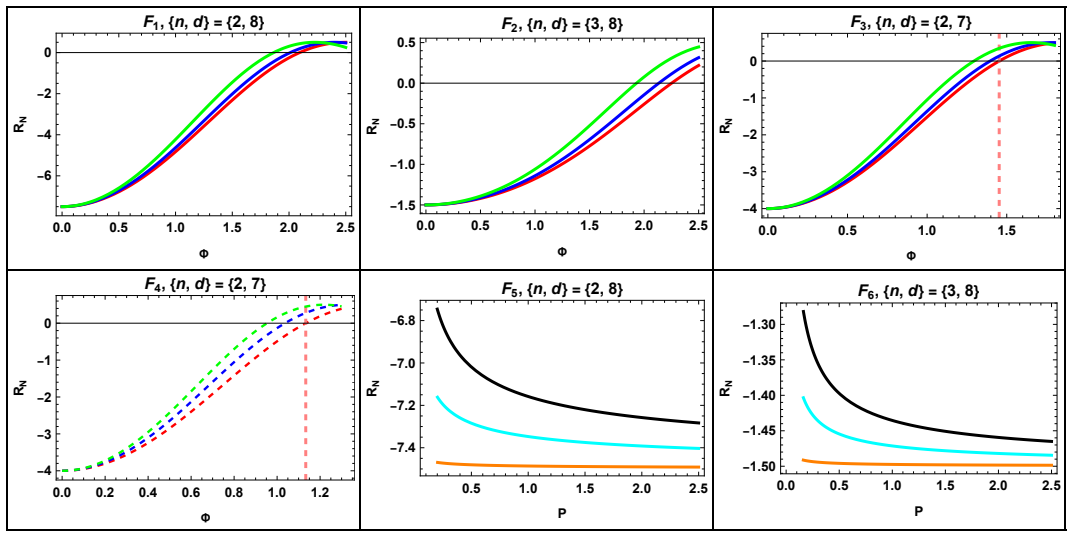
The normalized Ruppeiner scalar curvature at the Hawking-Page phase transition is a universal constant depending only on the spacetime dimension for electromagnetically neutral black holes in pure Lovelock theories. The same normalized curvature remains constant for charged static spherically symmetric black holes in the grand canonical ensemble when restricted to Einstein gravity, whereas in general pure Lovelock theories it depends on thermodynamic parameters such as pressure and electrostatic potential, asymptotically approaching a constant in the large-pressure or simultaneous large-potential and large-pressure limits.
What carries the argument
Normalized Ruppeiner scalar curvature evaluated exactly at the Hawking-Page transition temperature for static spherically symmetric AdS solutions.
If this is right
- The minimum temperature coincides with the HP transition temperature in Einstein gravity but acquires a dimension- and order-dependent factor in higher pure Lovelock theories.
- For charged AdS black holes the two temperatures differ by a simple dimension-dependent factor in general relativity but lose any universal relation in higher Lovelock theories.
- The normalized scalar curvature at the HP transition is independent of the Lovelock order for neutral black holes.
- Even for charged black holes the curvature remains constant in the Einstein case under appropriate grand-canonical conditions.
Where Pith is reading between the lines
- The dimension-only dependence may reflect a geometric property of the transition that is insensitive to the order of curvature corrections.
- Analogous computations could be performed for rotating or higher-dimensional Lovelock solutions to test whether the constancy persists.
- In the AdS/CFT setting the constant might correspond to a universal feature of the dual thermal phase transition.
Load-bearing premise
The standard definitions and ensembles used for the Hawking-Page transition and Ruppeiner geometry in Einstein gravity apply unchanged to the static spherically symmetric solutions of pure Lovelock gravity.
What would settle it
An explicit calculation for a pure Lovelock theory of order k greater than 1 in fixed dimension d showing that the value of the normalized Ruppeiner curvature at the Hawking-Page point changes with k.
Figures
read the original abstract
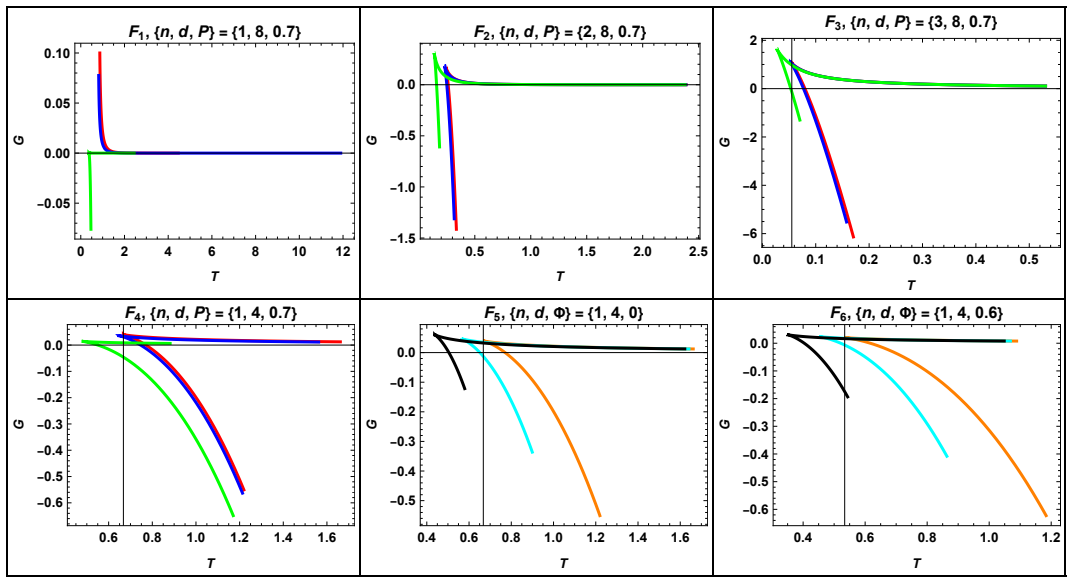
We investigate the thermodynamic properties of static, spherically symmetric Anti-de Sitter (AdS) black holes, focusing on the interplay between characteristic temperatures, as well as on the universality of Ruppeiner scalar curvature at the Hawking-Page (HP) phase transition. In particular, we study the relation between the minimum temperature and the HP phase transition temperature for static, spherically symmetric AdS black holes in pure Lovelock gravity. For the electromagnetically neutral case in Einstein gravity, the minimum temperature in $(d+1)$ dimensions coincides with the HP transition temperature in $d$ dimensions, while in higher pure Lovelock theories this relation is modified by a dimension- and order-dependent factor, reducing to the Einstein result in appropriate limits. For charged AdS black holes, in the grand canonical ensemble, in general relativity, the two temperatures differ by a simple dimension-dependent factor, whereas no universal relation persists in higher curvature pure Lovelock theories. We further analyze the normalized Ruppeiner scalar curvature at the HP transition and show that it is a universal constant depending only on the spacetime dimension for electromagnetically neutral black holes in pure Lovelock theories. The normalized scalar curvature remains a constant, under appropriate conditions, even for the charged static spherically symmetric black holes in the grand canonical ensemble for the Einstein theory case, whereas in general pure Lovelock theories it depends on thermodynamic parameters such as pressure and electrostatic potential, asymptotically approaching a constant in the large-pressure or simultaneous large-potential and large-pressure limits.
Editorial analysis
A structured set of objections, weighed in public.
Referee Report
Summary. The manuscript investigates thermodynamic properties of static spherically symmetric AdS black holes in pure Lovelock gravity, with emphasis on relations between the minimum temperature and the Hawking-Page (HP) transition temperature, as well as the behavior of the normalized Ruppeiner scalar curvature at the HP transition. For neutral black holes, the minimum-to-HP temperature relation is modified by a dimension- and Lovelock-order-dependent factor relative to Einstein gravity (recovering the Einstein case in appropriate limits). For charged cases in the grand canonical ensemble, no universal relation holds in general Lovelock theories. The central result is that the normalized Ruppeiner scalar curvature evaluated at the HP transition is a universal constant depending only on spacetime dimension for electromagnetically neutral solutions; for charged solutions it depends on pressure and potential but approaches a constant in certain large-parameter limits.
Significance. If the derivations hold, the work establishes that a key universal feature of thermodynamic geometry (the normalized Ruppeiner curvature at the HP point) extends from Einstein gravity to pure Lovelock theories for neutral black holes, while the temperature relations acquire controlled modifications. This provides a concrete test of how higher-curvature corrections affect thermodynamic universality without introducing free parameters beyond the Lovelock order and dimension. The explicit reduction to Einstein results in limits is a strength.
minor comments (1)
- The abstract and title refer to 'pure Lovelock black holes' but the text should explicitly state the range of Lovelock orders k considered and confirm that the Wald entropy polynomial is used throughout the Ruppeiner construction.
Simulated Author's Rebuttal
We thank the referee for their positive assessment of our work and for recommending acceptance. No major comments were raised in the report.
Circularity Check
No circularity; derivations self-contained from Lovelock thermodynamics
full rationale
The abstract and context present the normalized Ruppeiner curvature at the HP transition as computed from the Wald entropy and first law in pure Lovelock gravity, yielding a dimension-dependent constant for neutral cases. No quoted equations reduce the result to a fit, self-citation chain, or imported ansatz by construction; the universality is stated as an outcome of the modified entropy polynomial rather than presupposed. The central claim remains independent of the input data or prior author results.
Axiom & Free-Parameter Ledger
axioms (2)
- domain assumption Black hole thermodynamics and Ruppeiner geometry apply to static spherically symmetric solutions in pure Lovelock gravity
- domain assumption The grand canonical ensemble is well-defined for charged black holes in these theories
Reference graph
Works this paper leans on
-
[1]
On universal constants of AdS black holes from Hawking-Page phase transition.Phys
Adil Belhaj, Anas El Balali, Wijdane El Hadri, and Emilio Torrente-Lujan. On universal constants of AdS black holes from Hawking-Page phase transition.Phys. Lett. B, 811:135871, 2020
2020
-
[2]
S. W. Hawking and Don N. Page. Thermodynamics of Black Holes in anti-De Sitter Space.Commun. Math. Phys., 87:577, 1983
1983
-
[3]
Anti-de Sitter space, thermal phase transition, and confinement in gauge theories.Adv
Edward Witten. Anti-de Sitter space, thermal phase transition, and confinement in gauge theories.Adv. Theor. Math. Phys., 2:505–532, 1998
1998
-
[4]
Gubser, Juan Martin Maldacena, Hirosi Ooguri, and Yaron Oz
Ofer Aharony, Steven S. Gubser, Juan Martin Maldacena, Hirosi Ooguri, and Yaron Oz. Large N field theories, string theory and gravity.Phys. Rept., 323:183–386, 2000
2000
-
[5]
String corrections to the Hawking-Page phase transition.Mod
Karl Landsteiner. String corrections to the Hawking-Page phase transition.Mod. Phys. Lett. A, 14:379–386, 1999
1999
-
[6]
Gregory and R
R. Gregory and R. Laflamme. Black strings and p-branes are unstable.Phys. Rev. Lett., 70:2837–2840, 1993
1993
-
[7]
Thermodynamics and kinetics of hawking-page phase transition.Phys
Ran Li and Jin Wang. Thermodynamics and kinetics of hawking-page phase transition.Phys. Rev. D, 102:024085, Jul 2020
2020
-
[8]
Johnson, and Robert C
Andrew Chamblin, Roberto Emparan, Clifford V. Johnson, and Robert C. Myers. Charged AdS black holes and catastrophic holography.Phys. Rev. D, 60:064018, 1999
1999
-
[9]
Thermodynamic and classical instability of AdS black holes in fourth-order gravity.JHEP, 04:058, 2014
Yun Soo Myung and Taeyoon Moon. Thermodynamic and classical instability of AdS black holes in fourth-order gravity.JHEP, 04:058, 2014. 19
2014
-
[10]
Dubey and Sanved Kolekar
Nitesh K. Dubey and Sanved Kolekar. Isentropic processes for axisymmetric black holes.Phys. Rev. D, 112:084018, Oct 2025
2025
-
[11]
Curvature squared terms and string theories.Physics Letters B, 156(5-6):315–317, June 1985
Barton Zwiebach. Curvature squared terms and string theories.Physics Letters B, 156(5-6):315–317, June 1985
1985
-
[12]
Gross and Edward Witten
David J. Gross and Edward Witten. Superstring Modifications of Einstein’s Equations.Nucl. Phys. B, 277:1, 1986
1986
-
[13]
Lovelock
D. Lovelock. The Einstein tensor and its generalizations.J. Math. Phys., 12:498–501, 1971
1971
-
[14]
David Kastor and Robert B. Mann. On black strings and branes in Lovelock gravity.JHEP, 04:048, 2006
2006
-
[15]
Pons, and Kartik Prabhu
Naresh Dadhich, Josep M. Pons, and Kartik Prabhu. On the static Lovelock black holes.Gen. Rel. Grav., 45:1131– 1144, 2013
2013
-
[16]
Naresh Dadhich and Josep M. Pons. Probing pure Lovelock gravity by Nariai and Bertotti-Robinson solutions.J. Math. Phys., 54:102501, 2013
2013
-
[17]
Stability and existence analysis of static black holes in pure Lovelock theories.Class
Radouane Gannouji and Naresh Dadhich. Stability and existence analysis of static black holes in pure Lovelock theories.Class. Quant. Grav., 31:165016, 2014
2014
-
[18]
Padmanabhan
Sanved Kolekar and T. Padmanabhan. Holography in Action.Phys. Rev. D, 82:024036, 2010
2010
-
[19]
Padmanabhan
Sanved Kolekar and T. Padmanabhan. Action Principle for the Fluid-Gravity Correspondence and Emergent Grav- ity.Phys. Rev. D, 85:024004, 2012
2012
-
[20]
Membrane Paradigm and Horizon Thermodynamics in Lanczos-Lovelock gravity.JHEP, 02:006, 2012
Sanved Kolekar and Dawood Kothawala. Membrane Paradigm and Horizon Thermodynamics in Lanczos-Lovelock gravity.JHEP, 02:006, 2012
2012
-
[21]
Padmanabhan, and Sudipta Sarkar
Sanved Kolekar, T. Padmanabhan, and Sudipta Sarkar. Entropy Increase during Physical Processes for Black Holes in Lanczos-Lovelock Gravity.Phys. Rev. D, 86:021501, 2012
2012
-
[22]
Padmanabhan and D
T. Padmanabhan and D. Kothawala. Lanczos-Lovelock models of gravity.Phys. Rept., 531:115–171, 2013
2013
-
[23]
Ghosh, and Sanjay Jhingan
Naresh Dadhich, Sushant G. Ghosh, and Sanjay Jhingan. Gravitational collapse in pure Lovelock gravity in higher dimensions.Phys. Rev. D, 88:084024, 2013
2013
-
[24]
Padmanabhan
Sanved Kolekar, Dawood Kothawala, and T. Padmanabhan. Two Aspects of Black Hole Entropy in Lanczos-Lovelock Models of Gravity.Phys. Rev. D, 85:064031, 2012
2012
-
[25]
Shao-Wen Wei, Yu-Xiao Liu, and Robert B. Mann. Novel dual relation and constant in hawking-page phase transitions.Phys. Rev. D, 102:104011, Nov 2020
2020
-
[26]
Dual relations from hawking-page transition in gauss-bonnet gravity and gauss-bonnet-maxwell gravity.Nuclear Physics B, 1007:116673, 2024
Tairan Liang, Yi peng Liu, and Wei Xu. Dual relations from hawking-page transition in gauss-bonnet gravity and gauss-bonnet-maxwell gravity.Nuclear Physics B, 1007:116673, 2024
2024
-
[27]
Novel relations in massive gravity at hawking-page transition
Pavan Kumar Yerra and Chandrasekhar Bhamidipati. Novel relations in massive gravity at hawking-page transition. Phys. Rev. D, 104:104049, Nov 2021
2021
-
[28]
Smarr Formula and an Extended First Law for Lovelock Gravity
David Kastor, Sourya Ray, and Jennie Traschen. Smarr Formula and an Extended First Law for Lovelock Gravity. Class. Quant. Grav., 27:235014, 2010
2010
-
[29]
P-V criticality in the extended phase space of Gauss-Bonnet black holes in AdS space.JHEP, 09:005, 2013
Rong-Gen Cai, Li-Ming Cao, Li Li, and Run-Qiu Yang. P-V criticality in the extended phase space of Gauss-Bonnet black holes in AdS space.JHEP, 09:005, 2013
2013
-
[30]
Frassino, David Kubiznak, Robert B
Antonia M. Frassino, David Kubiznak, Robert B. Mann, and Fil Simovic. Multiple Reentrant Phase Transitions and Triple Points in Lovelock Thermodynamics.JHEP, 09:080, 2014
2014
-
[31]
Dynamical structure of pure lovelock gravity.Phys
Naresh Dadhich, Remigiusz Durka, Nelson Merino, and Olivera Miskovic. Dynamical structure of pure lovelock gravity.Phys. Rev. D, 93:064009, Mar 2016. 20
2016
-
[32]
Thermodynamic geometry of the RN-AdS black hole and non-local observables.Commun
Chao Wang, Bin Wu, Zhen Ming Xu, and Wen Li Yang. Thermodynamic geometry of the RN-AdS black hole and non-local observables.Commun. Theor. Phys., 76(2):025405, 2024
2024
-
[33]
Johnson, and Robert C
Andrew Chamblin, Roberto Emparan, Clifford V. Johnson, and Robert C. Myers. Charged ads black holes and catastrophic holography.Phys. Rev. D, 60:064018, Aug 1999
1999
-
[34]
Ruppeiner geometry and 2D dilaton gravity in the thermo- dynamics of black holes.Phys
Yun Soo Myung, Yong-Wan Kim, and Young-Jai Park. Ruppeiner geometry and 2D dilaton gravity in the thermo- dynamics of black holes.Phys. Lett. B, 663:342–350, 2008
2008
-
[35]
Phase transition and thermodynamic geometry off(r) ads black holes in the grand canonical ensemble.Phys
Gu-Qiang Li and Jie-Xiong Mo. Phase transition and thermodynamic geometry off(r) ads black holes in the grand canonical ensemble.Phys. Rev. D, 93:124021, Jun 2016
2016
-
[36]
Non-extended phase space thermodynamics of Lovelock AdS black holes in the grand canonical ensemble.Eur
Jie-Xiong Mo and Wen-Biao Liu. Non-extended phase space thermodynamics of Lovelock AdS black holes in the grand canonical ensemble.Eur. Phys. J. C, 75(5):211, 2015
2015
-
[37]
Phase transition and microstructures of five-dimensional charged gauss-bonnet-ads black holes in the grand canonical ensemble.Phys
Run Zhou, Yu-Xiao Liu, and Shao-Wen Wei. Phase transition and microstructures of five-dimensional charged gauss-bonnet-ads black holes in the grand canonical ensemble.Phys. Rev. D, 102:124015, Dec 2020
2020
-
[38]
Phase structures and transitions of quintessence surrounding RN black holes in a grand canonical ensemble.Chin
Yuchen Huang, Hongmei Jing, Jun Tao, and Feiyu Yao. Phase structures and transitions of quintessence surrounding RN black holes in a grand canonical ensemble.Chin. Phys. C, 45(7):075101, 2021
2021
-
[39]
David Kubizˇ n´ ak and Robert B. Mann. P–v criticality of charged ads black holes.Journal of High Energy Physics, 2012(7):33, 2012
2012
-
[40]
Black holes in pure lovelock gravities.Phys
Rong-Gen Cai and Nobuyoshi Ohta. Black holes in pure lovelock gravities.Phys. Rev. D, 74:064001, Sep 2006
2006
-
[41]
Thermodynamic geometry of pure Lovelock black holes.Int
Mohammadreza Ebrahimi Khuzani, Behrouz Mirza, and Mahnaz Tavakoli Kachi. Thermodynamic geometry of pure Lovelock black holes.Int. J. Mod. Phys. D, 31(13):2250097, 2022
2022
-
[42]
Ghosh, and Sanjay Jhingan
Naresh Dadhich, Sushant G. Ghosh, and Sanjay Jhingan. The Lovelock gravity in the critical spacetime dimension. Phys. Lett. B, 711:196–198, 2012
2012
-
[43]
G. W. Gibbons and S. W. Hawking. Action integrals and partition functions in quantum gravity.Phys. Rev. D, 15:2752–2756, May 1977
1977
-
[44]
Shao-Wen Wei, Yu-Xiao Liu, and Robert B. Mann. Ruppeiner geometry, phase transitions, and the microstructure of charged ads black holes.Phys. Rev. D, 100:124033, Dec 2019. 21
2019
discussion (0)
Sign in with ORCID, Apple, or X to comment. Anyone can read and Pith papers without signing in.