Wetting as an emergent property of water: reformulating Young equation on molecular grounds
Pith reviewed 2026-06-29 00:07 UTC · model grok-4.3
The pith
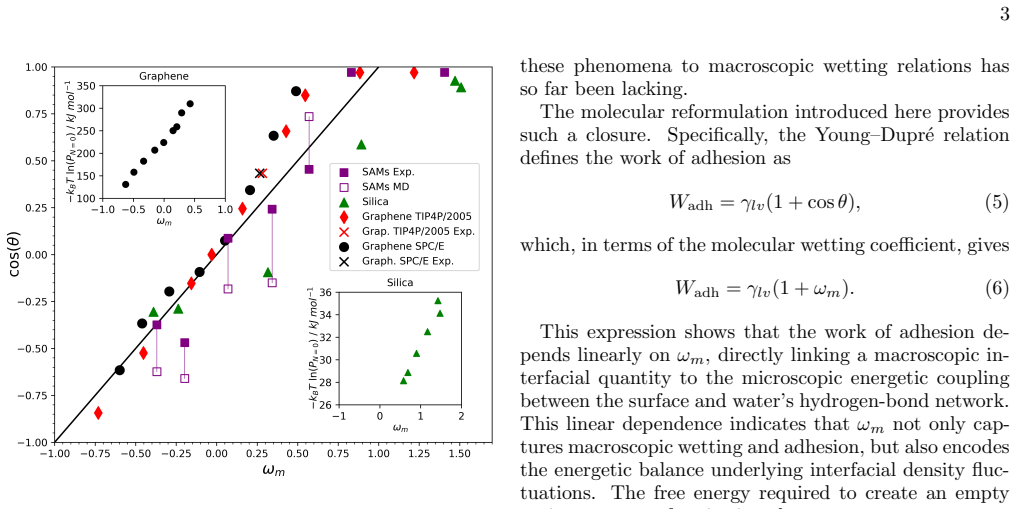
A molecular wetting coefficient collapses contact angles from chemically diverse surfaces onto one universal curve.
A machine-rendered reading of the paper's core claim, the machinery that carries it, and where it could break.
Core claim
Macroscopic contact angles collapse onto a single universal master curve when expressed through the molecular wetting coefficient omega_m across a broad and continuous spectrum of hydrophilicities spanning chemically diverse experimental and model surfaces, establishing wetting as an emergent property of water anchored to its intrinsic hydrogen-bond energetic scales.
What carries the argument
The molecular wetting coefficient omega_m, defined as the compensation of hydrogen-bond defects at the interface relative to bulk water.
If this is right
- Young and Young-Dupre relations close on energetic grounds without additional parameters.
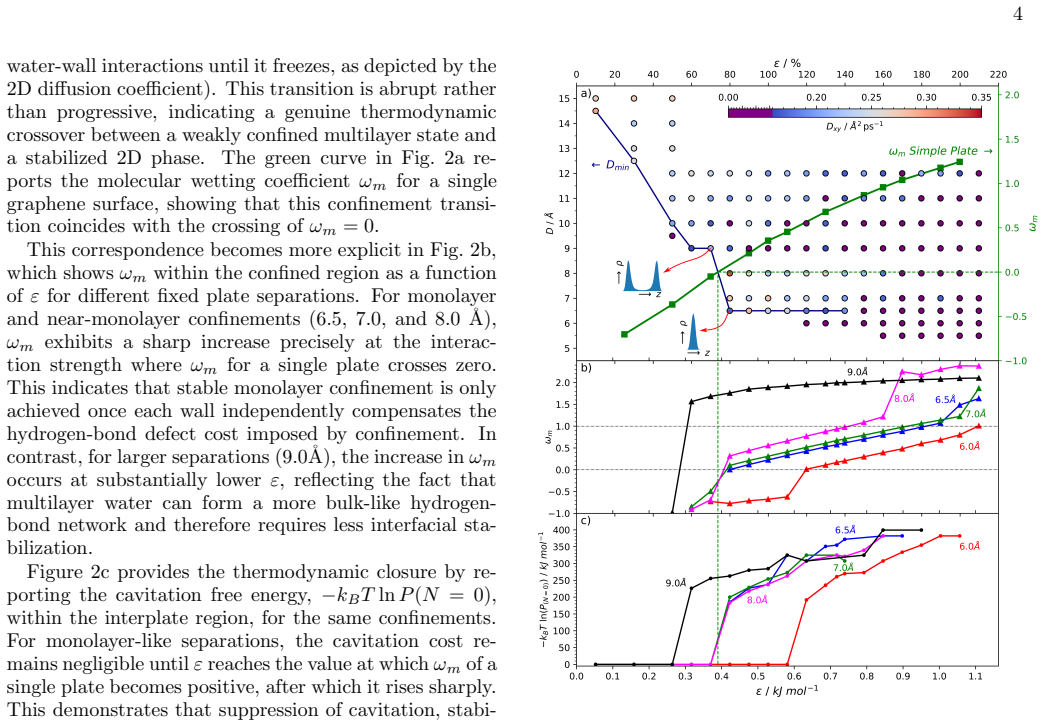
- A single coefficient links wetting, adhesion, cavitation, and nanoconfined filling.
- The framework supplies a transferable route to design aqueous interfaces from molecular energetics.
Where Pith is reading between the lines
- Surfaces sharing the same omega_m value should exhibit identical wetting regardless of their chemical makeup.
- The same coefficient could predict thresholds for cavitation or capillary filling in confined geometries.
- Direct computation of omega_m from molecular simulations alone would allow pre-experimental screening of candidate surfaces.
Load-bearing premise
The molecular wetting coefficient can be defined and evaluated for arbitrary surfaces independently of the contact-angle data used to test the master curve.
What would settle it
A new surface whose independently computed omega_m predicts a contact angle that deviates from the observed master-curve position.
Figures
read the original abstract
Young equation provides a remarkably successful macroscopic description of wetting, yet its molecular origin (particularly for water) has remained elusive for over two centuries. Here we make the molecular basis of aqueous wetting explicit by reformulating it in terms of a molecular wetting coefficient, omega m, which quantifies how an interface compensates the intrinsic energetic cost of hydrogen-bond defects relative to bulk water. Across a broad and continuous spectrum of hydrophilicities, spanning chemically diverse experimental and model surfaces, macroscopic contact angles collapse onto a single universal master curve when expressed through omega m. This molecular reformulation closes Young and Young-Dupre relations on energetic grounds, establishing a unified and predictive physical link between wetting, adhesion, cavitation, and nanoconfined filling. By anchoring interfacial behavior to waters intrinsic hydrogen-bond energetic scales, our results reveal wetting as an emergent property of water itself, rather than a surface-specific attribute and provide a transferable molecular framework that recalibrates energetic intuition and guides the rational design of aqueous interfaces. (This document is the unedited Author version of a Submitted Manuscript subsequently accepted for publication in J. Am. Chem. Soc. For the published version, which includes a more complete molecular-thermodynamics grounding of the method see the published version)
Editorial analysis
A structured set of objections, weighed in public.
Referee Report
Summary. The manuscript claims that a molecular wetting coefficient omega_m, defined to quantify compensation of hydrogen-bond defects at interfaces relative to bulk water, allows macroscopic contact angles theta to collapse onto a single universal master curve across chemically diverse experimental and model surfaces, thereby reformulating the Young equation on molecular grounds and establishing wetting as an emergent property of water with links to adhesion, cavitation, and nanoconfined filling.
Significance. If omega_m can be shown to be computed independently from molecular-scale quantities without reference to macroscopic theta, the result would offer a predictive, transferable framework anchoring interfacial behavior to water's intrinsic hydrogen-bond energetics rather than surface-specific attributes, with potential to unify several wetting-related phenomena.
major comments (2)
- [Abstract] Abstract: The central claim of a data collapse onto a master curve is asserted without any equations defining omega_m, without error bars, exclusion criteria for surfaces, or validation protocol against independent measurements, so the collapse cannot be checked from the given information.
- [Abstract] Abstract: The manuscript must explicitly demonstrate that omega_m for experimental surfaces is obtained solely from molecular-scale hydrogen-bond compensation metrics (without any input from or fitting to measured contact angles or the Young equation); otherwise the unification is circular by construction rather than emergent.
minor comments (1)
- [Abstract] The parenthetical note at the end of the abstract about the published version is meta-information that belongs in the cover letter rather than the manuscript text.
Simulated Author's Rebuttal
We thank the referee for their constructive comments on our manuscript. We have revised the abstract and added explicit clarifications in the main text to address the concerns about definitional completeness and independence of ω_m. Our responses to the major comments are provided below.
read point-by-point responses
-
Referee: [Abstract] Abstract: The central claim of a data collapse onto a master curve is asserted without any equations defining omega_m, without error bars, exclusion criteria for surfaces, or validation protocol against independent measurements, so the collapse cannot be checked from the given information.
Authors: We agree the abstract is necessarily concise. The revised version now includes the defining relation for ω_m (the ratio of interfacial to bulk hydrogen-bond defect energies) and references the full protocol. Error bars, surface exclusion criteria (e.g., exclusion of surfaces with unknown chemistry or non-aqueous contaminants), and validation against independent θ measurements are all detailed in the Methods and Results sections of the paper; the abstract now points readers to these elements. revision: yes
-
Referee: [Abstract] Abstract: The manuscript must explicitly demonstrate that omega_m for experimental surfaces is obtained solely from molecular-scale hydrogen-bond compensation metrics (without any input from or fitting to measured contact angles or the Young equation); otherwise the unification is circular by construction rather than emergent.
Authors: ω_m is defined exclusively from molecular-scale hydrogen-bond compensation: for model surfaces it is computed directly from MD trajectories as the excess defect energy at the interface relative to bulk; for experimental surfaces it is obtained from independent molecular descriptors (surface functional-group density and hydrogen-bond strengths taken from quantum-chemical calculations or spectroscopic data) with no reference to measured θ or the Young equation. The master-curve collapse is therefore a derived result. The revised manuscript adds an explicit paragraph stating this independence and the computational protocol used. revision: yes
Circularity Check
No significant circularity detected; derivation self-contained on molecular definition
full rationale
The abstract introduces omega_m explicitly as a quantifier of hydrogen-bond defect compensation relative to bulk water and reports that contact angles collapse onto a master curve when expressed through it. No equations, protocols, or descriptions are supplied that would indicate omega_m is obtained by fitting or calibration against the same macroscopic contact-angle data it later organizes. The claimed unification is therefore presented as an independent molecular reformulation rather than a reduction to its inputs by construction. This is the most common honest outcome when load-bearing steps cannot be shown to collapse tautologically.
Axiom & Free-Parameter Ledger
free parameters (1)
- omega_m
axioms (2)
- domain assumption The macroscopic Young equation remains valid and can be closed by a molecular energetic coefficient
- domain assumption Hydrogen-bond defects carry a well-defined intrinsic energetic cost relative to bulk water that can be compared across interfaces
invented entities (1)
-
molecular wetting coefficient omega_m
no independent evidence
Reference graph
Works this paper leans on
-
[1]
Young,An Essay on the Cohesion of Fluids, Philos
T. Young,An Essay on the Cohesion of Fluids, Philos. Trans. R. Soc. Lond.95, 65–87 (1805)
-
[2]
Dupr´ e,Th´ eorie m´ ecanique de la chaleur, Gauthier- Villars (1869)
A. Dupr´ e,Th´ eorie m´ ecanique de la chaleur, Gauthier- Villars (1869)
-
[3]
D. Bonn, J. Eggers, J. Indekeu, J. Meunier, and E. Rol- ley,Wetting and spreading, Rev. Mod. Phys.81, 739–805 (2009)
2009
-
[4]
J. N. Israelachvili,Intermolecular and Surface Forces, 3rd ed. (Academic Press, London, 2011)
2011
-
[5]
de Gennes,Wetting: statics and dynamics, Rev
P.-G. de Gennes,Wetting: statics and dynamics, Rev. Mod. Phys.57, 827–863 (1985)
1985
-
[6]
Li et al.,Effect of airborne contaminants on the wet- tability of supported graphene and graphite,Nat
Z. Li et al.,Effect of airborne contaminants on the wet- tability of supported graphene and graphite,Nat. Mater., 12, 925–931 (2013)
2013
-
[7]
Giacomello, L
A. Giacomello, L. Schimmele, and S. Dietrich,Wetting hysteresis induced by nanodefects, Proc. Natl. Acad. Sci. U.S.A.113, E262–E271 (2016)
2016
-
[8]
Y. Si, C. Yu, Z. Dong, and L. Jiang,Wetting and spread- ing: Fundamental theories to cutting-edge applications, Curr. Opin. Colloid Interface Sci.36, 10–19 (2018)
2018
-
[9]
Chandler,Interfaces and the driving force of hy- drophobic assembly, Nature437, 640–647 (2005)
D. Chandler,Interfaces and the driving force of hy- drophobic assembly, Nature437, 640–647 (2005)
2005
-
[10]
Giovambattista, P
N. Giovambattista, P. J. Rossky, and P. G. Debenedetti, Computational studies of pressure, temperature, and sur- face effects on the structure and thermodynamics of con- fined water, Annu. Rev. Phys. Chem.63, 179–200 (2012)
2012
-
[11]
N. B. Rego and A. J. Patel,Understanding hydrophobic effects: Insights from water density fluctuations, Annu. Rev. Condens. Matter Phys.13, 303–324 (2022)
2022
-
[12]
K. Lum, D. Chandler, and J. D. Weeks,Hydrophobicity at small and large length scales, J. Phys. Chem. B103, 4570–4577 (1999). 6
1999
-
[13]
K. A. Dill, S. B. Ozkan, M. S. Shell, and T. R. Weikl,The protein-folding problem, Annu. Rev. Biophys.37, 289– 316 (2008)
2008
-
[14]
Luzar and D
A. Luzar and D. Chandler,Hydrogen-bond kinetics in liq- uid water, Nature379, 55–57 (1996)
1996
-
[15]
F. H. Stillinger,Water revisited, Science209, 451–457 (1980)
1980
-
[16]
N. A. Loubet, A. R. Verde and G. A. Appignanesi,A water structure indicator suitable for generic contexts: Two-liquid behavior at hydration and nanoconfinement conditions and a molecular approach to hydrophobicity and wetting, J. Chem. Phys.160, 144502 (2024)
2024
-
[17]
N. A. Loubet, A. R. Verde and G. A. Appignanesi,The nature of water interactions and the molecular signatures of hydrophobicity, J. Chem. Phys.162, 244703 (2025)
2025
-
[18]
J. M. Montes de Oca, F. Sciortino and G. A. Appignanesi, A structural indicator for water built upon potential en- ergy considerations, J. Chem. Phys.152, 244503 (2020)
2020
-
[19]
A. J. Patel, P. V´ arilly, and D. Chandler,Fluctuations of water near extended hydrophobic and hydrophilic sur- faces, J. Phys. Chem. B114, 1632–1637 (2010)
2010
-
[20]
Tinti, A
A. Tinti, A. Giacomello, Y. Grosu, and C. M. Cas- ciola,Intrusion and extrusion of water in hydrophobic nanopores, Proc. Natl. Acad. Sci. U.S.A.114, E10266– E10273 (2017)
2017
-
[21]
Godawat, S
R. Godawat, S. N. Jamadagni, and S. Garde,Character- izing hydrophobicity of interfaces by using cavity forma- tion, solute binding, and water correlations, Proc. Natl. Acad. Sci. U. S. A.106, 15119–15124 (2009)
2009
-
[22]
G. B. Sigal, M. Mrksich, and G. M. Whitesides,Effect of surface wettability on the adsorption of proteins and detergents, J. Am. Chem. Soc.120, 3464–3473 (1998)
1998
-
[23]
Werder, J
T. Werder, J. H. Walther, R. L. Jaffe, T. Halicioglu and P. Koumoutsakos,On the Water-Carbon Interaction for Use in Molecular Dynamics Simulations of Graphite and Carbon Nanotube, J. Phys. Chem. B107, 1345–1352 (2003)
2003
-
[24]
W loch, A
J. W loch, A. Terzyk and P. Kowalczyk,New forcefield for water nanodroplet on a graphene surface, Chem. Phys. Lett.,674, 98–102 (2017)
2017
-
[25]
Giovambattista, P
N. Giovambattista, P. G. Debenedetti and P. J. Rossky Effect of Surface Polarity on Water Contact Angle and Interfacial Hydration Structure, J. Phys. Chem. B111, 9581–9587 (2007)
2007
discussion (0)
Sign in with ORCID, Apple, or X to comment. Anyone can read and Pith papers without signing in.