REVIEW 4 major objections 5 minor 51 references
SafeDriveRAG: Towards Safe Autonomous Driving with Knowledge Graph-based Retrieval-Augmented Generation
T0 review · 4 major / 5 minor · reviewed 2026-08-06 · deepseek-v4-flash
Pith's one-line read This paper argues that small vision-language models are not yet safe enough for driving, and that a plug-in knowledge-graph retriever measurably closes part of the gap.
desk verdict Useful benchmark, but the +14.57% commonsense RAG gain is likely inflated by test/retrieval corpus overlap, so the safety-reasoning claim needs a leakage analysis before you trust it. read the letter →
The pith
A machine-rendered reading of the paper's core claim, the machinery that carries it, and where it could break.
The reading
What carries the argument
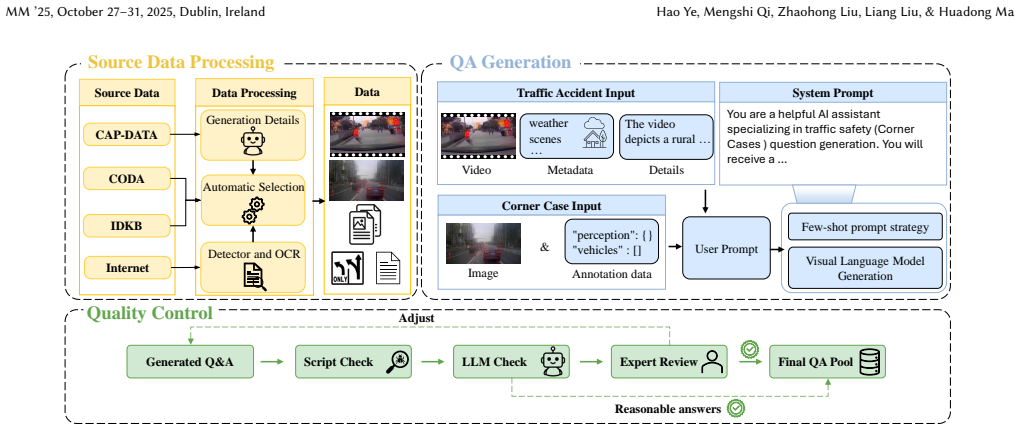
The load-bearing object is a heterogeneous knowledge graph $G=(V_e,V_i,V_c,E_{ee},E_{ec})$ whose nodes are entity nodes, image entity nodes, and text chunk nodes, with edges linking entities to entities and entities to chunks. Retrieval runs at multiple scales: a VLM extracts keywords from the query, keyword-entity similarity selects anchor nodes, a bounded $h$-hop expansion gathers candidate entities, and a weighted chunk score $S(c)=\alpha\sum_v s(q,v)\lambda^{k_v}+(1-\alpha)s(q,c)$ combines entity-level and chunk-level relevance to pick the top-$k$ context that is injected into the VLM. The benchmark construction is the second mechanism: a semi-automated pipeline that converts videos, images, and documents into question-answer pairs through few-shot prompting, script checks, LLM-based consistency review, and expert review of flagged items.
What would settle it
Take a random sample of Traffic Safety Commonsense questions, remove their source passages from the retrieval corpus, and re-run SafeDriveRAG; if scores drop sharply toward the no-RAG baseline, the reported gain is largely retrieval leakage. A complementary check is a human audit of a random sample of benchmark labels to measure how often the LLM-generated ground truth is unsupported by the source material.
Extended reading notes
Core claim
The central claim is that mainstream VLMs under 7B parameters lack the specialized knowledge needed for high-reliability traffic-safety reasoning, and that a substantial part of this gap is a knowledge-access problem rather than a pure model-capacity problem. SafeDriveRAG is presented as closing part of that gap: it builds a heterogeneous multimodal knowledge graph from internet-collected traffic-safety documents, then uses a multi-scale subgraph retrieval algorithm to extract keywords from the question, anchor entity nodes by semantic similarity, expand along graph edges, and pass the top-ranked entities, images, and chunks into the VLM prompt. The paper reports consistent gains across five open VLMs, with the largest improvement in traffic safety commonsense (+14.57), and shows that a 3B model with RAG can approach the performance of a 7B model without it. The paper also claims SafeDrive228K is the first large-scale multimodal QA benchmark focused on traffic safety, covering real accident videos, real corner-case images, and commonsense driving knowledge in 18 sub-tasks.
Load-bearing premise
The benchmark's ground-truth answers are mostly auto-generated by a large language model and only partially expert-checked, and the commonsense questions and the retrieval corpus come from the same internet driving documents and IDKB, so the measured RAG gains could partly be answer leakage rather than improved safety reasoning.
Editorial extensions
If this is right
- Smaller VLMs become materially safer on knowledge-heavy driving questions when given retrieved context, so a 3B model with RAG can approach a 7B model without it.
- Traffic safety commonsense benefits most from retrieval, suggesting that factual driving knowledge, not just perception, is a bottleneck for small VLMs.
- The benchmark provides a standardized 18-sub-task test for comparing VLMs on accident response, corner-case handling, and commonsense driving knowledge.
- Graph-based retrieval offers a middle ground between naive text-block RAG and heavier graph traversal, with the reported trade-off favoring SafeDriveRAG over MiniRAG in accuracy and over Naive RAG in structure awareness.
Reading between the lines
- Because the commonsense test questions and the retrieval corpus are both derived from the same internet driving documents and IDKB, a portion of the reported gains could be answer leakage; a held-out split where test sources are excluded from the corpus would settle this.
- The same graph-RAG plug-in could transfer to other safety-critical domains with structured manuals, such as aviation, medicine, or industrial operations, wherever a VLM must recall procedural knowledge under pressure.
- The practical value for autonomous driving depends on end-to-end latency, since the reported retrieval times are computed on a server-side vector index and may not reflect onboard constraints.
- If the gains hold up under leakage-controlled conditions, the method offers a path to keep lightweight in-vehicle models current without retraining: update the knowledge graph when regulations or safety guidelines change.
Editorial analysis
A structured set of objections, weighed in public.
Referee Report
Summary. The paper introduces SafeDrive228K, a 228K-pair multimodal VQA benchmark spanning traffic accident videos, corner-case images, and traffic safety commonsense questions, together with SafeDriveRAG, a graph-based retrieval-augmented generation method built on a multimodal knowledge graph and a multi-scale subgraph retrieval module. The authors evaluate five open-source VLMs under 7B parameters with and without SafeDriveRAG, reporting average SafeDrive Score gains of +4.73, +8.79, and +14.57 percentage points across the three sub-tasks, and claim that SafeDrive228K is the first large-scale multimodal QA benchmark for traffic safety.
Significance. If the evaluation is trustworthy, the paper would provide a broadly useful safety-focused benchmark and a plug-and-play RAG baseline for small VLMs. The strengths include the construction of a large benchmark anchored in real accident videos and corner-case images, explicit coverage of safety sub-tasks that existing driving QA datasets underweight, a concrete and reasonably motivated retrieval pipeline, and evaluation across five VLMs of practical deployment size. The release of source code and data is a concrete asset. However, the validity of the central empirical claim depends on separating the RAG corpus from the test set, which the current construction described in §3.2 does not convincingly do.
major comments (4)
- [§3.2 Dataset Construction] The document split creates a direct overlap between the RAG corpus and the commonsense test set. After OCR, documents are categorized into 'Traffic Safety Commonsense Documents' and 'Traffic Safety Commonsense Driving Test Documents,' with the former used as RAG references and the latter used for evaluation. The text then states that 'we integrated the driving manuals and test data from IDKB into these two document sets.' Because the commonsense Q&A pairs are generated by reorganizing the Driving Test Documents, gold answers are likely to be present verbatim or near-verbatim in the same IDKB content placed into the retrieval corpus. This makes the reported +14.57% Commonsense gain potentially a measure of retrieval and copying rather than improved safety reasoning. This concern lands. Please quantify the overlap between gold answers and retrieved chunks (for example, exact or near-duplicate rates), report oracle passage recall, or construct a clean split in which the IDKB test questions are excluded from the retrieval corpus.
- [§5.2 Evaluation Metrics and Table 2] The abstract and §5.3 use the word 'significantly' for the RAG gains, but Table 2 reports only point estimates with no error bars, confidence intervals, or significance tests. In addition, open-ended answers are scored automatically with ROUGE and SEMScore against LLM-written reference answers; RAG changes answer style, so part of the open-ended gain may reflect stylistic similarity to the reference rather than factual correctness. Please report standard deviations across question subsets, pairwise significance tests for the RAG versus non-RAG comparison, and a human evaluation on a random sample of open-ended answers.
- [§5.4 Ablation Study of RAG] The ablation is reported on a 10% commonsense test set and gives SafeDriveRAG 62.07%, MiniRAG 61.26%, and Naïve RAG 60.18%, but it does not include a no-RAG baseline on the same split, so the 'trade-off' claim only compares retrieval methods against each other, not against the un-augmented VLM. The numbers also need clarification: the full-set Qwen2.5-vl-7B RAG result in Table 2 is 60.18%, while the ablation reports 62.07% for the same model, and retrieval times of 884.10 s and 9519.98 s are given without specifying whether these are totals over the test set or per-question latencies. Please clarify comparability, add the no-RAG baseline, and state the aggregation unit for retrieval time.
- [§3.2 Data Quality Control] Ground-truth answers are generated by an LLM, checked by GPT-4o-mini for 'logical consistency,' and only 'contentious items' receive expert review. Because the same gold labels are used to judge both base VLMs and RAG variants, label noise or answer-generation style bias can directly affect the measured gains. Please report the fraction of items flagged for expert review, the number of items actually corrected, and inter-annotator agreement or a sample audit of the final gold labels.
minor comments (5)
- [§5.1 and Table 2] The model name 'LLAVAA-OneVision' is a typo; it should be 'LLaVA-OneVision.' Table 2 also says bold highlights the better results, but no entries appear bold in the rendered table.
- [§5.2 Evaluation Metrics] The SafeDrive Score weighting is described only in prose; please provide the explicit formula and state whether multiple-choice accuracy and open-ended metrics are combined by counts or by normalized scores.
- [§3.3 Dataset Statistics] The text says the benchmark contains '9,331 traffic accident videos and 35K images,' but earlier sections give 9,768 corner-case images and 26K commonsense images; the sum is about 35K, yet the text should state the exact image counts for each subset to avoid ambiguity.
- [Figure 4] Figure 4 lacks axis labels and units; the y-axis is presumably SafeDrive Score but this should be stated explicitly in the caption.
- [§5.4 Ablation Study of RAG] Please specify whether the ablation uses the same hyperparameters as the main RAG configuration (top-k entity retrieval, chunk size, overlap, alpha, lambda) so that the comparison with Naïve RAG and MiniRAG is controlled.
Circularity Check
Commonsense RAG gain partly reduces to retrieval of answer-bearing source passages because the same IDKB/internet corpus supplies both the test Q&A and the RAG references.
-
self definitional
[Sec 3.2 (Dataset Construction, Source Data Processing) and Fig. 3 retrieval example]
"We then reorganized the extracted information from the driving test documents into a standardized question-answer format. Lastly, we integrated the driving manuals and test data from IDKB [22] into these two document sets. In this framework, the Traffic Safety Commonsense Documents serve as references for subsequent RAG tasks, whereas the Driving Test Documents are utilized for model evaluation."
The commonsense gold answers are produced by reorganizing the Driving Test Documents, while SafeDriveRAG retrieves from the Traffic Safety Commonsense Documents; the construction explicitly puts IDKB driving manuals and test data into both sets, so the two sides of the retrieval boundary share the same knowledge source. The Fig. 3 three-point-turn example illustrates the mechanism: the retrieved chunk contains the exact procedural text from which the gold options (A, B, D) can be read off. The reported +14.57% RAG gain on this sub-task therefore partly measures the retriever returning the answer-bearing passage, not an independent gain in safety reasoning; the evaluation target is defined in terms of the retrieval source.
full rationale
The benchmark and RAG method are largely empirical, so most of the claimed improvements are not derived from a fitted parameter or a self-citation chain. The one load-bearing circular step is in the Traffic Safety Commonsense sub-task: the gold Q&A pairs are generated by reorganizing the Driving Test Documents, and SafeDriveRAG's reference corpus is built from the same collected corpus, with IDKB driving manuals and test data explicitly integrated into both document sets. Because the retrieved chunks can therefore contain the exact text from which the gold answers are read (as the three-point-turn example in Fig. 3 shows), the +14.57% commonsense gain partly measures retrieval of the answer-bearing passage rather than independent safety reasoning. The accident and corner-case sub-tasks use CAP-DATA and CODA-LM imagery and are not sourced from the RAG corpus, so those gains remain independent. Citations to the authors' prior work appear only in related work and are not load-bearing. The LLM-generated gold labels with partial expert review are a data-quality concern, but not a circular derivation.
Assumptions & free parameters
free parameters (8)
- top-k entity retrieval (k_e) =
5
- top-k chunk retrieval (k_c) =
3
- chunk size =
1200 tokens
- chunk overlap =
100 tokens
- entity similarity threshold delta_1 =
not reported
- hop limit h =
not reported
- path decay factor lambda =
not reported
- chunk semantic score weight alpha =
not reported
assumptions (3)
- domain assumption LLM-generated Q&A pairs are accurate enough to serve as ground truth, with expert review only for flagged items.
- domain assumption CAP-DATA and CODA-LM annotations are reliable and the LLM-written video descriptions faithfully capture the video content.
- domain assumption The RAG corpus and the evaluation questions are sufficiently disjoint that RAG gains measure reasoning rather than answer retrieval.
Cite this review
Pith. "Pith review of SafeDriveRAG: Towards Safe Autonomous Driving with Knowledge Graph-based Retrieval-Augmented Generation." pith.science (2026). https://pith.science/paper/KML4TLG2
@misc{pith2026250721585,
  author       = {Pith},
  title        = {Pith review of: SafeDriveRAG: Towards Safe Autonomous Driving with Knowledge Graph-based Retrieval-Augmented Generation},
  year         = {2026},
  howpublished = {\url{https://pith.science/paper/KML4TLG2}},
  note         = {Machine review of arXiv:2507.21585}
}
read the original abstract
In this work, we study how vision-language models (VLMs) can be utilized to enhance the safety for the autonomous driving system, including perception, situational understanding, and path planning. However, existing research has largely overlooked the evaluation of these models in traffic safety-critical driving scenarios. To bridge this gap, we create the benchmark (SafeDrive228K) and propose a new baseline based on VLM with knowledge graph-based retrieval-augmented generation (SafeDriveRAG) for visual question answering (VQA). Specifically, we introduce SafeDrive228K, the first large-scale multimodal question-answering benchmark comprising 228K examples across 18 sub-tasks. This benchmark encompasses a diverse range of traffic safety queries, from traffic accidents and corner cases to common safety knowledge, enabling a thorough assessment of the comprehension and reasoning abilities of the models. Furthermore, we propose a plug-and-play multimodal knowledge graph-based retrieval-augmented generation approach that employs a novel multi-scale subgraph retrieval algorithm for efficient information retrieval. By incorporating traffic safety guidelines collected from the Internet, this framework further enhances the model's capacity to handle safety-critical situations. Finally, we conduct comprehensive evaluations on five mainstream VLMs to assess their reliability in safety-sensitive driving tasks. Experimental results demonstrate that integrating RAG significantly improves performance, achieving a +4.73% gain in Traffic Accidents tasks, +8.79% in Corner Cases tasks and +14.57% in Traffic Safety Commonsense across five mainstream VLMs, underscoring the potential of our proposed benchmark and methodology for advancing research in traffic safety. Our source code and data are available at https://github.com/Lumos0507/SafeDriveRAG.
Figures


Figures from the paper (2 more)


Reference graph
Works this paper leans on
-
[1]
Ansar Aynetdinov and Alan Akbik. 2024. Semscore: Automated evaluation of instruction-tuned llms based on semantic textual similarity. arXiv preprint arXiv:2401.17072 (2024)
arXiv 2024
-
[2]
Shuai Bai, Keqin Chen, and Xuejing Liu et al. 2025. Qwen2.5-VL Technical Report. arXiv preprint arXiv:2502.13923 (2025)
arXiv 2025
-
[3]
Jasmin Breitenstein, Jan-Aike Termöhlen, and Daniel Lipinski et al. 2021. Corner cases for visual perception in automated driving: Some guidance on detection approaches. arXiv preprint arXiv:2102.05897 (2021)
work page Pith review arXiv 2021
-
[4]
Kai Chen, Yanze Li, and Wenhua Zhang et al. 2024. Automated Evaluation of Large Vision-Language Models on Self-driving Corner Cases. arXiv preprint arXiv:2404.10595 (2024)
arXiv 2024
-
[5]
Wenhu Chen, Hexiang Hu, and Xi Chen et al. 2022. MuRAG: Multimodal Retrieval- Augmented Generator for Open Question Answering over Images and Text. In Proc. Empir. Methods Nat. Lang. Process.Association for Computational Linguistics, Abu Dhabi, United Arab Emirates, 5558–5570
work page 2022
-
[6]
Thierry Deruyttere, Simon Vandenhende, and Dusan Grujicic et al. 2019. Talk2Car: Taking Control of Your Self-Driving Car. InProc. Empir. Methods Nat. Lang. Process. (EMNLP-IJCNLP). Association for Computational Linguistics, Hong Kong, China, 2088–2098
work page 2019
-
[7]
Hanxing Ding, Liang Pang, and Zihao Wei et al. 2024. Retrieve Only When It Needs: Adaptive Retrieval Augmentation for Hallucination Mitigation in Large Language Models. arXiv preprint arXiv:2402.10612 (2024)
arXiv 2024
-
[8]
Darren Edge, Ha Trinh, and Newman Cheng et al. 2025. From Lo- cal to Global: A Graph RAG Approach to Query-Focused Summarization. arXiv:2404.16130 [cs.CL] https://arxiv.org/abs/2404.16130
arXiv 2025
Show all 51 references
-
[9]
Tianyu Fan, Jingyuan Wang, and Xubin Ren et al. 2025. MiniRAG: Towards Ex- tremely Simple Retrieval-Augmented Generation. arXiv preprint arXiv:2501.06713 (2025)
2025 arXiv
-
[10]
Jianwu Fang, Lei-Lei Li, and Kuan Yang et al. 2022. Cognitive Accident Prediction in Driving Scenes: A Multimodality Benchmark. CoRR abs/2212.09381 (2022)
2022 arXiv
-
[11]
Yunfan Gao, Yun Xiong, and Xinyu Gao et al. 2024. Retrieval-Augmented Gen- eration for Large Language Models: A Survey. arXiv preprint arXiv:2312.10997 (2024)
2024 arXiv
-
[12]
Akshay Gopalkrishnan, Ross Greer, and Mohan Trivedi. 2024. Multi-Frame, Lightweight & Efficient Vision-Language Models for Question Answering in Autonomous Driving. arXiv preprint arXiv:2403.19838 (2024)
2024 arXiv
-
[13]
Zirui Guo, Lianghao Xia, and Yanhua Yu et al. 2024. LightRAG: Simple and Fast Retrieval-Augmented Generation. arXiv preprint arXiv:2410.05779 (2024)
2024 arXiv
-
[14]
Ziniu Hu, Ahmet Iscen, and Chen Sun et al. 2023. REVEAL: Retrieval-Augmented Visual-Language Pre-Training with Multi-Source Multimodal Knowledge Mem- ory. In Proc. IEEE Conf. Comput. Vis. Pattern Recognit. 23369–23379. doi:10.1109/ CVPR52729.2023.02238
2023
-
[15]
Muhammad Monjurul Karim, Zhaozheng Yin, and Ruwen Qin. 2023. An attention- guided multistream feature fusion network for early localization of risky traffic agents in driving videos. IEEE Trans. Intell. Veh. 9, 1 (2023), 1792–1803
2023
-
[16]
Jinkyu Kim, Anna Rohrbach, and Trevor Darrell et al. 2018. Textual Explanations for Self-driving Vehicles. In Proc. Eur. Conf. Comput. Vis. 563–578
2018
-
[17]
Bo Li, Yuanhan Zhang, and Dong Guo et al. 2024. LLaVA-OneVision: Easy Visual Task Transfer. arXiv preprint arXiv:2408.03326 (2024)
2024 arXiv
-
[18]
Chenxia Li, Weiwei Liu, and Ruoyu Guo et al. 2022. PP-OCRv3: More At- tempts for the Improvement of Ultra Lightweight OCR System. arXiv preprint arXiv:2206.03001 (2022)
2022 arXiv
-
[19]
Kaican Li, Kai Chen, and Haoyu Wang et al. 2022. Coda: A real-world road corner case dataset for object detection in autonomous driving. In Proc. Eur. Conf. Comput. Vis. Springer, 406–423
2022
-
[20]
Chin-Yew Lin. 2004. Rouge: A package for automatic evaluation of summaries. In Proc. Text Summarization Branches Out . 74–81
2004
-
[21]
Haotian Liu, Chunyuan Li, and Qingyang Wu et al. 2023. Visual Instruction Tuning. In Proc. Adv. Neural Inf. Process. Syst. , Vol. 36. 34892–34916
2023
-
[22]
Yuhang Lu, Yichen Yao, and Jiadong Tu et al. 2024. Can LVLMs Obtain a Driver’s License? A Benchmark Towards Reliable AGI for Autonomous Driving. arXiv preprint arXiv:2409.02914 (2024)
2024 arXiv
-
[23]
Changsheng Lv, Mengshi Qi, and Liang Liu et al. 2025. T2sg: Traffic topology scene graph for topology reasoning in autonomous driving. In Proc. IEEE Conf. Comput. Vis. Pattern Recognit. 17197–17206
2025
-
[24]
Changsheng Lv, Mengshi Qi, and Xia Li et al. 2024. SGFormer: Semantic Graph Transformer for Point Cloud-Based 3D Scene Graph Generation. In Proc. AAAI Conf. Artif. Intell., Vol. 38. 4035–4043
2024
-
[25]
Changsheng Lv, Shuai Zhang, and Yapeng Tian et al. 2023. Disentangled coun- terfactual learning for physical audiovisual commonsense reasoning. Proc. Adv. Neural Inf. Process. Syst. 36 (2023), 12476–12488
2023
-
[26]
Srikanth Malla, Chiho Choi, and Isht Dwivedi et al. 2023. DRAMA: Joint Risk Localization and Captioning in Driving. In Proc. IEEE Winter Conf. Appl. Comput. Vis. 1043–1052
2023
-
[27]
Jiageng Mao, Junjie Ye, and Yuxi Qian et al. 2024. A Language Agent for Au- tonomous Driving. arXiv preprint arXiv:2311.10813 (2024)
2024 arXiv
-
[28]
Yuning Mao, Pengcheng He, and Xiaodong Liu et al. 2020. Generation-augmented retrieval for open-domain question answering. arXiv preprint arXiv:2009.08553 (2020)
2020 arXiv
-
[29]
Aboli Marathe, Deva Ramanan, and Rahee Walambe et al. 2023. WEDGE: A Multi- Weather Autonomous Driving Dataset Built From Generative Vision-Language Models. In Proc. IEEE Conf. Comput. Vis. Pattern Recognit. Workshops . 3317–3326
2023
-
[30]
Microsoft, Abdelrahman Abouelenin, and Atabak Ashfaq et al. 2025. Phi-4- Mini Technical Report: Compact yet Powerful Multimodal Language Models via Mixture-of-LoRAs. arXiv preprint arXiv:2503.01743 (2025)
2025 arXiv
-
[31]
OpenAI, Josh Achiam, and Steven Adler et al. 2024. GPT-4 Technical Report. arXiv preprint arXiv:2303.08774 (2024)
2024 arXiv
-
[32]
SungYeon Park, MinJae Lee, and JiHyuk Kang et al. 2024. VLAAD: Vision and Language Assistant for Autonomous Driving. In Proc. IEEE Winter Conf. Appl. Comput. Vis. Workshops. 980–987. doi:10.1109/WACVW60836.2024.00107
2024
-
[33]
Mengshi Qi, Weijian Li, and Zhengyuan Yang et al. 2019. Attentive Relational Networks for Mapping Images to Scene Graphs. In Proc. IEEE Conf. Comput. Vis. Pattern Recognit. 3952–3961. doi:10.1109/CVPR.2019.00408
2019
-
[34]
Mengshi Qi, Jie Qin, and Yi Yang et al. 2021. Semantics-Aware Spatial-Temporal Binaries for Cross-Modal Video Retrieval. IEEE Trans. Image Process. 30 (2021), 2989–3004. doi:10.1109/TIP.2020.3048680
2021
-
[35]
Mengshi Qi, Yunhong Wang, and Annan Li et al. 2020. STC-GAN: Spatio- Temporally Coupled Generative Adversarial Networks for Predictive Scene Pars- ing. IEEE Trans. Image Process. 29 (2020), 5420–5430. doi:10.1109/TIP.2020.2983567
2020
-
[36]
Mengshi Qi, Yunhong Wang, and Jie Qin et al. 2019. KE-GAN: Knowledge Embedded Generative Adversarial Networks for Semi-Supervised Scene Parsing. In Proc. IEEE Conf. Comput. Vis. Pattern Recognit. 5232–5241. doi:10.1109/CVPR. 2019.00538
2019
-
[37]
Hongjin Qian, Peitian Zhang, and Zheng Liu et al. 2024. Memorag: Moving towards next-gen rag via memory-inspired knowledge discovery. arXiv preprint arXiv:2409.05591 (2024)
2024 arXiv
-
[38]
Tianwen Qian, Jingjing Chen, and Linhai Zhuo et al. 2024. nuScenes-QA: A Multi-modal Visual Question Answering Benchmark for Autonomous Driving Scenario. In Proc. AAAI Conf. Artif. Intell. , Vol. 38. 4542–4550
2024
-
[39]
Hao Shao, Yuxuan Hu, and Letian Wang et al. 2024. LMDrive: Closed-Loop End-to-End Driving with Large Language Models. In Proc. IEEE Conf. Comput. Vis. Pattern Recognit. 15120–15130
2024
-
[40]
Chonghao Sima, Katrin Renz, and Kashyap Chitta et al. 2025. DriveLM: Driving with Graph Visual Question Answering. In Proc. Eur. Conf. Comput. Vis
2025
-
[41]
Xiaoyu Tian, Junru Gu, and Bailin Li et al. 2024. DriveVLM: The Convergence of Autonomous Driving and Large Vision-Language Models. arXiv preprint arXiv:2402.12289 (2024)
2024 arXiv
-
[42]
Peng Wang, Shuai Bai, and Sinan Tan et al. 2024. Qwen2-VL: Enhancing Vision- Language Model’s Perception of the World at Any Resolution. arXiv preprint arXiv:2409.12191 (2024)
2024 arXiv
-
[43]
Jason Wei, Xuezhi Wang, and Dale Schuurmans et al. 2022. Chain-of-Thought Prompting Elicits Reasoning in Large Language Models. Proc. Adv. Neural Inf. Process. Syst. 35 (2022), 24824–24837
2022
-
[44]
Licheng Wen, Xuemeng Yang, and Daocheng Fu et al. 2023. On the Road with GPT-4V(ision): Early Explorations of Visual-Language Model on Autonomous Driving. arXiv preprint arXiv:2311.05332 (2023)
2023 arXiv
-
[45]
World Health Organization. 2023. Global Status Report on Road Safety
2023
-
[46]
Yiran Xu, Xiaoyin Yang, and Lihang Gong et al. 2020. Explainable Object-Induced Action Decision for Autonomous Vehicles. In IEEE/CVF Conference on Computer Vision and Pattern Recognition (CVPR)
2020
-
[47]
Zhenhua Xu, Yujia Zhang, and Enze Xie et al. 2024. DriveGPT4: Interpretable End-to-End Autonomous Driving via Large Language Model. IEEE Robot. Autom. Lett. (2024)
2024
-
[48]
Gus Ye. 2024. nano-vectordb. https://github.com/gusye1234/nano-vectordb
2024
-
[49]
Tianyu Yu, Haoye Zhang, and Qiming Li et al. 2024. RLAIF-V: Open-Source AI Feedback Leads to Super GPT-4V Trustworthiness.arXiv preprint arXiv:2405.17220 (2024)
2024
-
[50]
Ou Zheng, Mohamed Abdel-Aty, and Zijin Wang et al. 2023. Avoid: Au- tonomous vehicle operation incident dataset across the globe. arXiv preprint arXiv:2303.12889 (2023)
2023 arXiv
-
[2023]
Accessed: 2025-07-21
https://www.who.int/teams/social-determinants-of-health/safety-and- mobility/global-status-report-on-road-safety-2023. Accessed: 2025-07-21
2023
Reviewed August 6, 2026 · model on record in the stance chip above.
Discussion (0). Sign in to comment.