REVIEW 4 major objections 4 minor 1 cited by
In Einstein-Born-Infeld massive gravity, all geometry-derived quantities—entropy, HEE, and EWCS—share a universal 1/3 critical exponent at the second-order Hawking-Page transition.
Reviewed by Pith at T0; open to challenge. T0 means a machine referee read the full paper against a public rubric. the ladder, T0–T4 →
T0 review · deepseek-v4-flash
2026-08-03 13:11 UTC pith:KOENITM5
load-bearing objection Solid numerics and a genuinely new EWCS-vs-MIT diagnostic, but the "universal 1/3 exponent" headline outruns the derivation: Eq. (29) is asserted, not proven, and at least one geometry-derived quantity (the free energy) scales as 4/3, not 1/3. the 4 major comments →
Mixed-state entanglement and phase transitions in Einstein-Born-Infeld massive gravity
The pith
A machine-rendered reading of the paper's core claim, the machinery that carries it, and where it could break.
Core claim
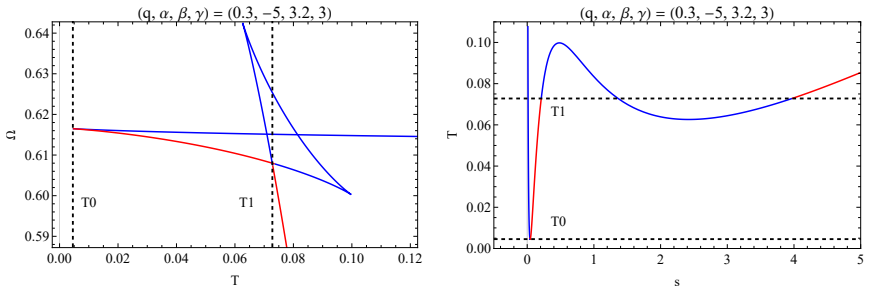
At a second-order Hawking-Page transition, the temperature–entropy relation satisfies T′(s)=T″(s)=0 at the critical point, forcing T−Tc ∝ (s−sc)³ and therefore a critical exponent αs = 1/3 for the entropy density. The paper then uses a linearized expansion A = Ac + A′δgμν and the assertion δgμν ∼ (T−Tc)^{αs} to transfer this exponent to holographic entanglement entropy and entanglement wedge cross-section, reporting log-log slopes of 1/3 for both. It also finds that EWCS increases monotonically with temperature, is independent of strip configuration, and jumps discontinuously at a first-order transition while becoming singular at a second-order one. For the effective metal-insulator transiti
What carries the argument
The central mechanism is the cubic inflection of the temperature function T(s) at the second-order critical point: the vanishing of the first two derivatives leaves (s−sc)³ as the leading term, fixing the entropy exponent at 1/3. The bridge to entanglement measures is a linearization of any geometry-derived quantity A in the metric deviation, A = Ac + A′δgμν, together with the asserted scaling δgμν ∼ (T−Tc)^{αs}, which carries the 1/3 exponent into HEE and EWCS. For the effective MIT, the diagnostic is the second temperature derivative of EWCS, whose non-monotonic peak is the signature that HEE and MI lack.
Load-bearing premise
The load-bearing bridge is the assertion that δgμν ∼ (T−Tc)^{1/3} in exactly the bulk regions that dominate the minimal-surface and entanglement-wedge integrals, so the entropy's exponent transfers unchanged to HEE and EWCS.
What would settle it
Numerically evaluate the full HEE and EWCS minimal-surface integrals using the exact bulk metric without invoking the linearization δgμν ∼ (T−Tc)^{αs}; if the log-log slopes of δSE and δEw versus δT drift from 1/3 over two decades, the universal exponent claim fails.
If this is right
- Near a second-order Hawking-Page transition, entropy density, HEE, and EWCS all scale as (T−Tc)^{1/3}, so one critical exponent governs both a thermodynamic quantity and quantum-information probes.
- EWCS can flag an effective metal-insulator crossover through the peak of its second temperature derivative in regimes where HEE and MI show no such feature.
- HEE and MI both diagnose first- and second-order Hawking-Page transitions, but their behavior depends on strip width—HEE at large width tracks thermal entropy and MI runs opposite—while EWCS avoids this configuration dependence.
- EWCS jumps at a first-order Hawking-Page transition and becomes singular at a second-order one, making it a direct diagnostic in this model.
Where Pith is reading between the lines
- If the 1/3 exponent is truly universal, it likely follows from the cubic inflection of T(s) alone, so any holographic model whose temperature–entropy curve has a double zero at criticality should show the same exponent for any geometry functional linear in the metric; this is testable in simpler black-hole models without Born-Infeld corrections.
- The paper's 'aligns closely' between the ∂²Ew peak and the MIT crossover is not quantified; defining the crossover independently—for example, by the zero of d²σ_DC/dT²—would separate a genuine diagnostic from a coincidental proximity.
- Because EWCS is configuration-independent and less contaminated by thermal entropy, it may detect zero-temperature quantum phase transitions driven by RG flow where HEE and MI are blind; the authors themselves flag this as future work.
Editorial analysis
A structured set of objections, weighed in public.
Referee Report
Summary. The paper studies holographic entanglement measures — holographic entanglement entropy (HEE), mutual information (MI), and entanglement wedge cross-section (EWCS) — in four-dimensional Einstein-Born-Infeld massive gravity. For the effective metal-insulator transition, the authors report that the second temperature derivative of EWCS has a peak that "aligns closely" with the crossover temperature, while HEE and its derivatives remain monotonic. For the Hawking-Page transition, they show that HEE, MI, and EWCS all jump or become singular at first- and second-order critical points, with EWCS appearing configuration-independent. The central new claim is that, near the second-order critical point, the entropy density, HEE, and EWCS all exhibit the same critical exponent α = 1/3. The entropy exponent is derived from the vanishing of T'(s) and T''(s), which forces T − Tc ∝ (s − sc)^3. The extension to entanglement measures relies on the asserted linearizations δgμν ∼ (T − Tc)^{1/3} and A = Ac + A'δgμν. The manuscript also emphasizes EWCS as a superior probe of finite-temperature transitions.
Significance. If established, the claim that HEE and EWCS share the entropy's critical exponent 1/3 at a second-order Hawking-Page transition would be a notable result connecting quantum information measures with bulk critical behavior in a concrete holographic model. The numerical evidence for jumps and singularities in HEE, MI, and EWCS at the transition is useful and generally consistent with previous massive-gravity studies. The paper also provides a self-contained derivation of the entropy exponent αs = 1/3 from the T(s) relation, which is a clean analytic step. However, the manuscript's headline universality statement extends well beyond what is derived: the bridge from entropy scaling to geometry scaling is asserted rather than proved, and the literal phrase "all geometry-related quantities" is contradicted by the free energy's different exponent. The MIT-sensitivity claim also rests on an unquantified visual alignment. These gaps affect the central message, so the paper requires substantial revision before the universality claim can be accepted.
major comments (4)
- [§IV.C, Eq. (29)] The universal exponent for HEE and EWCS rests entirely on the asserted relation δgμν ∼ (T − Tc)^αs, introduced without derivation. Eq. (28) then assumes that every geometry-related quantity A linearizes as A = Ac + A'δgμν. The text itself concedes before Eq. (25) that the Born-Infeld terms make analytic treatment difficult. To make the claim load-bearing, the authors need either (i) a derivation showing that the metric deviation is proportional to Δs in the region that dominates the minimal-surface/EWCS integrals, or (ii) a direct analytic or high-precision numerical computation of the HEE and EWCS exponents that does not presuppose Eq. (29). As written, the 1/3 exponent for entanglement measures is a supported conjecture, not an established result.
- [§IV.C and Abstract] The statement that "all geometry-related quantities" share the 1/3 exponent is literally false within the manuscript itself. From Ω = M − Ts and dΩ = −s dT, combined with s − sc ∼ (T − Tc)^{1/3}, one obtains Ω − Ωc ∼ (T − Tc)^{4/3}. The free energy is a geometry-derived quantity and does not scale with exponent 1/3. The abstract's universal phrasing should be narrowed to the specific entanglement/area functionals studied, or the claim should be reformulated to specify which class of quantities inherits the exponent and why.
- [Fig. 15] The numerical evidence for α_HEE ≈ α_EWCS ≈ 1/3 is presented only as log-log slopes read from plots without error bars, fit ranges, or a quantitative statement of which data points are included. The slope panels show scatter around 0.28–0.38, so the conclusion "converge to 1/3" needs a statistical fit (e.g., linear regression with uncertainties over a stated window). This is especially important because the central universality claim depends on these slopes, not on the analytic entropy derivation.
- [§III.B, Fig. 8] The claim that the EWCS second-derivative peak "aligns closely" with the effective MIT crossover temperature is not quantified. The effective MIT crossover is itself definition-dependent (e.g., sign change of σ_DC'(T), minimum of σ_DC, or inflection point), and the figure shows only red triangles scattered near the phase boundary. The paper should state the precise operational definition of the crossover temperature used for each panel and report the residual difference (T_peak − T_MIT)/T_MIT. Without this, the claimed superiority of EWCS over HEE as a finite-temperature probe is not established.
minor comments (4)
- [Fig. 8 caption] Panel D caption says "massive term β" but the horizontal axis is γ; the text also refers to "massive term β" in the surrounding passage. This should be corrected to γ.
- [§IV.A] The statement that HEE at large width is "dominated by thermal entropy" is used to explain the qualitative behavior, but no quantitative decomposition is provided. A brief estimate or a plot of S_E − s (or their derivatives) would make the argument more concrete.
- [§II.B] The definition of MI in Eq. (15) uses S(a∪c) but the text says "min(S(a∪c))" as if minimization is needed. In holography, the minimal surface prescription is implicit; the notation should be clarified to avoid confusion.
- [General] There are several typos/inconsistent notations: "EN-BI" vs. "EBI" in the abstract; "R´enyi" in the introduction; and Eq. (13) uses s=πrh² while Eq. (12) is written in terms of rh. A careful proofread is needed.
Circularity Check
No significant circularity: the 1/3 entropy exponent is derived from the cubic T(s), and HEE/EWCS slopes are computed independently.
full rationale
The central entropy scaling is genuinely derived, not fitted: the paper observes T'(s)=T''(s)=0 at the second-order critical point, so T-Tc ∝ (s-sc)^3 and hence αs=1/3 (Eqs. 26-27). The extension to HEE and EWCS passes through Eq. 29, δgμν ~ (T-Tc)^αs, which is asserted rather than proven and is the weakest link in the derivation. However, the log-log slopes in Fig. 15 are obtained from the actual holographic minimal-surface computations, not from the entropy fit, so they provide an independent numerical check. The self-citations [57] and [72] are supportive or motivational, not load-bearing; the paper does not rely on a self-citation chain to establish the 1/3 exponent. The overbroad phrase 'all geometry-related quantities' is inaccurate if taken literally (e.g., the free energy has a different singular scaling), but that is a correctness/overstatement concern, not a circularity. No step in the claimed derivation reduces by construction to its own input.
Axiom & Free-Parameter Ledger
free parameters (5)
- charge q =
MIT: 4.0–6.0; HP: 0.3–0.35782 (second-order at q≈0.3578)
- massive gravity parameter α =
0.6 (MIT), 1 (HP), -5 (special HP case)
- massive gravity parameter γ =
-1.2 (MIT), 3 (HP)
- Born-Infeld parameter β =
0.3 (MIT), 5 (HP), 2.8–3.2 (special HP)
- strip configuration (a,b,c) / half-width w =
(0.5,0.05,0.45), (0.5,0.1,0.5), (1,0.2,c), w∈[0.18,4.5]
axioms (5)
- domain assumption Holographic dictionary: HEE = minimal-surface area, MI built from HEE, EWCS = minimum cross-section of the entanglement wedge (Eqs. 14-16).
- domain assumption Massive-gravity reference metric ansatz fμν = diag(0,0,c0² hij) with c0 set to 1, and the dRGT potential forms Ui (Eqs. 2, 6).
- standard math Black-hole thermodynamics: T = f'(rh)/(4π) and stability from free energy Ω = M − Ts (Eqs. 12, 22).
- domain assumption Effective-MIT identification: metallic/insulating phases by sign of σ'_DC(T), crossover at its sign change/extremum (Eq. 21, Fig. 4).
- ad hoc to paper All geometry-related quantities inherit the horizon scaling: A = Ac + A'δgμν, δgμν ∼ (T−Tc)^αs (Eqs. 28-29).
read the original abstract
We study mixed-state entanglement measures in Einstein-Born-Infeld (EBI) massive gravity theory, a model exhibiting both Hawking-Page phase transitions and effective metal-insulator transitions (MIT) at finite temperatures. Our comprehensive investigation reveals that the entanglement wedge cross-section (EWCS), a novel mixed-state entanglement measure, demonstrates distinctive properties in detecting phase transitions. For effective MIT, we find the higher-order terms of EWCS align closely with the crossover temperature, outperforming measures like holographic entanglement entropy (HEE) and mutual information (MI) in finite temperature systems. This enhanced sensitivity provides a more accurate tool for probing effective phase transitions in a finite temperature system. In Hawking-Page phase transitions, we observe that all entanglement measures effectively diagnose both first-order and second-order phase transitions, with EWCS showing configuration-independent behavior. Importantly, we discover that all geometry-related quantities, including entanglement measures, demonstrate a universal critical exponent of 1/3 near the second-order phase transition point. This result suggests a fundamental connection between quantum information theory and critical phenomena in gravitational systems, and also highlights the potential of EWCS as a powerful probe for phase transitions.
Figures




Forward citations
Cited by 1 Pith paper
-
Multipartite entanglement characterizing topological phase transitions in holographic nodal line semimetals
Tripartite entanglement measures in holographic nodal line semimetals vanish at long distance but decay with phase-dependent power laws that jump at the quantum critical point.
Reference graph
Works this paper leans on
-
[1]
Entanglement in quantum information theory,
J. Eisert, “Entanglement in quantum information theory,” arXiv preprint quant-ph/0610253, 2006
Pith/arXiv arXiv 2006
-
[2]
Scaling of Entanglement close to a Quantum Phase Transitions
A. Osterloh, L. Amico, G. Falci, R. Fazio, “Scaling of Entanglement close to a Quantum Phase Transitions” Nature416, 608 (2002) [arXiv:0202029 [quant-ph]]
2002
-
[3]
Entanglement in many-body systems
L. Amico, R. Fazio, A. Osterloh and V. Vedral, “Entanglement in many-body systems” Rev.Mod.Phys.80, 517 (2008) [arXiv:0703044 [quant-ph]]
2008
-
[4]
Detecting topological order in a ground state wave function
Levin, Michael, and Xiao-Gang Wen. “Detecting topological order in a ground state wave function”. Physical review letters 96.11 (2006): 110405. 25
2006
-
[5]
Topological entanglement entropy
Kitaev, Alexei, and John Preskill. “Topological entanglement entropy”. Physical review letters 96.11 (2006): 110404
2006
-
[6]
Computable measure of entanglement,
G. Vidal and R. F. Werner, “Computable measure of entanglement,” Phys. Rev. A65(2002), 032314 doi:10.1103/PhysRevA.65.032314 [arXiv:quant-ph/0102117 [quant-ph]]
Pith/arXiv arXiv 2002
-
[7]
Logarithmic negativity: a full entanglement monotone that is not convex,
M. B. Plenio, “Logarithmic negativity: a full entanglement monotone that is not convex,” Physical review letters, vol. 95, no. 9, p. 090503, 2005
2005
-
[8]
R. Horodecki, P. Horodecki, M. Horodecki and K. Horodecki, “Quantum entanglement,” Rev. Mod. Phys.81(2009), 865-942 doi:10.1103/RevModPhys.81.865 [arXiv:quant-ph/0702225 [quant-ph]]
Pith/arXiv arXiv 2009
-
[9]
Dimensional reduction in quantum gravity,
G. ’t Hooft, “Dimensional reduction in quantum gravity,” Salamfest 1993:0284-296
1993
-
[10]
The World as a hologram
L. Susskind, “The World as a hologram” J. Math. Phys.36, 6377 (1995)
1995
-
[11]
The Large N limit of superconformal field theories and supergravity,
J. M. Maldacena, “The Large N limit of superconformal field theories and supergravity,” Int. J. Theor. Phys.38, 1113 (1999) [Adv. Theor. Math. Phys.2, 231 (1998)]
1999
-
[12]
Anti-de Sitter space and holography,
E. Witten, “Anti-de Sitter space and holography,” Adv. Theor. Math. Phys.2, 253 (1998)
1998
-
[13]
S. A. Hartnoll, A. Lucas and S. Sachdev, “Holographic quantum matter,” [arXiv:1612.07324 [hep-th]]
-
[14]
Holographic derivation of entanglement entropy from AdS/CFT,
S. Ryu and T. Takayanagi, “Holographic derivation of entanglement entropy from AdS/CFT,” Phys. Rev. Lett.96, 181602 (2006)
2006
-
[15]
E. Caceres, P. H. Nguyen and J. F. Pedraza, JHEP09(2015), 184 doi:10.1007/JHEP09(2015)184 [arXiv:1507.06069 [hep-th]]
Pith/arXiv arXiv 2015
-
[16]
Holographic Entanglement Entropy on P- wave Superconductor Phase Transition,
R. G. Cai, S. He, L. Li and Y. L. Zhang, “Holographic Entanglement Entropy on P- wave Superconductor Phase Transition,” JHEP07(2012), 027 doi:10.1007/JHEP07(2012)027 [arXiv:1204.5962 [hep-th]]
Pith/arXiv arXiv 2012
-
[17]
Holographic entanglement entropy in general holographic superconductor models,
Y. Peng and Q. Pan, “Holographic entanglement entropy in general holographic superconductor models,” JHEP06(2014), 011 doi:10.1007/JHEP06(2014)011 [arXiv:1404.1659 [hep-th]]
Pith/arXiv arXiv 2014
-
[18]
Holographic entanglement entropy in superconductor phase transition with dark matter sector,
Y. Peng, “Holographic entanglement entropy in superconductor phase transition with dark matter sector,” Phys. Lett. B750(2015), 420-426 doi:10.1016/j.physletb.2015.09.052 [arXiv:1507.07399 [hep-th]]
Pith/arXiv arXiv 2015
-
[19]
Phase transition of holographic entanglement entropy in massive gravity,
X. X. Zeng, H. Zhang and L. F. Li, “Phase transition of holographic entanglement entropy in massive gravity,” Phys. Lett. B756(2016), 170-179 doi:10.1016/j.physletb.2016.03.013 [arXiv:1511.00383 [gr-qc]]. 26
Pith/arXiv arXiv 2016
-
[20]
Holographic Entanglement Entropy Close to Quantum Phase Transitions,
Y. Ling, P. Liu, C. Niu, J. P. Wu and Z. Y. Xian, “Holographic Entanglement Entropy Close to Quantum Phase Transitions,” JHEP04, 114 (2016) doi:10.1007/JHEP04(2016)114 [arXiv:1502.03661 [hep-th]]
Pith/arXiv arXiv 2016
-
[21]
The mixed-state entanglement in holo- graphic p-wave superconductor model,
Z. Yang, F. J. Cheng, C. Niu, C. Y. Zhang and P. Liu, “The mixed-state entanglement in holo- graphic p-wave superconductor model,” JHEP04, 110 (2023) doi:10.1007/JHEP04(2023)110 [arXiv:2301.13574 [hep-th]]
Pith/arXiv arXiv 2023
-
[22]
Entanglement negativity and minimal entanglement wedge cross sections in holographic theories,
J. Kudler-Flam and S. Ryu, “Entanglement negativity and minimal entanglement wedge cross sections in holographic theories,” Phys. Rev. D99(2019) no.10, 106014 doi:10.1103/PhysRevD.99.106014 [arXiv:1808.00446 [hep-th]]
Pith/arXiv arXiv 2019
-
[23]
Notes on entanglement wedge cross sections,
N. Jokela and A. P¨ onni, “Notes on entanglement wedge cross sections,” JHEP07(2019), 087 doi:10.1007/JHEP07(2019)087 [arXiv:1904.09582 [hep-th]]
Pith/arXiv arXiv 2019
-
[24]
Some Aspects of Entanglement Wedge Cross-Section,
K. Babaei Velni, M. R. Mohammadi Mozaffar and M. H. Vahidinia, “Some Aspects of Entanglement Wedge Cross-Section,” JHEP05(2019), 200 doi:10.1007/JHEP05(2019)200 [arXiv:1903.08490 [hep-th]]
Pith/arXiv arXiv 2019
-
[25]
Holographic study of reflected entropy in anisotropic theories,
M. J. Vasli, M. R. Mohammadi Mozaffar, K. Babaei Velni and M. Sahraei, “Holographic study of reflected entropy in anisotropic theories,” Phys. Rev. D107, no.2, 026012 (2023) doi:10.1103/PhysRevD.107.026012 [arXiv:2207.14169 [hep-th]]
Pith/arXiv arXiv 2023
-
[26]
Balanced partial entanglement and mixed state correlations,
H. A. Camargo, P. Nandy, Q. Wen and H. Zhong, “Balanced partial entanglement and mixed state correlations,” SciPost Phys.12, no.4, 137 (2022) doi:10.21468/SciPostPhys.12.4.137 [arXiv:2201.13362 [hep-th]]
Pith/arXiv arXiv 2022
-
[27]
A canonical purification for the entanglement wedge cross-section,
S. Dutta and T. Faulkner, “A canonical purification for the entanglement wedge cross-section,” JHEP03(2021), 178 doi:10.1007/JHEP03(2021)178 [arXiv:1905.00577 [hep-th]]
Pith/arXiv arXiv 2021
-
[28]
Entanglement of Purification in Holographic Systems,
P. Liu, Y. Ling, C. Niu and J. P. Wu, “Entanglement of Purification in Holographic Systems,” JHEP09, 071 (2019) doi:10.1007/JHEP09(2019)071 [arXiv:1902.02243 [hep-th]]
Pith/arXiv arXiv 2019
-
[29]
Mixed State Entanglement for Holographic Axion Model,
Y. f. Huang, Z. j. Shi, C. Niu, C. y. Zhang andP . Liu,“Mixed State Entanglement for Holographic Axion Model,” Eur. Phys. J. C80, no.5, 426 (2020) doi:10.1140/epjc/s10052-020- 7921-y [arXiv:1911.10977 [hep-th]]
Pith/arXiv arXiv 2020
-
[30]
Mixed State Entanglement and Thermal Phase Transitions,
P. Liu and J. P. Wu, “Mixed State Entanglement and Thermal Phase Transitions,” [arXiv:2009.01529 [hep-th]]
Pith/arXiv arXiv 2009
-
[31]
Entanglement wedge minimum cross- section for holographic aether gravity,
C. Y. Chen, W. Xiong, C. Niu, C. Y. Zhang and P. Liu, “Entanglement wedge minimum cross- section for holographic aether gravity,” JHEP08(2022), 123 doi:10.1007/JHEP08(2022)123 27 [arXiv:2109.03733 [hep-th]]
Pith/arXiv arXiv 2022
-
[32]
Entanglement wedge cross-section with Gauss- Bonnet corrections and thermal quench,
Y. Z. Li, C. Y. Zhang and X. M. Kuang, “Entanglement wedge cross-section with Gauss- Bonnet corrections and thermal quench,” Sci. China Phys. Mech. Astron.64(2021) no.12, 120413 [arXiv:2102.12171 [hep-th]]
Pith/arXiv arXiv 2021
-
[33]
Entanglement wedge cross-section for noncommutative Yang-Mills theory,
A. R. Chowdhury, A. Saha and S. Gangopadhyay, “Entanglement wedge cross-section for noncommutative Yang-Mills theory,” JHEP02, 192 (2022) doi:10.1007/JHEP02(2022)192 [arXiv:2106.04562 [hep-th]]
Pith/arXiv arXiv 2022
-
[34]
Entanglement wedge cross section in holographic excited states,
M. Sahraei, M. J. Vasli, M. R. M. Mozaffar and K. B. Velni, “Entanglement wedge cross section in holographic excited states,” JHEP08, 038 (2021) doi:10.1007/JHEP08(2021)038 [arXiv:2105.12476 [hep-th]]
Pith/arXiv arXiv 2021
-
[35]
Mixed state information theoretic mea- sures in boosted black brane,
A. Chowdhury Roy, A. Saha and S. Gangopadhyay, “Mixed state information theoretic mea- sures in boosted black brane,” [arXiv:2204.08012 [hep-th]]
-
[36]
More on entanglement properties ofLif (2) 4 ×S 1 ×S 5 spacetime with string exci- tations,
S. Maulik, “More on entanglement properties ofLif (2) 4 ×S 1 ×S 5 spacetime with string exci- tations,” [arXiv:2209.05207 [hep-th]]
-
[37]
Mixed state entanglement measures as probe for confinement,
P. Jain and S. Mahapatra, “Mixed state entanglement measures as probe for confinement,” Phys. Rev. D102, 126022 (2020) doi:10.1103/PhysRevD.102.126022 [arXiv:2010.07702 [hep- th]]
Pith/arXiv arXiv 2020
-
[38]
Holographic confining/deconfining gauge theories and entanglement measures with a magnetic field,
P. Jain, S. S. Jena and S. Mahapatra, “Holographic confining/deconfining gauge theories and entanglement measures with a magnetic field,” [arXiv:2209.15355 [hep-th]]
-
[39]
Foundations of the new field theory,
M. Born and L. Infeld, “Foundations of the new field theory,” Proceedings of the Royal Society of London. Series A, Containing Papers of a Mathematical and Physical Character, vol. 144, no. 852, pp. 425–451, 1934
1934
-
[40]
Gravitational and electromagnetic mass in the born-infeld electrodynamics,
B. Hoffmann, “Gravitational and electromagnetic mass in the born-infeld electrodynamics,” Physical Review, vol. 47, no. 11, p. 877, 1935
1935
-
[41]
Black holes in string-generated gravity models,
D. L. Wiltshire, “Black holes in string-generated gravity models,” Physical Review D, vol. 38, no. 8, p. 2445, 1988
1988
-
[42]
Three dimensional black hole coupled to the born-infeld electrody- namics,
M. Cataldo and A. Garca “Three dimensional black hole coupled to the born-infeld electrody- namics,” Physics Letters B, vol. 456, no. 1, pp. 28–33, 1999
1999
-
[43]
Massive Born–Infeld and Other Dual Pairs,
S. Ferrara and A. Sagnotti, “Massive Born–Infeld and Other Dual Pairs,” JHEP04(2015), 032 doi:10.1007/JHEP04(2015)032 [arXiv:1502.01650 [hep-th]]
Pith/arXiv arXiv 2015
-
[44]
Born-Infeld black hole in the isolated horizon framework,
N. Breton, “Born-Infeld black hole in the isolated horizon framework,” Phys. Rev. D67(2003), 28 124004 doi:10.1103/PhysRevD.67.124004 [arXiv:hep-th/0301254 [hep-th]]
Pith/arXiv arXiv 2003
-
[45]
Asymptotic charged BTZ black hole solutions,
S. H. Hendi, “Asymptotic charged BTZ black hole solutions,” JHEP03(2012), 065 doi:10.1007/JHEP03(2012)065 [arXiv:1405.4941 [hep-th]]
Pith/arXiv arXiv 2012
-
[46]
Thermodynamics and Phase Transition of a Nonlinear Elec- trodynamics Black Hole in a Cavity,
P. Wang, H. Wu and H. Yang, “Thermodynamics and Phase Transition of a Nonlinear Elec- trodynamics Black Hole in a Cavity,” JHEP07(2019), 002 doi:10.1007/JHEP07(2019)002 [arXiv:1901.06216 [gr-qc]]
Pith/arXiv arXiv 2019
-
[47]
Steady-state Physics, Effective Temperature Dynamics in Holography,
A. Kundu and S. Kundu, “Steady-state Physics, Effective Temperature Dynamics in Holography,” Phys. Rev. D91, no.4, 046004 (2015) doi:10.1103/PhysRevD.91.046004 [arXiv:1307.6607 [hep-th]]
Pith/arXiv arXiv 2015
-
[48]
A. Karch, D. T. Son and A. O. Starinets, “Holographic Quantum Liquid,” Phys. Rev. Lett. 102, 051602 (2009) doi:10.1103/PhysRevLett.102.051602
-
[49]
On Effective Holographic Mott Insulators,
M. Baggioli and O. Pujolas, “On Effective Holographic Mott Insulators,” JHEP12, 107 (2016) doi:10.1007/JHEP12(2016)107 [arXiv:1604.08915 [hep-th]]
Pith/arXiv arXiv 2016
-
[50]
Quantum Criticality and DBI Magneto-resistance,
E. Kiritsis and L. Li, “Quantum Criticality and DBI Magneto-resistance,” J. Phys. A50, no.11, 115402 (2017) doi:10.1088/1751-8121/aa59c6 [arXiv:1608.02598 [cond-mat.str-el]]
Pith/arXiv arXiv 2017
-
[51]
Backreacted DBI Magnetotransport with Momentum Dissipation,
S. Cremonini, A. Hoover and L. Li, “Backreacted DBI Magnetotransport with Momentum Dissipation,” JHEP10, 133 (2017) doi:10.1007/JHEP10(2017)133 [arXiv:1707.01505 [hep- th]]
Pith/arXiv arXiv 2017
-
[52]
C. de Rham, “Massive Gravity,” Living Rev. Rel.17(2014), 7 doi:10.12942/lrr-2014-7 [arXiv:1401.4173 [hep-th]]
Pith/arXiv arXiv 2014
-
[53]
Holography without translational symmetry,
D. Vegh, “Holography without translational symmetry,” [arXiv:1301.0537 [hep-th]]
-
[54]
Holographic superconductors from the massive gravity,
H. B. Zeng and J. P. Wu, “Holographic superconductors from the massive gravity,” Phys. Rev. D90, no.4, 046001 (2014) doi:10.1103/PhysRevD.90.046001 [arXiv:1404.5321 [hep-th]]
Pith/arXiv arXiv 2014
-
[55]
Electron-Phonon Interactions, Metal-Insulator Transi- tions, and Holographic Massive Gravity,
M. Baggioli and O. Pujolas, “Electron-Phonon Interactions, Metal-Insulator Transi- tions, and Holographic Massive Gravity,” Phys. Rev. Lett.114(2015) no.25, 251602 doi:10.1103/PhysRevLett.114.251602 [arXiv:1411.1003 [hep-th]]
Pith/arXiv arXiv 2015
-
[56]
Thermodynamics of Black Holes in Massive Gravity,
R. G. Cai, Y. P. Hu, Q. Y. Pan and Y. L. Zhang, “Thermodynamics of Black Holes in Massive Gravity,” Phys. Rev. D91(2015) no.2, 024032 doi:10.1103/PhysRevD.91.024032 [arXiv:1409.2369 [hep-th]]
Pith/arXiv arXiv 2015
-
[57]
Entanglement wedge minimum cross-section in holographic massive gravity theory,
P. Liu, C. Niu, Z. J. Shi and C. Y. Zhang, “Entanglement wedge minimum cross-section in holographic massive gravity theory,” JHEP08(2021), 113 doi:10.1007/JHEP08(2021)113 29 [arXiv:2104.08070 [hep-th]]
Pith/arXiv arXiv 2021
-
[58]
Einstein-Born-Infeld-Massive Gravity: adS-Black Hole Solutions and their Thermodynamical properties,
S. H. Hendi, B. Eslam Panah and S. Panahiyan, “Einstein-Born-Infeld-Massive Gravity: adS-Black Hole Solutions and their Thermodynamical properties,” JHEP11(2015), 157 doi:10.1007/JHEP11(2015)157 [arXiv:1508.01311 [hep-th]]
Pith/arXiv arXiv 2015
-
[59]
Area laws for the entanglement entropy - a re- view,
J. Eisert, M. Cramer and M. B. Plenio, “Area laws for the entanglement entropy - a re- view,” Rev. Mod. Phys.82(2010), 277-306 doi:10.1103/RevModPhys.82.277 [arXiv:0808.3773 [quant-ph]]
Pith/arXiv arXiv 2010
-
[60]
Characterization of Quantum Phase Transition using Holo- graphic Entanglement Entropy,
Y. Ling, P. Liu and J. P. Wu, “Characterization of Quantum Phase Transition using Holo- graphic Entanglement Entropy,” Phys. Rev. D93, no. 12, 126004 (2016)
2016
-
[61]
Quantum Computation and Quantum In- formation: 10th Anniversary Edition,
Nielsen, Michael A. and Chuang, Isaac L., “Quantum Computation and Quantum In- formation: 10th Anniversary Edition,” Cambridge: Cambridge University Press (2010). doi:10.1017/CBO9780511976667
-
[62]
Holographic Mutual Information is Monogamous,
P. Hayden, M. Headrick and A. Maloney, “Holographic Mutual Information is Monogamous,” Phys. Rev. D87(2013) no.4, 046003 doi:10.1103/PhysRevD.87.046003 [arXiv:1107.2940 [hep- th]]
Pith/arXiv arXiv 2013
-
[63]
Entanglement of purification through holographic duality,
K. Umemoto and T. Takayanagi, “Entanglement of purification through holographic duality,” Nature Phys.14, no. 6, 573 (2018)
2018
-
[64]
Electronic and transport properties of nanotubes,
J.-C. Charlier, X. Blase, and S. Roche, “Electronic and transport properties of nanotubes,” Rev. Mod. Phys., vol. 79, pp. 677–732, May 2007
2007
-
[65]
An investigation of the electri- cal transport properties of graphene-oxide thin films,
G. Venugopal, K. Krishnamoorthy, R. Mohan, and S.-J. Kim, “An investigation of the electri- cal transport properties of graphene-oxide thin films,” Materials Chemistry and Physics, vol. 132, no. 1, pp. 29–33, 2012
2012
-
[66]
Conjugated polymers/semiconductor nanocrystals hybrid materials preparation, electrical transport properties and applications,
P. Reiss, E. Couderc, J. De Girolamo, and A. Pron, “Conjugated polymers/semiconductor nanocrystals hybrid materials preparation, electrical transport properties and applications,” Nanoscale, vol. 3, pp. 446–489, 2011
2011
-
[67]
Thermoelectric DC conductivities from black hole horizons,
A. Donos and J. P. Gauntlett, “Thermoelectric DC conductivities from black hole horizons,” JHEP11, 081 (2014) doi:10.1007/JHEP11(2014)081 [arXiv:1406.4742 [hep-th]]
Pith/arXiv arXiv 2014
-
[68]
Novel metals and insulators from holography,
A. Donos and J. P. Gauntlett, “Novel metals and insulators from holography,” JHEP06, 007 (2014) doi:10.1007/JHEP06(2014)007 [arXiv:1401.5077 [hep-th]]
Pith/arXiv arXiv 2014
-
[69]
Holographic Axion Model: a simple gravita- tional tool for quantum matter,
M. Baggioli, K. Y. Kim, L. Li and W. J. Li, “Holographic Axion Model: a simple gravita- tional tool for quantum matter,” Sci. China Phys. Mech. Astron.64, no.7, 270001 (2021) 30 doi:10.1007/s11433-021-1681-8 [arXiv:2101.01892 [hep-th]]
Pith/arXiv arXiv 2021
-
[70]
Effective holographic theories of mo- mentum relaxation and violation of conductivity bound,
B. Gout´ eraux, E. Kiritsis and W. J. Li, “Effective holographic theories of mo- mentum relaxation and violation of conductivity bound,” JHEP04, 122 (2016) doi:10.1007/JHEP04(2016)122 [arXiv:1602.01067 [hep-th]]
Pith/arXiv arXiv 2016
-
[71]
A novel insulator by holographic Q-lattices,
Y. Ling, P. Liu and J. P. Wu, “A novel insulator by holographic Q-lattices,” JHEP02, 075 (2016) doi:10.1007/JHEP02(2016)075 [arXiv:1510.05456 [hep-th]]
Pith/arXiv arXiv 2016
-
[72]
Mixed-state entanglement for AdS Born-Infeld theory,
P. Liu, Z. Yang, C. Niu, C. Y. Zhang and J. P. Wu, “Mixed-state entanglement for AdS Born-Infeld theory,” JHEP09, 105 (2023) doi:10.1007/JHEP09(2023)105 [arXiv:2301.04854 [hep-th]]
Pith/arXiv arXiv 2023
-
[73]
Quantum Correlations in Spin Chains at Finite Temperatures and Quantum Phase Transitions,
T. Werlang, C. Trippe, G. A. P. Ribeiro and G. Rigolin, “Quantum Correlations in Spin Chains at Finite Temperatures and Quantum Phase Transitions,” Phys. Rev. Lett.105, no.9, 095702 (2010) doi:10.1103/PhysRevLett.105.095702 [arXiv:1006.3332 [quant-ph]]
Pith/arXiv arXiv 2010
-
[74]
Entanglement Renyi Negativity across a Finite Temperature Transition: A Monte Carlo study,
K. H. Wu, T. C. Lu, C. M. Chung, Y. J. Kao and T. Grover, “Entanglement Renyi Negativity across a Finite Temperature Transition: A Monte Carlo study,” Phys. Rev. Lett.125, no.14, 140603 (2020) doi:10.1103/PhysRevLett.125.140603 [arXiv:1912.03313 [cond-mat.str-el]]. 31
Pith/arXiv arXiv 2020
discussion (0)
Sign in with ORCID, Apple, or X to comment. Anyone can read and Pith papers without signing in.