REVIEW 4 major objections 5 minor 41 references
Private Memorization Editing: Turning Memorization into a Defense to Strengthen Data Privacy in Large Language Models
T0 review · 4 major / 5 minor · reviewed 2026-08-07 · deepseek-v4-flash
Pith's one-line read Private Memorization Editing (PME) scrubs memorized PII from LLM weights by overwriting feed-forward memories with dummy values, cutting Training Data Extraction leakage—often to zero—while nearly preserving language-model utility.
desk verdict PME is a strong empirical entry in LLM privacy defense, but the per-layer contribution scheme—the paper's main novelty—is never validated against simpler alternatives, so the central mechanism is under-supported. read the letter →
The pith
A machine-rendered reading of the paper's core claim, the machinery that carries it, and where it could break.
The reading
What carries the argument
The central mechanism is a per-layer contribution coefficient $w_l = \frac{x_l \cdot x_L}{\|x_L\|^2}$, normalized across layers, computed from a single additional forward pass. It turns the hidden-state decomposition $x_L \approx \sum_{l=1}^{L} h_l$ into a recipe for distributing a target edit: PME optimizes a delta $\delta^*$ on the final hidden state so that a dummy PII $t^*$ is predicted, then sets each edited layer's new values to $v^* = w_l x^*$ and applies the MEMIT-style closed-form update $\Delta^l = (V^* - V^*_0) K^{*T} (K_0 K_0^T + K^* K^{*T})^{-1}$ to each feed-forward output matrix $W^l_{out}$. The projection coefficients carry the argument because they replace layer localization: every layer is edited, but proportionally to its measured contribution to the memorized output.
What would settle it
Take a transformer model with a known set of memorized PII, run PME on that set, then attack the edited model with extraction prompts that paraphrase or shorten the training contexts instead of repeating the 200-token prefixes used for the edit; any recovered real PII from the edited set would refute the claim that memorized PII has been removed from the weights.
Extended reading notes
Core claim
The central claim is that a memorized training sequence containing PII can be directly erased from the model's weights by editing every feed-forward output matrix, not just a localized subset of layers. PME first optimizes a small change to the final hidden representation so that a dummy PII value (for example, mail@domain.com or phone_number) becomes the predicted next token, then spreads that change across all layers in proportion to each layer's measured contribution to the original memorized output. Using a closed-form update derived from linear least squares, each edited layer is adjusted so that the old key-value mapping for the private token is replaced by the dummy-value mapping. Experiments on three transformer models show that this reduces leaked email, phone, and URL counts by about 96% on average in memorization attacks, reaches zero leakage in many configurations, and also suppresses association-based attacks, while benchmark accuracy and text-generation similarity stay close to the pre-edit model.
Load-bearing premise
PME's load-bearing premise is that the projection of each layer's partial sum onto the final hidden state correctly measures how much that layer should be changed, and that the model owner's list of memorized PII matches what an attacker would try to extract.
Editorial extensions
If this is right
- Deployed models with open weights can have identified PII scrubbed by their owner in a single editing pass, before release, without the cost of retraining.
- Because edits are made on the most informative 200-token contexts yet generalize to shorter contexts and association prompts, a single edit can protect against multiple attack strategies.
- The procedure scales to thousands of PII at once: editing all leaked emails, phone numbers, and URLs in the largest tested model removed nearly all leakage while benchmark scores stayed essentially flat.
- A post-edit model does not start generating new correct PII in the tested settings, suggesting the edit is localized rather than a general disruption of private-token behavior.
- The method outperforms reinforcement-learning unlearning and activation-based editing baselines in privacy protection and preserves language ability better than a standard mass-editing baseline when many edits are applied.
Reading between the lines
- The geometric decomposition suggests the same projection recipe could be used to scrub other verbatim-memorized content, such as secrets, copyrighted snippets, or toxic text, whenever the model owner can enumerate target strings.
- Measured efficacy is relative to the attack definition used; an attacker who constructs prompts outside the memorized-context distribution may still recover residual traces, so the zero-leak results should be read as defense against discoverable memorization rather than a guarantee against all extraction.
- One testable extension is to apply PME iteratively: after each edit, re-run extraction to see whether new PII emerge, and use the dummy-value replacement as a probe to audit what the model still remembers.
- Pairing PME with membership-inference-style auditing could let owners apply it to models with closed training data by first recovering candidate memorized strings.
Editorial analysis
A structured set of objections, weighed in public.
Referee Report
Summary. The paper proposes Private Memorization Editing (PME), a model-editing defense that removes memorized personally identifiable information (PII) from transformer-based LLMs. PME first identifies memorized PII via training-data extraction attacks on open models (GPT-J 6B, GPT-Neo 1.3B/2.7B) trained on the Pile, then edits the feed-forward output matrices using a MEMIT-style closed-form update. The novel component is a per-layer contribution coefficient w_l, computed by projecting partial sums of feed-forward outputs onto the final hidden representation, which is used to distribute a dummy-PII representation across layers. The paper reports that PME reduces memorization-attack leakage by 96% on average, often to zero, while preserving LM-evaluation-harness scores and generation similarity, and it compares favorably with MEMIT, GRACE, and DeMem.
Significance. If the mechanism is sound, PME would be a practical privacy-preserving editing method: it requires only one additional forward pass per example, uses fully open models and training data, and ships with code. The breadth of evaluation across model scales, PII types, and attack settings is a real strength, and the use of ground-truth PII from the Pile allows rigorous leakage measurement. However, the central geometric contribution estimate is not directly validated, and the evaluation does not confirm that the edited model actually generates the intended dummy values. These gaps currently limit the support for the paper's strong mechanistic claim that memorization is 'turned into a defense.'
major comments (4)
- [Section 2.2 and Table 6] The per-layer contribution coefficient w_l is the novel component that distinguishes PME from the MEMIT baseline, but the paper provides no evidence that this coefficient is responsible for the privacy improvements. Table 6 varies a constant contribution coefficient c and measures only BLEU/METEOR similarity of non-private generations; it does not report privacy leakage as a function of c or compare against uniform or random coefficient assignments. Without such an ablation, the central claim that the geometric projection 'turns memorization into a defense' is not supported, because the observed leakage reduction could come from the layer-wide MEMIT-style update rather than from the projection-based weighting. Please add an ablation that measures attack success under alternative coefficient schemes, including uniform and random w_l.
- [Section 2.2 and Section 4.2] PME optimizes x* to maximize the probability of the dummy PII t* at the final layer, then distributes v*_l = w_l x* across layers, but the paper never reports whether the edited model actually generates the intended dummy values for the edited prompts. If the post-edit model produces unrelated tokens instead of the original PII, the reduction in leakage could reflect generic disruption of memorized generation rather than the proposed defense mechanism. I recommend reporting the generation rate of t* (or an appropriate match) on the edited (p,t) pairs, and showing that this rate is high while leakage of the original t is low.
- [Section 2.2 and Algorithm 1] The text states that 'PME edits all layers,' but Algorithm 1 loops over l in [1, L-1] for both contribution computation and weight updates, leaving the final layer unedited. This inconsistency affects reproducibility and the interpretation of the per-layer mechanism. Please clarify the exact set of edited layers in the main text and in the algorithm, and state whether excluding the final layer is intentional.
- [Section 2.2, Eq. (4)] Equation (4) replaces the full decomposition in Eq. (1) by x_L^n approximately equal to the sum of feed-forward outputs h_l^n, omitting the embedding x_n and all attention outputs a_l^n. Appendix 6.2 itself shows that attention blocks contribute comparably to feed-forward blocks in early layers, so this approximation is not obviously negligible and may bias the computed w_l. Please justify this approximation empirically for the edited examples, for example by reporting the relative norm of the omitted terms, or explain why the feed-forward-only sum is sufficient for computing contribution coefficients.
minor comments (5)
- [Section 3.2] The random Wikipedia subset size used to estimate K0^l is not specified; please provide the subset size and sampling details for reproducibility.
- [Section 2.2] The gradient-descent procedure for δ* (number of steps, learning rate, early stopping criterion) is not specified in the main text; Algorithm 1 only says 'via Gradient Descent with early stopping.' Please give these details in the appendix.
- [Throughout] There are several typos and wording issues: 'ufficially' should be 'officially' (Section 3.3), 'leakes' should be 'leaks' (Section 4.1), 'Crowl' should be 'Crawl' (Section 3.1), 'lifecylce' should be 'lifecycle' (Limitations), 'the the number' is a duplicated article (Section 4.1), and 'LMM' should be 'LLM' (Section 3).
- [Table 7] Table 7 is difficult to read because multiple zero-shot templates are merged into single rows with ambiguous cells; please split rows per template or use clearer column separators.
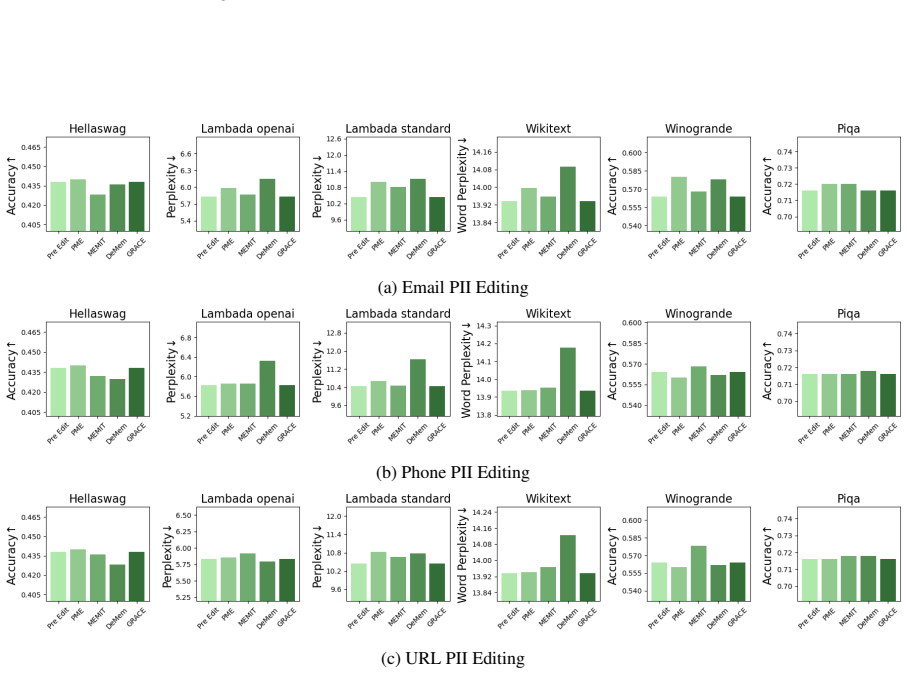
- [Figures 3–5] The LM-evaluation-harness figures report accuracy and perplexity without error bars or significance tests; since the post-edit differences are small, some indication of variability would help support the robustness claim.
Circularity Check
Partial circularity: PME's zero-leak results on the edited 200-token prompts restate the edit's own objective, since S is defined by the attack predicate M(p)=t and the update is constructed so M'(p)=t* on exactly those pairs; the central claim is not forced because the paper shows generalization to shorter and association prompts.
-
self definitional
[Section 2.1 (S definition), Section 2.2 (PME objective), Section 3.2 (edit setting), Tables 1 and 7.]
"S = {(p, t)| s.t. M (p) = t}; "The objective of the PME is to compute an update to the model weights {∆l}L l=1 so that ∀(p, t) ∈ S: M{W l out+∆l}L l=1 (p) = t∗"; "we perform the edit only in the more informative setting: the edit is conditioned to the model being fed with batches of prompts p with a fixed length of 200 tokens.""
The success metric for the edited configuration is the edit's own optimization target by construction: S is defined by the attack predicate M(p)=t, the update is built to force M'(p)=t* on exactly those (p,t) pairs, and Table 1 then re-runs the same attack on the same 200-token prompts (e.g., GPT-J email: 537 leaked before, 0 after). The zero-leak cells and the aggregate figure "PME decreases the accuracy of the attack by 96.03%" therefore include verification of the construction rather than independent prediction. Section 6.4 confirms the co-definition: "we define a PII as memorized in terms of the ability of the attack to extract it," so the detection set and the measured leakage share one predicate.
full rationale
Walking the derivation chain: the closed-form update Δ^l = (V* − V*_0)K*^T(K0K0^T + K*K*^T)^−1 is imported from Meng et al. (2023b), an external, code-reproduced result, so no circularity originates there. The PME-specific element is the per-layer coefficient w^l = (x^l_n · x^L_n / ||x^L_n||^2) / Σ_j w^j_p and the value assignment v*^l = w^l x*, which is a heuristic the paper states as a hypothesis ("we hypothesize that each layer has to contribute to the representation of x*"). The skeptic's concern that w^l is load-bearing but unvalidated is real but is a correctness/mechanism gap, not a circular step under the hard rules: the only ablation (Table 6) varies a constant contribution c and measures generation similarity (BLEU/METEOR), never leak reduction, so the paper does not prove the projection beats uniform or random coefficients for privacy; I flag this as a correctness risk rather than as a circularity step. Self-citations (Venditti et al., 2024 for the PAE baseline, the similarity evaluation protocol, and the fine-tuning caveat; the group's survey and contamination papers) are positioning and methodology, not load-bearing for the privacy outcome, and no uniqueness theorem or ansatz is imported by citation from the authors' own prior work. The genuine circularity is confined to the on-distribution cells: because S is co-defined with the attack success predicate, the 200-token Memorization Attack results are constructed outputs, and the paper's strongest phrasing ("reducing the accuracy of the privacy attacks to zero") leans on them. However, the central claim does not reduce to this: memorization attacks at 50 and 100 tokens use different keys and still drop to 0-2 leaks (e.g., GPT-J email 353→1 and 476→1), association attacks with unseen zero-shot templates collapse to ~0 across models, LM Evaluation Harness scores are effectively unchanged, and Table 4 shows essentially no new PII generation. These results are external to the edit's construction, so the paper is self-contained against its own fitted inputs despite the partial overlap.
Assumptions & free parameters
free parameters (3)
- number of gradient descent steps and early stopping criterion for delta* =
not reported
- random Wikipedia subset size for K0 estimation =
not reported
- dummy PII templates t* =
mail@domain.com, phone_number, etc.
assumptions (4)
- domain assumption The forward pass of a transformer can be written as a sum of component outputs, x_L = x + sum a_l + sum h_l.
- domain assumption Feed-forward layers act as associative memories, and the output matrix W_out stores key-value mappings.
- ad hoc to paper The projection of each partial sum onto the final representation estimates the contribution of that layer to the generation of the PII.
- ad hoc to paper Setting the new value at each layer to w_l * x* and editing all layers preserves the final representation and produces the dummy value.
Cite this review
Pith. "Pith review of Private Memorization Editing: Turning Memorization into a Defense to Strengthen Data Privacy in Large Language Models." pith.science (2026). https://pith.science/paper/KOYTVG5M
@misc{pith2026250610024,
  author       = {Pith},
  title        = {Pith review of: Private Memorization Editing: Turning Memorization into a Defense to Strengthen Data Privacy in Large Language Models},
  year         = {2026},
  howpublished = {\url{https://pith.science/paper/KOYTVG5M}},
  note         = {Machine review of arXiv:2506.10024}
}
read the original abstract
Large Language Models (LLMs) memorize, and thus, among huge amounts of uncontrolled data, may memorize Personally Identifiable Information (PII), which should not be stored and, consequently, not leaked. In this paper, we introduce Private Memorization Editing (PME), an approach for preventing private data leakage that turns an apparent limitation, that is, the LLMs' memorization ability, into a powerful privacy defense strategy. While attacks against LLMs have been performed exploiting previous knowledge regarding their training data, our approach aims to exploit the same kind of knowledge in order to make a model more robust. We detect a memorized PII and then mitigate the memorization of PII by editing a model knowledge of its training data. We verify that our procedure does not affect the underlying language model while making it more robust against privacy Training Data Extraction attacks. We demonstrate that PME can effectively reduce the number of leaked PII in a number of configurations, in some cases even reducing the accuracy of the privacy attacks to zero.
Figures


Figures from the paper (2 more)

Reference graph
Works this paper leans on
-
[1]
Yonatan Bisk, Rowan Zellers, Jianfeng Gao, Yejin Choi, et al. 2020. Piqa: Reasoning about physical commonsense in natural language. In Proceedings of the AAAI conference on artificial intelligence, volume 34, pages 7432--7439
2020
-
[2]
Sid Black, Leo Gao, Phil Wang, Connor Leahy, and Stella Biderman. 2021. https://doi.org/10.5281/zenodo.5297715 GPT-Neo: Large Scale Autoregressive Language Modeling with Mesh-Tensorflow . If you use this software, please cite it using these metadata
-
[3]
Hannah Brown, Katherine Lee, Fatemehsadat Mireshghallah, Reza Shokri, and Florian Tramèr. 2022. https://arxiv.org/abs/2202.05520 What does it mean for a language model to preserve privacy? Preprint, arXiv:2202.05520
arXiv 2022
-
[4]
Nicholas Carlini, Daphne Ippolito, Matthew Jagielski, Katherine Lee, Florian Tramer, and Chiyuan Zhang. 2023. https://arxiv.org/abs/2202.07646 Quantifying memorization across neural language models . Preprint, arXiv:2202.07646
arXiv 2023
-
[5]
Nicholas Carlini, Matthew Jagielski, Chiyuan Zhang, Nicolas Papernot, Andreas Terzis, and Florian Tramer. 2022. https://openreview.net/forum?id=ErUlLrGaVEU The privacy onion effect: Memorization is relative . In Advances in Neural Information Processing Systems
work page 2022
-
[6]
Nicholas Carlini, Florian Tramer, Eric Wallace, Matthew Jagielski, Ariel Herbert-Voss, Katherine Lee, Adam Roberts, Tom Brown, Dawn Song, Ulfar Erlingsson, et al. 2021. Extracting training data from large language models. In 30th USENIX Security Symposium (USENIX Security 21), pages 2633--2650
2021
-
[7]
Ting-Yun Chang, Jesse Thomason, and Robin Jia. 2024. https://doi.org/10.18653/v1/2024.naacl-long.176 Do localization methods actually localize memorized data in LLM s? a tale of two benchmarks . In Proceedings of the 2024 Conference of the North American Chapter of the Association for Computational Linguistics: Human Language Technologies (Volume 1: Long ...
-
[8]
Javier Ferrando, Gabriele Sarti, Arianna Bisazza, and Marta R. Costa-jussà. 2024. https://arxiv.org/abs/2405.00208 A primer on the inner workings of transformer-based language models . Preprint, arXiv:2405.00208
arXiv 2024
Show all 41 references
-
[9]
Leo Gao, Stella Biderman, Sid Black, Laurence Golding, Travis Hoppe, Charles Foster, Jason Phang, Horace He, Anish Thite, Noa Nabeshima, Shawn Presser, and Connor Leahy. 2020. https://arxiv.org/abs/2101.00027 The pile: An 800gb dataset of diverse text for language modeling . P...
2020 arXiv
-
[10]
Leo Gao, Jonathan Tow, Baber Abbasi, Stella Biderman, Sid Black, Anthony DiPofi, Charles Foster, Laurence Golding, Jeffrey Hsu, Alain Le Noac'h, Haonan Li, Kyle McDonell, Niklas Muennighoff, Chris Ociepa, Jason Phang, Laria Reynolds, Hailey Schoelkopf, Aviya Skowron, Lintang S...
2024 doi
-
[11]
Mor Geva, Avi Caciularu, Kevin Wang, and Yoav Goldberg. 2022. https://doi.org/10.18653/v1/2022.emnlp-main.3 Transformer feed-forward layers build predictions by promoting concepts in the vocabulary space . In Proceedings of the 2022 Conference on Empirical Methods in Natural L...
2022 doi
-
[12]
Mor Geva, Roei Schuster, Jonathan Berant, and Omer Levy. 2021. https://doi.org/10.18653/v1/2021.emnlp-main.446 Transformer feed-forward layers are key-value memories . In Proceedings of the 2021 Conference on Empirical Methods in Natural Language Processing, pages 5484--5495, ...
2021 doi
-
[13]
Thomas Hartvigsen, Swami Sankaranarayanan, Hamid Palangi, Yoon Kim, and Marzyeh Ghassemi. 2023. Aging with grace: Lifelong model editing with discrete key-value adaptors. In Advances in Neural Information Processing Systems
2023
-
[14]
Peter Hase, Mohit Bansal, Been Kim, and Asma Ghandeharioun. 2023. https://arxiv.org/abs/2301.04213 Does localization inform editing? surprising differences in causality-based localization vs. knowledge editing in language models . Preprint, arXiv:2301.04213
2023 arXiv
-
[15]
Choquette-Choo, Katherine Lee, and A
Jamie Hayes, Marika Swanberg, Harsh Chaudhari, Itay Yona, Ilia Shumailov, Milad Nasr, Christopher A. Choquette-Choo, Katherine Lee, and A. Feder Cooper. 2025. https://aclanthology.org/2025.naacl-long.469/ Measuring memorization in language models via probabilistic extraction ....
2025
-
[16]
Jie Huang, Hanyin Shao, and Kevin Chen-Chuan Chang. 2022. https://doi.org/10.18653/v1/2022.findings-emnlp.148 Are large pre-trained language models leaking your personal information? In Findings of the Association for Computational Linguistics: EMNLP 2022, pages 2038--2047, Ab...
2022 doi
-
[17]
Giuseppe Francesco Italiano, Alessio Martino, and Giorgio Piccardo. 2024. Security and privacy in large language and foundation models: A survey on genai attacks. In International Conference on Distributed Computing and Intelligent Technology, pages 1--17. Springer
2024
-
[18]
Aly Kassem, Omar Mahmoud, and Sherif Saad. 2023. https://doi.org/10.18653/v1/2023.emnlp-main.265 Preserving privacy through dememorization: An unlearning technique for mitigating memorization risks in language models . In Proceedings of the 2023 Conference on Empirical Methods...
2023 doi
-
[19]
Hirokazu Kiyomaru, Issa Sugiura, Daisuke Kawahara, and Sadao Kurohashi. 2024. https://aclanthology.org/2024.inlg-main.45/ A comprehensive analysis of memorization in large language models . In Proceedings of the 17th International Natural Language Generation Conference, pages ...
2024
-
[20]
Teuvo Kohonen. 1972. https://api.semanticscholar.org/CorpusID:21483100 Correlation matrix memories . IEEE Transactions on Computers, C-21:353--359
1972
-
[21]
Justus Mattern, Fatemehsadat Mireshghallah, Zhijing Jin, Bernhard Schoelkopf, Mrinmaya Sachan, and Taylor Berg-Kirkpatrick. 2023. https://doi.org/10.18653/v1/2023.findings-acl.719 Membership inference attacks against language models via neighbourhood comparison . In Findings o...
2023 doi
-
[22]
Kevin Meng, David Bau, Alex Andonian, and Yonatan Belinkov. 2023 a . https://arxiv.org/abs/2202.05262 Locating and editing factual associations in gpt . Preprint, arXiv:2202.05262
2023 arXiv
-
[23]
Kevin Meng, Arnab Sen Sharma, Alex Andonian, Yonatan Belinkov, and David Bau. 2023 b . https://arxiv.org/abs/2210.07229 Mass-editing memory in a transformer . Preprint, arXiv:2210.07229
2023 arXiv
-
[24]
Stephen Merity, Caiming Xiong, James Bradbury, and Richard Socher. 2017. https://openreview.net/forum?id=Byj72udxe Pointer sentinel mixture models . In International Conference on Learning Representations
2017
-
[25]
Timothee Mickus, Denis Paperno, and Mathieu Constant. 2022. https://doi.org/10.1162/tacl_a_00501 How to dissect a M uppet: The structure of transformer embedding spaces . Transactions of the Association for Computational Linguistics, 10:981--996
2022 doi
-
[26]
Michele Miranda, Elena Sofia Ruzzetti, Andrea Santilli, Fabio Massimo Zanzotto, S \'e bastien Brati \`e res, and Emanuele Rodol \`a . 2025. https://openreview.net/forum?id=Ss9MTTN7OL Preserving privacy in large language models: A survey on current threats and solutions . Trans...
2025
-
[27]
Fatemehsadat Mireshghallah, Kartik Goyal, Archit Uniyal, Taylor Berg-Kirkpatrick, and Reza Shokri. 2022. https://doi.org/10.18653/v1/2022.emnlp-main.570 Quantifying privacy risks of masked language models using membership inference attacks . In Proceedings of the 2022 Conferen...
2022 doi
-
[28]
Milad Nasr, Nicholas Carlini, Jonathan Hayase, Matthew Jagielski, A Feder Cooper, Daphne Ippolito, Christopher A Choquette-Choo, Eric Wallace, Florian Tram \`e r, and Katherine Lee. 2023. Scalable extraction of training data from (production) language models. arXiv preprint ar...
2023 arXiv
-
[29]
Denis Paperno, Germ \'a n Kruszewski, Angeliki Lazaridou, Ngoc Quan Pham, Raffaella Bernardi, Sandro Pezzelle, Marco Baroni, Gemma Boleda, and Raquel Fern \'a ndez. 2016. https://doi.org/10.18653/v1/P16-1144 The LAMBADA dataset: Word prediction requiring a broad discourse cont...
2016 doi
-
[30]
Jack W. Rae, Sebastian Borgeaud, Trevor Cai, Katie Millican, Jordan Hoffmann, Francis Song, John Aslanides, Sarah Henderson, Roman Ring, Susannah Young, Eliza Rutherford, Tom Hennigan, Jacob Menick, Albin Cassirer, Richard Powell, George van den Driessche, Lisa Anne Hendricks,...
2022 arXiv
-
[31]
Federico Ranaldi, Elena Sofia Ruzzetti, Dario Onorati, Leonardo Ranaldi, Cristina Giannone, Andrea Favalli, Raniero Romagnoli, and Fabio Massimo Zanzotto. 2024. https://doi.org/10.18653/v1/2024.findings-acl.827 Investigating the impact of data contamination of large language m...
2024 doi
-
[32]
Keisuke Sakaguchi, Ronan Le Bras, Chandra Bhagavatula, and Yejin Choi. 2021. https://doi.org/10.1145/3474381 Winogrande: an adversarial winograd schema challenge at scale . Commun. ACM, 64(9):99–106
2021 doi
-
[33]
Weijia Shi, Anirudh Ajith, Mengzhou Xia, Yangsibo Huang, Daogao Liu, Terra Blevins, Danqi Chen, and Luke Zettlemoyer. 2024. https://openreview.net/forum?id=zWqr3MQuNs Detecting pretraining data from large language models . In The Twelfth International Conference on Learning Re...
2024
-
[34]
Reza Shokri, Marco Stronati, Congzheng Song, and Vitaly Shmatikov. 2017. https://doi.org/10.1109/SP.2017.41 Membership inference attacks against machine learning models . In 2017 IEEE Symposium on Security and Privacy (SP), pages 3--18
2017 doi
-
[35]
Xompero, Cristina Giannone, Andrea Favalli, Raniero Romagnoli, and Fabio Massimo Zanzotto
Davide Venditti, Elena Sofia Ruzzetti, Giancarlo A. Xompero, Cristina Giannone, Andrea Favalli, Raniero Romagnoli, and Fabio Massimo Zanzotto. 2024. https://arxiv.org/abs/2406.18221 Enhancing data privacy in large language models through private association editing . Preprint,...
2024 arXiv
-
[36]
Ben Wang and Aran Komatsuzaki. 2021. GPT-J-6B: A 6 Billion Parameter Autoregressive Language Model . https://github.com/kingoflolz/mesh-transformer-jax
2021
-
[37]
Yifan Yao, Jinhao Duan, Kaidi Xu, Yuanfang Cai, Zhibo Sun, and Yue Zhang. 2024 a . A survey on large language model (llm) security and privacy: The good, the bad, and the ugly. High-Confidence Computing, page 100211
2024
-
[38]
Yuanshun Yao, Xiaojun Xu, and Yang Liu. 2024 b . https://arxiv.org/abs/2310.10683 Large language model unlearning . Preprint, arXiv:2310.10683
2024 arXiv
-
[39]
Rowan Zellers, Ari Holtzman, Yonatan Bisk, Ali Farhadi, and Yejin Choi. 2019. https://doi.org/10.18653/v1/P19-1472 H ella S wag: Can a machine really finish your sentence? In Proceedings of the 57th Annual Meeting of the Association for Computational Linguistics, pages 4791--4...
2019 doi
-
[40]
online" 'onlinestring :=
ENTRY address archivePrefix author booktitle chapter edition editor eid eprint eprinttype howpublished institution journal key month note number organization pages publisher school series title type volume year doi pubmed url lastchecked label extra.label sort.label short.list...
-
[41]
write newline
" write newline "" before.all 'output.state := FUNCTION n.dashify 't := "" t empty not t #1 #1 substring "-" = t #1 #2 substring "--" = not "--" * t #2 global.max substring 't := t #1 #1 substring "-" = "-" * t #2 global.max substring 't := while if t #1 #1 substring * t #2 gl...
Reviewed August 7, 2026 · model on record in the stance chip above.
Discussion (0). Sign in to comment.