From Celebrities to Anyone: Characterizing AI Nudification Content, Technology, and Community Dynamics on 4chan
Pith reviewed 2026-06-26 01:42 UTC · model grok-4.3
The pith
AI nudification now targets non-celebrities more than celebrities on 4chan.
A machine-rendered reading of the paper's core claim, the machinery that carries it, and where it could break.
Core claim
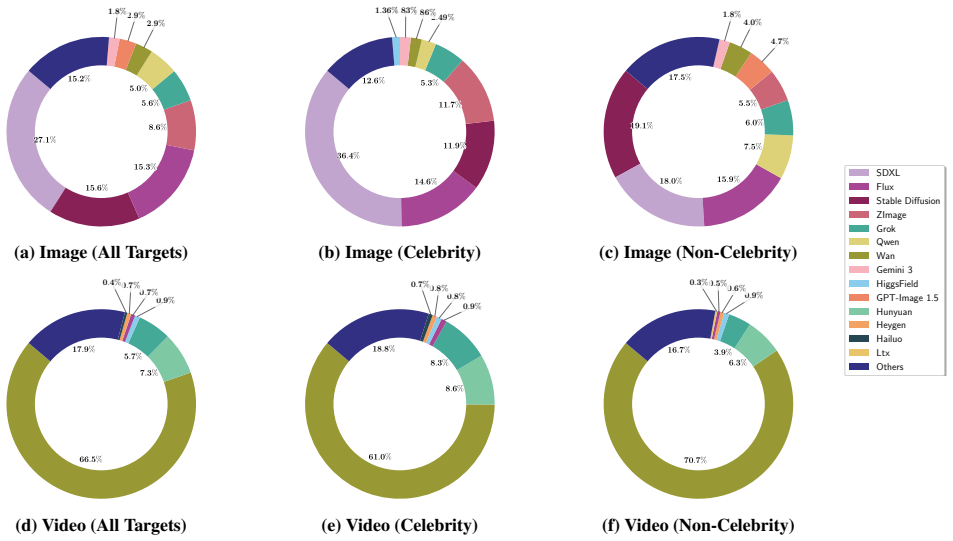
Analysis of 24,105 SNEACI items collected from 4chan reveals that non-celebrity individuals account for 55.8 percent of targets, compared with 4.7 percent in prior studies of dedicated platforms. Open-source models dominate, with the Stable Diffusion family generating 42.7 percent of images and Wan generating 66.5 percent of videos. Production depends on thousands of shared fine-tuned models and accessible tutorials, yet a small cohort of active producers creates the majority of items and shapes both target selection and technical knowledge shared in the community.
What carries the argument
Categorization of 24,105 SNEACI items by target type (celebrity versus non-celebrity), generation model family, and producer activity levels.
If this is right
- Open-source models and shared tutorials have lowered barriers so that production no longer requires specialized platforms.
- A handful of prolific producers drive most output and set the direction for target demographics.
- The ecosystem spreads technical knowledge that enables new participants to join.
- Platform governance and technical safeguards must now address harms to non-public individuals rather than only celebrities.
Where Pith is reading between the lines
- Similar demographic shifts may already be occurring on other anonymous or semi-public platforms where image requests circulate.
- Detection and removal tools focused on celebrity faces may miss the majority of current cases involving ordinary people.
- Protection efforts could benefit from methods that let individuals flag and request removal of images based on personal likeness rather than public status.
Load-bearing premise
The 24,105 items collected from 4chan accurately reflect the overall demographics of targets and producers without substantial selection bias or misclassification.
What would settle it
A larger or differently sampled collection of AI nudification content that still shows celebrities as the large majority of targets.
Figures

read the original abstract
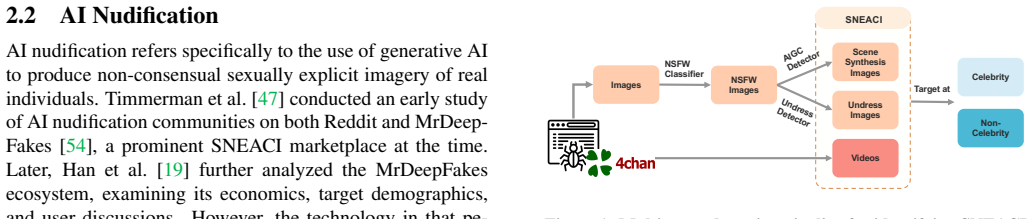
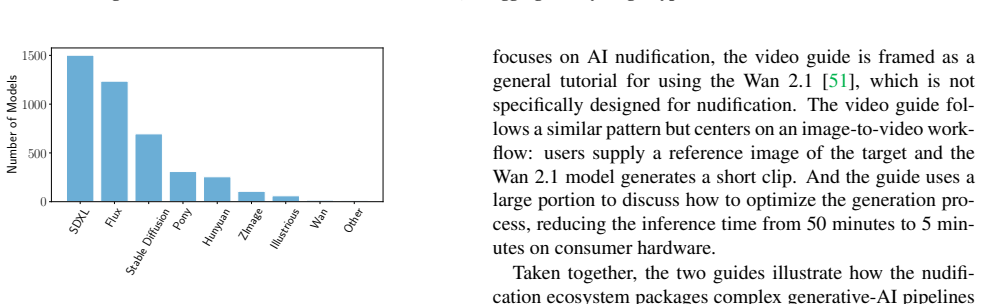
AI nudification uses generative models to create synthetic non-consensual sexually explicit imagery (SNEACI) of real individuals. Prior work has examined dedicated nudification platforms and model repositories, finding that most targets are female celebrities. However, the anonymous content community, where SNEACI is actively requested, generated, and exchanged, remains unexplored. In this work, we present a large-scale study of AI nudification in the wild, identifying 24,105 SNEACI items. We find a significant shift in target demographics: non-celebrity individuals now account for 55.8\% of targets, compared to only 4.7\% in prior studies, indicating that AI nudification has expanded from targeting public figures to increasingly harming individuals within users' own social circles. Meanwhile, open-source models dominate production, with Stable Diffusion family generating 42.7\% of images and Wan generating 66.5\% of videos, all driven by thousands of shared fine-tuned models and accessible tutorials. Yet the ecosystem runs on a small cohort of active producers, with the most prolific producing 780 items, drives community engagement, shapes target demographics, and disseminates technical knowledge that lowers barriers for new producers. Our work provides an empirical understanding of how AI nudification operates in the wild, revealing the mechanisms that sustain this ecosystem and highlighting the urgent need for interventions in platform governance, technical safeguards, and affected individual protection.
Editorial analysis
A structured set of objections, weighed in public.
Referee Report
Summary. The manuscript reports a large-scale observational study of AI-generated non-consensual sexually explicit imagery (SNEACI) on 4chan. From 24,105 identified items, it claims non-celebrity targets now comprise 55.8% of cases (versus 4.7% in prior work), open-source models dominate (Stable Diffusion family at 42.7% of images, Wan at 66.5% of videos), and a small cohort of prolific producers drives content creation, target selection, and knowledge dissemination.
Significance. If the underlying data collection and labeling are reliable, the work supplies empirical evidence that AI nudification has expanded beyond public figures to private individuals, with implications for platform policy, technical safeguards, and victim protection. The scale of the collected items is a positive feature of the study.
major comments (2)
- The headline result that non-celebrity targets account for 55.8% of the 24,105 items (and the comparison to 4.7% in prior studies) is load-bearing for the central claim of demographic expansion. The manuscript supplies no explicit classification criteria, celebrity list, reverse-image-search protocol, or inter-rater reliability statistics for distinguishing celebrity from non-celebrity targets. This directly matches the stress-test concern and renders the percentage sensitive to labeling decisions.
- Methods / data-collection description: the abstract and main text provide no information on sampling strategy, time window, boards searched, keywords or thread-selection rules, image-identification validation, or deduplication procedures used to assemble the 24,105 SNEACI items. Without these details it is impossible to assess selection bias or whether the reported statistics and community-dynamics observations are representative.
Simulated Author's Rebuttal
We thank the referee for their constructive comments, which highlight important areas for improving methodological transparency. We address each point below and will revise the manuscript to incorporate the requested details.
read point-by-point responses
-
Referee: The headline result that non-celebrity targets account for 55.8% of the 24,105 items (and the comparison to 4.7% in prior studies) is load-bearing for the central claim of demographic expansion. The manuscript supplies no explicit classification criteria, celebrity list, reverse-image-search protocol, or inter-rater reliability statistics for distinguishing celebrity from non-celebrity targets. This directly matches the stress-test concern and renders the percentage sensitive to labeling decisions.
Authors: We agree that the current manuscript lacks sufficient documentation of the target classification process. In the revised version, we will add a dedicated subsection in Methods that specifies the classification criteria (e.g., thresholds for public recognition via Wikipedia notability, IMDb presence, or news coverage), the exact celebrity list or database used, the reverse-image-search protocol and tools employed for verification, and inter-rater reliability statistics (including agreement rates and Cohen's kappa) from the labeling team. This will allow readers to assess the robustness of the 55.8% figure and the claimed demographic shift. revision: yes
-
Referee: Methods / data-collection description: the abstract and main text provide no information on sampling strategy, time window, boards searched, keywords or thread-selection rules, image-identification validation, or deduplication procedures used to assemble the 24,105 SNEACI items. Without these details it is impossible to assess selection bias or whether the reported statistics and community-dynamics observations are representative.
Authors: We acknowledge that the Methods section in the submitted manuscript does not provide these procedural details. The revised manuscript will expand the data collection subsection to describe the sampling strategy, the exact time window of data collection, the specific 4chan boards searched, the keywords and thread-selection rules, the validation steps for confirming SNEACI items, and the deduplication procedures. These additions will enable evaluation of selection bias and representativeness. revision: yes
Circularity Check
No circularity: purely observational empirical measurements
full rationale
This is an empirical data-collection study that identifies 24,105 SNEACI items from 4chan and reports direct counts and percentages (e.g., 55.8% non-celebrity targets). No equations, fitted parameters, predictions, or derivations appear in the provided text. All central claims rest on explicit measurements from the collected corpus rather than any self-referential reduction or self-citation chain. The analysis is therefore self-contained against external benchmarks.
Axiom & Free-Parameter Ledger
axioms (1)
- domain assumption The sampled 24,105 items accurately represent target demographics and production patterns on 4chan without major selection bias.
Reference graph
Works this paper leans on
-
[1]
Addressing the Psychi- atric Implications of AI-Enabled Non-Consensual Sex- ual Imagery.The British Journal of Psychiatry, 2026
Jose Ajay and Mathew Sonia. Addressing the Psychi- atric Implications of AI-Enabled Non-Consensual Sex- ual Imagery.The British Journal of Psychiatry, 2026. 13
2026
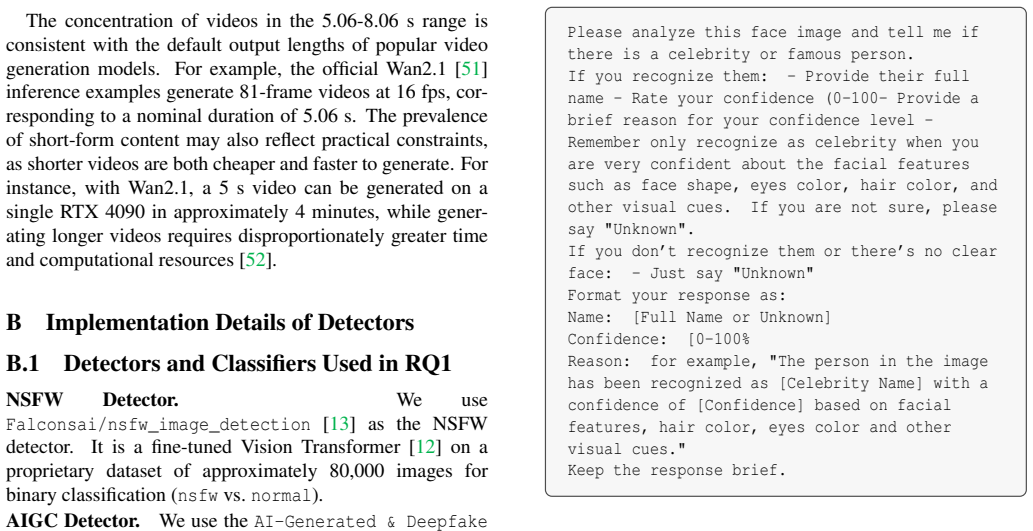
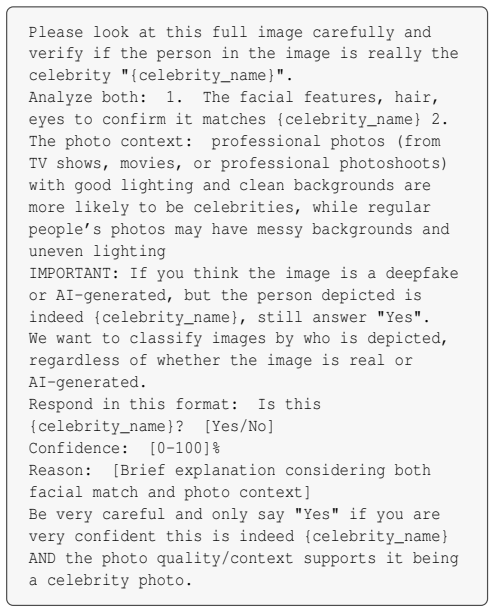
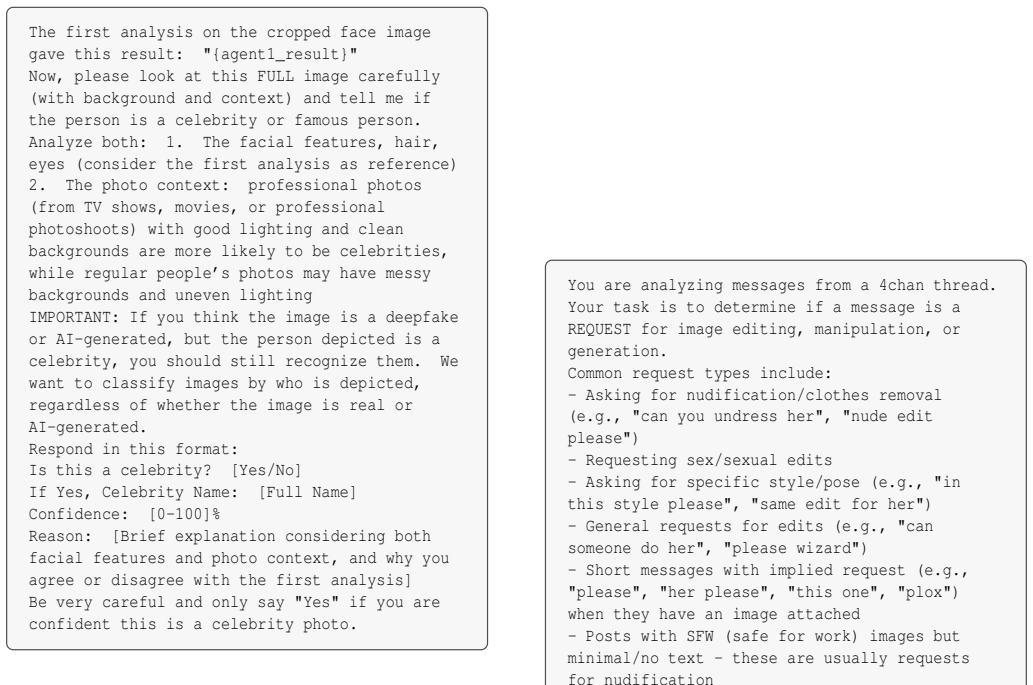
-
[2]
Black Forest Labs.https://github.com/black- forest-labs/flux, 2024. 2, 6
2024
-
[3]
Catbox.https://catbox.moe/, 2025. 9
2025
-
[4]
Catbox.https://catbox.moe/faq.php, 2025. 9
2025
-
[5]
Taylor swift deepfakes spread online, sparking outrage.https://www.cbsnews.com/news/taylor- swift-deepfakes-online-outrage-artificial- intelligence/, 2024
CBS. Taylor swift deepfakes spread online, sparking outrage.https://www.cbsnews.com/news/taylor- swift-deepfakes-online-outrage-artificial- intelligence/, 2024. 14
2024
-
[6]
Grok floods x with sexualized images of women and chil- dren.https://counterhate.com/research/grok- floods-x-with-sexualized-images/, 2026
Center for Countering Digital Hate. Grok floods x with sexualized images of women and chil- dren.https://counterhate.com/research/grok- floods-x-with-sexualized-images/, 2026. 1
2026
-
[7]
U-Sticker: A Large-Scale Multi-Domain User Sticker Dataset for Retrieval and Personalization
Heng Er Metilda Chee, Jiayin Wang, Zhiqiang Guo, Weizhi Ma, Qinglang Guo, and Min Zhang. U-Sticker: A Large-Scale Multi-Domain User Sticker Dataset for Retrieval and Personalization. InInternational ACM SIGIR Conference on Research and Development in In- formation Retrieval (SIGIR), pages 3772–3781. ACM,
-
[8]
Civitai.https://civitai.com, 2026
Civitai. Civitai.https://civitai.com, 2026. 6
2026
-
[9]
ComfyUI.https://www.comfy.org/, 2025. 8
2025
-
[10]
Deep- fake Pornography is Resilient to Regulatory and Plat- form Shocks.CoRR abs/2602.02754, 2026
Alejandro Cuevas and Manoel Horta Ribeiro. Deep- fake Pornography is Resilient to Regulatory and Plat- form Shocks.CoRR abs/2602.02754, 2026. 14
-
[11]
Amount of ai-generated child sex- ual abuse material found online surged in 2025
Dan Milmo. Amount of ai-generated child sex- ual abuse material found online surged in 2025. https://www.theguardian.com/technology/ 2026/mar/24/ai-generated-child-sexual- abuse-videos-images-online-surged-2025- internet-watch-foundation, 2026. 3
2025
-
[12]
An Image is Worth 16x16 Words: Transformers for Image Recognition at Scale
Alexey Dosovitskiy, Lucas Beyer, Alexander Kolesnikov, Dirk Weissenborn, Xiaohua Zhai, Thomas Unterthiner, Mostafa Dehghani, Matthias Minderer, Georg Heigold, Sylvain Gelly, Jakob Uszkoreit, and Neil Houlsby. An Image is Worth 16x16 Words: Transformers for Image Recognition at Scale. In International Conference on Learning Representations (ICLR), 2021. 17
2021
-
[13]
Falcons.ai.https://huggingface.co/Falconsai/ nsfw_image_detection, 2024. 4, 17
2024
-
[14]
Cassidy Gibson, Daniel Olszewski, Natalie Grace Brigham, Anna Crowder, Kevin R. B. Butler, Patrick 14 Traynor, Elissa M. Redmiles, and Tadayoshi Kohno. Analyzing the AI Nudification Application Ecosystem. InUSENIX Security Symposium (USENIX Security), pages 1–20. USENIX, 2025. 1, 3, 6, 9, 14
2025
-
[15]
Gofile.https://gofile.io/, 2026. 9
2026
-
[16]
Google.https://huggingface.co/google/vit- base-patch16-224/tree/main, 2022. 4, 17
2022
-
[17]
Google.https://docs.cloud.google.com/ vertex-ai/generative-ai/docs/models/ gemini/3-flash, 2026. 4
2026
-
[18]
Anna Yoo Jeong Ha, Josephine Passananti, Ronik Bhaskar, Shawn Shan, Reid Southen, Haitao Zheng, and Ben Y . Zhao. Organic or Diffused: Can We Dis- tinguish Human Art from AI-generated Images? In ACM SIGSAC Conference on Computer and Communi- cations Security (CCS), pages 4822–4836. ACM, 2024. 4
2024
-
[19]
Characterizing the MrDeepFakes Sexual Deepfake Marketplace
Catherine Han, Anne Li, Deepak Kumar, and Zakir Durumeric. Characterizing the MrDeepFakes Sexual Deepfake Marketplace. InUSENIX Security Sympo- sium (USENIX Security), pages 5169–5188. USENIX,
-
[20]
Mittelstadt, and Chris Rus- sell
Will Hawkins, Brent D. Mittelstadt, and Chris Rus- sell. Deepfakes on Demand: The Rise of Accessible Non-Consensual Deepfake Image Generators. InCon- ference on Fairness, Accountability, and Transparency (FAccT), pages 1602–1614. ACM, 2025. 1, 3, 4, 5, 6, 7, 12
2025
-
[21]
Hive AI.https://hivemoderation.com/ai- generated-content-detection, 2026. 4
2026
-
[22]
Hu, Yelong Shen, Phillip Wallis, Zeyuan Allen-Zhu, Yuanzhi Li, Shean Wang, Lu Wang, and Weizhu Chen
Edward J. Hu, Yelong Shen, Phillip Wallis, Zeyuan Allen-Zhu, Yuanzhi Li, Shean Wang, Lu Wang, and Weizhu Chen. LoRA: Low-Rank Adaptation of Large Language Models. InInternational Conference on Learning Representations (ICLR), 2022. 2
2022
-
[23]
Hugging Face.https:// huggingface.co/, 2026
Hugging Face. Hugging Face.https:// huggingface.co/, 2026. 6
2026
-
[24]
This 4chan board became a factory for ex- plicit ai ‘deepfakes.’ nobody is stopping it.https:// openmeasures.io/4chan-ai-deepfakes, 2026
Jared Holt. This 4chan board became a factory for ex- plicit ai ‘deepfakes.’ nobody is stopping it.https:// openmeasures.io/4chan-ai-deepfakes, 2026. 14
2026
-
[25]
Video Deepfake Abuse: How Company Choices Predictably Shape Misuse Patterns
Max Kamachee, Stephen Casper, Michelle L. Ding, Rui-Jie Yew, Anka Reuel, Stella Biderman, and Dy- lan Hadfield-Menell. Video Deepfake Abuse: How Company Choices Predictably Shape Misuse Patterns. CoRR abs/2512.11815, 2025. 6
work page internal anchor Pith review Pith/arXiv arXiv 2025
-
[26]
Kat Tenbarge. Nude deepfake images of taylor swift went viral on x, evading moderation and spark- ing outrage.https://www.nbcnews.com/tech/ misinformation/taylor-swift-nude-deepfake- goes-viral-x-platform-rules-rcna135669,
-
[27]
HunyuanVideo: A Systematic Framework For Large Video Generative Models
Weijie Kong, Qi Tian, Zijian Zhang, Rox Min, Zuozhuo Dai, Jin Zhou, Jiangfeng Xiong, Xin Li, Bo Wu, Jianwei Zhang, Kathrina Wu, Qin Lin, Junkun Yuan, Yanxin Long, Aladdin Wang, Andong Wang, Changlin Li, Duojun Huang, Fang Yang, Hao Tan, Hongmei Wang, Jacob Song, Jiawang Bai, Jianbing Wu, Jinbao Xue, Joey Wang, Kai Wang, Mengyang Liu, Pengyu Li, Shuai Li, ...
work page internal anchor Pith review Pith/arXiv arXiv 2024
-
[28]
Perspectives on Non-consensual Deepfake Pornography: A Content Analysis of Reddit Discussions Initiated by Perpetra- tors, Victims, and Bystanders.Sexuality & Culture,
Thuy Dung Le and Nicola Döring. Perspectives on Non-consensual Deepfake Pornography: A Content Analysis of Reddit Discussions Initiated by Perpetra- tors, Victims, and Bystanders.Sexuality & Culture,
-
[29]
PyCinemetricsV2: Interactive Computa- tional Film Software Based on Transformers and Py- Side6.SoftwareX, 2025
Chunfang Li, Yalv Fan, Yushi Shen, Kun Wang, Yuhe Hu, Fei Zhang, Yuchen Pei, Tongtong Zheng, and Zhuoqi Shi. PyCinemetricsV2: Interactive Computa- tional Film Software Based on Transformers and Py- Side6.SoftwareX, 2025. 10
2025
-
[30]
T2ISafety: Benchmark for Assessing Fairness, Toxicity, and Pri- vacy in Image Generation
Lijun Li, Zhelun Shi, Xuhao Hu, Bowen Dong, Yiran Qin, Xihui Liu, Lu Sheng, and Jing Shao. T2ISafety: Benchmark for Assessing Fairness, Toxicity, and Pri- vacy in Image Generation. InIEEE Conference on Computer Vision and Pattern Recognition (CVPR), pages 13381–13392. IEEE, 2025. 2
2025
-
[31]
Deepface- lab: Integrated, Flexible and Extensible Face-Swapping Framework.Pattern Recognition, 2023
Kunlin Liu, Ivan Perov, Daiheng Gao, Nikolay Cher- voniy, Wenbo Zhou, and Weiming Zhang. Deepface- lab: Integrated, Flexible and Extensible Face-Swapping Framework.Pattern Recognition, 2023. 1, 3
2023
-
[32]
Decoupled Weight Decay Regularization
Ilya Loshchilov and Frank Hutter. Decoupled Weight Decay Regularization. InInternational Conference on Learning Representations (ICLR), 2019. 17
2019
-
[33]
Meta.https://www.meta.ai/, 2025. 9
2025
-
[34]
Jaron Mink, Lucy Qin, and Elissa M. Redmiles. Unlim- ited Realm of Exploration and Experimentation: Meth- ods and Motivations of AI-Generated Sexual Content Creators.CoRR abs/2601.21028, 2026. 1, 6, 9
work page internal anchor Pith review Pith/arXiv arXiv 2026
-
[35]
Training-Free Safe Text Em- bedding Guidance for Text-to-Image Diffusion Models
Byeonghu Na, Mina Kang, Jiseok Kwak, Minsang Park, Jiwoo Shin, SeJoon Jun, Gayoung Lee, Jin-Hwa Kim, and Il-Chul Moon. Training-Free Safe Text Em- bedding Guidance for Text-to-Image Diffusion Models. CoRR abs/2510.24012, 2025. 4
-
[36]
4chan users create deepfake nude images of alysa liu and other female olympians
Niamh Ancell. 4chan users create deepfake nude images of alysa liu and other female olympians. https://cybernews.com/ai-news/alysa-liu- deepfake-4chan/?utm_source=cn_twitter&utm_ medium=social&utm_campaign=cybernews&utm_ content=tweet&source=cn_twitter&medium= social&campaign=cybernews&content=tweet,
-
[37]
Open Router.https://openrouter.ai/rankings,
-
[38]
GPT-4o mini: advancing cost-efficient intelli- gence.https://openai.com/index/gpt-4o-mini- advancing-cost-efficient-intelligence/,
OpenAI. GPT-4o mini: advancing cost-efficient intelli- gence.https://openai.com/index/gpt-4o-mini- advancing-cost-efficient-intelligence/,
-
[39]
Towards Understanding Unsafe Video Genera- tion
Yan Pang, Aiping Xiong, Yang Zhang, and Tianhao Wang. Towards Understanding Unsafe Video Genera- tion. InNetwork and Distributed System Security Sym- posium (NDSS). The Internet Society, 2025. 2
2025
-
[40]
SDXL: Improving Latent Diffusion Models for High-Resolution Image Synthesis
Dustin Podell, Zion English, Kyle Lacey, Andreas Blattmann, Tim Dockhorn, Jonas Müller, Joe Penna, and Robin Rombach. SDXL: Improving Latent Dif- fusion Models for High-Resolution Image Synthesis. CoRR abs/2307.01952, 2023. 1, 2, 6
work page internal anchor Pith review Pith/arXiv arXiv 2023
-
[41]
Unsafe Diffu- sion: On the Generation of Unsafe Images and Hateful Memes From Text-To-Image Models
Yiting Qu, Xinyue Shen, Xinlei He, Michael Backes, Savvas Zannettou, and Yang Zhang. Unsafe Diffu- sion: On the Generation of Unsafe Images and Hateful Memes From Text-To-Image Models. InACM SIGSAC Conference on Computer and Communications Secu- rity (CCS). ACM, 2023. 2
2023
-
[42]
Queen Mary Legal Advice Centre.https: //www.qmul.ac.uk/lac/our-legal-blog/2026- blogs/items/deepfakes-and-consent-the-law- finally-catches-up-.html6, 2026. 13
2026
-
[43]
Qwen Ecosystem.Qwenecosystem, 2026. 5
2026
-
[44]
High-Resolution Im- age Synthesis with Latent Diffusion Models
Robin Rombach, Andreas Blattmann, Dominik Lorenz, Patrick Esser, and Björn Ommer. High-Resolution Im- age Synthesis with Latent Diffusion Models. InIEEE Conference on Computer Vision and Pattern Recogni- tion (CVPR), pages 10684–10695. IEEE, 2022. 1, 2, 6
2022
-
[45]
The rise of deepfake pornography in schools: ’one girl was so horrified she vomited’
Sally Weale. The rise of deepfake pornography in schools: ’one girl was so horrified she vomited’. https://www.theguardian.com/society/ng- interactive/2025/dec/02/the-rise-of- deepfake-pornography-in-schools, 2025. 3
2025
-
[46]
Investigat- ing Toxicity and Bias in Stable Diffusion Text-to-Image Models.Scientific Reports, 2025
Matthias Schneider and Thilo Hagendorff. Investigat- ing Toxicity and Bias in Stable Diffusion Text-to-Image Models.Scientific Reports, 2025. 6
2025
-
[47]
Studying the Online Deepfake Community.Journal of Online Trust and Safety, 2023
Brian Timmerman, Pulak Mehta, Progga Deb, Kevin Gallagher, Brendan Dolan-Gavitt, Siddharth Garg, and Rachel Greenstadt. Studying the Online Deepfake Community.Journal of Online Trust and Safety, 2023. 1, 3
2023
-
[48]
tonyassi.https://huggingface.co/tonyassi/ celebrity-classifier, 2024. 4
2024
-
[49]
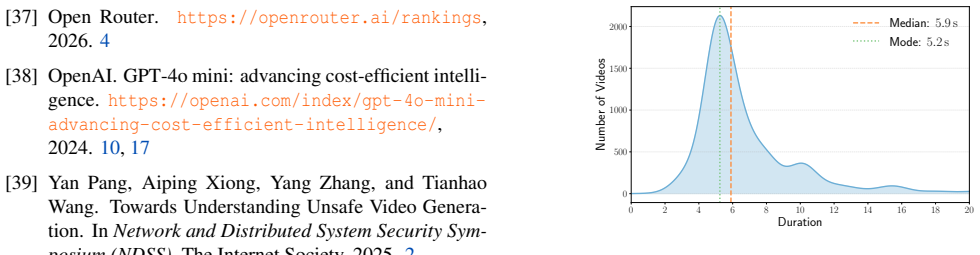
UN Women. Ai-powered online abuse: How ai is amplifying violence against women and what can stop it.https://www.unwomen.org/en/articles/ faqs/ai-powered-online-abuse-how-ai-is- amplifying-violence-against-women-and- what-can-stop-it, 2026. 3 0 2 4 6 8 10 12 14 16 18 20 Duration 0 500 1000 1500 2000Number of Videos Median: 5.9 s Mode: 5.2 s Figure 9: Distr...
2026
-
[50]
gov/bill/119th-congress/senate-bill/146,
United States Congress.https://www.congress. gov/bill/119th-congress/senate-bill/146,
-
[51]
1-FLF2V-14B-720P, 2025
Wan-AI.https://huggingface.co/Wan-AI/Wan2. 1-FLF2V-14B-720P, 2025. 8, 17
2025
-
[52]
Wan: Open and Advanced Large-Scale Video Generative Models
Ang Wang, Baole Ai, Bin Wen, Chaojie Mao, Chen- Wei Xie, Di Chen, Feiwu Yu, Haiming Zhao, Jianx- iao Yang, Jianyuan Zeng, Jiayu Wang, Jingfeng Zhang, Jingren Zhou, Jinkai Wang, Jixuan Chen, Kai Zhu, Kang Zhao, Keyu Yan, Lianghua Huang, Xiaofeng Meng, Ningyi Zhang, Pandeng Li, Pingyu Wu, Rui- hang Chu, Ruili Feng, Shiwei Zhang, Siyang Sun, Tao Fang, Tianxi...
work page internal anchor Pith review Pith/arXiv arXiv 2025
-
[53]
Taylor Swift deepfake pornography contro- versy.https://en.wikipedia.org/wiki/Taylor_ Swift_deepfake_pornography_controversy
Wikipedia. Taylor Swift deepfake pornography contro- versy.https://en.wikipedia.org/wiki/Taylor_ Swift_deepfake_pornography_controversy. 14
-
[54]
Wikipedia.https://en.wikipedia.org/wiki/ MrDeepFakes, 2026. 1, 3
2026
-
[55]
xAI.https://grok.com/, 2025. 1, 9
2025
-
[56]
Unknown". If you don’t recognize them or there’s no clear face: - Just say
Thomas P. Zollo, Nikita Rajaneesh, Richard S. Zemel, Talia Gillis, and Emily Black. Towards Effective Dis- crimination Testing for Generative AI. InConfer- ence on Fairness, Accountability, and Transparency (FAccT), pages 1028–1047. ACM, 2025. 4 A Durations of Video Content We analyze the duration distribution of 8,203 SNEACI videos. As shown in Figure 9,...
2025
-
[57]
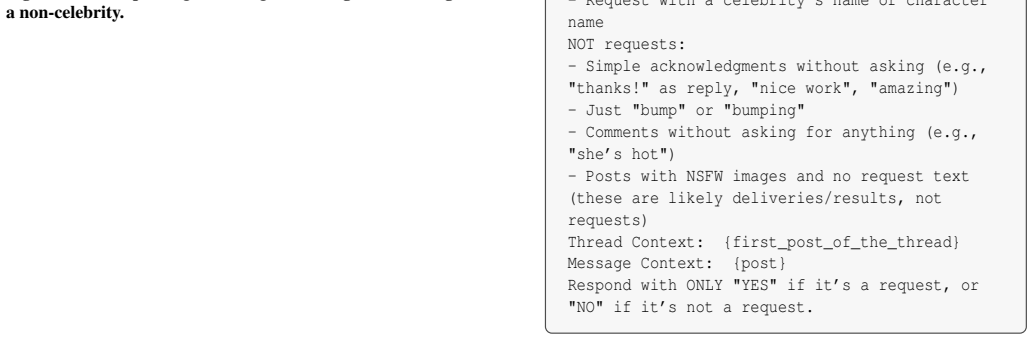
can you undress her
The photo context: professional photos (from TV shows, movies, or professional photoshoots) with good lighting and clean backgrounds are more likely to be celebrities, while regular people’s photos may have messy backgrounds and uneven lighting IMPORTANT: If you think the image is a deepfake or AI-generated, but the person depicted is a celebrity, you sho...
discussion (0)
Sign in with ORCID, Apple, or X to comment. Anyone can read and Pith papers without signing in.