REVIEW 4 major objections 5 minor 11 cited by
Optical Characteristics of the Kerr-Bertotti-Robinson Black Hole
T0 review · 4 major / 5 minor · reviewed 2026-08-06 · deepseek-v4-flash
Pith's one-line read For a rotating black hole in a uniform magnetic field, stronger fields enlarge the shadow and the Einstein ring while spin reshapes the shadow from a circle to a D.
desk verdict First full optical images for the Kerr-BR black hole, but the central B-enlargement claim is not yet supported because the observer radius is never fixed in a spacetime that is not asymptotically flat. read the letter →
The pith
A machine-rendered reading of the paper's core claim, the machinery that carries it, and where it could break.
The reading
What carries the argument
The load-bearing object is the exact Kerr-BR metric written in Eq. (1), with metric functions $P$, $Q$, $\Omega$, and $\Delta$ given in Eqs. (2)-(7); the magnetic field enters these functions directly, with $I_1=1-\frac12 B^2a^2$ and $I_2=1-B^2a^2$, which is what couples $B$ to the photon orbit geometry. Photon motion is governed by the Hamilton-Jacobi equations (13)-(18), with radial potential $R(r)$ and angular potential $\Theta(\theta)$; the shadow boundary comes from the circular-photon condition $R(r)=0=\partial_r R(r)$, which fixes the impact parameters $\alpha=\hat L/\hat E$ and $\beta=C/\hat E^2$. Full images are generated by backward ray tracing through the observer tetrad (20)-(23) with celestial coordinates (25)-(26), and, for the accretion disk, by summing direct, lensed, and higher-order intersections through the intensity formula $I_o=\sum_n f_n(\chi_n)^3 E_n$ in Eq. (39) with the emissivity profile (40) and redshift factors (41)-(44). The metric is the mechanism that turns a magnetic field increase into a shadow-size increase, because $B$ appears in the functions that determine the null geodesics themselves.
What would settle it
Independently integrate the null geodesic equations for the metric in Eqs. (1)-(7) with a second code and check whether the shadow radius at fixed $a=0.998$ grows monotonically from $B=0.001$ to $B=0.3$; a simpler check is verifying that the photon-sphere condition $R(r)=0=\partial_r R(r)$ with those metric functions reproduces the plotted contours and that the horizon condition (8) has real roots throughout the claimed parameter range. If the radius instead shrinks or the horizon disappears, the central claim would be refuted.
Extended reading notes
Core claim
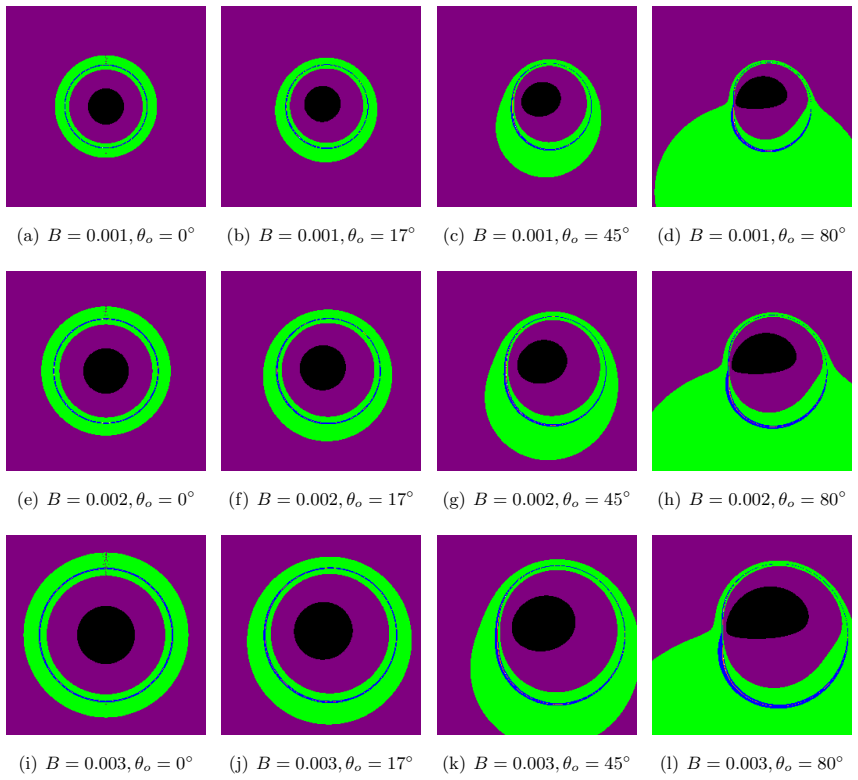
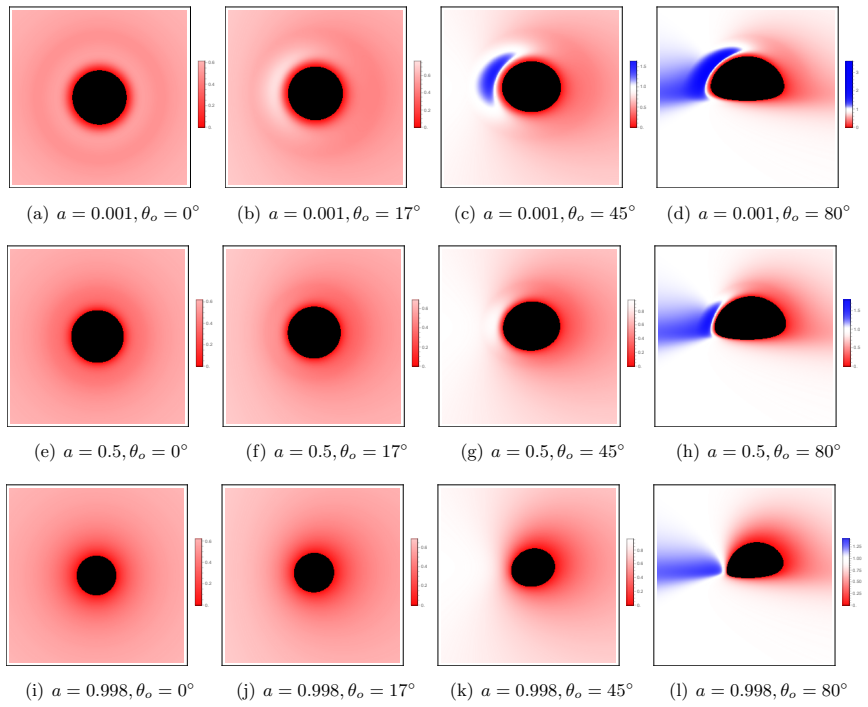
On its own terms, the paper establishes that in the Kerr-BR spacetime the shadow boundary is fixed by the circular-photon condition $R(r)=0=\partial_r R(r)$ for the radial geodesic potential, and that solving it across parameter space yields a clean split: the rotation parameter $a$ changes only the shadow's shape, from nearly circular to a D-shaped contour at high spin, while the magnetic field $B$ leaves the shape essentially unchanged and increases the shadow's radius. The split persists in the full images. Under celestial-sphere illumination, $B$ expands the Einstein ring as well as the shadow; under thin-disk illumination, $B$ increases the inner shadow, lensed image, and higher-order image sizes, whereas $a$ mainly shrinks the inner shadow and leaves the lensed images nearly unchanged. The redshift distribution on the screen is dominated by $a$ and the viewing inclination $\theta_o$, with $B$ leaving almost no imprint, so the brightness pattern resembles a pure Kerr image even when the overall size is shifted. When the predicted angular diameters are compared with measured shadows, M87* gives a tighter but still loose upper bound on $B$ (about $0.4$ at $1\sigma$ for $a=0.5$), while Sgr A* sits entirely inside the $1\sigma$ interval; the current data therefore cannot strongly constrain a BR-like magnetic field.
Load-bearing premise
The whole calculation rests on the recently proposed exact solution for a rotating black hole in a uniform magnetic field being correct, because the paper adopts that metric as given and every image inherits any error in it; if the metric or its allowed parameter range is wrong, the claimed enlargement effect fails with it.
Editorial extensions
If this is right
- At fixed mass and viewing angle, a measured shadow diameter larger than the pure-Kerr prediction for the same spin would be evidence for a uniform BR-like magnetic field.
- Because $B$ barely changes the D-shape, shadow shape remains a clean spin diagnostic in this spacetime, nearly independent of field strength.
- Under thin-disk illumination, the growth of the lensed and higher-order image sizes with $B$ provides a second observable, separate from the inner shadow, for estimating the magnetic field.
- The M87* angular diameter constrains $B$ to be no larger than about $0.4$ at $1\sigma$ for $a=0.5$, while Sgr A* is consistent with the full tested range, so current shadow measurements cannot rule out BR-like fields.
- The redshift pattern is essentially Kerr-like, so a Kerr-BR black hole would appear as a Kerr image whose ring diameters grow with $B$.
Reading between the lines
- A natural next step is a two-stage observational strategy: use the shadow shape to fix $a$, then use the residual size offset to isolate $B$, which would break the degeneracy the authors note in their constraint analysis.
- If the enlargement is monotone in $B$, higher-resolution photon-ring measurements should show the same scaling and could set much tighter field bounds than current angular diameters.
- Extending the same calculation to inclined or non-uniform magnetic fields would show how much of the size effect is specific to the axis-aligned Kerr-BR configuration and how quickly it degrades.
- Because $B$ leaves the redshift maps almost unchanged, spectrally resolved future images would mainly constrain spin; magnetic-field inference may have to come from image sizes rather than brightness patterns.
Editorial analysis
A structured set of objections, weighed in public.
Referee Report
Summary. The paper studies the optical appearance of the Kerr-Bertotti-Robinson (Kerr-BR) black hole, an exact solution describing a rotating black hole immersed in a uniform magnetic field. Using null geodesics and backward ray tracing, the authors compute the shadow outline, images under celestial-sphere and geometrically thin accretion-disk illumination, redshift-factor maps, and compare angular-diameter predictions with M87* and Sgr A* observations. The central claim is that the rotation parameter a and the magnetic field B affect the image differently: increasing a changes the shadow from circular to D-shaped, while increasing B enlarges both the shadow and the Einstein ring. The paper concludes that shadow size is a B-sensitive diagnostic and shadow shape is an a-sensitive diagnostic for this spacetime.
Significance. If the central claim is correct, the paper gives a concrete, falsifiable way to distinguish the magnetic-field parameter from the spin parameter in a specific exact magnetized black-hole spacetime. The analysis is forward-modeling rather than fitting: the metric is taken as input, geodesics are integrated, images are rendered, and observable angular diameters are compared with the EHT bounds on M87* and Sgr A*. The paper is honest that the resulting constraints on B are weak. Its main strengths are the systematic parameter study under two illumination models, the explicit use of the recently proposed exact Kerr-BR metric, and the clear separation of a- versus B-effects in the figures. The main weakness is that the B-dependent shadow-size claim is not shown to be independent of the observer's radial placement, which matters because the Kerr-BR spacetime is not asymptotically flat for B≠0.
major comments (4)
- [Section 3, Eqs. (5), (20)-(26); Section 5] The central B-enlargement claim is not yet supported because the observer's radial coordinate is never specified or shown to be a limit. For B≠0, Ω² in Eq. (5) grows as B²r² times an angle-dependent factor at large r, so the metric does not approach Minkowski space at spatial infinity. The ZAMO tetrad in Eqs. (20)-(23) and the celestial coordinates in Eqs. (24)-(26) are evaluated at an unspecified r_obs; the text says 'positioned at spatial infinity' in Section 3 but later requires a finite 'sufficiently large distance' in Section 5. Without stating r_obs and demonstrating that the shadow and Einstein-ring angular radii converge as r_obs is varied, the reported enlargement of the shadow and ring with increasing B could be partly an observer-placement artifact rather than a spacetime diagnostic.
- [Section 7, Eq. (45)] Eq. (45) applies a flat-space angular-diameter formula to shadows computed in a non-asymptotically-flat spacetime. For B≠0, there is no Minkowskian infinity in which the impact-parameter construction reduces to the standard angular-diameter relation. In addition, ~R_d is never defined for the non-circular, B-dependent contours used in Figs. 1-5. As written, the coefficient 9.87098 also appears to be missing a factor of 10^{-6} if D_o is in kpc; the correct conversion for a Schwarzschild shadow of dimensionless radius 3√3 is about 1.026×10^{-4} μas per solar mass at 1 kpc, not 9.87×2×3√3=102.6 μas. Please define ~R_d explicitly, state how it is extracted from the numerical shadows, and justify or replace Eq. (45) before using it for the M87*/Sgr A* constraints.
- [Section 3, Eqs. (17)-(19), and numerical method] The paper does not provide a validation of the geodesic solver and ray tracer against a known limit. Since B=0 reduces the metric to Kerr and a=0, B=0 reduces it to Schwarzschild, a direct test would be possible and would substantially strengthen confidence in the numerically observed B-enlargement. Please include a comparison of the shadow boundary and critical curve with the well-known Kerr/Schwarzschild results for a few parameter values, and state the numerical integrator accuracy and the r_obs used in the ray-tracing runs.
- [Section 6, Eqs. (41)-(44), Figs. 13-14] The quantity χ defined in Eqs. (41)-(44) is a ratio of frequencies and should be positive, but Figs. 13 and 14 display color bars extending to large negative values, including -20000. Either the plotted quantity is not χ itself, or there is a sign/definitional error in Eq. (44) or in the evaluation of the redshift factor for the plunging, retrograde region. This needs to be clarified and corrected, since it affects the interpretation of the redshift-factor results presented in Section 6.
minor comments (5)
- [Abstract and Introduction] There are several typographical errors: 'the affect of' should be 'the effect of'; 'significant different' should be 'significantly different'; 'condidered' should be 'considered'.
- [Section 5] The phrase 'a second-order polynomial in logarithmic space' for Eq. (40) is imprecise: log Eν is a quadratic polynomial in k, but the emissivity itself is a Gaussian. Please rephrase.
- [Section 5, Eq. (31)] The effective potential V_eff is not written out explicitly for the Kerr-BR metric, so the reader cannot reproduce the ISCO radii used in Figs. 3-8. Adding the explicit form of Eq. (32) in terms of the metric functions would improve reproducibility.
- [Section 6] The color-bar ranges in Figs. 13 and 14 are many orders of magnitude larger than the χ values shown in Figs. 9-12; even after the sign issue is resolved, the choice of scale and color scheme should be explained.
- [Figure 1] The horizontal and vertical axis ranges differ among the four panels, especially panel (d). Using a common scale would make the shape comparison less visually dependent on the chosen range.
Circularity Check
The paper is a forward ray-tracing analysis with no fitted parameters and no load-bearing self-citations.
full rationale
I walked the derivation chain. The Kerr-BR metric (Eqs. 1-7) enters as an external exact-solution input from Ref. [43] and is not re-derived; the photon equations (Eqs. 13-18) are taken from Ref. [65] (a different group), and the tetrad/celestial-coordinate and disk-emission machinery follows independent references ([39], [70]). The central diagnostic—B enlarges the shadow and Einstein ring while a changes the shape—is a computed consequence of those inputs via R(r)=0=∂_r R and the ray-tracing equations, not an identity or a fitted quantity. The M87*/Sgr A* comparison in Sec. 7 uses Eq. (45) with observed angular-diameter data, and the paper explicitly acknowledges the constraints are weak and incomplete; there is no parameter fitted to those data and then relabeled as a prediction. Self-citations: Ref. [64] is contextual (energy extraction/geodesics) and Ref. [72] is a non-unique supplementary citation for setting f_n=1, which is also supported by independent Ref. [70]; neither is load-bearing for the shadow-size/shape claims. The observer-radius issue raised in the skeptical reading is an asymptotic-correctness concern about B≠0, not a circularity of the derivation.
Assumptions & free parameters
free parameters (5)
- rotation parameter a =
0.001, 0.39, 0.5, 0.69, 0.998 (chosen per figure)
- magnetic field B =
historically 0.001 to 0.4 in the constraint section
- observer inclination angle theta_o =
0, 17, 45, 80 degrees
- field angle alpha_fov =
13 degrees for celestial-sphere images, 3 degrees for disk images
- emission profile exponent in E_nu(r) =
explicit form E_nu = exp(-1/2 k^2 - 2k), k = ln(r/r_h)
assumptions (4)
- domain assumption The Kerr-BR metric of Eqs. (1)-(7) is an exact solution of Einstein's equations describing a rotating black hole in a uniform magnetic field.
- standard math Null geodesics are governed by the Hamilton-Jacobi equation with a separable Carter-like constant C.
- domain assumption The thin accretion disk model of Ref. [70] applies to the Kerr-BR spacetime, with f_n = 1 and the redshift factors of Eqs. (41)-(44).
- domain assumption The angular size formula (45) with the numerical factor 9.87098 applies to the Kerr-BR shadow.
Cite this review
Pith. "Pith review of Optical Characteristics of the Kerr-Bertotti-Robinson Black Hole." pith.science (2026). https://pith.science/paper/KQXVRDEN
@misc{pith2026250803020,
  author       = {Pith},
  title        = {Pith review of: Optical Characteristics of the Kerr-Bertotti-Robinson Black Hole},
  year         = {2026},
  howpublished = {\url{https://pith.science/paper/KQXVRDEN}},
  note         = {Machine review of arXiv:2508.03020}
}
read the original abstract
The Kerr-Bertotti-Robinson (Kerr-BR) black hole, a theoretical model of a rotating black hole immersed in a uniform magnetic field, has been proposed recently by Podolsky and Ovcharenko. This study investigates the optical characteristics of the Kerr-BR black hole based on the exact solution. We analyze the optical image under two illumination models: a celestial light source and a geometrically thin accretion disk. We reveal distinct roles for the fundamental parameters in the model. Specifically, it is found that under both illumination models, the effect of the rotation parameter on the optical image of the Kerr-BR black hole is significantly different from that of the magnetic field. As the magnetic field increases, the radii of both the shadow and the Einstein ring enlarge. We also attempt to use the data from M87* and Sgr A* to constrain the magnetic field. These results enhance our understanding of the optical characteristics of the Kerr-BR black hole and establish a theoretical foundation for interpreting future observations on the optical image of the black hole immersed in a uniform magnetic field. Finally, we point out that with advances in the resolution of black hole images, it is possible to detect potential BR-like magnetic fields around black holes.
Figures


Figures from the paper (12 more)






Forward citations
Cited by 11 Pith papers
-
Geodesics and shadows of the spindle-deformed Kerr black hole
In the spindle-deformed Kerr black hole, null geodesics separate at O(B²) while timelike do not; the deformation shifts the ISCO, can create an OSCO, and enlarges the shadow versus Kerr.
-
Reshaping the inner shadow of a Kerr black hole by a torn accretion disk
Torn accretion disks around Kerr black holes erode the inner shadow and create bifurcated, crescent, and multi-ring shadow features driven by sub-disk discontinuities and outer tilt angle.
-
Reshaping the inner shadow of a Kerr black hole by a torn accretion disk
Torn accretion disks around Kerr black holes erode the inner shadow and produce bifurcated, crescent, and multi-order ring morphologies hard to obtain with standard equatorial disks.
-
Critical Behavior of Photon Rings in Kerr-Bertotti-Robinson Spacetime
For a magnetized Kerr-Bertotti-Robinson black hole, the photon-ring parameters gamma, delta, and tau all decrease compared with the unmagnetized Kerr case, weakening the self-similar stacking of higher-order images.
-
Optical Images of the Braneworld Black Hole Surrounded by an Optically Thin Accretion Disk
A rotating braneworld black hole with tidal charge casts an asymmetric, spin- and q-dependent shadow; with the adopted disk emissivity, its 86 GHz image is brighter than its 230 GHz image.
-
Probing Lorentz-violating effects via precession and accretion disk images of a rotating bumblebee black hole
Lorentz violation in a rotating bumblebee black hole suppresses Lense-Thirring precession, increases periastron precession, shrinks the inner shadow, and enhances the lensed ring while leaving the critical curve nearl...
-
Thermodynamics of Kerr-Bertotti-Robinson black hole
A consistent thermodynamics of the Kerr-Bertotti-Robinson black hole is constructed by adopting the Christodoulou-Ruffini mass relation, yielding a first law and Smarr formula without an explicit magnetic-field work term.
-
Optical Appearance of the Kerr-Bertotti-Robinson Black Hole with a Magnetically Driven Synchrotron Emissivity Model
Kerr-BR black hole images with magnetically coupled synchrotron emissivity show spin- and B-dependent shifts in the inner disk edge, altered lensing rings, and Doppler asymmetries, with retrograde cases displaying wid...
-
Photon Spheres and shadow of modified black-hole entropies
Entropy corrections to black holes produce modified metrics whose photon-sphere and shadow sizes can be constrained by Sgr A* observations.
-
Photon Spheres and shadow of modified black-hole entropies
Corrected black hole entropies produce distinct shifts in photon sphere radius and shadow size that are constrained by Event Horizon Telescope data on Sagittarius A*.
-
Photon Spheres and shadow of modified black-hole entropies
Modified black hole entropies alter photon sphere radii and shadow sizes, with parameters constrained by Event Horizon Telescope observations of Sgr A*.
Reference graph
Works this paper leans on
-
[1]
K. Akiyama et al. [Event Horizon Telescope], Astrophys. J. Lett. 875, L1 (2019) [arXiv:1906.11238 [astro-ph.GA]]
arXiv 2019
-
[2]
K. Akiyama et al. [Event Horizon Telescope], Astrophys. J. Lett. 930, no.2, L12 (2022) [arXiv:2311.08680 [astro-ph.HE]]
arXiv 2022
-
[3]
S. E. Gralla, D. E. Holz and R. M. Wald, Phys. Rev. D 100, no.2, 024018 (2019) [arXiv:1906.00873 [astro-ph.HE]]. 22
arXiv 2019
- [4]
-
[5]
D. Psaltis et al. [Event Horizon Telescope], Phys. Rev. Lett. 125, no.14, 141104 (2020) [arXiv:2010.01055 [gr-qc]]
arXiv 2020
-
[6]
X. X. Zeng, K. J. He, G. P. Li, E. W. Liang and S. Guo, Eur. Phys. J. C 82, no.8, 764 (2022) [arXiv:2209.05938 [gr-qc]]
arXiv 2022
-
[7]
X. X. Zeng, K. J. He and G. P. Li, Sci. China Phys. Mech. Astron. 65, no.9, 290411 (2022) [arXiv:2111.05090 [gr-qc]]
arXiv 2022
-
[8]
X. X. Zeng, G. P. Li and K. J. He, Nucl. Phys. B 974, 115639 (2022) [arXiv:2106.14478 [hep-th]]
arXiv 2022
Show all 77 references
-
[9]
X. X. Zeng, H. Ye, K. J. He and H. Yu, [arXiv:2507.11583 [gr-qc]]
-
[10]
R. P. Kerr, Phys. Rev. Lett. 11, 237-238 (1963)
1963
-
[11]
Chandrasekhar, The mathematical theory of black holes(Clarendon Press, 1985)
S. Chandrasekhar, The mathematical theory of black holes(Clarendon Press, 1985)
1985
-
[12]
J. L. Synge, Mon. Not. Roy. Astron. Soc. 131, no.3, 463-466 (1966)
1966
-
[13]
Hioki and K
K. Hioki and K. i. Maeda, Phys. Rev. D 80, 024042 (2009) [arXiv:0904.3575 [astro-ph.HE]]
2009 arXiv
-
[14]
Atamurotov, A
F. Atamurotov, A. Abdujabbarov and B. Ahmedov, Phys. Rev. D 88, no.6, 064004 (2013)
2013
-
[15]
S. E. Gralla, A. Lupsasca and A. Strominger, Mon. Not. Roy. Astron. Soc.475, no.3, 3829-3853 (2018) [arXiv:1710.11112 [astro-ph.HE]]
2018 arXiv
-
[16]
M. Wang, S. Chen and J. Jing, JCAP 10, 051 (2017) [arXiv:1707.09451 [gr-qc]]
2017 arXiv
-
[17]
S. Chen, M. Wang and J. Jing, JHEP 07, 054 (2020) [arXiv:2004.08857 [gr-qc]]
2020 arXiv
-
[18]
Tsukamoto, Phys
N. Tsukamoto, Phys. Rev. D 97, no.6, 064021 (2018) [arXiv:1708.07427 [gr-qc]]
2018 arXiv
-
[19]
S. W. Wei, Y. C. Zou, Y. X. Liu and R. B. Mann, JCAP 08, 030 (2019) [arXiv:1904.07710 [gr-qc]]
2019 arXiv
- [20]
-
[21]
Afrin, R
M. Afrin, R. Kumar and S. G. Ghosh, Mon. Not. Roy. Astron. Soc. 504, no.4, 5927-5940 (2021) [arXiv:2103.11417 [gr-qc]]
2021 arXiv
-
[22]
X. M. Kuang and A. ¨Ovg¨ un, Annals Phys.447, 169147 (2022) [arXiv:2205.11003 [gr-qc]]
2022 arXiv
-
[23]
H. B. Zheng, M. Q. Wu, G. P. Li and Q. Q. Jiang, Eur. Phys. J. C 85, no.1, 46 (2025) [arXiv:2411.10315 [gr-qc]]
2025 arXiv
-
[24]
J. P. Luminet, Astron. Astrophys. 75, 228-235 (1979)
1979
-
[25]
W. Cui, S. N. Zhang and W. Chen, Astrophys. J. Lett. 492, L53 (1998) [arXiv:astro- ph/9710352 [astro-ph]]
1998
-
[26]
G. S. Bisnovatyi-Kogan and O. Y. Tsupko, Universe 3, no.3, 57 (2017) [arXiv:1905.06615 [gr-qc]]
2017 arXiv
-
[27]
G. V. Kraniotis, Eur. Phys. J. C 81, no.2, 147 (2021) [arXiv:1912.10320 [gr-qc]]
2021 arXiv
-
[28]
G. N. Wong, Astrophys. J. 909, no.2, 217 (2021) [arXiv:2009.06641 [astro-ph.HE]]
2021 arXiv
-
[29]
X. M. Kuang, Z. Y. Tang, B. Wang and A. Wang, Phys. Rev. D 106, no.6, 064012 (2022) [arXiv:2206.05878 [gr-qc]]
2022 arXiv
-
[30]
R. D. Blandford and R. L. Znajek, Mon. Not. Roy. Astron. Soc. 179, 433-456 (1977)
1977
-
[31]
M. C. Begelman, R. D. Blandford and M. J. Rees, Rev. Mod. Phys. 56, 255-351 (1984). 23
1984
-
[32]
C. F. Gammie, J. C. McKinney and G. Toth, Astrophys. J. 589, 444-457 (2003) [arXiv:astro- ph/0301509 [astro-ph]]
2003
-
[33]
H. C. D. L. Junior, P. V. P. Cunha, C. A. R. Herdeiro and L. C. B. Crispino, Phys. Rev. D 104, no.4, 044018 (2021) [arXiv:2104.09577 [gr-qc]]
2021 arXiv
-
[34]
M. Wang, S. Chen and J. Jing, Phys. Rev. D 104, no.8, 084021 (2021) [arXiv:2104.12304 [gr-qc]]
2021 arXiv
-
[35]
Zhong, Z
Z. Zhong, Z. Hu, H. Yan, M. Guo and B. Chen, Phys. Rev. D 104, no.10, 104028 (2021) [arXiv:2108.06140 [gr-qc]]
2021 arXiv
-
[36]
H. C. D. L. Junior, J. Z. Yang, L. C. B. Crispino, P. V. P. Cunha and C. A. R. Herdeiro, Phys. Rev. D 105, no.6, 064070 (2022) [arXiv:2112.10802 [gr-qc]]
2022 arXiv
-
[37]
K. J. Taylor and A. Ritz, [arXiv:2505.11629 [gr-qc]]
-
[38]
Yumoto, D
A. Yumoto, D. Nitta, T. Chiba and N. Sugiyama, Phys. Rev. D 86, 103001 (2012) [arXiv:1208.0635 [gr-qc]]
2012 arXiv
-
[39]
Z. Hu, Z. Zhong, P. C. Li, M. Guo and B. Chen, Phys. Rev. D 103, no.4, 044057 (2021) [arXiv:2012.07022 [gr-qc]]
2021 arXiv
-
[40]
Bertotti, Phys
B. Bertotti, Phys. Rev. 116, 1331 (1959)
1959
-
[41]
Robinson, Bull
I. Robinson, Bull. Acad. Pol. Sci. Ser. Sci. Math. Astron. Phys. 7, 351-352 (1959)
1959
-
[42]
H. K. Kunduri and J. Lucietti, Living Rev. Rel. 16, 8 (2013) [arXiv:1306.2517 [hep-th]]
2013 arXiv
-
[43]
Podolsky and H
J. Podolsky and H. Ovcharenko, [arXiv:2507.05199 [gr-qc]]
-
[44]
J. B. Griffiths and J. Podolsky, Int. J. Mod. Phys. D 15, 335-370 (2006) [arXiv:gr-qc/0511091 [gr-qc]]
2006 arXiv
-
[45]
Podolsky and J
J. Podolsky and J. B. Griffiths, Phys. Rev. D 73, 044018 (2006) [arXiv:gr-qc/0601130 [gr-qc]]
2006 arXiv
-
[46]
Podolsky and A
J. Podolsky and A. Vratny, Phys. Rev. D 107, no.8, 084034 (2023) [erratum: Phys. Rev. D 108, no.12, 129902 (2023)] [arXiv:2212.08865 [gr-qc]]
2023 arXiv
-
[47]
S. Q. Wu and D. Wu, Phys. Rev. D 110, no.10, 104072 (2024) [arXiv:2409.06733 [gr-qc]]
2024 arXiv
-
[48]
Ovcharenko, J
H. Ovcharenko, J. Podolsky and M. Astorino, Phys. Rev. D 111, no.8, 084016 (2025) [arXiv:2501.07537 [gr-qc]]
2025 arXiv
-
[49]
R. M. Wald, Phys. Rev. D 10, 1680-1685 (1974)
1974
-
[50]
Garfinkle and E
D. Garfinkle and E. N. Glass, Class. Quant. Grav. 28, 215012 (2011) [arXiv:1109.1535 [gr-qc]]
2011 arXiv
-
[51]
M. A. Melvin, Phys. Lett. 8, 65-70 (1964)
1964
-
[52]
M. A. Melvin, Phys. Rev. 139, B225-B243 (1965)
1965
-
[53]
F. J. Ernst and W. J. Wild, J. Math. Phys. 17, no.2, 182 (1976)
1976
-
[54]
J. M. Maldacena, J. Michelson and A. Strominger, JHEP 02, 011 (1999) [arXiv:hep-th/9812073 [hep-th]]
1999 arXiv
- [55]
-
[56]
Clement and D
G. Clement and D. Gal’tsov, Phys. Rev. D 63, 124011 (2001) [arXiv:gr-qc/0102025 [gr-qc]]
2001 arXiv
-
[57]
de Cesare, R
M. de Cesare, R. Oliveri and A. P. Porfyriadis, Phys. Rev. D 111, no.4, 044028 (2025) [arXiv:2410.23446 [gr-qc]]
2025 arXiv
-
[58]
Strominger, JHEP 01, 007 (1999) [arXiv:hep-th/9809027 [hep-th]]
A. Strominger, JHEP 01, 007 (1999) [arXiv:hep-th/9809027 [hep-th]]
1999 arXiv
-
[59]
Spradlin and A
M. Spradlin and A. Strominger, JHEP 11, 021 (1999) [arXiv:hep-th/9904143 [hep-th]]. 24
1999 arXiv
-
[60]
Cadoni and S
M. Cadoni and S. Mignemi, Phys. Rev. D 51, 4319-4329 (1995) [arXiv:hep-th/9410041 [hep- th]]
1995 arXiv
-
[61]
Navarro-Salas and P
J. Navarro-Salas and P. Navarro, Nucl. Phys. B 579, 250-266 (2000) [arXiv:hep-th/9910076 [hep-th]]
2000 arXiv
-
[62]
Caldarelli, G
M. Caldarelli, G. Catelani and L. Vanzo, JHEP 10, 005 (2000) [arXiv:hep-th/0008058 [hep-th]]
2000 arXiv
-
[63]
A. C. Ottewill and P. Taylor, Phys. Rev. D 86, 104067 (2012) [arXiv:1209.6080 [gr-qc]]
2012 arXiv
-
[64]
X. X. Zeng and K. Wang, [arXiv:2507.21777 [gr-qc]]
-
[65]
X. Wang, Y. Hou, X. Wan, M. Guo and B. Chen, [arXiv:2507.22494 [gr-qc]]
-
[66]
P. V. P. Cunha and C. A. R. Herdeiro, Gen. Rel. Grav. 50, no.4, 42 (2018) [arXiv:1801.00860 [gr-qc]]
2018 arXiv
-
[67]
T. C. Lee, Z. Hu, M. Guo and B. Chen, Phys. Rev. D 108, no.2, 024008 (2023) [arXiv:2211.04143 [gr-qc]]
2023 arXiv
-
[68]
K. J. He, J. T. Yao, X. Zhang and X. Li, Phys. Rev. D 109, no.6, 064049 (2024)
2024
-
[69]
S. Guo, Y. X. Huang, E. W. Liang, Y. Liang, Q. Q. Jiang and K. Lin, Astrophys. J. 975, no.2, 237 (2024) [arXiv:2411.07914 [astro-ph.HE]]
2024 arXiv
-
[70]
Y. Hou, Z. Zhang, H. Yan, M. Guo and B. Chen, Phys. Rev. D 106, no.6, 064058 (2022) [arXiv:2206.13744 [gr-qc]]
2022 arXiv
-
[71]
Zhang, Y
Z. Zhang, Y. Hou and M. Guo, Chin. Phys. C 48, no.8, 085106 (2024) [arXiv:2305.14924 [gr-qc]]
2024 arXiv
-
[72]
C. Y. Yang, M. I. Aslam, X. X. Zeng and R. Saleem, JHEAp 46, 345 (2025) [arXiv:2411.11807 [astro-ph.HE]]
2025 arXiv
-
[73]
Perlick and O
V. Perlick and O. Y. Tsupko, Phys. Rept. 947, 1-39 (2022) [arXiv:2105.07101 [gr-qc]]
2022 arXiv
-
[74]
Amarilla and E
L. Amarilla and E. F. Eiroa, Phys. Rev. D 85, 064019 (2012) [arXiv:1112.6349 [gr-qc]]
2012 arXiv
-
[75]
G. P. Li, H. B. Zheng, K. J. He and Q. Q. Jiang, Eur. Phys. J. C 85, no.3, 249 (2025) [arXiv:2410.17295 [gr-qc]]
2025 arXiv
-
[76]
Capozziello, S
S. Capozziello, S. Zare, L. M. Nieto and H. Hassanabadi, [arXiv:2311.12896 [gr-qc]]
-
[77]
Kumar Walia, S
R. Kumar Walia, S. G. Ghosh and S. D. Maharaj, Astrophys. J. 939, no.2, 77 (2022) [arXiv:2207.00078 [gr-qc]]. 25
2022 arXiv
Reviewed August 6, 2026 · model on record in the stance chip above.
Discussion (0). Sign in to comment.