REVIEW 3 major objections 4 minor 61 references
Extraction of baryon number susceptibilities at finite density from heavy-ion collisions
T0 review · 3 major / 4 minor · reviewed 2026-08-14 · deepseek-v4-flash
Pith's one-line read The paper claims the first Bayesian extraction of the second-order QCD baryon susceptibility from heavy-ion collision data, matching lattice QCD at baryon chemical potentials up to 300 MeV and showing a fluctuation enhancement at higher…
desk verdict A credible, genuinely new extraction of chi_2^B from BES data, with the low-energy enhancement still hostage to unmodeled volume fluctuations. read the letter →
The pith
A machine-rendered reading of the paper's core claim, the machinery that carries it, and where it could break.
The reading
What carries the argument
The load-bearing mechanism is a four-step forward map. Maximum-entropy freeze-out, the least-prejudiced assignment of hadronic fluctuations consistent with the local baryon susceptibilities, converts local equation-of-state susceptibilities, parametrized by $\gamma=(\chi_2^B/\bar\chi_2^B, \chi_3^B/\chi_1^B, \chi_4^B/\chi_2^B)$, into joint baryon-antibaryon factorial cumulants on every hydrodynamic hypersurface element. Independent binomial thinning with the local proton-to-baryon fraction and the kinematic acceptance maps those cumulants onto accepted (net-)proton cumulants, and the subensemble acceptance method (SAM-3.0) then imposes exact global baryon-number conservation. The whole chain is linear in the three susceptibility deviations before the conservation step, so a Bayesian posterior over the three ratios can be evaluated on a grid and marginalized. This is what lets the extracted $\chi_2^B$ be compared with lattice QCD along a freeze-out line.
What would settle it
If centrality-bin-width or more complete volume-fluctuation corrections revise the measured cumulants so that the extracted $\chi_2^B/\bar\chi_2^B$ at the lowest collider energy drops back into the lattice band, or if the nonmonotonic peak in $\hat{C}_3/\hat{C}_1$ vanishes when the same framework is applied to fixed-target data, then the central claim of a data-driven low-energy enhancement and of a conservation-driven peak would be falsified.
Extended reading notes
Core claim
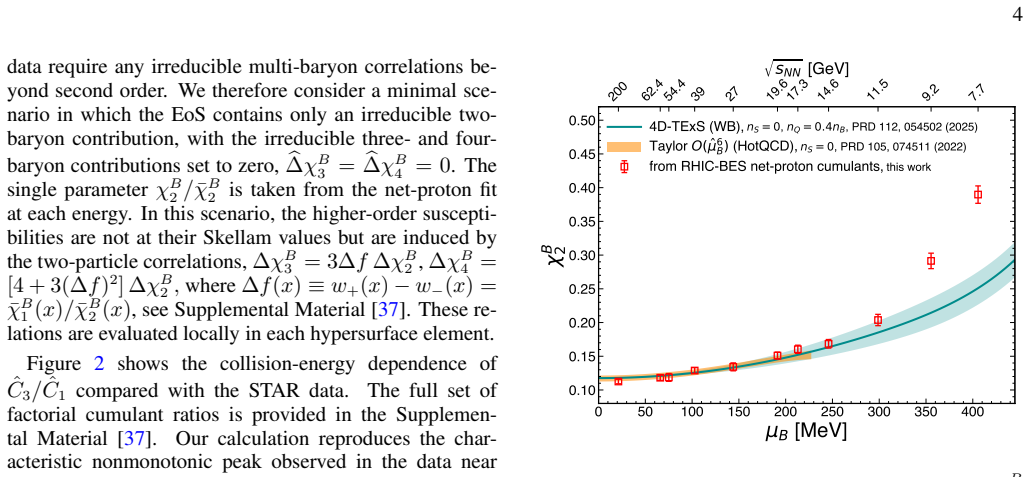
On its own terms, the paper establishes that the measured cumulants and factorial cumulants of (net-)protons in Au-Au collisions can be inverted into the baryon number susceptibilities $\chi_2^B$, $\chi_3^B$, and $\chi_4^B$ along the chemical freeze-out line, rather than being compared with pre-selected equations of state. The second-order ratio $\chi_2^B/\bar\chi_2^B$ is tightly constrained and shows a non-monotonic energy dependence: near the ideal-gas value at 7.7 GeV, a suppression around 0.73-0.82 at 11.5-19.6 GeV, and a flat suppression at high energies. In absolute terms $\chi_2^B$ agrees with lattice-based estimates for $\mu_B \lesssim 300$ MeV and is enhanced by up to about 50% at $\sqrt{s_{NN}} = 7.7$ GeV. The third- and fourth-order susceptibilities remain weakly constrained, but a scenario retaining only the irreducible two-baryon correlation describes the measured $\hat{C}_3/\hat{C}_1$ peak, meaning the data do not require genuine multi-baryon correlations of order three or four.
Load-bearing premise
The load-bearing premise is that the low-energy rise in the extracted fluctuation strength is a property of equilibrium QCD matter, not an artifact of event-to-event volume or baryon-stopping fluctuations that the model leaves out; the paper itself flags this as the main caveat.
Editorial extensions
If this is right
- The second-order baryon susceptibility along the chemical freeze-out line becomes a data-driven observable, and its agreement with lattice QCD at $\mu_B\lesssim300$ MeV supports the idea that baryon-number fluctuations equilibrate locally at freeze-out.
- At $\mu_B\gtrsim300$ MeV the data point to enhanced baryon-number fluctuations, up to about 50% above the lattice/HRG baseline at 7.7 GeV, which, if confirmed, would signal attractive correlations not present in the noncritical baseline.
- The measured nonmonotonic peak in $\hat{C}_3/\hat{C}_1$ near 11 GeV is reproduced without irreducible three- or four-baryon correlations; it is generated by the energy dependence of $\chi_2^B$ combined with exact baryon-number conservation.
- Third- and fourth-order susceptibilities are too weakly constrained to discriminate critical-point scenarios; definite conclusions about genuine multi-baryon correlations will require reduced experimental uncertainties or new observables.
- The two complementary extractions, from proton factorial cumulants and from net-proton cumulants, agree within uncertainties, providing an internal consistency check of the forward model.
Reading between the lines
- A natural next step is to apply the same forward map at fixed-target energies; the extraction predicts that if the low-energy enhancement persists once volume fluctuations are controlled, it is a thermodynamic property, whereas if it moves, it was a modeling artifact.
- Because the framework treats baryons and antibaryons as a two-species system with only the baryon-density mode fluctuating, an observable that is invariant under baryon-to-proton dilution and conservation corrections would be needed to isolate genuine critical correlations; the current factorial cumulant ratios are not such observables.
- The same inversion strategy could be applied to strangeness or electric-charge fluctuations: data on kaon or pion cumulants could yield the corresponding susceptibilities along the freeze-out line, provided the analogous conservation laws are imposed.
- If the framework were applied at another centrality or acceptance and the extracted $\chi_2^B/\bar\chi_2^B$ stayed unchanged, that would validate the uniform susceptibility-ratio assumption; if it drifted, the effective single-order-parameter reduction would be too coarse.
Editorial analysis
A structured set of objections, weighed in public.
Referee Report
Summary. The manuscript presents a Bayesian extraction of baryon number susceptibilities from STAR measurements of proton factorial cumulant ratios and net-proton cumulant ratios in 0–5% central Au–Au collisions at √sNN = 7.7–200 GeV. The forward model combines event-averaged MUSIC hydrodynamic hypersurfaces with maximum-entropy freeze-out, binomial thinning to accepted (anti)protons, and the SAM-3.0 exact baryon-number-conservation correction. The authors report tight constraints on χ2B/¯χ2B, quantitative agreement with lattice-QCD-based estimates for μB ≲ 300 MeV, an upward deviation at larger μB, and a demonstration that the nonmonotonic energy dependence of the proton factorial cumulant ratio Ĉ 3/Ĉ 1 can be reproduced without irreducible three- or four-baryon correlations.
Significance. The approach is novel: it converts heavy-ion fluctuation data into a data-driven determination of QCD baryon susceptibilities along the freeze-out line, rather than comparing data with a single assumed equation of state. The forward map is transparent and the supplemental material supplies explicit formulas for the MaxEnt mapping, binomial thinning, and the SAM-3.0 correction. The two independent extractions (proton factorial cumulants and net-proton cumulants) cross-validate each other, and the variation of the switching energy density is a useful robustness check. The two-baryon-dominance scenario makes a concrete, falsifiable statement about the origin of the Ĉ 3/Ĉ 1 peak. However, the current significance is bounded by the paper's own admissions that model systematics are not propagated and that volume fluctuations, initial-state fluctuations, and baryon-stopping fluctuations are neglected; these effects are largest exactly where the most interesting deviations appear.
major comments (3)
- [Bayesian inference and Fig. 3] The quoted uncertainties propagate only experimental errors; the hydrodynamic input, initial state, transport coefficients, switching energy density, and freeze-out prescription are held fixed (Bayesian inference paragraph and footnote [40]). The abstract's claim of 'tight constraints' and the quantitative agreement with lattice-QCD estimates for μB ≲ 300 MeV are therefore conditional on this fixed setup. Because the central claim is a comparison with lattice QCD, the absence of model systematics leaves open the possibility that the agreement, or the low-energy enhancement, is partly a consequence of the chosen hydrodynamic baseline. The paper should either estimate and propagate model uncertainties or state unambiguously in the abstract that the constraints are conditional on the hydrodynamic model.
- [Comparison with lattice QCD, caveats paragraph] The extraction uses event-averaged hypersurfaces and includes only the centrality-bin-width correction for volume fluctuations; the paper itself states that volume-fluctuation, initial-state, and baryon-stopping effects 'are expected to become increasingly important at the lowest collision energies' and that the extraction 'should be revisited' if more complete corrections revise the cumulants. The observed enhancement of χ2B/¯χ2B at 7.7 GeV and the nonmonotonic Ĉ 3/Ĉ 1 peak near 11 GeV lie precisely in this regime. As a result, the claimed deviation from lattice at large μB and the two-baryon-dominance interpretation of Ĉ 3/Ĉ 1 are not yet robust; the manuscript must either include a quantitative estimate of these effects or present the large-μB enhancement as an explicitly model-dependent hint rather than an extracted result.
- [Bayesian inference, footnote [40]] The Gaussian likelihood neglects correlations among the three measured ratios because the experimental covariance matrices are unavailable. This affects the size of the 68% credible intervals and, in particular, the 2.3σ preference for negative χ4B/χ2B at 19.6 GeV ('Extracted susceptibilities' section). Since the ratios are constructed from the same event samples, their correlations are likely non-negligible; without an estimate, statements of statistical significance for the higher-order susceptibilities are not supported. The authors should either obtain or estimate the covariances, or refrain from quoting significances.
minor comments (4)
- [Abstract] The phrase 'tight constraints' should be qualified as 'conditional tight constraints' given the fixed hydrodynamic setup; similarly, 'indicate an enhancement' should be flagged as model-dependent.
- [Fig. 1 caption] The upper axis converts √sNN to μB using the freeze-out parametrization of Ref. [43]; this mapping carries model uncertainty and should be mentioned in the caption or in the text.
- [Table I] The 200 GeV entry for χ3B/χ1B uses a widened prior and the posterior 'was verified to saturate'; this entry should be clearly marked as unconstrained or removed from the table of extracted values.
- [Two-baryon correlation dominance] The statement that Ĉ 3/Ĉ 1 can be described 'without irreducible three- or four-baryon correlations' is correct, but the higher-order susceptibilities in the scenario are nonzero through the induced relations in Eqs. (A7)–(A8); consider wording that makes this distinction clearer, e.g., 'without irreducible multi-baryon correlations beyond second order'.
Circularity Check
No circularity: the extraction is an inverse fit by design, the C3/C1 test is a cross-validated model scenario, and self-cited tools are supporting and explicitly constructed.
full rationale
The paper's central operation is a Bayesian inference of the susceptibility ratios gamma1, gamma2, gamma3 from STAR cumulant data, so the extracted values are by definition the fitted parameters of the forward model. That is the stated goal of the paper, not a hidden circularity. The lattice comparison is external: chi2^B is put on an absolute scale using QMHRG2020 and compared with 4D-TExS and HotQCD results, neither of which is derived from the fitted parameters. The two-baryon dominance scenario is also not circular in the prohibited sense. The paper sets bDelta chi3^B = bDelta chi4^B = 0, takes gamma1 from the net-proton cumulant fit, and then computes the proton factorial cumulant ratio C3/C1. That ratio is a different observable set from the net-proton cumulants used to constrain gamma1, and the match is presented as a cross-validation with the STAR data; it is not an identity following from the fit by construction. The self-cited elements are supporting tools: SAM-3.0 is a parameter-free conservation-correction method whose cumulant construction is described in the Supplemental Material, and the baryon-conservation-generated C3/C1 effect is computed explicitly in the stage-by-stage decomposition, not merely asserted from a self-citation. No uniqueness theorem from the authors' own prior work is invoked to forbid alternatives, and no known result is renamed as a new prediction. The paper's own caveats about unmodeled volume fluctuations at low energies are modeling limitations, not circular reasoning. Therefore no load-bearing step reduces to its own input by construction, and the appropriate finding is no significant circularity.
Assumptions & free parameters
free parameters (3)
- gamma_1(E) = chi_2^B / bar chi_2^B at each collision energy =
7.7 GeV: 1.074/1.060; 11.5: 0.765/0.781; 19.6: 0.770/0.819; 200: 0.848/0.857 (factorial/net-p medians, Table I)
- gamma_2(E) = chi_3^B / chi_1^B at each collision energy =
Mostly within [-3,3] except 200 GeV (large uncertainty); weakly constrained by prior [-15,15] ([-60,60] at 200 GeV)…
- gamma_3(E) = chi_4^B / chi_2^B at each collision energy =
Weakly constrained; largest deviation at 19.6 GeV: -34 +/- 28 (factorial) and -33 +/- 14 (net-p), see Table I
assumptions (5)
- domain assumption Each hypersurface element is an independent grand-canonical subsystem; only local baryon-density fluctuations are retained in MaxEnt, so baryon-antibaryon factorial cumulants take the factorized form of Eq. (2).
- domain assumption Baryon-to-proton mapping is independent binomial sampling with probability alpha_p(x)=q+(x)p(x) set by ideal-HRG proton fractions and Cooper-Frye acceptance.
- domain assumption The three susceptibility ratios gamma are uniform across the hypersurface at each collision energy, making them effective hypersurface-averaged quantities.
- domain assumption Event-averaged hydrodynamic hypersurfaces from MUSIC with constant energy density particlization (eps_sw = 0.26 GeV/fm3) and neglect of volume fluctuations beyond centrality-bin-width correction are adequate.
- domain assumption The measured cumulant ratios enter a Gaussian likelihood with statistical and systematic errors added in quadrature and correlations among the three ratios neglected.
Cite this review
Pith. "Pith review of Extraction of baryon number susceptibilities at finite density from heavy-ion collisions." pith.science (2026). https://pith.science/paper/KRHJTKF6
@misc{pith2026260810238,
  author       = {Pith},
  title        = {Pith review of: Extraction of baryon number susceptibilities at finite density from heavy-ion collisions},
  year         = {2026},
  howpublished = {\url{https://pith.science/paper/KRHJTKF6}},
  note         = {Machine review of arXiv:2608.10238}
}
abstract
We present, to our knowledge, the first Bayesian extraction of baryon number susceptibilities of QCD matter at finite baryon density from heavy-ion collision data on proton number cumulants. The framework embeds arbitrary equation-of-state susceptibilities $\chi_n^B$ into realistic hydrodynamic particlization hypersurfaces through maximum-entropy freeze-out, maps the resulting (anti)baryon fluctuations onto protons, applies the experimental kinematic acceptance, and accounts for exact baryon number conservation. Applying the framework to measurements of (net-)proton number fluctuations in 0--5\% central Au-Au collisions from the RHIC Beam Energy Scan in the collider mode, we extract, at each collision energy, the second-order susceptibility normalized by the hadron resonance gas value, $\chi_{2}^B/\bar{\chi}_{2}^B$, and the higher-order susceptibility ratios $\chi_{3}^B/\chi_{1}^B$ and $\chi_{4}^B/\chi_{2}^B$. We obtain tight constraints on $\chi_{2}^B$, with extracted values in quantitative agreement with lattice QCD based estimates along the chemical freeze-out line for $\mu_B \lesssim 300$~MeV. At larger $\mu_B$, the extracted values indicate an enhancement of baryon number fluctuations relative to the noncritical lattice-based extrapolation and HRG baseline considered here. The third- and fourth-order susceptibilities are only weakly constrained. In particular, we find that the observed nonmonotonic collision-energy dependence of the proton factorial cumulant ratio $\hat{C}_{3}/\hat{C}_{1}$ can be described without irreducible three- or four-baryon correlations. This behavior emerges from the interplay between the energy dependence of $\chi_{2}^B$ and exact baryon number conservation.
Figures


Reference graph
Works this paper leans on
-
[40]
A2 in the Supplemental Material [37]
Because the corresponding experimental covariance matri- ces are unavailable, correlations among the three measured ratios are neglected in the likelihood Separately, we cross- validate the framework by using the posterior inferred from each observable set to predict the other set, see Fig. A2 in the Supplemental Material [37]
-
[1]
M. A. Stephanov, Phys. Rev. Lett.102, 032301 (2009), arXiv:0809.3450 [hep-ph]
arXiv 2009
- [2]
-
[3]
M. A. Stephanov, Phys. Rev. Lett.107, 052301 (2011), arXiv:1104.1627 [hep-ph]
arXiv 2011
-
[4]
A. Bazavovet al., Phys. Rev. D95, 054504 (2017), arXiv:1701.04325 [hep-lat]
arXiv 2017
-
[5]
S. Borsanyi, Z. Fodor, J. N. Guenther, S. K. Katz, K. K. Szabo, A. Pasztor, I. Portillo, and C. Ratti, JHEP10, 205, arXiv:1805.04445 [hep-lat]
-
[6]
D. Bollweg, J. Goswami, O. Kaczmarek, F. Karsch, S. Mukherjee, P. Petreczky, C. Schmidt, and P. Scior (HotQCD), Phys. Rev. D104, 074512 (2021), arXiv:2107.10011 [hep-lat]
arXiv 2021
-
[7]
S. Borsanyi, Z. Fodor, J. N. Guenther, S. D. Katz, P. Parotto, A. Pasztor, D. Pesznyak, K. K. Szabo, and C. H. Wong, Phys. Rev. D110, L011501 (2024), arXiv:2312.07528 [hep- lat]
arXiv 2024
Show all 61 references
-
[8]
Bollweg, D
D. Bollweg, D. A. Clarke, J. Goswami, O. Kaczmarek, F. Karsch, S. Mukherjee, P. Petreczky, C. Schmidt, and S. Sharma (HotQCD), Phys. Rev. D108, 014510 (2023), arXiv:2212.09043 [hep-lat]
2023 arXiv
- [9]
-
[10]
D. A. Clarke, P. Dimopoulos, F. Di Renzo, J. Goswami, C. Schmidt, S. Singh, and K. Zambello, Phys. Rev. D112, L091504 (2025), arXiv:2405.10196 [hep-lat]
2025 arXiv
-
[11]
H. Shah, M. Hippert, J. Noronha, C. Ratti, and V . V ovchenko, Phys. Rev. C113, L012201 (2026), arXiv:2410.16206 [hep-ph]
2026
-
[12]
Abuali, S
A. Abuali, S. Bors ´anyi, Z. Fodor, J. Jahan, M. Kahangirwe, P. Parotto, A. P´asztor, C. Ratti, H. Shah, and S. A. Trabulsi, Phys. Rev. D112, 054502 (2025), arXiv:2504.01881 [hep- lat]
2025 arXiv
-
[13]
Y . Lu, F. Gao, Y .-x. Liu, and J. M. Pawlowski, Phys. Rev. D 113, 054019 (2026), arXiv:2504.05099 [hep-ph]
2026 arXiv
-
[14]
C. S. Fischer and J. M. Pawlowski, Phase structure and ob- servables at high densities from first principles QCD (2026), arXiv:2603.11135 [hep-ph]
2026
-
[15]
M. A. Stephanov, K. Rajagopal, and E. V . Shuryak, Phys. Rev. Lett.81, 4816 (1998), arXiv:hep-ph/9806219
1998 arXiv
-
[16]
M. A. Stephanov, K. Rajagopal, and E. V . Shuryak, Phys. Rev. D60, 114028 (1999), arXiv:hep-ph/9903292
1999 arXiv
-
[17]
Asakawa, S
M. Asakawa, S. Ejiri, and M. Kitazawa, Phys. Rev. Lett. 103, 262301 (2009), arXiv:0904.2089 [nucl-th]
2009 arXiv
-
[18]
Athanasiou, K
C. Athanasiou, K. Rajagopal, and M. Stephanov, Phys. Rev. D82, 074008 (2010), arXiv:1006.4636 [hep-ph]
2010 arXiv
-
[19]
Adamet al.(STAR), Phys
J. Adamet al.(STAR), Phys. Rev. Lett.126, 092301 (2021), [Erratum: Phys. Rev. Lett. 134, 139902 (2025)], arXiv:2001.02852 [nucl-ex]
2021
-
[20]
B. E. Aboonaet al.(STAR), Phys. Rev. Lett.135, 142301 (2025), arXiv:2504.00817 [nucl-ex]
2025 arXiv
-
[21]
Braun-Munzinger, B
P. Braun-Munzinger, B. Friman, K. Redlich, A. Rusta- mov, and J. Stachel, Nucl. Phys. A1008, 122141 (2021), arXiv:2007.02463 [nucl-th]
2021 arXiv
-
[22]
V ovchenko, V
V . V ovchenko, V . Koch, and C. Shen, Phys. Rev. C105, 014904 (2022), arXiv:2107.00163 [hep-ph]
2022 arXiv
-
[23]
R.-z. Zhao, S. Yin, S. Wu, L. Du, X. Luo, and W.-j. Fu, Critical net-proton number fluctuations with hydrodynamics (2026), arXiv:2607.26912 [nucl-th]
2026 arXiv
-
[24]
S. A. Basset al., Prog. Part. Nucl. Phys.41, 255 (1998), arXiv:nucl-th/9803035
1998 arXiv
-
[25]
Bleicheret al., J
M. Bleicheret al., J. Phys. G25, 1859 (1999), arXiv:hep- ph/9909407
1999
-
[26]
Schenke, S
B. Schenke, S. Jeon, and C. Gale, Phys. Rev. C82, 014903 (2010), arXiv:1004.1408 [hep-ph]
2010 arXiv
-
[27]
Paquet, C
J.-F. Paquet, C. Shen, G. S. Denicol, M. Luzum, B. Schenke, S. Jeon, and C. Gale, Phys. Rev. C93, 044906 (2016), arXiv:1509.06738 [hep-ph]
2016 arXiv
-
[28]
G. S. Denicol, C. Gale, S. Jeon, A. Monnai, B. Schenke, and C. Shen, Phys. Rev. C98, 034916 (2018), arXiv:1804.10557 [nucl-th]
2018 arXiv
-
[29]
Shen and S
C. Shen and S. Alzhrani, Phys. Rev. C102, 014909 (2020), arXiv:2003.05852 [nucl-th]
2020 arXiv
-
[30]
[29] by performing additional MUSIC simulations at BES-II energies, √sNN = 9.2,11.5, and17.3GeV
Here we supplement Ref. [29] by performing additional MUSIC simulations at BES-II energies, √sNN = 9.2,11.5, and17.3GeV
-
[31]
M. S. Pradeep and M. Stephanov, Phys. Rev. Lett.130, 162301 (2023), arXiv:2211.09142 [hep-ph]
2023 arXiv
-
[32]
J. M. Karthein, K. Rajagopal, M. S. Pradeep, M. Stephanov, and Y . Yin, Phys. Rev. D113, 074010 (2026), arXiv:2508.19237 [nucl-th]
2026
-
[33]
Kitazawa and M
M. Kitazawa and M. Asakawa, Phys. Rev. C85, 021901 (2012), arXiv:1107.2755 [nucl-th]. 6
2012 arXiv
-
[34]
Poberezhniuk, V
R. Poberezhniuk, V . A. Kuznietsov, G. Pihan, and V . V ovchenko, Subensemble Acceptance Method 3.0: Gen- eral Corrections to Cumulants from Exact Conservation Constraints (2026), arXiv:2607.01783 [hep-ph]
2026 arXiv
-
[35]
V ovchenko and H
V . V ovchenko and H. Stoecker, Comput. Phys. Commun. 244, 295 (2019), arXiv:1901.05249 [nucl-th]
2019 arXiv
-
[36]
Therefore, by construction,χ B 1 = ¯χB 1
-
[37]
See Supplemental Material for the explicit construction of the joint cumulants entering the SAM-3.0 correction, poste- rior distributions and cross-validation of the two extractions, and tabulated extracted values
-
[38]
Abdallahet al.(STAR), Phys
M. Abdallahet al.(STAR), Phys. Rev. C104, 024902 (2021), [Erratum: Phys. Rev. C 111, 029902 (2025)], arXiv:2101.12413 [nucl-ex]
2021
-
[39]
We used a widened prior range of[−60,60]for √sNN = 200GeV due to large extracted uncertainty
-
[41]
[2] to denote ordinary and factorial cumulants while the STAR publication [20] uses the opposite notation
We use the notation from Ref. [2] to denote ordinary and factorial cumulants while the STAR publication [20] uses the opposite notation
-
[42]
Bzdak, V
A. Bzdak, V . Koch, and V . V ovchenko, Phys. Rev. C112, 024901 (2025), arXiv:2503.16405 [nucl-th]
2025 arXiv
-
[43]
V ovchenko, V
V . V ovchenko, V . V . Begun, and M. I. Gorenstein, Phys. Rev. C93, 064906 (2016), arXiv:1512.08025 [nucl-th]
2016 arXiv
- [44]
-
[45]
Bzdak and V
A. Bzdak and V . Koch, Phys. Rev. C86, 044904 (2012), arXiv:1206.4286 [nucl-th]
2012 arXiv
-
[46]
We obtain essentially the same result using an alternative freeze-out line from [56]
-
[47]
Jahanet al., Studying the QCD Matter produced in Heavy-Ion Collisions using the MUSES Calculation Engine (2026), arXiv:2606.26326 [nucl-th]
J. Jahanet al., Studying the QCD Matter produced in Heavy-Ion Collisions using the MUSES Calculation Engine (2026), arXiv:2606.26326 [nucl-th]
2026 arXiv
-
[48]
Jahan, P
J. Jahan, P. Parotto, and H. Shah, 4D-TExS:T ′-expansion scheme equation of state, NSF MUSES GitLab repository (2025), version 1.0.4
2025
-
[49]
Bollweg, J
D. Bollweg, J. Goswami, O. Kaczmarek, F. Karsch, S. Mukherjee, P. Petreczky, C. Schmidt, and P. Scior (HotQCD), Phys. Rev. D105, 074511 (2022), arXiv:2202.09184 [hep-lat]
2022 arXiv
-
[50]
X. Luo, J. Xu, B. Mohanty, and N. Xu, J. Phys. G40, 105104 (2013), arXiv:1302.2332 [nucl-ex]
2013 arXiv
-
[51]
Wang and X
Z. Wang and X. Luo, Phys. Lett. B871, 139984 (2025), arXiv:2505.03666 [physics.data-an]
2025
-
[52]
V ovchenko, R
V . V ovchenko, R. V . Poberezhnyuk, and V . Koch, JHEP10, 089, arXiv:2007.03850 [hep-ph]
2007 arXiv
-
[53]
V ovchenko, Phys
V . V ovchenko, Phys. Rev. C106, 064906 (2022), arXiv:2208.13693 [hep-ph]
2022 arXiv
-
[54]
Braun-Munzinger, K
P. Braun-Munzinger, K. Redlich, A. Rustamov, and J. Stachel, JHEP08, 113, arXiv:2312.15534 [nucl-th]
-
[55]
V ovchenko, Phys
V . V ovchenko, Phys. Rev. C110, L061902 (2024), arXiv:2409.01397 [hep-ph]
2024 arXiv
-
[56]
Andronic, P
A. Andronic, P. Braun-Munzinger, K. Redlich, and J. Stachel, Nature561, 321 (2018), arXiv:1710.09425 [nucl- th]
2018 arXiv
-
[57]
V ovchenko and V
V . V ovchenko and V . Koch, Phys. Rev. C103, 044903 (2021), arXiv:2012.09954 [hep-ph]
2021 arXiv
-
[58]
G. M. Constantine and T. H. Savits, Trans. Am. Math. Soc. 348, 503 (1996)
1996
-
[59]
V ovchenko, Phys
V . V ovchenko, Phys. Rev. C105, 014903 (2022), arXiv:2106.13775 [hep-ph]
2022 arXiv
-
[60]
Comtet,Advanced Combinatorics(D
L. Comtet,Advanced Combinatorics(D. Reidel Publishing Company, Dordrecht, 1974)
1974
-
[61]
V ovchenko, O
V . V ovchenko, O. Savchuk, R. V . Poberezhnyuk, M. I. Gorenstein, and V . Koch, Phys. Lett. B811, 135868 (2020), arXiv:2003.13905 [hep-ph]. Supplemental Material MaxEnt mapping from baryon susceptibilities to baryon–antibaryon cumulants For each hypersurface elementx∈Σ, the i...
2020 arXiv
Reviewed August 14, 2026 · model on record in the stance chip above.
Discussion (0). Continue with ORCID to comment.