REVIEW 4 major objections 3 minor 11 cited by
Merging black holes with Cauchy-characteristic matching: Computation of late-time tails
T0 review · 4 major / 3 minor · reviewed 2026-08-11 · deepseek-v4-flash
Pith's one-line read Cauchy-characteristic matching is shown to work for fully nonlinear binary black hole mergers, producing stable, convergent waveforms on an effectively infinite domain.
desk verdict First fully nonlinear 3D CCM for BBH mergers is real, important, and honestly presented; tail measurements are interesting but not yet hardened, and the open hyperbolicity question is acknowledged rather than resolved. read the letter →
The pith
A machine-rendered reading of the paper's core claim, the machinery that carries it, and where it could break.
The reading
What carries the argument
The central object is the decomposition of the forty incoming characteristic fields of the generalized harmonic Cauchy system into constraint, physical, and gauge subsets. Only the two physical components, tied to the Weyl scalar $\Psi_0$ and encoding backscattered radiation, must be matched; the characteristic evolution supplies their boundary values exactly, which replaces approximate absorbing boundary conditions with an effective infinite-order nonlinear condition. A characteristic code evolved in Bondi-Sachs coordinates carries the worldtube data to future null infinity, with careful gauge and tetrad transformations at the interface. For tail extraction, the key tool is the rational quasinormal-mode filter, which removes QNMs given their complex frequencies without fitting amplitudes, exposing the power-law decay underneath.
What would settle it
Take the equal-mass head-on configuration of Table I and move the CCM worldtube from 650M to, say, 300M or 1200M; if the extracted $\Psi_4$ differs from the causally disconnected reference run by more than the resolution error, the physical-subset matching is missing backscattered physics.
Extended reading notes
Core claim
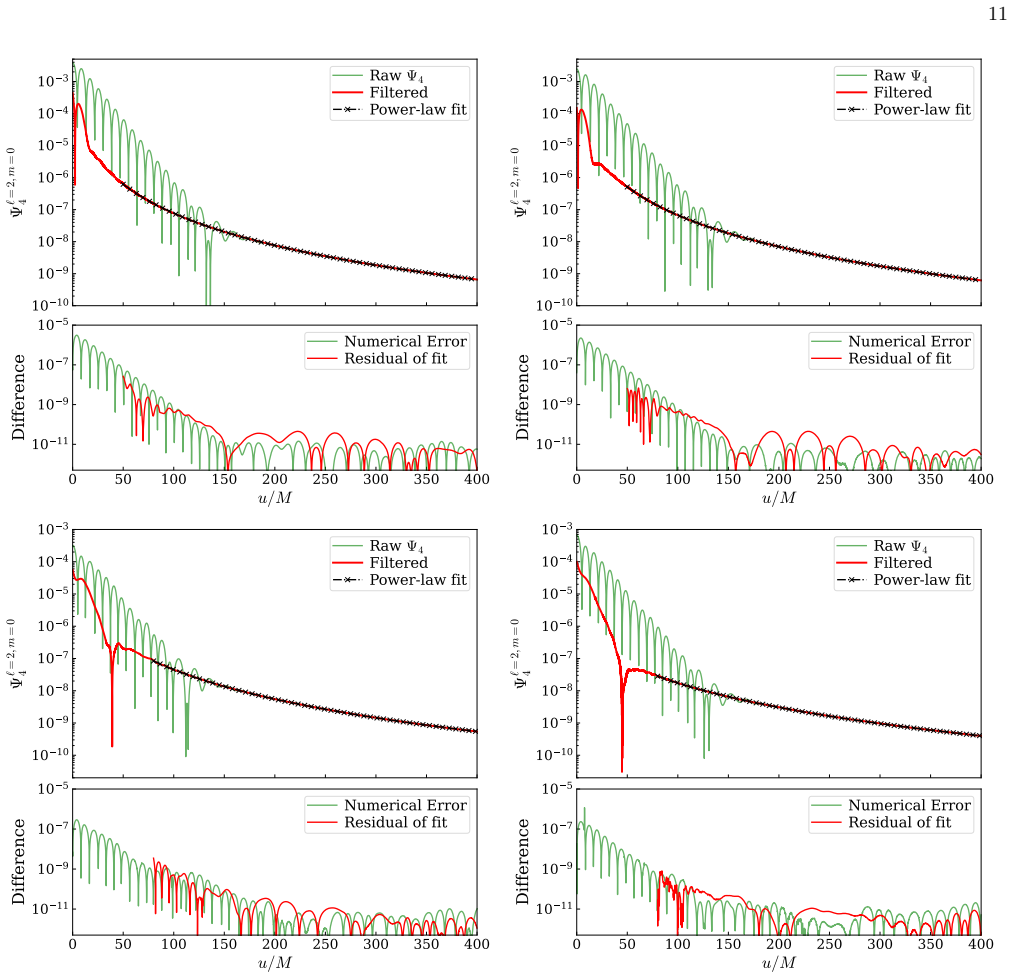
The central claim is that Cauchy-characteristic matching (CCM) is now shown to work for fully nonlinear, dynamical binary black hole spacetimes, and not just for symmetric or perturbative testbeds. The paper presents nine simulations—head-on, quasi-head-on, eccentric, and quasi-circular binaries—and reports that all run stably, converge under resolution, and agree with reference systems whose outer boundaries are placed far enough away to be causally disconnected from the merger. In ordinary Cauchy-characteristic extraction without matching, the same configurations show systematic late-time errors; with CCM they do not. The physical payoff is the first systematic look at late-time tails after merger: the $(\ell=2,m=0)$ harmonic of $\Psi_4$ is fit to a single power law $A(u+u_0)^p$ with $p$ between $-3.51$ and $-3.79$, and the tail amplitude decreases as the pre-merger orbital angular velocity grows. The authors leave open whether these tails are the intermediate regime of the linear Price tail or a nonlinear tail driven by quadratic quasinormal modes.
Load-bearing premise
The stability argument rests on the assumption that the two physical incoming characteristic fields tied to $\Psi_0$ carry all backscattered radiation that matters at the worldtube, and that the Sommerfeld gauge boundary conditions used for the remaining fields do not contaminate the extracted waveforms; if either fails, the matching is not giving the exact infinite-domain evolution.
Editorial extensions
If this is right
- CCM waveforms can serve as reference standards for calibrating surrogate and effective-one-body models, since they are free of outer-boundary systematics.
- Late-time tails can now be mapped systematically across mass ratio, spin, and eccentricity; the paper's fits give amplitude and exponent for five configurations.
- Smaller Cauchy domains make long simulations feasible: the reported runs use 2–3 times fewer CPU hours than reference runs, and the eccentric merger, at about 14,800M, was practical only with CCM.
- The technique sharpens ringdown studies by separating quasinormal modes from the underlying tail with rational filters rather than by discarding early-time data.
- If the tail's nonlinear origin is confirmed, late-time gravitational-wave emission would be a case where nonlinearity dominates linearity, affecting predictions for ringdown and memory analyses.
Reading between the lines
- A direct extension would be to vary the worldtube radius for a single configuration and check that the extracted $\Psi_4$ is independent of it; the paper's comparison with distant-boundary references already suggests this, but not as a dedicated test.
- The observed exponents clustering near $-3.7$ rather than the Price-law $-6$ imply that tail models used in data analysis should carry at least one more parameter, and that quadratic QNM contributions may need to be modeled jointly with linear tails.
- For detector-band waveforms, the relevant $\ell=m=2$ strain tail was not seen in the quasi-circular run; a longer or louder quasi-circular simulation could settle whether that absence is physical or a sensitivity limit.
- The same two-field matching idea could be transplanted to other Cauchy formulations, but only if the analogous physical incoming degrees of freedom can be cleanly isolated; whether that is possible is not addressed here.
Editorial analysis
A structured set of objections, weighed in public.
Referee Report
Summary. The paper reports nine Cauchy-characteristic matching (CCM) simulations of binary black hole mergers using a hybrid SpEC/SpECTRE implementation, covering head-on, quasi-head-on, eccentric, and quasi-circular configurations. For seven (quasi-)head-on cases, the CCM waveforms are compared with large-domain reference simulations and agree at the level of numerical error, while standard CCE shows boundary contamination. The paper also extracts late-time tails from the Weyl scalar Psi_4 using QNM rational filters and fits them to a single power law A(u+u0)^p, finding p between -3.51 and -3.79, and discusses two candidate physical explanations: an intermediate linear tail regime and a QNM-driven nonlinear tail. The authors acknowledge the open weak-hyperbolicity question for CCM and cite recent work suggesting a tentative resolution.
Significance. If the claims hold, this is a substantial advance: it would be the first fully nonlinear three-dimensional CCM simulations of BBH mergers, removing outer-boundary systematics and giving access to late-time tails near null infinity. The paper's strengths are its explicit convergence tests (Figs. 3, 4, 7), constraint monitoring, and the use of independent large-domain reference runs for the head-on and quasi-head-on families, which directly address the circularity concern about boundary effects. The tail-analysis pipeline with QNM rational filters is innovative, and the authors are candid about the two possible interpretations of the power-law index. However, the general robustness claim rests on empirical stability rather than well-posedness, and the tail parameters lack uncertainty quantification. The result is therefore promising and important, but the manuscript currently overstates the degree to which it has settled the CCM feasibility question.
major comments (4)
- [Sec. V and Abstract] The central claim that CCM gives a "positive answer" to full nonlinear robustness is stronger than the evidence presented. The paper itself concedes in Sec. V that CCM may be only weakly hyperbolic and that the only available resolution (Ref. [92]) is a linearized well-posedness result about Schwarzschild with a conjectured generalization to arbitrary backgrounds. The nine runs are stable and convergent, which is valuable empirical evidence, but stability of nine configurations is not a demonstration of robustness for a general numerical scheme. Please either provide a well-posedness analysis for the specific GH/characteristic formulation or explicitly restate the abstract and Sec. V claims as an empirical demonstration for the simulated families, clearly separating the eccentric and quasi-circular runs (which lack reference validation) from the reference-validated head-on family.
- [Sec. IV, Table II] The tail exponents p, amplitudes A, and offsets u0 are reported without uncertainties, and they are extracted from fits whose inputs include the QNM content list determined from the same waveform and the per-case fitting window. The residuals shown in Figs. 11-12 are comparable to the numerical error within the chosen window, but this does not quantify the sensitivity to mode-content selection, window placement, or the rational-filter time-shift correction. Moreover, the comparison with Ref. [136] is arithmetically inconsistent as written: if Ref. [136] reports strain exponents of -3.5 to -4.2, then the corresponding Psi_4 exponents are reduced by 2, so the values in Table II do not fall within that range. Please add a sensitivity analysis, report uncertainties, and correct the comparison.
- [Sec. III C and III D] The eccentric and quasi-circular simulations are presented as part of the nine successful CCM runs, but unlike the head-on and quasi-head-on cases they are not checked against causally disconnected large-domain reference simulations. For the eccentric run the paper shows long-term stability and constraint convergence, but accuracy is not directly established; for the quasi-circular run the CCM and CCE waveforms agree and no tail is visible. The abstract's general claim should therefore be qualified: accuracy validation applies to the seven (quasi-)head-on configurations, while the eccentric and quasi-circular runs provide stability evidence only, and the robustness claim should be stated accordingly.
- [Sec. II and Ref. [109]] The treatment of the gauge subset of u1^- relies on the assertion that these four incoming fields do not affect gravitational waves after transformation to the Bondi-Sachs frame. This assertion is supported by a citation to an in-preparation paper (Ref. [109]) and by a "modulo BMS" argument. Because the late-time tail in Figs. 11-12 is roughly ten orders of magnitude below the merger peak, even small discrete gauge reflections at the worldtube could contaminate the tail. Please quantify this risk, for example by comparing at least one configuration under alternative gauge boundary conditions or by showing that the CCM-reference agreement extends to the tail floor for all reference-validated runs.
minor comments (3)
- [Table I] The reference CPU hours are listed in the format (Cauchy)+(characteristic), but the meaning of the "+2" suffix is not explained; please clarify in the caption.
- [Eq. (5) and Table II] Please state the sign convention for u0 and the range of u over which u+u0 is positive, since the power-law model A(u+u0)^p is otherwise ambiguous.
- [Sec. II, Eq. (1)] The sentence "CCM is unnecessary here" for the constraint subset could be misunderstood; the text later explains that manual constraint injection may cause instability, but consider rephrasing to avoid the appearance that the constraint modes are not matched.
Circularity Check
Central CCM claim is independently validated against large-domain reference runs, so it is not circular; the tail parameters are honestly labeled fits, with only mild residual self-reference in the QNM-from-same-waveform decomposition and an unpublished self-citation for the gauge no-contamination claim.
-
other
[Sec. IV (Tail analysis with rational filters), QNM-identification paragraph and Table II]
"We first apply the Fourier-analysis method from Sec. III B of [132] to identify QNMs in Ψℓ=2,m=0 4 . The extracted modes are listed in Table II. After filtering out the QNMs from the ringdown regime, the resulting filtered waveforms are shown as red curves in the upper panels of Figs. 11 and 12. Using the fitting windows listed in Table II, we find that each filtered waveform can be well described by a single power law: A(u +u0)p."
The rational filters are built from QNM complex frequencies measured by Fourier analysis of the very same Ψℓ=2,m=0 4 time series whose QNM-free residual is then fit to Eq. (5), so A, u0, and p are best-fit descriptors of a residual of a decomposition chosen from the data itself, not independent predictions. The paper consistently labels them 'extracted fitting parameters' and defers any theoretical comparison to future work ('one can make theoretical predictions for the parameters in Eq. (5)... We leave these discussions for future work'). The authors acknowledge the related circularity (amplitude fitting needs a tail model) and mitigate it with frequency-only rational filters that 'break this circular dependency'; the fit is additionally checked against resolution error.
-
self citation load bearing
[Sec. II (Summary of CCM), gauge-subset paragraph (sentence citing Ref. [109])]
"While this subset controls the dynamics of the Cauchy grids, it does not affect GWs [109] once transformed into the Bondi-Sachs frame (modulo BMS transformations [110, 111]), which represents inertial observers at future null infinity. Therefore, for waveform modeling, CCM is not required for this subset."
The claim that the four gauge components of u1−, set by approximate Sommerfeld conditions at the CCM worldtube, cannot contaminate extracted waveforms is load-bearing for trusting late-time tails at roughly 1e-10 of the merger amplitude. The paper's justification is delegated to Ref. [109], an in-preparation paper by overlapping authors (Sun, Ma, Scheel, Teukolsky), rather than derived here. In-paper agreement with large-domain reference runs supports the physical sector empirically, so this is minor; however, the reference runs share the same characteristic-extraction code, so the gauge no-contamination statement itself rests on an unverifiable self-citation.
full rationale
The paper's central claim — that CCM stably, convergently, and accurately evolves BBH mergers on an effectively infinite domain — is not circular. For the (quasi-)head-on families it is validated against reference runs whose outer boundaries (4672-6000M) are causally disconnected from the extraction window, and the CCM-vs-reference differences are comparable to resolution-error estimates (Figs. 1 and 6); the GH constraint energy and the characteristic constraints CΨ0,1,2 converge with resolution (Figs. 3, 4, and 7). This is a nontrivial empirical result generated within the paper, not an output of the cited algorithm. The self-citation to Paper I [93] for the matching algorithm is load-bearing, but that algorithm is parameter-free with stated assumptions that do not include the BBH target, and the present reference comparisons make it externally falsifiable, so under the review rules it counts as real evidence rather than circularity. The tail analysis is the mildest self-referential part: QNM frequencies are measured from the same Ψ4 series whose QNM-free residual is then fit to A(u+u0)p, so A, u0, and p are fit values — which the paper itself consistently labels ('extracted fitting parameters') — not predictions; the paper explicitly breaks the amplitude-fit/tail-model loop via frequency-only rational filters and defers the theoretical comparison of Eq. (5) to future work. The one genuinely load-bearing self-citation is [109], an in-preparation paper by overlapping authors, used to justify that the Sommerfeld gauge boundary subset 'does not affect GWs'; the empirical reference agreement mitigates this, but the in-paper runs share the same characteristic-extraction code, so that specific claim rests on an unverifiable citation. The weak-hyperbolicity tension flagged in Sec. V is conceded by the authors and addressed by citing external work (Gundlach [92]), not a self-citation, which is a further sign of non-circularity. Overall score 3: the central claim has independent content, with two minor self-referential steps that the authors themselves either acknowledge or mitigate.
Assumptions & free parameters
free parameters (6)
- Tail amplitude A =
e.g., 22.7 eta (head-on); range 0.86-22.7 eta across cases
- Tail time offset u0 =
19.1M to 55.6M
- Tail decay exponent p =
-3.79 to -3.51
- Fitting window start =
50M or 80M
- QNM content list per system =
e.g., (2,0,0,+-), (2,0,0,+-;2,0,0,+-), etc.
- Bondi time integration constant =
0
assumptions (7)
- standard math Vacuum Einstein equations in generalized harmonic gauge
- standard math The Bondi-Sachs characteristic formulation and the Einstein field equations in partially flat Bondi-like coordinates
- domain assumption The two physical incoming characteristic fields u1- correspond to the two polarizations of backscattered radiation Psi0
- domain assumption Gauge boundary conditions do not affect gravitational-wave observables at future null infinity
- domain assumption Reference simulations with outer boundary at 6000M are causally disconnected and approximate the exact infinite-domain result
- ad hoc to paper Characteristic initial data ansatz J = A/r + B/r^3 with ConformalFactor coordinate mapping is adequate
- domain assumption The exterior region is a perturbed Schwarzschild spacetime for identifying the physical subset
Cite this review
Pith. "Pith review of Merging black holes with Cauchy-characteristic matching: Computation of late-time tails." pith.science (2026). https://pith.science/paper/KRYBK327
@misc{pith2026241206906,
  author       = {Pith},
  title        = {Pith review of: Merging black holes with Cauchy-characteristic matching: Computation of late-time tails},
  year         = {2026},
  howpublished = {\url{https://pith.science/paper/KRYBK327}},
  note         = {Machine review of arXiv:2412.06906}
}
read the original abstract
Cauchy-characteristic matching (CCM) is a numerical-relativity technique that solves Einstein's equations on an effectively infinite computational domain, thereby eliminating systematic errors associated with artificial boundary conditions. Whether CCM can robustly handle fully nonlinear, dynamical spacetimes, such as binary black hole (BBH) mergers, has remained an open question. In this work, we provide a positive answer by presenting nine successful CCM simulations of BBHs; and demonstrate a key application of this method: computing late-time tails. Our results pave the path for systematic studies of late-time tails in BBH systems, and for producing highly accurate waveforms essential to next-generation gravitational-wave detectors.
Figures


Figures from the paper (8 more)


Forward citations
Cited by 11 Pith papers
-
Foundations of Direct Waves in Schwarzschild Ringdown
Direct waves in filtered Schwarzschild ringdown are the anti-causal filter-pole contribution sourced by near-horizon trajectory dynamics and do not vanish.
-
Probing Direct Waves in Black Hole Ringdowns
Merger gravitational wave signals contain a 'direct wave' from the plunging companions, screened by the remnant's potential, with frequency near the superradiant value for high-spin remnants and SNR above 10 in GW1509...
-
From spatial to null infinity: Connecting initial data to peeling
For asymptotically regular spacetimes, parity-time reversal symmetry of the leading and subleading initial data implies the Weyl scalars Psi2 and Psi1 peel at null infinity with rates 1/r^3 and 1/r^4.
-
Quasinormal modes from numerical relativity with Bayesian inference
A catalog-trained Gaussian-process noise model converts numerical-relativity waveforms into Bayesian quasinormal-mode fits with analytic posteriors and mode significances, demonstrated on CCE simulations.
-
GW250114 reveals black hole horizon signatures
The merger signal of GW250114 contains a residual 'direct wave' component whose frequency and damping match the remnant horizon's rotation frequency and surface gravity.
-
Gravitational-wave tails and memory effect for mergers in astrophysical environments
A dark matter halo around a black hole amplifies the transient tail of a perturbation but leaves the asymptotic decay and the linear memory unchanged.
-
Constraining deviations from the Teukolsky equation with GW250114
GW250114's fundamental ringdown mode bounds theory-agnostic deviations from the Teukolsky equation to be consistent with zero at characteristic scales of 60-100 km.
-
Analysis of late-time tails in spin-aligned eccentric binary black hole mergers
Late-time gravitational-wave tails from eccentric, spin-aligned black hole mergers decay as t^-(l+4) for psi4 in all six modes studied, with same-l modes sharing identical exponents.
-
Quasinormal mode content of binary black hole ringdowns
A Bayesian, evidence-based analysis of 13 simulated black-hole ringdowns tabulates which quasinormal overtones, retrograde modes, and nonlinear (quadratic and cubic) modes are present at each start time, and finds no ...
-
The AdS Perspective on the Nonlinear Tails in Black Hole Ringdown
The known t^{-(2L+2)} nonlinear ringdown tail is rederived via AdS2 x S2, with a proposed but incorrectly normalized Aretakis amplitude relation.
-
The Nonlinear Tails in Black Hole Ringdown: the Scattering Perspective
Nonlinear ringdown tails in the transverse-traceless gauge decay as t^{-(2ℓ+1)}, and this paper rederives that law from in-in scattering diagrams.
Reference graph
Works this paper leans on
-
[92]
Gundlach, Simulations of gravitational collapse in null coordinates
C. Gundlach, Simulations of gravitational collapse in null coordinates. III. Hyperbolicity, Phys. Rev. D110, 024020 (2024), arXiv:2404.16720 [gr-qc]
arXiv 2024
-
[136]
M. De Amicis, S. Albanesi, and G. Carullo, Inspiral- inherited ringdown tails, Phys. Rev. D 110, 104005 (2024), arXiv:2406.17018 [gr-qc]
arXiv 2024
-
[109]
D. Sun, S. Ma, M. A. Scheel, and S. Teukolsky, Gauge boundary conditions to mitigate com drift in bbh simu- lations, in preparation
-
[1]
(LIGOScientific, Virgo),BinaryBlack Hole Mergers in the first Advanced LIGO Observing Run, Phys
B.P.Abbott et al. (LIGOScientific, Virgo),BinaryBlack Hole Mergers in the first Advanced LIGO Observing Run, Phys. Rev. X6, 041015 (2016), [erratum: Phys. Rev.X8,no.3,039903(2018)], arXiv:1606.04856 [gr-qc]
arXiv 2016
-
[2]
B. P. Abbottet al. (LIGO Scientific, Virgo), GWTC-1: A Gravitational-Wave Transient Catalog of Compact Binary Mergers Observed by LIGO and Virgo during the First and Second Observing Runs, Phys. Rev.X9, 031040 (2019), arXiv:1811.12907 [astro-ph.HE]
arXiv 2019
-
[3]
R. Abbott et al. (LIGO Scientific, Virgo), GWTC-2: Compact Binary Coalescences Observed by LIGO and Virgo During the First Half of the Third Observing Run, Phys. Rev. X11, 021053 (2021), arXiv:2010.14527 [gr-qc]. 5 The Bondi J was still constructed using Eq. (A1)
arXiv 2021
-
[4]
R. Abbott et al. (LIGO Scientific, VIRGO, KAGRA), GWTC-3: Compact Binary Coalescences Observed by LIGO and Virgo During the Second Part of the Third Observing Run, (2021), arXiv:2111.03606 [gr-qc]
arXiv 2021
-
[5]
J. Aasi et al. (LIGO Scientific), Advanced LIGO, Class. Quant. Grav.32, 074001 (2015), arXiv:1411.4547 [gr-qc]
arXiv 2015
Show all 147 references
-
[6]
Acernese et al
F. Acernese et al. (Virgo), Advanced Virgo: a second- generation interferometric gravitational wave detector, Class. Quant. Grav.32, 024001 (2015), arXiv:1408.3978 [gr-qc]
2015 arXiv
-
[7]
Somiya (KAGRA), Detector configuration of KA- GRA: The Japanese cryogenic gravitational-wave detector, Class
K. Somiya (KAGRA), Detector configuration of KA- GRA: The Japanese cryogenic gravitational-wave detector, Class. Quant. Grav. 29, 124007 (2012), arXiv:1111.7185 [gr-qc]
2012 arXiv
-
[8]
Y. Pan, A. Buonanno, L. T. Buchman, T. Chu, L. E. Kid- der, H. P. Pfeiffer, and M. A. Scheel, Effective-one-body waveforms calibrated to numerical relativity simulations: coalescence of non-precessing, spinning, equal-mass black holes, Phys. Rev. D81, 084041 (2010), arXiv:0912...
2010 arXiv
-
[9]
Bohé et al., Improved effective-one-body model of spinning, nonprecessing binary black holes for the era of gravitational-wave astrophysics with advanced detectors, Phys
A. Bohé et al., Improved effective-one-body model of spinning, nonprecessing binary black holes for the era of gravitational-wave astrophysics with advanced detectors, Phys. Rev. D95, 044028 (2017), arXiv:1611.03703 [gr- qc]
2017 arXiv
-
[10]
Pompili et al., Laying the foundation of the effective- one-body waveform models SEOBNRv5: Improved ac- curacy and efficiency for spinning nonprecessing bi- nary black holes, Phys
L. Pompili et al., Laying the foundation of the effective- one-body waveform models SEOBNRv5: Improved ac- curacy and efficiency for spinning nonprecessing bi- nary black holes, Phys. Rev. D 108, 124035 (2023), arXiv:2303.18039 [gr-qc]
2023 arXiv
-
[11]
Nagar et al., Time-domain effective-one-body gravi- tational waveforms for coalescing compact binaries with nonprecessing spins, tides and self-spin effects, Phys
A. Nagar et al., Time-domain effective-one-body gravi- tational waveforms for coalescing compact binaries with nonprecessing spins, tides and self-spin effects, Phys. Rev. D 98, 104052 (2018), arXiv:1806.01772 [gr-qc]
2018 arXiv
-
[12]
Nagar, G
A. Nagar, G. Riemenschneider, G. Pratten, P. Rettegno, and F. Messina, Multipolar effective one body waveform model for spin-aligned black hole binaries, Phys. Rev. D 102, 024077 (2020), arXiv:2001.09082 [gr-qc]
2020 arXiv
-
[13]
Blackman, S
J. Blackman, S. E. Field, M. A. Scheel, C. R. Galley, C. D. Ott, M. Boyle, L. E. Kidder, H. P. Pfeiffer, and B. Szilágyi, Numerical relativity waveform surrogate model for generically precessing binary black hole merg- ers, Phys. Rev.D96, 024058 (2017), arXiv:1705.07089 [gr-qc]
2017 arXiv
-
[14]
Varma, S
V. Varma, S. E. Field, M. A. Scheel, J. Blackman, L. E. Kidder, and H. P. Pfeiffer, Surrogate model of hybridized numerical relativity binary black hole waveforms, Phys. Rev. D99, 064045 (2019), arXiv:1812.07865 [gr-qc]
2019 arXiv
-
[15]
Varma, S
V. Varma, S. E. Field, M. A. Scheel, J. Blackman, D. Gerosa, L. C. Stein, L. E. Kidder, and H. P. Pfeiffer, Surrogate models for precessing binary black hole sim- ulations with unequal masses, Phys. Rev. Research.1, 033015 (2019), arXiv:1905.09300 [gr-qc]
2019 arXiv
-
[16]
Yoo et al., Numerical relativity surrogate model with memory effects and post-Newtonian hybridization, Phys
J. Yoo et al., Numerical relativity surrogate model with memory effects and post-Newtonian hybridization, Phys. Rev. D 108, 064027 (2023), arXiv:2306.03148 [gr-qc]
2023 arXiv
-
[17]
Abbott et al
R. Abbott et al. (LIGO Scientific, Virgo), Population Properties of Compact Objects from the Second LIGO- Virgo Gravitational-Wave Transient Catalog, Astrophys. J. Lett. 913, L7 (2021), arXiv:2010.14533 [astro-ph.HE]
2021 arXiv
-
[18]
(LIGOScientific, Virgo),Testsofgeneral relativity with binary black holes from the second LIGO- Virgo gravitational-wave transient catalog, Phys
R.Abbott et al. (LIGOScientific, Virgo),Testsofgeneral relativity with binary black holes from the second LIGO- Virgo gravitational-wave transient catalog, Phys. Rev. D 103, 122002 (2021), arXiv:2010.14529 [gr-qc]. 14
2021 arXiv
-
[19]
Abbott et al
R. Abbott et al. (LIGO Scientific, Virgo), GW190521: A Binary Black Hole Merger with a Total Mass of150M⊙, Phys. Rev. Lett.125, 101102 (2020), arXiv:2009.01075 [gr-qc]
2020
-
[20]
Abbott et al
R. Abbott et al. (LIGO Scientific, Virgo), GW190412: Observation of a Binary-Black-Hole Coalescence with Asymmetric Masses, Phys. Rev. D102, 043015 (2020), arXiv:2004.08342 [astro-ph.HE]
2020 arXiv
-
[21]
Abbott et al
R. Abbott et al. (LIGO Scientific, Virgo), Properties and Astrophysical Implications of the 150 M⊙ Binary Black Hole Merger GW190521, Astrophys. J.900, L13 (2020), arXiv:2009.01190 [astro-ph.HE]
2020
-
[22]
Abbott et al
R. Abbott et al. (LIGO Scientific, VIRGO, KAGRA), Search for intermediate-mass black hole binaries in the third observing run of Advanced LIGO and Ad- vanced Virgo, Astron. Astrophys. 659, A84 (2022), arXiv:2105.15120 [astro-ph.HE]
2022 arXiv
-
[23]
Abbott et al
R. Abbott et al. (LIGO Scientific, VIRGO), Search for Lensing Signatures in the Gravitational-Wave Observa- tions from the First Half of LIGO–Virgo’s Third Observ- ing Run, Astrophys. J.923, 14 (2021), arXiv:2105.06384 [gr-qc]
2021 arXiv
-
[24]
Pürrer and C.-J
M. Pürrer and C.-J. Haster, Gravitational waveform accuracy requirements for future ground-based detectors, Phys. Rev. Res.2, 023151 (2020), arXiv:1912.10055 [gr- qc]
2020 arXiv
-
[25]
T. W. Baumgarte and S. L. Shapiro,Numerical Rela- tivity: Solving Einstein ’s Equations on the Computer (Cambridge University Press, 2010)
2010
-
[26]
E. W. Allen, E. Buckmiller, L. M. Burko, and R. H. Price, Radiation tails and boundary conditions for black hole evolutions, Phys. Rev. D70, 044038 (2004), arXiv:gr- qc/0401092
2004
-
[27]
Dafermos and I
M. Dafermos and I. Rodnianski, A Note on bound- ary value problems for black hole evolutions, (2004), arXiv:gr-qc/0403034
2004 arXiv
-
[28]
Zenginoglu, Hyperboloidal evolution with the Ein- stein equations, Class
A. Zenginoglu, Hyperboloidal evolution with the Ein- stein equations, Class. Quant. Grav.25, 195025 (2008), arXiv:0808.0810 [gr-qc]
2008 arXiv
-
[29]
Rinne and V
O. Rinne and V. Moncrief, Hyperboloidal Einstein- matterevolutionandtailsforscalarandYang-Millsfields, Class. Quant. Grav.30, 095009 (2013), arXiv:1301.6174 [gr-qc]
2013 arXiv
-
[30]
Vañó Viñuales, S
A. Vañó Viñuales, S. Husa, and D. Hilditch, Spher- ical symmetry as a test case for unconstrained hy- perboloidal evolution, Class. Quant. Grav.32, 175010 (2015), arXiv:1412.3827 [gr-qc]
2015 arXiv
-
[31]
Vañó Viñuales and S
A. Vañó Viñuales and S. Husa, Unconstrained hyper- boloidal evolution of black holes in spherical symmetry with GBSSN and Z4c, J. Phys. Conf. Ser.600, 012061 (2015), arXiv:1412.4801 [gr-qc]
2015 arXiv
-
[32]
M. D. Morales and O. Sarbach, Evolution of scalar fields surrounding black holes on compactified constant mean curvature hypersurfaces, Phys. Rev. D95, 044001 (2017), arXiv:1609.05756 [gr-qc]
2017 arXiv
-
[33]
Vañó Viñuales and T
A. Vañó Viñuales and T. Valente, Height-function-based 4D reference metrics for hyperboloidal evolution, Gen. Rel. Grav. 56, 135 (2024), arXiv:2408.08952 [gr-qc]
2024 arXiv
-
[34]
Peterson, S
C. Peterson, S. Gautam, A. Vañó Viñuales, and D. Hilditch, Spherical Evolution of the Generalized Har- monic Gauge Formulation of General Relativity on Com- pactified Hyperboloidal Slices, (2024), arXiv:2409.02994 [gr-qc]
2024 arXiv
-
[35]
Friedrich, Gravitational fields near space-like and null infinity, Journal of Geometry and Physics24, 83 (1998)
H. Friedrich, Gravitational fields near space-like and null infinity, Journal of Geometry and Physics24, 83 (1998)
1998
-
[36]
Frauendiener and C
J. Frauendiener and C. Stevens, The non-linear pertur- bation of a black hole by gravitational waves. II. Quasi- normal modes and the compactification problem, Class. Quant. Grav. 40, 125006 (2023), arXiv:2211.13276 [gr- qc]
2023 arXiv
-
[37]
Frauendiener, A
J. Frauendiener, A. Goodenbour, and C. Stevens, The non-linear perturbation of a black hole by gravitational waves. III. Newman–Penrose constants, Class. Quant. Grav. 41, 065005 (2024), arXiv:2301.05268 [gr-qc]
2024 arXiv
-
[38]
Frauendiener and C
J. Frauendiener and C. Stevens, The non-linear pertur- bation of a black hole by gravitational waves. I. The Bondi–Sachs mass loss, Class. Quant. Grav.38, 194002 (2021), arXiv:2105.09515 [gr-qc]
2021 arXiv
-
[39]
Frauendiener, C
J. Frauendiener, C. Stevens, and S. Thwala, Fully non- linear gravitational wave simulations from past to future null-infinity, (2025), arXiv:2504.02188 [gr-qc]
2025 arXiv
-
[40]
Winicour, Characteristic evolution and matching, Liv- ing Reviews in Relativity15, 1 (2012)
J. Winicour, Characteristic evolution and matching, Liv- ing Reviews in Relativity15, 1 (2012)
2012
-
[41]
N.T.Bishop,Numericalrelativity: combiningthecauchy and characteristic initial value problems, Classical and Quantum Gravity10, 333 (1993)
1993
-
[42]
N. T. Bishop, R. Gomez, L. Lehner, and J. Winicour, Cauchy-characteristic extraction in numerical relativity, Phys. Rev. D54, 6153 (1996), arXiv:gr-qc/9705033 [gr- qc]
1996 arXiv
-
[43]
N. T. Bishop, R. Gomez, L. Lehner, M. Maharaj, and J. Winicour, High powered gravitational news, Phys. Rev. D 56, 6298 (1997), arXiv:gr-qc/9708065
1997 arXiv
-
[44]
N. T. Bishop, R. Gomez, L. Lehner, B. Szilagyi, J. Wini- cour,andR.A.Isaacson,Cauchycharacteristicmatching, in Black Holes, Gravitational Radiation and the Uni- verse: Essays in Honor of C.V. Vishveshwara , edited by B. R. Iyer and B. Bhawal (1998) pp. 383–408, arXiv:gr- qc/9801070
1998
-
[45]
Barkett, J
K. Barkett, J. Moxon, M. A. Scheel, and B. Szilágyi, Spectral Cauchy-Characteristic Extraction of the Gravi- tational Wave News Function, Phys. Rev. D102, 024004 (2020), arXiv:1910.09677 [gr-qc]
2020 arXiv
-
[46]
Moxon, M
J. Moxon, M. A. Scheel, and S. A. Teukolsky, Im- proved Cauchy-characteristic evolution system for high- precision numerical relativity waveforms, Phys. Rev. D 102, 044052 (2020), arXiv:2007.01339 [gr-qc]
2020 arXiv
-
[47]
Moxon, M
J. Moxon, M. A. Scheel, S. A. Teukolsky, N. Deppe, N. Fischer, F. Hébert, L. E. Kidder, and W. Throwe, SpECTRE Cauchy-characteristic evolution system for rapid, precise waveform extraction, Phys. Rev. D107, 064013 (2023), arXiv:2110.08635 [gr-qc]
2023 arXiv
-
[48]
Corkill and J
R. Corkill and J. Stewart, Numerical relativity. ii. numer- ical methods for the characteristic initial value problem and the evolution of the vacuum field equations for space– times with two killing vectors, Proceedings of the Royal Society of London. A. Mathematical and Phys...
1983
-
[49]
Friedrich and J
H. Friedrich and J. M. Stewart, Characteristic initial data and wavefront singularities in general relativity, Proceedings of the Royal Society of London. A. Mathe- matical and Physical Sciences385, 345 (1983)
1983
-
[50]
J. M. Stewart, The characteristic initial value problem in general relativity, inAstrophysical Radiation Hydrody- namics, edited by K.-H. A. Winkler and M. L. Norman (Springer Netherlands, Dordrecht, 1986) pp. 531–568
1986
-
[51]
Frittelli and E
S. Frittelli and E. T. Newman, Singularities of wavefronts and lightcones in the context of GR via null foliations, 15 Twistor Newslett.43, 14 (1997), arXiv:gr-qc/0006077
1997 arXiv
-
[52]
Bhagwat, M
S. Bhagwat, M. Okounkova, S. W. Ballmer, D. A. Brown, M. Giesler, M. A. Scheel, and S. A. Teukolsky, On choos- ing the start time of binary black hole ringdowns, Phys. Rev. D97, 104065 (2018), arXiv:1711.00926 [gr-qc]
2018 arXiv
-
[53]
T. W. Baumgarte, B. Brügmann, D. Cors, C. Gundlach, D. Hilditch, A. Khirnov, T. Ledvinka, S. Renkhoff, and I. S. Fernández, Critical Phenomena in the Collapse of Gravitational Waves, Phys. Rev. Lett.131, 181401 (2023), arXiv:2305.17171 [gr-qc]
2023 arXiv
-
[54]
R. A. Isaacson, J. S. Welling, and J. Winicour, Null cone computation of gravitational radiation, Journal of Mathematical Physics 24, 1824 (1983)
1983
-
[55]
N. T. Bishop, Some aspects of the characteristic initial value problem in numerical relativity., inApproaches to Numerical Relativity, edited by R. D’Inverno (1992) pp. 20–33
1992
-
[56]
J.Winicour,Newtoniangravityonthenullcone.,Journal of Mathematical Physics24, 1193 (1983)
1983
-
[57]
Winicour, Null infinity from a quasi-newtonian view, Journal of Mathematical Physics25, 2506 (1984)
J. Winicour, Null infinity from a quasi-newtonian view, Journal of Mathematical Physics25, 2506 (1984)
1984
-
[58]
Papadopoulos, and J
N.T.Bishop, R.Gómez, P.R.Holvorcem, R.A.Matzner, P. Papadopoulos, and J. Winicour, Cauchy Characteris- tic Evolution and Waveforms, Journal of Computational Physics 136, 140 (1997)
1997
-
[59]
Szilagyi, Cauchy characteristic matching in general relativity, Other thesis (2000), arXiv:gr-qc/0006091
B. Szilagyi, Cauchy characteristic matching in general relativity, Other thesis (2000), arXiv:gr-qc/0006091
2000 arXiv
-
[60]
Gomez, P
R. Gomez, P. Papadopoulos, and J. Winicour, Null cone evolution of axisymmetric vacuum space–times, Journal of Mathematical Physics35, 4184 (1994)
1994
-
[61]
Gomez, Gravitational wave forms with controlled accuracy, Phys
R. Gomez, Gravitational wave forms with controlled accuracy, Phys. Rev. D 64, 024007 (2001), arXiv:gr- qc/0103011
2001
-
[62]
N. T. Bishop and S. S. Deshingkar, New approach to calculating the news, Phys. Rev. D68, 024031 (2003), arXiv:gr-qc/0303021
2003 arXiv
-
[63]
Reisswig, N
C. Reisswig, N. T. Bishop, C. W. Lai, J. Thornburg, and B. Szilagyi, Numerical relativity with characteristic evolution, using six angular patches, Class. Quant. Grav. 24, S327 (2007), arXiv:gr-qc/0610019
2007 arXiv
-
[64]
Gomez, W
R. Gomez, W. Barreto, and S. Frittelli, A Framework for large-scale relativistic simulations in the charac- teristic approach, Phys. Rev. D 76, 124029 (2007), arXiv:0711.0564 [gr-qc]
2007 arXiv
-
[65]
M. C. Babiuc, N. T. Bishop, B. Szilagyi, and J. Winicour, Strategies for the Characteristic Extraction of Gravi- tational Waveforms, Phys. Rev. D79, 084011 (2009), arXiv:0808.0861 [gr-qc]
2009 arXiv
-
[66]
Reisswig, N
C. Reisswig, N. T. Bishop, and D. Pollney, General relativistic null-cone evolutions with a high-order scheme, Gen. Rel. Grav.45, 1069 (2013), arXiv:1208.3891 [gr-qc]
2013 arXiv
-
[67]
Reisswig, N
C. Reisswig, N. T. Bishop, D. Pollney, and B. Szilagyi, Unambiguous determination of gravitational waveforms from binary black hole mergers, Phys. Rev. Lett.103, 221101 (2009), arXiv:0907.2637 [gr-qc]
2009 arXiv
-
[68]
Reisswig, N
C. Reisswig, N. T. Bishop, D. Pollney, and B. Szilagyi, Characteristic extraction in numerical relativity: bi- nary black hole merger waveforms at null infinity, Class. Quant. Grav.27, 075014 (2010), arXiv:0912.1285 [gr-qc]
2010 arXiv
-
[69]
M. C. Babiuc, B. Szilagyi, J. Winicour, and Y. Zlochower, A Characteristic Extraction Tool for Gravitational Wave- forms, Phys. Rev. D84, 044057 (2011), arXiv:1011.4223 [gr-qc]
2011 arXiv
-
[70]
M. C. Babiuc, J. Winicour, and Y. Zlochower, Binary Black Hole Waveform Extraction at Null Infinity, Class. Quant. Grav.28, 134006 (2011), arXiv:1106.4841 [gr-qc]
2011 arXiv
-
[71]
C. J. Handmer and B. Szilagyi, Spectral Characteristic Evolution: A New Algorithm for Gravitational Wave Propagation, Class. Quant. Grav. 32, 025008 (2015), arXiv:1406.7029 [gr-qc]
2015 arXiv
-
[72]
C. J. Handmer, B. Szilágyi, and J. Winicour, Gauge Invariant Spectral Cauchy Characteristic Extraction, Class. Quant. Grav.32, 235018 (2015), arXiv:1502.06987 [gr-qc]
2015 arXiv
-
[73]
C. J. Handmer, B. Szilágyi, and J. Winicour, Spectral Cauchy Characteristic Extraction of strain, news and gravitational radiation flux, Class. Quant. Grav. 33, 225007 (2016), arXiv:1605.04332 [gr-qc]
2016 arXiv
-
[74]
S. Ma, K. C. Nelli, J. Moxon, M. A. Scheel, N. Deppe, L. E. Kidder, W. Throwe, and N. L. Vu, Ein- stein–Klein–Gordon system via Cauchy-characteristic evolution: computation of memory and ringdown tail, Class. Quant. Grav.42, 055006 (2025), arXiv:2409.06141 [gr-qc]
2025 arXiv
-
[75]
Mitman, J
K. Mitman, J. Moxon, M. A. Scheel, S. A. Teukolsky, M. Boyle, N. Deppe, L. E. Kidder, and W. Throwe, Com- putation of displacement and spin gravitational memory in numerical relativity, Phys. Rev. D102, 104007 (2020), arXiv:2007.11562 [gr-qc]
2020 arXiv
-
[76]
Mitman et al., A review of gravitational memory and BMS frame fixing in numerical relativity, Class
K. Mitman et al., A review of gravitational memory and BMS frame fixing in numerical relativity, Class. Quant. Grav. 41, 223001 (2024), arXiv:2405.08868 [gr-qc]
2024 arXiv
-
[77]
Papadopoulos, and J
N.T.Bishop, R.Gomez, P.R.Holvorcem, R.A.Matzner, P. Papadopoulos, and J. Winicour, Cauchy-characteristic matching: A new approach to radiation boundary con- ditions, Phys. Rev. Lett.76, 4303 (1996)
1996
-
[78]
M. R. Dubal, R. A. d’Inverno, and J. A. Vickers, Combining cauchy and characteristic codes. v. cauchy- characteristic matching for a spherical spacetime con- taining a perfect fluid, Phys. Rev. D58, 044019 (1998)
1998
-
[79]
Gomez, P
R. Gomez, P. Laguna, P. Papadopoulos, and J. Wini- cour, Cauchy characteristic evolution of Einstein-Klein- Gordon systems, Phys. Rev. D54, 4719 (1996), arXiv:gr- qc/9603060
1996
-
[80]
C. J. S. Clarke, R. A. d’Inverno, and J. A. Vickers, Com- bining cauchy and characteristic codes. i. the vacuum cylindrically symmetric problem, Phys. Rev. D52, 6863 (1995)
1995
-
[81]
M. R. Dubal, R. A. d’Inverno, and C. J. S. Clarke, Com- bining cauchy and characteristic codes. ii. the interface problem for vacuum cylindrical symmetry, Phys. Rev. D 52, 6868 (1995)
1995
-
[82]
R. A. d’Inverno, M. R. Dubal, and E. A. Sarkies, Cauchy characteristic matching for a family of cylindrical vac- uum solutions possessing both gravitational degrees of freedom, Class. Quant. Grav.17, 3157 (2000), arXiv:gr- qc/0002057
2000
-
[83]
R. A. d’Inverno and J. A. Vickers, Combining cauchy and characteristic codes. iii. the interface problem in axial symmetry, Phys. Rev. D54, 4919 (1996)
1996
-
[84]
R. A. d’Inverno and J. A. Vickers, Combining cauchy and characteristic codes. iv. the characteristic field equations in axial symmetry, Phys. Rev. D56, 772 (1997)
1997
-
[85]
A. M. Abrahamset al. (Binary Black Hole Grand Chal- lenge Alliance), Gravitational wave extraction and outer boundary conditions by perturbative matching, Phys. Rev. Lett. 80, 1812 (1998), arXiv:gr-qc/9709082
1998 arXiv
-
[86]
M. E. Rupright, A. M. Abrahams, and L. Rezzolla, 16 Cauchy perturbative matching and outer boundary con- ditions. 1. Methods and tests, Phys. Rev. D58, 044005 (1998), arXiv:gr-qc/9802011
1998 arXiv
-
[87]
Rezzolla, A
L. Rezzolla, A. M. Abrahams, R. A. Matzner, M. E. Rupright, and S. L. Shapiro, Cauchy perturbative match- ing and outer boundary conditions: Computational studies, Phys. Rev. D 59, 064001 (1999), arXiv:gr- qc/9807047
1999
-
[88]
Giannakopoulos, Characteristic formulations of gen- eral relativity and applications , Other thesis (2023), arXiv:2308.16001 [gr-qc]
T. Giannakopoulos, Characteristic formulations of gen- eral relativity and applications , Other thesis (2023), arXiv:2308.16001 [gr-qc]
2023 arXiv
-
[89]
Giannakopoulos, D
T. Giannakopoulos, D. Hilditch, and M. Zilhao, Hyper- bolicity of General Relativity in Bondi-like gauges, Phys. Rev. D 102, 064035 (2020), arXiv:2007.06419 [gr-qc]
2020 arXiv
-
[90]
Zilhao, Gauge structure of the Einstein field equations in Bondi-like coordinates, Phys
T.Giannakopoulos, N.T.Bishop, D.Hilditch, D.Pollney, and M. Zilhao, Gauge structure of the Einstein field equations in Bondi-like coordinates, Phys. Rev. D105, 084055 (2022), arXiv:2111.14794 [gr-qc]
2022 arXiv
-
[91]
Zilhão, Numerical convergence of model Cauchy- characteristic extraction and matching, Phys
T.Giannakopoulos, N.T.Bishop, D.Hilditch, D.Pollney, and M. Zilhão, Numerical convergence of model Cauchy- characteristic extraction and matching, Phys. Rev. D 108, 104033 (2023), arXiv:2306.13010 [gr-qc]
2023 arXiv
-
[93]
Ma et al., Fully relativistic three-dimensional Cauchy- characteristic matching for physical degrees of freedom, Phys
S. Ma et al., Fully relativistic three-dimensional Cauchy- characteristic matching for physical degrees of freedom, Phys. Rev. D109, 124027 (2024), arXiv:2308.10361 [gr- qc]
2024 arXiv
-
[94]
R. H. Price, Nonspherical perturbations of relativistic gravitational collapse. i. scalar and gravitational pertur- bations, Phys. Rev. D5, 2419 (1972)
1972
-
[95]
E.W.Leaver,Spectraldecompositionoftheperturbation response of the schwarzschild geometry, Phys. Rev. D 34, 384 (1986)
1986
-
[96]
K. S. Thorne and S. J. Kovacs, The generation of gravi- tational waves. I. Weak-field sources., Astrophys. J.200, 245 (1975)
1975
-
[97]
K. S. Thorne, Multipole expansions of gravitational ra- diation, Rev. Mod. Phys.52, 299 (1980)
1980
-
[98]
Blanchet and T
L. Blanchet and T. Damour, Tail-transported temporal correlations in the dynamics of a gravitating system, Phys. Rev. D37, 1410 (1988)
1988
-
[99]
Lindblom, M
L. Lindblom, M. A. Scheel, L. E. Kidder, R. Owen, and O. Rinne, A New generalized harmonic evolution system, Class. Quant. Grav.23, S447 (2006), arXiv:gr- qc/0512093 [gr-qc]
2006
-
[100]
L. E. Kidder, L. Lindblom, M. A. Scheel, L. T. Buch- man, and H. P. Pfeiffer, Boundary conditions for the Ein- stein evolution system, Phys. Rev.D71, 064020 (2005), arXiv:gr-qc/0412116 [gr-qc]
2005 arXiv
-
[101]
L. T. Buchman and O. C. A. Sarbach, Towards absorb- ing outer boundaries in general relativity, Class. Quant. Grav. 23, 6709 (2006), arXiv:gr-qc/0608051
2006 arXiv
-
[102]
L. T. Buchman and O. C. A. Sarbach, Improved outer boundary conditions for Einstein’s field equations, Class. Quant. Grav. 24, S307 (2007), arXiv:gr-qc/0703129
2007 arXiv
-
[103]
Rinne, L
O. Rinne, L. T. Buchman, M. A. Scheel, and H. P. Pfeif- fer, Implementation of higher-order absorbing boundary conditions for the Einstein equations, Class. Quant. Grav. 26, 075009 (2009), arXiv:0811.3593 [gr-qc]
2009 arXiv
-
[104]
L. T. Buchman, M. D. Duez, M. Morales, M. A. Scheel, T. M. Kostersitz, A. M. Evans, and K. Mitman, Numer- ical relativity multimodal waveforms using absorbing boundary conditions, Class. Quant. Grav.41, 175011 (2024), arXiv:2402.12544 [gr-qc]
2024 arXiv
-
[105]
Rinne, Stable radiation-controlling boundary con- ditions for the generalized harmonic Einstein equa- tions, Class
O. Rinne, Stable radiation-controlling boundary con- ditions for the generalized harmonic Einstein equa- tions, Class. Quant. Grav. 23, 6275 (2006), arXiv:gr- qc/0606053 [gr-qc]
2006
-
[106]
Rinne, L
O. Rinne, L. Lindblom, and M. A. Scheel, Testing outer boundary treatments for the Einstein equations, Class. Quant. Grav. 24, 4053 (2007), arXiv:0704.0782 [gr-qc]
2007 arXiv
-
[107]
Dailey, E
C. Dailey, E. Schnetter, and N. Afshordi, Formulating the complete initial boundary value problem in numerical relativity to model black hole echoes, Class. Quant. Grav. 42, 025002 (2025), arXiv:2409.17970 [gr-qc]
2025 arXiv
-
[108]
Szilagyi, L
B. Szilagyi, L. Lindblom, and M. A. Scheel, Simulations of Binary Black Hole Mergers Using Spectral Methods, Phys. Rev. D80, 124010 (2009), arXiv:0909.3557 [gr-qc]
2009 arXiv
-
[110]
Bondi, M
H. Bondi, M. G. J. van der Burg, and A. W. K. Metzner, Gravitational Waves in General Relativity. VII. Waves from Axi-Symmetric Isolated Systems, Proceedings of the Royal Society of London Series A269, 21 (1962)
1962
-
[111]
R. K. Sachs, Gravitational waves in general relativity viii. waves in asymptotically flat space-time, Proceedings of the Royal Society of London. Series A. Mathematical and Physical Sciences270, 103 (1962)
1962
-
[112]
Szilágyi, J
B. Szilágyi, J. Blackman, A. Buonanno, A. Taracchini, H. P. Pfeiffer, M. A. Scheel, T. Chu, L. E. Kidder, and Y. Pan, Approaching the Post-Newtonian Regime with Numerical Relativity: A Compact-Object Binary Simu- lation Spanning 350 Gravitational-Wave Cycles, Phys. Rev. Lett. ...
2015 arXiv
-
[113]
Deppe, W
N. Deppe, W. Throwe, L. E. Kidder, N. L. Vu, K. C. Nelli, et al., Spectre, 10.5281/zenodo.10967177 (2024)
2024 doi
-
[114]
org/SpEC.html
The Spectral Einstein Code,http://www.black-holes. org/SpEC.html
-
[115]
Lovelace et al., Simulating binary black hole mergers using discontinuous Galerkin methods, Class
G. Lovelace et al., Simulating binary black hole mergers using discontinuous Galerkin methods, Class. Quant. Grav. 42, 035001 (2025), arXiv:2410.00265 [gr-qc]
2025 arXiv
-
[116]
Szilágyi, Key Elements of Robustness in Binary Black Hole Evolutions using Spectral Methods, Int
B. Szilágyi, Key Elements of Robustness in Binary Black Hole Evolutions using Spectral Methods, Int. J. Mod. Phys. D23, 1430014 (2014), arXiv:1405.3693 [gr-qc]
2014 arXiv
-
[117]
J. W. York, Jr., Conformal ’thin sandwich’ data for the initial-value problem, Phys. Rev. Lett.82, 1350 (1999), arXiv:gr-qc/9810051 [gr-qc]
1999 arXiv
-
[118]
H. P. Pfeiffer and J. W. York, Jr., Extrinsic curvature and the Einstein constraints, Phys. Rev.D67, 044022 (2003), arXiv:gr-qc/0207095 [gr-qc]
2003 arXiv
-
[119]
H. P. Pfeiffer, The Initial value problem in numerical rel- ativity, J. Hyperbol. Diff. Equat.2, 497 (2005), arXiv:gr- qc/0412002
2005
-
[120]
Varma, M
V. Varma, M. A. Scheel, and H. P. Pfeiffer, Comparison of binary black hole initial data sets, Phys. Rev.D98, 104011 (2018), arXiv:1808.08228 [gr-qc]
2018 arXiv
-
[121]
Boyle, Transformations of asymptotic gravitational- wave data, Phys
M. Boyle, Transformations of asymptotic gravitational- wave data, Phys. Rev. D93, 084031 (2016), arXiv:1509.00862 [gr-qc]
2016 arXiv
-
[122]
De Amiciset al., Late-time tails in nonlinear evolu- tions of merging black holes, (2024), arXiv:2412.06887 [gr-qc]
M. De Amiciset al., Late-time tails in nonlinear evolu- tions of merging black holes, (2024), arXiv:2412.06887 [gr-qc]
2024
-
[123]
Ashtekar, T
A. Ashtekar, T. De Lorenzo, and N. Khera, Compact binary coalescences: Constraints on waveforms, Gen. Rel. Grav. 52, 107 (2020), arXiv:1906.00913 [gr-qc]. 17
2020 arXiv
-
[124]
D. A. B. Iozzo, M. Boyle, N. Deppe, J. Moxon, M. A. Scheel, L. E. Kidder, H. P. Pfeiffer, and S. A. Teukol- sky, Extending gravitational wave extraction using Weyl characteristic fields, Phys. Rev. D103, 024039 (2021), arXiv:2010.15200 [gr-qc]
2021 arXiv
-
[125]
H. P. Pfeiffer, D. A. Brown, L. E. Kidder, L. Lindblom, G. Lovelace, and M. A. Scheel, Reducing orbital eccen- tricity in binary black hole simulations,New frontiers in numerical relativity. Proceedings, International Meet- ing, NFNR 2006, Potsdam, Germany, July 17-21, 2006 , ...
2007 arXiv
-
[126]
Buonanno, L
A. Buonanno, L. E. Kidder, A. H. Mroue, H. P. Pfeif- fer, and A. Taracchini, Reducing orbital eccentricity of precessing black-hole binaries, Phys. Rev.D83, 104034 (2011), arXiv:1012.1549 [gr-qc]
2011 arXiv
-
[127]
A. H. Mroue and H. P. Pfeiffer, Precessing Binary Black Holes Simulations: Quasicircular Initial Data, (2012), arXiv:1210.2958 [gr-qc]
2012 arXiv
-
[128]
S. Ma, K. Mitman, L. Sun, N. Deppe, F. Hébert, L. E. Kidder, J. Moxon, W. Throwe, N. L. Vu, and Y. Chen, Quasinormal-mode filters: A new approach to analyze the gravitational-wave ringdown of binary black-hole mergers, Phys. Rev. D106, 084036 (2022), arXiv:2207.10870 [gr-qc]
2022 arXiv
-
[129]
S. Ma, L. Sun, and Y. Chen, Black Hole Spectroscopy by Mode Cleaning, Phys. Rev. Lett.130, 141401 (2023), arXiv:2301.06705 [gr-qc]
2023 arXiv
-
[130]
S. Ma, L. Sun, and Y. Chen, Using rational filters to uncover the first ringdown overtone in GW150914, Phys. Rev. D 107, 084010 (2023), arXiv:2301.06639 [gr-qc]
2023 arXiv
-
[131]
https://github.com/Sizheng-Ma/qnm_filter
-
[132]
T. May, S. Ma, J. L. Ripley, and W. E. East, Nonlinear effect of absorption on the ringdown of a spinning black hole, Phys. Rev. D110, 084034 (2024), arXiv:2405.18303 [gr-qc]
2024 arXiv
-
[133]
Khera, S
N. Khera, S. Ma, and H. Yang, Quadratic Mode Cou- plings in Rotating Black Holes and Their Detectability, (2024), arXiv:2410.14529 [gr-qc]
2024 arXiv
-
[134]
D. P. O’Leary and B. W. Rust, Variable projection for nonlinear least squares problems, Computational Opti- mization and Applications54, 579 (2013)
2013
-
[135]
Giesler et al., Overtones and Nonlinearities in Binary Black Hole Ringdowns, (2024), arXiv:2411.11269 [gr-qc]
M. Giesler et al., Overtones and Nonlinearities in Binary Black Hole Ringdowns, (2024), arXiv:2411.11269 [gr-qc]
2024 arXiv
-
[137]
Cardoso, G
V. Cardoso, G. Carullo, M. De Amicis, F. Duque, T. Katagiri, D. Pereniguez, J. Redondo-Yuste, T. F. M. Spieksma, and Z. Zhong, Hushing black holes: Tails in dynamical spacetimes, Phys. Rev. D109, L121502 (2024), arXiv:2405.12290 [gr-qc]
2024 arXiv
-
[138]
Okuzumi, K
S. Okuzumi, K. Ioka, and M.-a. Sakagami, Possible Discovery of Nonlinear Tail and Quasinormal Modes in Black Hole Ringdown, Phys. Rev. D77, 124018 (2008), arXiv:0803.0501 [gr-qc]
2008 arXiv
-
[139]
S. R. Green, F. Carrasco, and L. Lehner, Holographic Path to the Turbulent Side of Gravity, Phys. Rev. X4, 011001 (2014), arXiv:1309.7940 [hep-th]
2014 arXiv
-
[140]
H. Yang, A. Zimmerman, A. Zenginoğlu, F. Zhang, E. Berti, and Y. Chen, Quasinormal modes of nearly extremal Kerr spacetimes: spectrum bifurcation and power-law ringdown, Phys. Rev. D88, 044047 (2013), arXiv:1307.8086 [gr-qc]
2013 arXiv
-
[141]
Ma and H
S. Ma and H. Yang, Excitation of quadratic quasinormal modes for Kerr black holes, Phys. Rev. D109, 104070 (2024), arXiv:2401.15516 [gr-qc]
2024 arXiv
-
[142]
Albanesi, S
S. Albanesi, S. Bernuzzi, T. Damour, A. Nagar, and A. Placidi, Faithful effective-one-body waveform of small- mass-ratio coalescing black hole binaries: The eccentric, nonspinning case, Phys. Rev. D 108, 084037 (2023), arXiv:2305.19336 [gr-qc]
2023 arXiv
-
[143]
Islam, G
T. Islam, G. Faggioli, G. Khanna, S. E. Field, M. van de Meent, and A. Buonanno, Phenomenology and origin of late-time tails in eccentric binary black hole mergers, (2024), arXiv:2407.04682 [gr-qc]
2024
-
[144]
Szilagyi and J
B. Szilagyi and J. Winicour, Well posed initial boundary evolution in general relativity, Phys. Rev. D68, 041501 (2003), arXiv:gr-qc/0205044
2003 arXiv
-
[145]
https://spectre-code.org/structCce_1_ 1InitializeJ_1_1ConformalFactor.html
-
[146]
Bishop, D
N. Bishop, D. Pollney, and C. Reisswig, Initial data transients in binary black hole evolutions, Class. Quant. Grav. 28, 155019 (2011), arXiv:1101.5492 [gr-qc]
2011 arXiv
-
[147]
E. E. Flanagan and D. A. Nichols, Conserved charges of the extended Bondi-Metzner-Sachs algebra, Phys. Rev. D 95, 044002 (2017), [Erratum: Phys.Rev.D 108, 069902 (2023)], arXiv:1510.03386 [hep-th]
2017 arXiv
Reviewed August 11, 2026 · model on record in the stance chip above.
Discussion (0). Continue with ORCID to comment.