REVIEW 4 major objections 4 minor 38 references
Chain-of-thought reasoning smooths the sharpest direction of an LLM's loss landscape, and a three-phase 'annealing' reasoning design stabilizes value-conflict resolution and improves moral reasoning beyond generic step-by-step reasoning.
Reviewed by Pith at T0; open to challenge. T0 means a machine referee read the full paper against a public rubric. the ladder, T0–T4 →
T0 review · deepseek-v4-flash
2026-08-01 16:31 UTC pith:KT6HKGVN
load-bearing objection Honest, clearly written empirical paper; the annealing CoT is a genuinely new prompt design, but the geometric evidence has a load-bearing reproducibility gap -- the Hessian loss is never defined. the 4 major comments →
A Geometric Perspective on Stabilizing Value Conflict Resolution
The pith
A machine-rendered reading of the paper's core claim, the machinery that carries it, and where it could break.
Core claim
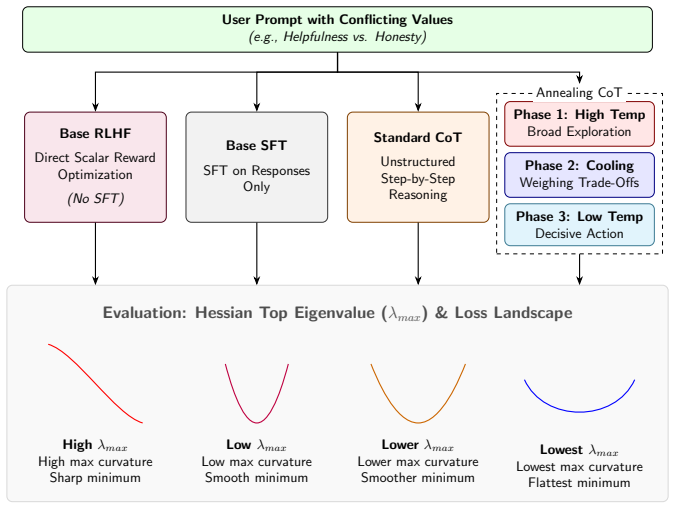
The paper's central claim is that unresolved value conflicts under scalar-reward training leave an LLM in a sharp, cliff-like region of its loss landscape, while chain-of-thought training moves the model into a wider, basin-like minimum. The authors quantify this with the top Hessian eigenvalue, which drops from roughly 4,084 for an RLHF-only baseline to about 1,346 for standard CoT and about 1,218 for their annealing-inspired CoT on a sub-billion-parameter model. They report that the annealing CoT also improves accuracy on moral-reasoning benchmarks by a larger margin than standard CoT, and that the ordering—flatter sharpest direction, better performance—holds for a second model family and
What carries the argument
The load-bearing object is the annealing-inspired chain of thought, a three-phase scaffold appended inside <think> tags during supervised fine-tuning: a high-temperature phase that broadly weighs the conflicting values, a cooling phase that applies hierarchical principles to narrow options, and a low-temperature phase that commits to a decisive action. The analysis relies on the top eigenvalue of the loss Hessian, λmax, as a curvature measure in the sharpest parameter direction, computed by a stochastic trace-estimation method; lower values correspond to flatter, more stable minima. The authors also visualize the landscape by perturbing weights along the top two Hessian eigenvectors. The ann
Load-bearing premise
The annealing CoT's advantage over standard CoT is credited to its three-phase structure, but the two SFT datasets differ in the full text of the reasoning traces, not just in the phase scaffolding; no control condition isolates the phase design from the specific reasoning content, so the causal role of the phase structure is untested.
What would settle it
Train two additional models on the same 1,146 value-conflict prompts: one on the annealing CoT text with the phase headings removed or shuffled, and one on the standard CoT text reformatted into three phase headings. If the annealing model's lower top eigenvalue and higher benchmark scores persist only when the phase-ordered text is used, the scaffold is the cause; if both variants match the annealing numbers, the effect is driven by the reasoning content rather than the annealing dynamics.
If this is right
- Alignment recipes could add a geometric criterion—targeting a low top Hessian eigenvalue—when selecting among CoT variants, instead of relying only on downstream accuracy.
- The exploration-to-commitment ordering can be transplanted to other multi-objective LLM tasks, such as safety-policy deliberation or preference aggregation.
- The ordering of effects reproduces at 9B parameters and across a second model family, suggesting it is not an artifact of one small architecture.
- A deliberately structured reasoning trace may reduce the need for aggressive reward shaping in pluralistic alignment, because the CoT itself guides the model into a stable basin.
Where Pith is reading between the lines
- The three-phase scaffold is itself a structured output; a natural control would remove the 'Phase 1/2/3' labels while keeping the text. If the gap persists, content matters more than framing; if it vanishes, the explicit staging carries the effect.
- The annealing analogy implies a tunable schedule: harder value conflicts should benefit from longer high-temperature exploration. The paper does not vary phase length, but this is a direct testable prediction.
- The reported λmax drop might partly reflect narrower output distributions rather than a genuinely flatter basin; examining the full Hessian spectrum rather than only the top eigenvalue would disambiguate the two.
Editorial analysis
A structured set of objections, weighed in public.
Referee Report
Summary. The paper studies how chain-of-thought (CoT) reasoning affects value-conflict resolution in LLMs. The authors train four variants of Qwen 3.5 0.8B (base RLHF, base SFT, standard CoT, and an annealing-inspired three-phase CoT) on the ConflictScope dataset and use PyHessian to estimate the top Hessian eigenvalue on a held-out subset. They report that CoT lowers the top eigenvalue relative to SFT, and annealing CoT lowers it further; on MMLU Moral Scenarios, DecodingTrust Machine Ethics, and SafetyBench, annealing CoT shows larger accuracy gains. Ablations replicate the benchmark pattern on Llama 3.2 1B and Qwen 3.5 9B, with Hessian analysis only on the two sub-billion models.
Significance. If the results hold, the paper offers a mechanistic link between CoT design and loss-landscape geometry for value-conflict resolution, and a concrete design principle for alignment. The release of dataset and code, the use of external benchmarks, and the explicit limitations section are strengths. However, the Hessian loss is never defined, making the core geometric comparison not reproducible and potentially confounded across models with different training objectives. In addition, the annealing-vs-standard comparison does not isolate the phase structure from reasoning content. These issues are load-bearing for the central claims, but they are fixable within the manuscript's scope.
major comments (4)
- [Section 3.3, Eq. (1), Table 2] The loss function L(θ) whose Hessian is computed is never specified. The top eigenvalue and eigenplane plots depend critically on this choice. The four compared models were trained with different objectives: Base RLHF is GRPO-only, Base SFT is SFT-on-responses then GRPO, Standard CoT and Annealing CoT are SFT-on-CoT+response then GRPO. If L is, for example, teacher-forcing cross-entropy over the evaluation subset, the Base RLHF model was never trained on the CoT/response tokens, so its high λmax may reflect distribution mismatch rather than 'instability caused by direct scalar reward training.' Similarly, the lower λmax of the CoT models may be an artifact of the token sequence used in L. The paper should explicitly define L (e.g., cross-entropy over which tokens, with or without conditioning on the CoT) and, ideally, report λmax under a common loss with appropriate controls.
- [Section 3.1 and 3.3] The geometric evaluation uses a held-out subset of ConflictScope, but the SFT training data are generated from the same ConflictScope pipeline (Liu et al., 2026, one of the co-authors of the present paper). This makes the principal geometric comparison in-distribution; it does not test out-of-distribution smoothness. While the external benchmarks provide some independent grounding, the geometric claim itself rests on an in-distribution subset, so the paper should acknowledge this and, if possible, evaluate on a genuinely external set that was not used to construct any training data.
- [Section 3.1, Table 1, Appendix D] The annealing CoT and standard CoT conditions differ not only in phase structure but also in generation prompts, output format, and example demonstrations. The generated reasoning traces therefore differ in content, helpfulness, and specificity as well as in the presence of phase labels. The larger gains of annealing CoT over standard CoT could be due to the specific content of the generated traces rather than the three-phase 'reasoning dynamics.' To support the causal claim that phase structure is responsible, a control condition is needed that holds content fixed or uses a non-thermal but equally structured CoT (e.g., the same three sections with different labels, or annealing content without phase labels).
- [Table 3] For the 0.8B model, the standard CoT model's improvements over Base SFT are within one standard error on all three benchmarks (e.g., MMLU Moral Scenarios 30.33±2.40 vs 29.67±0.33; SafetyBench 53.67±5.46 vs 48.67±1.76). The paper acknowledges this in the text, but the 'potential to improve moral reasoning' claim rests on a non-significant trend. The authors should report a significance test or effect-size estimate, or temper the claim accordingly. This is not a fatal flaw because the annealing CoT gains are larger, but the two claims should be clearly separated.
minor comments (4)
- [Section 3.3, Figure 2] The eigenvector visualizations use eigenvectors computed from the first Hessian subset, but the loss used in Eq. (1) and the ranges of α and β are not given. This makes the 3D plots hard to interpret quantitatively; please specify the grid and the loss.
- [Section 5.2] No Hessian analysis is performed at the 9B scale, so the 'generalize' claim for the geometric result is not supported at that scale. The benchmark results still support the performance claim, but the wording should be more precise.
- [Throughout] The phrase 'margin of error' is used to describe ±1 standard error. This is not a formal statistical term here; please use 'standard error' or '95% confidence interval' consistently.
- [References] Some references have inconsistent formatting (e.g., spacings in author lists, missing venue information). A final pass for reference consistency would be helpful.
Circularity Check
No circularity: the empirical claims are grounded in external benchmarks, and the co-authored dataset citation is a data source, not a result that forces the conclusions.
full rationale
The paper's central claims are empirical measurements and benchmark comparisons, not derivations from their own inputs. The geometric result (Table 2) reports top Hessian eigenvalues measured on a held-out ConflictScope subset rather than values fitted to reproduce a target ordering; no equation in the paper defines lambda_max in terms of the very outcome it is used to explain. Performance claims are evaluated on independent external benchmarks (MMLU Moral Scenarios, DecodingTrust Machine Ethics, SafetyBench), so the improvement from annealing CoT does not reduce to the SFT data by construction. The one self-citation (Liu et al., 2026, co-authored by Andy Liu) supplies the ConflictScope prompt sets used for both SFT and geometric evaluation, but the paper's conclusions do not follow from that citation; the citation is a data source, not a uniqueness theorem or fitted parameter. The main genuine concerns are non-circular: Section 3.3 never specifies the loss L(theta) whose Hessian is computed, and the CoT-versus-annealing comparison in Table 1/Appendix D differs in full reasoning content rather than only phase scaffolding. These are reproducibility and confounding limitations, not cases where a prediction equals an input by construction. I therefore find no significant circularity.
Axiom & Free-Parameter Ledger
free parameters (3)
- Annealing CoT phase structure =
3 phases (phase_1_high_temp, phase_2_cooling, phase_3_low_temp)
- CoT length requirements =
Not numeric; length requirements given in generation prompts
- Hessian evaluation settings =
3 subsets × 100 prompts/subset × 50 max iterations
axioms (6)
- domain assumption Top Hessian eigenvalue λmax of the loss landscape is a valid proxy for optimization stability and value-conflict resolution capability.
- standard math PyHessian's Hutchinson method converges to the true top eigenvalue of the Hessian with the given settings.
- domain assumption The held-out ConflictScope subset is representative of the value-conflict distribution and independent of the SFT training prompts.
- ad hoc to paper The three-phase annealing prompt produces CoTs whose content differs from standard CoTs only in structure, not in helpfulness or quality.
- domain assumption LLM-as-a-judge (GPT-5.5 at temperature 0.0) correctly parses model outputs against MMLU and SafetyBench labels.
- domain assumption Base RLHF model trained without SFT is a valid comparison point for isolating the effect of SFT on landscape smoothing.
read the original abstract
Large Language Models (LLMs) often struggle to navigate value conflicts when trained with the compressed scalar rewards of Reinforcement Learning from Human Feedback (RLHF). To address this challenge, we investigate how chain-of-thought (CoT) reasoning can help improve performance in this domain. Geometrically, we show that CoT correlates with further smoothing the model's loss landscape in its sharpest direction, helping resolve the optimization instability of traditional scalar rewards. We also demonstrate via relevant downstream benchmarks that value conflict-focused CoT may generalize to different kinds of moral reasoning, demonstrating that this CoT has the potential to be an effective mechanism for better moral reasoning. To capitalize on this potential, we create a new value conflict-focused CoT design that further smooths the sharpest direction of the loss landscape and increases moral reasoning performance. This finding shows that explicitly modifying and improving the design of reasoning dynamics offers a promising avenue for improving model performance on user requests with complex value conflicts, advancing pluralistic alignment in LLMs.
Figures


Reference graph
Works this paper leans on
-
[1]
A. L. Samuel , title =. IBM Journal of Research and Development , year =
-
[2]
Advances in Neural Information Processing Systems , volume=
Training language models to follow instructions with human feedback , author=. Advances in Neural Information Processing Systems , volume=
-
[3]
Shao, Zhihong and Wang, Peiyi and Zhu, Qihao and Xu, Runxin and Song, Junxiao and Bi, Xiao and Zhang, Haowei and Zhang, Mingchuan and Li, YK and Wu, Y and Guo, Daya , journal=
-
[4]
Advances in Neural Information Processing Systems , year=
Regularizing Hidden States Enables Learning Generalizable Reward Model for LLMs , author=. Advances in Neural Information Processing Systems , year=
-
[5]
arXiv preprint arXiv:2204.05862 , year=
Training a Helpful and Harmless Assistant with Reinforcement Learning from Human Feedback , author=. arXiv preprint arXiv:2204.05862 , year=
-
[6]
Advances in Neural Information Processing Systems , volume=
Chain-of-Thought Prompting Elicits Reasoning in Large Language Models , author=. Advances in Neural Information Processing Systems , volume=
-
[7]
arXiv preprint arXiv:2412.16339 , year=
Deliberative Alignment: Reasoning Enables Safer Language Models , author=. arXiv preprint arXiv:2412.16339 , year=
-
[8]
Zhang, Yichi and Zhang, Siyuan and Huang, Yao and Xia, Zeyu and Fang, Zhengwei and Yang, Xiao and Duan, Ranjie and Yan, Dong and Dong, Yinpeng and Zhu, Jun , booktitle=
-
[9]
Nature , volume=
Geometric frustration of Jahn-Teller order in the infinite-layer lattice , author=. Nature , volume=. 2023 , publisher=
2023
-
[10]
Physical Review E , volume=
Bound on annealing performance from stochastic thermodynamics, with application to simulated annealing , author=. Physical Review E , volume=. 2023 , publisher=
2023
-
[11]
Science , volume=
Optimization by simulated annealing , author=. Science , volume=. 1983 , publisher=
1983
-
[12]
Advances in Neural Information Processing Systems , volume=
Visualizing the loss landscape of neural nets , author=. Advances in Neural Information Processing Systems , volume=
-
[13]
arXiv preprint arXiv:2505.17646 , year=
Unveiling the Basin-Like Loss Landscape in Large Language Models , author=. arXiv preprint arXiv:2505.17646 , year=
-
[14]
arXiv preprint arXiv:2505.02809 , year=
Towards Quantifying the Hessian Structure of Neural Networks , author=. arXiv preprint arXiv:2505.02809 , year=
-
[15]
arXiv preprint arXiv:2509.25783 , year=
Sharpness of Minima in Deep Matrix Factorization: Exact Expressions , author=. arXiv preprint arXiv:2509.25783 , year=
-
[16]
Proceedings of the 42nd International Conference on Machine Learning (ICML) , year=
From Low Rank Gradient Subspace Stabilization to Low-Rank Weights: Observations, Theories, and Applications , author=. Proceedings of the 42nd International Conference on Machine Learning (ICML) , year=
-
[17]
arXiv preprint arXiv:2602.22681 , year=
Accelerating LLM Pre-Training through Flat-Direction Dynamics Enhancement , author=. arXiv preprint arXiv:2602.22681 , year=
-
[18]
Proceedings of the International Conference on Learning Representations (ICLR) , year=
Generative Value Conflicts Reveal LLM Priorities , author=. Proceedings of the International Conference on Learning Representations (ICLR) , year=
-
[19]
arXiv preprint arXiv:1912.07145 , year=
PyHessian: Neural Networks Through the Lens of the Hessian , author=. arXiv preprint arXiv:1912.07145 , year=
Pith/arXiv arXiv 1912
-
[20]
Communications in Statistics-Simulation and Computation , volume=
A stochastic estimator of the trace of the influence matrix for Laplacian smoothing splines , author=. Communications in Statistics-Simulation and Computation , volume=. 1990 , publisher=
1990
-
[21]
arXiv preprint arXiv:2212.08073 , year=
Constitutional ai: Harmlessness from ai feedback , author=. arXiv preprint arXiv:2212.08073 , year=
-
[22]
Proceedings of the International Conference on Learning Representations (ICLR) , year=
Chain of hindsight aligns language models with feedback , author=. Proceedings of the International Conference on Learning Representations (ICLR) , year=
-
[23]
arXiv preprint arXiv:2210.10760 , year=
Scaling Laws for Reward Model Overoptimization , author=. arXiv preprint arXiv:2210.10760 , year=
-
[24]
Advances in Neural Information Processing Systems , year=
Evaluating Loss Landscapes from a Topology Perspective , author=. Advances in Neural Information Processing Systems , year=
-
[25]
arXiv preprint arXiv:2602.07135 , year=
Landscaper: Understanding Loss Landscapes Through Multi-Dimensional Topological Analysis , author=. arXiv preprint arXiv:2602.07135 , year=
-
[26]
, title =
Xiao, Jiancong and Li, Ziniu and Xie, Xingyu and Getzen, Emily and Fang, Cong and Long, Qi and Su, Weijie J. , title =. Journal of the American Statistical Association , year =
-
[27]
Proceedings of the 2025 ACM Conference on Fairness, Accountability, and Transparency , year =
Khan, Ariba and Casper, Stephen and Hadfield-Menell, Dylan , title =. Proceedings of the 2025 ACM Conference on Fairness, Accountability, and Transparency , year =
2025
-
[28]
Yu Ying Chiu and Michael S. Lee and Rachel Calcott and Brandon Handoko and Paul de Font-Reaulx and Raphaël Millière and Paula Rodriguez and Chen Bo Calvin Zhang and Ziwen Han and Udari Madhushani Sehwag and Yash Maurya and Christina Knight and Harry Lloyd and Florence Bacus and Conor Downey and Mantas Mazeika and Bing Liu and Yejin Choi and Mitchell Gordo...
-
[29]
Chiu, Yu Ying and Jiang, Liwei and Choi, Yejin , booktitle=
-
[30]
arXiv preprint arXiv:2510.07686 , year=
Stress-Testing Model Specs Reveals Character Differences among Language Models , author=. arXiv preprint arXiv:2510.07686 , year=
-
[31]
arXiv preprint arXiv:2602.20042 , year=
AI Alignment Breaks at the Edge , author=. arXiv preprint arXiv:2602.20042 , year=
-
[32]
arXiv preprint arXiv:2604.17053 , year=
Jailbreaking Large Language Models with Morality Attacks , author=. arXiv preprint arXiv:2604.17053 , year=
-
[33]
Dubey, Rohit and Dailisan, Damian and Mahajan, Sachit , journal=
-
[34]
Advances in Neural Information Processing Systems , volume=
When to Make Exceptions: Exploring Language Models as Accounts of Human Moral Judgment , author=. Advances in Neural Information Processing Systems , volume=
-
[35]
Proceedings of the International Conference on Learning Representations (ICLR) , year=
Measuring Massive Multitask Language Understanding , author=. Proceedings of the International Conference on Learning Representations (ICLR) , year=
-
[36]
and Arora, Simran and Mazeika, Mantas and Hendrycks, Dan and Lin, Zinan and Cheng, Yu and Koyejo, Sanmi and Song, Dawn and Li, Bo , booktitle=
Wang, Boxin and Chen, Weixin and Pei, Hengzhi and Xie, Chulin and Kang, Mintong and Zhang, Chenhui and Xu, Chejian and Xiong, Zidi and Dutta, Ritik and Schaeffer, Rylan and Truong, Sang T. and Arora, Simran and Mazeika, Mantas and Hendrycks, Dan and Lin, Zinan and Cheng, Yu and Koyejo, Sanmi and Song, Dawn and Li, Bo , booktitle=
-
[37]
2024 , publisher=
Zhang, Zhexin and Lei, Leqi and Wu, Lindong and Sun, Rui and Huang, Yongkang and Long, Chong and Liu, Xiao and Lei, Xuanyu and Tang, Jie and Huang, Minlie , booktitle=. 2024 , publisher=
2024
-
[38]
Proceedings of the 36th International Conference on Machine Learning , pages=
An Investigation into Neural Net Optimization via Hessian Eigenvalue Density , author=. Proceedings of the 36th International Conference on Machine Learning , pages=
discussion (0)
Sign in with ORCID, Apple, or X to comment. Anyone can read and Pith papers without signing in.