REVIEW 4 major objections 5 minor 2 cited by
Half-Physics: Enabling Kinematic 3D Human Model with Physical Interactions
T0 review · 4 major / 5 minor · reviewed 2026-08-06 · deepseek-v4-flash
Pith's one-line read A kinematic 3D human motion can be made physically interactive with no learning by replacing per-frame poses with per-body-part velocities, so that the body tracks its input exactly until a collision, at which point physics takes over.
desk verdict Useful, simple kinematic-to-physics bridge for SMPL-X, but the PHC+ comparison is circular and the 'physical plausibility' claim outruns the disabled-internal-forces pipeline. read the letter →
The pith
A machine-rendered reading of the paper's core claim, the machinery that carries it, and where it could break.
The reading
What carries the argument
The central mechanism is "half physics": a velocity-override bridge between kinematics and dynamics. Instead of applying joint torques, the method computes the linear velocity of each body part as the finite difference between the current position and the next kinematic target, applies the same finite-difference and spherical-interpolation scheme to global and joint angular velocities, and lets a simulator step the system forward. The body thus moves ballistically toward the kinematic target when nothing touches it, and the engine's collision and friction solver takes over when something does; internal-force and damping terms are switched off because the kinematic input is taken to already carry the muscular coordination, and an optional passive stiffness compensation torque can pull the pose back toward the intended trajectory after contact.
What would settle it
Run a motion-capture experiment in which a human kicks a 0.5 kg ball and a 200 kg ball with the same intended motion, and compare post-contact joint-angle trajectories with half-physics predictions; if the human's joints show muscle-driven braking or pre-impact stiffening that the simulator, which disables internal forces, cannot reproduce, the claim that physical plausibility is preserved after collisions is falsified.
Extended reading notes
Core claim
The paper's central claim is that a kinematic SMPL-X motion can be embedded in a physics engine with no learning by directly overriding per-body-part velocities instead of driving joints with torques. On dance motions, this achieves tracking error of about 3 micrometers versus centimeters for a trained physical tracker, and 100% success without falls; on scene interactions it reduces penetration from 7.9% of vertices to zero; and on object interactions it produces emergent responses — grasp, lift, drop, kick — that depend correctly on object mass and friction, without any predicted object trajectories. This is presented as a faithful transfer: absent collisions the output equals the kinematic input, and upon collisions the physics engine dictates the interaction.
Load-bearing premise
The load-bearing assumption is that a kinematic motion sequence already encodes the outcome of the body's muscular coordination, so the simulator can safely ignore internal joint forces and damping and respond only to external collisions; if real muscle dynamics matter right after impact, the post-collision body responses are not biomechanically faithful.
Editorial extensions
If this is right
- Any kinematic SMPL-X motion sequence can be replayed inside a physics engine with zero training, preserving the original poses while blocking penetration against static scenes.
- Object responses in human-object interaction emerge from mass, friction, and contact rather than from learned or scripted object trajectories, so physical factors can be varied to generate new interaction outcomes.
- Tracking fidelity shifts from centimeter-scale errors (typical of torque-driven learned trackers) to near machine precision, making the method suitable for applications such as VR where exact alignment with user motion matters.
- The same half-physics layer can augment interaction datasets with physically realistic labels, such as what happens when a ball is very heavy or a surface is very slippery.
- Because the conversion is a simple velocity computation, the approach can be ported to other physics simulators that expose per-link velocity interfaces.
Reading between the lines
- If the central claim holds, half physics offers a cheap post-processing layer for generative motion models: sample kinematic poses, then let the simulator decide what happens at contact, with object state as a free byproduct of the interaction.
- The method's own limitation text notes that internal muscle-skeletal dynamics are not modeled, so its "physical plausibility" is about external-contact behavior, not biomechanical fidelity; a biomechanical validation study would be the decisive test of that scope.
- The stiffness parameter lambda suggests a controllable trade-off between preserving local joint poses and allowing whole-body displacement; a natural extension would be to fit lambda per motion or per body style from human muscle-tension data.
- Because the approach does not semantically correct the motion, it would not by itself fix an input that walks into a newly inserted wall; combining it with a motion planner or semantic scene-aware generator is a promising division of labor.
Editorial analysis
A structured set of objections, weighed in public.
Referee Report
Summary. The paper introduces "half-physics," a method to embed the kinematic SMPL-X human model into a physics simulator by converting per-frame positions and rotations into body-part velocities. At each timestep, the body parts are assigned the finite-difference velocity toward the next kinematic target, so that in the absence of contact the simulated pose exactly matches the input, while collisions are handled by the physics engine to block penetration and drive object motion. The authors demonstrate the approach on AIST++ dance tracking, penetration removal on the Trumans HSI dataset, and a range of human-object interactions (grasping, lifting, kicking, dropping) with fully simulated object dynamics. The method is learning-free, runs at roughly 950 fps, and generalizes to arbitrary SMPL-X inputs.
Significance. If the claims are taken at face value, the contribution is practically useful: a simple, training-free, real-time bridge between kinematic human motion and physics simulation, with potential applications in VR/AR, embodied AI, and synthetic data augmentation. The paper honestly lists several limitations in Appendix B.3, including the absence of internal actuation dynamics. However, the central claims of "physical plausibility" and "seamless physical interaction" are undermined by two methodological choices: the near-zero tracking error in Table 1 is a tautology of the velocity override, and the explicit disabling of internal force propagation in Appendix A removes the articulated-body response that a real collision would produce. These issues are load-bearing for the paper's main contribution and need to be addressed before the claims can be accepted.
major comments (4)
- [Section 4.1, Table 1 and Algorithm 1] The reported MPJPE-g of 0.003 mm is a direct consequence of the control law rather than an empirical tracking result. In Algorithm 1, line 7, the global linear velocity is set to (x_body,t - x_body,t-1)/dt, and joint velocities are set to the angular difference to the target divided by dt. In the absence of collisions, the simulated state must therefore advance exactly to the target pose, up to rounding errors. Comparing this with PHC+, whose agent must contend with inertia and internal dynamics, is an apples-to-oranges comparison. The claim that half-physics reduces tracking error from centimeter scale to negligible is misleading; the correct statement is that the output is identical to the input when no contact occurs. Please reframe this comparison or report fidelity only under contacts.
- [Appendix A, 'Damping-Free Dynamics and the Neglect of Internal Force'; Table 4] Disabling internal force propagation in the Featherstone pipeline eliminates the inertial coupling between links. In a real articulated collision, the contact impulse at the foot is resisted by the effective mass of the whole leg (shank, thigh, pelvis), and joint reaction forces transmit deceleration through the skeleton. With internal forces disabled, the post-impact state of the struck link depends almost entirely on the link's own inertia, and the next-frame velocity override then resets the joint velocities toward the kinematic target. As a result, examples such as Figure 5(h) (200 kg ball) and Figure 5(i) (200 kg suitcase) demonstrate collision-local deformation rather than whole-body physical response, and the object's exit speed may be incorrect even when the visual outcome looks plausible. The paper's own Table 4 shows that enabling internal forces destroys the perfect tracking, indicating that the fidelity claim is purchased exactly by suppressing the dynamics needed for a faithful articulated collision response. I recommend either (i) a quantitative validation of contact impulses and object velocities against a full rigid-body simulator with internal forces enabled, or (ii) a careful restatement of the contribution as 'kinematically driven collision response with physically simulated object dynamics,' with the human body's physical plausibility explicitly qualified.
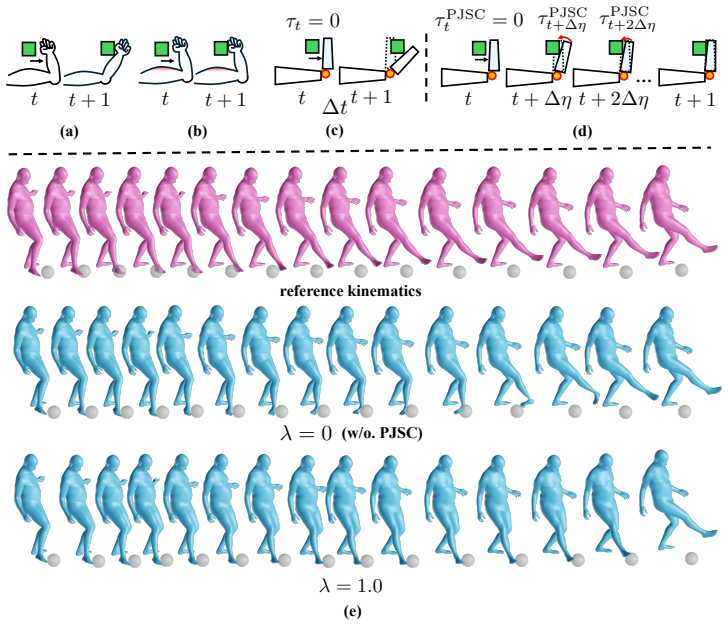
- [Appendix A, Eq. (4) and Section 4.3] Passive Joint Stiffness Compensation (PJSC) applies a corrective joint torque, which is itself an internal actuation. The main HOI experiments in Section 4.3 use lambda = 0 (no PJSC), so the claimed 'fingers bend under strain' in Figure 5(i) cannot be attributed to passive stiffness; it must be a result of the velocity override and contact dynamics within the timestep, whose physical meaning is unclear. The paper should clarify what physical mechanism produces the bending, and how PJSC (which re-introduces internal torque) interacts with the 'no internal forces' setting and with the reported penetration and tracking metrics.
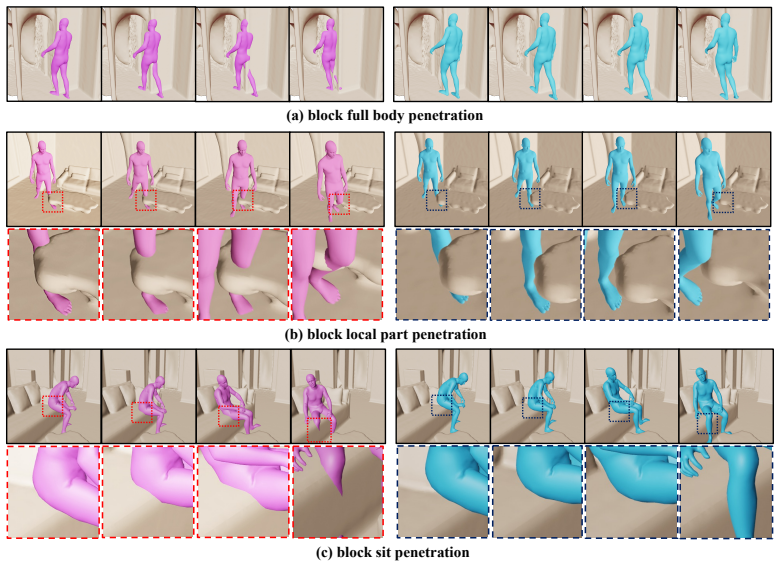
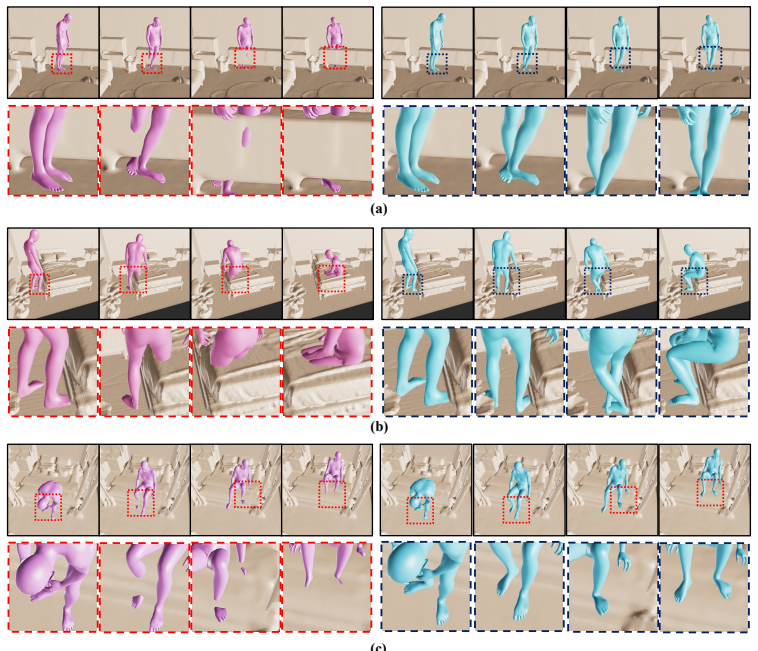
- [Section 4.2 and Figure 4] The penetration elimination results are plausible and well presented, but the evaluation only reports zero penetration and does not quantify side effects such as foot sliding, body rotation, or deviation from the intended motion after contacts. Appendix B.3 mentions foot sliding as a possible issue, but the main body of the paper claims the motion remains faithful to the original intent without qualification. A quantitative measure of motion deviation after contact (e.g., global trajectory displacement or joint-angle deviation) would strengthen the HSI evaluation and clarify the trade-off between penetration removal and kinematic fidelity.
minor comments (5)
- [Section 4.1] The text says 'The results are shown in Table 2' but the comparison results appear in Table 1; Table 2 has the HSI results. Please correct the references.
- [Figure 2 caption] The caption contains the typo 'frameword' instead of 'framework'.
- [Section 3.2] The notation introduces both global body velocity and per-part velocities, but the superscript convention is used inconsistently; for instance, ˙x_body,0_t is used for the root global velocity, while later in the text the same symbol with index i denotes part velocities. Please clarify the indexing in the equations.
- [Figure 8] PJSC is defined only in Appendix A but is referenced in the main text and Figure 8. Consider defining the acronym at first use or moving a short explanation to Section 3.
- [References] Reference [38] cites the SMPL-H/Embodied Hands model as an arXiv preprint; the published version (ACM Transactions on Graphics, 2022) should be cited if available.
Circularity Check
The claimed near-perfect kinematic tracking (MPJPE 3 µm) is definitional: velocities are set to the finite difference to the target pose, so the no-collision output equals the input by construction; the contact-response contribution is genuinely emergent and not circular.
-
self definitional
[Section 3.2, Algorithm 1 (lines 6-8); Section 4.1, Table 1]
"Joint velocities ˙qjoint t ... are computed via spherical linear interpolation ... between their targets (qjoint t and qbody,0 t ) and their current states (ˆqjoint t−1 and ˆqbody,0 t−1 ), respectively. In contrast, the global linear velocity ˙xbody,0 t is computed as the difference between the target global positions at frames t and t − 1. ... If no collision occurs, the half-physics SMPL-X variant can maintain the same pose sequence as the original SMPL-X, i.e., ˆθ = H(θ). ... HP achieves a global error of merely 3 µm ..."
The velocity command is, by the algorithm's definition, exactly the displacement from the current simulated state to the kinematic target divided by Δt, with rotations handled by SLERP toward the same target. Integrating that prescribed velocity over one timestep reproduces the target pose whenever no collision occurs. Therefore the 'tracking' output is the kinematic input by construction, and the reported MPJPE of 3 µm is an identity check on the finite-difference formula rather than an empirical tracking result. The paper itself states that in the no-collision case the output equals the input and that the residual is rounding error. Comparing this number with PHC+'s centimeter-level error conflates a definitional identity with a control achievement.
full rationale
The paper's central practical novelty is the half-physics velocity override, and the object-response experiments (kicking, lifting, dropping, mass/friction variation) are emergent from the simulator rather than read off from the input. However, the headline quantitative claim of 3 µm tracking fidelity is tautological: the per-frame linear and angular velocities are defined as the finite differences (or SLERP differences) between the current state and the kinematic target, so integrating them with no contact returns the target. The paper explicitly says the no-collision output is identical to the input and that the residual is rounding. This makes the MPJPE comparison to PHC+ a comparison between a definitional identity and a genuine physical-tracking result, which is a real circular step in the evaluation. No load-bearing self-citation chain or imported uniqueness theorem is present; the Appendix A decision to disable internal force propagation is a stated modeling assumption and limitation rather than a circular step, and Appendix B.3 candidly admits that internal actuating dynamics are not modeled. Because one central supporting result reduces by construction while the main interaction contribution remains independent, the appropriate score is 6.
Assumptions & free parameters
free parameters (4)
- PJSC gain lambda =
0 (most experiments), 1 (HSI)
- PJSC substep count N =
8 (HSI)
- Body part masses and inertias =
not specified
- Contact friction coefficients =
not specified
assumptions (4)
- domain assumption SMPL-X body can be approximated as 55 rigid body parts derived from vertex segmentation
- domain assumption Internal joint damping and internal force propagation can be disabled because the kinematic motion already encodes complete muscle-skeletal coordination
- standard math Finite-difference velocity over Delta t accurately represents the intended body motion during the simulation step
- domain assumption The physics engine's collision detection with the rigid variant is numerically consistent with mesh-level penetration measurements
Cite this review
Pith. "Pith review of Half-Physics: Enabling Kinematic 3D Human Model with Physical Interactions." pith.science (2026). https://pith.science/paper/KUKLD6RC
@misc{pith2026250723778,
  author       = {Pith},
  title        = {Pith review of: Half-Physics: Enabling Kinematic 3D Human Model with Physical Interactions},
  year         = {2026},
  howpublished = {\url{https://pith.science/paper/KUKLD6RC}},
  note         = {Machine review of arXiv:2507.23778}
}
read the original abstract
While current general-purpose 3D human models (e.g., SMPL-X) efficiently represent accurate human shape and pose, they lacks the ability to physically interact with the environment due to the kinematic nature. As a result, kinematic-based interaction models often suffer from issues such as interpenetration and unrealistic object dynamics. To address this limitation, we introduce a novel approach that embeds SMPL-X into a tangible entity capable of dynamic physical interactions with its surroundings. Specifically, we propose a "half-physics" mechanism that transforms 3D kinematic motion into a physics simulation. Our approach maintains kinematic control over inherent SMPL-X poses while ensuring physically plausible interactions with scenes and objects, effectively eliminating penetration and unrealistic object dynamics. Unlike reinforcement learning-based methods, which demand extensive and complex training, our half-physics method is learning-free and generalizes to any body shape and motion; meanwhile, it operates in real time. Moreover, it preserves the fidelity of the original kinematic motion while seamlessly integrating physical interactions
Figures


Figures from the paper (5 more)


Forward citations
Cited by 2 Pith papers
-
HumanCLAW: Can Vision-Language Models Act Through a Body?
Off-the-shelf VLMs fail closed-loop whole-body find-navigate-interact tasks (best 16.8%) because they lack embodied self-awareness, not target recognition.
-
Advances in 4D Representation: Geometry, Motion, and Interaction
A representation-centric survey of 4D generation and reconstruction, organized by geometry, motion, and interaction, with qualitative trade-off comparisons across seven representation families.
Reference graph
Works this paper leans on
- [1]
-
[2]
Keep it smpl: Automatic estimation of 3d human pose and shape from a single image
Federica Bogo, Angjoo Kanazawa, Christoph Lassner, Peter Gehler, Javier Romero, and Michael J Black. Keep it smpl: Automatic estimation of 3d human pose and shape from a single image. In ECCV, 2016
work page 2016
-
[3]
Erwin Coumans. Bullet physics simulation. In ACM SIGGRAPH 2015 Courses, page 1. ACM, 2015
work page 2015
-
[4]
Habitat 2.0: Training home assistants to rearrange their habitat
Mikael Dallaire Côté, Eric Undersander, Alexander Clegg, et al. Habitat 2.0: Training home assistants to rearrange their habitat. In NeurIPS, pages 21525–21537, 2021
work page 2021
-
[5]
The calculation of robot dynamics using articulated-body inertias
Roy Featherstone. The calculation of robot dynamics using articulated-body inertias. Interna- tional Journal of Robotics Research, 2(1):13–30, 1983
work page 1983
-
[6]
Chatpose: Chatting about 3d human pose
Yao Feng, Jing Lin, Sai Kumar Dwivedi, Yu Sun, Priyanka Patel, and Michael J Black. Chatpose: Chatting about 3d human pose. In CVPR, 2024
work page 2024
-
[7]
Mohamed Hassan, Duygu Ceylan, Ruben Villegas, Jun Saito, Jimei Yang, Yi Zhou, and Michael J. Black. Stochastic scene-aware motion prediction. In ICCV, 2021
work page 2021
-
[8]
Resolving 3d human pose ambiguities with 3d scene constraints
Mohamed Hassan, Vasileios Choutas, Dimitrios Tzionas, and Michael J Black. Resolving 3d human pose ambiguities with 3d scene constraints. In ICCV, 2019
work page 2019
Show all 59 references
-
[9]
Avatarclip: Zero-shot text-driven generation and animation of 3d avatars
Fangzhou Hong, Mingyuan Zhang, Liang Pan, Zhongang Cai, Lei Yang, and Ziwei Liu. Avatarclip: Zero-shot text-driven generation and animation of 3d avatars. arXiv preprint arXiv:2205.08535, 2022
2022 arXiv
-
[10]
Diffusion-based generation, optimization, and planning in 3d scenes
Siyuan Huang, Zan Wang, Puhao Li, Baoxiong Jia, Tengyu Liu, Yixin Zhu, Wei Liang, and Song-Chun Zhu. Diffusion-based generation, optimization, and planning in 3d scenes. In ICCV, 2023
2023
-
[11]
Advanced character physics
Thomas Jakobsen. Advanced character physics. In Game developers conf., 2001. 10
2001
-
[12]
Au- tonomous character-scene interaction synthesis from text instruction
Nan Jiang, Zimo He, Zi Wang, Hongjie Li, Yixin Chen, Siyuan Huang, and Yixin Zhu. Au- tonomous character-scene interaction synthesis from text instruction. In SIGGRAPH Asia, 2024
2024
-
[13]
Scaling up dynamic human-scene interaction modeling
Nan Jiang, Zhiyuan Zhang, Hongjie Li, Xiaoxuan Ma, Zan Wang, Yixin Chen, Tengyu Liu, Yixin Zhu, and Siyuan Huang. Scaling up dynamic human-scene interaction modeling. In CVPR, 2024
2024
-
[14]
End-to-end recovery of human shape and pose
Angjoo Kanazawa, Michael J Black, David W Jacobs, and Jitendra Malik. End-to-end recovery of human shape and pose. In CVPR, 2018
2018
-
[15]
Vibe: Video inference for human body pose and shape estimation
Muhammed Kocabas, Nikos Athanasiou, and Michael J Black. Vibe: Video inference for human body pose and shape estimation. In CVPR, 2020
2020
-
[16]
Karen Liu
Jiaman Li, Alexander Clegg, Roozbeh Mottaghi, Jiajun Wu, Xavier Puig, and C. Karen Liu. Controllable human-object interaction synthesis. In ECCV, 2024. Oral Presentation
2024
-
[17]
Karen Liu
Jiaman Li, Jiajun Wu, and C. Karen Liu. Object motion guided human motion synthesis. ACM ToG, 2023
2023
-
[18]
Ai choreographer: Music conditioned 3d dance generation with aist++
Ruilong Li, Shan Yang, David A Ross, and Angjoo Kanazawa. Ai choreographer: Music conditioned 3d dance generation with aist++. In ICCV, 2021
2021
-
[19]
Revisit human-scene interaction via space occupancy
Xinpeng Liu, Haowen Hou, Yanchao Yang, Yong-Lu Li, and Cewu Lu. Revisit human-scene interaction via space occupancy. In ECCV, 2024
2024
-
[20]
SMPL: A skinned multi-person linear model
Matthew Loper, Naureen Mahmood, Javier Romero, Gerard Pons-Moll, and Michael J Black. SMPL: A skinned multi-person linear model. ACM ToG, 34(6), 2015
2015
-
[21]
Carl: Controllable agent with reinforcement learning for quadruped locomotion
Ying-Sheng Luo, Jonathan Hans Soeseno, Trista Pei-Chun Chen, and Wei-Chao Chen. Carl: Controllable agent with reinforcement learning for quadruped locomotion. ACM ToG, 39(4):38– 1, 2020
2020
-
[22]
Omnigrasp: Grasping diverse objects with simulated humanoids
Zhengyi Luo, Jinkun Cao, Sammy Christen, Alexander Winkler, Kris Kitani, and Weipeng Xu. Omnigrasp: Grasping diverse objects with simulated humanoids. In NeurIPS, 2024
2024
-
[23]
Perpetual humanoid control for real-time simulated avatars
Zhengyi Luo, Jinkun Cao, Kris Kitani, Weipeng Xu, et al. Perpetual humanoid control for real-time simulated avatars. In ICCV, 2023
2023
-
[24]
Universal humanoid motion representations for physics-based control
Zhengyi Luo, Jinkun Cao, Josh Merel, Alexander Winkler, Jing Huang, Kris M Kitani, and Weipeng Xu. Universal humanoid motion representations for physics-based control. In ICLR, 2024
2024
-
[25]
Embodied scene-aware human pose estimation
Zhengyi Luo, Shun Iwase, Ye Yuan, and Kris Kitani. Embodied scene-aware human pose estimation. NeurIPS, 2022
2022
-
[27]
Humanoidlympics: Sports environments for physically simulated humanoids
Zhengyi Luo, Jiashun Wang, Kangni Liu, Haotian Zhang, Chen Tessler, Jingbo Wang, Ye Yuan, Jinkun Cao, Zihui Lin, Fengyi Wang, Jessica Hodgins, and Kris Kitani. Humanoidlympics: Sports environments for physically simulated humanoids. In arXiv preprint arXiv:2407.00187, 2025
2025 arXiv
-
[28]
Xpbd: position-based simulation of compliant constrained dynamics
Miles Macklin, Matthias Müller, and Nuttapong Chentanez. Xpbd: position-based simulation of compliant constrained dynamics. In ICMG, 2016
2016
-
[29]
Amass: Archive of motion capture as surface shapes
Naureen Mahmood, Nima Ghorbani, Nikolaus F Troje, Gerard Pons-Moll, and Michael J Black. Amass: Archive of motion capture as surface shapes. In ICCV, 2019
2019
-
[30]
Generating continual human motion in diverse 3d scenes
Aymen Mir, Xavier Puig, Angjoo Kanazawa, and Gerard Pons-Moll. Generating continual human motion in diverse 3d scenes. In ICCV, 2023. 11
2023
-
[31]
Detailed rigid body simulation with extended position based dynamics
Matthias Müller, Miles Macklin, Nuttapong Chentanez, Stefan Jeschke, and Tae-Yong Kim. Detailed rigid body simulation with extended position based dynamics. In CGF, 2020
2020
-
[32]
Synthesizing physically plausible human motions in 3d scenes
Liang Pan, Jingbo Wang, Buzhen Huang, Junyu Zhang, Haofan Wang, Xu Tang, and Yangang Wang. Synthesizing physically plausible human motions in 3d scenes. In 3DV, 2021
2021
-
[33]
Georgios Pavlakos, Vasileios Choutas, Nima Ghorbani, Timo Bolkart, Ahmed A. A. Osman, Dimitrios Tzionas, and Michael J. Black. Expressive body capture: 3D hands, face, and body from a single image. In CVPR, 2019
2019
-
[34]
Deepmimic: Example- guided deep reinforcement learning of physics-based character skills
Xue Bin Peng, Pieter Abbeel, Sergey Levine, and Michiel Van de Panne. Deepmimic: Example- guided deep reinforcement learning of physics-based character skills. ACM ToG, 37(4):1–14, 2018
2018
-
[35]
Amp: Adversarial motion priors for stylized physics-based character control
Xue Bin Peng, Ze Ma, Pieter Abbeel, Sergey Levine, and Angjoo Kanazawa. Amp: Adversarial motion priors for stylized physics-based character control. ACM ToG, 40(4):1–20, 2021
2021
-
[36]
Habitat 3.0: A co-habitat for humans, avatars, and robots
Xavier Puig, Eric Undersander, Andrew Szot, et al. Habitat 3.0: A co-habitat for humans, avatars, and robots. arXiv preprint arXiv:2310.13724, 2023
2023 arXiv
-
[37]
Diffmimic: Efficient motion mimicking with differentiable physics
Jiawei Ren, Cunjun Yu, Siwei Chen, Xiao Ma, Liang Pan, and Ziwei Liu. Diffmimic: Efficient motion mimicking with differentiable physics. In ICLR, 2022
2022
-
[38]
Embodied hands: Modeling and capturing hands and bodies together
Javier Romero, Dimitrios Tzionas, and Michael J Black. Embodied hands: Modeling and capturing hands and bodies together. arXiv preprint arXiv:2201.02610, 2022
2022 arXiv
-
[39]
Airpose: Multi-view fusion network for aerial 3d human pose and shape estimation
Nitin Saini, Elia Bonetto, Eric Price, Aamir Ahmad, and Michael J Black. Airpose: Multi-view fusion network for aerial 3d human pose and shape estimation. IEEE Robotics and Automation Letters, 7(2):4805–4812, 2022
2022
-
[40]
Habitat: A platform for embodied ai research
Manolis Savva, Abhishek Kadian, Oleksandr Maksymets, et al. Habitat: A platform for embodied ai research. In ICCV, 2019
2019
-
[41]
Animating rotation with quaternion curves
Ken Shoemake. Animating rotation with quaternion curves. In Annual Conf. on Comput. Graph. and Interactive Techs, 1985
1985
-
[42]
Duolando: Follower gpt with off-policy reinforcement learning for dance accompaniment
Li Siyao, Tianpei Gu, Zhitao Yang, Zhengyu Lin, Ziwei Liu, Henghui Ding, Lei Yang, and Chen Change Loy. Duolando: Follower gpt with off-policy reinforcement learning for dance accompaniment. In ICLR, 2024
2024
-
[43]
Bailando: 3d dance generation by actor-critic gpt with choreographic memory
Li Siyao, Weijiang Yu, Tianpei Gu, Chunze Lin, Quan Wang, Chen Qian, Chen Change Loy, and Ziwei Liu. Bailando: 3d dance generation by actor-critic gpt with choreographic memory. In CVPR, 2022
2022
-
[44]
Bailando++: 3d dance gpt with choreographic memory
Li Siyao, Weijiang Yu, Tianpei Gu, Chunze Lin, Quan Wang, Chen Qian, Chen Change Loy, and Ziwei Liu. Bailando++: 3d dance gpt with choreographic memory. IEEE TPAMI, 45(12):14192–14207, 2023
2023
-
[45]
Black, and Dimitrios Tzionas
Omid Taheri, Nima Ghorbani, Michael J. Black, and Dimitrios Tzionas. GRAB: A dataset of whole-body human grasping of objects. In ECCV, 2020
2020
-
[46]
Bermano, and Michiel van de Panne
Guy Tevet, Sigal Raab, Setareh Cohan, Daniele Reda, Zhengyi Luo, Xue Bin Peng, Amit H. Bermano, and Michiel van de Panne. CLoSD: Closing the loop between simulation and diffusion for multi-task character control. In ICLR, 2025
2025
-
[47]
Mocapact: A multi-task dataset for simulated humanoid control.NeurIPS, 2022
Nolan Wagener, Andrey Kolobov, Felipe Vieira Frujeri, Ricky Loynd, Ching-An Cheng, and Matthew Hausknecht. Mocapact: A multi-task dataset for simulated humanoid control.NeurIPS, 2022
2022
-
[48]
Synthesizing long-term 3d human motion and interaction in 3d scenes
Jiashun Wang, Huazhe Xu, Jingwei Xu, Sifei Liu, and Xiaolong Wang. Synthesizing long-term 3d human motion and interaction in 3d scenes. In CVPR, 2021
2021
-
[49]
Towards diverse and natural scene-aware 3d human motion synthesis
Jingbo Wang, Yu Rong, Jingyuan Liu, Sijie Yan, Dahua Lin, and Bo Dai. Towards diverse and natural scene-aware 3d human motion synthesis. In CVPR, 2022. 12
2022
-
[50]
Scene-aware generative network for human motion synthesis
Jingbo Wang, Sijie Yan, Bo Dai, and Dahua Lin. Scene-aware generative network for human motion synthesis. In CVPR, 2021
2021
-
[51]
PhysHOI: Physics-based imitation of dynamic human-object interaction
Yinhuai Wang, Jing Lin, Ailing Zeng, Zhengyi Luo, Jian Zhang, and Lei Zhang. PhysHOI: Physics-based imitation of dynamic human-object interaction. arXiv preprint arXiv:2312.04393, 2023
2023 arXiv
-
[52]
SkillMimic: Learning reusable basketball skills from demonstrations
Yinhuai Wang, Qihan Zhao, Runyi Yu, Ailing Zeng, Jing Lin, Zhengyi Luo, Hok Wai Tsui, Jiwen Yu, Xiu Li, Qifeng Chen, Jian Zhang, Lei Zhang, and Ping Tan. SkillMimic: Learning reusable basketball skills from demonstrations. In CVPR, 2025
2025
-
[53]
Karen Liu
Zhen Wu, Jiaman Li, Pei Xu, and C. Karen Liu. Human-object interaction from human-level instructions. arXiv preprint, arXiv 2406.17840, 2024
2024 arXiv
-
[54]
Unified human-scene interaction via prompted chain-of-contacts
Zeqi Xiao, Tai Wang, Jingbo Wang, Jinkun Cao, Wenwei Zhang, Bo Dai, Dahua Lin, and Jiangmiao Pang. Unified human-scene interaction via prompted chain-of-contacts. In ICLR, 2024
2024
-
[55]
Econ: Explicit clothed humans optimized via normal integration
Yuliang Xiu, Jinlong Yang, Xu Cao, Dimitrios Tzionas, and Michael J Black. Econ: Explicit clothed humans optimized via normal integration. In CVPR, 2023
2023
-
[56]
Icon: Implicit clothed humans obtained from normals
Yuliang Xiu, Jinlong Yang, Dimitrios Tzionas, and Michael J Black. Icon: Implicit clothed humans obtained from normals. In CVPR, 2022
2022
-
[57]
Interdiff: Generating 3d human-object interactions with physics-informed diffusion
Sirui Xu, Zhengyuan Li, Yu-Xiong Wang, and Liang-Yan Gui. Interdiff: Generating 3d human-object interactions with physics-informed diffusion. In ICCV, 2023
2023
-
[58]
Intermimic: Towards universal whole-body control for physics-based human-object interactions
Sirui Xu, Hung Yu Ling, Yu-Xiong Wang, and Liangyan Gui. Intermimic: Towards universal whole-body control for physics-based human-object interactions. In CVPR, 2025
2025
-
[59]
Learning physically simulated tennis skills from broadcast videos
Ye Yuan, Viktor Makoviychuk, Y Guo, S Fidler, XB Peng, and K Fatahalian. Learning physically simulated tennis skills from broadcast videos. ACM ToG, 42(4), 2023
2023
-
[60]
internal
Kaifeng Zhao, Yan Zhang, Shaofei Wang, Thabo Beeler, and Siyu Tang. DIMOS: Synthesizing diverse human motions in 3d indoor scenes. In ICCV, 2023. A Implementation Details of Half-Physics Simulator In theory, half physics can be extended to any simulator. However, since half ph...
2023
Reviewed August 6, 2026 · model on record in the stance chip above.
Discussion (0). Continue with ORCID to comment.