Residual stress gradient in a thin film within the dislocation pile-up theory
Pith reviewed 2026-06-27 08:57 UTC · model grok-4.3
The pith
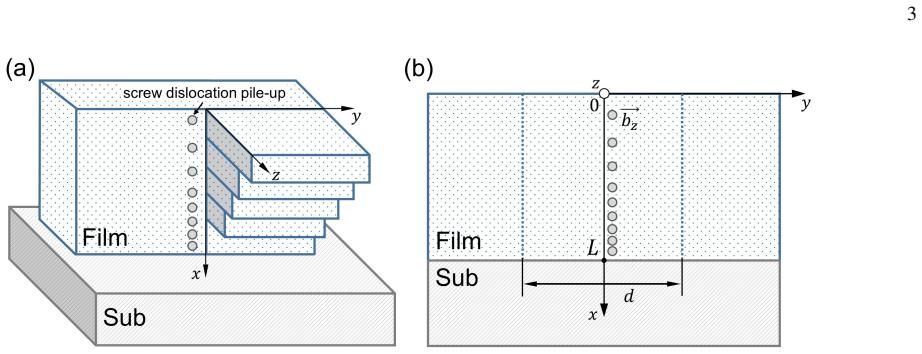
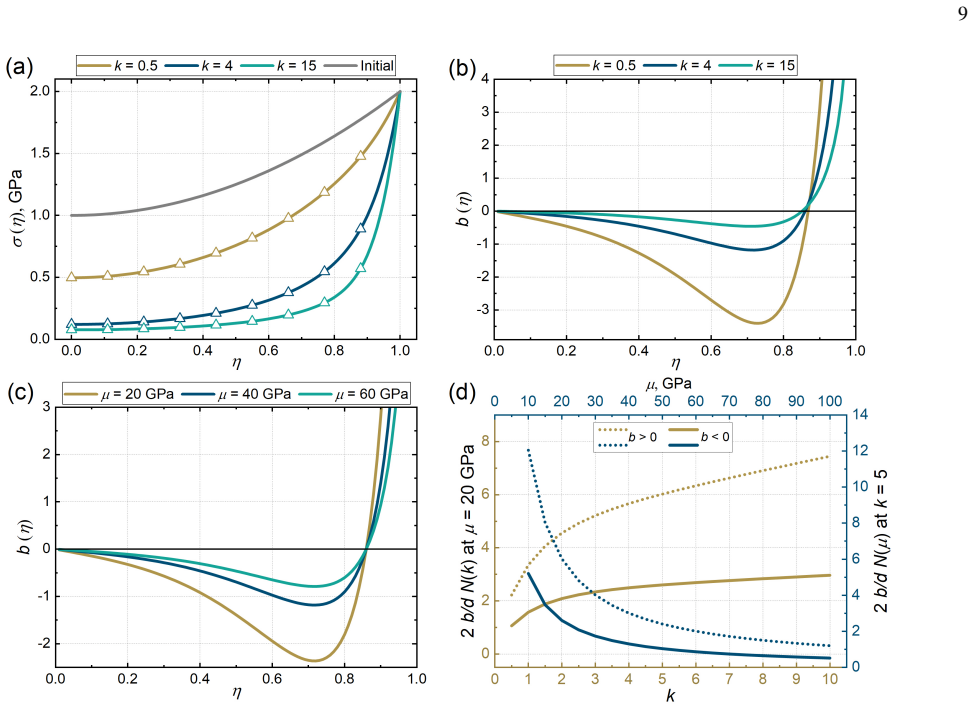
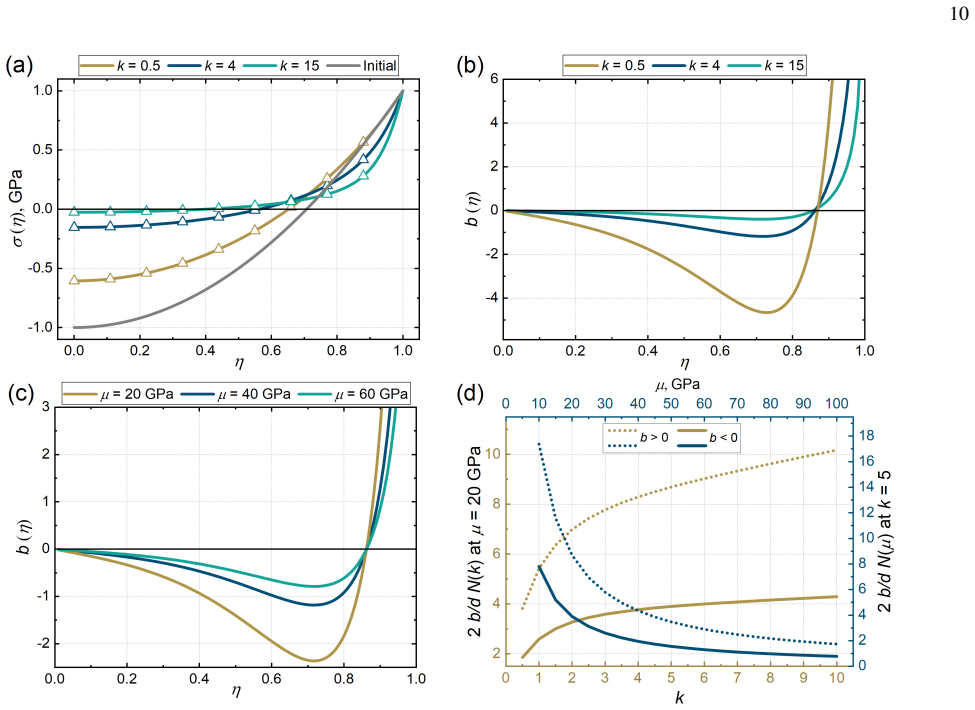
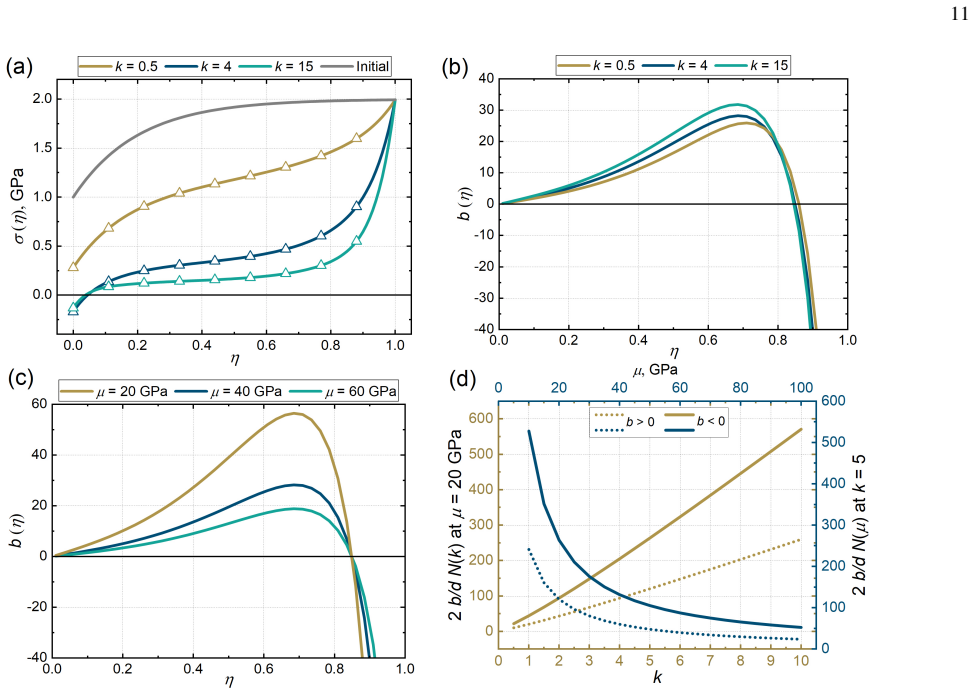
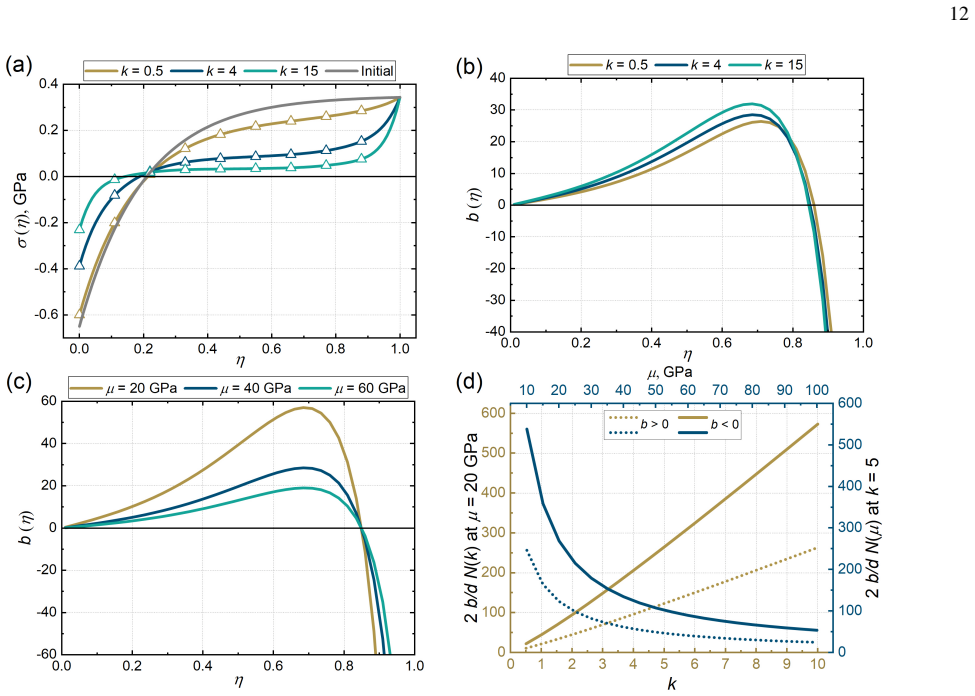
Residual stress gradients in thin films arise from mixed-sign screw dislocation pile-ups and depend on the segment's thickness-to-width ratio plus the initial stress distribution.
A machine-rendered reading of the paper's core claim, the machinery that carries it, and where it could break.
Core claim
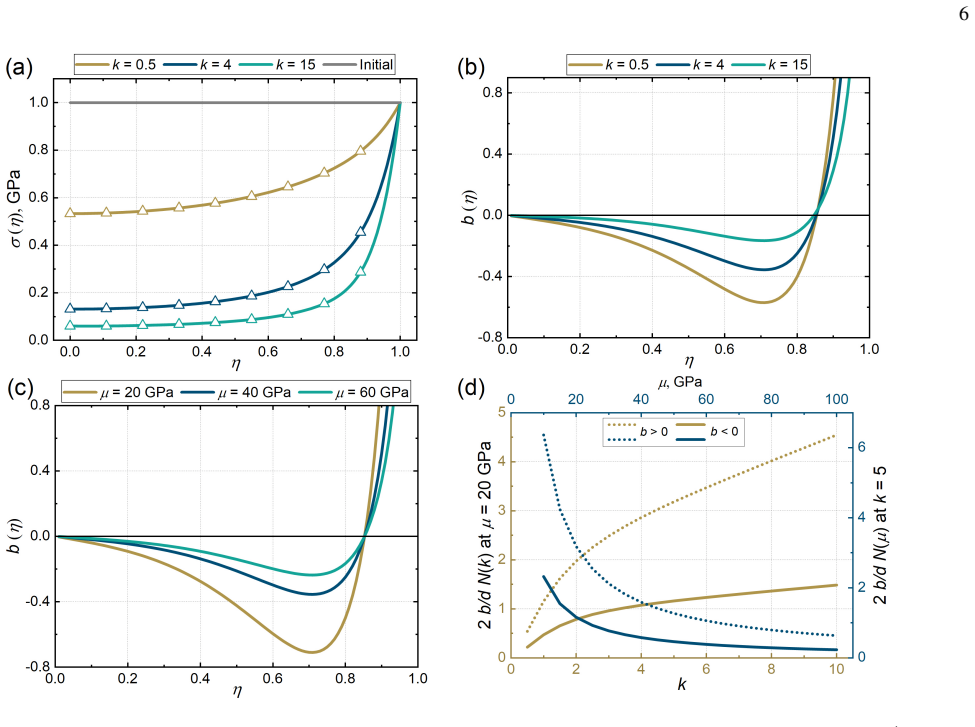
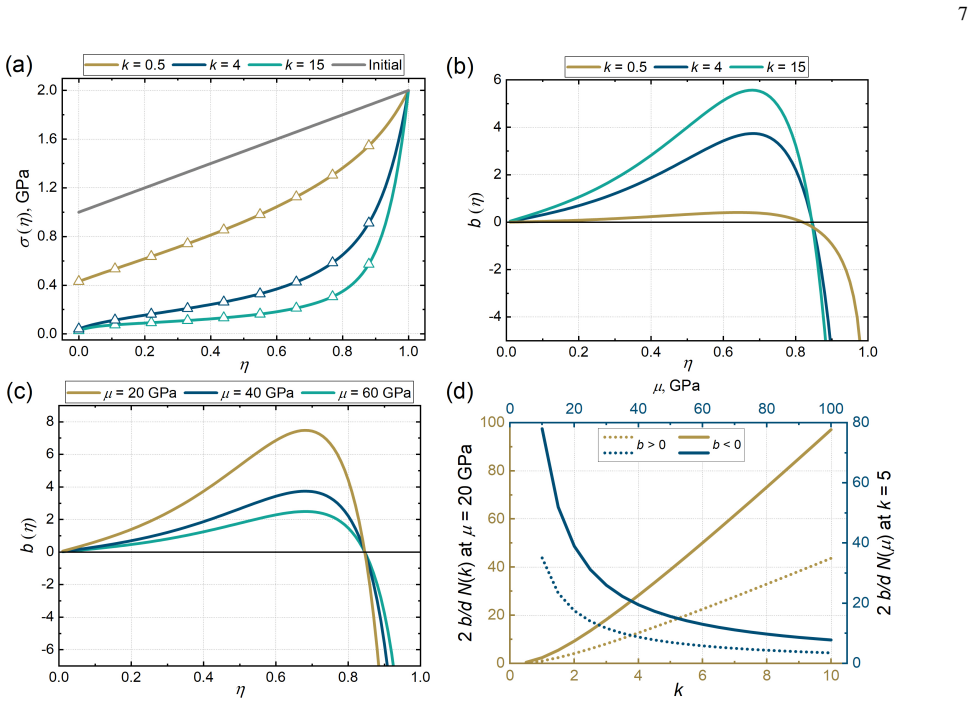
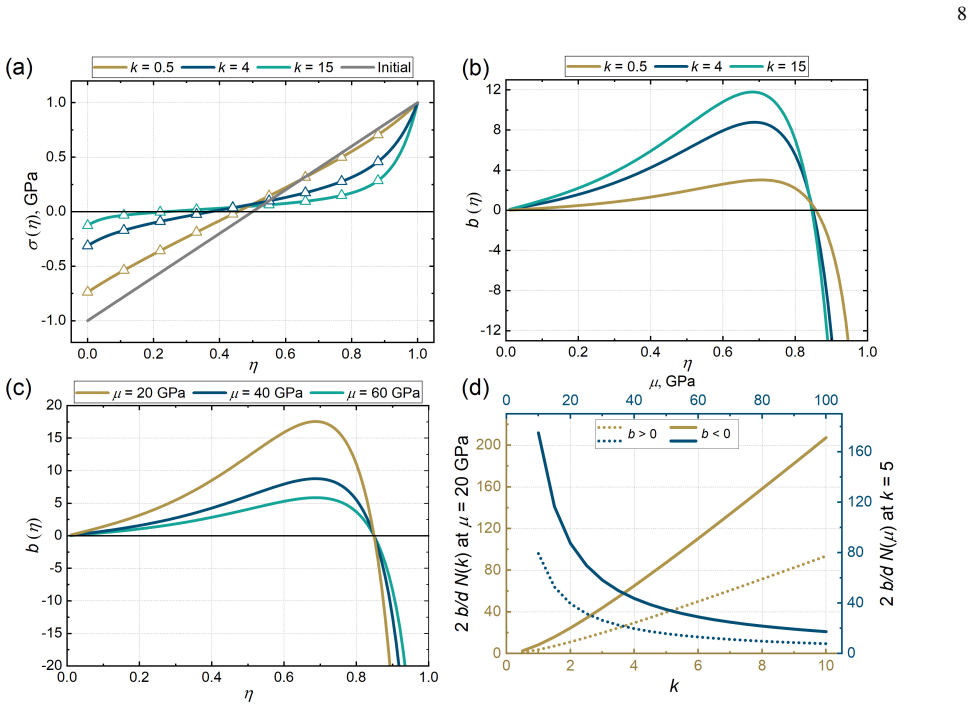
Solving the singular integro-differential equation for residual stress that follows from force balance on a mixed-sign screw dislocation pile-up shows that the resulting stress profile depends on the film segment thickness-to-width ratio and on the form of the initial stress distribution, with both positive and negative Burgers vector dislocations required for equilibrium in every case examined.
What carries the argument
The singular integro-differential equation for the residual stress profile obtained by enforcing force balance on the dislocation density in a pile-up of screw dislocations with both positive and negative Burgers vectors.
If this is right
- The final residual stress profile depends strongly on the thickness-to-width ratio of the film segment.
- Stress relaxation becomes more effective away from the film-substrate interface as this ratio increases.
- The total number of dislocations and their density distribution change markedly with the shape of the initial stress profile.
- The approach supplies a step toward modeling residual stress in other constrained thin-film systems.
Where Pith is reading between the lines
- The numerical collocation scheme could be reused to test initial stress distributions measured directly from experiment.
- The necessity of mixed-sign dislocations implies that local stress reversal is a general feature of equilibrium in these films.
- Adding mechanisms such as dislocation climb would likely change the predicted density profiles near the interface.
Load-bearing premise
The initial shear stress relaxes entirely by forming a pile-up of screw dislocations against an impenetrable interface, with plastic strain taken as directly proportional to dislocation density.
What would settle it
Transmission electron microscopy measurement of dislocation signs, densities, and resulting stress gradient in a thin film of known thickness-to-width ratio and known initial stress distribution, checked against the numerical solution for that initial distribution.
Figures
read the original abstract
A model for predicting the residual stress gradient in a thin film segment is developed on the basis of the theory of dislocation pile-ups. The initial shear stress within the film is relaxed via the formation of a pile-up of screw dislocations against the impenetrable film-substrate interface. Plastic strain is related to the dislocation density, leading to a fundamental equation, which links the residual stress to this density. The distribution of dislocations within the pile-up for an arbitrary, non-uniform residual stress profile is derived analytically by applying the force balance condition. This results in a singular integro-differential equation for the residual stress profile. The equation is solved numerically by a collocation method for various initial stress distributions: constant, linear, parabolic, and exponential functions. The solutions demonstrate that the established residual stress profile strongly depends on the film segment's thickness-to-width ratio and the initial stress distribution. As this ratio increases, stress relaxation becomes more effective away from the film-substrate interface. In all cases, equilibrium requires a pile-up containing dislocations with both positive and negative Burgers vectors. The total number of dislocations and their density distribution vary significantly with the initial stress profile. This model provides a critical step towards more complex models of residual stress formation in constrained material systems, specifically, thin films.
Editorial analysis
A structured set of objections, weighed in public.
Referee Report
Summary. The paper develops a model for the residual stress gradient in a thin film segment based on dislocation pile-up theory. It assumes initial shear stress relaxation occurs via formation of a pile-up of screw dislocations at the impenetrable film-substrate interface. Plastic strain is related to dislocation density to obtain a fundamental linking equation between residual stress and density. Force balance yields an analytical dislocation distribution, resulting in a singular integro-differential equation for the residual stress profile, which is solved numerically via collocation for constant, linear, parabolic, and exponential initial stress distributions. The solutions indicate strong dependence on the film thickness-to-width ratio, with more effective relaxation away from the interface as the ratio increases, and require pile-ups containing both positive and negative Burgers vectors in all cases.
Significance. If the central linking equation and numerical solutions hold, the work provides an analytical-numerical framework for stress relaxation in constrained thin films that could inform more complex models of residual stress formation. The explicit demonstration that mixed-sign dislocations are required across multiple initial profiles is a notable outcome, and the parameter-free derivation from force balance is a strength.
major comments (1)
- [Abstract / model derivation] Abstract and model derivation section: the fundamental linking equation between residual stress and dislocation density is stated to follow directly from relating plastic strain to dislocation density, but the numerical solutions require pile-ups with both positive and negative Burgers vectors. Net plastic strain is then governed by the signed difference ρ+ − ρ− rather than total density; no adjustment to the compatibility/equilibrium relation or the singular integro-differential equation for this case is described, which is load-bearing for the validity of all reported profiles.
minor comments (2)
- [Numerical solution section] The manuscript would benefit from an explicit statement of the numerical collocation scheme, including discretization details, convergence checks, and any handling of the singular integral.
- [Results] No error analysis or sensitivity to the thickness-to-width ratio discretization is provided; adding this would strengthen the claim that results depend strongly on this ratio.
Simulated Author's Rebuttal
We thank the referee for their careful reading of the manuscript and for highlighting this important point regarding the treatment of dislocation signs in the model derivation. We address the comment below.
read point-by-point responses
-
Referee: [Abstract / model derivation] Abstract and model derivation section: the fundamental linking equation between residual stress and dislocation density is stated to follow directly from relating plastic strain to dislocation density, but the numerical solutions require pile-ups with both positive and negative Burgers vectors. Net plastic strain is then governed by the signed difference ρ+ − ρ− rather than total density; no adjustment to the compatibility/equilibrium relation or the singular integro-differential equation for this case is described, which is load-bearing for the validity of all reported profiles.
Authors: The fundamental linking equation is derived using the net (signed) dislocation density ρ(x), where the sign of ρ encodes the Burgers vector direction: positive values correspond to one sign and negative values to the opposite. Plastic strain is therefore computed from the integral of this signed density, not from the absolute total density. The force-balance condition used to obtain the analytical dislocation distribution, and the resulting singular integro-differential equation, are formulated directly in terms of the signed ρ(x). The numerical collocation solutions are performed on this signed density and naturally produce sign changes, which is precisely the feature reported as requiring mixed Burgers vectors. We agree that the manuscript does not state this signed-density convention with sufficient explicitness in the derivation section; we will revise the text to clarify that ρ is the signed density and that the compatibility relation employs the net Burgers-vector content. revision: yes
Circularity Check
No significant circularity; derivation rests on independent force-balance and strain-density relations
full rationale
The paper derives the central linking equation from the standard force-balance condition on dislocations in a pile-up together with the direct relation between plastic strain and dislocation density. These are standard inputs from dislocation theory and are not defined in terms of the target residual-stress profile. No parameters are fitted to data and then relabeled as predictions, no self-citations are invoked as load-bearing uniqueness theorems, and no ansatz is smuggled through prior work. The subsequent numerical solutions for different initial stress profiles follow directly from that equation without circular reduction. The presence of mixed-sign Burgers vectors is noted but does not alter the logical independence of the derivation steps themselves.
Axiom & Free-Parameter Ledger
axioms (3)
- domain assumption The film-substrate interface is impenetrable to dislocations.
- domain assumption Plastic strain is directly proportional to local dislocation density.
- domain assumption Force balance on each dislocation determines its position in the pile-up.
Reference graph
Works this paper leans on
-
[11]
author author V. Araullo-Peters , author C. Cancellieri , author M. Chiodi , author J. Janczak-Rusch , \ and\ author L. P. H. \ Jeurgens ,\ 10.1021/acsami.8b19091 journal journal ACS Applied Materials & Interfaces \ volume 11 ,\ pages 6605 ( year 2019 ) NoStop
-
[29]
author author M. Tucker ,\ 10.1016/0022-5096(73)90009-4 journal journal Journal of the Mechanics and Physics of Solids \ volume 21 ,\ pages 411 ( year 1973 ) NoStop
-
[34]
author author J. P. \ Hirth \ and\ author J. Lothe ,\ http://www.amazon.com/Theory-Dislocations-John-Price-Hirth/dp/0894646176/ref=sr_1_1?s=books&ie=UTF8&qid=1293986464&sr=1-1 title Theory of Dislocations \ ( publisher Krieger Publishing Company ,\ year 1992 ) NoStop
arXiv 1992
-
[37]
author author L. B. \ Freund \ and\ author S. Suresh ,\ 10.1017/CBO9780511754715 title Thin Film Materials \ ( publisher Cambridge University Press ,\ year 2004 ) NoStop
-
[38]
author author N. Li , author J. Wang , author A. Misra , \ and\ author J. Y. \ Huang ,\ 10.1017/S143192761200133X journal journal Microscopy and Microanalysis \ volume 18 ,\ pages 1155 ( year 2012 ) NoStop
-
[39]
Chou, Y. T. , title =. physica status solidi (b) , volume =. doi:https://doi.org/10.1002/pssb.19660170206 , url =. https://onlinelibrary.wiley.com/doi/pdf/10.1002/pssb.19660170206 , abstract =
-
[40]
Theory of Dislocations , url =
Hirth, John Price and Lothe, Jens , biburl =. Theory of Dislocations , url =
-
[41]
Kuang, J. G. and Mura, T. , title =. Journal of Applied Physics , volume =. 1969 , month =. doi:10.1063/1.1657348 , url =
-
[42]
Kuang, J. G. and Mura, T. , title =. Journal of Applied Physics , volume =. 1968 , month =. doi:10.1063/1.1655715 , url =
-
[43]
A kinetic analysis of residual stress evolution in polycrystalline thin films , journal =
Eric Chason , keywords =. A kinetic analysis of residual stress evolution in polycrystalline thin films , journal =. 2012 , issn =. doi:https://doi.org/10.1016/j.tsf.2012.11.001 , url =
-
[44]
Freund, L. B. and Suresh, S. , doi =
-
[45]
and Unutulmazsoy, Yeliz and Neels, Antonia and Jeurgens, Lars P.H
Cancellieri, Claudia and Ariosa, Daniel and Druzhinin, Aleksandr V. and Unutulmazsoy, Yeliz and Neels, Antonia and Jeurgens, Lars P.H. Strain depth profiles in thin films extracted from in-plane X-ray diffraction. Journal of Applied Crystallography. 2021. doi:10.1107/S1600576720014843 , url =
-
[46]
and Barthel, Etienne and Doll, Gary L
Abadias, Grégory and Chason, Eric and Keckes, Jozef and Sebastiani, Marco and Thompson, Gregory B. and Barthel, Etienne and Doll, Gary L. and Murray, Conal E. and Stoessel, Chris H. and Martinu, Ludvik , title =. Journal of Vacuum Science and Technology A , volume =. 2018 , month =. doi:10.1116/1.5011790 , url =
-
[47]
From telephone cords to branched buckles: A phase diagram , journal =
Jean-Yvon Faou and Sergey Grachev and Etienne Barthel and Guillaume Parry , keywords =. From telephone cords to branched buckles: A phase diagram , journal =. 2017 , issn =. doi:https://doi.org/10.1016/j.actamat.2016.12.025 , url =
-
[48]
C. Malerba and M. Valentini and C.L. Blistering in Cu2ZnSnS4 thin films: correlation with residual stresses , journal =. 2016 , issn =. doi:https://doi.org/10.1016/j.matdes.2016.07.019 , url =
-
[49]
Haiying Zhang and Zhenwen Zhou and Alexander Chudnovsky and Hoang Pham , keywords =. Time-dependent buckling delamination of thin plastic films and their conformability: Observations and modeling , journal =. 2020 , issn =. doi:https://doi.org/10.1016/j.ijengsci.2020.103258 , url =
-
[50]
Chengming Li and Hao Li and Decao Niu and Fanxiu Lu and Weizhong Tang and Guanchao Chen and Hai Zhou and Fei Chen , keywords =. Effects of residual stress distribution on the cracking of thick freestanding diamond films produced by DC arc jet plasma chemical vapor deposition operated at gas recycling mode , journal =. 2007 , note =. doi:https://doi.org/10...
-
[51]
F. Moszner and C. Cancellieri and M. Chiodi and S. Yoon and D. Ariosa and J. Janczak-Rusch and L.P.H. Jeurgens , keywords =. Thermal stability of Cu/W nano-multilayers , journal =. 2016 , issn =. doi:https://doi.org/10.1016/j.actamat.2016.02.003 , url =
-
[52]
A.V. Druzhinin and D. Ariosa and S. Siol and N. Ott and B.B. Straumal and J. Janczak-Rusch and L.P.H. Jeurgens and C. Cancellieri , keywords =. Effect of the individual layer thickness on the transformation of Cu/W nano-multilayers into nanocomposites , journal =. 2019 , issn =. doi:https://doi.org/10.1016/j.mtla.2019.100400 , url =
-
[53]
A.V. Druzhinin and C. Cancellieri and E.A. Klyatskina and A.A. Mazilkin and N.N. Khrapova and B.B. Straumal and J. Janczak-Rusch , keywords =. Thermally-induced microstructure evolution of Ag/AlN nano-multilayers: The role of annealing atmosphere on the Ag outflow driving force , journal =. 2023 , issn =. doi:https://doi.org/10.1016/j.surfcoat.2023.129880 , url =
-
[54]
Chiodi, Mirco and Cancellieri, Claudia and Moszner, Frank and Andrzejczuk, Mariusz and Janczak-Rusch, Jolanta and Jeurgens, Lars P. H. Massive Ag migration through metal/ceramic nano-multilayers: an interplay between temperature , stress-relaxation and oxygen-enhanced mass transport. J. Mater. Chem. C. 2016. doi:10.1039/C6TC01098A
-
[55]
Jeyun Yeom and Claudia Cancellieri and Jolanta Janczak-Rusch , keywords =. Novel degradation mechanism of Cu/Nb nanomultilayers into nanocomposite structure with hillock growth , journal =. 2025 , issn =. doi:https://doi.org/10.1016/j.apsusc.2025.162805 , url =
-
[56]
Araullo-Peters, Vicente and Cancellieri, Claudia and Chiodi, Mirco and Janczak-Rusch, Jolanta and Jeurgens, Lars P. H. , title =. ACS Applied Materials & Interfaces , volume =. 2019 , doi =
2019
-
[57]
Stresses in thin films: The relevance of grain boundaries and impurities , journal =. 1976 , issn =. doi:https://doi.org/10.1016/0040-6090(76)90453-3 , url =
-
[58]
Model for stress evolution during the early stages of non-energetic thin film growth , journal =
Tong Su and Eric Chason , keywords =. Model for stress evolution during the early stages of non-energetic thin film growth , journal =. 2025 , issn =. doi:https://doi.org/10.1016/j.actamat.2025.121534 , url =
-
[59]
Measurements of the intrinsic stress in thin metal films , journal =. 1990 , note =. doi:https://doi.org/10.1016/0042-207X(90)93933-A , url =
-
[60]
A.V. Druzhinin and G. Lorenzin and D. Ariosa and S. Siol and B.B. Straumal and J. Janczak-Rusch and L.P.H. Jeurgens and C. Cancellieri , keywords =. The effect of the graded bilayer design on the strain depth profiles and microstructure of Cu/W nano-multilayers , journal =. 2021 , issn =. doi:https://doi.org/10.1016/j.matdes.2021.110002 , url =
-
[61]
Fischer, G. and Selvadurai, U. and Nellesen, J. and Sprute, T. and Tillmann, W. Analysis of stress gradients in physical vapour deposition multilayers by X-ray diffraction at fixed depth intervals. Journal of Applied Crystallography. 2014. doi:10.1107/S1600576713030951 , url =
-
[62]
X-ray residual stress analysis on multilayer systems: an approach for depth-resolved data evaluation
Klaus, Manuela and Genzel, Christoph. X-ray residual stress analysis on multilayer systems: an approach for depth-resolved data evaluation. Journal of Applied Crystallography. 2013. doi:10.1107/S0021889813018517 , url =
-
[63]
A.M. Korsunsky and E. Salvati and A.G.J. Lunt and T. Sui and M.Z. Mughal and R. Daniel and J. Keckes and E. Bemporad and M. Sebastiani , keywords =. Nanoscale residual stress depth profiling by Focused Ion Beam milling and eigenstrain analysis , journal =. 2018 , issn =. doi:https://doi.org/10.1016/j.matdes.2018.02.044 , url =
-
[64]
J. Keckes and R. Daniel and J. Todt and J. Zalesak and B. Sartory and S. Braun and J. Gluch and M. Rosenthal and M. Burghammer and C. Mitterer and S. Niese and A. Kubec , keywords =. 30 nm X-ray focusing correlates oscillatory stress, texture and structural defect gradients across multilayered TiN-SiOx thin film , journal =. 2018 , issn =. doi:https://doi...
-
[65]
J. Wang and A. Misra and R.G. Hoagland and J.P. Hirth , keywords =. Slip transmission across fcc/bcc interfaces with varying interface shear strengths , journal =. 2012 , issn =. doi:https://doi.org/10.1016/j.actamat.2011.11.047 , url =
-
[66]
The effect of shear modulus on the stress distribution produced by a planar array of screw dislocations near a bi-metallic interface , journal =. 1967 , issn =. doi:https://doi.org/10.1016/0001-6160(67)90101-0 , url =
-
[67]
A continuum theory of stress gradient plasticity based on the dislocation pile-up model , journal =
Dabiao Liu and Yuming He and Bo Zhang and Lei Shen , keywords =. A continuum theory of stress gradient plasticity based on the dislocation pile-up model , journal =. 2014 , issn =. doi:https://doi.org/10.1016/j.actamat.2014.07.043 , url =
-
[68]
Vlado A. Lubarda , keywords =. An analysis of edge dislocation pileups against a circular inhomogeneity or a bimetallic interface , journal =. 2017 , issn =. doi:https://doi.org/10.1016/j.ijsolstr.2017.09.004 , url =
-
[69]
Vlado A. Lubarda , keywords =. A pileup of edge dislocations against an inclined bimetallic interface , journal =. 2018 , issn =. doi:https://doi.org/10.1016/j.mechmat.2017.10.010 , url =
-
[70]
Theoretical and Applied Mechanics , keywords =
Lubarda, Vlado , doi =. Theoretical and Applied Mechanics , keywords =
-
[71]
Tucker, M.O. , doi =. Journal of the Mechanics and Physics of Solids , month =
-
[72]
S. Akarapu and J.P. Hirth , keywords =. Dislocation pile-ups in stress gradients revisited , journal =. 2013 , issn =. doi:https://doi.org/10.1016/j.actamat.2013.02.049 , url =
-
[73]
R.G. Hoagland and R.J. Kurtz and C.H. Henager , keywords =. Slip resistance of interfaces and the strength of metallic multilayer composites , journal =. 2004 , note =. doi:https://doi.org/10.1016/j.scriptamat.2003.11.059 , url =
-
[74]
J. Wang and R.G. Hoagland and J.P. Hirth and A. Misra , keywords =. Atomistic modeling of the interaction of glide dislocations with “weak” interfaces , journal =. 2008 , issn =. doi:https://doi.org/10.1016/j.actamat.2008.07.041 , url =
-
[75]
J. Wang and R.G. Hoagland and X.Y. Liu and A. Misra , keywords =. The influence of interface shear strength on the glide dislocation–interface interactions , journal =. 2011 , issn =. doi:https://doi.org/10.1016/j.actamat.2011.01.056 , url =
-
[76]
Inclined pileup of screw dislocations at the crack tip with a dislocation-free zone , journal =. 1987 , issn =. doi:https://doi.org/10.1016/0020-7225(87)90107-8 , url =
-
[77]
The piling-up of screw dislocations against a rigid inclusion , journal =. 1973 , issn =. doi:https://doi.org/10.1016/0022-5096(73)90010-0 , url =
-
[78]
Microscopy and Microanalysis , keywords =
Li, Nan and Wang, Jian and Misra, Amit and Huang, Jian Yu , doi =. Microscopy and Microanalysis , keywords =
discussion (0)
Sign in with ORCID, Apple, or X to comment. Anyone can read and Pith papers without signing in.